
You're probably reading this because the car still looks decent from ten feet away, but one day in the driveway you spotted a little brown bubble near a wheel arch, a seam, or the edge of a door. That's how the conversation usually starts. Not with a dramatic hole in the floor. With a tiny spot that seems rude more than dangerous.
In Ontario, that small spot deserves respect. Winter doesn't just make cars dirty. It keeps steel wet, salty, and repeatedly reheated and re-cooled by slush, garages, meltwater, and spray. Rust proofing steel isn't one magic product you apply once and forget. It's a layered defence. Different parts of the vehicle need different protection because they face different kinds of attack.
A scarf won't replace boots, and boots won't replace a proper coat. Your underbody, body seams, and hidden cavities all need their own version of protection. Ontario road salt is equal-opportunity misery, but it doesn't land evenly.
Table of Contents
- Why Steel on Your Car Needs Active Protection
- How Rust Forms and Why Road Salt Changes the Equation
- The Main Rust-Proofing Methods Explained
- When to Apply Rust Proofing and How Often
- What Rust Proofing Costs and What Drives the Price
- Matching Your Driving Habits to the Right Approach
- Why a Professional Service Often Beats a DIY Kit
- Putting It Together for a Salt-Ready Vehicle
Why Steel on Your Car Needs Active Protection
A five-year-old crossover pulls into the lot in February. Frost on the glass, salt haze up the doors, owner still trusting the “factory corrosion protection” pitch from delivery day. Then they point at a rust bubble starting from the lip of the rear wheel well and ask the question every shop hears: “How is this happening already?”
Because factory protection is a starting point, not a lifetime promise.
Modern vehicles aren't one big block of steel. They're a mixed bag of mild steel, high-strength steel, coatings, sealers, plastic liners, fasteners, and in some cases aluminum panels. That sounds advanced, and it is. It also means water and salt can reach hidden joints, folded seams, pinch welds, brackets, and boxed sections that you'll never see during a quick wash in the driveway.
What factory coatings can and can't do
Paint, primer, and E-coat work like a thin weather jacket. They're excellent until they're chipped, scuffed, cracked, or worn thin by stone impact and road grit. The trouble is that Ontario winters keep throwing little insults at the same spots:
- Wheel-arch blast zones where slush and grit sandblast the finish
- Lower doors and rocker panels where salty spray hangs on
- Pinch welds and seams where moisture sits instead of draining cleanly
- Underbody hardware that gets soaked and then left to dry with residue on it
Once bare metal is exposed, the car doesn't need dramatic damage to start corroding. A stone chip the size of a lentil will do nicely. Rust isn't picky.
Practical rule: If you wait until corrosion is obvious from outside the car, the hidden side is usually farther along than you think.
What rust proofing steel really means
For a vehicle owner, rust proofing steel means maintaining and renewing protection before corrosion gets a proper foothold. That can include cavity wax inside doors and rocker panels, an underbody treatment on exposed metal, regular rinsing to remove salt residue, and fixing chips before they become little moisture traps.
That's the shift. You either pay for prevention on schedule, or you pay later for cutting, patching, and apologising to your wallet.
A lot of owners think rust proofing is a product. In practice, it's a routine. That routine matters in Ontario because winter exposure isn't occasional. It's sustained, repetitive, and annoyingly thorough.
How Rust Forms and Why Road Salt Changes the Equation
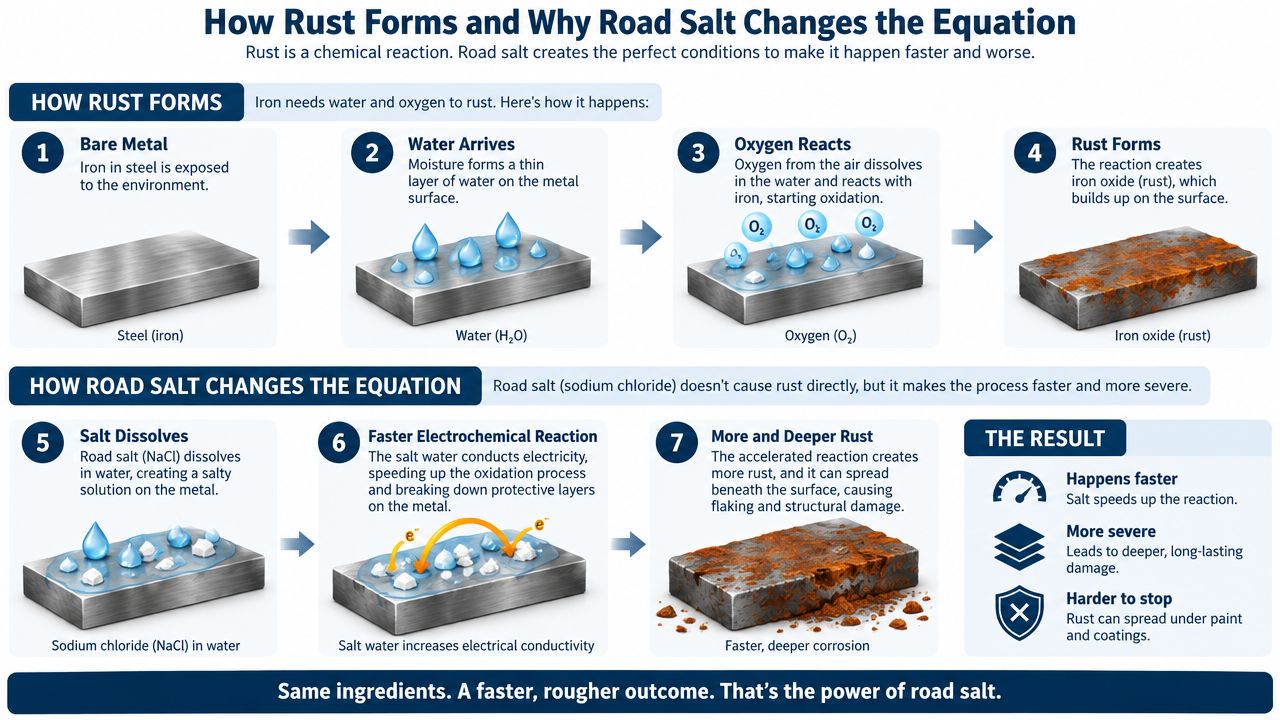
Rust starts with three familiar ingredients. Steel, moisture, and oxygen. Give them time together and the metal starts changing. Not philosophically. Chemically.
At the surface of steel, tiny electrochemical reactions begin. Some spots on the metal give up electrons more readily than others. Water helps those reactions move along, and oxygen joins in. The result is iron oxide, which is rust. Once it starts, the corrosion products can hold moisture and keep the process going.
Barrier protection versus sacrificial protection
Most vehicle protection methods fall into one of two jobs.
Barrier protection tries to keep water and oxygen away from the steel. Paint, waxes, sealants, undercoatings, and cavity films all do this in different ways. If the barrier stays intact, the steel underneath stays much safer.
Sacrificial protection works differently. Zinc-rich coatings are the classic example. The coating corrodes first so the steel underneath gets a chance to stay intact longer. It's less like an umbrella and more like a bodyguard taking the punch for you.
A scratch changes everything. Once moisture reaches steel through a chip, seam, or worn spot, the local reaction can begin. In a dry climate, that may progress slowly. In southern Ontario, salt changes the pace.
Why chloride makes Ontario tougher on steel
Road salt doesn't create rust out of nowhere. It makes the moisture on the metal more conductive, which helps the corrosion reactions move faster. It also leaves deposits behind in seams, on brackets, and on lower-body surfaces where rinse water may not fully reach.
Ontario's winter maintenance and climate make this especially relevant. A Transportation Association of Canada paper notes that treated sodium chloride available in the Ontario market produced about 0.2117% average weight loss in steel rebar testing, while alternative salts in that comparison reduced loss to roughly 0.087% to 0.081% in the same study, which shows that de-icer chemistry directly affects steel degradation rates (Transportation Association of Canada corrosion paper).
That's the important bit for a car owner. It isn't just “salt is bad.” The chloride exposure itself changes how aggressively the metal is attacked.
Saltwater on steel is like turning a damp surface into a better electrical pathway. The chemistry gets less patient.
A Canadian bridge-corrosion study adds another practical lesson. Corrosion rates can vary sharply by orientation and exposure, with downward-facing steel surfaces reaching up to 95 µm per year, splash-zone surfaces at 56 to 60 µm per year, and sheltered abutments around 29 µm per year in the documented cases (National Research Council guidance on chloride-rich exposure).
That's why underbody and lower-body protection deserve so much attention. The hidden, downward-facing, splash-prone areas are often the ones taking the worst beating while the hood still looks presentable.
The Main Rust-Proofing Methods Explained
If you put a vehicle on a lift and point at the places where corrosion usually starts, the treatments stop looking interchangeable. They all have a job. They just don't have the same job.
What each method is actually trying to protect
Some methods target hidden cavities. Others target exposed steel underneath. Others help the painted body panels survive chips and winter grime. Then there's the gadget category, which usually sounds more dramatic than it performs.
Here's the honest side-by-side.
| Method | Best Applied To | Strengths | Drawbacks |
|---|---|---|---|
| Electronic rust module | As a supplement only, if an owner insists on one | No mess, no dripping, no coating cleanup | Low confidence in real-world vehicle use, especially compared with physical coatings and cavity treatments |
| Drip-style oil or cavity wax | Doors, rocker panels, seams, frame rails, inner panels | Reaches hidden areas, creeps into seams, useful where salt slurry collects out of sight | Needs renewal, can drip depending on product, can attract grime |
| Underbody coating or rubberized undercoat | Floor pans, exposed underbody steel, brackets, some lower-body surfaces | Builds a physical barrier against splash, grit, and brine | Can trap moisture if applied over active corrosion or poor prep |
| Paint sealant, ceramic coating, or clear film | Painted body panels, leading edges, visible surfaces | Helps reduce chip damage and makes winter grime easier to remove | Doesn't protect hidden cavities or replace underbody treatment |
Electronic modules
These are the “plug it in and let science handle it” option. Owners like them because they seem clean and modern. Shops like them because they don't make a mess on the floor.
The trouble is simple. On a modern vehicle, real rust risk usually starts in seams, cavities, welds, edges, and underbody exposure points. A module doesn't physically displace moisture or coat the steel there. At best, treat it like garnish, not dinner.
Oil sprays and cavity waxes
This is the workhorse method for hidden areas. Doors, rocker panels, hatch seams, frame rails, and boxed sections are exactly where salty moisture likes to hide. A creeping oil or wax film gets into places your eyes and wash mitt never will.
Ontario-specific vehicle guidance also flags rocker panels, brake lines, pinch-welds, and drain holes as vulnerable areas during winter, especially on newer vehicles with liners, plastics, and tighter underbody packaging that can trap brine in less visible spots (Ontario vehicle winter corrosion guidance).
That's why cavity treatment earns its place. It goes where rust likes to start.
Underbody coatings
These are for the parts that live in the firing line. Floor pans, lower brackets, suspension mounting areas, and exposed undercarriage steel all benefit from a proper physical barrier when the surface is prepared correctly.
This is also where people get themselves in trouble. A thick coating over damp, flaky, already advancing rust can seal in the problem. That's not protection. That's a time capsule for corrosion.
Surface protection on visible panels
Sealants, ceramic products, and clear film help the painted skin of the vehicle. They reduce chip risk and make salty residue easier to wash off. They're worthwhile, especially if you care about appearance or resale, but they don't protect the places that usually become structural headaches.
A shiny hood and rusting rocker panel can exist on the same car quite happily. Rust is very comfortable being ignored behind something glossy.
When to Apply Rust Proofing and How Often
Timing matters almost as much as product choice. Rust proofing done at the right stage is preventive maintenance. Rust proofing done very late is damage control with lower odds.
New vehicles and newer daily drivers
If the vehicle is new or close to new, that's the easiest time to start. The underbody is cleaner, seams are easier to inspect, and you're working ahead of visible corrosion instead of behind it.
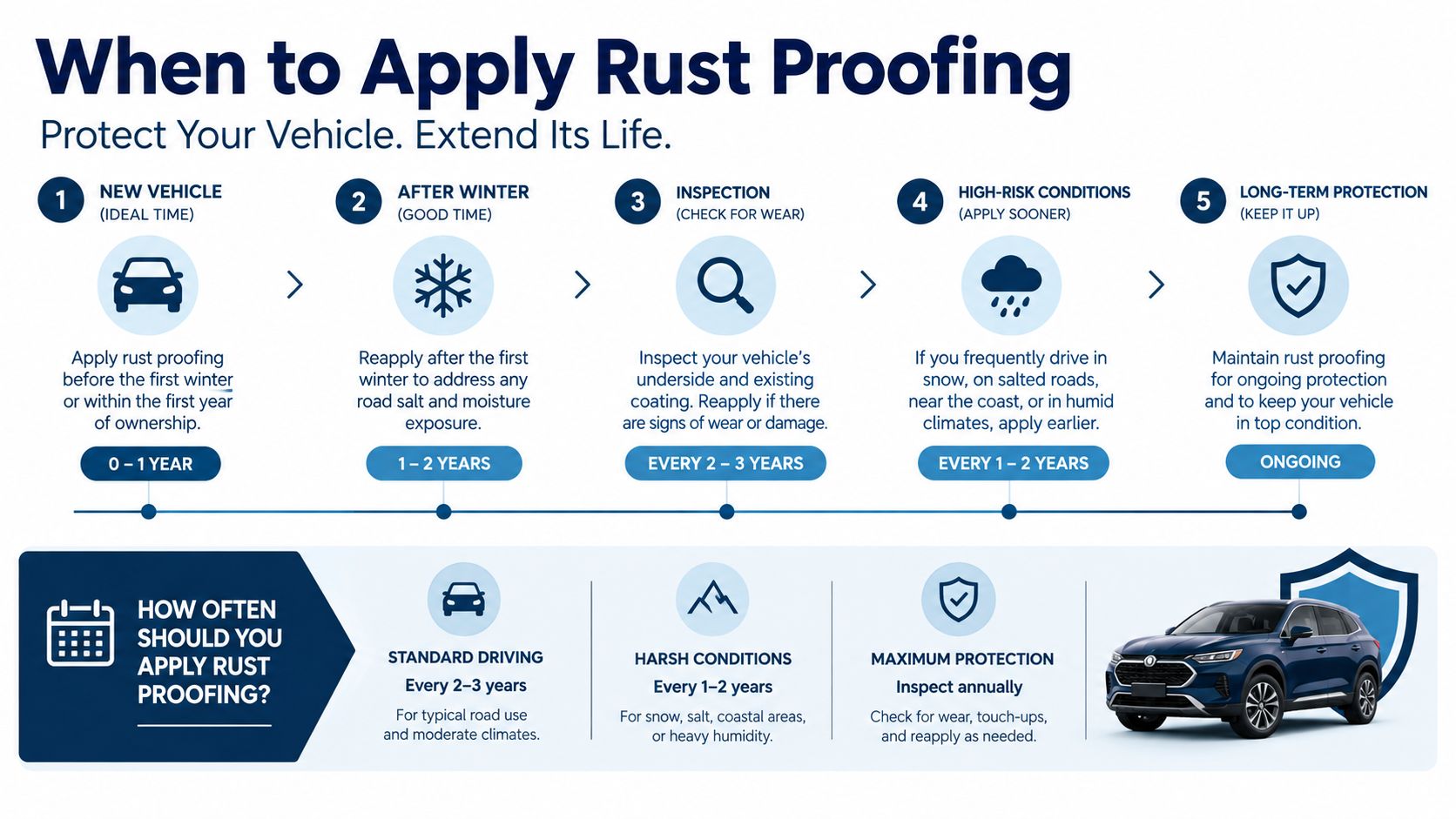
A sensible approach for Ontario drivers is:
- Start early: Don't assume factory protection means you can ignore the first winters.
- Treat before salt season: Fall is the practical window because the surfaces are easier to prep and the protection is in place before roads get ugly.
- Pair it with washing: Underbody rinsing through winter helps the treatment last and reduces chloride build-up.
Older vehicles and high-exposure use
If the car has already seen several Ontario winters, inspection becomes more important than brand labels. A technician should look at wheel-well lips, rocker seams, pinch welds, drain points, brake and fuel line routing, and any boxed sections that tend to hold grime.
Some owners ask whether road-salt reduction products or inhibitors solve the whole issue. They help, but not completely. A University of Waterloo study requested by Ontario's transportation ministry found sodium chloride was generally the least damaging of four anti-icing agents studied for certain steel-related exposures, yet it was still materially corrosive. Earlier Canadian field work on auto-body steel also found inhibitor-based treatments could reduce salt-driven corrosion, but the expected total corrosion reduction was only about 25% if half of vehicle corrosion is attributed to road salt, which supports using rust proofing as a damage-reduction layer rather than a complete barrier (University of Waterloo de-icing and corrosion research).
That's the practical takeaway. Don't look for perfection. Build a maintenance cycle.
A realistic service rhythm
For most GTA daily drivers, the routine usually looks like this:
- Fall application before sustained salt exposure.
- Winter underbody rinses during the dirty months.
- Spring inspection to catch chips, clogged drains, or missed areas.
- Renew cavity or underbody treatments based on how the specific product ages on the vehicle.
If the car is a garage-kept seasonal toy, you can usually lean harder on inspection and spot treatment. If it's a commuter, delivery car, or family hauler that sees slush every week, annual attention is the safer habit.
What Rust Proofing Costs and What Drives the Price
Pull into any Ontario shop in October and ask, “What does rust proofing cost?” The honest answer starts with another question. Are we protecting a clean newer underbody, or are we trying to slow down a vehicle that has already spent a few winters bathing in chloride soup?
That difference matters because rust proofing is not one can of magic. It is a layered defence plan. One layer protects exposed underbody steel from direct spray. Another creeps into doors, rockers, seams, and other boxed sections where salty moisture likes to hide. Surface add-ons protect painted panels from chips and moisture hold. In Ontario, where road salt exposure keeps showing up year after year, shops price the work based on how many of those layers the vehicle needs.
What changes the bill
The cheapest invoice is usually a straightforward underbody treatment on a clean, accessible vehicle. The price climbs when the job includes cavity treatment, extra disassembly, drain checks, seam attention, or heavier prep to deal with old residue and loose scale.
Here is the basic pattern:
| Method | Typical Price (CAD) | Main Price Drivers |
|---|---|---|
| Basic underbody spray | Varies by shop and vehicle | Vehicle size, exposed area, prep needed |
| Cavity wax or oil treatment | Varies by shop and access points | Number of cavities, body design, whether liners or access holes are needed |
| Combined rust-proofing package | Varies by shop and treatment scope | Size, current corrosion, product type, labour time |
| Surface protection add-ons | Varies by product and coverage | Panel count, paint condition, prep and polishing |
A compact sedan with a clean floorpan is usually the easy job. A pickup or three-row SUV with plastic shields, packed-on grime, and early rust around seams takes more labour. Same idea as painting a wall. Fresh drywall is quick. Flaking paint and old tape lines turn it into a Saturday.
Condition changes the math fast.
If the underside has trapped mud, blocked drain holes, peeling old coating, or rust scale that needs knocking back, the shop has to spend time getting the surface ready before any product goes on. Otherwise you are paying to seal dirt against steel, which is about as clever as putting a winter coat on over a wet shirt.
What local service menus tell you
Published shop pricing helps set expectations, even if it is not a final quote. Nanak Car Wash, for example, lists rust proofing with a dedicated chemical compound at about $119.95 to $149.95 plus tax depending on vehicle size, alongside wash and detailing services at its GTA-area locations.
That range is useful for one reason. It shows basic rust proofing often sits closer to routine maintenance pricing than to body-repair pricing.
The catch is scope. A posted menu price often reflects a standard application, not a full corrosion-management plan with cavity access, extra prep, or follow-up inspection. If your vehicle needs all three defence layers, underbody, cavities, and exposed surfaces, the bill will rise because the labour rises.
Cost versus consequence
Owners usually notice rust costs in the repair bay, not at the wash counter. A seized fastener turns a simple brake job into extra labour. A crusty line or bracket gets flagged during service. Bubbling at a seam starts as an eyesore, then becomes bodywork.
Transport Canada has treated corrosion as a real ownership cost for decades, not just a cosmetic annoyance, as noted earlier in the article. That old point still holds up in Ontario because chloride exposure attacks hidden areas long before the damage looks dramatic from six feet away.
So the practical question is not just “What does rust proofing cost?” It is “Which layers are worth paying for on this vehicle, in this salt exposure, before repairs start charging interest?” That is the foreman's version, anyway. Ontario road salt always sends its invoice. The only mystery is whether you want to pay early for prevention or later for parts and labour.
Matching Your Driving Habits to the Right Approach
The right treatment depends less on what badge is on the grille and more on how the vehicle lives.
The year-round highway commuter
If you're on the 401, 407, QEW, or Gardiner all winter, the vehicle takes constant lower-body spray. That kind of use usually benefits from annual underbody attention plus cavity protection in the hidden seams and rocker sections. Highway speed throws salty mist everywhere, including places you'd rather not think about.
The ride-share or delivery driver
City driving sounds easier on a car until you remember the stop-and-go slush, curbside puddles, short trips, and endless exposure hours. These vehicles often benefit from creeping cavity treatment because doors, lower seams, pinch welds, and underbody corners stay damp and dirty for long stretches.
A delivery car doesn't need romance. It needs practical protection and frequent washing.
The SUV, pickup, or cottage-road machine
If the vehicle sees gravel, ruts, snow-packed lots, or shoulder debris, the issue isn't only salt. It's impact damage. A thicker underbody barrier can make sense here, provided the prep is proper and the surface isn't already trapping active corrosion.
The weekend-only, garage-kept vehicle
This owner can often get away with a lighter touch. Inspection, underbody cleaning after any winter outing, and spot treatment may be enough if the car avoids regular salt exposure.
A simple rhythm helps most GTA drivers:
- During salt season: underbody flushes on a steady schedule
- In autumn: main rust-proofing appointment
- In spring: inspection for chips, trapped debris, and blocked drains
That's the layered-defence idea in real life. Match the coating plan to the way the car gets abused.
Why a Professional Service Often Beats a DIY Kit
DIY rust proofing has one big advantage. It feels cheaper on Saturday morning.
By Sunday afternoon, you're under the car with overspray on your glasses, a half-clogged nozzle, and a strong suspicion that the sections you couldn't reach are exactly the sections that needed help most.
Access changes the result
A professional appointment starts with access. The vehicle goes up. The technician can inspect the underbody, see where factory coatings are thinning, look for scale, check seam sealer condition, and spot moisture traps inside boxed sections and behind liners.
In a driveway, most owners can only reach what they can see from the edge of the car. Rust rarely limits itself to those courtesy areas.
Application tools matter
Shops use cavity wands, pressure-fed applicators, and products designed to creep or coat consistently in enclosed spaces. That matters in doors, rocker cavities, frame rails, seam overlaps, and other awkward sections where a small missed strip becomes a future problem.
Prep conditions matter too. A clean bay, proper drying time, and a repeatable process give coatings a better chance to stick and do their job.
Professional rust proofing doesn't win because it's mysterious. It wins because technicians can actually get to the places that fail first.
Inspection and follow-up are part of the value
The other advantage is accountability. Reputable shops usually build in re-inspection, touch-up advice, or a maintenance schedule. A can from the parts store doesn't check your drain holes next spring.
There is one limit worth saying plainly. Professional rust proofing cannot reverse structural rust that's already advanced. If metal is delaminating, perforated, or badly scaled, treatment may slow progression in nearby areas, but it won't turn rotten steel back into healthy steel. Honest shops say that out loud.
Putting It Together for a Salt-Ready Vehicle
You pull into a wash bay in late March, look down the side of the car, and it still seems fine. Then you crouch for one honest look underneath. That is usually where Ontario has been leaving its fingerprints all winter.
A salt-ready vehicle is built on layers, not wishful thinking and not one miracle can. The underside takes the blast from salty spray and grit. Hidden cavities trap moisture and chlorides where you cannot see them. Painted outer surfaces deal with stone chips and slush splash. Each zone needs its own kind of protection, the same way a winter coat, gloves, and boots each cover a different problem.
Start with three questions. How old is the vehicle? How much winter driving does it see? What condition is the metal and factory coating in right now? A newer commuter with clean seams and regular washing usually needs maintenance and touch-ups. An older SUV that lives on Highway 401 and spends weekends parked outside may need a more aggressive plan for the underbody, inside panels, and chip-prone surfaces.
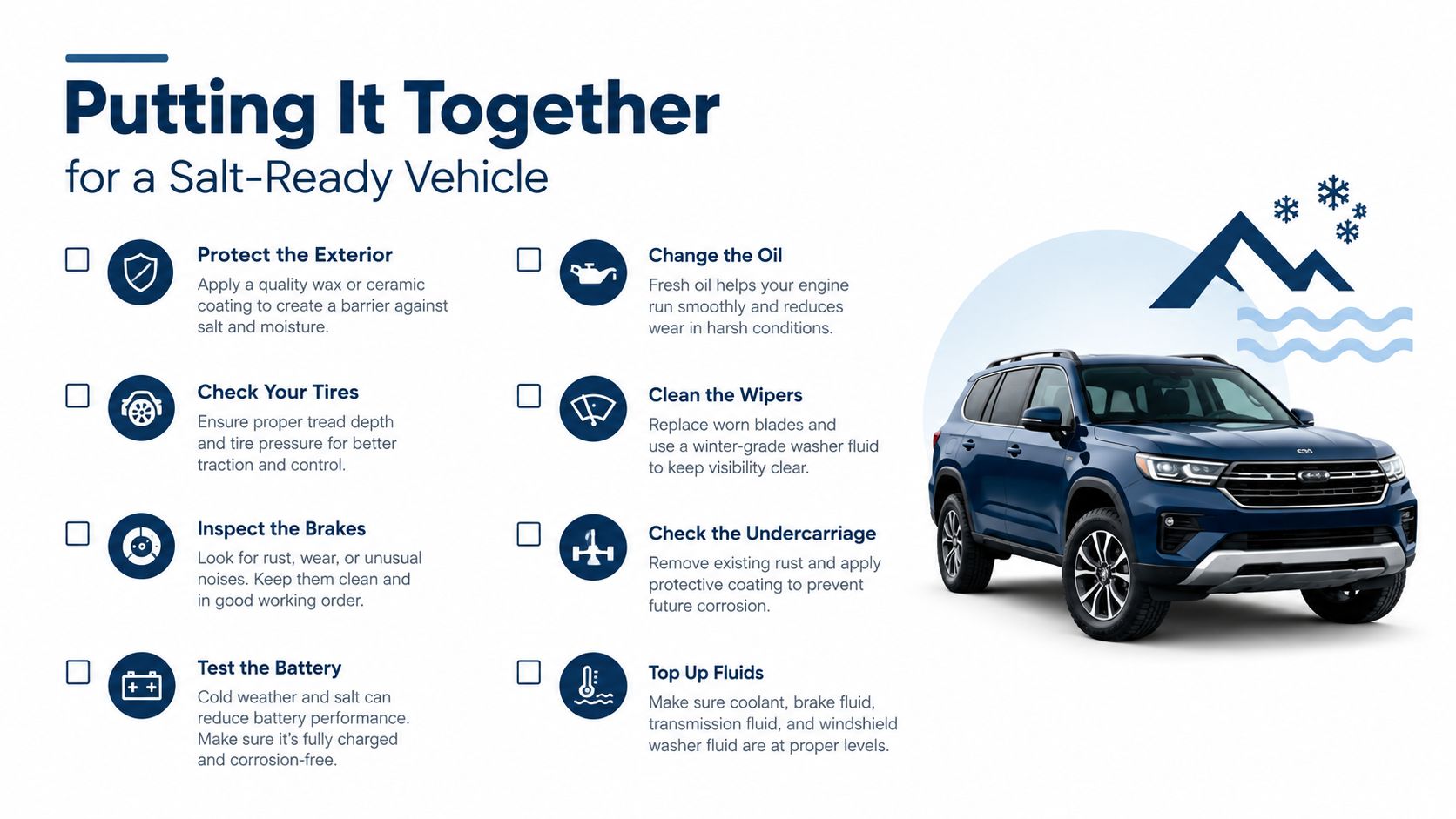
A practical checklist for Ontario use
- Check the underbody: Look for exposed metal, flaky coatings, and packed debris.
- Protect hidden cavities: Doors, rocker panels, and boxed sections need internal protection.
- Guard exposed lower surfaces: Use an appropriate underbody treatment where splash and grit hit hardest.
- Keep drain paths open: Water that can't escape becomes a tenant.
- Wash through winter: Especially the underside.
- Repair chips early: Small paint damage grows up into rust.
- Inspect every spring: Winter always leaves notes.
- Repeat before the next salt season: Rust prevention works best on schedule.
What success should look like
After one salted season, success usually looks boring. That is good. Drain holes stay open. Wheel arch lips do not start bubbling. Suspension and subframe areas do not pick up fresh reddish bloom. Doors and rocker seams stay dry instead of brewing corrosion out of sight.
The Toronto corrosion record mentioned earlier helps explain why this layered approach matters here. Toronto has long shown up as a heavy-corrosion environment in North American exposure work, and Ontario winter maintenance uses road salt at a scale that keeps chloride exposure high year after year. That is why underbody coatings, cavity treatments, and prompt chip repair each earn their place. They are not duplicate steps. They are covering different attack points on the same vehicle.
Ontario winters are persistent mechanics. They work nights, weekends, and especially during freeze-thaw slush. Your job is to slow them down by making sure steel is covered where spray hits, protected where moisture hides, and cleaned before salt gets too comfortable.
If you want that routine handled in one stop, Nanak Car Wash offers underbody-focused wash options, detailing, and vehicle rust proofing with size-based pricing that fits the GTA driver who'd rather prevent corrosion than chase it later. If your car has already had a few salty winters, book a visit at Nanak Car Wash and have the underside looked at before the next round of slush starts auditioning for structural damage.


 6600 Finch Ave W, Etobicoke, ON M9V 3Z6
 647-703-8515
 MON – SUN 8 AM to 7 PM