
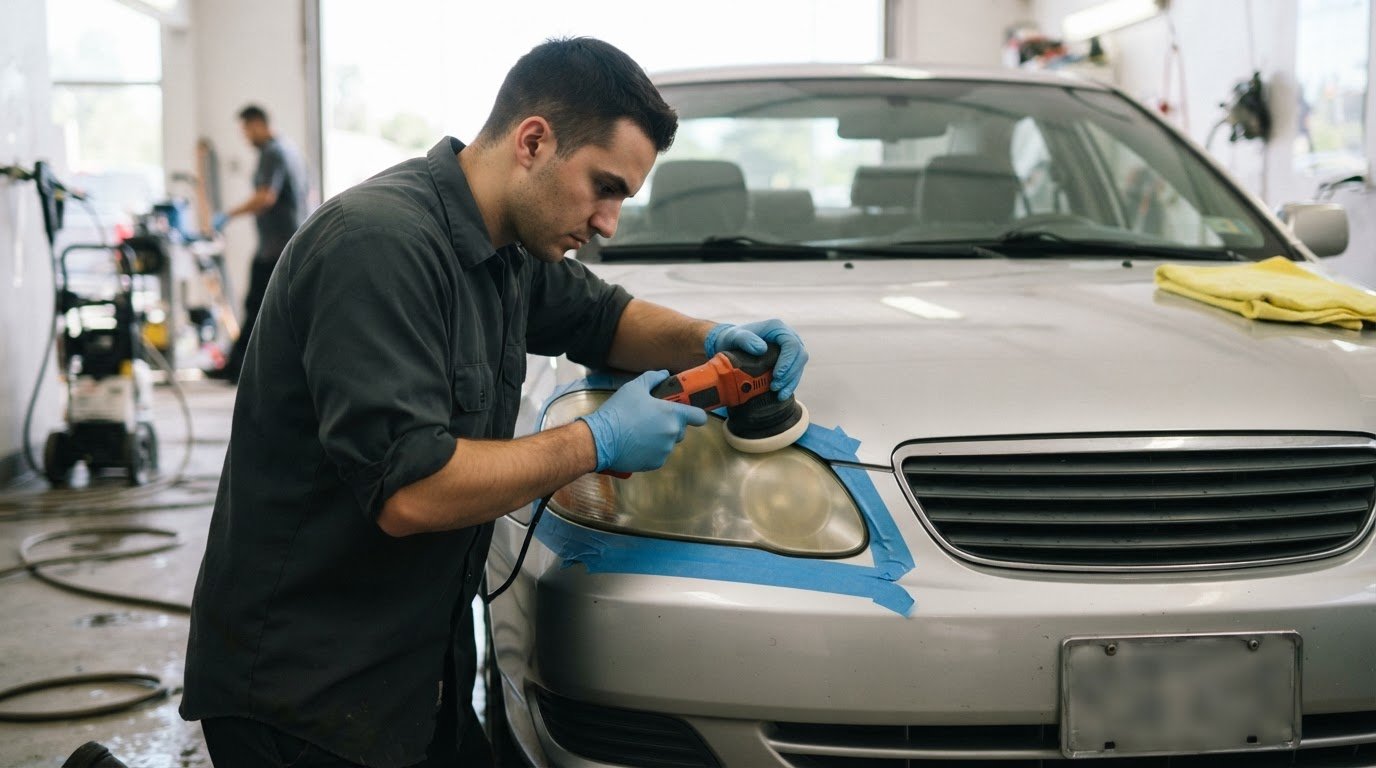
Replacing cloudy headlights isn’t always the right first step. If you’re asking what a headlight restoration service does, it improves existing lenses by cleaning, sanding and polishing away exterior oxidation. Restoration may improve exterior lens clarity, but it may not address problems inside the headlight.
Cloudy lenses can reduce the light reaching the road and make nighttime driving harder. Whether restoration can help or replacement makes more sense depends on where the damage is and how worn the housing is.
This guide explains how restoration works, what DIY kits involve, and when the condition of a headlight points toward replacement instead. You’ll also learn what to expect from professional service, which factors affect the cost, and how to choose the right next step for your vehicle. No guesswork, just a practical way to understand your options.
Key Takeaways
- Learn how sunlight, exhaust and road debris contribute to cloudy or yellowed headlight lenses.
- Understand why hazy headlights can reduce light on the road and affect nighttime visibility.
- Use the location and type of damage to judge whether restoration or housing replacement makes more sense.
- See what lens cleaning and sanding can address, and which problems they can’t fix.
- Compare the steps involved in DIY kits and professional restoration before choosing an approach.
Headlight Replacement or Restoration?
Restoration treats exterior cloudiness or yellowing on an existing lens. Replacement is a separate option when restoration cannot address the damage. A cloudy lens can reduce light output, but appearance alone does not determine an inspection result.
For a Canadian vehicle inspection, assess the headlights against the requirements that apply in your province or territory. Restoration works on the lens surface, not damage inside the housing.
Causes of Cloudy and Yellow Lenses
Sunlight exposes polycarbonate headlight lenses to ultraviolet rays, which can break down their protective coating and leave the surface yellow or cloudy. Vehicle exhaust and road debris also contribute to changes in the clear plastic over time.
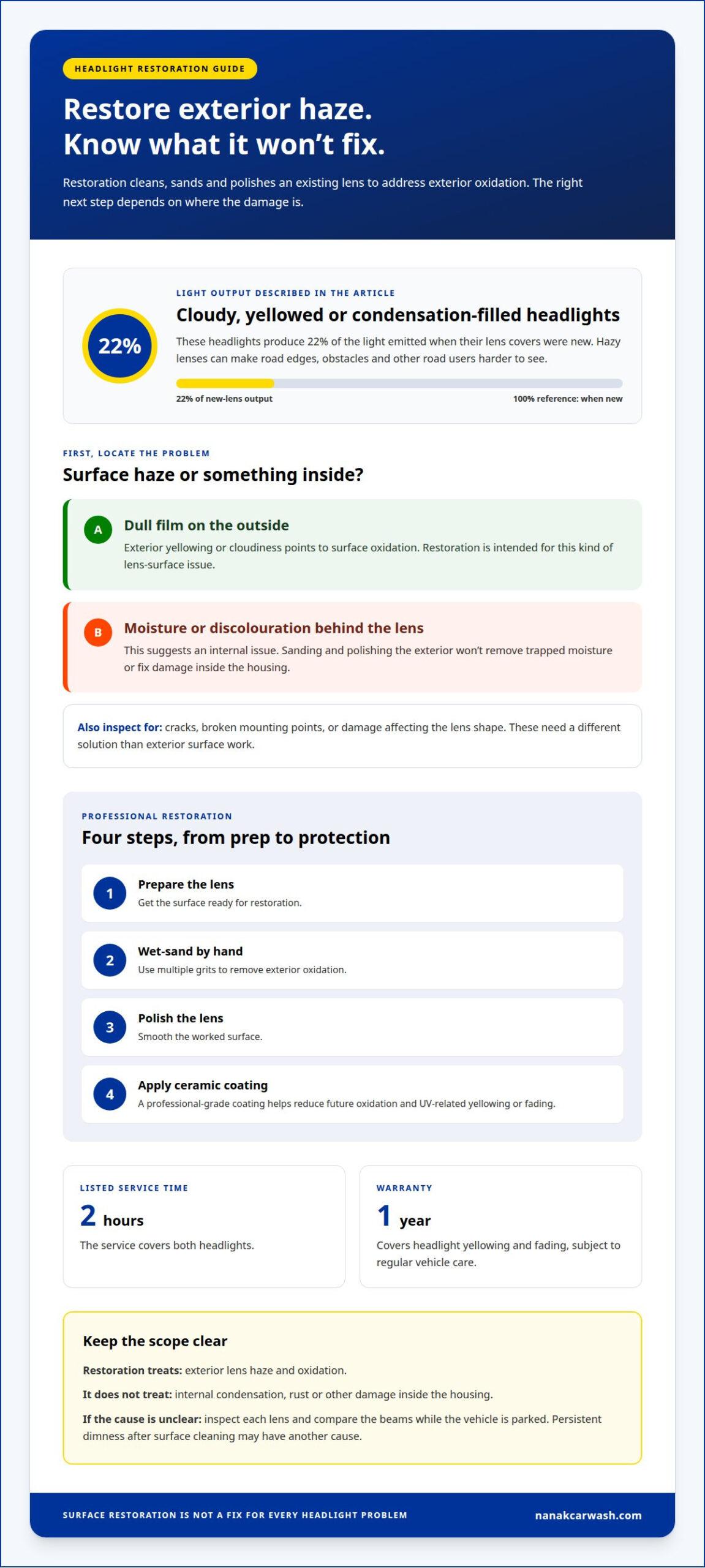
Check where the haze appears. A dull film on the outside points to surface oxidation, while moisture or discolouration behind the lens suggests an internal issue. Restoration is intended for exterior lens issues; problems inside the lens may need separate attention.
Restoring Yellowed or Dim Headlights
Restoration keeps the existing headlights and improves the lenses’ appearance and function. It suits yellowing or dimness caused by exterior oxidation. Clearer lenses can help light pass through, but restoration won’t fix every cause of poor headlight performance.
Check whether the haze is on the lens exterior or seems to come from inside the housing. For example, sanding and polishing may improve exterior cloudiness, while condensation inside remains after surface work. This distinction helps identify whether restoration can address the problem.
Service Steps and Included Work
Professional restoration uses multi-grit hand wet-sanding to remove exterior oxidation, then polishes the lens to smooth its surface. A professional-grade ceramic coating is applied afterward to help reduce future oxidation and UV-related yellowing or fading. The service covers both headlights.
The process follows a clear sequence:
- Prepare the lens surface for restoration.
- Wet-sand by hand with multiple grits to remove exterior oxidation.
- Polish the lens to smooth the worked surface.
- Apply a protective ceramic coating.
These steps treat surface haze, not moisture or discolouration inside the headlight.
Restoration Time and Warranty
The listed professional service time is 2 hours. The work covers both headlights, so the lenses are treated within the same service rather than as separate jobs. Use that duration as a planning guide for the restoration process.
A 1-year warranty against headlight yellowing and fading is subject to regular vehicle care. It applies to those specific issues, not internal condensation, rust or other damage. Keep the distinction in mind: the restoration targets exterior oxidation, and the warranty concerns yellowing and fading under its stated care condition.
Effect of headlight degradation on nighttime visibility
Cloudy or yellow headlight lenses reduce the light reaching the road, making road edges, obstacles and changes in the driving surface harder to see. Headlights also help other road users notice your vehicle. A clear beam supports your view ahead and your vehicle’s visibility to people approaching from another direction.
Darkness leaves drivers with less daylight to reveal hazards. Yellowed, cloudy or condensation-filled headlights produce 22 percent of the light emitted when their lens covers were new. Reduced output can make a roadside object or lane edge harder to spot from the driver’s seat. It can also make an approaching vehicle less noticeable to pedestrians and other drivers.
Rain adds another visibility challenge on Canadian roads. Water on the windshield and wet pavement can make objects and markings harder to distinguish. If headlight lenses are hazy, less light reaches the road. For example, a worn lane marking may be difficult to see when rain covers the pavement and the headlight beam is already reduced.
Foggy headlights need a closer look because haze can occur in different places. A cloudy exterior surface can scatter light and reduce the beam’s usefulness. Condensation inside the housing points to moisture entering the headlight, which can affect performance. Cleaning or sanding the outside won’t remove moisture trapped behind the lens.
Check the headlights while the vehicle is parked. Look at each lens from the front, then switch on the lights and observe the beams on a nearby surface. Compare their brightness and appearance. Uneven output, a hazy lens or visible moisture can help explain why nighttime driving feels less clear. Don’t assume a brighter bulb will solve a cloudy lens or internal moisture.
Visibility also depends on the windshield and road conditions. Maintaining clear, damage-free glass with auto glass specialists like Monster Glass helps preserve the driver’s view, while wet pavement can make markings less distinct. Headlight restoration treats exterior lens haze, not every visibility problem. If a headlight remains dim after surface cleaning, the cause may be inside the housing or elsewhere.
A Full-Service Car Wash can remove ordinary road film from a vehicle, but washing alone doesn’t restore an oxidized lens. For routine exterior cleaning, consider the Full-Service Car Wash. Persistent haze needs attention suited to the lens itself, so match the next step to what you can see on the parked vehicle.
Restoration versus replacing headlight housings
Choose based on where the damage is, not simply how old the vehicle looks. Restoration treats exterior lens oxidation, while replacement changes the housing. If a lens looks cloudy but remains intact, restoring its surface can be a practical alternative to replacing the assembly.
Start with a visual inspection in good light. Look for surface haze, cracks, broken mounting points, moisture inside the housing or damage that affects the lens shape. Exterior dullness points toward restoration. A cracked housing or internal problem needs a different solution because sanding and polishing only treat the outside.
Headlight housings tend to cost more for newer cars. Restoration is worth considering when the problem is limited to an oxidized exterior lens and the housing remains intact. For example, a newer vehicle with a cloudy lens but no visible cracks presents a different decision from one with a broken housing.
Replacement makes more sense when the housing is physically damaged or the issue is inside the sealed assembly. Surface restoration won’t remove internal condensation, rust, yellowing or fading. If moisture remains behind the lens after its exterior is cleaned, further surface work won’t address the source.
Use this simple comparison to organize the decision:
- Exterior oxidation: Restoration treats the lens surface and improves its appearance.
- Cracked or broken housing: Surface sanding cannot repair the physical damage.
- Internal condensation or rust: Exterior restoration does not remove these issues.
- Intact housing with cloudy lenses: Restoration can preserve the existing assembly.
Consider the condition of both headlights, not just the worse-looking one. If one lens is clear and the other heavily hazed, the difference can affect the vehicle’s appearance and the balance of light reaching the road. A professional assessment can distinguish surface oxidation from problems beyond the lens.
Replacement also requires matching the housing to the vehicle. Newer vehicles can have more expensive housings, so don’t treat replacement as the automatic answer to every cloudy lens. Consider where the damage is, the housing’s physical condition and whether exterior restoration can address the visible problem.
In practical terms, restore an intact housing when the defect is on its outer lens. Choose replacement when the housing is broken or the fault is internal. This distinction helps avoid paying for surface work that cannot solve the problem, or replacing an assembly when restoration can treat the damage.
Cleaning plastic headlight lenses
Cleaning helps distinguish loose surface grime from damage to the lens coating. Road film can make a plastic headlight look dull, while oxidation creates persistent cloudiness. A basic wash can remove surface dirt, but it won’t remove oxidation embedded in the protective coating. Check the lens after washing: any remaining haze points to a deeper surface problem.
Plastic lenses need careful treatment because their coating protects the surface. Restoration cleans and sands the lens to remove the damaged coating, then polishes it to smooth imperfections. The aim is a clearer, more even surface, not simply a shiny appearance. Check both lenses, since one headlight may be more worn than the other.
Cleaning helps when visibility is reduced or compromised, or when you want to improve the vehicle’s appearance. For example, routine cleaning may remove road grime, while a cloudy patch that remains needs more than washing. The deciding factor is whether the obstruction is on the surface or within the lens assembly.
Sanding the lens also serves a functional purpose. Cleaning and sanding can help maximize headlight performance and reduce glare for the driver and other motorists. A rough or uneven coating can scatter light instead of allowing a clear beam. Smoothing imperfections treats that surface condition, but won’t repair problems inside the housing.
- Loose grime: Wash the lens and see whether the visible film clears.
- Persistent exterior haze: Consider cleaning and sanding to address coating film.
- Uneven surface: Polishing can smooth lens imperfections after sanding.
- Internal moisture or damage: Surface cleaning won’t resolve the issue inside the housing.
After restoration, a professional-grade ceramic coating helps reduce future oxidation and yellowing or fading from UV exposure. This protection matters because polishing alone doesn’t prevent the lens from facing the same environmental exposure again. Regular vehicle care supports the coating, but the surface still needs attention if visibility becomes compromised.
Use the lens condition to decide how much work is appropriate. If washing clears the lens, routine cleaning may be enough. If a film remains, restoration can clean, sand and polish the exterior. If condensation is inside the headlight, cleaning the outside won’t fix it. Choose the process that matches the issue.
Exposure to the sun’s ultraviolet rays, vehicle exhaust and road debris can yellow and cloud clear plastic headlight lenses over time. These sources of wear explain why a lens may gradually lose clarity again after restoration. Keeping it clean makes changes easier to notice, but routine washing won’t prevent this exposure or reverse coating damage. Checking the surface during regular vehicle care can help you spot changes before they significantly affect visibility.
Body shops and dedicated automotive service centers often offer headlight restoration for customers who don’t want to restore lenses themselves; specialized facilities such as grandprixcafe.com illustrate the value of professional vehicle services in preserving exterior clarity and finish. This may suit persistent exterior cloudiness that needs more than routine cleaning. Before choosing an approach, identify whether the haze is on the outside or the concern is inside the housing. Exterior restoration treats the lens surface, not internal problems.
DIY restoration versus professional service
DIY kits and professional restoration both treat exterior lens damage, but differ in tools, control and included protection. Understanding what a headlight restoration service involves helps you compare the work, rather than judging by the word “restoration” alone. Kits use sanding to remove damaged coating, then apply a protective layer. Some require an electric drill for buffing.
A DIY kit may suit someone comfortable following a careful sequence. Work evenly across the lens and use each abrasive stage as directed. For example, rushing one section can leave cloudy patches beside clearer plastic. A drill also requires steady handling: lingering over one spot may create an uneven finish.
Professional restoration follows a controlled process. The technician prepares the lens, hand wet-sands with multiple grits, polishes the surface and applies a ceramic coating. The service covers both headlights, giving each lens the same treatment. This helps keep their appearance consistent, even when one side looks more worn.
Choose based on the damage and the work you’re prepared to do. An intact headlight with exterior haze may suit a kit or professional treatment. A crack, internal condensation or rust is different. Sanding the outside won’t resolve a problem inside the housing, so a restoration kit isn’t right for every headlight issue.
Protection is another practical difference. With a kit, you apply its protective layer after sanding. If that step is skipped or uneven, the exposed surface has less protection. Professional service includes a ceramic coating intended to reduce future oxidation and UV-related yellowing or fading. Regular vehicle care still matters after either approach.
Headlight haze typically becomes noticeable again after a year following restoration. Before starting, consider whether you have suitable tools, time for each sanding stage and confidence applying the finish evenly. If the lens has complicated surface wear, professional work may be simpler. If the damage is internal, neither exterior approach addresses its cause.
In Canada, restoration cost depends on the vehicle’s type, age and headlight wear; the price is provided after a quote request. Understanding what a headlight restoration service includes gives you a practical basis for comparing DIY and professional work. Consider sanding, polishing and protective coating, not just the kit or service label.
For ordinary road film between restoration work, choose a Full-Service Car Wash. Washing cleans the vehicle’s exterior, but it doesn’t replace sanding and coating an oxidized lens.
Nanak Car Wash: Full-Service Car Wash
Nanak Car Wash offers a Full-Service Car Wash for routine vehicle cleaning. It can remove ordinary road film from the exterior, but washing doesn’t restore an oxidized or yellowed headlight lens. If your lenses remain cloudy after cleaning, restoration or housing replacement addresses a different problem.
Choose a Full-Service Car Wash when your vehicle needs an exterior clean as part of regular care. For a more comprehensive clean, Nanak Car Wash also offers Car Detailing Packages. Match the service to your vehicle’s cleaning needs, and treat persistent headlight haze separately from surface dirt.
Contact Nanak Car Wash to discuss which vehicle-cleaning option suits your needs.
Make a Clear Next Move for Your Vehicle
Now that you know what a headlight restoration service can address, use the lens condition to choose your next step. Keep routine exterior cleaning separate from restoration or housing replacement. This helps you choose care that matches the issue instead of expecting one service to solve everything.
Build vehicle cleaning into your maintenance routine, and pay attention when a headlight’s appearance changes. Nanak Car Wash offers an Express Car Wash for a quick exterior clean. For persistent haze, use the restoration-versus-replacement criteria in this guide to identify the work needed.
For help choosing a vehicle-cleaning option, contact Nanak Car Wash. Take the next step with a clearer plan for keeping your vehicle clean and cared for.
Frequently Asked Questions
How long do restored headlights stay clear?
Restored headlights can start showing haze again after about a year. The timing depends partly on exposure to sunlight, road debris and vehicle exhaust, as well as ongoing care. Watch for cloudiness gradually returning, especially on a vehicle parked outdoors. If a lens becomes hazy again, distinguish new surface oxidation from dirt or moisture inside the housing.
Is headlight restoration better than replacing the headlights?
Restoration fits best when the housing is intact and the problem is limited to exterior lens oxidation. Replacement is more appropriate for a cracked housing or damage inside the assembly. For example, if washing removes the dirt but a cloudy film remains on an undamaged lens, restoration treats that surface. If moisture is trapped inside, exterior work won’t address it.
Can headlight restoration fix cloudy, yellowed, or scratched headlights?
Restoration can improve cloudiness and yellowing caused by oxidation on the lens exterior. Sanding and polishing can also smooth some surface imperfections. It won’t fix internal yellowing, condensation or rust, and deep scratches or cracks may remain beyond the reach of surface work. The key is whether the blemish is on the surface or inside the headlight.
What are the risks of DIY headlight restoration?
Uneven sanding can leave visible patches, while careless polishing can make the lens surface uneven. A kit that uses an electric drill also requires steady control to avoid concentrating abrasion in one spot. The protective layer matters too: poor or incomplete application leaves the sanded surface less protected. Follow the kit’s sequence closely, and stop if the lens has cracks or internal moisture.
Does headlight restoration improve nighttime visibility and safety?
Restoration can improve light passing through a lens when exterior haze reduces clarity. That can make the road and nearby objects easier to see at night. It doesn’t correct every cause of poor visibility, such as moisture inside the housing or another headlight fault. Clear lenses support safer driving, but they’re only one part of visibility, alongside clean glass and attentive driving.
How much does headlight restoration cost in Canada?
Professional restoration costs vary based on the vehicle’s type, age and headlight wear.

 6600 Finch Ave W, Etobicoke, ON M9V 3Z6

 647-703-8515
 MON – SUN 8 AM to 7 PM