

You type car rust proofing near me after noticing the brown haze around a door seam, or after hearing that gritty crunch under the tyres on a February morning and wondering what that slush is doing underneath your car. In the GTA, that concern is justified. Winter doesn't just make your commute ugly. It turns every drive into a salt bath for the underbody, wheel wells, rocker panels, brake lines, and hidden seams you never see until the damage is expensive.
A lot of drivers get bad advice at this stage. One shop pushes a one-time coating. Another says regular washes are enough. A friend swears by whatever they used ten years ago on a different vehicle. Ontario cars don't care about old opinions. They care about salt, moisture, temperature swings, and whether protection reaches the places rust starts.
Table of Contents
- That Crunching Sound The Unofficial Anthem of GTA Winters
- Why Your Car Despises Ontario Winters More Than You Do
- The Four Types of Rust Protection Explained
- How Much Does Quality Rust Proofing Cost in the GTA
- What to Expect During Your Rust Proofing Service
- How to Choose the Right Rust Proofing Provider Near You
- GTA Rust Proofing Frequently Asked Questions
That Crunching Sound The Unofficial Anthem of GTA Winters
Every GTA driver knows the sound. You back out of the driveway, tyres roll over crusted salt, and the car sounds like it's chewing gravel. By lunchtime, that same mess has turned into grey soup sprayed up into the wheel wells and packed into every lip, seam, and bracket under the car.
That's the part most owners underestimate. Salt doesn't need drama. It just needs access. It rides in with slush, sticks to damp metal, and sits there while you're busy with work, school runs, deliveries, or a long Highway 401 crawl. The car may still look decent from ten feet away, but underneath, winter has already started writing the repair bill.
In the shop, the pattern is familiar. The owner usually notices rust too late. Maybe it starts with a bubble at the edge of a rear wheel arch. Maybe a mechanic points out scaling on the underbody during a routine service. Maybe the rocker panel finally gives away what's been happening inside for years.
Salt is like sand in a winter boot. If you leave it there, it keeps grinding away long after the storm is over.
Drivers searching for car rust proofing near me usually aren't being fussy. They're reacting to something real. In Ontario, rust isn't a niche problem for old beaters. It's regular maintenance territory for anyone who plans to keep a vehicle longer than a couple of winters, especially in the GTA where roads stay wet, salty, and filthy for long stretches.
Why Your Car Despises Ontario Winters More Than You Do
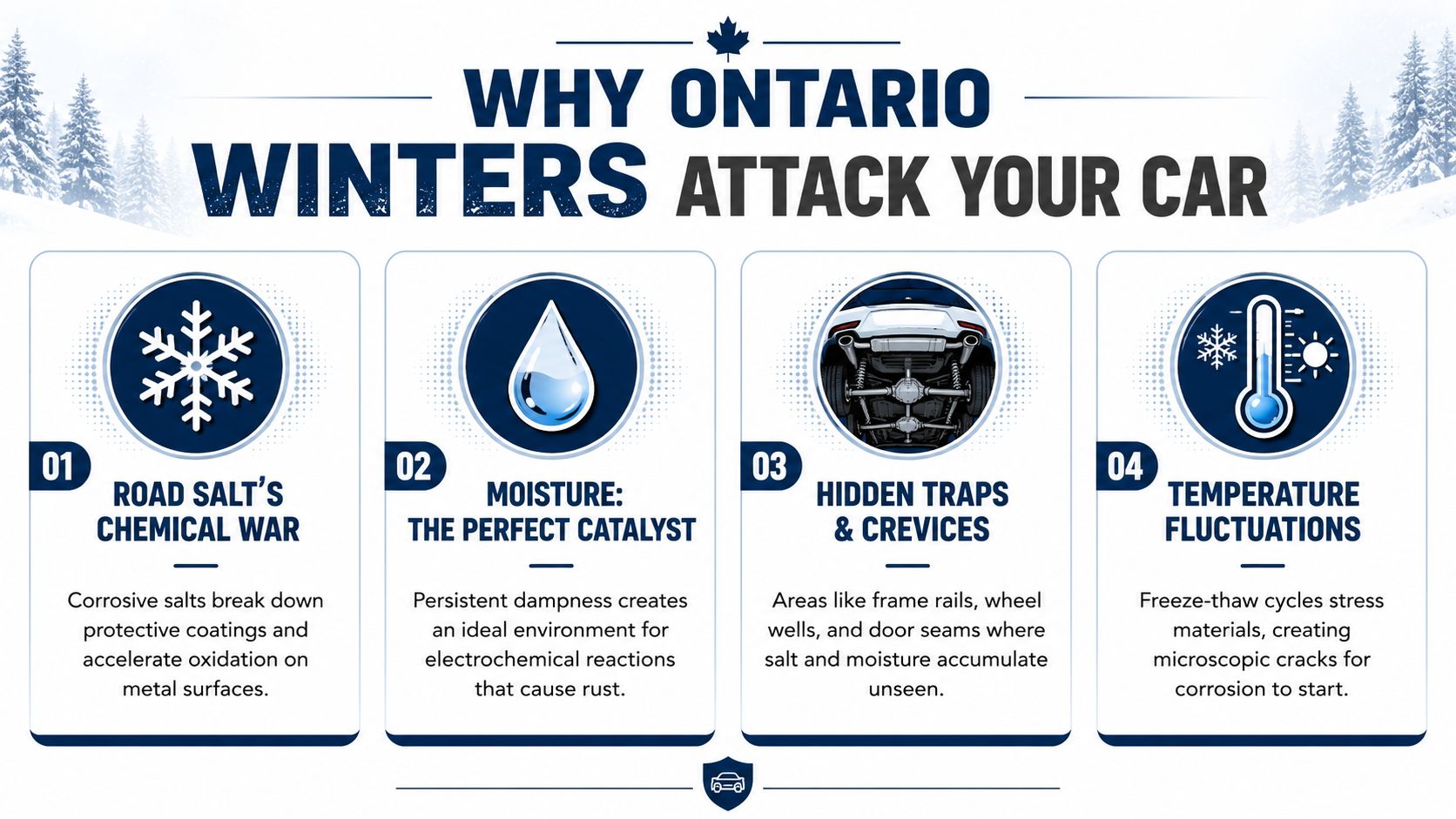
A GTA car can leave the driveway clean enough in the morning and come home wearing a layer of salty slush by dinner. That wet grit gets fired into the wheel wells, packed into the rocker panels, and pushed into seams you will never see without getting the car on a hoist. In Ontario, rust starts because salt keeps metal wet for long stretches, then the freeze-thaw cycle keeps reopening tiny weak spots in the factory coating.
Salt is only part of the problem
Trapped contamination is the issue. Slush mixed with salt, sand, and road grime gets lodged in places a quick wash misses. Wheel lips, pinch welds, subframe pockets, brake and fuel line brackets, door bottoms, and the inside edges of panels stay damp long after the outside looks fine.
That matters even more in the GTA because a lot of vehicles do short trips. The car heats up a bit, melts the buildup, then sits. It never fully dries. Ride-hail drivers, delivery vehicles, and fleet units get hit from both sides. More mileage means more exposure, and constant stop-and-go use means salty moisture keeps getting refreshed instead of drying out.
A clean hood and shiny doors do not tell you much about the underside.
Ontario rust turns expensive fast
In the shop, rust rarely shows up first as a dramatic hole in the floor. It starts with swollen seams, flaky brackets, and crust around weld points. Then you get seized bolts during routine repairs, brake lines that look rough years before the owner expected, suspension hardware that fights every job, and rocker panels rotting from the inside out.
That is why rust proofing is maintenance, not vanity. Paint damage is one problem. Corrosion in structural areas, mounting points, and hidden cavities is a different problem with a much bigger bill attached.
Here is where we usually see trouble first:
- Rear wheel arches and wheel wells: Constant blast from salty spray and grit.
- Rocker panels: They trap moisture and often rust from the inside before the paint bubbles.
- Underside seams and brackets: These hold grime and stay wet.
- Door bottoms, hatch edges, and inner cavities: Water gets in and drains poorly once dirt builds up.
Shop rule: If rust is visible on the outside, inspect the backside of that panel and the nearest seam.
Drivers also mix up rust prevention with cosmetic protection. Paint protection film helps against stone chips on exposed painted panels, but it does nothing for the inside of a rocker panel or a boxed frame section. If you want to evaluate PPF with Lionheart Detailing, do it as a separate paint-protection decision, not as a substitute for proper rust proofing.
Ontario winter does not attack every car the same way. A garage-kept car driven twice a week has a different risk profile than a Corolla doing airport runs six days a week. High-mileage GTA drivers need a plan that accounts for constant salt exposure, not a one-and-done treatment and wishful thinking.
The Four Types of Rust Protection Explained
Most generic advice often falls short. People throw around “undercoating” and “rust proofing” like they're the same thing. They aren't. In Ontario, that difference matters.
Oil spray versus thick undercoating
The easiest way to understand it is this. Oil-based spray acts more like a moisturizer. It creeps. It flows into seams, folds, and hidden cavities. Rubberized or thick undercoating acts more like a raincoat. It covers exposed surfaces, but if it gets chipped or lifts in one area, moisture can sit underneath it.
Authoritative Canadian guidance specifically favours oil-based treatments over old-fashioned wax or thick rubberized coatings for daily-driven vehicles in Ontario's climate, because oil penetrates seams and cavities that rigid coatings can't reach, as outlined in this comparison of rust proofing approaches in Canada.
That doesn't make thick coatings useless. It means you need to know what problem each method solves.
| Method | Best For | Application Frequency | Pros | Cons |
|---|---|---|---|---|
| Oil-based spray | Daily-driven GTA vehicles, commuters, ride-hail cars, family SUVs | Annual | Reaches seams, cavities, overlaps, and internal panels | Needs reapplication |
| Dripless oil spray | Drivers who want cleaner application with seam penetration | Annual | Penetrates hidden gaps with less mess than older oil styles | Still not a one-and-done service |
| Rubberized or thick undercoating | Specific exposed underbody surfaces on suitable vehicles | One-time application with annual inspection | Strong barrier on outer surfaces | Can hide issues if chipped or damaged |
| Electronic module | Drivers asking for a low-mess add-on | Varies by product and installer | No wet coating | Doesn't physically coat seams or internal cavities |
Where cavity wax fits
Cavity wax has a place. It's typically used inside doors, body cavities, and enclosed sections where a technician wants extra protection in boxed-in metal spaces. Think of it as a targeted treatment rather than a full answer for everything under the car.
Good shops don't treat one product like magic. They match the product to the area. Exposed underbody metal, inner body cavities, and seam overlaps don't all behave the same way.
The electronic module question
Drivers ask about electronic rust modules because they sound tidy. No drips, no oily residue, no annual mess. The problem is practical. Corrosion in Ontario starts where salty moisture sits on and inside metal sections. A module doesn't wash out debris, doesn't displace moisture, and doesn't creep into seams.
That's why, for a daily-driven vehicle here, I'd rather see real material applied into real problem areas than a promise that sounds convenient.
A useful side note. Rust proofing protects metal. It doesn't protect paint from stone strikes, road rash, or door-edge abuse. If you're also weighing surface protection for painted panels, it helps to evaluate PPF with Lionheart Detailing so you don't confuse paint film with rust prevention. They solve different problems.
The best rust treatment for a GTA commuter is usually the one that gets into the seams you'll never clean by hand.
How Much Does Quality Rust Proofing Cost in the GTA
A lot of GTA drivers only start asking about rust proofing after the first brown bubbles show up on a door edge or rocker. By then, the cheap option is already gone.
What you'll usually pay
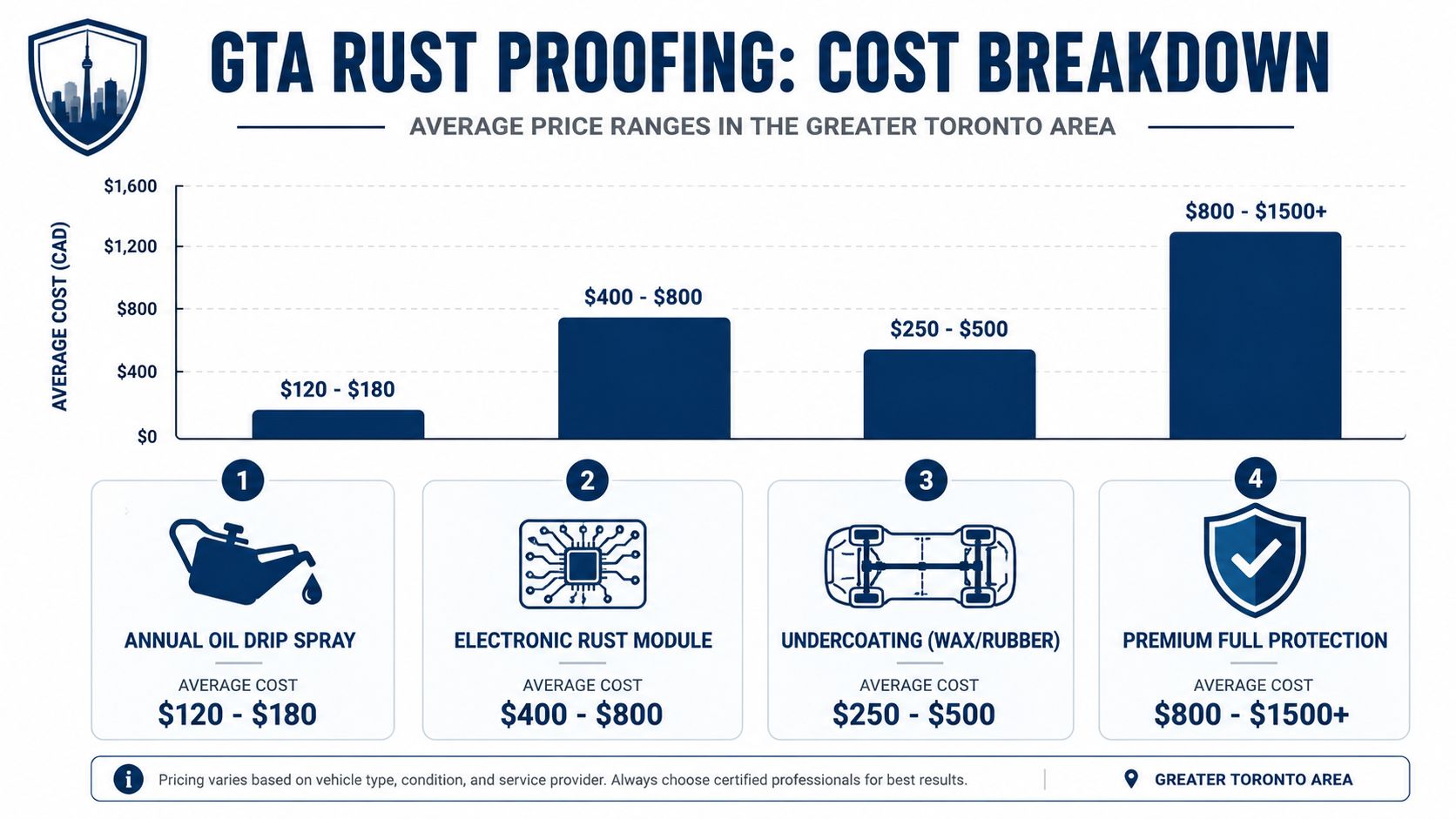
For professional annual oil-spray rustproofing in Ontario, expect roughly $140 to $175 for standard vehicles and $160 to $200 for SUVs and light-duty pickups. Complete treatment in Canada typically falls around $130 to $170, while more permanent undercoating options can run $500+ and may last 2 to 3 years, according to this Canadian rust proofing cost breakdown.
That same source estimates an annual rust prevention plan at $335 to $740 total once you factor in oil-spray treatment and regular winter washes. That is still a much smaller bill than major corrosion repair.
The part many shops gloss over is that these prices are for different strategies, not just different brands. Annual oil spray is cheaper per visit, but it needs repeat service. A thicker one-time undercoat costs more up front, but it is not automatically the better choice for every vehicle, especially if the shop misses the inner seams and cavities where Ontario salt starts doing its work.
For high-mileage drivers, the schedule matters as much as the sticker price. If you drive for Uber, courier work, or a company fleet, your car sees more slush, more brine, and more highway spray than the average commuter car. In that case, annual treatment usually makes more practical sense than stretching intervals and hoping for the best.
Why cheap rust repair gets expensive fast
Repair bills climb fast once corrosion gets into rockers, wheel arches, subframes, or mounting points. The same source puts minor rust spot repairs around $500 to $1,000, rocker panel replacements at $2,000 to $4,000, and major frame repairs above $5,000.
Those numbers are only part of the problem.
- Downtime: The car can be tied up in a body shop for days or longer.
- Scope creep: Once trim or panels come off, hidden rust often turns a small repair into a much bigger one.
- Resale hit: Buyers and dealers notice bubbling paint, flaky seams, and patched metal right away.
Nanak Car Wash lists rust proofing at about $119.95 to $149.95 plus tax, based on its published pricing. That gives GTA drivers a useful local benchmark for entry-level annual protection.
Searching for “car rust proofing near me” to find the lowest possible number is understandable. Just compare apples to apples. A quick basic spray, a full cavity treatment, and a heavier underbody coating are not the same job, and Ontario winter punishes the cheaper shortcut every time.
What to Expect During Your Rust Proofing Service
Book a rust proofing appointment in the GTA in October, and the shop parking lot usually tells the story. Wet wheel wells. White salt dust starting to show. Drivers trying to get ahead of winter after the first cold snap. The service itself is usually simple. What matters is whether the shop treats the car properly and uses the right product for how you drive.

What a proper visit looks like
A good appointment starts with inspection, not a spray gun.
The technician should check the underbody, wheel wells, door bottoms, rocker areas, hatch or trunk seams, and any spots that already show surface rust. If the car has scale rust, soft metal, or old undercoating peeling off in sheets, a decent shop will say so. Rust proofing slows corrosion. It does not rewind it.
Then comes prep. On a clean vehicle, that may just mean clearing dirt from drain holes, wiping key areas, and making sure the product can stick and creep where it needs to go. If the underside is packed with mud, greasy buildup, or old salt residue, spraying over it is lazy work. It traps the mess against the metal.
After that, the main job starts.
Access to hidden areas
Door cavities, rocker panels, seams, inside fenders, and other boxed sections matter more than the broad flat surfaces drivers can see. Ontario salt gets into folds and spot-welded seams, then sits there.Application based on product type
Oil spray should be worked into cavities and corrosion-prone joints. A heavier underbody coating, if the vehicle is a good candidate for one, needs proper surface prep and careful placement. Shops that treat every car the same usually miss the point.Coverage of winter trouble spots
Wheel arches, rear quarter seams, subframe areas, fuel and brake line zones, and the bottom edges of doors take a beating in GTA winter driving. Highway cars and ride-hail cars usually need extra attention here because they see more spray and more slush loading.Post-service instructions
Some products drip for a day or two. That is normal with many oil-based treatments. A good shop tells you where to expect it, whether to avoid your driveway for a night, and when to wash the vehicle afterward.
If a service only darkens the visible underbody and sends you out in 20 minutes, ask more questions.
What the shop should tell you before you leave
Drivers often get confused because shops lump very different products together.
If you booked an annual oil spray, expect maintenance. It works because it stays active, creeps into seams, and needs to be refreshed. If you booked a one-time undercoating, expect a different conversation. That type of product depends heavily on prep, condition of the metal, and periodic inspection for chips or separation. These are not interchangeable plans, and GTA drivers get burned when a shop sells one like it behaves like the other.
High-mileage drivers should be even more direct about expectations. Uber drivers, delivery drivers, couriers, and fleet operators put a winter's worth of road spray on a vehicle fast. In that case, the service interval matters just as much as the product itself. A car doing constant airport runs on the 401 and Gardiner will not age like a weekend grocery getter.
Timing also matters, but it is not complicated. Applying protection before roads are heavily salted gives the product time to settle into seams and cavities under better conditions. Waiting until mid-winter is still better than skipping it. Earlier is smarter in Ontario.
The best rust proofing visit is the one where the shop explains what they are applying, where it is going, what it will not fix, and when you need to come back.
How to Choose the Right Rust Proofing Provider Near You
Typing car rust proofing near me gives you a list. It doesn't tell you who does careful work. Some places treat rust protection like a quick add-on. Others know exactly where Ontario vehicles fail and how to slow it down.
Questions worth asking before you book
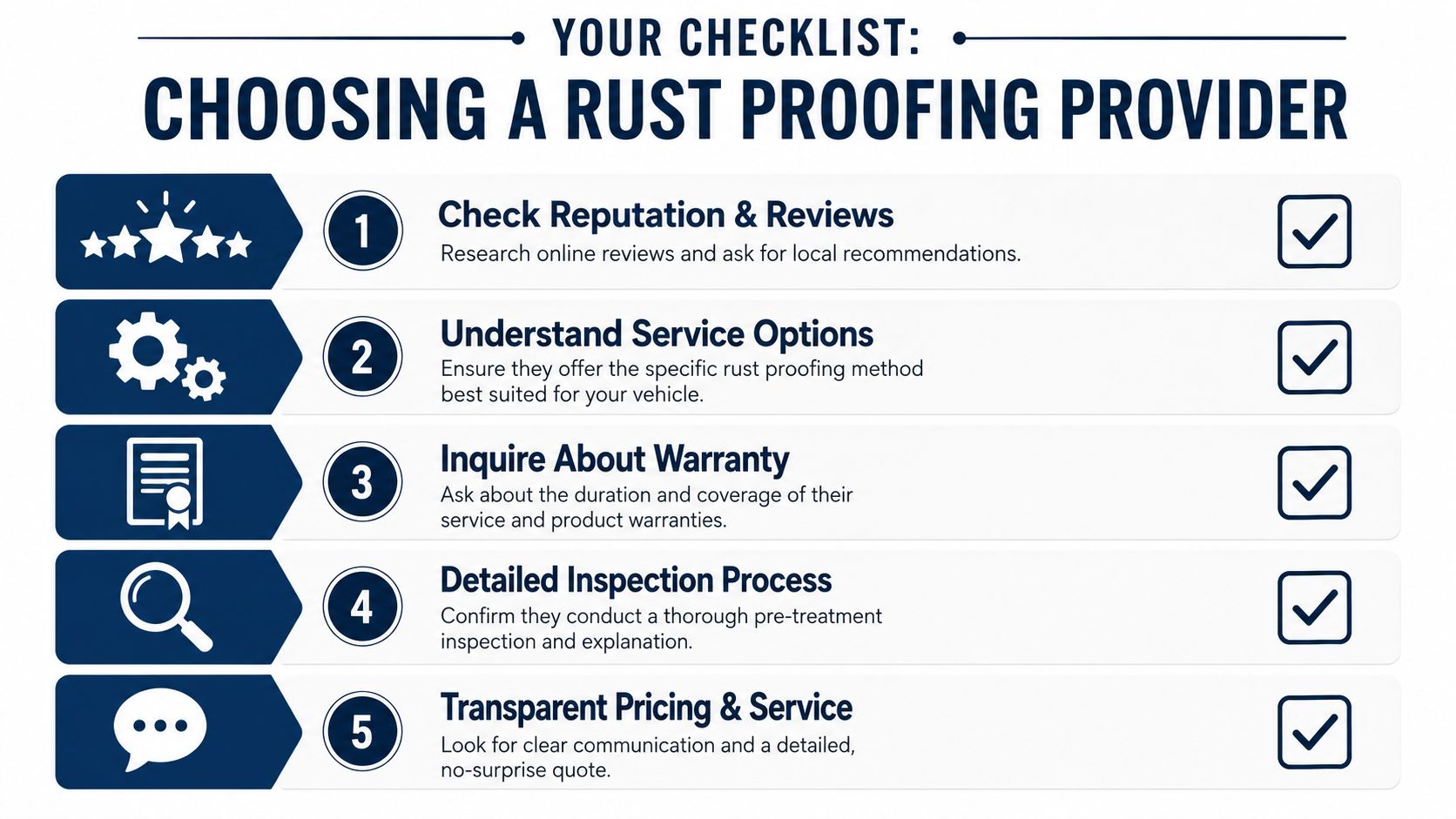
A decent provider should answer practical questions without getting slippery.
- What product are you applying: Ask whether it's an annual oil-based spray, a dripless version, a thick undercoating, or a combination.
- Where does it go: You want clear mention of seams, cavities, rocker areas, wheel wells, and underbody trouble spots.
- What does maintenance look like: Annual products need annual follow-up. One-time products need inspection.
- How do you handle existing rust: Honest shops won't pretend a coating reverses major corrosion.
- Is there any warranty support: If a provider offers one, ask what it covers and what maintenance keeps it valid.
The Canadian Automobile Association recommendation noted earlier is useful background here. Annual rustproofing is the standard expectation for Ontario drivers using oil-based treatments, because most remain effective for about one year before reapplication is needed, as discussed in the earlier source.
Advice for high-mileage drivers and fleets
Ride-hail drivers, delivery drivers, contractors, and small fleets should be stricter than casual owners. High mileage means more exposure. More highway spray, more slush, more filthy shoulder lanes, more winter wash cycles, more salt packed into every corner of the chassis.
For those vehicles, focus on consistency:
- Book annual applications before the season gets ugly
- Use underbody rinses regularly through winter
- Inspect wheel wells and rocker areas often
- Don't treat a busy work vehicle like a weekend toy
SUVs, vans, and pickups need the same discipline, plus attention to larger underbody surfaces and frame sections. More vehicle means more places for salt to sit.
A provider's history matters too. Nanak Car Wash has been operating since 2004, which means more than two decades in the region, and it combines wash, detailing, and rust protection in the same service lineup. That doesn't make it the only option. It does make it a practical example of the kind of shop model many GTA drivers want, especially if they prefer to handle wash maintenance and rust protection in one place.
GTA Rust Proofing Frequently Asked Questions
Can winter washes replace rust proofing
No. Regular washes help, especially underbody rinses, but they don't replace professional rust proofing.
The reason is simple. Washing removes surface salt. It does not reliably reach internal panels, hidden seams, and door cavities where corrosion often starts. That distinction is spelled out in this Ontario discussion of why winter washing doesn't replace rust proofing.
If you only do one thing, don't stop washing. But don't mistake washing for seam protection.
Is a heated garage helping or hurting
It can hurt if you park a salt-covered vehicle inside without rinsing it first. Parking a salty car in a heated garage without a cold-water rinse can accelerate corrosion by 4 to 5 times, and the recommended prevention step is to rinse the undercarriage, wheel wells, and lower panels with cold water before garage entry, as described in this guide to rustproofing and heated garage risk.
That catches people out all the time. They think the garage is protecting the car. In reality, warmth plus humidity plus salt can create a perfect corrosion chamber.
Rinse first. Then park inside.
Is it too late on an older vehicle
Not always. If the vehicle has surface rust, early flaking, or visible corrosion starting around common trouble spots, protection can still slow further spread. If the metal is already perforated or structurally weak, the job changes from prevention to repair.
Honesty matters more than optimism. Rust proofing preserves what's still there. It doesn't rebuild missing metal.
Does a new car still need it
For a GTA daily driver, yes, it's worth serious consideration. Factory protection helps, but it doesn't change the local climate, road salt, or the way slush works into seams over time. New vehicles become used vehicles very quickly in Ontario winters.
The best time to protect a clean underbody is before years of salt contamination build up. Waiting until you “see some rust” usually means the process is already underway in hidden areas.
If you want a practical local option, Nanak Car Wash offers rust proofing alongside underbody washing and detailing services across the GTA. For drivers who'd rather handle prevention before rust turns into body work, it's the kind of one-stop maintenance setup that makes staying ahead of Ontario salt a lot easier.


 6600 Finch Ave W, Etobicoke, ON M9V 3Z6
 647-703-8515
 MON – SUN 8 AM to 7 PM