

Your car probably doesn't get dirty at a convenient time. It happens after a slushy commute on the 401, after parking under dripping winter grime, or right before you need to pick up a client, a passenger, or the kids. The body looks dull, the wheels are wearing a ring of brake dust, and the lower panels have that familiar chalky salt film that says, “Yes, this car lives in the GTA.”
The problem isn't knowing your car needs a wash. The problem is fitting it into a day that already feels full.
That's where an Express Auto Wash makes sense. It's the car-care version of choosing takeout on a busy night. Fast, organised, and built for repeat use. For drivers in the Greater Toronto Area, especially people who wash often, that speed and routine matter even more. If you drive for ride-hail, manage service vehicles, or just hate watching salt sit on your paint, the express model can save both time and money.
Table of Contents
- Your Car Is Dirty and You Have No Time
- What Is an Express Auto Wash
- A Look Inside the Tunnel What Is Included
- The Smart Choice for GTA Drivers Who Benefits Most
- Decoding Express Wash Pricing and Memberships
- Express Wash vs Detailing Choosing the Right Clean
- FAQ and Pro Tips for Your Nanak Car Wash Visit
Your Car Is Dirty and You Have No Time
Toronto winter grime has a talent for showing up all at once. One storm, one wet road, one parking lot puddle, and your clean car turns into a rolling salt shaker. Then the same thing happens again two days later.
For a lot of GTA drivers, old-school washing doesn't fit real life. Hand washing takes time, the weather doesn't always cooperate, and standing around with a hose in cold months sounds miserable for good reason. Even a slower wash format can feel like a detour when you're trying to get back to work.
Why this feels worse in the GTA
Local driving conditions are rough on a car's exterior. Salt, slush, wet roads, and stop-and-go traffic leave a film that builds up quickly, especially around wheel wells and lower doors. If you drive every day, you don't get to “save” the wash for next month.
That's why the express auto wash has become such a practical option. It's built for frequency. You drive in, stay in your vehicle, let the tunnel do the heavy lifting, and get back on the road without turning car care into a half-day chore.
Practical rule: If your car gets dirty faster than you can spare an hour, you need a wash routine that works at commuting speed.
What Is an Express Auto Wash
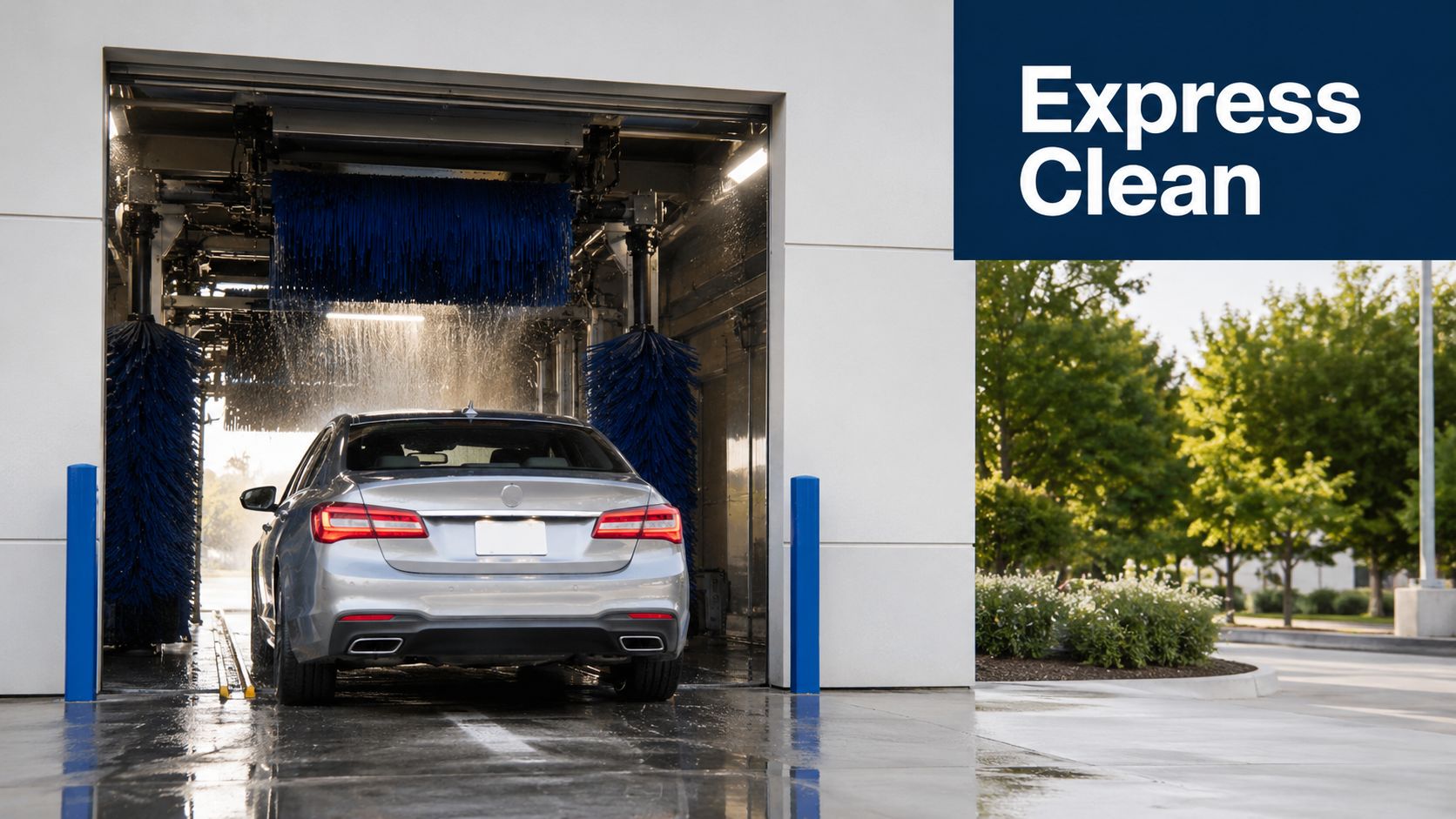
An Express Auto Wash is basically a drive-thru for your car. You line up, your vehicle is guided onto a conveyor, and the tunnel moves it through a series of automated cleaning stages. Soap goes on, brushes or cleaning materials remove grime, rinse systems clear everything away, and blowers help dry the surface before you exit.
Why it's called express
The key difference is speed. According to Superoperator's overview of express car wash technology, these systems typically clean a vehicle in 3 to 5 minutes from entry to exit, while traditional methods can take 10 to 15 minutes. Premium packages can extend the process to 6 to 8 minutes.
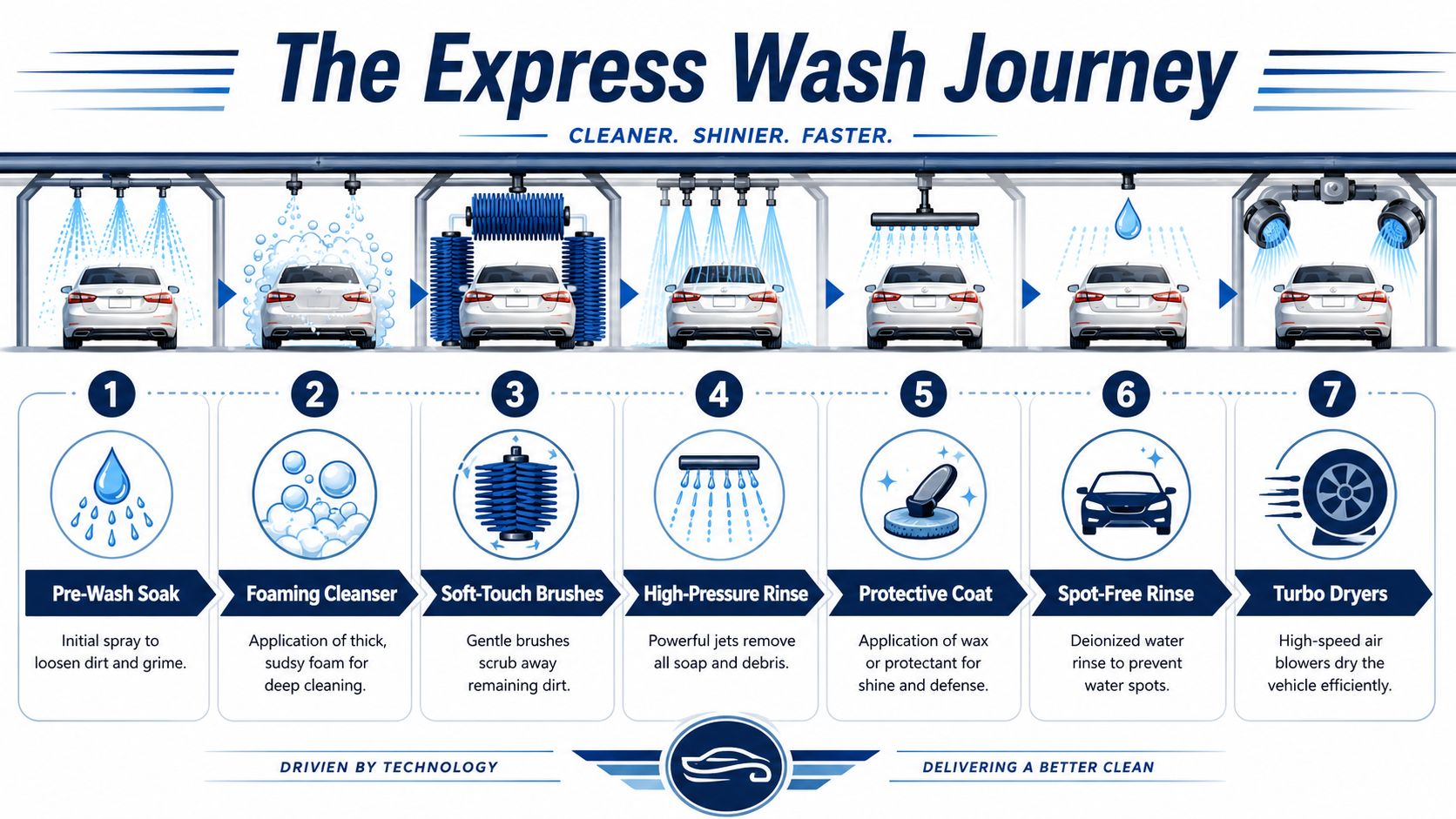
That speed doesn't happen by accident. The tunnel is designed like a well-timed assembly line. Each station has one job. Pre-soak loosens grime. Foam helps lift dirt. Brushes or contact systems agitate the surface. Rinse arches clear residue. Dryers finish the job. The conveyor keeps the timing steady so every part works in sequence.
What drivers often get confused about
A lot of people hear “automatic wash” and picture something basic or rough. Modern express systems are more organised than that. The whole point is consistency. You're not relying on whether someone has enough time that day to do a careful exterior clean. The equipment follows the same process each time.
Three details help people understand the format:
- You stay in the vehicle. That makes it easy for errands, work breaks, or quick stops between trips.
- It focuses on the exterior. An express wash is for routine outside cleaning, not a full interior reset.
- You can repeat it often. That's one of the biggest reasons busy GTA drivers use it.
The express model isn't trying to replace every car-care service. It's trying to remove the biggest barrier to regular washing, which is time.
Why automation matters for frequent users
If you wash often, predictability matters as much as shine. You want to know roughly how long the stop will take and what kind of result you'll get. That's especially useful for drivers who can't afford long downtime between pickups, appointments, or deliveries.
In plain terms, an express auto wash works because it removes friction. You don't need a free afternoon. You just need a few minutes and a dirty car.
A Look Inside the Tunnel What Is Included
Once your car rolls onto the conveyor, the wash tunnel starts to feel less mysterious and more like a choreographed cleaning routine. Each stage has a specific job. The concept is similar to washing your hands properly. Wet first, add soap, scrub, rinse, then dry. The tunnel applies the same logic to a much larger object.
The basic wash flow
A standard express package usually includes the essentials needed to remove everyday road film.
Pre-soak
This first spray helps loosen dirt, salt, and grime clinging to the paint.Foam bath
The soap stage adds lubrication and starts lifting debris off the surface.Cleaning action
Brushes or tunnel materials work over the exterior to remove what the pre-soak loosened.Rinse cycle
Water clears away soap, loosened grit, and remaining residue.Drying agent and air blowers
The tunnel finishes with products that help water sheet off, followed by strong blowers.
That's the core of the experience. Quick, repeatable, and designed for routine upkeep.
The upgrades people actually notice
Menu boards can get confusing. Names like Triple Foam Wax, Hot Wax, Sealer Wax, and Lava Foam sound dramatic, but they're easier to understand if you think of them as add-ons with different jobs.
- Underbody wash helps target the lower sections of the vehicle, which matters in a region where salt and slush collect underneath.
- Triple Foam Wax adds a visual, sudsy layer and supports surface protection.
- Hot Wax is usually chosen by drivers who want more shine and a smoother finish.
- Sealer Wax acts more like a protective top layer.
- Lava Foam is the colourful, high-visibility option that makes the tunnel look like your car drove through a bubble party.
Some drivers choose the basic package every time. Others alternate. A common habit is using a simple wash for maintenance and stepping up to a wax package when the car needs extra protection or a cleaner finish before an event, meeting, or weekend trip.
If your car faces salt, grime, and highway spray all week, the underbody and protective upgrades usually make more sense than purely cosmetic add-ons.
What about water use
This is one area where people often assume a tunnel wash must be wasteful. Many modern express tunnels are built differently. As noted in this description of tunnel water treatment and recycling systems, modern express car wash tunnels can include complete water treatment and recycling systems that reduce freshwater use from 40 to 100 gallons per vehicle in traditional washes down to 15 to 25 gallons by filtering and reusing water.
That doesn't mean every site operates the same way, but it does explain why the modern tunnel format is often discussed as a more organised and efficient way to handle repeat washing.
What your car experiences in real life
From the driver's seat, the whole thing feels fast. Spray hits first. Foam covers the windshield. The side brushes move in, rinse arches pass overhead, and then the dryers start roaring like a giant hair dryer aimed at your hood.
It's a short ride, but once you know what each stage is doing, the wash menu becomes easier to read. You stop guessing and start choosing based on what your vehicle needs.
The Smart Choice for GTA Drivers Who Benefits Most
Not every driver needs an express wash in the same way. For some people, it's a convenience. For others, it's operational equipment. In the GTA, where weather and road conditions can make a clean car look temporary, the value becomes obvious fastest for people who drive a lot.

The ride-hail driver
If you drive passengers around the city, the car isn't just transportation. It's your waiting room, your first impression, and part of the service people judge before they even sit down.
For high-frequency commercial drivers in Canada who need 3 to 5 washes monthly, paying $10 to $30 per wash can eat into margins, according to this industry discussion about wash memberships in Canada. That's why flexible wash plans matter so much. A driver who washes often doesn't need a luxury experience every visit. They need a clean exterior, a quick in-and-out stop, and predictable costs.
The fleet manager
A small business fleet has a different problem. One dirty van doesn't look great. Five dirty vans look disorganised. Service companies, couriers, and contractors all send a message with vehicle appearance, whether they mean to or not.
An express wash suits fleets because it simplifies repeat maintenance:
- Less downtime: Drivers can fit washes into active workdays.
- More consistency: Vehicles don't swing wildly between spotless and neglected.
- Easier budgeting: Wash use can be planned instead of handled one muddy emergency at a time.
If you're also trying to improve how local customers find your business online, tools like seo software for local businesses can help with visibility while your vehicles handle the on-road side of the brand. One works on the search results. The other works in the parking lot.
The busy family with an SUV
Families use their vehicles like mobile base camps. School runs, hockey bags, grocery hauls, muddy boots, weekend errands. An SUV can go from clean to chaotic in no time, especially around the wheel wells and tailgate area.
The express format works here because it doesn't ask for perfect planning. You can squeeze in a wash between errands, after a cottage run, or before visiting people you'd rather not greet with a car wearing a crust of winter salt.
A fast wash isn't only about vanity. It's often about keeping up with a vehicle that gets used hard and often.
The common thread
These drivers all have different schedules, but the same core need. They can't treat washing like a special occasion. They need a system they can return to regularly without wasting time every single visit.
That's where the express model stops feeling like a nice extra and starts feeling like basic maintenance.
Decoding Express Wash Pricing and Memberships
Pricing makes more sense once you match it to how often the vehicle gets dirty.
For a driver who washes once in a while, paying per visit is straightforward. For a Brampton commuter dealing with slush every week, a Mississauga ride-hail driver trying to keep a car presentable between fares, or a fleet manager watching several vehicles collect salt and grime at the same time, the better question is different. How much time and money does regular washing cost over a month if you keep starting from zero every visit?
That is why express wash pricing usually comes in three lanes. Single washes for occasional use. Bundles for drivers who want some savings without a monthly plan. Memberships for high-frequency users who need the car cleaned often enough that the routine matters more than the individual transaction.

When a membership makes sense
A membership works like a transit pass for your car. If you only use it once in a while, the value is limited. If you use it regularly, the cost per use drops and the decision gets easier.
That matters a lot in the GTA. Winter salt, spring rain, highway spray, and construction dust can make a clean car short-lived. High-mileage drivers feel that first. Ride-hail drivers need a car that looks cared for when passengers open the door. Fleets need vehicles that reflect the business without creating constant approval requests for one-off wash expenses.
In those cases, an unlimited plan is not just about saving a few dollars on soap and water. It helps control two things busy operators care about every week. Cost predictability and downtime.
Quick pricing logic
| Wash option | Best fit | Cost style | Why people choose it |
|---|---|---|---|
| Single wash | Occasional users | Pay per visit | Simple, no ongoing commitment |
| Multi-wash bundle | Semi-regular users | Prepaid savings | Better value without a monthly plan |
| Membership | Frequent users | Lower effective cost per wash | Predictable routine and better long-term value |
Why recurring plans appeal to high-frequency drivers
If you drive all day, the hidden cost is not only the wash price. It is the repeated stop-and-decide cycle. Every dirty day becomes another small choice, another receipt, another delay.
Memberships remove much of that friction. You already know the car can be washed. You already know what it will cost this month. For owner-operators and fleet supervisors, that kind of predictability is easier to manage than a string of scattered purchases.
Retail businesses use the same logic in customer retention programs. If you want a simple example from another category, the cost of BonusQR loyalty shows how recurring plans are often structured around repeat use and predictable value.
One local example
One GTA option is Nanak Car Wash, which offers one-time washes, prepaid bundles, and monthly wash memberships alongside detailing and rust proofing. For drivers who return often, having those choices in one place makes it easier to pick a routine that fits the vehicle's workload instead of guessing every time.
Express Wash vs Detailing Choosing the Right Clean
A lot of drivers mix up washing, full-service cleaning, and detailing. That's understandable because all three involve making the car look better. But they solve different problems.
The simplest way to think about it is this. An express wash is your regular shower. Detailing is a deep spring clean. Rust proofing is preventative maintenance.
Choosing the right tool for the job
If the outside of your vehicle is covered in road grime, an express wash is the quick answer. If your cup holders are sticky, the floor mats are a mess, and there's salt ground into the carpet, you've moved into full-service or detailing territory.
Canada's car wash and auto detailing industry is projected to reach $1.7 billion in 2026, with a 3.5% compound annual growth rate since 2021, according to IBISWorld's industry profile. That tells you demand is strong across different service types, not just one.
Choosing Your Car Care Service
| Service | Best For | Time Required | Typical Cost |
|---|---|---|---|
| Express wash | Frequent exterior maintenance | Short | Lower-cost routine option |
| Full-service wash | Exterior cleaning plus light interior refresh | Moderate | Mid-range |
| Detailing | Deep interior and exterior restoration | Longer appointment | Higher than routine washing |
| Rust proofing | Preventative protection in salt-heavy conditions | Appointment-based | Separate specialised service |
How to decide without overbuying
Use this simple filter:
- Choose express wash when the car is dirty outside and you need a quick reset.
- Choose full-service when the exterior is dirty and the cabin needs a light tidy-up.
- Choose detailing when stains, odours, salt buildup, or neglected surfaces need serious attention.
- Choose rust proofing when your goal is protection against Ontario's harsh seasonal conditions.
The wrong service isn't always bad. It's often just inefficient. A detail is overkill for light road film, and an express wash won't fix salt ground into carpet.
Why these services work together
Drivers often treat these options like rivals when they're really teammates. A good routine might involve regular express washes, occasional interior cleaning, and a booked detail when the vehicle has fallen behind.
If you run a detailing business or manage one, operational guides like optimizing auto detailing operations can be useful for thinking through scheduling, customer flow, and service delivery. On the customer side, the lesson is simpler. Match the service to the mess.
FAQ and Pro Tips for Your Nanak Car Wash Visit
You finish a shift, glance at the car, and see the usual GTA mix of salt dust, spray, and road film. The outside looks tired, but your schedule is tighter than your parking spot. That is where a good express wash routine helps. It works like a drive-thru for your car. You stay efficient, the vehicle stays presentable, and buildup never gets a chance to settle in for long.
For frequent drivers, the goal is not chasing a perfect showroom finish every visit. The goal is staying ahead of the mess. That matters for ride-hail drivers, delivery drivers, and fleet managers because a lightly dirty car is easy to reset, while a heavily neglected one takes more time, more money, and sometimes a different service altogether.
Common questions
Are express washes safe for paint?
Yes, for routine exterior cleaning, provided you use a professional wash and follow the entry instructions. If you are unsure about mirrors, antennas, or accessories, ask the staff before you roll in.
How often should I wash in winter?
Wash based on what the roads are doing. In a GTA winter, that often means washing more often because salt and slush keep coming back. High-mileage drivers usually benefit from a repeatable routine rather than waiting until the vehicle looks rough.
Should I pay for extras like wax or underbody service?
Choose add-ons based on exposure. If the vehicle sees highway spray, salted roads, or long daily routes, protection-focused options can make sense. If you only need a quick exterior reset before your next pickup, a basic package may do the job.
Pro tips that make the visit smoother
- Go with a plan: Decide before you arrive whether today is a quick rinse-and-reset or a protection visit.
- Wash before grime hardens: Fresh salt and road film are easier to remove than layers that have been sitting for days.
- Use quieter times if your schedule allows: A short stop feels even shorter when the line is light.
- Add a quick interior reset after the wash: If vacuums are available, use them for mats, crumbs, and loose dirt. Two extra minutes can make the whole car feel newer.
- Check your closest location before leaving: That small step helps busy drivers fit a wash between errands, school runs, or shifts.
Here is the simple rule. The more often you drive, the more valuable consistency becomes.
That is why unlimited wash plans appeal to frequent users. If you are washing one car often for work, or keeping several vehicles clean across a small fleet, the membership model can turn car care into a predictable routine instead of a recurring decision. You spend less time debating whether today is worth it and more time keeping the vehicle ready for customers, passengers, or the next route.
A smart wash habit keeps dirt from becoming a bigger job.
If you have been delaying a wash because it felt like another errand, the express format usually removes that friction. It is fast enough for weekdays, easy for first-timers, and practical for drivers who need clean vehicles over and over.
If your vehicle picks up GTA salt, road film, or daily grime faster than you can keep up, Nanak Car Wash is worth a look. As noted earlier, you can compare wash options, check locations, and decide whether a single wash or an unlimited plan fits how often you drive.

 6600 Finch Ave W, Etobicoke, ON M9V 3Z6
 647-703-8515
 MON – SUN 8 AM to 7 PM