
The laundry chair has become a piece of furniture. It started with one hoodie, then a couple of towels, then that mystery sock that somehow survives every clean cycle. Now it's a soft mountain in the corner of the room, and your weekend is being held hostage by sorting, washing, drying, folding, and trying to remember which shirts can't go near heat.
That's where full service laundry starts to feel less like a luxury and more like a life-hack. It's comparable to a meal kit service for your clothes. You hand off the prep and repetitive work, and clean, ready-to-wear results come back to you without the usual mess taking over your day.
Most guides stop at price and speed. Useful, yes, but incomplete. If you live in the GTA and care about convenience, fabric care, and what happens to all that water and detergent after your clothes are cleaned, there are smarter questions to ask.
Table of Contents
- The End of Laundry Day As You Know It
- What Exactly Is a Full Service Laundry
- The Full Service Experience From Start to Finish
- Full Service Laundry vs The Alternatives
- How to Choose the Right Laundry Service in Your Area
- Your Top Laundry Questions Answered
The End of Laundry Day As You Know It
Laundry has a sneaky way of stealing time in tiny chunks. A load goes in, then you forget it. You restart it. Then you wait for the dryer, fold half the pile, and leave the fitted sheet for “later”, which is usually code for never.
For a lot of people, the problem isn't washing clothes. It's the mental clutter around washing clothes. You're tracking darks, lights, delicates, workwear, gym gear, bedding, and that one sweater you're afraid to ruin. It's like running a tiny fabric logistics company out of your hallway.
Full service laundry changes the job. Instead of doing every step yourself, you hand the routine to a provider that picks up, cleans, folds, and returns your items ready to put away. Your role shifts from “weekend laundry manager” to “person who opens the door and receives clean clothes”.
Practical rule: If laundry keeps rolling into the next day, the issue usually isn't discipline. It's that the task has too many steps.
That's why the appeal is bigger than convenience alone. You reclaim time, reduce decision fatigue, and stop building your week around machine cycles. Parents use it to stay ahead of school uniforms. Condo residents use it to avoid fighting for shared machines. Busy professionals use it because they'd rather spend an evening cooking, working out, or doing absolutely nothing.
And if you care about sustainability, there's another layer. A lot of people want easier laundry, but they also want to know how a provider handles water, detergents, and chemical discharge. That question doesn't get asked often enough.
What Exactly Is a Full Service Laundry
The easiest way to think about it
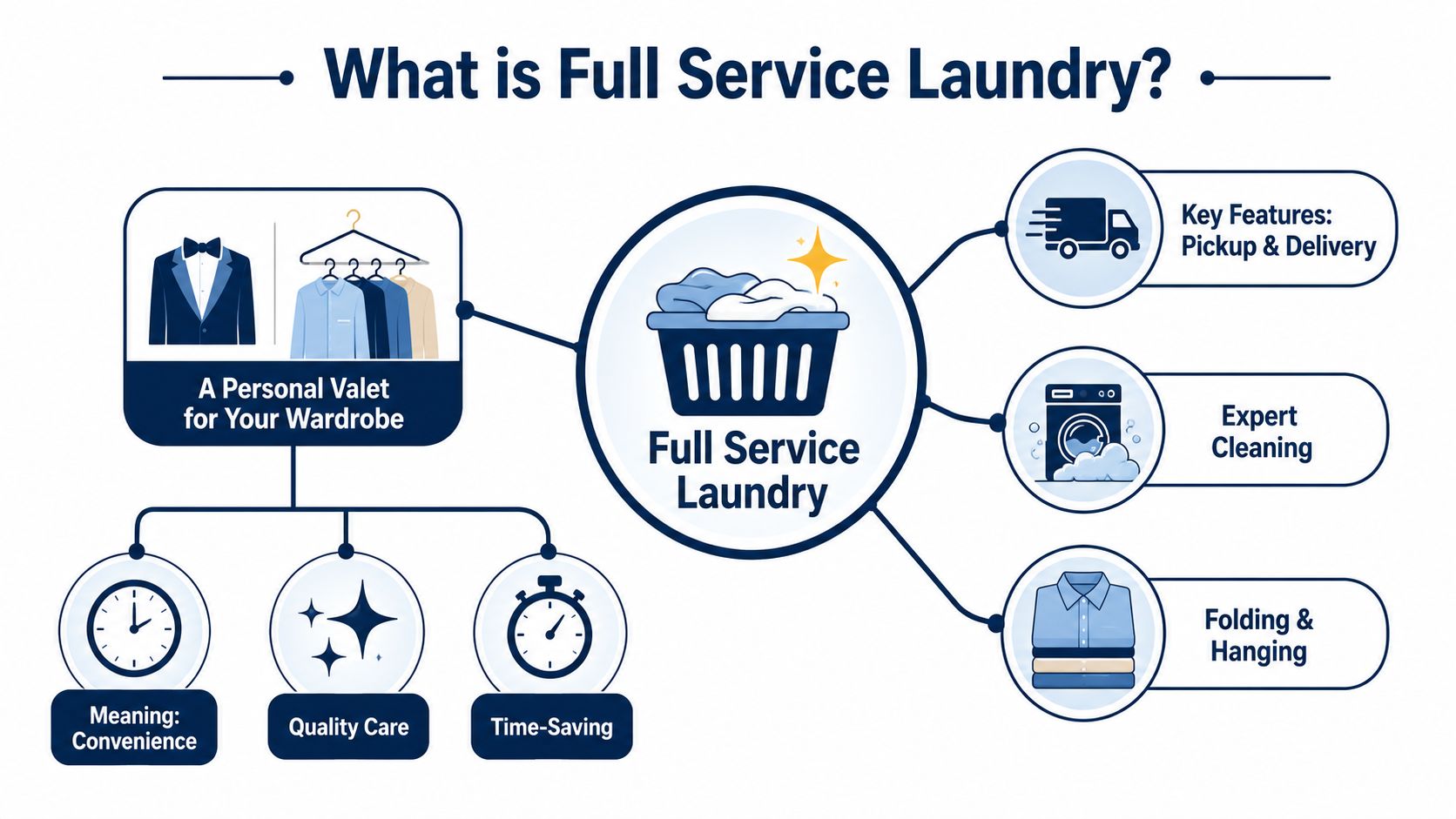
A full service laundry is a personal valet for your wardrobe. Not in a fancy, red-carpet way. In a practical, “someone else handles the repetitive bits” way.
It combines the parts of laundry that usually eat your time into one managed service. You schedule a pickup or drop-off. The provider sorts and cleans your clothes according to care needs. Then they fold, hang, or package everything and return it ready to wear or store.
That's what makes it different from using a machine at a laundromat. At a laundromat, you're still doing the labour. With full service laundry, you're outsourcing both the machine time and the human time.
Here's the big-picture version:
The four parts people usually mean
Most services bundle together four common categories.
Wash and fold
This is the everyday workhorse. T-shirts, joggers, towels, kids' clothes, socks, pyjamas, and basic household laundry usually land here. Items are washed, dried, folded, and packed so you can put them away quickly.Dry cleaning
This covers garments that need special solvent-based cleaning or more careful handling, such as suits, structured dresses, dress shirts, wool pieces, and some coats. If the label says the item needs extra care, dry cleaning is the appropriate service.Pickup and delivery
This is the convenience engine. Instead of carrying bags across town or waiting around in a laundry room, the service moves around your schedule. For many people, this is the feature that turns laundry from a chore into background admin.Special treatments
Some items need spot treatment, odour removal, stain attention, or handling based on fabric type. Think sports gear, bedding, table linens, or garments with specific instructions pinned to the bag.
Full service laundry works best when you treat it like a system, not a one-time rescue mission. Keep one bag for everyday wash and fold, and another for items that need special care.
People sometimes get confused about where the line sits between wash and fold and dry cleaning. A simple rule helps. If it's durable and lives in your regular wardrobe rotation, it's probably wash and fold. If the fabric, shape, or care label makes you nervous, ask before it goes in.
The Full Service Experience From Start to Finish
A good full-service laundry order should feel less like running an errand and more like handing off a meal kit. You do a little prep, someone else handles the messy middle, and the useful part arrives back ready to use.
It usually starts with a booking. Some services use an app or website. Others keep it simple with text or phone. You choose a pickup window, mention anything unusual, and leave your bag where the provider instructs. If that process feels confusing before the first pickup, it often stays confusing later, so this is a good moment to notice how organized the company really is.
In the GTA, some providers price wash-and-fold by the bag, and Harco industrial laundry benchmarks show attended self-serve bag pricing can vary widely. That matters because a cheap-looking rate is only useful if you also know what fits in the bag, how special-care items are handled, and whether delivery or detergent choices change the final bill.
If you're curious how service businesses organize routes, timing, and recurring appointments behind the scenes, it's useful to evaluate scheduling software for cleaners. It helps explain why some providers feel orderly and others feel like they are guessing.
After pickup, your clothes move into sorting. This is the part customers rarely see, but it shapes the result more than the machines do. Staff separate by colour, fabric, care label, and service type, then pull out anything that needs extra attention, such as delicates, stain treatment, or dry cleaning.
That sorting step also has an environmental side. An eco-conscious provider should be able to explain the basics of its process, such as whether loads are grouped efficiently, whether detergents are chosen with fabric and water impact in mind, and how they avoid over-washing items that do not need heavy treatment. Sustainability is not just about a green label on the website. It shows up in routine decisions, load after load.
Turnaround comes next. Wash-and-fold is often the fastest lane. Dry cleaning, stain work, and specialty items usually take longer because they need different handling and extra checks. Ask what “standard turnaround” means before your first order, and ask what can delay it. That saves the frustration of assuming next-day service when the provider means two or three days.
For a first order, a little prep goes a long way:
- Pull out obvious special-care items so everyday laundry does not get mixed with pieces that need gentler treatment.
- Add clear notes for air-dry garments, delicates, fragrance concerns, or anything you do not want washed in the usual way.
- Empty pockets so small items do not damage clothing or disappear into the system.
- Point out stains early because fresh information helps staff look in the right place.
- Ask about detergent and packaging options if lower-impact cleaning matters to you.
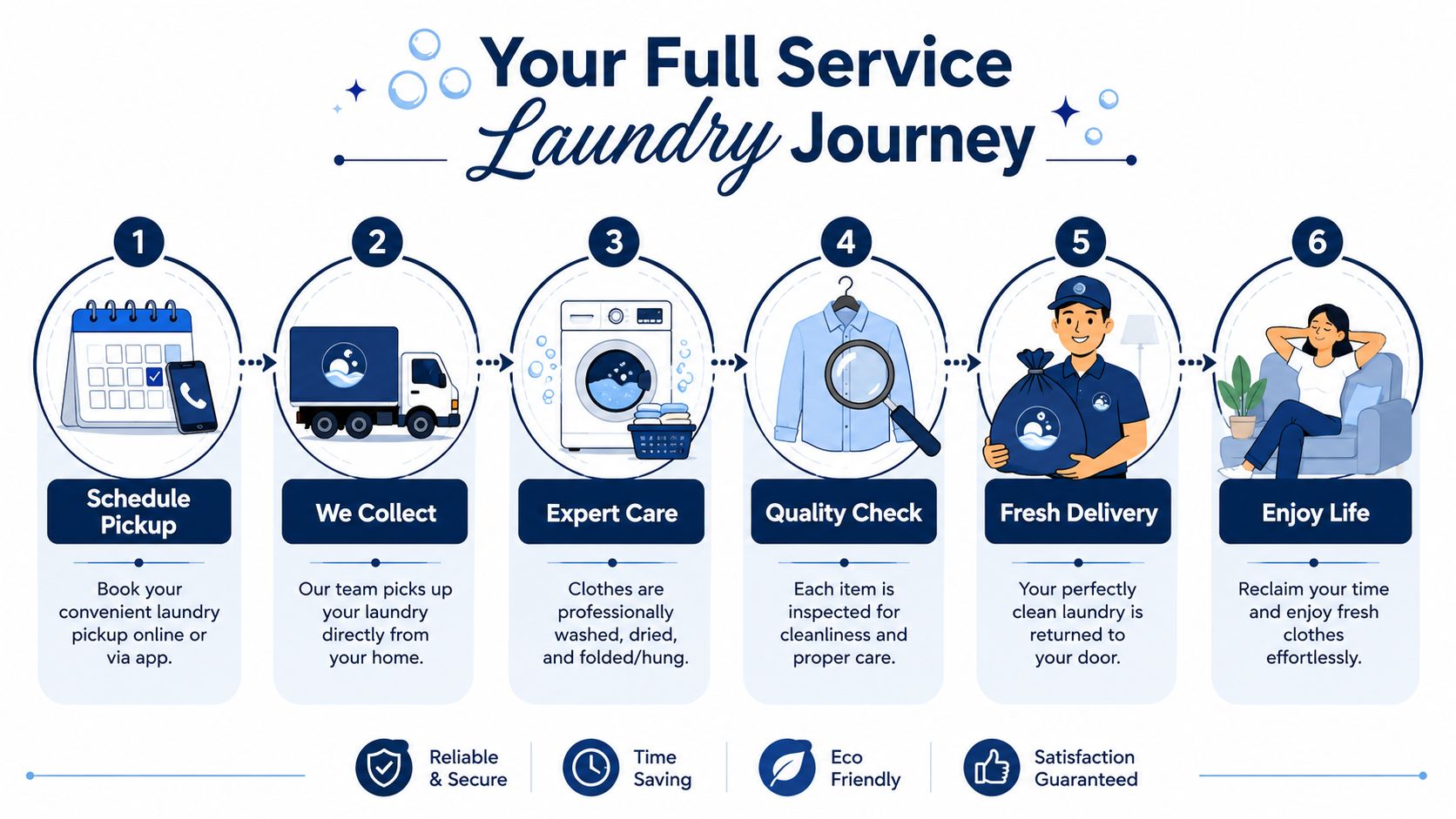
The return is where the time-saving becomes real. Clothes come back cleaned, folded, grouped, and ready to put away. Instead of giving up half a weekend to washing, drying, folding, and hunting for matching socks, you spend a few minutes packing a bag and a few minutes unpacking it later.
That is the full-service experience. It is not only about getting clean clothes. It is about removing a repeating task from your week, while choosing a provider whose process fits your standards for care, clarity, and environmental responsibility.
Full Service Laundry vs The Alternatives
Laundry options compared
Some people love doing laundry at home. Some tolerate it. Some would rather assemble flat-pack furniture in silence. The best option depends on what you value most: control, cost, convenience, or time.
| Factor | Full Service Laundry | DIY At-Home | Laundromat |
|---|---|---|---|
| Time investment | Low personal effort after booking and bag prep | Highest, because you handle every step | Moderate to high, because travel and waiting are still yours |
| Monetary cost | Usually higher upfront, but bundled with labour and convenience | Often looks cheapest, but you still absorb utilities, supplies, and your time | Mid-range, depending on machine use and transport |
| Convenience | Highest, especially with pickup and delivery | Good only if you have reliable machines at home | Lower, because you travel, wait, and carry loads |
| Quality of results | Often more consistent for folding, sorting, and garment handling | Depends on your machines, products, and patience | Depends on machine condition and how busy the location is |
| Equipment and supply costs | Included in the service | You buy detergent, maintain machines, and replace them eventually | You usually buy supplies and transport bags yourself |
Where each option wins
DIY at home wins when control matters most. You choose the detergent, the water temperature, the timing, and the exact way each item gets dried. That's useful if you have highly specific routines or just enjoy doing small household tasks on autopilot.
But DIY has hidden friction. Your machine can only handle so much. Drying takes longer than you think. Folding still waits at the end like a final boss. If your building has shared machines, the process gets even more annoying.
Laundromats can be efficient for bulky loads or homes without in-suite laundry. You get access to larger machines, and you can run multiple loads at once. The catch is that you still need to be present. You're carrying bags, buying supplies, waiting on cycles, and guarding your place like you're defending a campsite.
If you still have to spend your evening near a machine, you haven't really outsourced the chore. You've only changed the location.
Full service laundry makes the strongest case when your schedule is crowded or your tolerance for repetitive tasks is low. It's not the cheapest way to clean clothes in a narrow, dollars-only sense. It can be the best value when you count reclaimed hours, reduced hassle, and cleaner handoff between “dirty pile” and “ready to wear”.
This is also where quality can matter. Folding sounds minor until you realise that neatly returned laundry is far easier to put away than a basket of half-dry clothes collapsing in the bedroom corner.
How to Choose the Right Laundry Service in Your Area
Questions worth asking before your first order
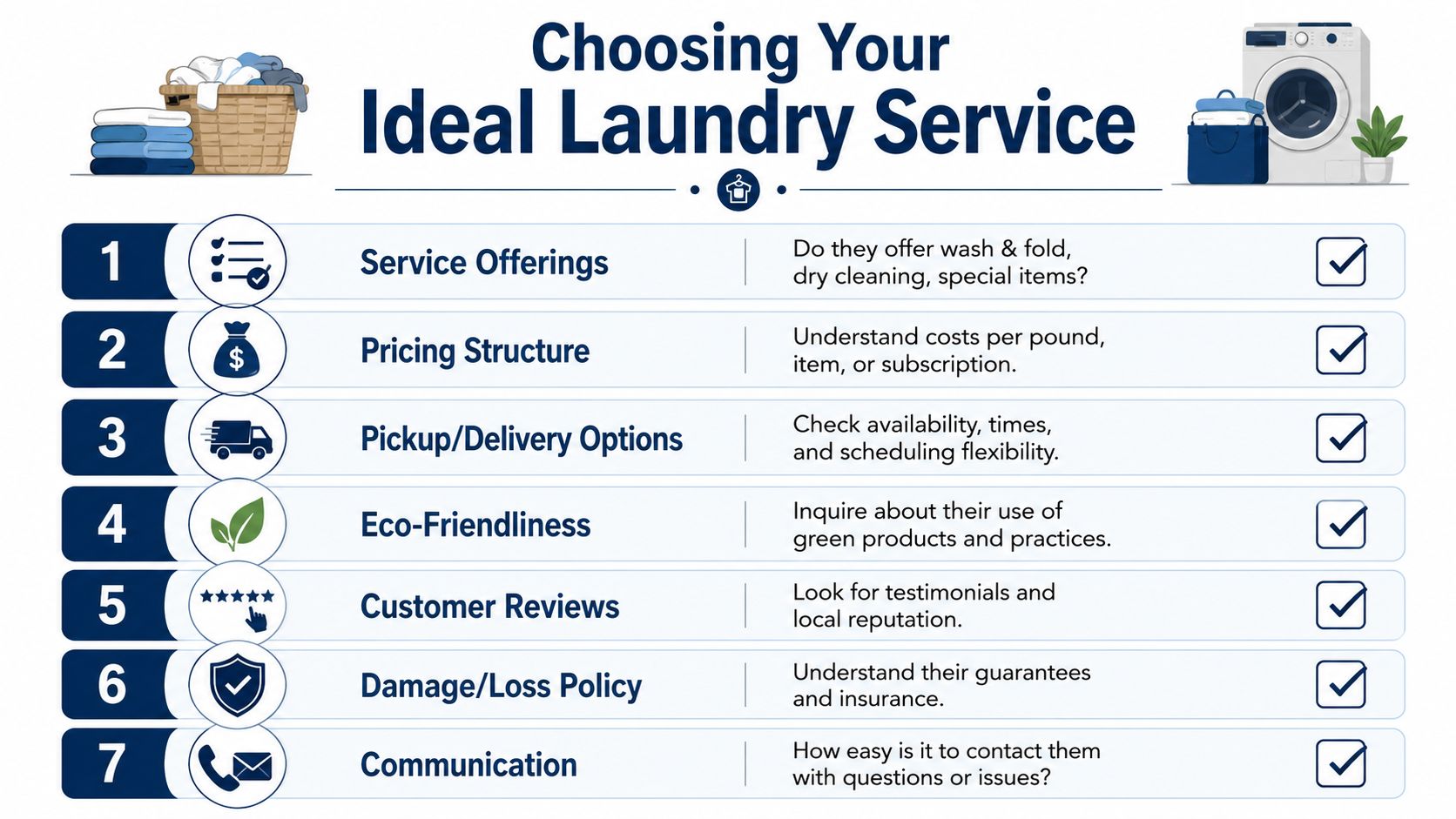
Choosing a provider isn't just about finding the lowest price. You're trusting someone with the clothes you wear to work, sleep in, exercise in, and sometimes panic-clean before guests arrive. Ask better questions and you'll avoid most bad experiences.
Start with the basics:
How is pricing structured
Ask whether the service charges by bag, by weight, by item, or by plan. You want clear wording on extras such as stain work, oversized items, delicate handling, or missed pickup fees.What's the turnaround promise
“Fast” means nothing. Ask what a standard order looks like and what happens if there's a delay.How are loss and damage handled
Every service should have a policy. If they can't explain it plainly, that's a warning sign.Can they accommodate skin or scent preferences
If you react badly to strong fragrances or need a gentler detergent, ask before booking.How easy is it to reach someone
A real customer support channel matters. If your clothes are late or a garment needs review, you shouldn't be shouting into a chatbot void.
If you run a home service business yourself, it's interesting to see how appointment-heavy companies handle incoming enquiries and missed calls. Tools that discover automated lead booking solutions show why some local service brands feel responsive from the first interaction.
The sustainability questions most people forget
This is the gap most shoppers miss. According to Cleaning Service Reviewed's Toronto laundry coverage, a critical underserved angle in full service laundry content is the lack of transparent information on sustainability practices and water usage among Toronto-area providers.
That matters because “eco-friendly” can be vague. A provider might use the word without explaining anything useful. Ask direct questions instead.
Try this checklist:
What detergents do you use
Ask whether they can explain the products in plain language and whether alternatives are available.How do you handle water use
Look for providers willing to discuss recycling systems, treatment steps, or efficiency practices in practical terms.Do you separate regular loads from special-care items
Good sorting protects fabrics and can reduce unnecessary rewashing.Are environmental practices documented anywhere
If the company talks about sustainability, they should be able to point to a policy, process, or operating standard.
A few red flags are worth taking seriously:
- Vague answers about how garments are processed
- No clear support channel for problems or special instructions
- Messy pricing language that makes extras hard to predict
- Reviews that repeatedly mention missing items, late orders, or poor communication
The right service should feel organised before they ever touch your clothes. If the booking process is sloppy, the back room probably isn't magical.
Your Top Laundry Questions Answered
Should you pre-treat stains before sending clothes out
Usually, you should at least flag them. A note on the bag or in the app helps staff spot the issue before the item goes through a standard cycle. If the stain is fresh, blotting it can help. Rubbing aggressively usually doesn't.
For expensive or sentimental items, mention what caused the stain if you know. Coffee, oil, makeup, and ink don't all behave the same way, and extra context can help the cleaner choose a safer approach.
How do services handle delicates and dry cleaning
The safest move is to separate anything that isn't ordinary day-to-day laundry. Bras, silk, wool, structured garments, embellished tops, and items with clear care labels should be identified before pickup.
A good provider won't guess. They'll route garments based on care needs and confirm instructions when something is unclear. If they act as if every item belongs in the same general process, keep looking.
Quick check: If a garment would make you nervous in your own dryer, don't toss it into a general laundry bag without a note.
What should eco-conscious customers in Toronto look for
Local rules matter, particularly in Ontario's commercial laundry sector, where full-service operations must adhere to the City of Toronto's Pollution Prevention Plan, which requires environmental monitoring for water discharge and chemical usage. The plan also requires pollution control measures such as closed-loop water systems or treatment before discharge to reduce contamination from detergents and bleaches entering municipal waterways, as outlined in the City of Toronto P2 Plan form for dry cleaners and commercial laundries.
For you as a customer, that means the best question isn't “Are you eco-friendly?” It's “Can you explain how you manage water discharge and chemical handling?” A serious provider should be able to answer that without sounding surprised.
What if you're worried about colours fading
Ask whether the item should be handled separately and whether the provider has any care guidance for dyed fabrics. You can also learn more about protecting colored garments with OxiClean if you want a practical overview of how colour-safe stain treatment is typically approached at home.
The simplest rule is to speak up early. Laundry services are much better at protecting garments when they know what matters to you. “Please keep this out of high heat” is a very useful sentence.
If reclaiming time feels good at home, it feels just as good for your car care routine. Nanak Car Wash serves drivers across the GTA with express and full-service washes, interior cleaning, detailing, and rust proofing, so you can keep your vehicle clean without turning it into another weekend chore.





 6600 Finch Ave W, Etobicoke, ON M9V 3Z6
 647-703-8515
 MON – SUN 8 AM to 7 PM