
Once the car is on the conveyor, an express wash takes about 5 to 10 minutes. The whole visit usually runs 15 to 25 minutes once you count the queue, the payment and the exit.
That gap tells the story. The machine lives up to the name on the sign; the lineup does not. Ontario recorded 8.8 million light-duty vehicle registrations in 2024, which is 35.9% of all Canadian light-duty vehicle registrations, according to Statistics Canada. That many cars competing for the same handful of wash bays on a Saturday morning tells you more about your wait than any conveyor speed ever will.
So treat a minute auto wash as two products sold together. One is a fast tunnel. The other is a queue you have to schedule around, and knowing which one you're buying turns the trip from a gamble into a decision.
Table of Contents
- How Long a Minute Auto Wash Actually Takes
- What Happens Inside an Express Tunnel
- Salt, Slush and the Add-Ons Worth Paying For
- How Much Water a Quick Wash Really Uses
- Minute Wash, Hand Wash or Waterless Compared
- Book Your Quick Wash Before the Weekend Rush
How Long a Minute Auto Wash Actually Takes
The conveyor is the fast part. From the moment the roller catches your front tyre to the moment the blowers cut out, an express tunnel runs 5 to 10 minutes, and that figure barely moves whether the lot is empty or jammed three deep.
Everything around it does move. Here's the arithmetic as I'd sketch it on the back of a receipt.
| Stage | Typical time | What happens |
|---|---|---|
| Queue at a quiet weekday entrance | 0-5 min | Car waits behind one or two vehicles |
| Queue on a Saturday or after snowfall | 10-20 min | Line backs onto the street at peak times |
| Pay and choose a package | 1-2 min | Card or cash at the kiosk, package selected |
| Time on the conveyor | 5-10 min | Presoak, foam, rinse, drying and air blowers |
| Exit and vacuum | 3-8 min | Drive out, vacuum if free vacuums are offered |
On a quiet Tuesday those rows total roughly 9 to 25 minutes door to door. On the Saturday after a snowfall the same rows read 19 to 40 minutes, and almost all of the extra time is a queue that has nothing to do with how fast the equipment is.
Why the sign and the clock disagree
A tunnel is engineered for throughput. Brushes, nozzles and blowers are timed to the second, and the whole line is built to keep cars rolling at a fixed pace. The queue is engineered by everyone else's schedule. Drivers cluster at the same obvious moments: Saturday late morning, the hour after a storm, the afternoon the salt finally dries white on the hood. Arrival time is the one variable you fully control, and it's worth more than any package upgrade on the menu.
The wash takes minutes. The waiting takes whichever minutes you handed over.
Three habits shave the visit down:
- Go mid-morning or mid-afternoon on a weekday. The school run is finished, lunch traffic hasn't formed, and the tunnel runs at its design speed rather than stop-start.
- Have a card or exact change ready before you reach the kiosk. Payment is 60 seconds of your visit if you're organised and five if you're digging through a console.
- Budget 20 minutes for a Friday evening wash. That's the realistic window when commuters and weekend planners collide, and it beats arriving at 5:45 expecting to be home by six.
If the car must be ready in under half an hour, an express tunnel is the right call. If you have a free morning and the paint needs genuine work, a detail earns its hours.
What Happens Inside an Express Tunnel
From the driver's seat, a tunnel is a strange, slow, loud ride. You sit in neutral with your hands off the wheel while machinery works its way from the front bumper to the rear glass, and a minute auto wash feels less like driving and more like sitting inside a very orderly rainstorm.
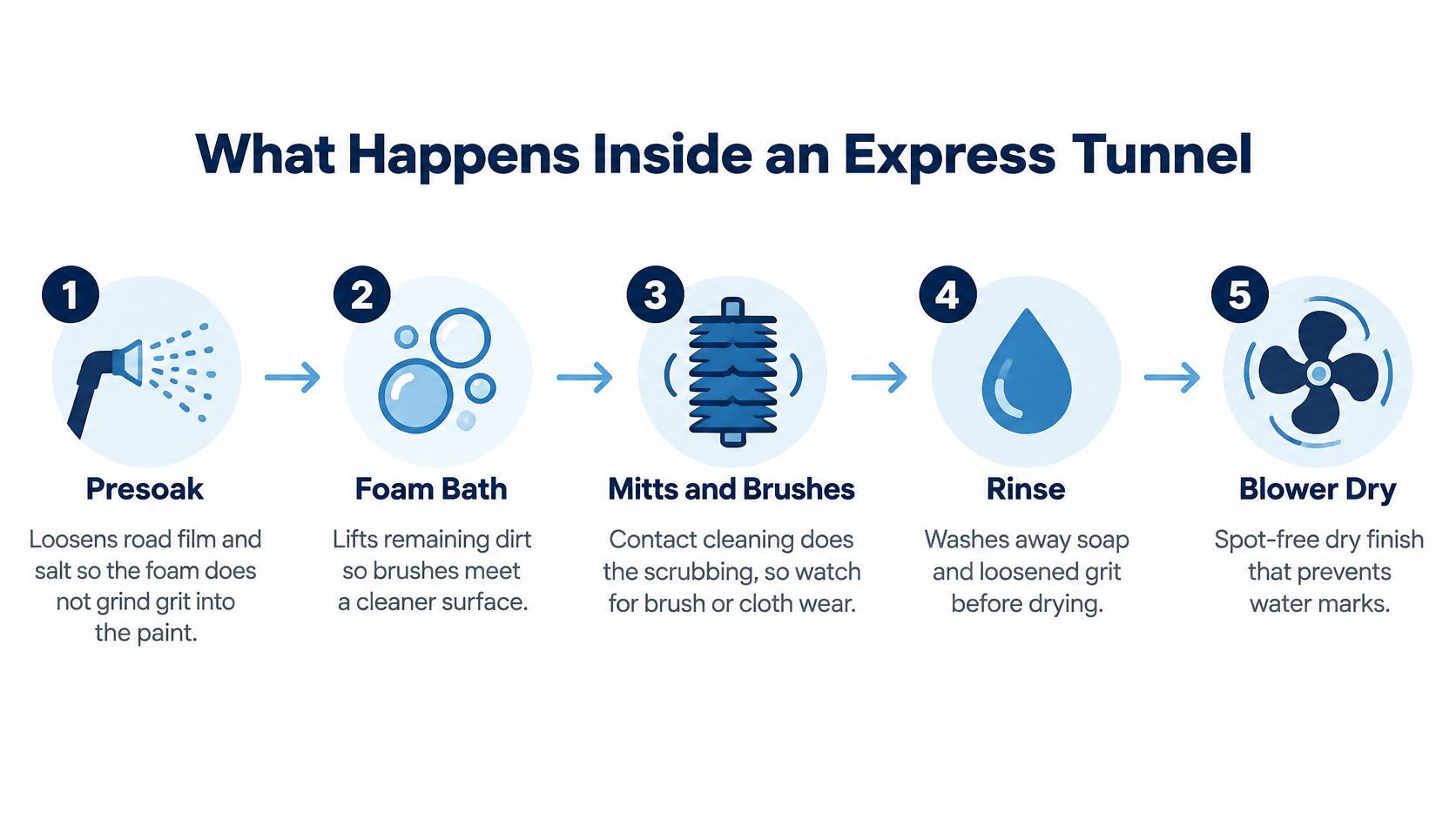
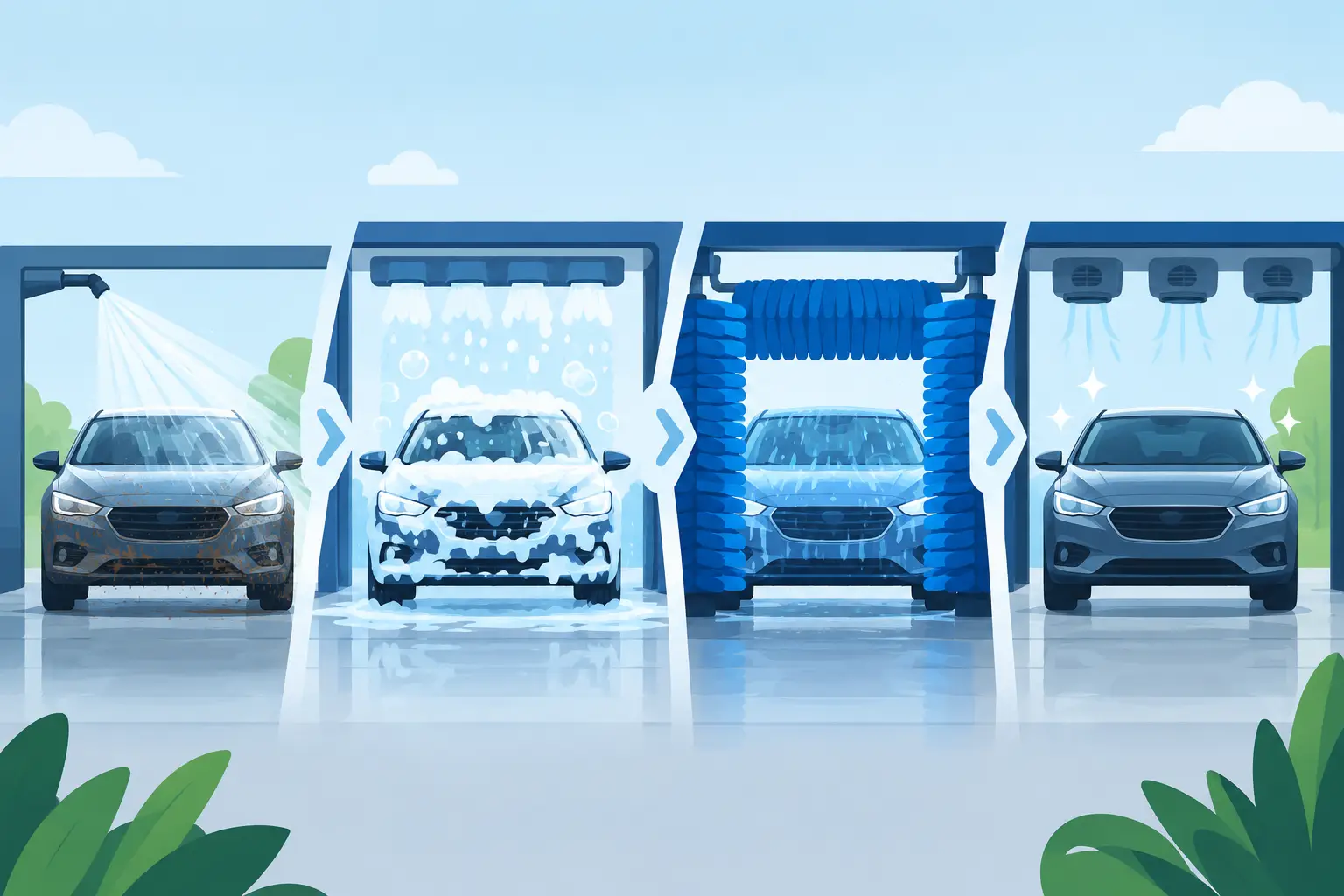
Here's the sequence, and the reason each stage exists.
- Presoak. A detergent spray hits the panels before anything touches them, loosening road film, bug residue and dried salt. The point is to float grit off the paint so the brushes meet a wet, slippery surface instead of dragging debris across the clear coat.
- Foam bath. Thick foam clings to vertical panels and wheels, giving the chemistry time to lift what the presoak loosened. The colour is theatre; the dwell time is the working part, and a tunnel that rushes it will leave a film behind.
- Mitts and brushes. Soft cloth or closed-cell foam does the actual scrubbing, which is where a tunnel either protects paint or dulls it. Watch the material as you roll in. Frayed, matted or grit-loaded brushes are the source of swirl marks, and well-kept equipment looks clean and uniform.
- Rinse, including the underbody. High-pressure water carries away soap and loosened dirt, and a separate underside pass sprays wheel wells, rocker panels and chassis rails. It's the only stage most drivers never see, and the one that matters most in February.
- Drying agent or wax. A hydrophobic layer makes water bead so the blowers can finish the job. Triple foam wax, hot wax and sealer are the usual upgrades, and they add shine and a little protection rather than cleaning.
- Air blowers. A wall of air pushes the remaining water off panels, mirrors and glass. It's the loudest minute of the ride and the reason a good tunnel hands you back a dry car instead of a streaked one.
Before You Roll In
- Fold the mirrors in on any tunnel with close-riding side brushes.
- Retract the antenna and remove anything magnetic or clamp-on, including phone mounts and driveway passes.
- Close everything. Windows, sunroof, vents on recirculate. Water finds the one seal you forgot.
- Check the roof. Loose trim, bike carriers and bolt-on crossbars are the parts tunnels break.
- Car in neutral, feet off the pedals, wipers off. The conveyor does the moving, and braking against it is what jams the line.
A good pass leaves panels free of streaks, wheels mostly clean and door seals dry. If the glass is still spotted at the exit, the rinse water or the blower alignment needs attention, and that's worth mentioning to staff rather than scrubbing off at home.
Salt, Slush and the Add-Ons Worth Paying For
Road salt doesn't eat steel directly. Chloride brine lowers the electrical resistance of the moisture sitting on a panel, which lets the electrochemical reaction that turns iron into rust run faster. An NSERC-supported Canadian research project attributes approximately 50% of vehicle corrosion to road salts (NSERC project record).
The exposure is not subtle. Ontario organisations reported using 1,679,395 tonnes of road salt and salting 104,187 kilometres of road in the latest figures published by Environment and Climate Change Canada. Freeze-thaw cycles do the rest, because melting snow re-wets the salt deposits packed around rocker panels, brake components, seams and the undercarriage, and each re-wetting restarts the reaction.
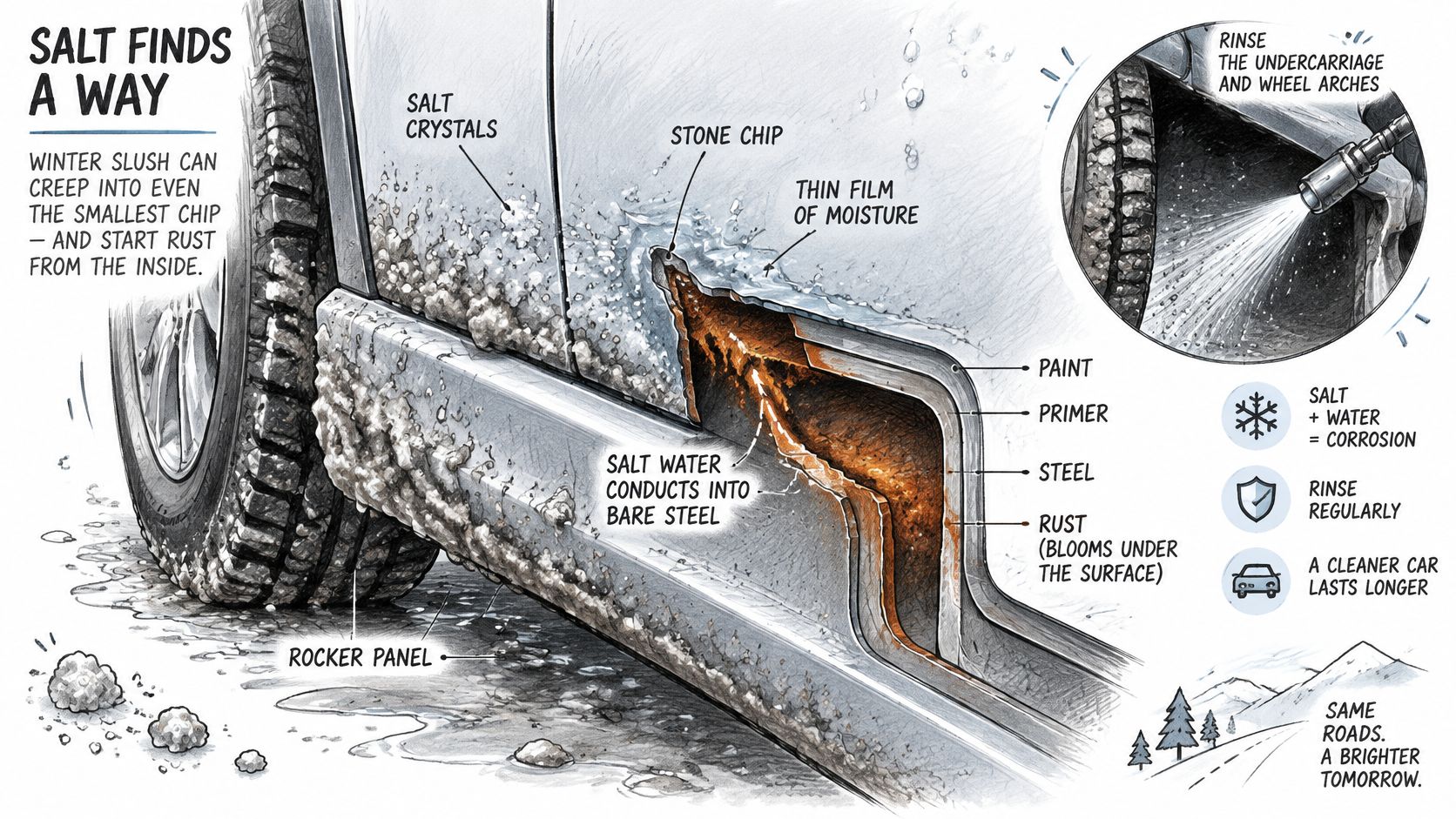
That splits the add-on menu cleanly in two.
Protective add-ons remove the chloride. An underbody rinse that reaches wheel wells, rocker-panel undersides and chassis surfaces is the only upgrade on the list that physically takes salt away from the places it corrodes.
Cosmetic add-ons change how the car looks. Hot wax, sealer and triple foam wax leave a glossy, water-beading finish, and none of them dislodge brine from a seam. Wax is the lipstick of car care. It makes a real difference to appearance and almost none to corrosion once salt is already sitting in a crevice.
Rust proofing belongs in this conversation as a complement, not a replacement. A coating adds a barrier, but salt-laden moisture trapped before the coating went on keeps working underneath it, around chips and behind damaged areas.
Practical rule: wash on conditions, not on a calendar. Visible salt on the rocker panels, or a thaw that turns the road into brine, means wash now, and pay for the underbody pass while you're there.
Priority differs by driver, so match the spend to the use:
- Ride-hail and delivery drivers rack up slushy kilometres daily and should treat the underbody rinse as standard, not an occasional treat.
- Pickup and commercial owners carry road spray onto the frame and rear arches, so they get the most value from a targeted underside spray after every storm cycle.
- Garage-kept leased cars see less brine and less time parked wet, so a prompt wash after a thaw covers most of the risk without extra add-ons.
How Much Water a Quick Wash Really Uses
Water use per vehicle is the clearest number a driver can ask about, and the spread between setups is enormous.
| Wash setup | Litres per vehicle | What drives the number |
|---|---|---|
| Automatic with water recycling | under 30 | Filtration and well-kept recycling loops |
| Well-maintained, no recycling | about 60 | Fresh water used on every car |
| Poorly maintained or non-recycling automatic | over 300 | Leaks, misaligned nozzles and long spray times |
| Average commercial wash (heated water) | about 260 | Heating water, the main energy load |
Read that table and the label on the sign stops meaning much. Automatic describes the machinery, not the water. The Capital Regional District water guide for vehicle wash operations puts a well-maintained facility without recycling at about 60 litres per vehicle, a recycling automatic at under 30 litres, and a poorly maintained or non-recycling automatic at over 300 litres.
The guide also cites Natural Resources Canada's estimate of roughly 260 litres of heated water for an average commercial wash, which reframes the whole issue. Heating water is a major operating load, so a wasteful tunnel burns gas as well as water, and a lean one saves both.
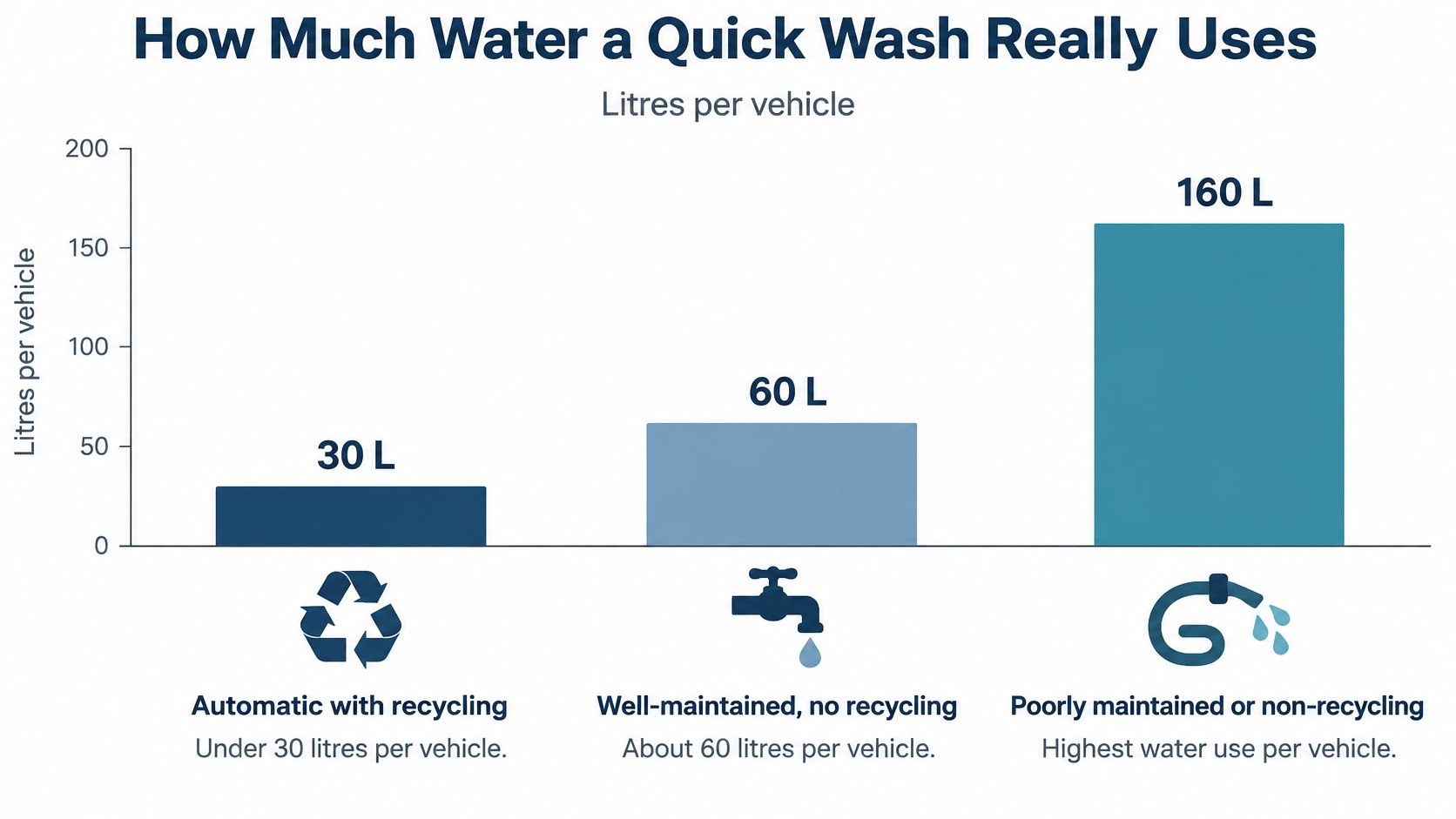
Three numbers worth asking about
Litres per vehicle, the percentage of recycled water, and heated-water energy per vehicle. An operator who tracks all three can tell you where they sit; one who tracks none is guessing, and the guess usually costs the customer in the end.
- Does the wash recycle, and at what rate? Filtration and loop maintenance decide whether recycling performs or just recirculates grit.
- Where does the wastewater go? Municipal guidance on car washing notes that wash water can carry grit, oil, grease and detergents, that it shouldn't enter storm drains, and that commercial wastewater generally needs treatment before it goes to the sanitary sewer, as set out in Calgary's car-wash bylaw guidance.
- Are meter readings logged by shift? Metered litres against vehicle counts is the cheapest diagnostic an operator has, and a sudden jump usually means a leaking valve or a misaligned nozzle.
Fresh water is not automatically the greener choice. Recycling cuts consumption but demands filtration, blowdown and contaminant management, so judge the whole system rather than the badge on the wall.
Nanak Car Wash states its washes use 100% fresh water, which makes treatment and metering the questions worth asking rather than the recycling percentage. A clean-looking car tells you nothing about where the water went.
Minute Wash, Hand Wash or Waterless Compared
Four options, four different jobs. Choosing on speed alone is how people end up disappointed with a perfectly good wash.
| Wash type | Typical time in bay | Best for | Watch out for |
|---|---|---|---|
| Express tunnel | 5-10 min | Commuters and ride-hail drivers | Brush or cloth contact, less detail work |
| Full-service hand wash | 30-60 min | Show cars and deep cleaning | Longer wait and higher cost |
| Waterless wash | 15-30 min | Light dust in apartment parking | Weak against heavy road salt |
| Self-serve bay | 15-25 min | DIY owners and oversized vehicles | Needs a steady hand and a meter timer |
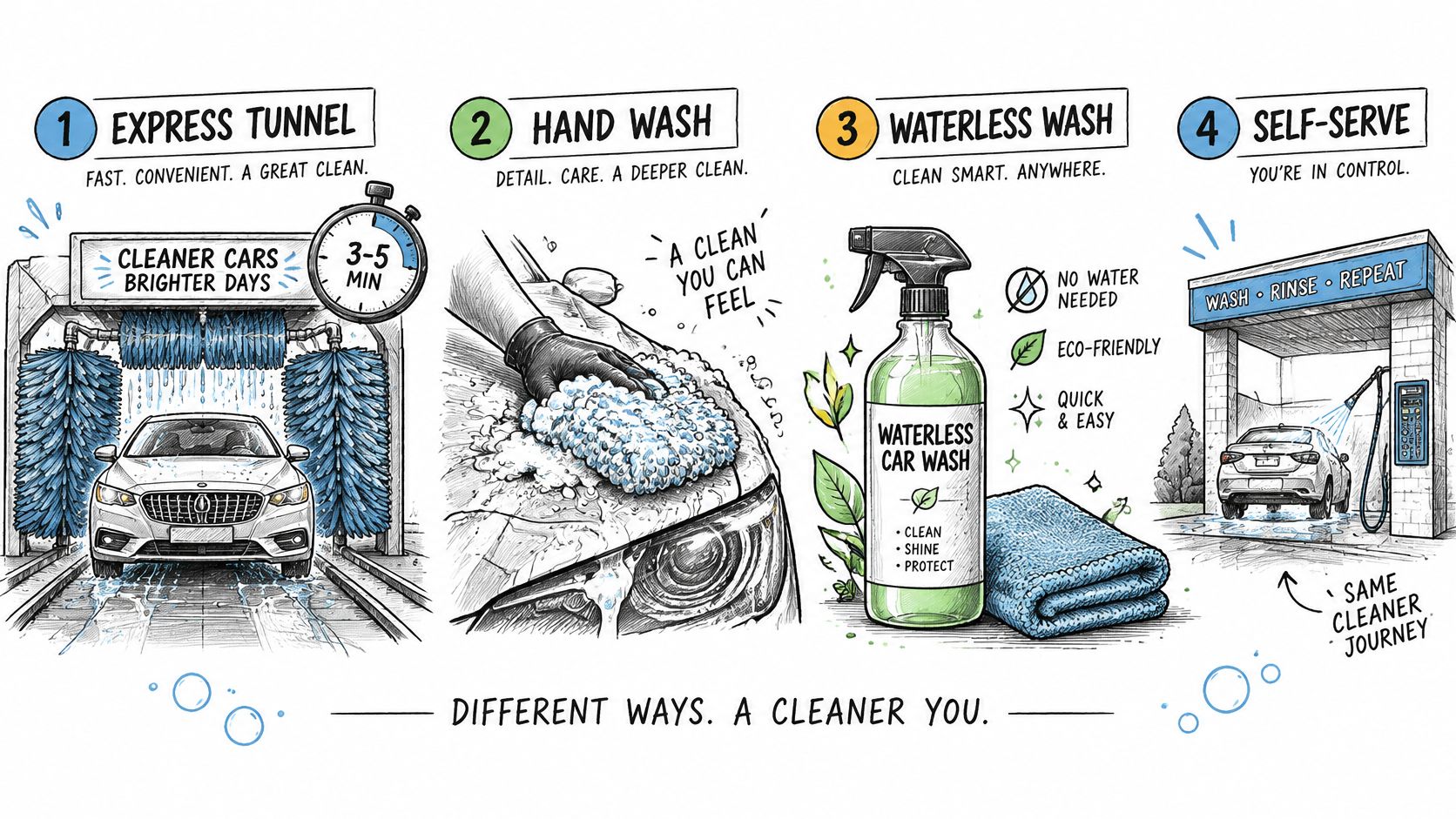
Volume explains why the express model spreads so fast. A typical Canadian car wash operation can use up to 304 million gallons of water per day, with approximately 38 to 50 gallons used per vehicle wash, according to 2025 reporting on Canadian car-wash operations.
Here's the verdict I'd give each driver:
- Ride-hail or delivery driver washing several times a week: express tunnel on a fixed rhythm. Frequency beats intensity when the car is a tool, and a repetitive tunnel visit keeps the paint consistent.
- Delivery van or small fleet: express for routine upkeep, with a hand detail booked every few months to deal with tar, door jambs and the interior.
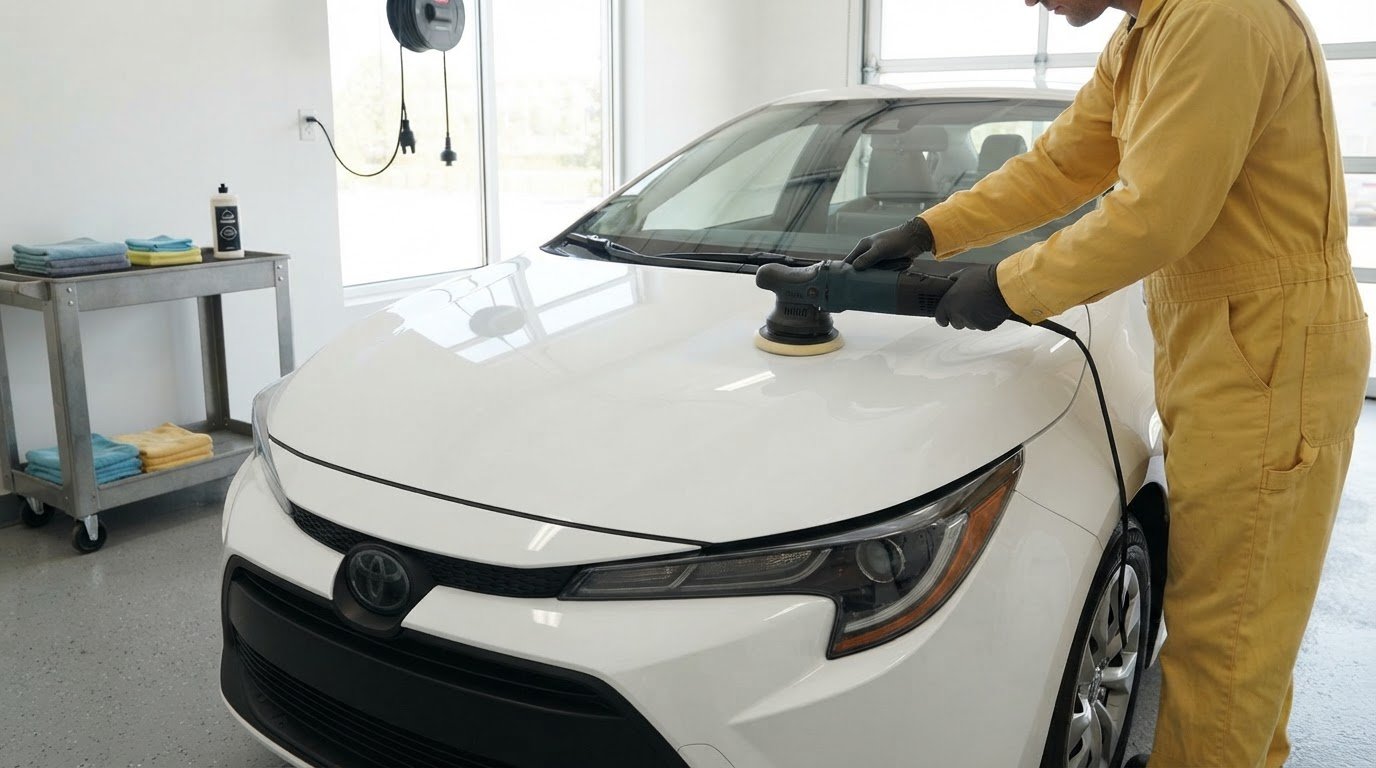
- Show car or fresh paint: hand wash. You're paying for controlled technique and individual attention on panels, glass and trim.
- Apartment dweller with light dust: waterless, done properly. It's the practical option when there's no hose and no drain. If you want the method done right rather than as a panic measure in a parking garage, APEX NANO's waterless cleaning advice covers the sequence and the mistakes that dull paint.
- Oversized pickup, van or lifted vehicle: self-serve bay, where you control the wand and the timer and nobody's brush is deciding your paint's future.
Check current package prices on the business site before you choose, because menus and tier names change faster than the equipment does. The car doesn't care which wash it gets. Your wallet and your queue position do.
Book Your Quick Wash Before the Weekend Rush
A two-minute check before you leave the driveway saves twenty at the entrance. Confirm three things on the Nanak Car Wash site first: current opening hours, what the express packages include, and whether your chosen location has free vacuums. Hours run Monday to Sunday from 8 AM to 7 PM, and free vacuums are available at participating Express Car Wash locations, so a location that lacks them changes how you plan the last five minutes of the visit.
Know what you're buying. Express packages start at $14.99 plus tax and include presoak soap, foam bath, rinse, drying agent and air blowers. That's the core tunnel cycle, and it's the correct baseline for a car that's washed regularly. The underbody pass is the upgrade worth adding when the roads are white with salt or a thaw has turned everything to brine, because it's the stage that removes chloride from the chassis.
Timing does the rest of the work. A weekday mid-morning or mid-afternoon slot keeps you out of the peak queue, and after a snowfall or a thaw, give yourself a longer window rather than assuming the tunnel's advertised pace applies to the parking lot. Choose the package by matching the road conditions you're driving in, confirm the location has the vacuums you want, then go.
Nanak Car Wash runs express and full-service washes, interior cleaning, detailing and rust proofing across the Greater Toronto Area, with locations in Etobicoke, Brampton, Concord, Oshawa, Sheppard, Burlington, Cambridge, Guelph and North York, so a salt-related wash is rarely far out of your way. Packages start at $14.99 plus tax and include the full tunnel cycle, with underbody and wax upgrades available when the roads demand them. Visit Nanak Car Wash to check hours, packages and your nearest location before the weekend queue forms.

 6600 Finch Ave W, Etobicoke, ON M9V 3Z6

 647-703-8515
 MON – SUN 8 AM to 7 PM