
Light smoke odour treatment in Canada starts at $179, while heavy, long-term restoration can cost $400 to $950, depending on severity and vehicle size. Complete smoke smell removal requires source-first cleaning, cabin-filter replacement, and ozone as a finishing step, not a quick spray or fragrance cover-up.
You finish a long shift, open the driver's door, and get hit by stale tobacco before you've even turned the key. The smell has settled into the seats, carpet, headliner, and vents, and every cold morning seems to bring it back. In the GTA, road salt, damp carpets, and sealed winter cabins give smoke residue plenty of places to hide.
Most DIY fixes only create a temporary illusion. Air fresheners, surface wipes, and a basic vacuum may make the car smell like artificial citrus for a day, but they don't remove the contamination feeding the odour. The practical approach is simple: remove loose residue, deep-clean porous materials, replace the cabin filter, then use ozone only after the interior is clean and dry.
If smoke has affected your vehicle and you're also dealing with broader damage or an insurance question, car damage claim assistance can help you understand what support may be available. For everyday odour problems, though, the answer starts inside the cabin.
Table of Contents
- Why Your Car Smells Like a Smoke Ring
- DIY Smoke Smell Removal Steps That Actually Work
- The Science Behind Deep Cleaning and Ozone Treatment
- When to DIY and When to Call in Professionals
- Nanak Car Wash Service Recommendations for GTA Drivers
- Making the Right Choice for Your Situation
Why Your Car Smells Like a Smoke Ring
A smoky car doesn't just smell bad in the air. Smoke residue clings to fabric fibres, seat foam, plastic trim, carpets, headliners, and HVAC pathways, then releases its odour whenever the cabin warms up or moisture rises.
That explains the familiar GTA experience. You clean the dashboard, hang a freshener from the mirror, and think the job is finished. Then the car sits outside overnight during a damp winter spell, the heater starts, and the old smell returns through the vents. The fragrance didn't fail. It never reached the source.
Ontario weather gives residue extra staying power
Ontario conditions make this problem stubborn. Winter salt and slush add moisture to floor mats and carpet edges, while closed windows reduce air exchange. Summer humidity can make upholstery and foam hold odours more aggressively. A vehicle that gets used for long shifts, school runs, or delivery work also receives repeated heat and moisture cycles, which keep embedded residue active.
Health Canada describes second-hand smoke inside a car as concentrated because a vehicle is a small enclosed space. Its guidance reports that 18% of Canadians said they'd been exposed to second-hand smoke in a car or vehicle during the previous month, while 96% of Canadians aged 15 and older believe smoking shouldn't be allowed in a car when children or youth are present (Health Canada's smoke-free home and car guidance).
Masking isn't remediation
A fragrance can overpower smoke for a short time. It can't clean the tar-like film on plastics, pull residue from seat foam, or clear contaminated air channels. Baking soda and charcoal may help absorb some ambient odour, but they're supporting tools, not a complete restoration plan.
The practical test: If the smell returns when you turn on the fan or heat, stop buying stronger air fresheners. The contamination is probably still in the HVAC system, filter, or soft materials.
Health Canada also notes that washing, shampooing carpets, and cleaning upholstery can help, but removing every trace of smoking is very difficult. That's why the right expectation matters. Light exposure may respond to disciplined cleaning, while years of smoking usually require professional extraction and deodorization.
DIY Smoke Smell Removal Steps That Actually Work
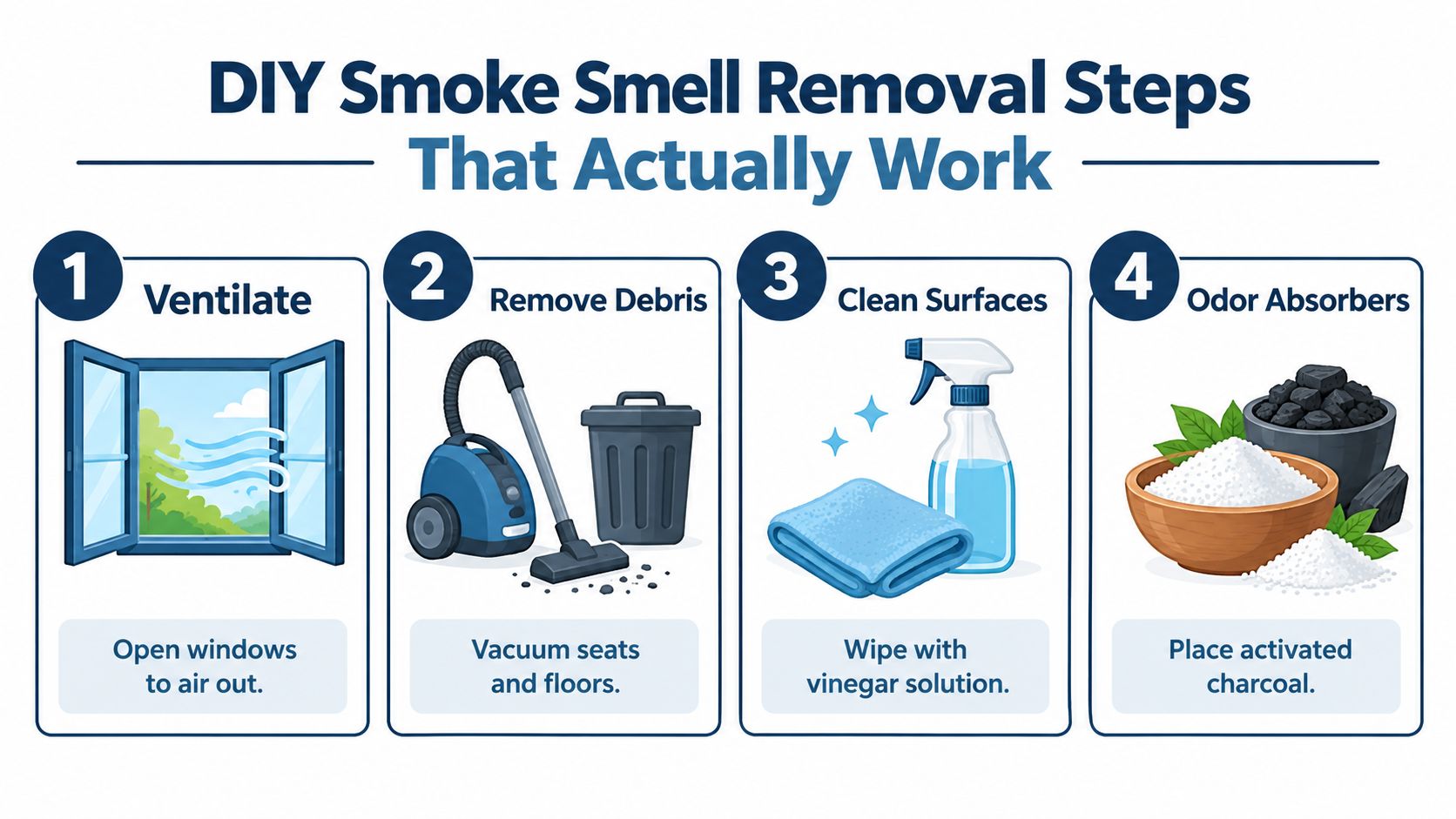
DIY smoke smell removal works best when you follow the order instead of jumping straight to a deodorizer. The sequence is contaminant removal first, drying second, and odour treatment last.
Start with air and loose debris
Park outdoors on a dry day and open the doors or windows to exchange stale cabin air. Don't rely on ventilation alone, but use it before cleaning so you aren't working in a concentrated smoky cabin.
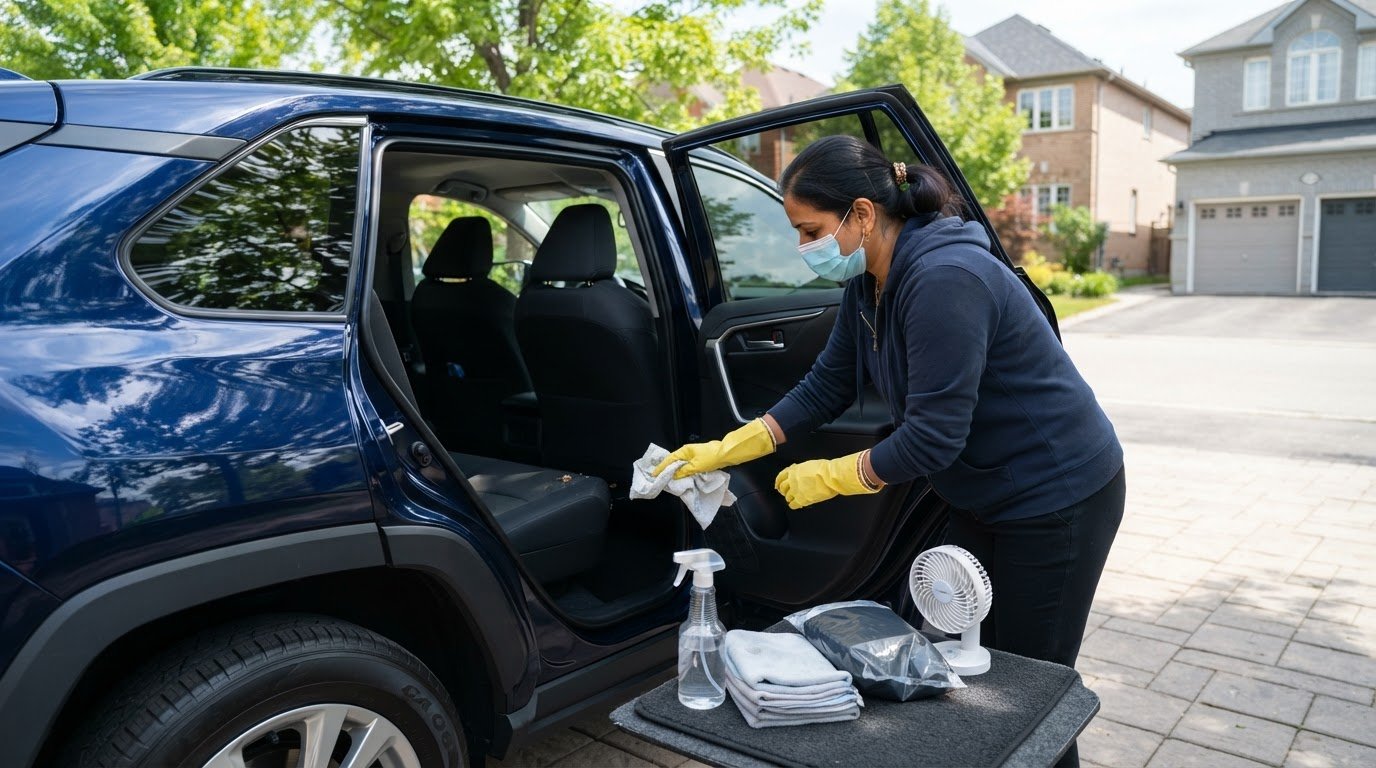
Remove rubbish, ash, cigarette butts, floor mats, and anything that carries the smell. Vacuum the seats, carpet, trunk edge, door pockets, console gaps, and under-seat areas with a crevice tool. Ash and loose particulates are small, but leaving them behind gives the odour another source.
Clean from the roof down
Wipe hard surfaces with a cleaner suitable for your interior material. Pay attention to the steering wheel, dash, door panels, seat plastics, visor backs, window surrounds, and the area around the shifter. Smoke film often hides where hands and eyes don't usually go.
Clean the headliner gently. Saturating it can loosen the adhesive or leave sagging fabric, so use a lightly dampened cloth and test an inconspicuous area first. For leather, choose a leather-safe cleaner rather than an aggressive household degreaser.
Treat carpets and cloth seats with an upholstery or carpet extractor. A baking-soda treatment can support the process on dry fabric, but vacuum it thoroughly afterward. Don't leave damp carpet in a closed vehicle, especially during a GTA winter. Moisture trapped under mats can create a second odour problem.
Don't forget the filter
Replace the cabin air filter after smoke exposure. If the old filter is contaminated, the blower can keep moving stale odour through the vents even after the cabin looks clean. Check the filter housing and nearby intake area for loose debris as well.
Give the vehicle time to dry fully, then reassess it after the interior has warmed up and the HVAC fan has run. If smoke remains after a complete cleaning, the residue has likely reached deeper foam, the headliner, or air channels. That's the point where a professional two-pass treatment makes more sense than repeating surface sprays.
The Science Behind Deep Cleaning and Ozone Treatment
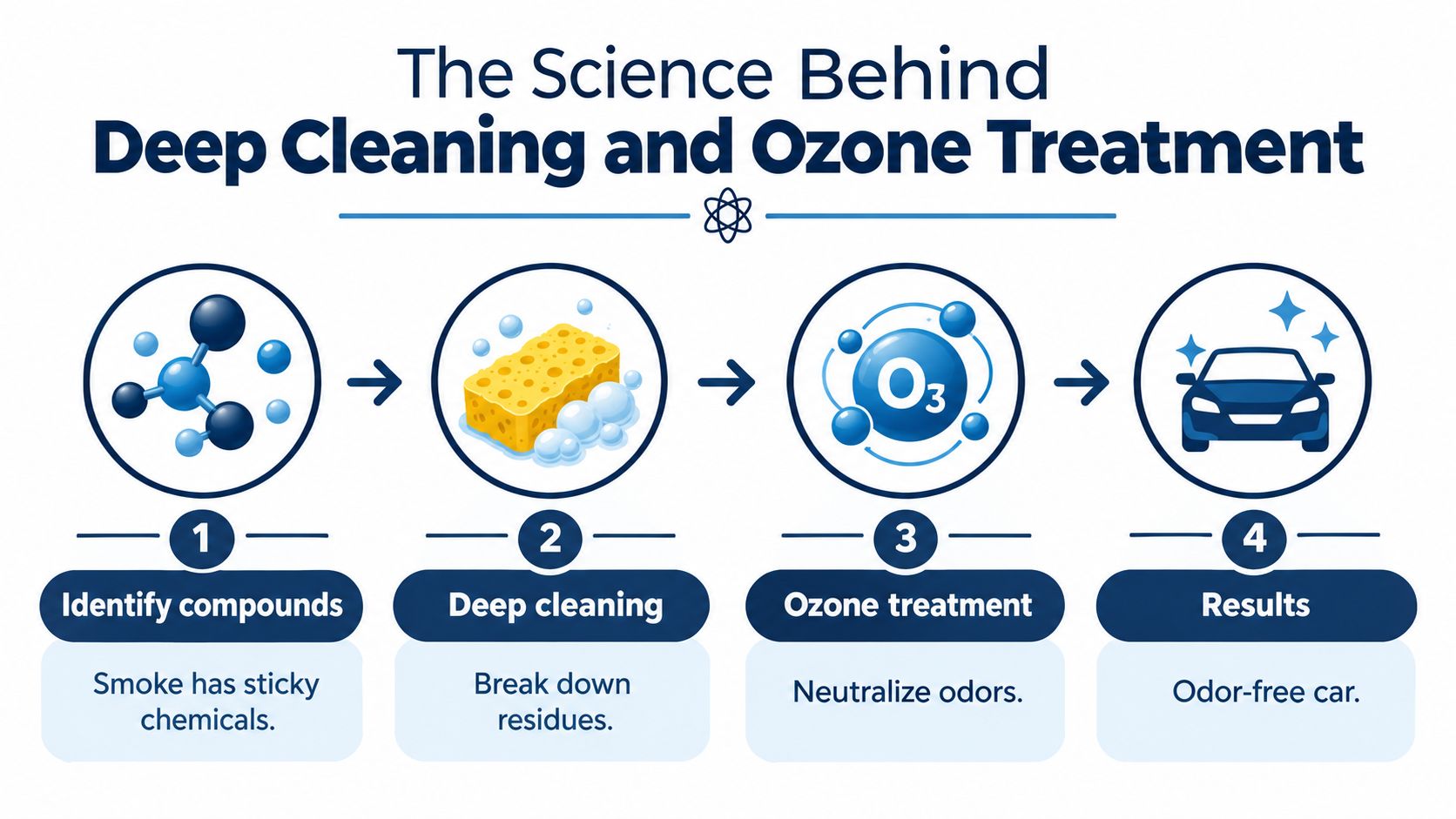
Smoke odour stays in a vehicle because smoke leaves residue on surfaces and inside porous materials. In Ontario, cold winters, road salt, and trapped moisture make that residue harder to dry out and easier to carry back into the cabin. Foam, carpet backing, upholstery, and headliners can release the smell long after smoking has stopped.
A surface spray only reaches exposed areas. It will not clean the foam beneath a seat cover or the carpet backing below the visible pile. Professional technicians target upholstery, headliners, carpets, plastics, vents, and HVAC paths because those areas can hold residue beyond the reach of a quick wipe-down.
Physical cleaning removes the source
A practical Canadian detailing workflow follows this order:
- Preparation: Remove rubbish, ash, loose objects, and floor mats.
- Vacuuming: Pull loose particulates from seats, carpets, seams, and crevices.
- Steam cleaning: Loosen residue on suitable hard and soft surfaces.
- Shampooing or extraction: Clean fabrics, carpets, and upholstery thoroughly.
- Ozone treatment: Treat the sealed cabin after bulk contamination has been removed.
- Ventilation: Air out the vehicle so residual ozone can dissipate.
An Ontario service description specifies 30 minutes of ozone treatment, followed by ventilation (Canadian automotive odour-removal workflow). The sequence matters. Ozone oxidizes odour molecules, and it performs best after cleaning and extraction have removed ash, film, and embedded residue.
Ozone needs strict exposure control
Technicians seal the vehicle during ozone treatment so the gas can reach cabin surfaces and air channels. Nobody should sit inside while the machine runs. After treatment, the vehicle needs thorough ventilation before use.
The cabin filter sits directly in the HVAC air path, so it deserves separate attention. Replacing it removes one contaminated component, while cleaning vents and the intake area addresses residue around the system. Skipping either step leaves a predictable path for stale odour to return.
My rule: Ozone is the finishing tool. If a detailer offers ozone without explaining what gets vacuumed, extracted, cleaned, and dried first, ask more questions before paying.
Ontario winter conditions change the drying plan. Wet mats and cold upholstery dry slowly, especially when salt and moisture have already entered the carpet layers. Technicians must control moisture before closing the vehicle. A clean but damp cabin can replace tobacco odour with mustiness, which is hardly an upgrade.
When to DIY and When to Call in Professionals
Not every smoky vehicle needs full restoration. A car exposed briefly to smoke may respond to careful vacuuming, surface cleaning, upholstery treatment, drying, and a new cabin filter. A long-term smoker's car is a different job entirely.
Canadian pricing gives GTA drivers useful reference points. Light odour treatment starts at $179, while full restoration for heavy or long-term smoke ranges from $400 to $950, with severity and vehicle size affecting the final price (Montreal smoke-odour treatment benchmarks).
| Method | Cost range | Effectiveness | Timeline |
|---|---|---|---|
| Basic DIY ventilation and vacuuming | Product-dependent | Useful for loose contamination and mild odour | Same day, with reassessment after drying |
| DIY upholstery cleaning and cabin-filter replacement | Product and filter costs vary | Better for light exposure, but limited by access to foam and HVAC paths | Several cleaning and drying stages |
| Light professional treatment | Starts at $179 (Canadian pricing reference) | Appropriate for mild odour when the cabin isn't heavily saturated | Appointment-based |
| Heavy professional restoration | $400 to $950 (Canadian pricing reference) | Designed for long-term or severe contamination | Multi-stage, with possible repeat treatment |
Use DIY for a contained problem
DIY makes sense when the smoke exposure is recent or limited, the seats and carpet don't carry a strong visible film, and the odour isn't coming back through the HVAC system. You'll need patience, proper drying, and honest testing. Smell the car after it has warmed up, not only immediately after spraying it.
Professional help becomes the sensible option when a previous owner smoked heavily, the headliner smells, the vents push out tobacco odour, or repeated cleaning produces only short-lived improvement. Toronto-area guidance similarly recommends cleaning the headliner, seats, carpets, plastics, and ventilation areas before relying on ozone (Toronto smoke-odour removal guidance).
For a broader explanation of why odours need source removal rather than simple masking, this odour-elimination guide from Pine Country Window Cleaning offers useful context, even though vehicle interiors have their own materials and access challenges.
Be suspicious of one-and-done promises
Heavy cases may need a second treatment. Ask what the quoted service includes, whether the cabin filter is changed, how the seats and headliner are handled, and how the vehicle is ventilated afterward. A cheap ozone-only appointment can become expensive when the smell returns and you have to start again.
Nanak Car Wash Service Recommendations for GTA Drivers
For drivers who want the interior handled professionally, Nanak Car Wash offers interior and exterior detailing packages by appointment. The listed work includes carpet and seat shampooing, salt and stain removal, vent and crevice blowout, leather deep cleaning, and machine buff and polish, with typical service duration of 1–4 hours and SUV, van, truck, and pet-hair surcharges where applicable (Nanak Car Wash detailing services).
Match the appointment to the contamination
Ask for smoke odour treatment when you book and describe the exposure plainly. “It smells a bit smoky” could mean a vehicle that needs interior cleaning, or it could mean years of residue in the headliner and HVAC system. Mention whether the smell is light, moderate, or heavy, and identify whether the odour is strongest in the seats, carpet, roof lining, or vents.
Nanak's detailing work is more relevant than a basic exterior wash for this problem because smoke lives inside the cabin. Vent and crevice blowout can reach areas a household vacuum misses, while carpet, seat, and leather cleaning address the materials that passengers touch and the surfaces that retain odour.

Account for GTA grime as well
Ontario vehicles often carry salt and road debris into the cabin, so smoke remediation can uncover a second layer of mess around mats, door sills, and lower trim. Nanak's listed interior and exterior appointment format lets drivers address those issues in the same broader vehicle-care visit.
The provider lists locations serving Etobicoke, Brampton, Concord, Oshawa, North York, Burlington, Cambridge, and Guelph. Its full-service car wash packages start at $29.99 plus tax, but a standard wash with vacuuming and dashboard cleaning shouldn't be confused with heavy smoke restoration. For entrenched odour, request the deeper interior service and ask how they'll handle the cabin filter, HVAC areas, drying, and any ozone treatment.
If you drive for rideshare or deliveries, tell the staff that the cabin sees frequent passenger use. That context helps them judge whether a quick refresh is enough or whether the interior needs a more thorough extraction and deodorization plan.
Making the Right Choice for Your Situation
Start with the condition of the cabin, not the strength of the air freshener. A light, recent odour with no visible residue is a reasonable DIY job. Remove loose debris, clean hard surfaces, wash upholstery, replace the cabin filter, and dry the interior fully. Run the HVAC afterward. If the smell stays away, your approach was sufficient.
Smoke that returns when the heat or fan runs points to residue in areas you cannot easily reach. Seats, carpet, headliner, air channels, and seat foam can all hold odour. At that stage, professional detailing earns its cost through extraction equipment, crevice access, and a structured cleaning process. You are paying for equipment and labour, not a stronger fragrance.
Cost should guide the decision. Nanak Car Wash lists full-service packages starting at $29.99 plus tax, but a basic wash with vacuuming and dashboard cleaning is not smoke restoration. Ask for the deeper interior service and confirm whether the quote covers extraction, cabin-filter inspection, HVAC-area cleaning, drying, and ozone treatment. GTA pricing can vary with the vehicle's size and contamination, so get the scope before approving the work.
Ontario conditions make the drying step matter more than many DIY guides admit. Salt and moisture enter through mats, shoes, and door sills, while cold weather slows evaporation. Do not reinstall wet mats or close the vehicle while carpets and upholstery remain damp. A temporary clean smell followed by mustiness means the job was incomplete.
If ozone is recommended, it should follow source cleaning, not replace it. Confirm that the vehicle will be ventilated before pickup, and ask what surfaces were cleaned first.
For rideshare and delivery vehicles, frequent passenger use raises the standard. Remove smoke residue from the cabin because passengers breathe the same enclosed air, not just to make the car smell better. Children and other vulnerable passengers also justify acting sooner rather than waiting for the odour to return.
Choose DIY when the contamination is limited and you can clean and dry the cabin properly. Book professional service when smoke survives a thorough attempt, returns through the vents, or has settled into multiple materials.
Nanak Car Wash offers appointment-based interior and exterior detailing, including carpet and seat shampooing, vent and crevice cleaning, salt and stain removal, and leather care. Describe the smoke exposure when booking, then visit Nanak Car Wash to choose a GTA location and request the appropriate interior service.

 6600 Finch Ave W, Etobicoke, ON M9V 3Z6
 647-703-8515
 MON – SUN 8 AM to 7 PM