

You're halfway through a GTA winter commute, and the lower doors of your vehicle already have a grey line of salt stuck to them. The exterior looks merely dusty, but underneath, brine has reached the wheel wells, suspension parts, rocker panels, and other places a quick driveway rinse rarely cleans properly.
That's why a 6 bay car wash should be judged by more than its number of washing positions. The useful question is how quickly the site can move vehicles through pre-rinse, underbody cleaning, drying, and protection when every driver wants service after a snowfall. In Ontario, where winter maintenance crews use vast quantities of road salt, fast repeat access to the undercarriage can matter more than an elaborate exterior package. Provincial and road-salt reporting records 1,679,395 tonnes, 2,985,873 tonnes, and 2,781,677 tonnes used by reporting organizations in different years, with tens of thousands of kilometres of roadway salted annually.
Table of Contents
- Why a 6 Bay Car Wash Exists in the First Place
- The Anatomy of a Six-Bay Layout
- Throughput and Wait Times Under Peak Demand
- Ontario Road Salt and the Case for High-Capacity Underbody Service
- Who Benefits Most from a Multi-Bay Operation
- Water Efficiency and Sustainability at Scale
- Choosing the Right Wash Frequency and Service Mix
Why a 6 Bay Car Wash Exists in the First Place
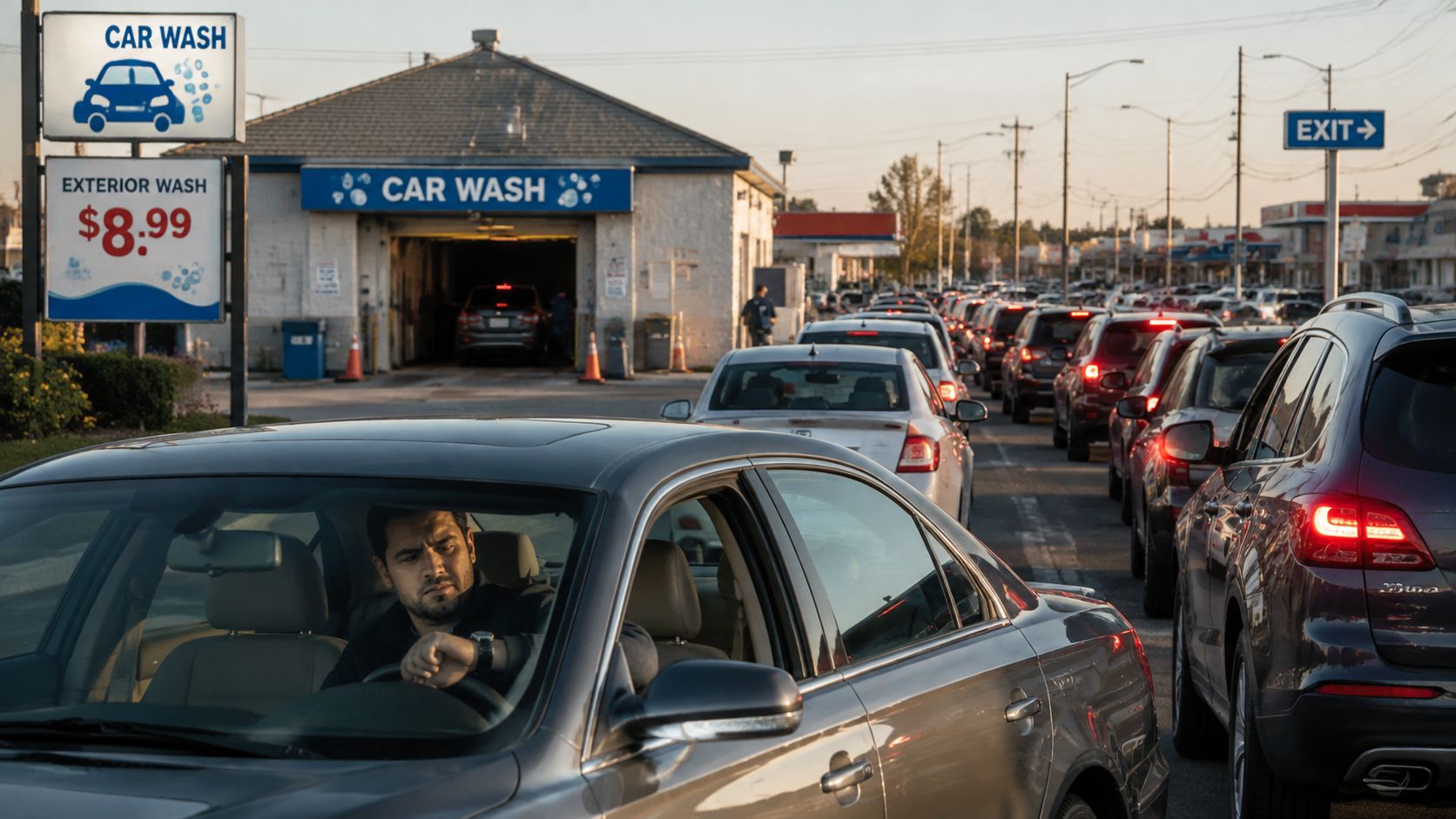
On a busy Saturday morning, the queue at a small GTA wash can become its own traffic problem. Brake lights stretch towards the access road, drivers check their watches, and someone who expected a quick clean starts wondering whether the wash is worth losing the rest of the morning.
A single bay doesn't fail because the equipment is necessarily poor. It fails because one vehicle occupies the whole operation while the next customer waits. A payment question, a blocked vacuum, a forgotten floor mat, or a brief equipment reset can hold up everyone behind it. A six-position site separates those delays and gives the operator room to keep vehicles moving.
The GTA demand pattern
The Greater Toronto and Hamilton Area has built a large, recurring base of vehicle-owning households over time. Research from the University of Toronto's Transportation Modelling Group records car-owning households rising from 1.3 million in 1986 to 2.3 million in 2016, while households without a car changed only slightly, from 15% to 16% over the same period. The regional vehicle-ownership report also records growth in Toronto's core, even though car-less households remained much more common there.
That mix creates a predictable operating challenge. Suburban families, highway commuters, delivery drivers, and commercial fleets often arrive in waves, particularly after snowfall or during the weekend. A six-bay layout spreads those arrivals across parallel service points instead of forcing every vehicle through one narrow opening.
The configuration is therefore less about an arbitrary number and more about peak-hour resilience. It offers enough capacity for routine demand while leaving room for express services, interior work, underbody rinses, and occasional maintenance without bringing the entire site to a standstill.
The Anatomy of a Six-Bay Layout
A well-designed site should feel simple to the customer. The vehicle enters once, follows a clear path, receives the selected treatment, and exits without crossing incoming traffic or blocking the next customer.
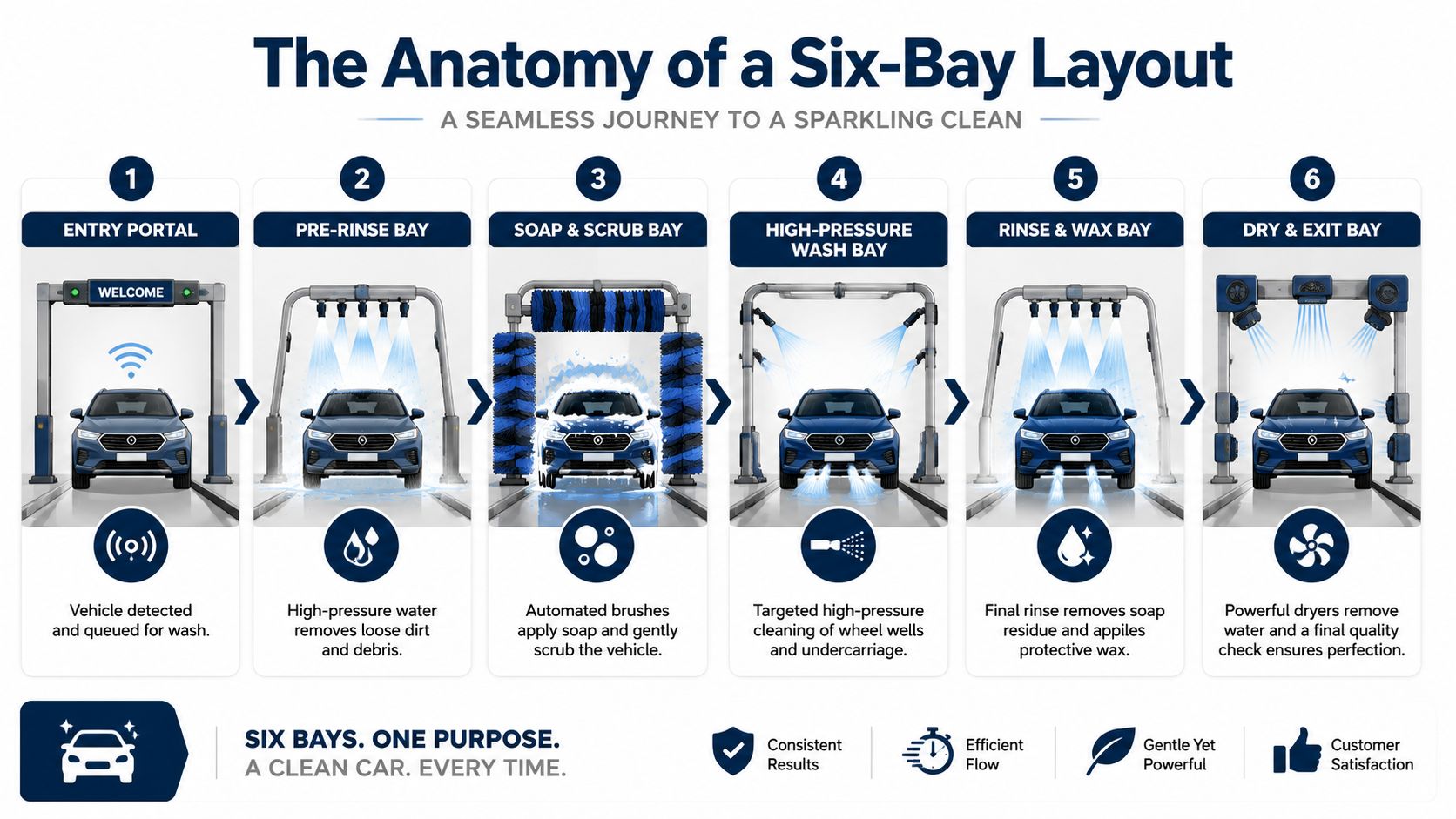
Entry and soil removal
The first stage is the entry portal, where the operator or system identifies the vehicle and confirms its package. Good sites make the menu easy to understand before the driver reaches the wash equipment. Confusion at the pay point creates a queue before cleaning even begins.
The pre-rinse stage does the dirty work. High-pressure water loosens road film, grit, and salt before brushes or detergents touch the paint. In winter, this stage also needs to reach wheel wells and lower body panels, where packed material can act like abrasive paste.
The soap or scrub stage then lifts what remains. Friction equipment can agitate stubborn contamination, while touchless systems rely more heavily on chemical dwell time and pressure. Neither approach is automatically right for every vehicle. Operators have to balance cleaning strength, paint safety, vehicle dimensions, and the customer's chosen package.
Underbody, rinse, and exit
The underbody stage deserves deliberate equipment placement. High-volume nozzles should target the wheel wells, frame rails, rocker areas, suspension components, and other low surfaces rather than merely spraying water across the floor. A visibly clean bonnet doesn't prove that the chloride residue underneath has been removed.
The final rinse removes detergent, while wax or sealant options add a protective layer. Spot-free water helps reduce visible mineral marks, and drying equipment prevents the customer from leaving with water trapped around mirrors, trims, and door seams.
Drainage is just as important as wash chemistry. Floors need a controlled slope towards collection points, with grates positioned so debris doesn't create standing water or interfere with vehicle movement. GTA winter sites also benefit from heated floors, protected pipework, and an enclosed drying zone. A frozen approach lane or icy exit can erase the advantage of every other design decision.
In parallel layouts, several vehicles can receive service at the same time. In series layouts, each stage must pass the vehicle smoothly to the next one. The best arrangement depends on whether the site uses conveyors, self-serve wands, in-bay automatics, or a hybrid model. The operational test is straightforward: does each vehicle keep moving, or does one slow step stop the whole line?
Throughput and Wait Times Under Peak Demand
Capacity calculations are useful, but operators shouldn't confuse theoretical output with the number of cars customers experience. A six-bay wash can run multiple vehicles at once, yet payment delays, unclear menus, staff handoffs, full vacuum areas, and maintenance interruptions all reduce practical flow.
The strength of six bays is that these problems don't have to affect every customer. If one position needs attention, the remaining positions can continue serving vehicles. That redundancy matters more during a post-snowfall rush, when a small site has no spare capacity and a minor fault can turn a short visit into a long queue.
A simple comparison helps clarify the trade-off. The table below uses qualitative operating categories rather than unsupported throughput promises.
| Bay count | Maximum vehicles per hour | Average peak wait time | Redundancy if one bay is down |
|---|---|---|---|
| One bay | Low, because every vehicle shares one service point | High when demand surges | None |
| Two bays | Better, but still vulnerable to one interruption | Moderate to high | Limited |
| Six bays | High parallel capacity when equipment and staffing are balanced | Lower and more stable | Stronger, because service can continue across the remaining bays |
What actually moves the line
The fastest equipment won't rescue a badly organised entrance. Staff should confirm package choices early, keep payment processing simple, and prevent customers from stopping in the exit lane to make decisions. Signage must distinguish express washing, interior cleaning, detailing appointments, and add-on services before vehicles reach the active bays.
A six-bay operation also needs maintenance discipline. Operators should inspect nozzles, dryers, brushes, pumps, drainage points, payment terminals, and winter heating systems before the busiest periods. Preventive maintenance is less dramatic than repairing a breakdown in front of a queue, but it protects the capacity customers came for.
Practical rule: design the site around the slowest repeatable step, not the fastest piece of equipment.
The business case isn't “more bays equals more cars.” It's more usable capacity during the exact windows when GTA drivers need salt removal most. A compact site may look efficient on a quiet afternoon, but the six-bay model earns its keep when demand arrives all at once.
Ontario Road Salt and the Case for High-Capacity Underbody Service
A commuter can leave a six-bay wash with a clean hood while chloride remains behind the wheel liners and along the undercarriage. In Ontario winter, the practical question is not only how many bays the site has. It is how quickly the operation can direct water beneath the vehicle, remove brine and packed salt, and return the driver to the road.
Road salt changes the service priority. Exterior appearance matters, but corrosion control depends on reaching metal surfaces that splash and airflow repeatedly wet. The Transportation Research Board's Canadian corrosion data records Toronto atmospheric corrosion exposure at 5,108 mg/dm² over 19 months in the referenced sample. That finding supports a practical operating decision: winter capacity should include underbody work, not treat it as a cosmetic add-on.
What underbody equipment must do
A useful underbody system needs deliberate nozzle placement and enough flow to cover the centre underside, wheel wells, rocker panels, brake lines, and suspension members. Fixed jets that miss the inner arches or spray only the visible lower body leave contamination in the areas drivers cannot inspect easily. Operators should also check nozzle alignment and pressure regularly, because worn or obstructed equipment can reduce coverage while the wash still appears to be running normally.
Heated bays and protected service areas matter during freeze-thaw weather. They help keep equipment, drainage, and access points working when packed snow and slush reach the site. Drainage must move salt-laden water away from the wash path without creating icy surfaces for the next vehicle.
A high-capacity layout gives the operator room to separate services. One bay can handle an express exterior package with underbody coverage, while another manages a more involved interior or wheel service. That separation protects the repeatable wash cycle from slower add-ons and makes it easier to keep underbody rinsing available during post-storm demand.
Capacity turns winter maintenance into a usable routine
A six-bay site earns its winter advantage only when equipment and staffing stay balanced. If drivers face a long queue after every storm, they defer the visit and leave chloride residue underneath for another wet-dry cycle. Parallel bays reduce that friction, but only when pumps, heated systems, payment points, and drainage are maintained before peak periods.
Ontario road-salt guidance links regular washing with attention to the undercarriage, as described in Ontario road-salt damage guidance. Frequency still depends on exposure, storage, temperature, and distance driven, so detailed visit planning belongs with the service-mix discussion later in the article.
For GTA commuters, ride-hail vehicles, and fleets, the priority is direct: put underbody coverage and wheel-well rinsing ahead of upgrades that do not remove salt. Protective products can support the program, but they do not replace physical removal of chloride.
Who Benefits Most from a Multi-Bay Operation
A six-bay site doesn't deliver the same value to every driver. The right customer sees it as a repeatable maintenance stop, not a once-a-season indulgence.
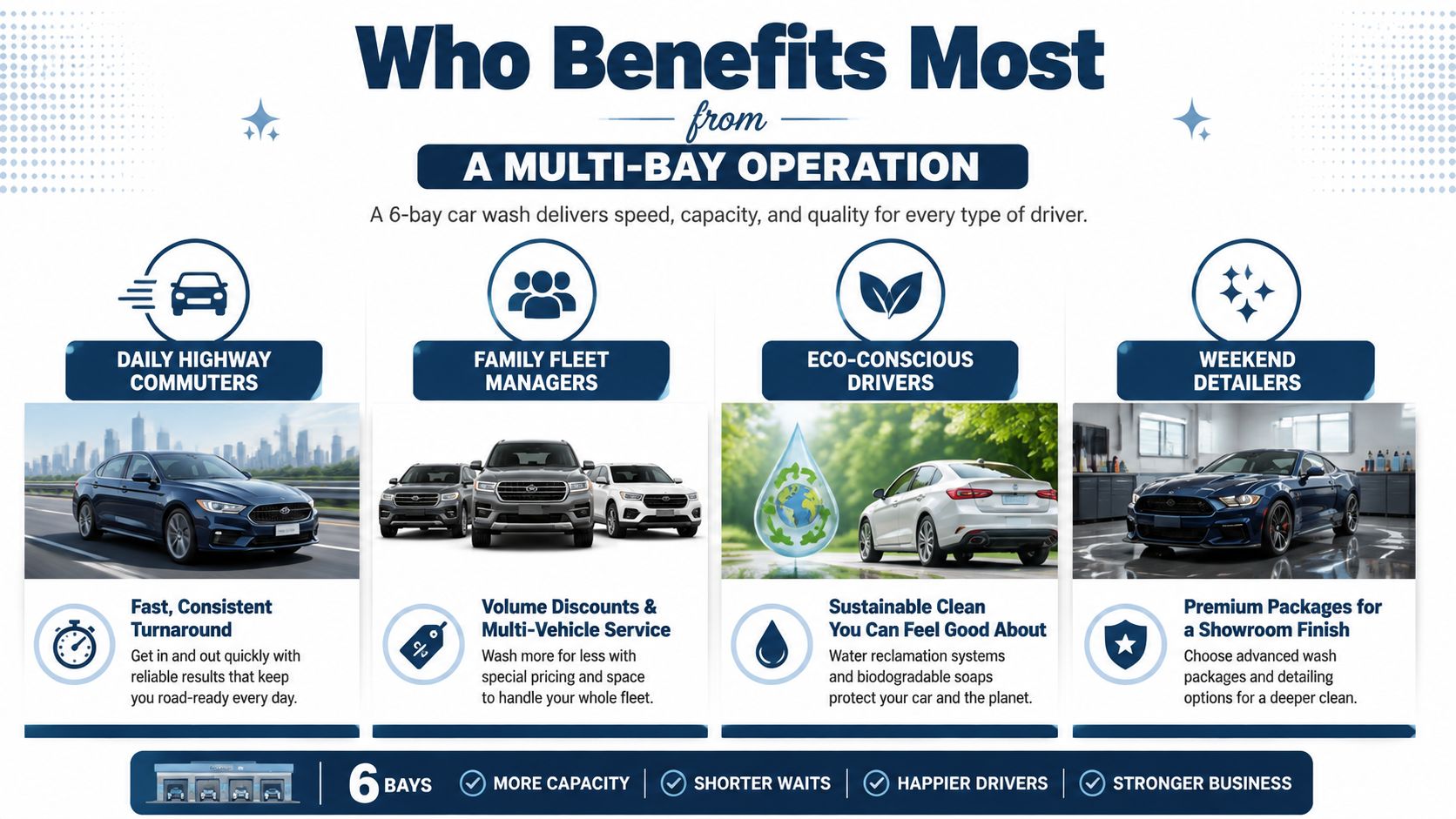
A daily highway commuter needs predictable entry and exit. Someone travelling across the 401 or QEW faces constant exposure to spray, grit, and treated pavement, so an express exterior wash with underbody coverage may be more useful than a long appointment for interior detailing. The commuter's best strategy is usually to visit during a quieter operating window and use a membership or prepaid bundle if regular washing is part of the routine.
Ride-hail and delivery drivers have a different calculation. Their vehicle works as part of the customer experience, and they often need a quick exterior refresh without abandoning the workday. A multi-bay site can support a fast wash, vacuum access, and a return to service without the driver committing to a full-detail appointment.
Matching the operation to the customer
Fleet managers should think in rotations rather than individual visits. A contractor with several vans can coordinate service near a depot, prioritise underbody cleaning during salt season, and reserve deeper interior work for vehicles that need it most. The benefit isn't just speed. It's consistency, because every vehicle receives the same basic process.
Dealerships and rental operators also value repeatability. They may need exterior presentation, interior touch-ups, odour removal, or salt and stain treatment across a changing group of vehicles. A high-capacity site gives them more options than sending every unit through an appointment-only detail bay.
| Driver type | Most useful service mix | Operational priority |
|---|---|---|
| Highway commuter | Express wash, underbody rinse, protective finish | Consistent repeat access |
| Ride-hail driver | Exterior wash, vacuum, targeted interior cleaning | Minimal downtime |
| Small fleet | Batch washing, underbody service, scheduled detailing | Vehicle rotation |
| Dealership or rental operator | Exterior presentation and selected interior services | Same-day coordination |
Teams running several vehicles may also benefit from stronger scheduling, staff allocation, and route planning. Guidance on operations management for cleaning firms can be useful when a wash operation expands beyond ad hoc service and starts coordinating people, equipment, and recurring work.
Water Efficiency and Sustainability at Scale
A large wash site sounds water-intensive until you examine what happens beneath the floor. Commercial facilities can collect wastewater, separate solids, treat used water, and return suitable water to selected wash stages instead of allowing every rinse to run directly to waste.
The Canadian Car Wash Association's guidance on commercial washing states that washing at home can use as much as 50% more water, while commercial facilities treat wastewater before discharge into the sanitary sewer system. Calgary reporting cited in the verified data notes that most car washes there use roughly 85% recycled water, an example of how reclamation can reduce potable-water demand.
Where scale helps
A six-bay operation can justify dedicated collection and treatment infrastructure because many vehicles share the same system. Water from pre-rinse and washing stages can move through settling and filtration equipment, while cleaner water is reserved for applications where finish quality matters most.
That separation also improves chemical control. The operator can calibrate detergent, wax, and rinse products through metered equipment rather than leaving each customer to guess how much water and soap to use with a garden hose. Controlled application produces a more repeatable clean and reduces unnecessary runoff.
The environmental advantage isn't automatic. A poorly maintained reclaim system can create odour, clogging, poor wash quality, or higher repair costs. Operators need to monitor filters, tanks, pumps, drainage, and discharge procedures. When the infrastructure is maintained properly, however, scale can support sustainability, not undermine it.
For GTA drivers, the practical comparison is simple. A commercial wash can combine controlled water use, wastewater handling, fast service, and underbody access in one visit. Driveway washing offers convenience, but it gives the owner less control over runoff, pressure, chemical dosing, and the areas reached.
Choosing the Right Wash Frequency and Service Mix
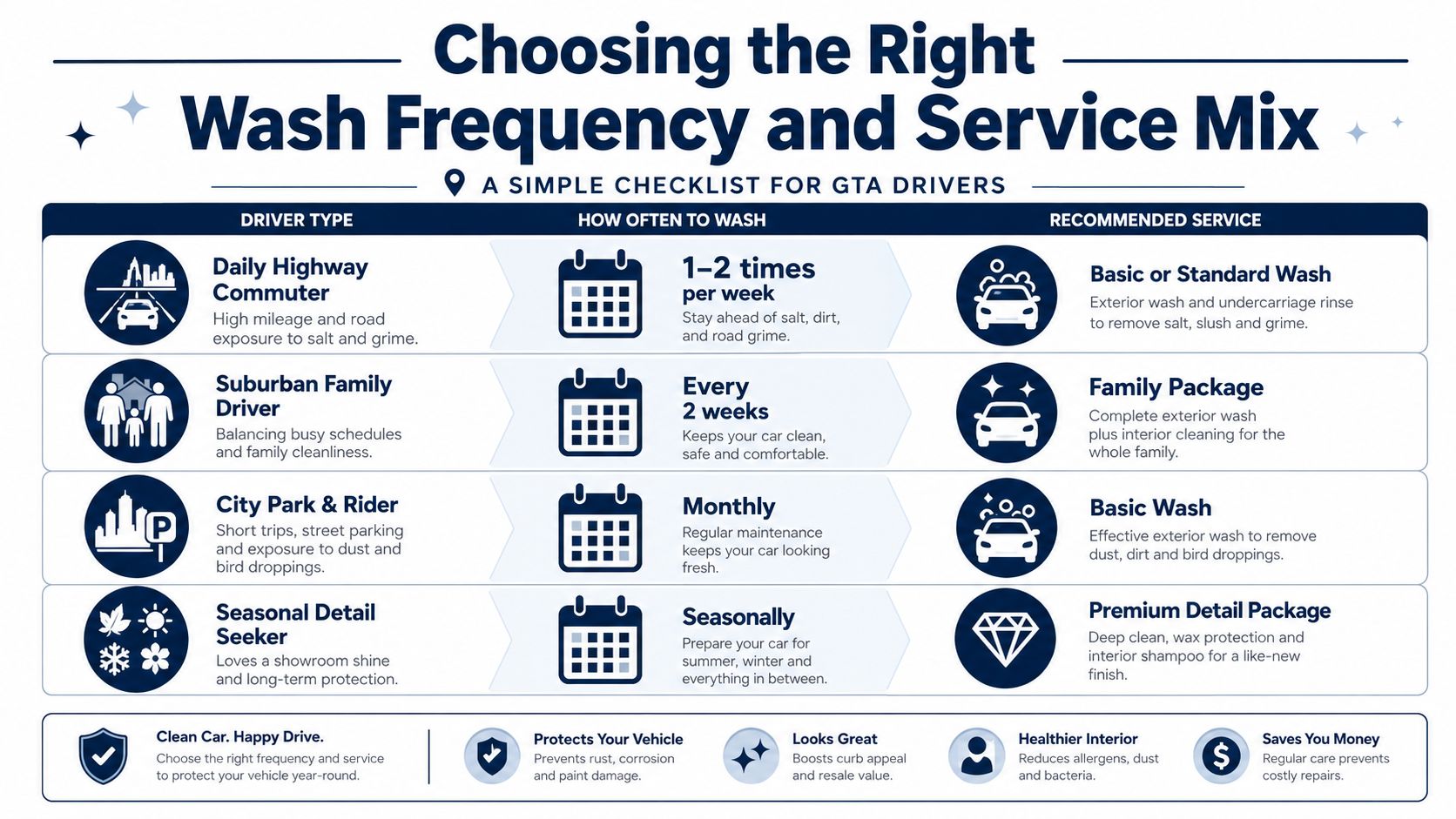
A January commute on the 401, a week of suburban errands, and a vehicle stored indoors create different wash decisions. Start with the vehicle's exposure, then match the service to the parts of the car that collect salt, slush, and road grime.
Use this diagnostic:
- Daily 401 or major-highway driving in winter: Select an exterior wash that includes underbody rinsing. The priority is removing chloride from the underside during active salting, not adding cosmetic services.
- Ride-hail and delivery work: Choose a fast, repeatable package with underbody coverage, vacuum access, and a membership or prepaid option. Short stops matter when the vehicle works every day.
- Suburban family vehicle: Combine exterior and underbody cleaning with periodic interior service. Boots and wet clothing carry salt into mats and carpet, so interior cleaning becomes more valuable through the slush season.
- Fleet vehicles: Set a service rotation around routes, shifts, and vehicle availability. Routine salt removal should stay separate from occasional detailing, so a deep-clean appointment does not delay basic maintenance.
- Garage-stored weekend vehicle: Use a lighter routine when it avoids salted roads, but inspect the underside after winter trips. Storage reduces exposure, not the residue left by every storm drive.
- Older vehicle or visible corrosion: Give underbody rinsing priority and consider rust proofing or a protective finish if the vehicle's condition and storage pattern support the cost. Those treatments do not replace washing away salt.
A service menu should reflect that decision. A commuter needs throughput and underbody reach. A family may value interior cleaning. A working vehicle needs predictable access and quick turnaround. A fleet manager needs scheduling control more than occasional cosmetic upgrades.
The road-salt maintenance guidance can help frame winter maintenance decisions, but driving exposure should determine the actual mix. A membership or prepaid bundle is useful when it removes the delay between noticing salt buildup and getting the vehicle washed.
At Nanak Car Wash, drivers can choose express exterior washes, full-service interior and exterior cleaning, detailing, rust proofing, prepaid bundles, and monthly wash options across GTA-area locations. Visit Nanak Car Wash to compare the service mix with your vehicle, route, and winter storage pattern.


 6600 Finch Ave W, Etobicoke, ON M9V 3Z6
 647-703-8515
 MON – SUN 8 AM to 7 PM