
That gritty crunch under your car in a slushy Toronto parking lot isn't just winter background noise. It's the sound of road salt, wet grime, and sand getting packed into the exact places you rarely see and almost never clean properly. By the time spring shows up, most drivers are thinking about tires, potholes, and maybe a wash. The underbody is still taking the hit.
If you drive in the GTA, you're in the Salt Belt whether you like it or not. Your car's underside gets blasted by salty spray, freeze-thaw mess, and road film for months. That matters more than the odd rust bubble on a fender. Underbody corrosion goes after seams, brake and fuel line areas, mounting points, and the structure that keeps the whole vehicle solid.
The first thing worth saying is the honest thing. Rust proofing helps a lot, but it doesn't make a car immortal. NAPA AUTOPRO puts it plainly: “You can't fully stop rust, but you can slow it down,” and that's exactly how smart owners should think about it. Not magic. Not a forever shield. A practical maintenance step that buys time, protects vulnerable areas, and can keep a good vehicle from aging fast underneath.
Table of Contents
- Your Complete Guide to Underbody Rust Proofing
- Why Your Car Hates Ontario Winters
- The Main Types of Underbody Rust Proofing
- Inside a Professional Rust Proofing Service
- DIY Versus Professional Application
- How Much Does Rust Proofing Cost in the GTA
- Maintaining Your Vehicle's Protection
- GTA Rust Proofing Frequently Asked Questions
Your Complete Guide to Underbody Rust Proofing
A lot of people only start thinking about rust proofing after they notice something ugly. A flaky bracket. Orange staining around a seam. A mechanic pointing at the underside and giving that look that means, “This has been building for a while.” By then, you're no longer talking about prevention. You're talking about limiting damage.
Rust proofing car underbody areas works best when you treat it like routine maintenance, not emergency response. In Ontario, the problem isn't one dramatic event. It's repetition. Salt spray today, meltwater tomorrow, then a cold night that leaves moisture sitting inside seams and overlaps.
What protection actually does
Good underbody rust proofing creates a barrier and, in the case of lighter oil products, reaches into spots you can't wipe by hand or coat neatly with a brush. That's the whole game. The underside of a vehicle has too many joints, folds, fasteners, and hidden ledges for surface-only protection to be enough.
The practical payoff is simple:
- Slower corrosion: You're reducing how quickly rust gets established in vulnerable areas.
- Better long-term ownership: A vehicle that stays cleaner underneath is easier to maintain.
- Fewer ugly surprises: Shops are less likely to find neglected corrosion during other work.
Practical rule: If you plan to keep the vehicle for years, underbody protection makes more sense than waiting until rust is visible.
What honest shops will tell you
The salesy version of rust proofing says one treatment solves everything. The experienced version is less glamorous and more useful. Products wear off. Road spray strips exposed areas. Seasonal grime holds moisture. That's why maintenance matters as much as the first application.
For a GTA driver, the primary decision isn't whether winter roads are harsh enough to justify protection. They are. The key decision is which method fits your car, your tolerance for mess, and how consistently you're willing to keep up with it.
Why Your Car Hates Ontario Winters
Ontario winters don't rust cars because the weather is cold. They rust cars because the roads stay wet, dirty, and salty for long stretches, and your underbody catches all of it.
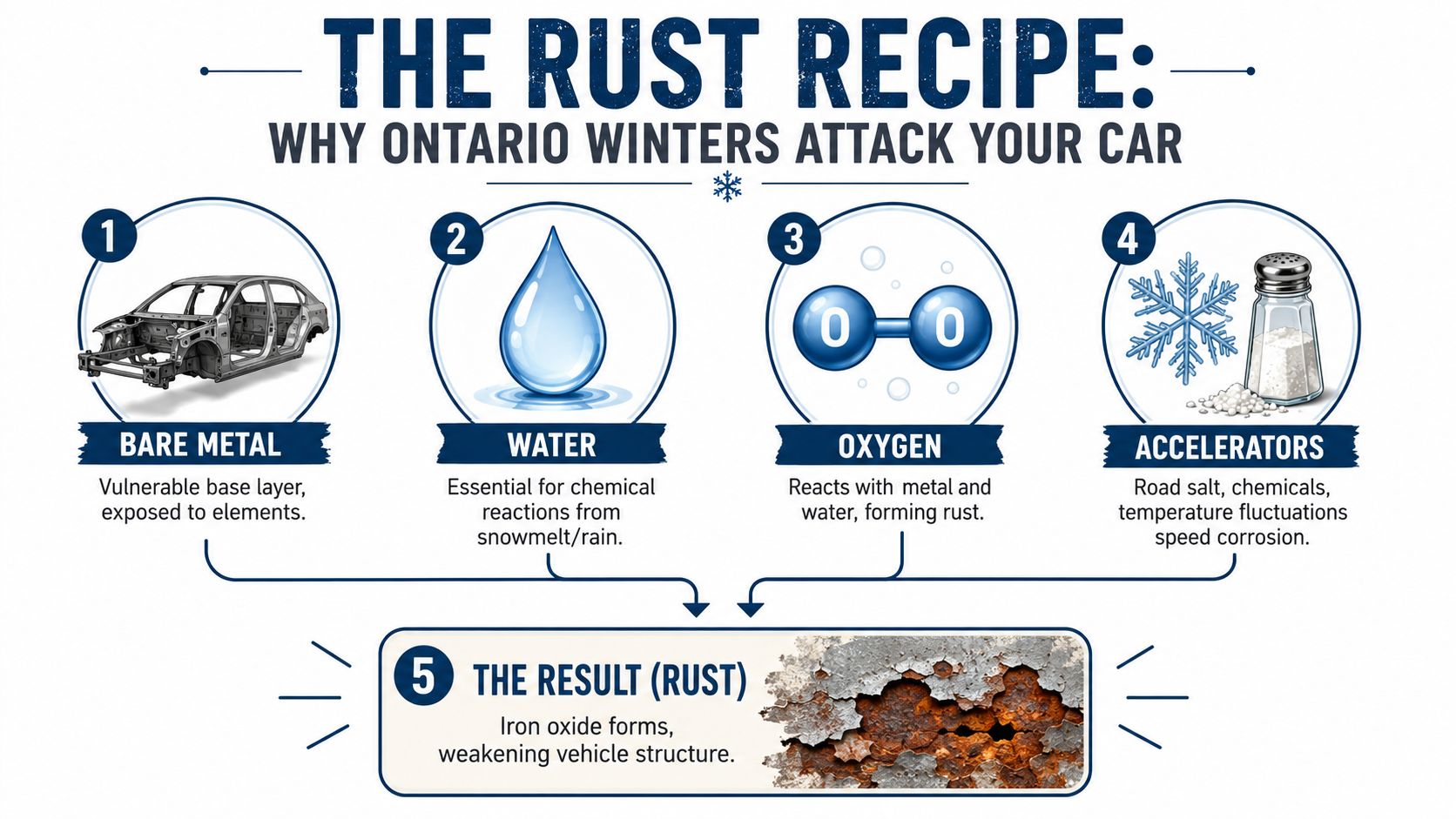
The rust recipe under your car
Think of rust like a recipe with three basic ingredients. You need metal, water, and oxygen. Add road salt and the reaction speeds up. That's why a car can look fine up top but start aging fast underneath after a few Ontario winters.
The underbody lives in the worst zone on the vehicle. Tires throw slush everywhere. Salt mist gets forced into welds and seams. Packed snow sits in wheel wells and around suspension components. Even when roads look dry, the residue they leave behind keeps working against bare or poorly protected metal.
Why the underbody pays the price first
Drivers often focus on visible body panels because that's what they see while washing the car. The underside is different. It gets neglected because it's harder to inspect and awkward to clean properly. That's exactly why corrosion gets ahead there.
Here's what underbody rust can lead to in real ownership terms:
- Structural trouble: Rot around key mounting areas can turn a solid car into a safety concern.
- Repair headaches: Rusted fasteners and seized hardware make ordinary repairs slower and more expensive.
- Resale damage: Buyers and shops care what the underside looks like, even if the paint shines.
Annual rust proofing in the GTA can significantly slow corrosion and extend a vehicle's usable life by years while helping preserve structural integrity against salt and moisture, as noted in this Ontario discussion summarising local experience.
Most owners don't need a chemistry lesson. They need the takeaway. If your car spends winter in the GTA, corrosion pressure is constant. Ignore the underside long enough and the car starts losing value and durability from the bottom up.
The Main Types of Underbody Rust Proofing
A GTA driver usually hears the same three options at the counter. Annual oil spray, a thicker undercoating, or an electronic module. The right choice depends on how the vehicle is used, what condition the underside is already in, and how much upkeep the owner will tolerate.
For Ontario's Salt Belt, the main question is simple. Do you want a product that creeps into seams and overlaps where salt water sits, or one that mainly covers exposed surfaces? That distinction matters more than branding.
Annual oil spray
For most daily driven vehicles in the GTA, this is the practical default. A light oil-based product moves into spot welds, pinch seams, rocker cavities, and other tight areas where corrosion usually starts first. It also stays workable, so a fresh yearly application can keep renewing protection instead of relying on one layer to stay perfect for years.
That makes it a strong fit for commuters, family SUVs, work vans, and pickups that see 400-series highways, wet slush, and repeated freeze-thaw cycles. It is also the option many local owners can budget for without turning rust prevention into a major expense.
The trade-off is mess. Fresh oil spray can drip for a short period after application, and it may collect dust. Some owners hate that. From a corrosion-control standpoint, I would still take creep and coverage into hidden areas over a cleaner-looking finish on the parts you can already see.
Wax and tar style coatings
These products create more of a barrier layer. On clean, dry metal, they can protect exposed underbody sections well and leave a neater appearance than oil spray. That appeals to owners who want the underside to look finished and less oily after service.
Preparation decides whether this type works or causes trouble. If the vehicle already has scale, trapped moisture, or missed pockets of salt contamination, a thick coating can seal over problems instead of addressing them. Once that coating gets chipped by road debris or starts separating from the metal, water can sit behind it and corrosion keeps working out of sight.
There is a place for this approach. A newer vehicle with a very clean underside, careful prep, and an owner who plans to inspect it regularly can do well with it. For older Ontario vehicles with a few winters behind them, I treat thick coatings more cautiously.
Electronic modules
These systems are easy to market because they sound clean and low effort. No spray, no smell, no annual drip. The problem is straightforward. They do not wash salt off the underbody, they do not displace moisture, and they do not coat exposed metal or inner seams.
For a GTA vehicle that spends winter outside, drives salted roads, and picks up packed slush around suspension and brake lines, that leaves a big gap in protection. An electronic unit may be sold as an add-on, but it is a weak primary plan for Ontario conditions.
What usually makes sense in the GTA
If the vehicle is a daily driver and you plan to keep it for several winters, annual oil spray is usually the safest bet. If the vehicle is newer, very clean underneath, and you are willing to stay on top of inspections, a wax-style coating can make sense. Electronic modules sit at the bottom of the list for most owners because they do not deal with the actual contamination sitting on the metal.
This is also where shop quality matters. A good local provider such as Nanak is not just selling a product. They should be looking at the age of the vehicle, existing rust, access points, and whether the owner wants yearly maintenance or a thicker one-time style treatment. The right recommendation changes with the car.
Rust Proofing Methods Compared
| Method | Best For | Pros | Cons |
|---|---|---|---|
| Oil-based annual spray | Daily-driven cars, SUVs, vans, pickups in Ontario winter conditions | Reaches seams and joints, helps push out moisture, easy to renew each year | Can drip after treatment, needs repeat application |
| Wax or tar-style coating | Newer vehicles with very clean underbodies and owners willing to inspect regularly | Strong surface barrier, tidier appearance when fresh | Limited penetration into hidden seams, can trap moisture if prep or condition is poor |
| Electronic module | Owners looking for a low-mess add-on | Minimal visible residue | Does not physically protect metal surfaces or inner cavities, weak as a primary strategy |
Inside a Professional Rust Proofing Service
A proper rust proofing appointment should feel methodical, not rushed. When a shop does it well, every stage has a purpose. The underbody isn't just getting sprayed and sent out the door.
What happens before the spray starts
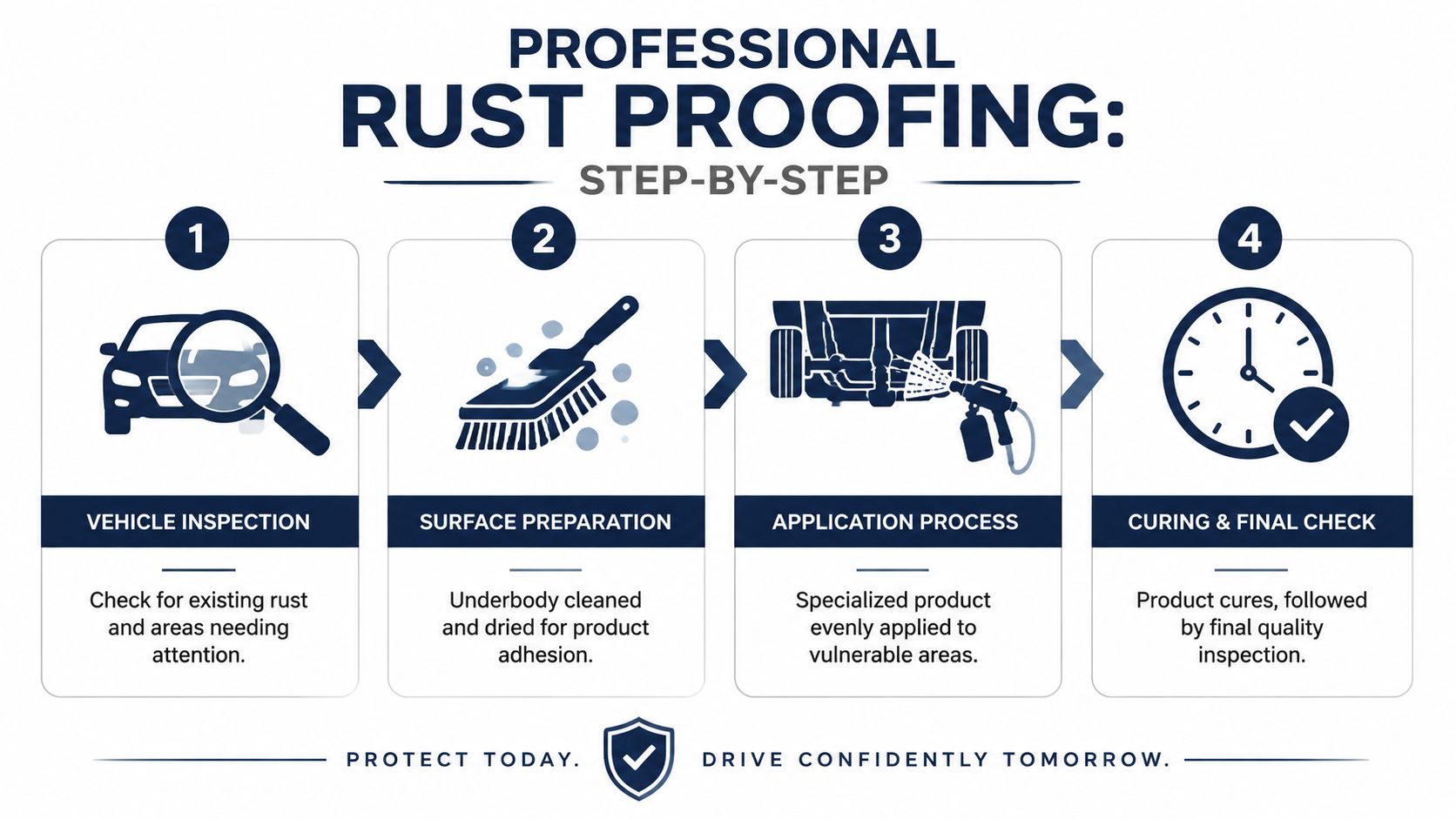
The first step is inspection. A technician looks for existing corrosion, damp buildup, damaged splash shields, and spots where grime has collected heavily. If a vehicle already has flaky rust, the goal shifts slightly. You're not pretending the metal is new. You're trying to stabilise what's there and protect what's still solid.
Then comes cleaning. That matters more than a lot of drivers realise. Salt, mud, and oily road film can block product from reaching the metal or from settling where it needs to. An underbody wash helps clear the surface so the treatment has a fighting chance.
A reputable shop will also think about drying. Spraying over obvious moisture isn't smart. The product needs access to seams, joints, and exposed areas without a layer of fresh contamination in the way.
Where the real work happens
Application is the part customers picture, but technique matters more than theatrics. The technician uses spray equipment to reach the underside, wheel arches, bumper supports, liners, and other corrosion-prone zones. On oil-based jobs, the aim is even coverage plus access to hidden pockets where moisture lingers.
That's where a professional setup beats a driveway shortcut. A lift gives access to the full underside. Proper wands and nozzles let the technician direct product into areas you can't reach well while lying on your back with a consumer aerosol can.
At shops that combine washing and rust protection services, including Nanak Car Wash, the process is built around that sequence. The vehicle gets cleaned first, then treated, which is the logical order for underbody protection.
Shop standard: If nobody checks the underside before spraying, that's a warning sign. Rust proofing works better when the application is based on the vehicle's actual condition.
The last part is cleanup and a final once-over. Good shops make sure obvious overspray is handled, confirm vulnerable areas were covered, and explain what to expect afterward, especially if the product is an oil-based formula that may remain active for a while.
DIY Versus Professional Application
DIY rust proofing has real appeal. You control the timing, you save some money on labour, and if you enjoy working on your own vehicle, it can be satisfying. For the right person, it isn't nonsense.
When DIY makes sense
If you already have ramps or a lift, decent spray equipment, protective gear, space to work, and the patience to prep properly, DIY can be viable. It also helps if you know your vehicle's underside well and don't mind crawling around hunting for missed seams, drain points, and splash-prone areas.
DIY tends to suit owners who enjoy maintenance work and understand that coverage is everything. Missing one hidden seam won't ruin the whole job, but lots of small misses add up.
A realistic DIY checklist looks like this:
- Access: You need safe clearance and room to move around the car.
- Prep: The underside has to be cleaned well enough that you aren't spraying over packed grime.
- Reach: Tight cavities, overlaps, and awkward corners are the whole challenge.
- Tolerance for mess: Oil-based products don't care about your sleeves, garage floor, or driveway.
Why most daily drivers do better with a shop
Most owners don't lack effort. They lack the setup. The average garage floor isn't a pleasant place to coat a vehicle underside thoroughly. Even motivated DIYers often struggle with visibility, coverage, and comfort. You can't protect what you can't reach, and you can't inspect properly if you're working inches off the floor.
Professional application also removes the guesswork around product placement. Shops do this repeatedly. They know the common trap areas, the spots that get blasted by winter spray, and the cavities that matter most on modern vehicles.
If your vehicle is a daily driver and your goal is dependable protection rather than a weekend project, paying for a proper application usually makes more sense than buying supplies, making a mess, and hoping you didn't miss the exact seam where rust likes to start.
How Much Does Rust Proofing Cost in the GTA
A lot of GTA drivers ask about rust proofing right after the first ugly February thaw, when the slush is grey, the roads are white with salt, and the underside of the car is taking a beating every day. Fair question. Between winter tires, insurance, and regular service, nobody wants another vague upsell. Rust proofing is one of the easier maintenance costs to price if you know what you're comparing.

What the market looks like
For a solid Canadian reference point, Krown's pricing page lists $149.95 for sedans and small cars, $159.95 for minivans, standard SUVs, and some pickups, and $169.95 for larger trucks, XL SUVs, heavy-duty pickups, and full-size vans. The same page says most applications take under an hour.
That lines up with what shops around the GTA generally charge for annual oil-spray rust proofing. In practice, most owners in the Salt Belt are deciding between a full-body spray that reaches seams and cavities, or a more limited underbody package focused on exposed metal underneath. The cheaper option can make sense on an older daily driver, but it is not the same service.
Why one quote is $70 and another is $170
Price changes for three main reasons. Vehicle size is the obvious one, but it is not the only one.
- Coverage: Underbody-only service costs less than a full rust proofing application that also treats doors, rockers, hatch areas, and other cavities.
- Vehicle size: A compact sedan takes less product and less time than a pickup, van, or three-row SUV.
- Condition: A clean, fairly dry underside is faster to work on than a vehicle packed with mud, salt residue, and heavy buildup.
- Access and design: Some vehicles have more liners, shields, tight sections, and overlap points that slow the job down.
In the GTA, that difference matters. A Mississauga commuter car doing highway mileage through winter spray has different exposure than a weekend vehicle that rarely sees salted roads. The right quote depends on how the vehicle is used, not just what badge is on the hood.
A practical way to decide what to buy
For most Ontario drivers, the better question is not “What is the cheapest rust proofing?” It is “What level of coverage matches this vehicle and how long I plan to keep it?”
Use this simple framework:
- Keeping the car 1 to 3 more years: Basic underbody protection may be enough if the vehicle already has age, cosmetic wear, or existing rust.
- Keeping it long term: Annual full rust proofing usually makes more financial sense, especially on newer vehicles and trucks.
- Driving mostly in the GTA through winter: Prioritize coverage in wheel wells, rocker areas, seams, and cavities where salty slush sits.
- Already seeing rust spots underneath: Ask for an honest assessment first. Rust proofing slows further corrosion. It does not reverse established rust.
That is the trade-off I explain to customers. Spending less up front can be reasonable. Spending too little on a newer vehicle in Ontario often costs more later when brake lines, fuel lines, subframes, or body seams start showing corrosion.
What to ask before you book
A low advertised price is only useful if you know what is included. Ask direct questions.
- Is this underbody-only, or a full vehicle rust proofing service?
- Are cavities and inner panels being treated, or only visible underside areas?
- Is there any cleaning or prep before application?
- How often does the shop recommend reapplication for GTA winter use?
- If you are comparing local providers, including shops like Nanak, ask how they handle high-salt Ontario driving conditions, not just the base package price.
That last part matters. In the GTA, rust proofing is not a generic service. Ontario's salt load is heavy, roads stay wet for months, and stop-and-go driving keeps grime on the vehicle longer than many owners realize. A useful quote should reflect that reality.
Maintaining Your Vehicle's Protection
Rust proofing isn't a one-and-done event. It works better as part of a routine, especially in a place where winter roads stay dirty for months.
What to check between appointments
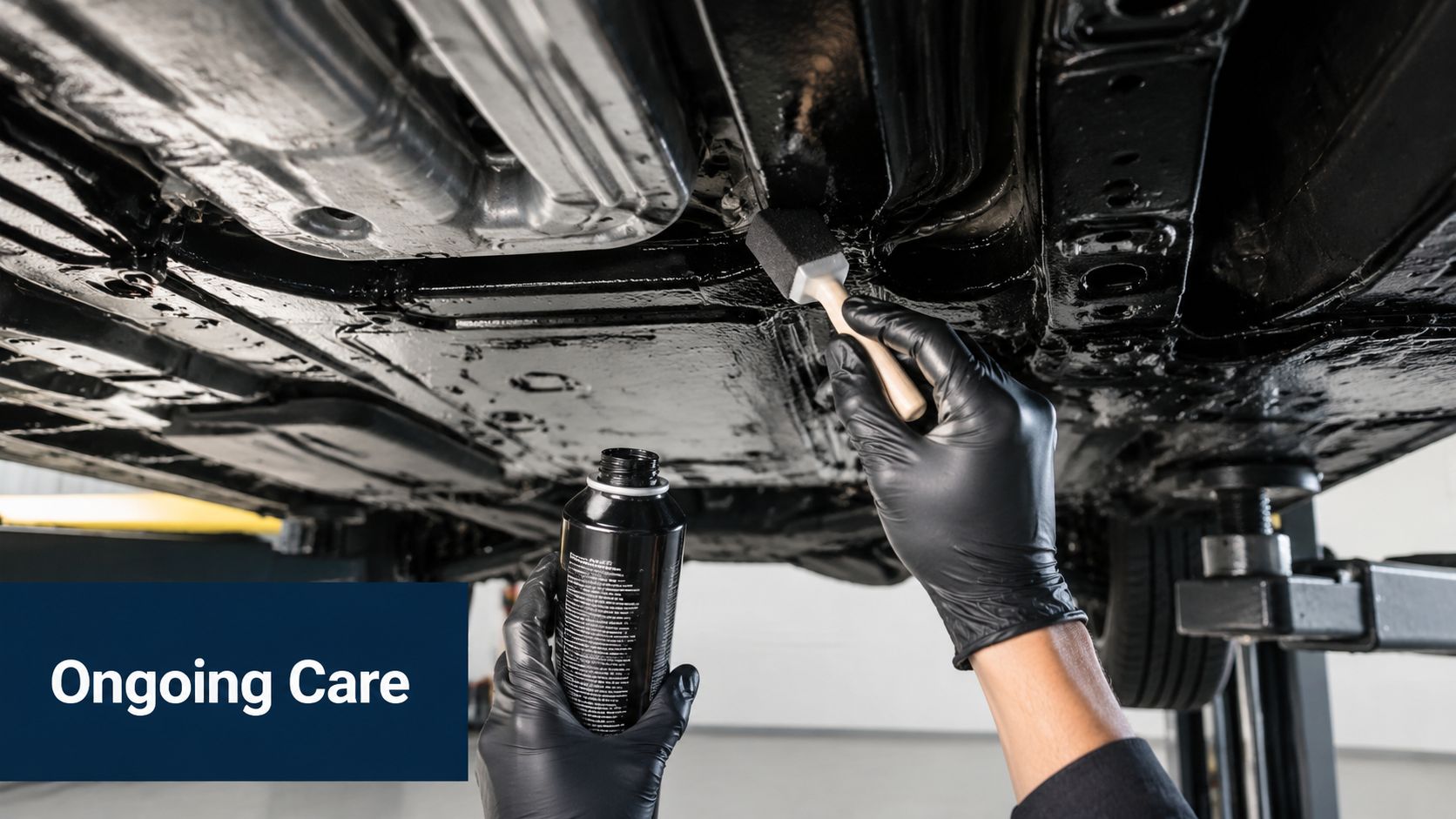
You don't need to become an underbody expert, but you should know what deserves a second look. A quick visual check during tire swaps or regular service goes a long way.
Use a simple checklist:
- Look for washed-off areas: High-spray zones behind wheels and near the rocker area take abuse.
- Check for fresh surface rust: Orange staining around exposed metal or brackets can mean the protection has thinned there.
- Notice physical damage: Bent shields, loose liners, and scraped spots can leave metal exposed.
- Watch drip-sensitive areas: If an oil product has fully worn away in obvious spots, it may be time to book again.
Why washing still matters
Some owners think rust proofing means they can stop worrying about the underside. It doesn't. Protection and cleaning work together. Washing removes fresh salt and grime before they sit on the vehicle for weeks.
In Ontario, regular underbody washing through winter is a smart companion to rust proofing car underbody areas because it reduces the load that the protective layer has to deal with. Even a good treatment lasts better when the underside isn't carrying around a season's worth of corrosive sludge.
A protected underbody still benefits from being clean. Salt left in place keeps testing every weak spot in the coating.
If you want the treatment to do its job longer, don't let the car wear a salt sweater until April.
GTA Rust Proofing Frequently Asked Questions
A few questions come up over and over from GTA drivers, especially from people who've put this job off and aren't sure whether they missed the window.
Is it too late to rust proof an older car
Usually, no. Older vehicles can still benefit. The goal changes, though. On a newer car, you're mostly preventing corrosion from getting established. On an older one, you're slowing what has already started and protecting the solid areas that remain. If the underside is structurally far gone, rust proofing won't reverse that.
Will rust proofing completely stop rust
No. It slows corrosion. That's the honest answer and the one owners should expect. If anyone sells it as permanent or absolute, treat that with caution.
Should I rust proof a new vehicle
If you plan to keep it through Ontario winters, yes, it's worth serious consideration. New vehicles aren't magically immune to salt and moisture. In many cases, starting early is the whole point because it's easier to protect clean metal than to stabilise neglected corrosion later.
Will an oil-based treatment drip
It can, especially shortly after application. That's normal with many oil-based products because they stay mobile and creep into seams. If your driveway is immaculate and any drip annoys you, that trade-off matters. If your priority is penetration into hidden rust-prone areas, a bit of short-term mess is often part of the deal.
How often should it be done
For Canadian conditions, annual service is the standard expectation for oil-based rust proofing. Some dripless products may be described differently, but many experienced shops still favour regular repeat treatment because winter exposure is relentless here.
If your vehicle spends winter in the GTA, rust prevention isn't cosmetic housekeeping. It's maintenance. Nanak Car Wash offers rust proofing alongside wash and detailing services, which makes it practical to pair underbody cleaning with protection instead of treating them as separate chores.

 6600 Finch Ave W, Etobicoke, ON M9V 3Z6
 647-703-8515
 MON – SUN 8 AM to 7 PM