
You know the look. You parked a reasonably clean car on Friday, drove through one GTA snow squall, and by Sunday it looked like it had been dredged out of a salted slush pit. The doors are crusted white, the rear hatch wears a grey film, and the wheel wells are carrying half of Southern Ontario home with them.
That's the moment most drivers start weighing the same question. Is a car wash drive thru just a quick cosmetic fix, or is it one of the smartest maintenance habits you can build in this climate? Around the GTA, where winter grime sticks hard and schedules stay packed, the answer is a lot more practical than glamorous.
Table of Contents
- So Your Car Looks Like a Salty Pretzel
- The Magical Tunnel A Peek Behind the Curtain
- Decoding the Drive-Thru Menu
- The Real Benefits and Honest Limitations
- A Pre-Wash Checklist for a Perfect Finish
- Finding the Best Value for Every GTA Driver
- Drive Away Happy Your Next Step to a Cleaner Car
So Your Car Looks Like a Salty Pretzel
In the GTA, your car doesn't get dirty in a polite, even way. It gets laminated with salt spray, black road film, and that gritty paste that builds up around rocker panels and behind the wheels. By mid-winter, a dark-coloured car can turn chalky in a day.
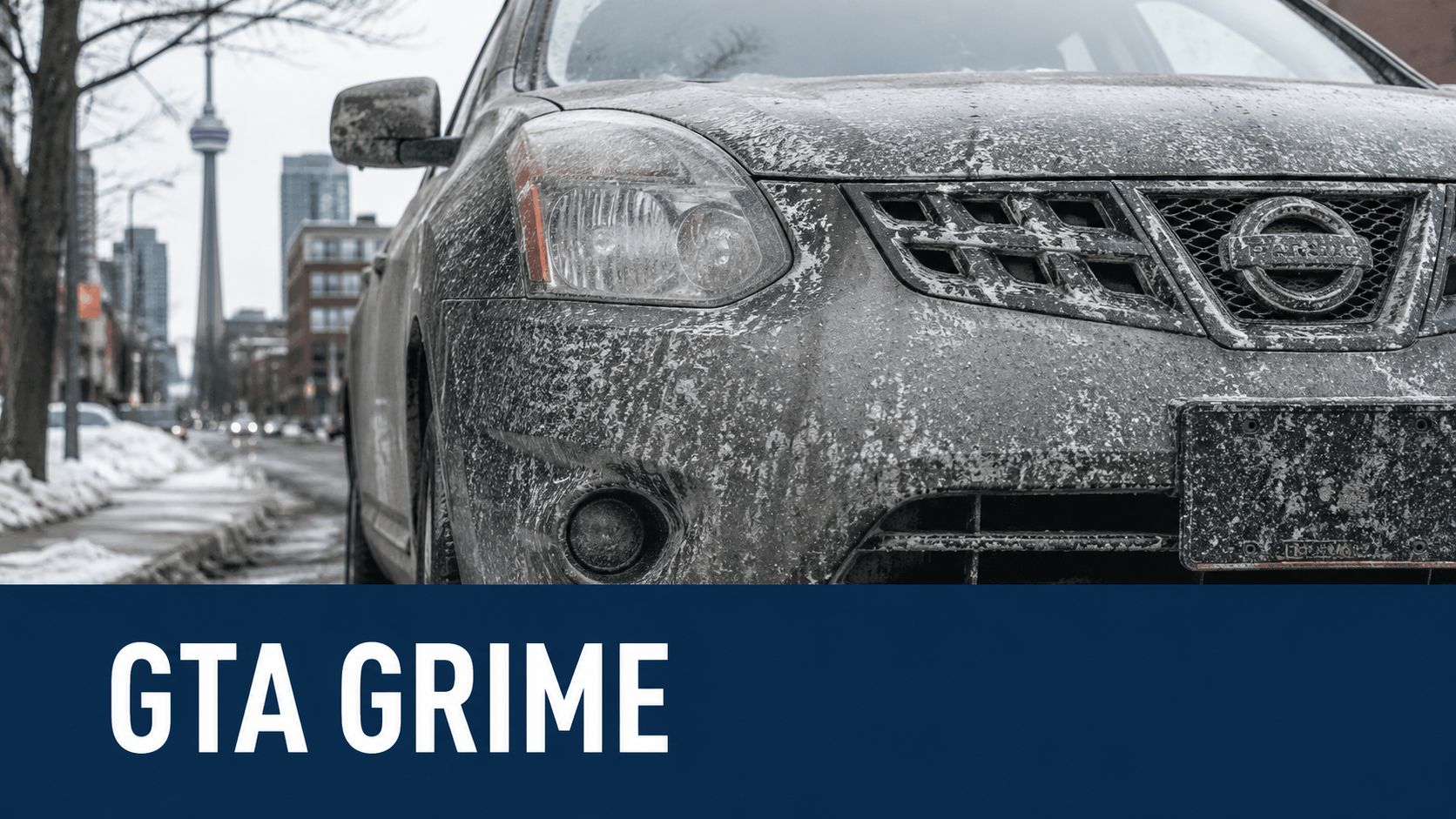
That's why the car wash drive thru isn't some fringe convenience. It's part of regular vehicle care in this province. The Ontario Car Wash & Auto Detailing industry is projected to reach $617.2 million in 2026, with 3.6% annual growth between 2021 and 2026, according to IBISWorld's Ontario car wash and auto detailing industry outlook. Those numbers tell a simple story. Ontario drivers use these services because the climate gives them a good reason to.
Why salt is more than an eyesore
Salt does two annoying things at once. First, it makes your vehicle look neglected even when it's mechanically fine. Second, it settles into the places you don't inspect often enough, especially the underbody, wheel arches, and lower door edges.
If you're new to winter driving here, that's where confusion starts. Many people assume a wash is mainly about shine. In the GTA, it's also about reducing what sits on the car for days at a time.
Practical rule: If your car is wearing a white crust after a storm, don't think of washing as vanity. Think of it as cleanup after exposure.
Why a drive-thru fits real life
A proper hand wash at home sounds noble until you factor in freezing temperatures, apartment parking, and a schedule that's already packed. A drive-thru works because it meets people where they are. You stay warm, the process is quick, and the wash reaches parts of the vehicle most driveway rinses miss.
For many GTA drivers, the smartest habit isn't waiting until the car looks terrible. It's using a wash often enough that salt and film never get firmly settled in the first place.
The Magical Tunnel A Peek Behind the Curtain
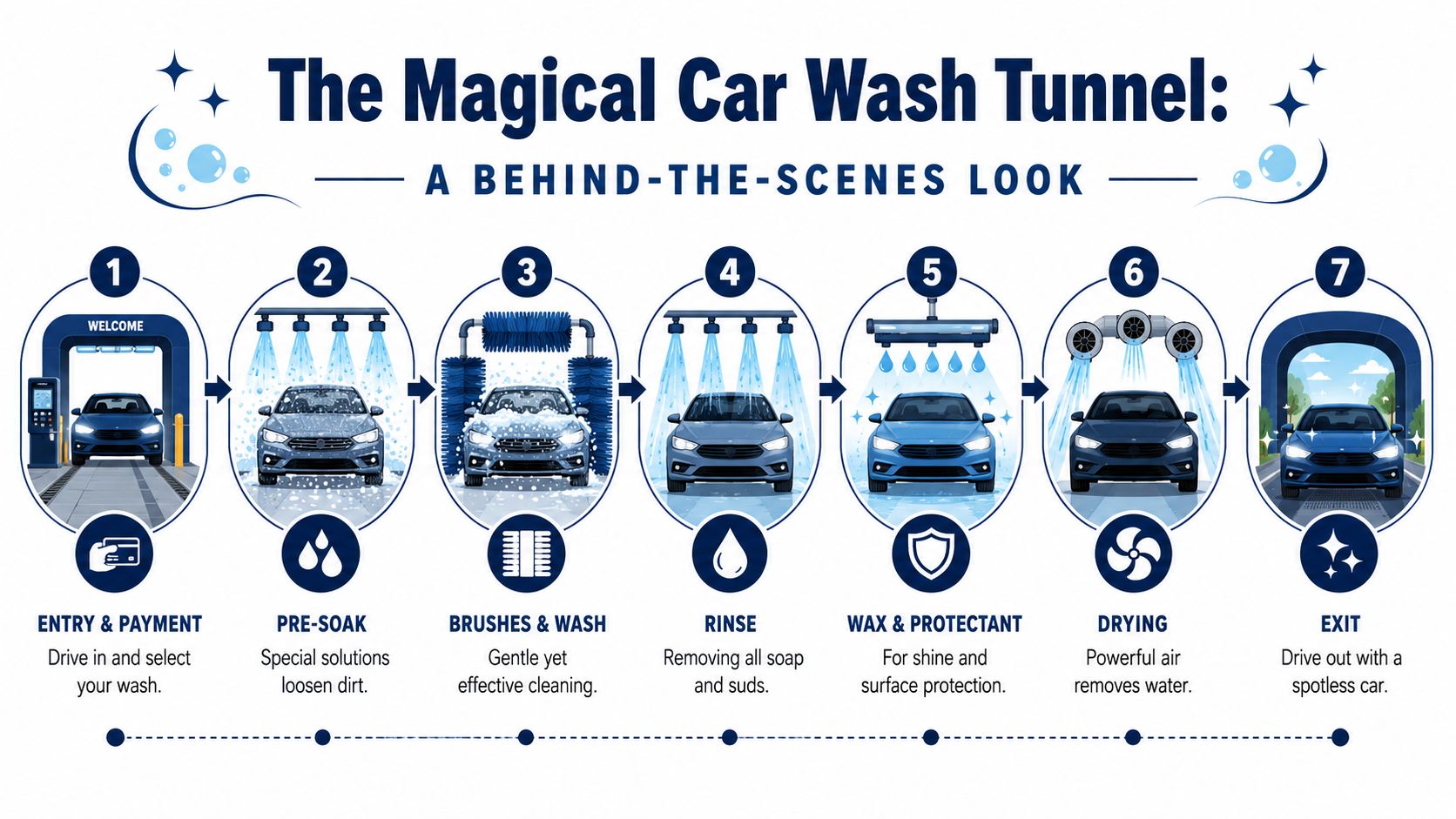
A modern wash tunnel is less random than it sounds from inside your car. It's a sequence. Each stage sets up the next one, like a spa treatment for a vehicle that's had a rough week on the 401.
Why the first spray matters
The opening phase usually looks unimpressive. Water, presoak, maybe some dramatic foam. But it's at this stage that the chemistry starts earning its keep.
In a typical Ontario tunnel, operators use high-pH detergents in the pH 10 to 12 range to break down road salt and grime. The same source notes that this kind of wash chemistry helps reduce corrosion risk, and modern dryers can remove 95% of moisture in under 15 seconds using multiple nozzles running at up to 3,000 RPM, according to KKE's overview of automatic car wash machines in Canada.
What does that mean in plain language? The soap isn't there just to make bubbles. It's there to loosen the ugly bond between your paint and the mess winter throws at it.
Here's the usual order of operations:
- Entry and alignment. Your vehicle gets positioned on the conveyor so the wash equipment can hit the right zones consistently.
- Pre-soak. Chemical solution starts softening road film and salt residue.
- High-pressure application. Water and soap get driven into seams, lower panels, and dirty recesses.
- Mechanical cleaning or touchless pass. Depending on the tunnel, brushes or targeted jets do the heavy lifting.
- Rinse. Soap and loosened grime get flushed away.
- Protectant stage. Wax or sealant adds slickness and helps water sheet off.
- Drying. High-powered air pushes most remaining water away fast.
What the brushes, wax, and dryers are really doing
People often fixate on the fun stuff. Triple foam, hot wax, lava colours, dramatic lights. That's fine. It makes the experience more entertaining than sitting in traffic on the DVP.
But the practical pieces matter more:
- Underbody cleaning helps target the part of the car that takes the worst winter punishment.
- Soft-cloth contact gives physical agitation that chemicals alone may not deliver.
- Wax or sealant doesn't make your car invincible, but it can leave the surface slicker and easier to clean next time.
- Drying agents and blowers reduce leftover water that can spot on warm days or cling around mirrors and trim.
A good tunnel wash feels quick from the driver's seat because the hard work was built into the sequence before you arrived.
The best way to think about it is simple. A solid car wash drive thru is not just soap sprayed at random. It's chemistry, friction, rinsing, and airflow working in a specific order.
Decoding the Drive-Thru Menu
The menu board can be oddly stressful. One option sounds bare-bones. One sounds like a game show prize. One promises “the works,” which could mean anything from useful protection to colourful theatre.
Soft-touch or touchless in a GTA winter
This is the big debate, and GTA conditions make it more interesting.
A touchless wash relies on chemical action and water pressure. It appeals to drivers who want as little physical contact with the paint as possible. That can be a reasonable choice for lightly soiled vehicles.
A soft-touch wash uses gentle cloth or brush contact to physically remove grime. In salt-heavy Ontario conditions, that extra contact can matter. In fact, this discussion of touchless washing and Ontario winter salt highlights a key issue: high-concentration road salt can bypass chemical-only systems, and underbody washes plus rust inhibitors are often necessary for meaningful corrosion prevention.
If your car is dusty in July, touchless may be enough. If it's February and your wheel wells look like they were dipped in a brine bucket, a basic chemical-only wash may leave too much behind.
What the menu names usually mean
Marketing names vary, but the features are usually pretty familiar. This table helps translate them into plain English.
| Feature | Basic Express Wash | Upgraded Wash | Premium 'The Works' Wash |
|---|---|---|---|
| Exterior soap and rinse | Included | Included | Included |
| Drying air blowers | Usually included | Included | Included |
| Underbody wash | Often not included | Commonly included | Commonly included |
| Triple foam or coloured foam | Usually not included | Sometimes included | Often included |
| Wax or sealant | Basic drying aid only | Added surface protection | More complete protection package |
| Rust inhibitor | Often not included | Sometimes included | More likely to be included |
| Best fit | Light dirt, quick spruce-up | Weekly maintenance | Winter grime, heavier buildup |
A few menu terms deserve translation:
- Underbody wash means water is aimed at the underside of the car. In Ontario, that's one of the most useful upgrades on the board.
- Rust inhibitor is there to support salt-season protection. It's not the same thing as a dedicated rust-proofing service, but it's more useful than a cosmetic add-on.
- Triple foam wax mostly improves lubrication and experience during the wash, with some short-term surface benefit.
- Sealer wax usually signals longer-lasting surface protection than the flashy foam stage.
- Lava foam is the crowd-pleaser. Fun, colourful, and satisfying. Just don't confuse it with the feature doing winter defence.
If your main enemy is Ontario salt, choose the package by what it cleans underneath, not by how dramatic the foam looks on the windshield.
The Real Benefits and Honest Limitations
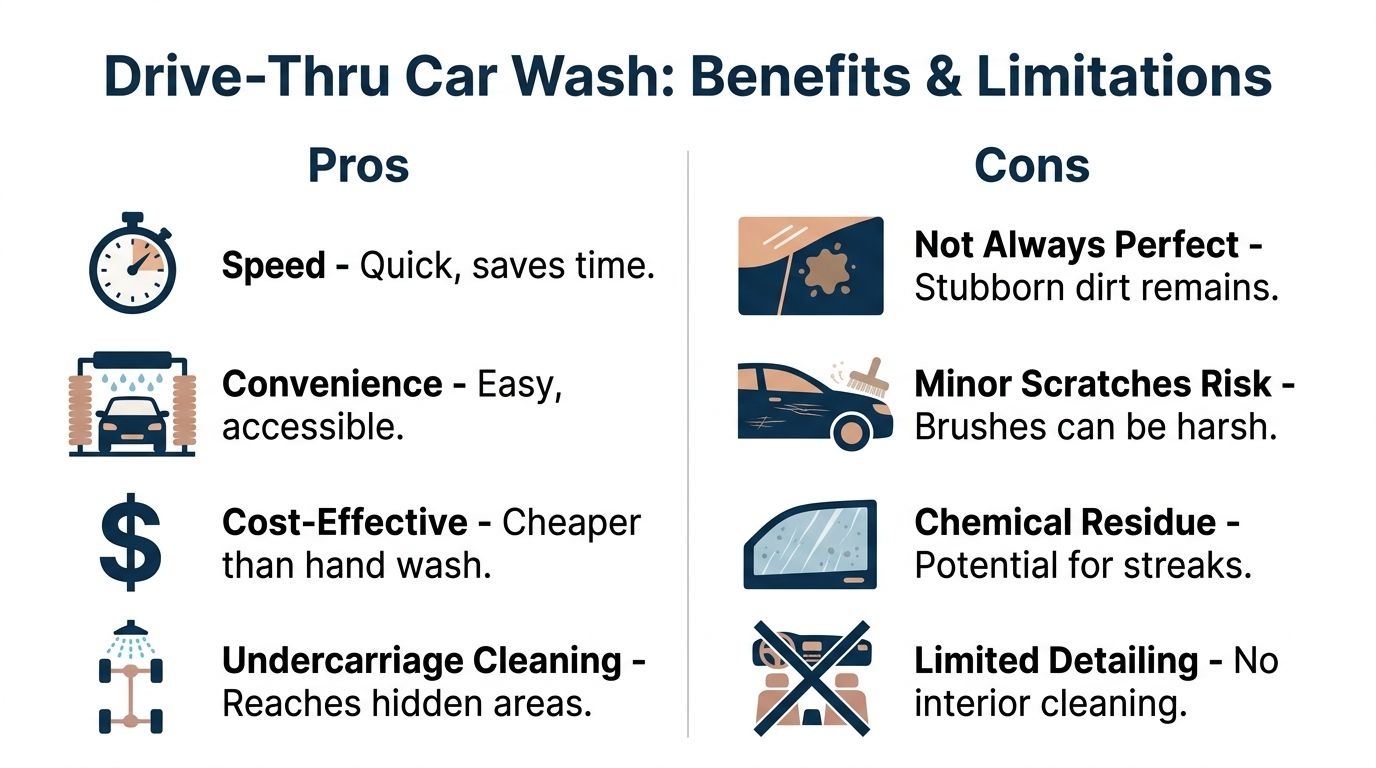
A drive-thru wash deservedly earns its popularity. It's fast, repeatable, and a lot easier to fit into life than dragging out buckets in a slushy parking spot.
Why the convenience is real
One long-standing misconception deserves to disappear. Many people still assume washing in the driveway is greener than using a commercial site. But an Ipsos report on consumer views about car washing and the environment found that only 38% of consumers recognised commercial facilities as the more eco-friendly option, even though commercial systems use controlled water handling and keep harmful runoff out of storm drains.
That matters in a city region full of paved surfaces, drains, and winter contaminants. A well-run facility is designed to contain the dirty stuff instead of sending soap, salt, and grime wherever gravity takes them.
There's also the practical value of speed. If you work in delivery, field service, or retail runs, you already know how useful curbside operations can be for saving time. The same thinking applies to vehicle care. If you're interested in how that efficiency model works in logistics, what is curbside for delivery gives a good plain-language explanation.
What a tunnel wash won't fix
Balance matters here. A car wash drive thru is excellent at maintenance cleaning. It is not bodywork, paint correction, or interior restoration.
It won't:
- Erase scratches that already cut into the paint
- Pull tar or bonded contaminants off every surface in one pass
- Deep-clean upholstery or remove interior odours
- Repair neglected finishes that need polishing or detailing work
It can also leave behind the occasional stubborn patch. Lower rear panels, licence plate recesses, and heavily packed winter grime sometimes need a second pass or extra attention.
That doesn't make the service disappointing. It means you'll get better results when you use the tunnel for what it does best: regular exterior maintenance, especially during salt season.
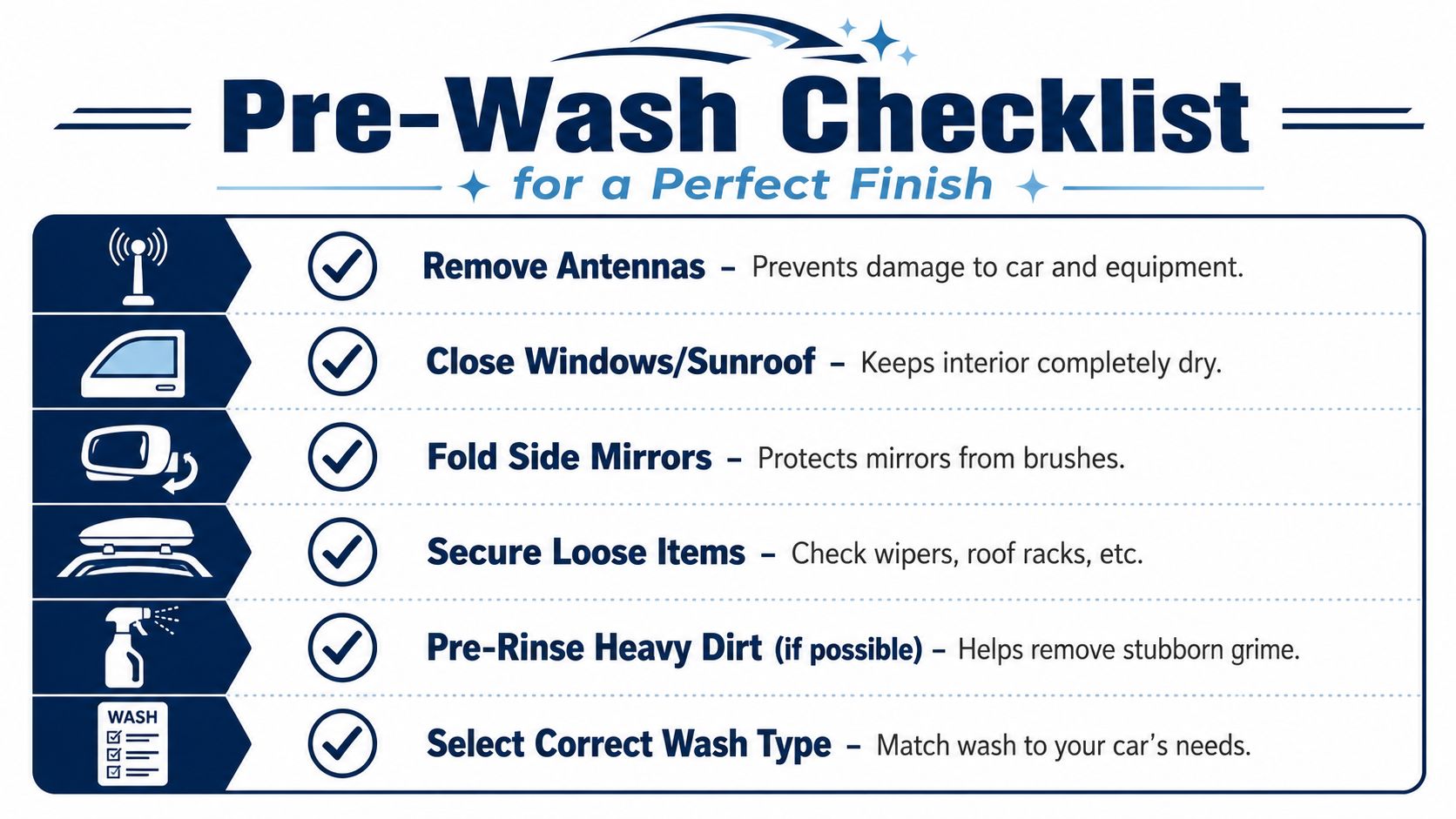
A Pre-Wash Checklist for a Perfect Finish
The wash quality starts before the conveyor even moves. A few quick checks can save you from the small annoyances people wrongly blame on the tunnel itself.
What to do before the conveyor pulls you in
Use this as a fast routine:
- Remove or retract antennas if your vehicle has an older-style mast antenna.
- Close every window and the sunroof. It sounds obvious until one rear window is cracked open by habit.
- Fold mirrors if your vehicle and the wash instructions call for it.
- Check roof accessories like racks, cargo boxes, or add-ons that may not be wash-compatible.
- Secure wipers and loose trim if you already know something is flimsy.
- Choose the wash based on the dirt level. Heavy winter grime usually needs more than the cheapest option.
Most problems come from vehicle condition, not from normal operation. Loose aftermarket trim, damaged mirror caps, or half-attached accessories are common troublemakers.
Why modern equipment is gentler than many people think
People still talk about automated washes as if every tunnel is stuck in the brush-slap era. Modern systems are far more controlled.
According to CRD information on vehicle washing systems and requirements, sensor-calibrated brushes maintain 8 to 12 psi of contact force, causing less than 0.03 microns of paint abrasion per wash. The same source notes that a typical manual hand wash averages 0.15 to 0.25 microns because debris can get dragged unpredictably across the surface.
That surprises a lot of drivers. The hand wash feels gentler, but if a mitt or sponge picks up grit, your paint pays for it.
Clean, calibrated equipment with controlled pressure can be kinder to paint than an enthusiastic driveway scrub with trapped debris.
The best habit is simple. Inspect your vehicle, follow posted instructions, and don't treat the tunnel like a test track for accessories you forgot were attached.
Finding the Best Value for Every GTA Driver
A GTA winter can turn a normal driving routine into a salt-delivery service for your own car. By February, value is not really about shiny foam or a nicer receipt. It is about how cheaply and consistently you can clear off the grime that keeps coming back.

Unlimited plans sound appealing, but the math changes by driver type. Frequency matters. Route habits matter. In the GTA, winter road salt matters most of all because it keeps resetting the problem every time the roads are wet.
The occasional commuter
If your car handles office runs, groceries, and the usual weekend loop around the city, a membership can still be worthwhile. The biggest benefit is often behavioral. Prepaid washes remove the little debate in your head about whether today's grime is bad enough to justify another visit.
That matters more than it sounds.
A commuter who washes soon after a sloppy storm usually spends less effort catching up later. It works like brushing snow off your driveway before people trample it down. Small, regular passes are easier than dealing with a packed mess after it sits.
For this driver, the value usually comes from:
- Predictable monthly cost
- More consistent wash habits
- Less salt and film sitting on the vehicle between storms
The SUV or pickup owner
Bigger vehicles often get more out of a higher-tier wash, especially in Ontario winter. An SUV, van, or pickup has more lower-body area collecting slush, grime, and spray from the vehicle ahead. You also notice the mess less at eye level while the dirtiest parts build up down low.
That makes package choice more practical than cosmetic.
Ask a simple question. Does the plan mainly add visual extras, or does it help you clean the areas that take the worst beating from salt and road spray? For larger vehicles, that distinction matters because a flashy top coat is nice, but cleaning the hard-working lower sections usually delivers more day-to-day value.
The Uber, Lyft, and delivery crowd
For high-frequency drivers, unlimited plans become particularly interesting.
If you drive for Uber, Lyft, or delivery apps, your car is part workplace, part waiting room, and part first impression. A clean exterior signals care before a passenger even opens the door. Clean glass and mirrors also help on wet, dirty nights when road film builds fast and visibility starts to suffer.
The return usually comes from a few practical places:
- Lower cost per wash if you are visiting several times a week
- Less time spent cleaning at home or hunting around for single-wash deals
- A better presentation for riders, customers, and ratings-driven work
- Less heavy buildup because frequent quick washes prevent the car from getting buried in grime
There is a route-planning angle too. A membership only pays off if the locations fit where you already drive. If every visit means fighting across town traffic, the savings on paper can disappear into wasted time and fuel.
That is the true GTA test.
For a high-mileage driver, ROI is not only a dollar figure. It is also fewer awkward pickups in a crusty car, fewer minutes spent scrubbing in a parking lot, and a steadier routine during the months when Ontario roads keep throwing salt back at you.
Drive Away Happy Your Next Step to a Cleaner Car
The GTA is hard on paint, wheels, and underbodies. Snow, slush, road film, and salt don't wait for a convenient time, and they don't care whether you meant to wash the car last weekend. That's why a car wash drive thru works so well here. It gives you a fast, repeatable way to manage the mess before it becomes a habit on your vehicle.
The trick is choosing with your eyes open. If winter salt is your main problem, look past the colourful foam and focus on underbody cleaning and practical protection. If you're worried about safety, modern calibrated equipment is gentler than many people assume. If you drive constantly for work, a membership can be as much an operational tool as a car-care purchase.
A clean car in the GTA isn't about vanity. It's about making smart, regular maintenance easy enough that you'll do it.
If your car is wearing this week's salt storm or you want a simpler routine for year-round upkeep, take a look at Nanak Car Wash to find a nearby location, compare wash options, and see whether an express wash, rust proofing service, or Unlimited Wash Club fits how you drive.

 6600 Finch Ave W, Etobicoke, ON M9V 3Z6
 647-703-8515
 MON – SUN 8 AM to 7 PM