
Ontario drivers are still being sold a neat little fantasy: bolt on a box, forget about rust, and let invisible electrons do what wash bays, wax, and underbody care supposedly can't. The problem is that corrosion doesn't care about marketing language. It cares about salt, moisture, trapped grime, and whether the steel under your car keeps getting cleaned and protected after every winter drive.
| Approach | What it claims | What the evidence-backed sources say | What you're really buying |
|---|---|---|---|
| Electronic rust prevention | A weak current or pulse is supposed to interrupt oxidation inside the body | Canadian consumer and technical sources report no credible proof it reduces road-vehicle corrosion, and lab comparisons have gone badly for at least one branded device | A debated aftermarket gadget, often sold at a premium |
| Chemical rustproofing | A coating or spray creates a physical moisture barrier on exposed metal | Mainstream Canadian advice still points to washing, underbody cleaning, wax, and professional rustproofing as the practical defence in salty winters | A recurring maintenance habit with a visible service result |
Table of Contents
- The Two Rust-Proofing Philosophies Facing GTA Drivers
- How Electronic Rust Prevention Claims to Work
- What the Lab Tests and Independent Reviews Actually Show
- The Real Cost of Going Electronic vs Chemical
- Electronic Modules Against Modern Vehicles and Electronics
- Which Approach Fits Which GTA Driver
- The Smart GTA Play and When Nanak Car Wash Fits
The Two Rust-Proofing Philosophies Facing GTA Drivers
A GTA winter car wash tells you almost everything you need to know about this debate. The lower panels are streaked white, the wheel wells are packed with slush, and the owner is asking a reasonable question, why does every season seem to attack the underside of the car so aggressively? In southern Ontario, that question matters because road salt is routine, and mainstream Canadian advice still treats washing, underbody cleaning, and waxing as the basic defence against corrosion CARFAX maintenance guidance.
Two ways to fight the same enemy
Electronic rust prevention sits in one camp. It is marketed as a low-current module that attaches to the vehicle and is supposed to influence corrosion from the inside, without adding a coating or requiring repeated reapplication Reader's Digest Canada explainer. The other camp is physical protection, oil sprays, rustproofing coatings, waxes, and underbody treatments that try to keep water, salt, and grime off the steel in the first place.
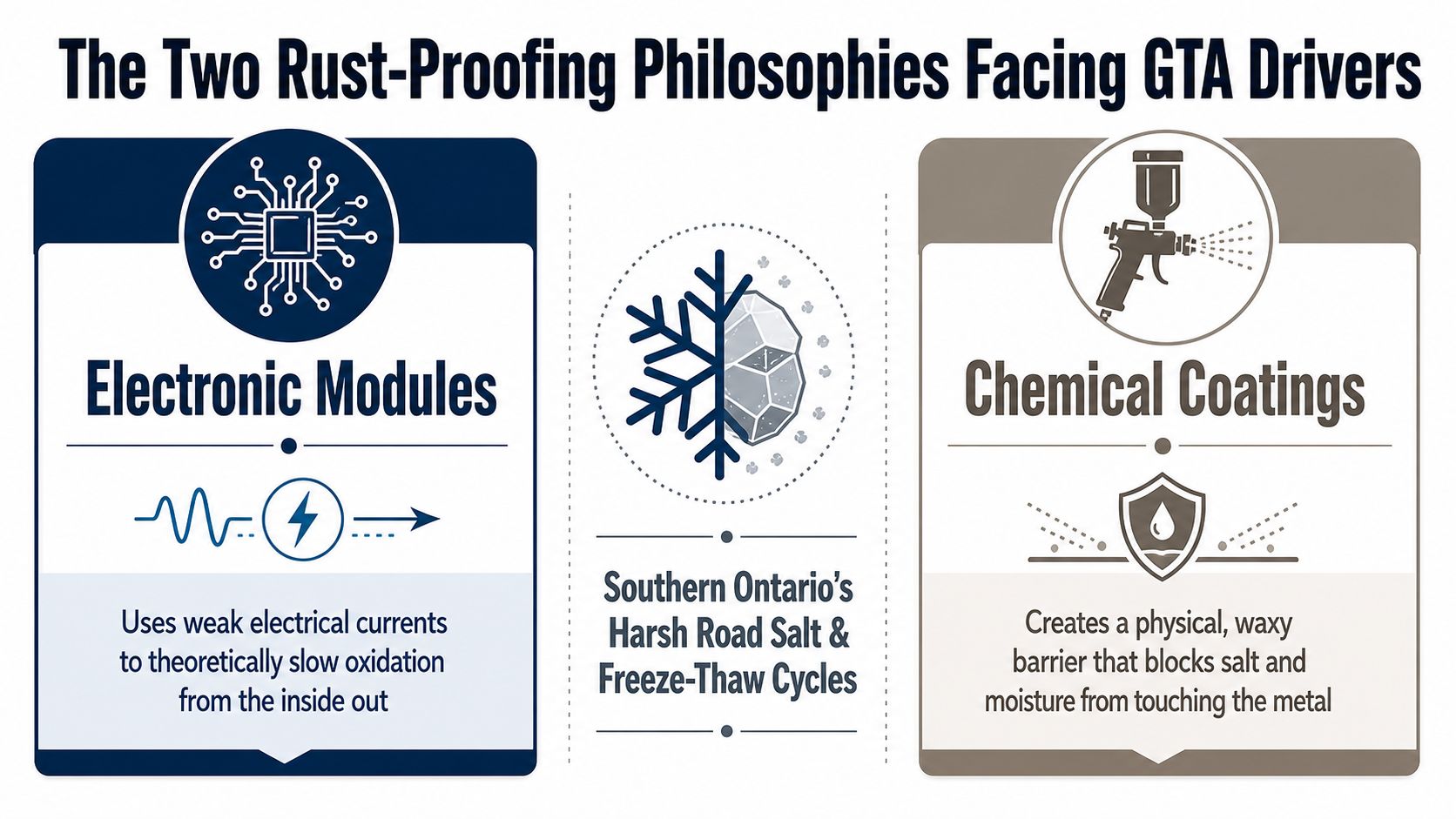
The distinction sounds small until you drive through February. Salt slush gets thrown into seams, onto the frame, and into wheel wells, then sits there while temperatures swing above and below freezing. That's why the industry argument splits into two philosophies, the gadget that claims to work from within, and the coating that works by making the steel harder to reach.
Practical rule: if a rust-prevention pitch sounds like it doesn't depend on cleaning, rinsing, or reapplication, assume the salesperson wants you to stop asking about the underside of the car.
What the rest of the decision really comes down to
The choice isn't between “modern” and “old-fashioned.” It's between a claim about altering corrosion electrically and a service that creates a physical barrier against the stuff that causes rust in the first place. That matters because Canadian consumer guidance has consistently treated electronics as an aftermarket add-on, while traditional rustproofing remains tied to routine maintenance and the realities of winter road salt Rates.ca rust guide.
For a GTA owner, the practical question becomes blunt. Do you want to pay for a device that promises to influence chemistry invisibly, or do you want to pay for the services that are still recommended when salt hits the underbody every week? The evidence trail makes that choice much less romantic than the advertising does.
How Electronic Rust Prevention Claims to Work
Electronic rust modules are sold on an appealing idea. If rust is an electrochemical reaction, then a weak current should be able to interfere with it. That sounds tidy, and for a non-engineer it's easy to imagine the car body as a kind of giant metal pipe with a problem that electricity can somehow neutralise.
The theory in plain English
The claim is that the module sends a weak current through the vehicle's metal body and alters the conditions that let oxidation keep spreading Reader's Digest Canada explainer. In the simplest analogy, think of a water pipe system where the wrong mix of oxygen, moisture, and metal starts a breakdown process. The electronic device says it can change the electrical environment so the breakdown doesn't get traction.
That is very different from a coating. A chemical rustproofing treatment doesn't try to persuade the steel to behave better. It coats vulnerable areas so salt water has a harder time touching bare metal. One approach is an internal theory, the other is a physical obstruction.
Why the sales pitch is so persistent
The pitch works because it's convenient. Install once, then stop thinking about rust. No annual reapplication, no messy underbody spray, no appointment every season. Canadian coverage has described these systems as professionally installed aftermarket modules attached to the chassis, which helps explain why they're sold as a premium convenience product rather than a maintenance service Reader's Digest Canada explainer.
But convenience isn't proof. The most important thing to understand is that the electronic category claims to prevent corrosion without building a barrier, which means its value depends entirely on whether the invisible mechanism works under road conditions. That's the part the lab evidence has struggled to support.
Bottom line: if a rust solution depends on a theory you can't see and nobody can benchmark in normal winter driving, you should treat it like an unproven claim, not an upgrade.
Why the distinction matters to Ontario drivers
For Ontario owners, the mechanism question isn't academic. Salt-heavy winters punish exposed metal, and the protection that matters is the protection that stays effective after slush, wash cycles, and freeze-thaw abuse. The gadget story sounds elegant. The coating story sounds less glamorous, but it's the one that matches the environment cars live in.
What the Lab Tests and Independent Reviews Actually Show
The clearest answer comes from the sources that are least interested in selling you anything. An Ontario auto-service comparison reported that the Counter Act Electronic Rust Protection device did not prove out in the laboratory, while Krown T-40 dramatically out-performed it under the same test conditions Niagara Chrysler comparison. That's not a subtle result, and it's the sort of comparison drivers should care about far more than brochure language.
The evidence gap is bigger than one bad comparison
The broader problem is that independent technical sources don't just say the category is imperfect, they say the proof is missing. Corrosion Doctors states that no peer-reviewed scientific testing supports these devices and that corrosion-control professionals do not consider them effective Corrosion Doctors. That's a strong position, and it's important because it comes from a source focused on corrosion rather than retailing a competing product.
Mainstream Canadian journalism has pointed in the same direction. The Globe and Mail reported the Automobile Protection Association's view that electronic rust protectors would “eat a hole through your wallet” and that it had seen no studies proving they protect cars on the road The Globe and Mail report. The article also noted that some vehicles, including Hyundai models, already come with factory rust-prevention coating, which makes the added electronic pitch even harder to justify for many buyers The Globe and Mail report.
The independent verdict, side by side
| Method | Lab Performance | Independent Expert Position |
|---|---|---|
| Electronic module | One Ontario comparison says the Counter Act device did not prove out in the laboratory | Corrosion Doctors says no peer-reviewed testing supports it, and Canadian reporting describes it as unproven on road vehicles |
| Chemical rustproofing | The same comparison says Krown T-40 dramatically out-performed the electronic device | Still treated by mainstream automotive guidance as a practical anti-corrosion measure for salted winters |
A sane reading of that evidence is simple. Electronic modules are not positioned as a substitute for underbody protection on salt-heavy roads, because the strongest available public evidence doesn't show them outperforming a real coating in meaningful conditions. They might be a purchase for people who like the idea of a set-and-forget device. They are not a credible first-line answer to Ontario winter rust.
The Real Cost of Going Electronic vs Chemical
The money story gets messy fast, because the electronic industry likes to talk about one-time purchase convenience while retailers and dealers stretch the price in very different ways. A Canadian rust guide described retail electronic modules at around $150, while dealers may charge about $500 to $1,000 The Globe and Mail report. That spread alone should make any buyer pause.
Sticker price is only half the story
Chemical rustproofing sits in a much more predictable lane. Canadian guidance says rustproofing services commonly start around $130 and run to $170, with reapplication recommended every 18 months CARFAX guidance. That means the service is priced like maintenance, not like a miracle device.
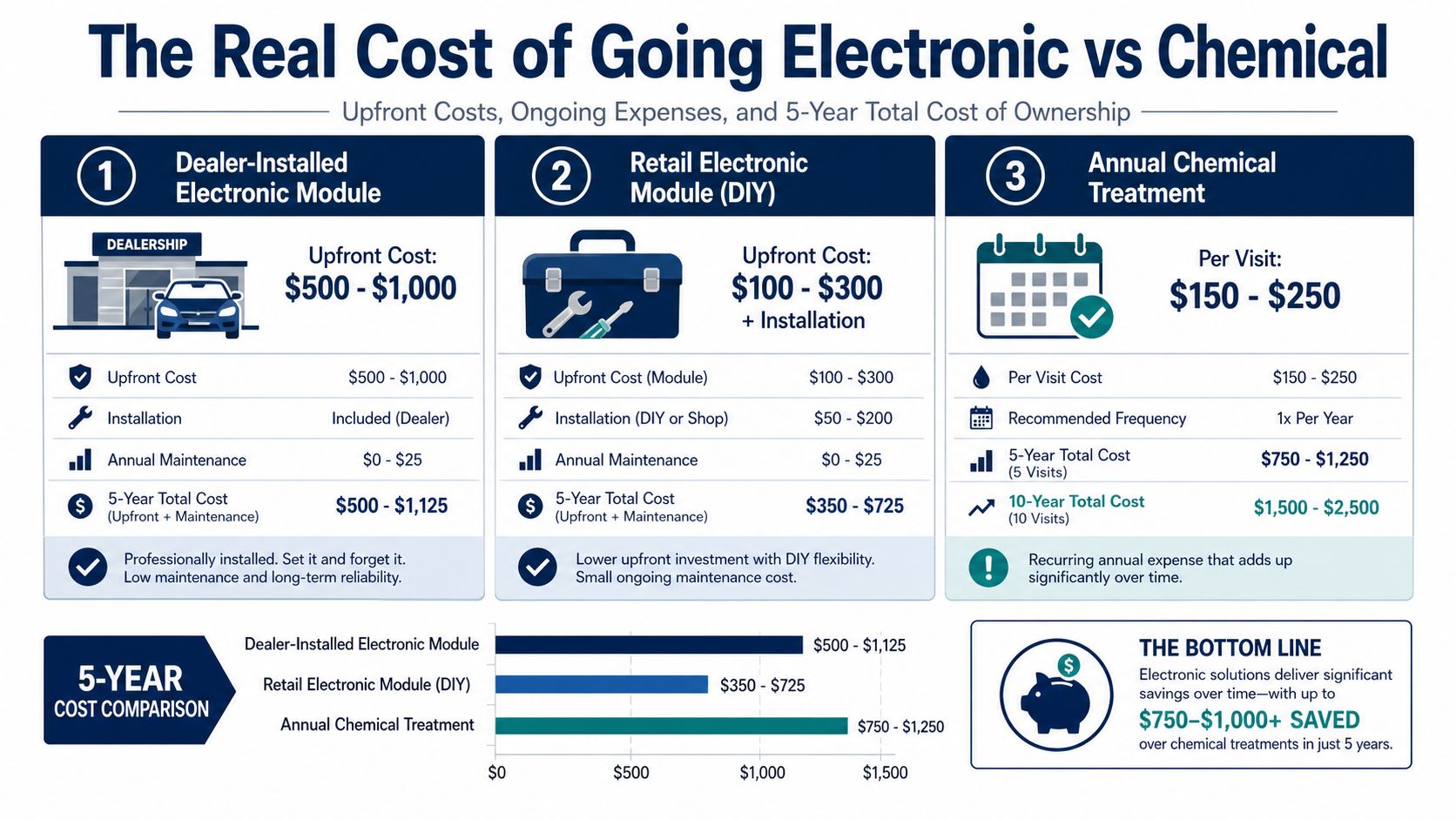
The difference becomes obvious if you think in cycles rather than first invoices. A dealer-installed electronic module is a single upfront purchase with no built-in refresh cycle. A chemical treatment is a repeat service, but the repeat is part of the value, because corrosion protection in a salt climate is not a one-and-done event.
What that means for a real buyer
If you're choosing between a dealer quote and routine rustproofing, the electronic option only looks cheaper if you ignore the effectiveness question. Once you factor in the unresolved proof problem, the premium price becomes a bet, not an investment. The chemical route, by contrast, stays anchored to a service model that Canadian sources still recommend for winter-driven corrosion control CARFAX guidance.
Practical takeaway: a higher price is easier to accept when the product has evidence behind it. Without that evidence, expensive just means expensive.
There's also the hidden cost of complacency. A gadget can make a driver feel protected while the underside keeps collecting salt. A coating service at least keeps the owner tied to a recurring maintenance habit, which is exactly what Ontario vehicles need if they live outdoors, commute daily, or sit in slush between washes.
Electronic Modules Against Modern Vehicles and Electronics
The compatibility question is where this topic gets under-discussed. Modern vehicles aren't simple lumps of steel with a battery attached. They're dense networks of control modules, ground points, sensors, and, in hybrids and EVs, high-voltage hardware that rust-prevention advice already treats carefully [Ontario vehicle electrification note in the brief]. That creates a sensible question, can an aftermarket current-based device coexist cleanly with today's electronics?
What the concern is, in practical terms
An electronic rust module is still a device that sends current through the body. On older vehicles, that sounds harmless enough to a salesperson. On newer platforms, the body is part of a much more complicated electrical ecosystem, and even the rust-prevention industry's own advice is shifting toward architecture-specific caution around exposed hybrid cables and high-voltage components [vehicle-architecture caution in the brief]. That alone should make blanket promises feel outdated.
The big gap is not just interference. It's silence. Most marketing for these devices doesn't answer whether they affect CAN-bus systems, grounding points, battery management systems, or warranty conversations. That's a real problem because buyers aren't just protecting sheet metal anymore, they're protecting software-heavy cars that cost a lot more to confuse than a 1990s sedan ever did.
A side-by-side buyer check
- Installation: electronic modules are marketed as professionally installed, but they still depend on aftermarket wiring and proper placement Reader's Digest Canada explainer.
- Maintenance: electronic systems are sold as low-maintenance, while chemical protection needs reapplication and wash discipline CARFAX guidance.
- Salt performance: the evidence-backed sources still favour physical cleaning and coatings over gadgets in salted winters CARFAX guidance.
- Evidence: the strongest public reviews describe electronic protection as debated and unproven Corrosion Doctors.
- Warranty impact: aftermarket electronics introduce a question that coating services usually don't, because they involve wiring and a device attached to the vehicle.
That last point matters more than many owners admit. A spray treatment can be messy, but it's conceptually simple. A current-emitting module introduces another electrical component into a car that probably already has enough of them.
Which Approach Fits Which GTA Driver
A daily 401 commuter does not need a philosophy seminar. That driver needs the underside of the car to survive repeated salt exposure, regular slush, and the rinse cycle between workdays. For that pattern of use, the evidence-backed answer is frequent washing plus a chemical rustproofing habit, not a one-time electronic gadget CARFAX guidance.
Three drivers, three realistic decisions
A ride-hail or delivery driver is in even worse shape, because the vehicle stays exposed and racks up more road grime. For that owner, recurring underbody cleaning and a repeat treatment schedule make sense because the car never really gets a break. The added miles don't make an electronic module more convincing, they make maintenance more important.
A weekend SUV or truck owner has a different profile. If the vehicle spends a lot of time parked and sees less winter exposure, the urgency drops, but the logic stays the same. A chemical treatment still fits better than a debated device, unless the owner has a very specific reason to experiment with a gadget and accepts that the evidence is thin.
Rule of thumb: the more winter road time a vehicle sees, the less sensible it is to gamble on an unproven box and the more sensible it is to keep salt off the metal.
The one modern wrinkle that doesn't get enough airtime is electrified vehicles. Ontario's fleet is moving toward more battery-electric and plug-in hybrid models, which makes it even more important to think about how an aftermarket current-based device sits beside high-voltage architecture. That doesn't prove incompatibility, but it does make the silence around compatibility harder to ignore.
Where the split really lands
If a driver wants a protection plan that aligns with what Canadian automotive sources still recommend, the answer is straightforward. Wash more often, get the underbody cleaned, and use a rustproofing treatment that creates a barrier and can be renewed. If the driver wants a gadget because it feels cleaner and more convenient, that's a preference, not a conclusion supported by the current evidence.
The Smart GTA Play and When Nanak Car Wash Fits
For most GTA drivers, the sensible choice is still the boring one. Use frequent washing to keep salt from sitting on the underbody, then back that up with chemical rustproofing on a repeating schedule. That's the strategy Canadian maintenance guidance keeps returning to, and it matches the way Ontario winters punish vehicles CARFAX guidance.
What that looks like in real life
The daily commuter should treat the wash bay as part of rust prevention, not just appearance care. The ride-hail driver should think in terms of routine underbody cleaning and repeat protection, because the car never stops collecting corrosive film. The weekend driver can stretch intervals, but shouldn't mistake a lightly used vehicle for a corrosion-proof one.
Nanak Car Wash fits that logic because it offers rust proofing applications using a dedicated chemical compound, with size-based pricing of about $119.95 to $149.95 plus tax, alongside wash services and memberships Nanak Car Wash service lineup. Its Unlimited Wash Club also gives a practical way to keep salt from building up between treatments, which is the part gadget marketing usually skips.

That combination matters more than the brand name. A repeatable wash habit plus a physical rustproofing service lines up with the evidence, while an electronic module still depends on claims that independent sources have not been able to validate.
If you want a rust-prevention plan that matches Ontario driving instead of marketing copy, visit Nanak Car Wash and look at the wash and rust-proofing options side by side. The smartest move is usually the one that keeps salt off the car, not the one that promises electrons will save you after the damage is already sitting under the rocker panels.


 6600 Finch Ave W, Etobicoke, ON M9V 3Z6
 647-703-8515
 MON – SUN 8 AM to 7 PM