
You pull into the driveway after a wet GTA commute, step out, and see the familiar winter artwork: grey road film, gritty salt, and dull paint where yesterday's shine used to be. You wash the car, drive through another slushy stretch, and the whole cycle starts again. For many Ontario drivers, keeping paint clean can feel like trying to dry a floor while someone's still walking through the room.
That's why the question what is ceramic coating for cars has moved from enthusiast forums into everyday conversations among commuters, SUV owners, ride-hailing drivers, and anyone who keeps a vehicle outdoors. Is it a fancy wax? Does it stop scratches? Can it make winter washing easier? Does the upfront cost make sense compared with repeated washes and seasonal salt removal?
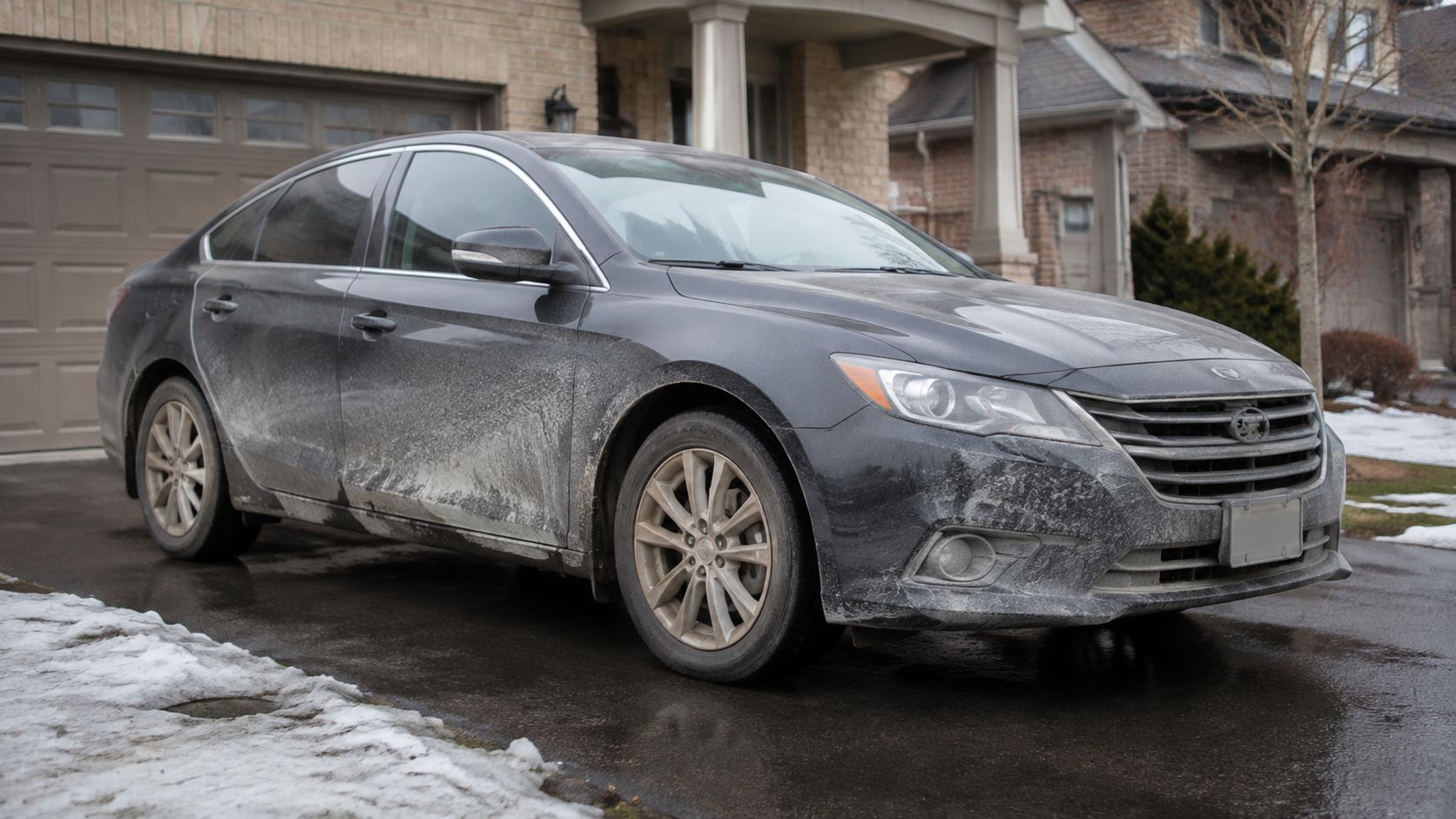
Table of Contents
- Introduction to Ceramic Coating and Why GTA Drivers Ask About It
- What Ceramic Coating Really Is and How It Bonds to Your Paint
- What Ceramic Coating Can and Cannot Do for Your Car
- Ceramic Coating Versus Wax and Paint Sealants Compared
- How Professional Ceramic Coating Is Applied and How Long It Takes
- Cost Durability and Maintenance Expectations in Ontario
- Keeping Your Coating Looking Great With Help From Nanak Car Wash
Introduction to Ceramic Coating and Why GTA Drivers Ask About It
Ontario gives automotive paint a demanding workload. Winter road salt sits in seams and wheel arches, wet roads spray grime along the doors, summer sun contributes to fading, and bird droppings or acidic contamination can mark an unprotected clear coat if they remain too long. A normal wash removes the mess, but it doesn't create a lasting barrier between the next drive and the paint.
Wax helps, but it behaves like a replaceable raincoat. It sits over the surface and gradually wears away through washing, weather, and daily contact. Ceramic coating takes a different approach. Ontario detailing providers describe it as a liquid polymer that chemically bonds to the paint, creating a semi-permanent layer that's harder than the clear coat and hydrophobic. Ceramic Pro Vaughan describes its practical role around road salt, UV exposure, and contaminants.
Why this matters for daily drivers
A ceramic coating doesn't turn a car into a showroom sculpture that never needs attention. It changes the maintenance experience. Water tends to bead or sheet away more readily, road film has less opportunity to cling tightly, and washing can become less of a wrestling match with a bucket and mitt.
The technology has become established across the Greater Toronto Area and Ontario, where several providers now present ceramic coating as a standard paint-protection option rather than an unusual upgrade. Published local examples place the service in the premium category, with packages starting at different levels depending on the product, vehicle, preparation, and promised service life. Ceramic Pro Toronto shows how GTA providers position coating around weather exposure and easier cleaning.
The useful question isn't “Will coating make my car invincible?” It's “Will a bonded protective layer save enough effort and paint stress to justify its cost for my driving routine?”
This guide answers that question from the surface chemistry outward. You'll see what the coating is, what it can and can't do, how it compares with wax, what professional installation involves, and how to judge the economics against frequent washes, salt exposure, parking conditions, and GTA wash memberships.
What Ceramic Coating Really Is and How It Bonds to Your Paint
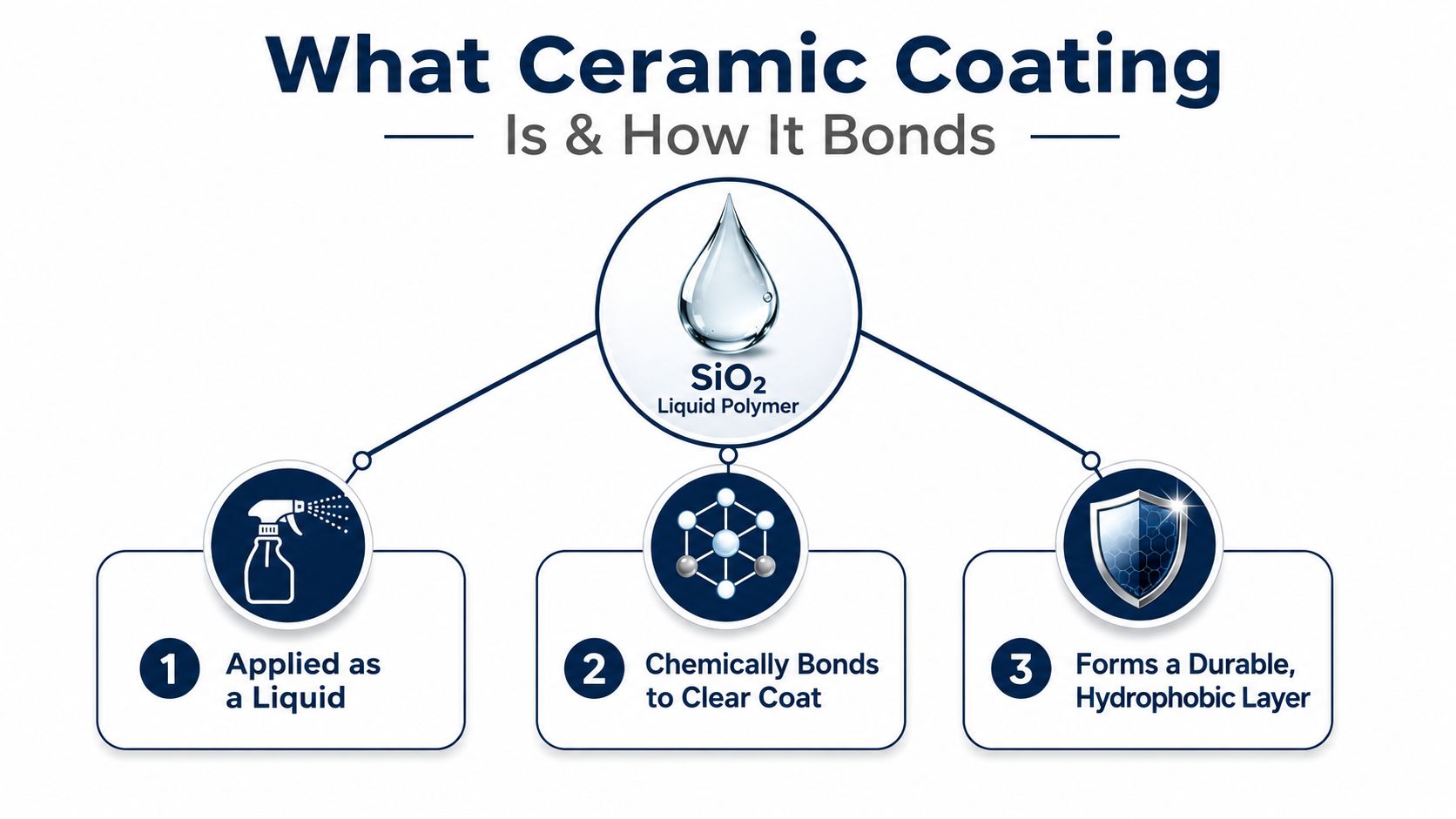
Ceramic coating is a liquid polymer, usually based on silicon dioxide, or SiO2, that cures into a thin protective film. Unlike wax, it isn't designed to sit on the surface until the next few washes. The product is applied to prepared paint, bonds chemically with the clear coat, and forms a semi-permanent layer with hydrophobic behaviour.
Think of the clear coat as the outside skin of the vehicle. Wax is like laying a soft blanket over that skin. The blanket can make the surface look richer and help water roll away, but it remains a separate layer. Ceramic coating is closer to adding a very thin glass-like skin that becomes integrated with the surface as it cures.
Ceramic coating starts as a liquid, chemically bonds to the clear coat, then hardens into a dense, water-repelling layer.
The bonding process in plain language
First, the installer cleans and prepares the paint so oils, embedded contamination, and polishing residue don't interfere with adhesion. The coating is then spread across small sections rather than dumped over the entire vehicle at once. As the product flashes and cures, its silica structure forms a network that grips the prepared clear coat.
Professional coatings in Canada are commonly specified at about 1 to 2 microns of cured film thickness, according to 3M Canada's ceramic coating information. That's extremely thin compared with a physical film such as paint protection film. The value doesn't come from bulk. It comes from the density, bonding, and surface chemistry of the cured layer.
Why water behaviour changes
Hydrophobicity means the surface resists water spreading across it. Instead of forming a broad, sticky sheet, water tends to gather into beads or move away more easily. That behaviour can reduce the time dirt and dissolved salt remain attached, although it doesn't mean every contaminant will slide off without washing.
The silica network also helps slow UV-driven oxidation and chemical attack from road salts and acidic grime. 3M Canada's technical documentation explains the coating category as a bonded protective film rather than a temporary surface dressing. The layer remains thin, but its connection to the clear coat gives it a different working life from wax or a quick spray sealant.
What Ceramic Coating Can and Cannot Do for Your Car
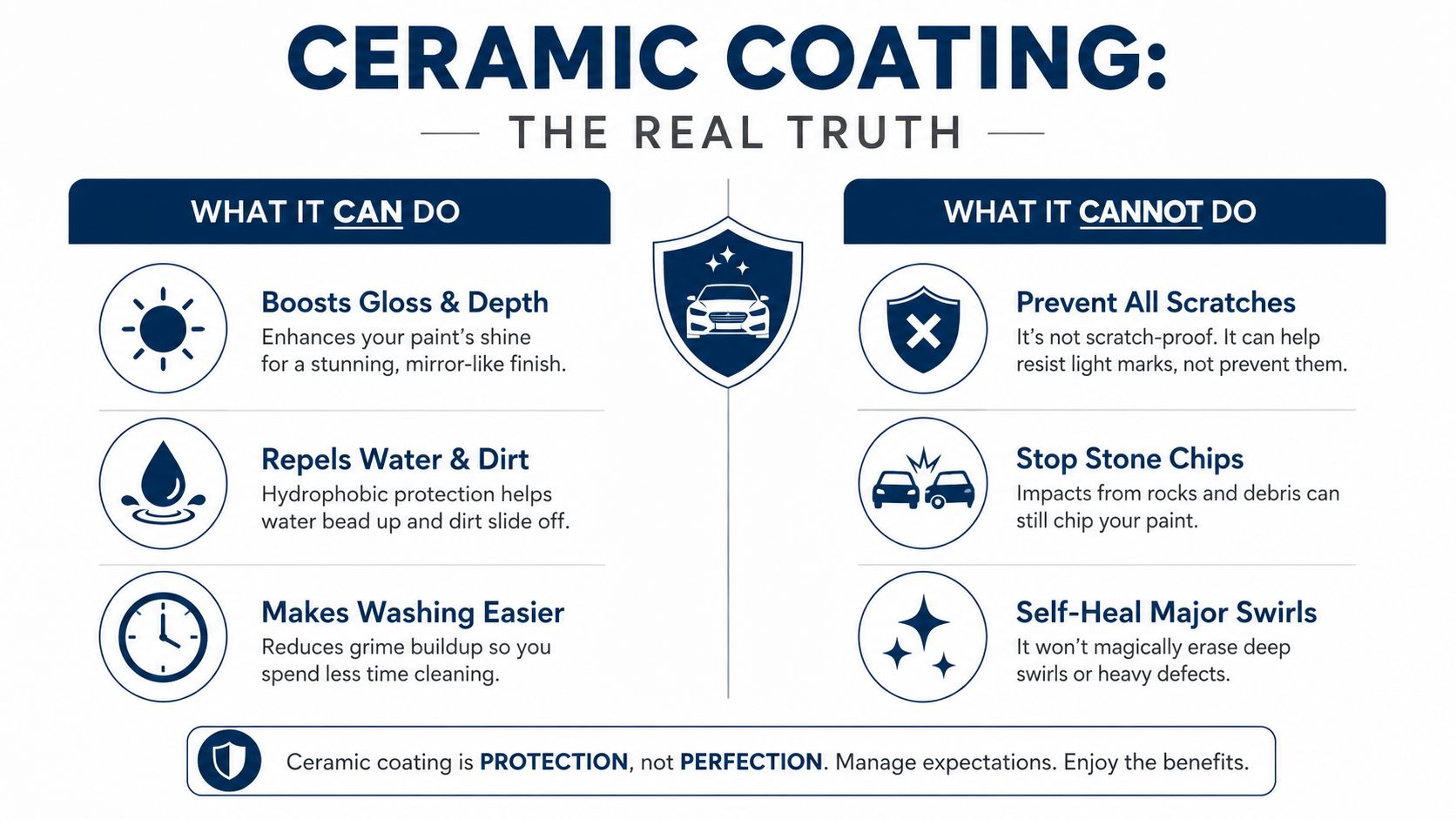
Ceramic coating earns its reputation through several small daily advantages rather than one magical superpower. The paint can look deeper and glossier, water can move away more readily, and routine washing can require less aggressive effort. For a GTA driver dealing with road salt and grime, that combination matters.
What it can help with
A cleaner-looking finish: A well-prepared surface can gain more gloss and visual depth because the coating creates a smooth, reflective layer over the clear coat.
Simpler washing: Hydrophobic behaviour makes it harder for some dirt and road film to form a stubborn bond. You'll still wash the vehicle, but rinsing and gentle contact can become more productive.
Time against contaminants: Bird droppings, bugs, salt residue, and acidic grime can attack exposed paint. The coating helps resist that chemical contact and gives you a better chance of removing contamination before it etches.
Reduced wash marring: A slicker surface can make careful washing less abrasive. That benefit depends heavily on clean tools, proper lubrication, and sensible technique.
Slower UV-related deterioration: The bonded layer helps slow the process that leaves paint oxidised and faded, especially when the vehicle spends long periods outside.
What it can't do
Ceramic coating is hard, but it's still a thin chemical layer. It won't prevent rock chips, deep scratches, collision damage, or every mark caused by careless washing. Paint protection film is the more appropriate physical defence for impact-prone areas, while coating focuses on gloss, chemical resistance, and easier maintenance.
It also won't repair existing defects. Swirls, oxidation, and scratches remain underneath unless the paint receives suitable correction before application. A coating can preserve a corrected finish, but it can't polish the clear coat after the bottle has been put away.
Hydrophobic behaviour is a performance signal, not a force field. When beading weakens, the coating may be wearing or contaminated, but the car still needs proper cleaning and inspection.
Performance usually fades first in water behaviour as the silica network experiences mechanical wear. 3M's technical data sheet connects professional coating performance with preparation, curing, and maintenance. Harsh detergents, dirty wash media, and neglect can shorten the useful experience even when the underlying product is sound.
Ceramic Coating Versus Wax and Paint Sealants Compared
Wax, paint sealants, and ceramic coatings all sit under the broad umbrella of paint care, but they're not interchangeable. The practical difference is how each layer interacts with the paint, how quickly it wears, and how much preparation the owner is willing to fund or perform.
Traditional wax offers warmth and shine with a relatively simple application. A synthetic paint sealant generally brings more chemical consistency and longer service than ordinary wax. Ceramic coating requires more careful preparation and application, but its bonded structure is designed for a multi-year ownership conversation rather than a frequent reapplication routine.
Ceramic Coating vs Wax vs Sealant at a Glance
| Feature | Ceramic Coating | Traditional Wax | Paint Sealant |
|---|---|---|---|
| How it sits on paint | Chemically bonds to the clear coat | Sits as a sacrificial surface layer | Sits as a synthetic protective layer |
| Typical service life | Professional claims commonly range from years, depending on product and maintenance, with Canadian examples from 3 years for a single-layer package to 5 years for a two-layer system with annual maintenance. 3M Canada | Usually a short-term option that needs regular refreshing | Generally a short- to medium-term option that needs repeated application |
| Film thickness | Professional systems commonly cure at about 1 to 2 microns. 3M Canada | A fraction of a micron or a very thin surface deposit | A fraction of a micron or a thin surface deposit |
| Water behaviour | Strong hydrophobic response when clean and healthy | Good beading that fades as the wax wears | Useful water repellency that diminishes over time |
| Salt and chemical exposure | Helps resist chemical attack from road salt and acidic grime | Offers temporary sacrificial protection | Offers more durable temporary protection than many waxes |
| Application effort | High. Paint preparation, panel-by-panel application, levelling, and curing matter | Lower, especially for routine home use | Moderate, depending on product |
| Best fit | Owners who want a longer maintenance cycle and are prepared to wash correctly | Owners who enjoy frequent, low-cost refreshes | Owners who want a middle ground between wax and coating |
The table isn't a ranking. It's a lifestyle comparison. Someone who enjoys detailing on weekends may prefer wax because the ritual is affordable and repeatable. A commuter who dislikes frequent reapplication may favour a professional coating, provided the vehicle's paint condition and parking environment justify the initial work.
The phrase “ceramic” also causes confusion because some spray products use ceramic terminology while behaving more like sealants. The bottle name alone doesn't tell you the cured thickness, preparation requirements, or realistic service life. Ask what product is being used, how it's applied, what maintenance it requires, and whether the advertised durability depends on annual inspections or refresh products.
A coating is the more involved choice. Wax and sealants remain sensible for drivers who want lower upfront commitment, occasional gloss enhancement, or a simple sacrificial layer before winter. The right answer depends less on internet hype than on how often you wash, where you park, how long you'll keep the vehicle, and how much salt your routine exposes it to.
How Professional Ceramic Coating Is Applied and How Long It Takes
A proper coating appointment is mostly preparation. The bottle may be small, but the installer's work begins long before the first drop reaches the paint.
The day in the bay
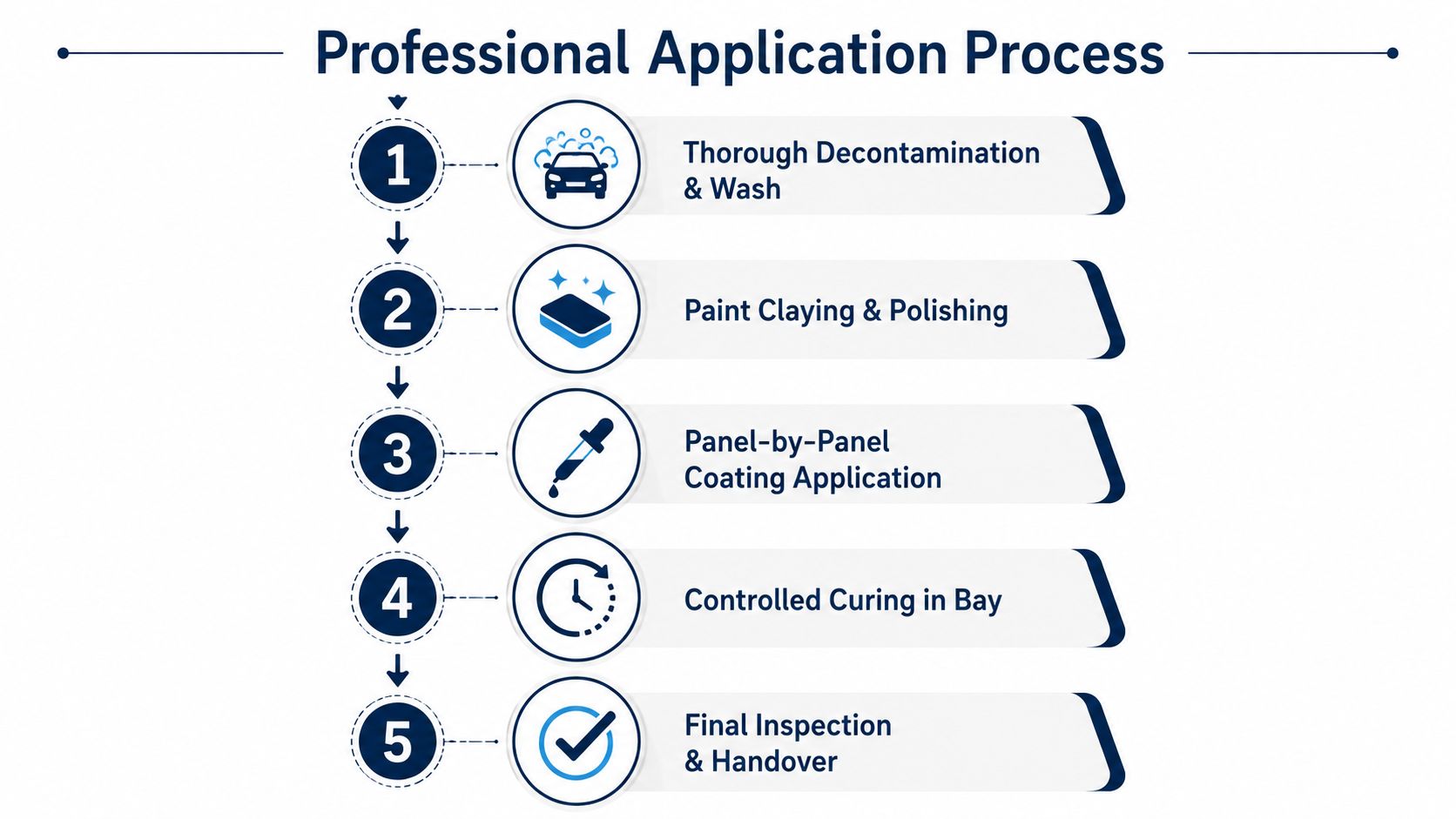
The vehicle receives a thorough wash and decontamination first. That removes loose dirt, traffic film, and bonded particles that could become trapped under the coating. The paint may then be clayed and polished to refine the surface and improve its appearance before the protective layer goes on.
A careful installer works panel by panel. The coating is spread evenly, allowed to flash for the appropriate time, then levelled so high spots don't cure as visible streaks or patches. Lighting and temperature control matter because the product's working time changes with the environment.
Timing and curing
Professional application can commonly take 6 to 10 hours, with 24 to 48 hours of dry cure time before normal use, according to the GTA-focused service discussion from Honest Car Detailing. That's why a coating appointment isn't the same as dropping the car off for a quick exterior wash.
Higher-end professional coatings are marketed with an initial cure of about 4 hours and a full cure window of 2 to 3 weeks, as described in 3M's Canadian technical material. The first dry period protects the fresh application from water and contamination. The longer hardening window is when gentle, pH-neutral care becomes especially important.
What to ask before booking
Preparation: Ask whether the service includes chemical decontamination, clay treatment, and paint correction where needed.
Product specification: Confirm the coating brand, layer count, expected service life, and maintenance conditions.
Cure instructions: Get clear guidance on when the vehicle can be driven, washed, or exposed to wet weather.
Inspection process: A final check under appropriate lighting can catch uneven levelling before you take the vehicle home.
The short version is simple. A thorough installation protects the coating's future performance by giving it a clean, properly prepared surface and enough undisturbed time to cure.
Cost Durability and Maintenance Expectations in Ontario
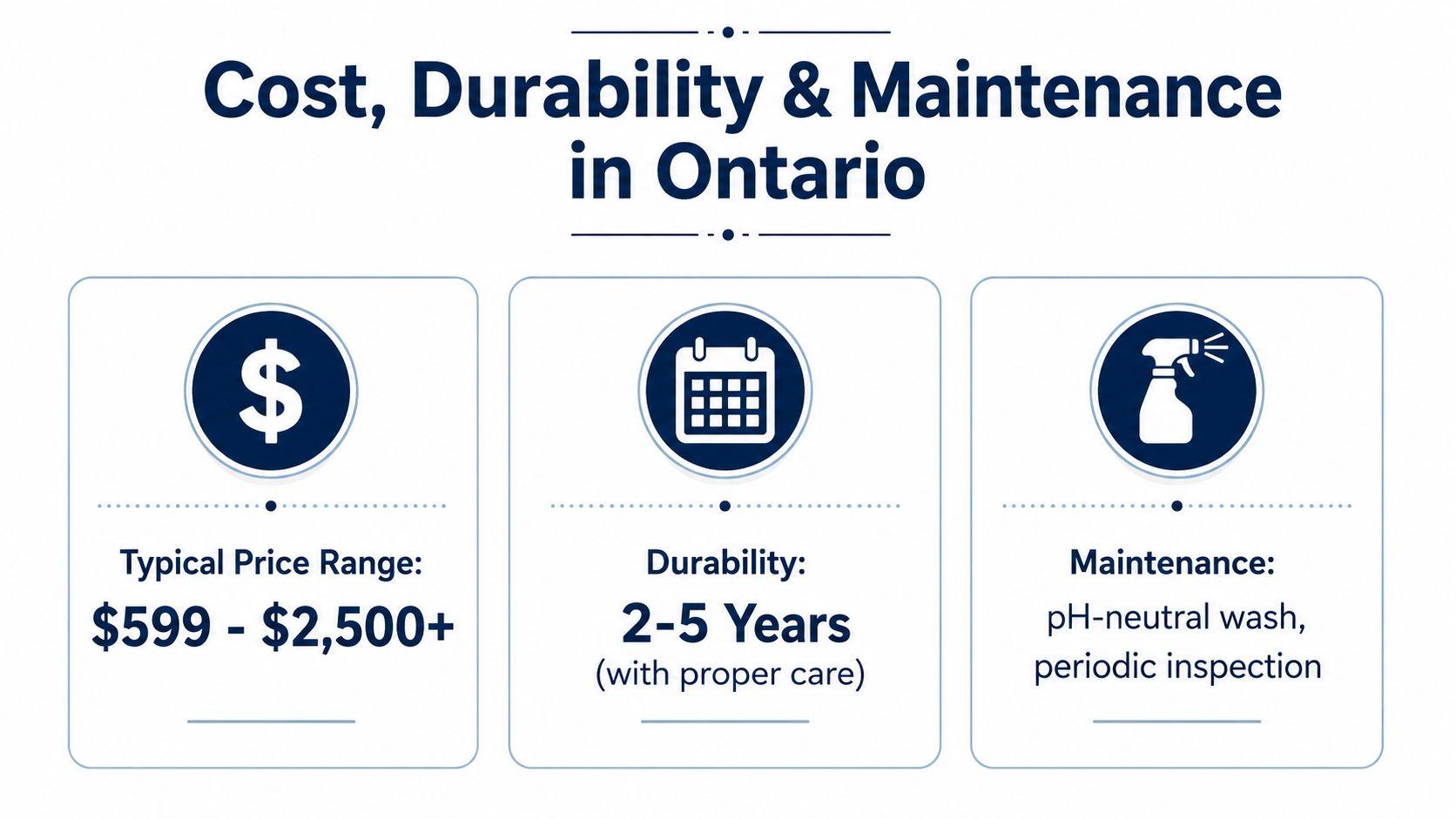
Ceramic coating becomes easier to judge when you stop treating the price as a shine fee and start treating it as a maintenance decision. GTA examples show professional packages starting around C$599 with claims of more than 3 years of protection, while another Ontario provider lists a 3-year package starting at C$895 and a separate 4-year option at C$999. Ceramic Pro Toronto provides these local pricing examples and positions coating around Ontario weather.
Service life varies widely because products, preparation, layers, washing, storage, and exposure all vary. Ontario provider claims range from about 2 years to as long as 9 years, while specific Canadian coating information describes packages from 3 years for a single layer to 5 years for a two-layer system with annual maintenance. Ceramic Pro Vaughan and 3M Canada show why a single “how long does it last?” answer can mislead.
The GTA break-even question
Suppose you're a commuter who pays for frequent washes because salt and road film build up quickly. A coating may make those washes easier and help preserve the finish, but the coating itself doesn't automatically replace washing. You need to compare the upfront service with your existing routine:
Wash frequency: How often do you currently pay for exterior cleaning, and would easier maintenance change that pattern?
Salt exposure: Do you drive heavily through winter, or does the vehicle spend most of its time parked indoors?
Ownership horizon: Will you keep the car long enough to benefit from a multi-year protective layer?
Vehicle size: A compact passenger car and a full-size truck require different amounts of labour and product. GTA pricing discussions place coating costs from roughly C$499 to C$599 for passenger cars, with services reaching C$999 for full-size trucks in recent local examples. Honest Car Detailing
Maintenance discipline: Are you willing to use pH-neutral soap, clean wash media, and prompt salt removal instead of relying on the coating to do everything?
The economic answer is personal. A high-mileage driver who washes often may value reduced effort and paint preservation more than someone who drives occasionally and enjoys applying wax. Either way, include winter underbody rinses and salt removal in the budget. A clean top surface doesn't cancel the need to clean hidden areas.
Keeping Your Coating Looking Great With Help From Nanak Car Wash
A coated car still needs regular washing. Fresh water, gentle contact, and timely salt removal matter more than dramatic beading videos. Avoid harsh alkaline detergents where possible, use pH-neutral wash chemistry, and don't let road film become a permanent grey layer on the lower panels.
Nanak Car Wash has served the region since 2004, and its published service lineup includes express washes from $9.99, full-service washes from $29.99, detailing by appointment, and Unlimited Wash Club options. Nanak Car Wash lists locations across Etobicoke, Brampton, Concord, Oshawa, North York, Burlington, Cambridge, and Guelph. For a coated vehicle, the practical value is consistent cleaning, with options such as underbody rinsing and hand-finished service depending on the selected package.
The same maintenance logic applies if your car isn't coated. Regular washing helps remove salt and road film before they sit on the finish, while detailing can address accumulated stains, contamination, and interior winter mess. If you're shopping for a used vehicle and assessing paint condition before deciding whether protection is worthwhile, these salvage vehicle purchase tips can help you think through inspection and ownership risk before committing.
Your next step is to write down your current wash frequency, winter driving exposure, parking situation, and expected ownership period. If the coating cost feels difficult to justify against your real routine, a wash plan and periodic detailing may be the smarter fit. If you keep the car for years and want easier maintenance, request a coating quote that separates preparation, product, curing, and aftercare instead of judging the package by gloss alone.
Nanak Car Wash offers express and full-service washes, detailing by appointment, underbody cleaning options, and Unlimited Wash Club plans across the GTA. Visit Nanak Car Wash to check a nearby location, choose a service that suits your coated or uncoated vehicle, and keep winter salt from becoming a long-term paint problem.

 6600 Finch Ave W, Etobicoke, ON M9V 3Z6
 647-703-8515
 MON – SUN 8 AM to 7 PM