
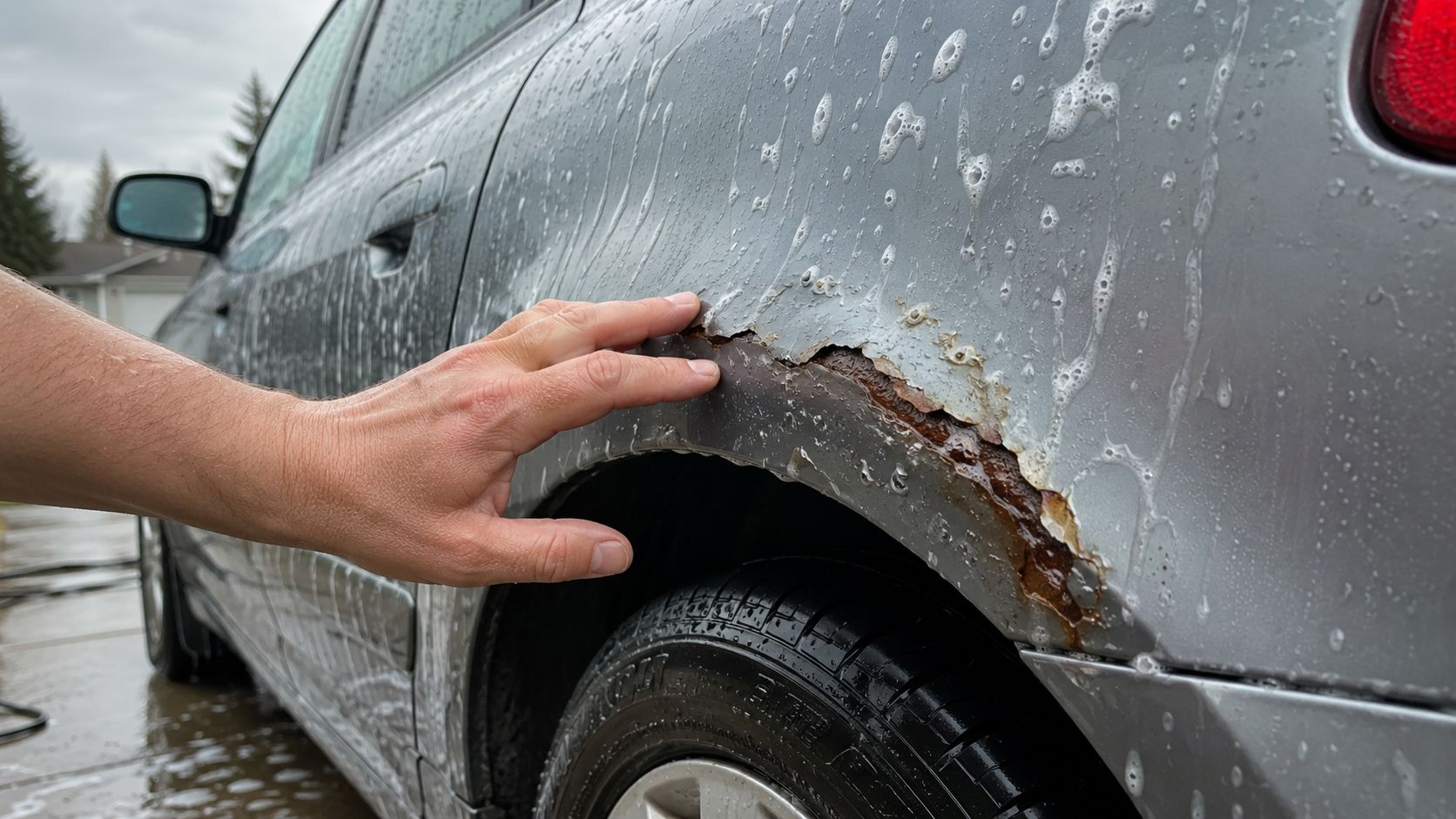
You notice it during a spring wash. The salt film is finally gone, and a small bubble has appeared on the rear wheel arch. You press it with a fingertip, expecting loose paint. Instead, the surface gives slightly, revealing corrosion that has been working from the inside for months.
That's how rust usually enters the conversation. It doesn't start as a dramatic hole in the floor. It begins in seams, behind liners, around fasteners, inside rocker panels, and along underbody components that rarely receive a close inspection. In Ontario, automotive rust proofing is less about making a vehicle look shiny and more about slowing damage where winter conditions are hardest on metal.
Table of Contents
- Why Ontario Drivers Need Rust Protection
- How Automotive Rust Proofing Actually Works
- The Science Behind Ontario Corrosion Pressure
- Comparing Rust Proofing Methods and Chemicals
- Modern Vehicle Compatibility and EV Considerations
- Rust Proofing Costs and Return on Investment
- How to Choose the Right Rust Proofing Provider
Why Ontario Drivers Need Rust Protection
A GTA vehicle can look clean above the beltline while salt is attacking it underneath. Ontario spreads roughly 1.5 to 3 million tonnes of road salt per winter, and Toronto alone uses about 130,000 to 150,000 tonnes annually, according to this Ontario road salt and vehicle rust overview. Wet salt forms a conductive film that stays on wheel arches, frame rails, brake lines, suspension mounts, and door cavities.
The GTA creates repeated corrosion cycles. A daily commute on the 401, DVP, or suburban arterials sends brine spray into the underbody, where it dries, freezes, thaws, and returns with the next application. Plastic shields protect selected surfaces, but they also hide early damage until a fastener breaks or a panel begins to bubble.
The first visible sign is rarely the beginning
Unprotected or older vehicles can show visible undercarriage rust within 2 to 3 winters in the GTA. Structural risk commonly becomes a serious concern after about 8 to 12 years of year-round driving without rustproofing. Treat those figures as warning points, not promises. Exposure, washing, storage, existing damage, and vehicle construction change the timeline, as outlined later in this guide.
The break-even question is practical. A rustproofing treatment costs less than many corrosion repairs, but its value depends on vehicle age, expected ownership period, winter mileage, and resale plans. Protecting a newer vehicle before salt reaches seams can preserve condition and reduce future repair exposure. Spraying over active scale on an older vehicle will not reverse damage, so inspection comes first.
Modern construction makes visual checks less reliable. High-strength steel, galvanized components, aluminium panels, adhesives, and plastic cladding corrode differently from older mild-steel bodies. Aluminium does not form familiar red steel scale, yet it can oxidise, pit, and develop galvanic corrosion where dissimilar metals meet.
Shop-floor rule: If rust is visible at a seam, wheel arch, or mounting point, inspect the hidden side before applying any product.
Rust threatens more than appearance. Corroded brake lines, weakened suspension mounts, and compromised structural sections can turn a routine safety inspection into a major repair decision. Standard auto insurance generally excludes rust damage, leaving the owner responsible for the bill, as noted in Canadian rustproofing guidance from the APA.
Paint protection also matters where humidity and contamination keep surfaces damp. This explanation of what Columbus humidity does to paint offers useful paint-care context, while GTA road salt demands focused underbody protection.
How Automotive Rust Proofing Actually Works
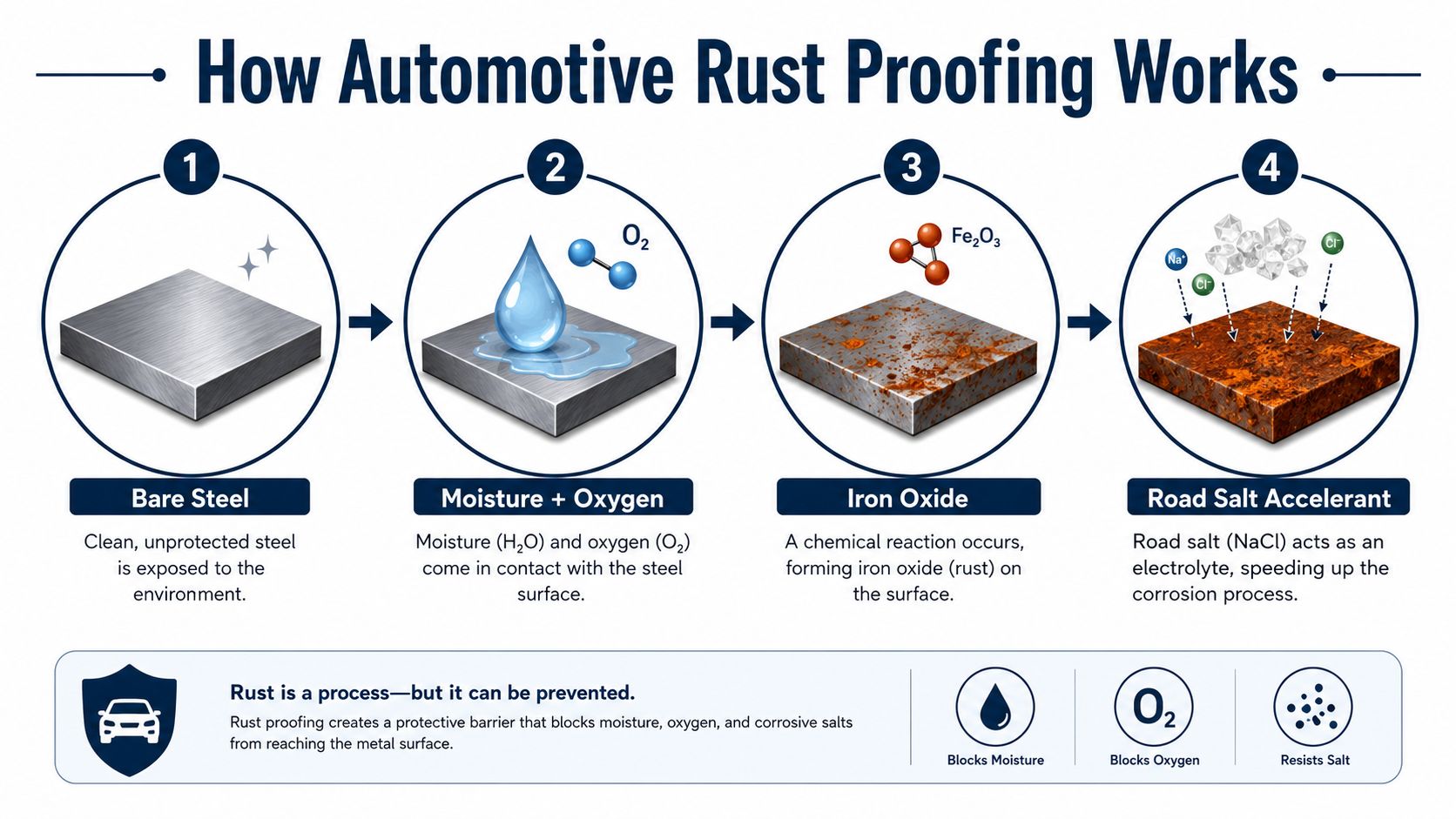
Rust is an electrochemical reaction, not “old metal getting dirty.” Steel needs moisture and oxygen to form iron oxide, and road salt makes the moisture more conductive. That lets corrosion cells form and spread more readily across exposed metal.
Rustproofing works by interrupting that contact. Think of a rain jacket. It doesn't change the weather or repair damaged skin, but it keeps water away from the surface underneath. A suitable rust-control product creates a barrier, repels moisture, or creeps into seams so salty water has less opportunity to sit against steel.
Preparation decides whether the treatment helps
A competent application follows a deliberate sequence:
- Inspect first. The technician should identify existing scale, damaged coatings, blocked drains, exposed seams, and sensitive components.
- Clean and degrease. Salt, mud, oil, and loose contamination must come off. Applying material over salt residue can hold corrosive contamination against the metal instead of preventing it.
- Reach the vulnerable zones. Rocker panels, frame rails, subframes, door bottoms, tailgates, bonnet seams, suspension mounts, and internal cavities need different access and coverage.
- Mask sensitive areas. Brakes, exhaust components, belts, cameras, connectors, charging hardware, and electrical components shouldn't receive careless overspray.
- Allow the product to set. Some compounds remain fluid and creeping, while waxes and coatings form a more stable film. The behaviour determines how the treatment handles movement, washing, and future inspection.
The product matters, but preparation matters more. A thick layer over loose rust is not a restoration. It can hide corrosion and make later diagnosis harder.
Surface coating and cavity treatment aren't interchangeable
A rubberised or wax-based underbody product protects exposed surfaces. It may suit a clean, properly prepared underside, but it isn't automatically the right answer for a vehicle with active corrosion or tight seams.
Cavity waxes and penetrating oils serve a different purpose. Technicians apply them through factory openings or carefully selected access points so they can reach enclosed sections where moisture collects. A flexible product that remains mobile can follow seams and spot welds more effectively than a rigid film that eventually cracks.
Practical rule: Never approve a treatment until the shop explains what it will do about existing rust, trapped salt, drains, and enclosed cavities.
The Science Behind Ontario Corrosion Pressure
A GTA vehicle can look clean after a wash while salt residue remains inside seams, fasteners, rocker panels, and frame sections. Winter road spray dries on those surfaces, then becomes active again with humidity or fresh moisture. That cycle creates corrosion where an exterior inspection cannot see it.
The strongest Ontario-specific evidence comes from a University of Windsor engineering study, summarised in research on rust-control treatments in Ontario conditions. Untreated vehicles showed 6.8 times more visible corrosion on body panels than treated vehicles. Their untreated underbody parts also showed 3.6 times more corrosion than treated underbodies.
The figures do not promise a corrosion-free vehicle. They support a practical recommendation: drivers who keep vehicles through multiple Ontario winters should treat rust control as maintenance, not as a cosmetic add-on.
What Ontario's corrosion pressure means for ownership
Ontario's salt exposure affects more than appearance. Early surface rust can signal moisture entering enclosed areas, while corrosion around mounts, brake lines, subframes, and fasteners can raise repair costs and reduce resale confidence. Transport Canada's historical corrosion-cost estimate, summarised in our earlier corrosion timeline, placed average damage at about $200 per vehicle owner per year in 1975. The age of that estimate limits its use for today's pricing, but it still shows that rust has long carried a measurable ownership cost.
The break-even question for GTA drivers is straightforward. Compare the treatment cost with the repairs, inspection concerns, and resale loss that become more likely as corrosion advances. A vehicle kept only briefly may not recover the full investment. A daily driver kept into its later service life has more opportunity to preserve usable value.
The University of Windsor summary found little statistically significant difference between treated and untreated vehicles through 6 years. The gap became much clearer from 7 to 15 years, according to the research cited above. That timing matters because many owners decide whether to sell or keep a vehicle during precisely the period when hidden corrosion starts affecting trade-in assessments and repair decisions.
Rust proofing makes the strongest financial case before severe scaling begins. Once structural metal has weakened, treatment can slow further exposure but cannot restore lost metal or reverse an unsafe component. Inspect the underside, assess existing corrosion, and choose protection based on how long you plan to keep the vehicle, not on the appearance of the paint.
Comparing Rust Proofing Methods and Chemicals
There isn't one universal rustproofing product. The right choice depends on whether the underside is clean, lightly oxidised, heavily scaled, or already covered in an old coating.
| Method | Chemical base | Reapplication | Penetration | Best for | Typical cost |
|---|---|---|---|---|---|
| Penetrating oil spray | Oil-based corrosion inhibitor | Annual treatment is common | Strong in seams and cavities | Daily drivers in heavy salt exposure | Varies by provider and vehicle |
| Dripless oil formulation | Less mobile oil or wax-oil blend | Periodic inspection and reapplication | Moderate, with less runoff | Owners wanting cleaner application | Varies by provider and vehicle |
| Cavity wax | Wax-based protective film | Reapply when inspection shows deterioration | Good inside prepared cavities | Door interiors, seams, and enclosed sections | Varies by provider and vehicle |
| Rubberised undercoating | Polymer or rubberised barrier | Depends on condition and adhesion | Limited after curing | Clean, prepared exposed underbodies | Varies by provider and vehicle |
| Electronic module | Electrical corrosion-control concept | Device-specific | No physical cavity coverage | Supplementary use only, if appropriate | Varies by provider and vehicle |
Penetration beats thickness in many Ontario applications
A thick coating looks reassuring, but appearance isn't the same as coverage. Penetrating oil can creep into seams, fastener interfaces, and spot-welded joints where a surface film cannot reach. It also remains more forgiving when panels flex or when freeze-thaw movement stresses a rigid coating.
The trade-off is obvious. Oil sprays may drip, attract dust, and require regular renewal. Dripless products create less mess, but a technician may have less ability to reach hidden cavities. Wax-based products can provide a durable barrier, although they demand clean preparation and careful inspection for cracks or lifted edges.
Electronic modules divide opinion in the repair trade. Most independent shops remain more comfortable recommending physical barriers because a spray or cavity treatment can be inspected directly. An electronic device doesn't replace cleaning, drainage, or protection of exposed metal.
My recommendation: For a GTA commuter, choose a reputable penetrating or flexible cavity treatment when the vehicle is sound, then inspect it regularly. Use hard undercoating only when the shop can prove the surface is properly prepared and still accessible for future repairs.
Vehicle construction also matters. Owners comparing corrosion protection for cars, trucks, and recreational platforms can learn from adjacent material choices, such as this discussion of a best aluminum frame cart. Aluminium changes the corrosion pattern, but it doesn't make every fastener, bracket, or steel substructure immune.
Modern Vehicle Compatibility and EV Considerations
New vehicles deserve rust protection only when the application respects the platform. EVs, hybrids, and sensor-heavy vehicles contain battery enclosures, high-voltage wiring, connectors, cameras, radar units, and control modules that need deliberate masking and inspection.
Don't let a technician treat an EV like an old body-on-frame pickup. The battery case and its service access points must remain clean and accessible. Charging hardware, orange high-voltage cables, ventilation paths, and connector faces shouldn't receive random oil or coating.
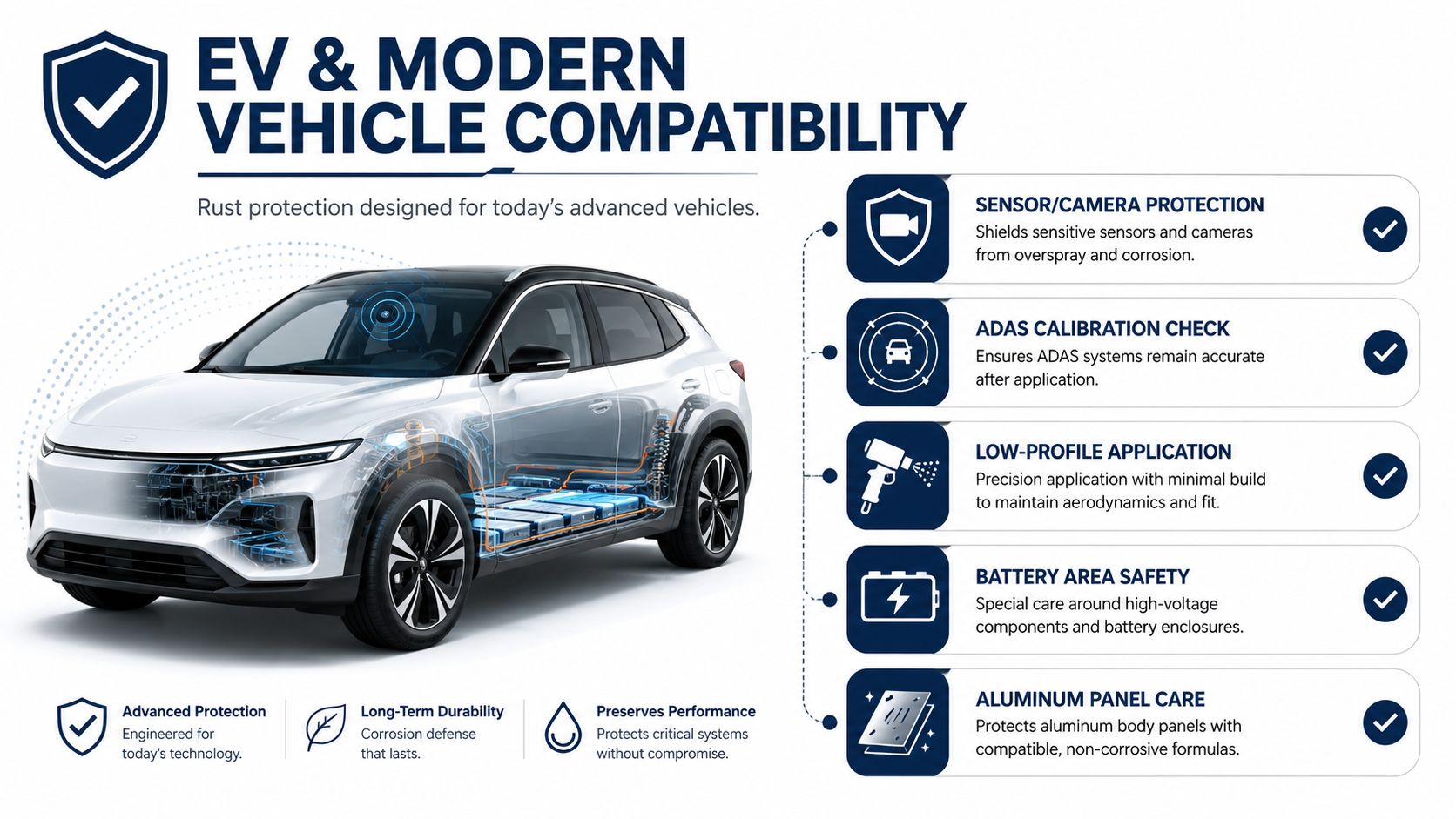
Ask these questions before booking
- Platform experience: Has the shop treated this model or a closely related EV or hybrid platform?
- Manufacturer procedure: Can the provider explain any manufacturer restrictions around battery housings, charging ports, and warranty coverage?
- Compound selection: What product will be used near wiring, connectors, sensors, and aluminium?
- Masking standard: Which components are physically protected before spraying?
- Documentation: Will the shop record the pre-treatment condition and confirm that critical areas were checked afterward?
- Maintenance access: Can future battery, suspension, exhaust, or underbody service proceed without removing an unreasonable amount of hardened material?
Modern unibody vehicles often combine galvanised steel, high-strength steel, aluminium, adhesives, and plastic shields. That can reduce some forms of visible body rust, but it doesn't eliminate corrosion at seams, brackets, subframes, brake lines, and fasteners.
The safest approach is conservative. Use a low-profile, compatible product in the right locations, keep drains clear, avoid coating brakes and exhaust components, and insist on a post-application inspection. Canadian guidance continues to emphasise inspection and reapplication on roughly annual cycles for drivers with heavy exposure, as described in rust prevention advice for new Canadian vehicles.
Rust Proofing Costs and Return on Investment
A GTA vehicle can look clean on the lot while salt is already attacking its subframe, brake lines, fasteners, and seams. The break-even question is practical: how long will you keep the vehicle, how much winter exposure will it receive, and which corrosion costs are you trying to avoid?
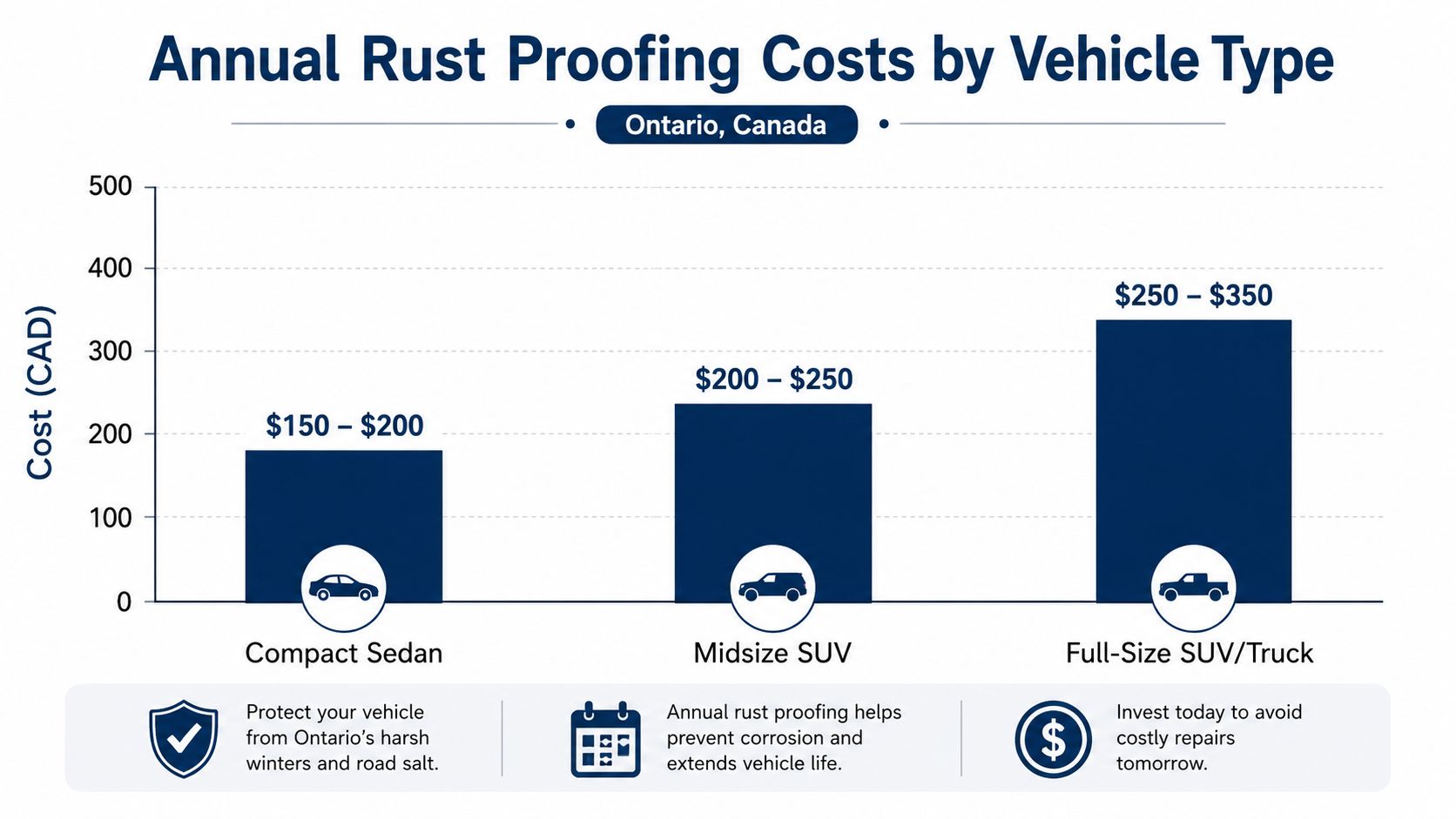
Treatment cost is only one part of the calculation. Preparation, product placement, inspection quality, and future reapplication determine whether the money buys meaningful protection. The chart below provides an Ontario cost comparison by vehicle type.
Use an ownership-horizon calculation
Start with three questions:
- How long will you keep the vehicle? A short-term owner may not recover the treatment cost through resale. A long-term owner has more time to benefit from slower underbody deterioration and fewer corrosion-related repairs.
- How much winter exposure does it receive? Highway commuters, outdoor parkers, ride-hailing drivers, delivery vehicles, and fleets collect more salt and moisture than lightly used vehicles stored indoors.
- What is the vehicle's current condition? Rustproofing prevents or slows corrosion. It does not replace welding, brake-line replacement, structural repair, or removal of advanced rust.
Use this formula:
Expected protection value = avoided corrosion repairs + preserved resale appeal + extended usable life, minus treatment cost.
Base the calculation on an inspection, not an assumed repair saving. Ask for a written estimate covering the vehicle's actual weak points. A clean underside and documented maintenance can support a stronger resale discussion, but no treatment guarantees a specific premium.
Historical context still helps. Transport Canada's 1975 estimate of about $200 per vehicle owner per year for average corrosion damage shows that rust has long carried a real ownership cost in Canada, as noted in the corrosion timeline above.
My recommendation is straightforward. GTA drivers who plan to keep a sound vehicle through several more winters should treat regular rust control as a maintenance expense, not a cosmetic upgrade. Drivers considering a vehicle with serious structural corrosion should pay for an honest inspection first. Protection makes financial sense when it slows damage before repairs threaten the vehicle's usable life or resale appeal.
How to Choose the Right Rust Proofing Provider
A low-priced appointment can cost more later if the shop sprays over salt, blocks drains, contaminates brakes, or conceals active corrosion. In Ontario, judge the provider by preparation and coverage, not by the shine immediately after application.
Ask for a walk-through before the vehicle goes on the lift
A credible technician should explain what will be inspected, cleaned, masked, and treated. Ask whether the shop uses factory openings or drills new access holes. If drilling is proposed, require a clear reason and a plan to protect the new openings. Unnecessary holes can hold moisture and create future corrosion points.
Use this booking checklist:
- Preparation: Does the provider wash and dry the underside, remove loose contamination, and identify existing rust?
- Coverage: Will the treatment reach cavities, seams, rocker panels, frame rails, and door interiors where appropriate?
- Protection: How will the shop mask brakes, exhaust parts, sensors, cameras, connectors, and high-voltage components?
- Product: Can the technician show you the container, explain the chemical base, and describe its behaviour after application?
- Warranty: Are coverage terms written down, including exclusions and renewal requirements?
- Inspection access: Will future repairs remain practical, or will the coating make fasteners and seams difficult to evaluate?
Reviews help most when they describe results after multiple seasons. Look for customer evidence of photographs, condition notes, renewal reminders, and a clear explanation of what the product can and cannot do. Fresh, glossy photographs taken on the appointment day prove application, not long-term corrosion control.
What I reject: A provider who promises permanent protection without inspecting the underside. GTA vehicles require treatment decisions based on condition and salt exposure, not a one-time slogan.
For GTA owners combining a wash with corrosion care, Nanak Car Wash lists dedicated rustproofing applications alongside wash and detailing services. Before authorising work, confirm the preparation standard, treatment areas, compatibility plan, and written terms. Ask who handles missed areas or later repair access.
If your vehicle sees GTA winter salt, do not wait for bubbling paint to force the decision. Visit Nanak Car Wash to ask about its dedicated automotive rust proofing service and underbody care options available at participating locations.

 6600 Finch Ave W, Etobicoke, ON M9V 3Z6
 647-703-8515
 MON – SUN 8 AM to 7 PM