
You've just pulled into the driveway after a slushy run along the 401 or QEW. The doors and bonnet look respectable, but the wheel wells are crusted white and brown, and everything below the rocker panels has collected a wet paste of road salt, grit, and grime. That hidden mess is where an Ontario winter starts doing its expensive work.
Learning how to wash the undercarriage of a car at home can help, but only if you flush the places a casual hose spray misses. The job isn't about making the underside look pretty. It's about removing chloride brine from brake lines, suspension parts, exhaust hangers, frame areas, and the seams where damp salt stays trapped.
Table of Contents
- Why the Underside of Your Car Cries for Help After a GTA Winter
- Gear and Setup You Need Before You Touch a Hose
- Getting the Car Up Safely Without Bending a Brake Line
- The Actual Undercarriage Wash From Front Bumper to Tailpipe
- Drying, Inspecting, and Stopping Rust Before It Starts
- When the Driveway Rinse Is Not Enough
- A Salt-Season Routine You Can Actually Stick To
Why the Underside of Your Car Cries for Help After a GTA Winter
Ontario road crews spread roughly 1.5 to 3 million tonnes of road salt each winter, and the province's freeze-thaw season can expose a vehicle's underside to corrosive chloride slush for five to six months a year. That combination makes undercarriage washing practical maintenance for GTA drivers, particularly around low, poorly ventilated components. Ontario road salt and vehicle corrosion
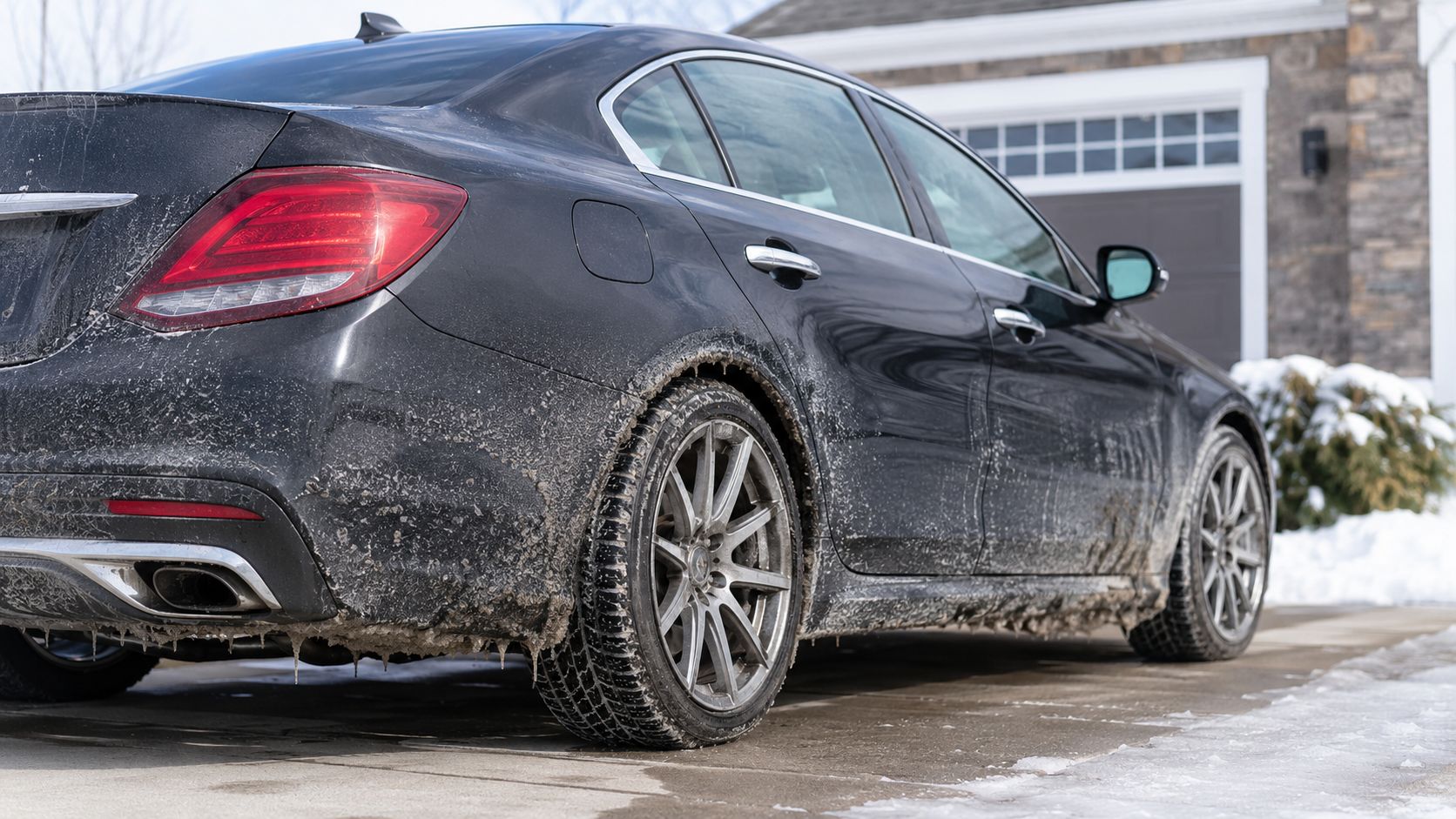
The visible body panels get attention because you can see them. The underside doesn't. Saltwater reaches control arm bushings, brake hard lines, exhaust hangers, fuel tank straps, subframe bolts, and factory coatings that were never designed to hold a permanent layer of wet road film. Rust often begins at a seam, fastener, or shield edge, then spreads while the car continues to look fine from the kerb.
A quick automatic wash can improve the paint and wheel faces while leaving packed residue behind splash shields, inside wheel-well liners, and along frame rails. A garden hose aimed straight upward often produces the same false confidence. It wets the buildup without creating enough flow or angle to carry it out.
The problem is trapped brine
Salt sticks to wet metal and continues corroding after temperatures climb above freezing. Canadian winter-driving guidance says salt can begin bonding to and corroding metal surfaces within 240 hours of contact, while another Canadian recommendation favours washing every week or two during salt season with an underbody rinse. Canadian winter washing guidance
Practical rule: A clean underside isn't one that's merely wet. It's one where dirty water, salt, and mud have been physically flushed out of seams and cavities.
The rest of the job follows that rule. You'll rinse from several angles, work around shields and liners, dry the places that hold water, and inspect what the road has been hiding.
Gear and Setup You Need Before You Touch a Hose
A first-time underbody wash goes much better when the equipment is chosen for flushing rather than punishment. An electric pressure washer in the 1,800 to 2,400 PSI range is sufficient for a passenger car, provided you use a sensible nozzle and keep it moving. A 25-degree nozzle gives you a useful general spray, while a 40-degree nozzle is safer around soft plastic shields and delicate coatings.
Skip the turbo nozzle. Its concentrated rotating impact is unnecessary underneath a car and can lift soft factory undercoating, damage plastic liners, or drive dirty water into places you're trying to protect.
Put the kit together
You'll want:
- Pressure washer: Use an electric unit with adjustable spray options. You're looking for controlled flushing, not maximum force.
- Wide-fan nozzles: Keep the 25-degree nozzle for metal and broad surfaces, and switch to 40 degrees near plastic shields, wiring covers, and weathered coatings.
- Undercarriage cleaner: A pH-neutral automotive wash in a foam cannon or pump sprayer helps loosen road film. Keep a separate automotive degreaser for oil-stained subframes, and follow its label carefully.
- Long hose: A 50-foot hose gives you room to move around the vehicle without dragging the machine into puddles.
- Electrical protection: Use a GFCI outlet or an outdoor-rated extension cord. Keep every connection away from standing water.
- Wheel chocks and supports: Rubber chocks or solid wood blocks are useful for securing the vehicle. If lifting is necessary, use a suitable hydraulic jack and properly rated jack stands.
- Personal protection: Wear ANSI Z87 safety glasses, not sunglasses, plus nitrile gloves, closed-toe rubber boots, and knee protection. A respirator may be appropriate when a solvent-based degreaser requires it.
Choose a flat asphalt or concrete pad with a mild slope so water doesn't pool beneath the vehicle. Before starting, check local water restrictions and runoff rules. Municipal restrictions in Canadian cities can limit residential vehicle washing during drought stages, while commercial washes may remain permitted, so driveway washing isn't automatically the practical or lawful choice in every season. Canadian municipal vehicle-washing restrictions
Getting the Car Up Safely Without Bending a Brake Line
You don't need to lift the vehicle for every rinse. A low-profile undercarriage wand can reach much of the underside while the car is on the ground. If you need a proper inspection or must reach behind shields, treat lifting as a separate safety job, not a minor part of washing.
Park on level concrete. Set the parking brake, select park or first gear, and chock both rear wheels with rubber chocks or solid blocks before lifting the front. If you're working at the rear, secure the front wheels instead. Never lift on an icy driveway, soft asphalt, loose gravel, or a surface that slopes toward traffic.
Lift only at approved points
Loosen the wheel lugs slightly before the car leaves the ground. Position a 2-ton hydraulic trolley jack under the manufacturer's factory pinch weld or a specified subframe lift point. Never place the saddle on a plastic side skirt, thin floor pan, exhaust component, fuel tank, or differential cover unless the vehicle manufacturer specifically identifies that point for lifting.
Raise one end at a time, then place a pair of 3-ton jack stands beneath approved support points. Lower the vehicle gently onto the stands and leave the jack positioned as secondary support if it can remain safely clear. The jack is for lifting. It isn't a substitute for stands.
Check stability before crawling underneath
Push the body firmly at the front and side. If the vehicle shifts, creaks, or settles, stop and reset the supports. Keep your hands away from the tyre and fender gap while lifting, and route the pressure-washer hose so it can't catch on a stand or pull against the car.
Brake lines deserve special respect. A stand placed too close to a line can crush or bend it, and a hose or wand can snag a loose line while you're moving around. Don't use a stand as a convenient shelf for tools, and don't wedge a rag or block against a brake component.
Never crawl beneath a vehicle supported only by an OEM scissor jack. If the ground, weather, vehicle load, or lifting points look questionable, postpone the work or use approved ramps on a flat pad.
The Actual Undercarriage Wash From Front Bumper to Tailpipe
Start with a cool vehicle and a low-pressure pre-rinse. If the brakes, exhaust, or catalytic converter is hot, cold water can create unnecessary thermal shock, and you'll be working around components that can burn skin. Remove loose stones and chunks of frozen slush from the wheel wells by hand only when they're safe to handle.
Begin at the lower front bumper and move toward the tailpipe. That direction lets dirty water and dissolved chloride flow rearward instead of washing over areas you've already cleaned. Keep the 25-degree nozzle about 20 to 30 centimetres from the surface, use a steady side-to-side sweep, and avoid holding the spray in one place.
Work the front and centre deliberately
Angle the stream across the front subframe, control-arm mounting points, pinch welds, steering rack area, sway-bar links, and transmission pan. Don't aim directly into rubber boots at close range. The objective is to carry off salt and mud, not force water past a seal.
Move along the rocker panels and into the front wheel wells. Wash the back side of the liner, the lower fender cavity, and the areas where the liner meets the rocker. A 40-degree nozzle is the safer choice when the spray reaches thin plastic or a coating that's already lifting.
Use the cleaner after the first rinse has removed loose grit. Apply the pH-neutral product, let it dwell according to the label, then rinse from several directions. For an oily subframe, use a dedicated automotive degreaser sparingly. Degreaser can strip protective products, so don't fog the entire underside with it just because the road film looks dark.
Don't stop at the easy surfaces
At the rear, flush the subframe cradles, suspension arms, fuel-tank strap area, exhaust hangers, and the space behind the bumper beam. Sweep upward into the rear wheel-well liners, then approach the liner edges from inside and outside.
The hidden-cavity pass is where most home washes fail. Salt packs behind the liner, under fender lips, around shield fasteners, and in frame or rocker seams. Spray from the rear of the wheel well toward the opening, then reverse the direction so the loosened material has somewhere to escape.
Give brake components a light rinse from a distance, concentrating on the caliper exterior, rotor edges, and surrounding splash areas. Don't blast caliper slide boots or wheel-bearing seals. Keep the nozzle moving around wiring connectors and sensors, and never use the wand to pry a liner or splash shield open.
Canadian undercarriage guidance recommends washing every one to two weeks during Ontario winter and continuing through early spring, with attention to the frame, suspension arms, wheel wells, and rocker panels. Ontario undercarriage-washing protocol
Drying, Inspecting, and Stopping Rust Before It Starts
The rinse removes contamination, but standing water in a boxed rail or seam can leave the underside wet again. Use the pressure washer on its lowest practical setting with a wide fan to push water out of frame seams and cavities. Don't replace a controlled rinse with an aggressive blast.
A leaf blower is useful for wheel wells, backing plates, bumper cavities, and the gaps behind liners. Compressed air also works, but keep the nozzle away from rubber boots, electrical connectors, and loose undercoating. Reachable metal can be dried with a towel while the vehicle remains securely supported.
Use the drying time as inspection time
Once the heavy water has cleared, inspect systematically:
- Brake lines: Look for flaky crust, swelling, deep pitting, or a line that no longer looks uniformly solid.
- Suspension: Check control-arm and subframe bushings for splits, separation, or obvious deterioration.
- Exhaust: Examine hangers, shields, joints, and brackets for cracks or severe corrosion.
- Frame and floor areas: Watch for bubbling paint, perforation, damaged coating, or rust around seams.
- Drainage paths: Make sure accessible drain holes and channels aren't blocked by mud or salt residue.
Mark suspicious spots with masking tape so you can show them to a technician without trying to remember their location later. Don't scrape aggressively at a corroded brake line or poke a questionable structural area with a screwdriver. Washing is maintenance, not a substitute for a proper safety inspection.
Finish the lower body with a pH-neutral wash, then protect reachable painted panels with a suitable spray wax or sealant. If the vehicle lives outdoors, discuss a compatible rust inhibitor or oil-based treatment with a professional. Frequency should respond to salt exposure and wet driving, not just the calendar.
When the Driveway Rinse Is Not Enough
A home rinse is useful for routine salt removal, especially when the vehicle has light road grime and you can safely reach the underside. It becomes a poor substitute for professional service when rust is already visible, the car sits unusually low, access is limited, or you can only wash during long gaps in the salt season.
A commercial underbody bay has a dedicated spray arrangement and better access than a person kneeling on a driveway. It can be the smarter option when runoff rules restrict home washing, when freezing weather prevents proper drying, or when packed slush has built up inside areas your wand can't reach. Check the wash's actual process, because an underbody option is only useful if it reaches more than the visible centre of the floor pan.
Professional rust proofing is different from cleaning. Washing removes salt and mud. A rust-inhibiting treatment is intended to protect exposed areas after preparation, and it needs appropriate product selection and coverage. Applying a coating over trapped dirt or wet corrosion can hide the problem rather than solve it.
| Factor | Home Driveway Rinse | Commercial Underbody Bay | Professional Rust Proofing |
|---|---|---|---|
| Best use | Routine removal of salt and loose road film | Fast flushing when access, weather, or runoff is a concern | Additional corrosion protection after cleaning and inspection |
| Control | You choose nozzle, angle, dwell time, and drying method | Equipment and coverage depend on the facility | A technician selects and applies a treatment for the vehicle |
| Main limitation | Easy to miss boxed rails, liner cavities, and hidden seams | You may not know exactly how thoroughly the cavities were reached | It doesn't replace washing or repair of existing damage |
| Safety demand | Requires careful lifting, electrical setup, runoff control, and protective gear | Little physical exposure for the owner | Requires correct preparation and product compatibility |
| When to choose it | You have a safe pad, suitable equipment, and time to dry and inspect | You need a dependable rinse during a long salt stretch | The vehicle needs a planned rust-prevention service, not just a wash |
Ask your municipality about driveway washing rules before connecting the hose. Canadian water-restriction reporting shows that residential washing can be limited during drought stages while commercial facilities remain available, so legality and water use belong in the decision, not as an afterthought. Water-restriction context for vehicle washing
For GTA owners who want the wash and corrosion treatment handled together, Nanak Car Wash offers an underbody wash option and rust proofing service through its GTA car wash and rust proofing services. That's a practical route when the vehicle needs more consistent coverage than a driveway setup can provide.
A Salt-Season Routine You Can Actually Stick To
Ontario's salt season lasts long enough that an occasional spring clean won't undo months of wet residue. Build the routine around driving conditions: a wet highway commute, freezing rain, thawing snow, and slush thrown into the wheel wells are better triggers than a date on the calendar.
After a salty drive, rinse the accessible wheel wells and lower body when temperatures rise above freezing and the vehicle can dry. During active salt use, schedule a full undercarriage wash every one to two weeks, using the deeper cavity-flushing method rather than a quick upward spray. Recommended winter wash interval
Keep the checklist short
- After wet salt exposure: Rinse the wheel wells, rocker areas, and underside as soon as conditions allow.
- During winter: Complete a thorough underbody wash every one to two weeks.
- After a long slush run: Give the rear liners, front subframe, and rocker cavities extra attention.
- In early spring: Wash through the final thaw period, then inspect seams, brake lines, and suspension mounts.
- When drying: Push water from cavities with air, then let the underside dry fully.
- When rust appears: Stop treating it as a washing problem and arrange an inspection.
- When driveway washing is restricted or unsafe: Use a commercial underbody bay.
A monthly rinse can remain useful outside active salt exposure, but the important habits are simple: flush hidden cavities, dry standing water, and act on corrosion before it becomes structural. Tape the checklist inside the garage door, keep the safety glasses beside the pressure washer, and don't let a busy week turn into an entire season of trapped brine.
If you'd rather skip the driveway crawl, visit Nanak Car Wash for an underbody wash that targets winter buildup, or ask about its rust proofing service when the underside needs longer-term protection. Choose the commercial option when you can't safely lift, thoroughly flush, and dry your vehicle at home.

 6600 Finch Ave W, Etobicoke, ON M9V 3Z6
 647-703-8515
 MON – SUN 8 AM to 7 PM