
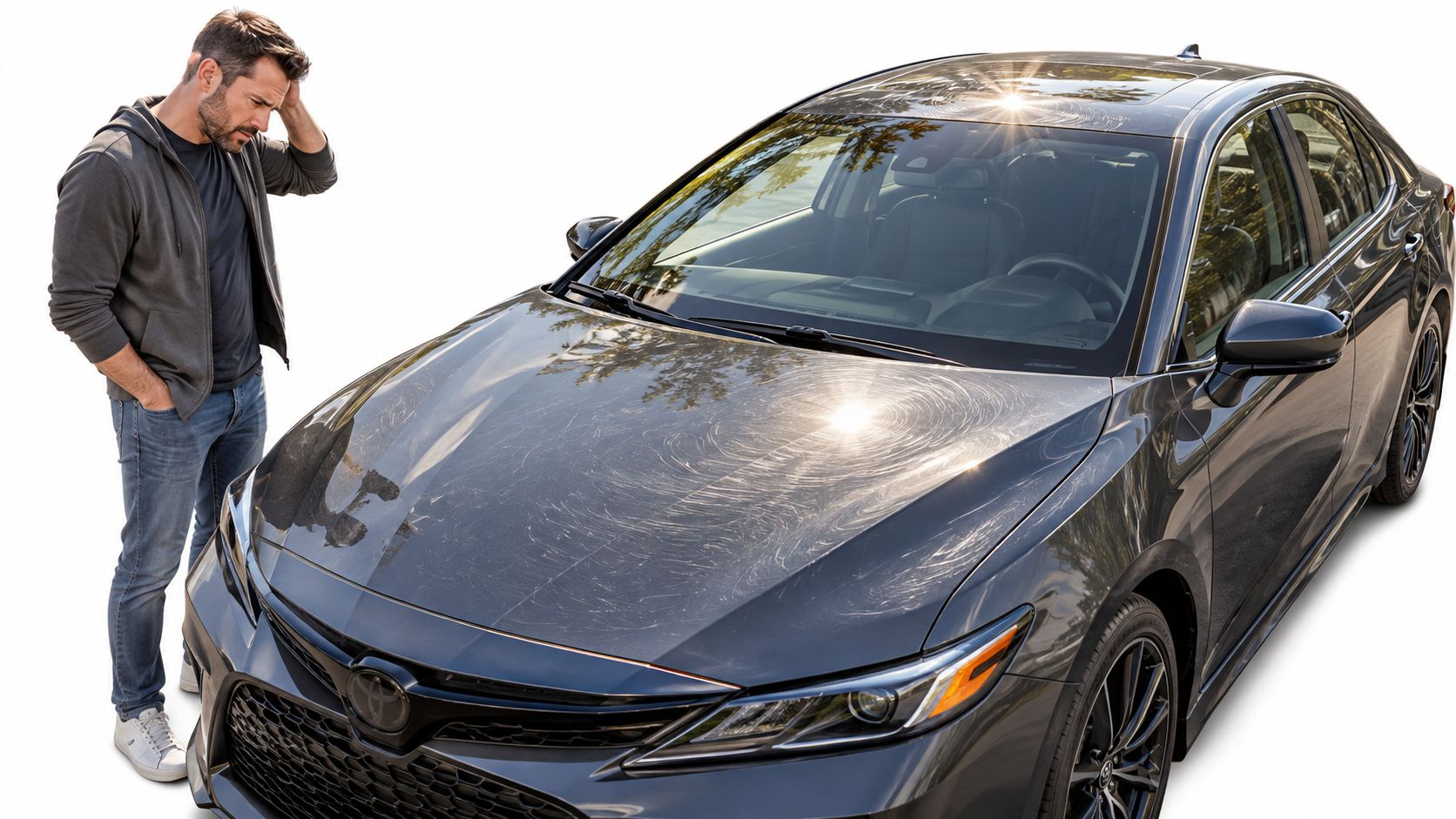
You've just finished washing your car after another GTA winter commute. The salt film is gone, but under the sunlight, the bonnet still looks cloudy. Fine circular marks appear around the door handles, the dark paint seems grey instead of deep, and every overhead light reveals another scratch you didn't notice in the driveway.
That doesn't necessarily mean your vehicle needs the most aggressive detailing package available. It may need paint correction, but the right answer could also be decontamination, a careful polish, or protection paired with a lighter enhancement. The useful question isn't, “How do I make every mark disappear?” It's, “How can I improve the finish without spending clear coat that my daily driver needs for the long term?”
Ontario gives paint plenty to deal with. The province is reported to use about 3 to 5 million tonnes of road salt per winter, while Toronto alone uses roughly 130,000 to 150,000 tonnes annually, according to this Ontario paint-chip repair reference. Salt, road film, automatic washes, hurried towel drying, water spots, and freeze-thaw conditions all make a glossy finish harder to maintain.
This guide breaks down what paint correction does, how to inspect your own vehicle, what happens during a professional service, and why a one-step correction plus protection often makes more sense than show-car perfection for a commuter, rideshare vehicle, SUV, or work truck. You'll get plain-language explanations, practical examples, and a clear way to choose the lightest effective solution.
Table of Contents
- Introduction Why Your Paint Looks Tired Even After a Wash
- What Paint Correction Really Is and How It Works
- How to Tell If Your Vehicle Actually Needs Paint Correction
- Inside the Process From Decontamination to Final Polish
- Choosing Your Level of Correction and What It Costs
- Benefits Risks and Common Myths About Paint Correction
- What to Expect From Paint Correction at Nanak Car Wash
Introduction Why Your Paint Looks Tired Even After a Wash
A wash removes dirt sitting on the surface. It doesn't necessarily remove damage that has settled into the clear coat.
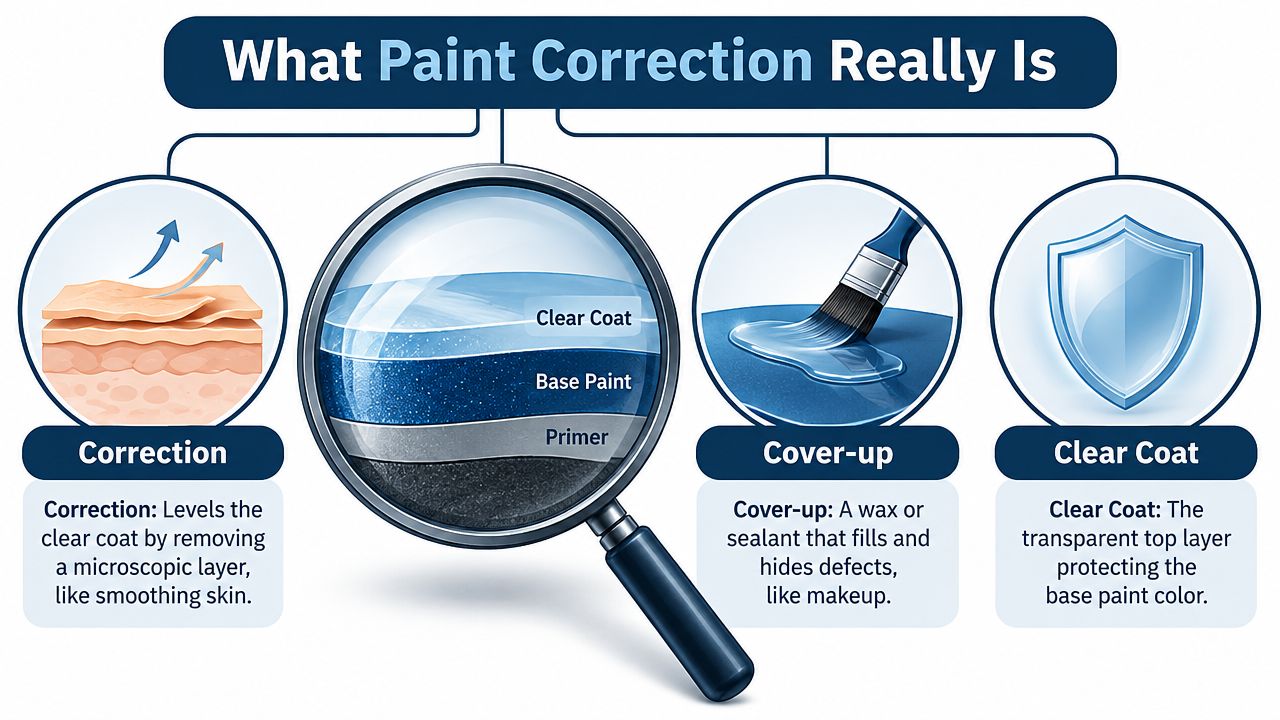
Think of your paint as a layered sandwich. The metal or plastic panel sits at the bottom, the coloured base coat gives the vehicle its colour, and the transparent clear coat forms the protective top layer. When washing marks, oxidation, haze, or light scratches disturb that upper surface, shampoo can clean the panel without restoring its reflection.
That's why a black SUV can look clean but still appear tired. The paint may be free of mud, yet sunlight scatters across thousands of tiny surface imperfections instead of reflecting in a crisp, mirror-like way.
Why GTA driving makes the problem personal
Winter road chemicals are more than an aesthetic nuisance. Salt accelerates surface degradation and can promote corrosion when paint or clear coat has already been breached. Ontario's freeze-thaw environment adds repeated stress, with some Ontario-focused automotive references describing 40 to 60 freeze-thaw cycles per year in the province, as reported in the same Ontario-focused paint-chip repair guide.
You don't need to own a collector car for this to matter. A daily driver parked outside, a delivery vehicle exposed to road film, and a family minivan washed through automatic equipment all face the same basic challenge. The finish needs sensible management, not endless polishing.
The practical mindset: Paint correction should restore useful gloss while preserving enough clear coat for future cleaning, weather, and ownership.
The rest becomes much easier once you separate three problems: dirt on top, bonded contamination attached to the surface, and defects inside the clear coat. The first two often need washing and decontamination. The third is where correction enters the picture.
What Paint Correction Really Is and How It Works
Paint correction is controlled abrasion. A machine, pad, and polishing compound remove or level a very small amount of the clear coat so the surface becomes more even. Instead of filling a valley with a temporary product, the technician carefully reduces the surrounding high spots until light reflects more consistently.
A useful analogy is skin exfoliation. Exfoliation removes a thin layer of uneven surface material, leaving a smoother feel. Paint correction follows a similar principle, but the technician must work within the safe limits of a vehicle's finish.
Wax and fillers are more like makeup. They can improve the way paint looks by filling or disguising fine defects, but they haven't necessarily changed the defect itself. A ceramic coating is different again. It adds a protective layer over the prepared surface. If swirls remain underneath, the coating can preserve those swirls rather than magically erase them.
The clear coat is your working safety buffer
Toronto-based correction guidance describes standard correction as removing about 1 to 5% of total clear-coat thickness, while an Ontario source estimates modern factory clear coat at roughly 40 to 60 microns and total paint readings often around 100 microns or more, as explained in this Toronto paint-correction service guide. Another GTA detailing source says a typical correction may remove only about 1 to 3 microns, while describing modern clear coat at about 100 to 120 microns, according to this paint-correction stages guide.
Those figures aren't a licence to polish casually. They show why measurement matters. Clear coat doesn't have an unlimited reserve, and the reading you get on one panel may not represent the next. A factory bonnet, a repainted door, and an edge near a body line can all respond differently.
A professional technician uses a paint-thickness gauge, inspects the panel under focused lighting, and tests a small area before committing to a larger correction. Pads and compounds are selected to match the paint's hardness and the depth of the defects.
Paint correction removes or reduces defects. Wax, sealant, and coating products protect or disguise the surface, but they aren't interchangeable with correction.
A polish can increase gloss without delivering major defect removal. That's still useful for a newer vehicle or a well-maintained commuter. The important thing is knowing whether you're paying for surface enhancement, actual correction, or protection after preparation.
How to Tell If Your Vehicle Actually Needs Paint Correction
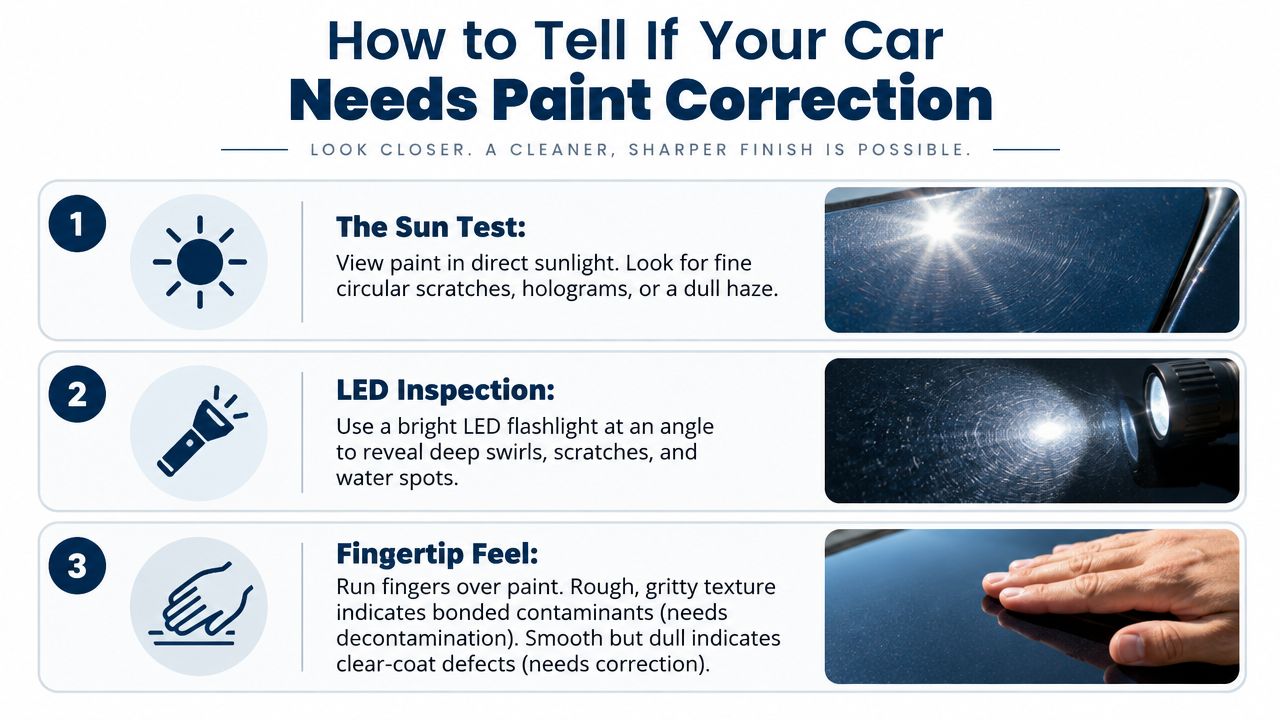
Start with the simplest test: inspect the paint in direct sunlight after it's clean and dry. Move around the vehicle rather than judging it from one angle. If you see circular swirls, fine scratches, holograms, or a broad dull haze radiating around the reflection, the problem may sit in the clear coat.
A bright LED flashlight adds a more controlled view. Hold it at an angle and inspect one panel at a time. Direct light can reveal marks that disappear under cloudy skies, while angled LED light helps separate a real scratch from a patch of leftover grime.
The fingertip test prevents an expensive mistake
Place a clean plastic bag over your fingertips and lightly glide it across the washed paint. A gritty, rough sensation often points to bonded contamination such as industrial fallout or stubborn road residue. That doesn't automatically call for correction. Chemical treatment and clay decontamination may remove the texture while preserving the finish.
Smooth but dull paint suggests a different problem. If your fingertips glide easily yet the reflection remains hazy and swirls stay visible, the clear coat may need polishing.
Use these observations as a decision filter:
- Swirls in sunlight: A one-step correction may improve the appearance if the marks are shallow.
- Rough texture: Try decontamination before assuming the paint needs abrasion.
- Water spots that survive washing: The marks may be mineral deposits on the surface, or etching that needs careful polishing.
- Deep scratches: If your fingernail catches strongly or the mark reveals a different layer, polishing may not be a safe complete repair.
- Light dullness on a daily driver: Decontamination, a finishing polish, and protection may deliver better value than aggressive correction.
The same logic applies to rideshare and delivery vehicles. If the car is cleaned frequently and spends much of its life on GTA roads, chasing every tiny defect can become an ongoing maintenance bill. A clean, smooth, protected finish may be more practical than maximum defect removal.
Inspection rule: Don't choose a correction stage from the colour of the car or the package name. Choose it after seeing the defects under proper light.
Inside the Process From Decontamination to Final Polish
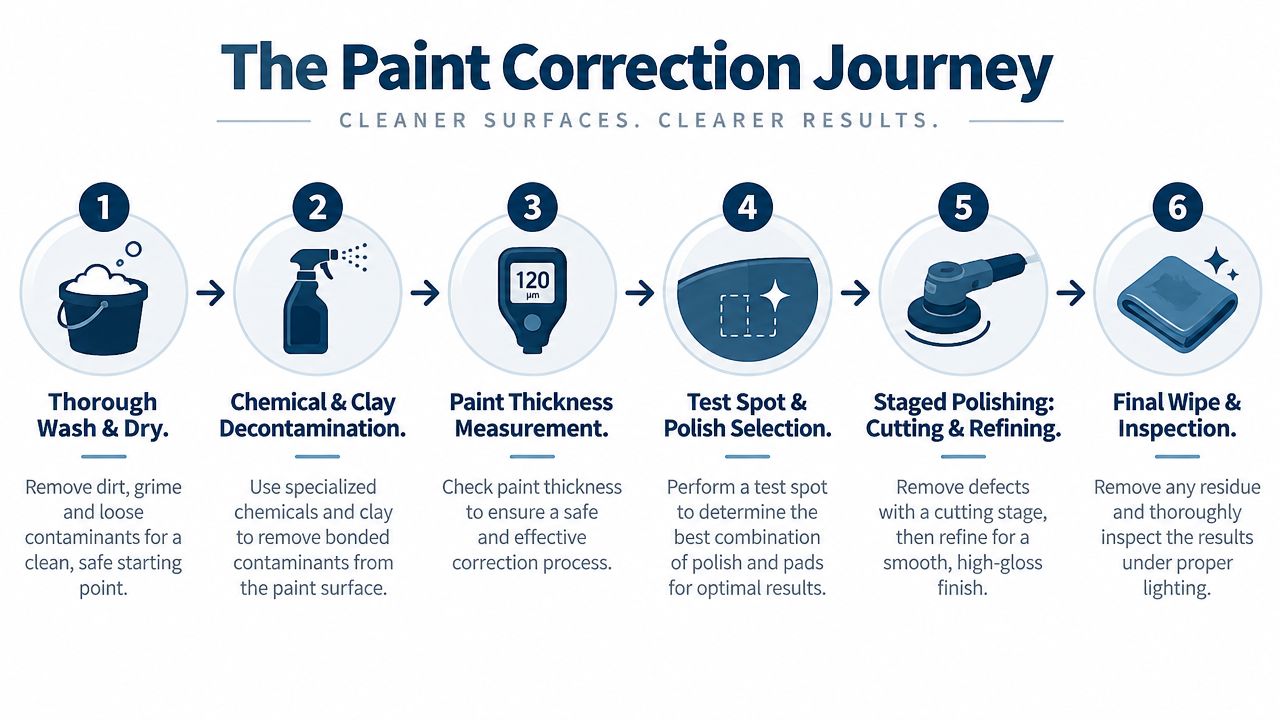
A good correction job begins before the machine touches paint. The technician first removes loose dirt, salt, and road film with a thorough wash, then dries the vehicle with clean, paint-safe towels or air. This step reduces the chance that grit becomes an extra source of marring during polishing.
Next comes decontamination. Chemical products can loosen certain bonded particles, while clay removes contamination that leaves the surface feeling rough. The goal is a clean, smooth starting point. Polishing contaminated paint is like sanding a tabletop with gravel under the sandpaper. It creates more problems than it solves.
Measurement turns guesswork into management
After preparation, the technician inspects the panels under sunlight or focused lighting and takes paint-thickness readings where appropriate. The numbers matter most when a vehicle has previous bodywork, unusually thin areas, or sharp edges that can lose material faster than broad flat panels.
The technician then performs a test spot, usually on a representative section of paint. A light pad and polish combination may be tried first. If it improves the defects enough, there's no reason to begin with a more aggressive compound.
Polishing happens in stages
A cutting stage uses a stronger abrasive and pad combination to reduce more pronounced defects. A refining stage follows when needed, removing haze left by the heavier process and improving clarity.
The technician adjusts the approach according to paint hardness, colour, panel history, and defect depth. A black panel can reveal faint haze that a light-coloured vehicle hides. A repainted door can behave differently from the original bonnet beside it.
Edges and creases receive special caution because the paint layer can be less forgiving there. The technician may mask trim, reduce pressure, change the pad, or avoid chasing a defect that would require too much material removal.
The best correction is not the most aggressive correction. It's the safest process that produces the improvement you actually want.
The final stage involves removing residue, checking the finish from multiple angles, and applying protection. That protection might be a wax, sealant, or ceramic coating, depending on the owner's maintenance habits and goals.
Choosing Your Level of Correction and What It Costs
Correction levels are easier to understand when you match them to ownership rather than to marketing language. A commuter with light wash marks has a different need from an enthusiast preparing a show vehicle. A leased vehicle also deserves a conservative approach because preserving the finish can matter more than removing every visible imperfection.
Local detailing information often describes ordinary detailing visits as taking 1 to 4 hours, with larger vehicles and heavier interior conditions affecting the appointment, as shown in Nanak Car Wash's detailing information. Paint correction time grows with the number of polishing stages, the severity of the defects, the size of the vehicle, and the care required around edges and repainted areas.
Paint Correction Levels Compared
| Correction Level | Best For | Clear Coat Impact | Time and Value |
|---|---|---|---|
| One-step enhancement | Light swirls, mild haze, newer vehicles, daily drivers, resale presentation | Lightest practical correction approach, subject to inspection and testing | Usually the strongest balance for owners who want better gloss without chasing every mark |
| Two-stage correction | More noticeable swirls, moderate dullness, water-spot etching, darker paint | Greater material removal than a light enhancement, so measurement and panel history matter | More labour and preparation, suitable when a one-step result won't meet the owner's expectations |
| Multi-stage correction | Severe defects, enthusiast vehicles, demanding finish goals, targeted refinements | Highest clear-coat management concern, especially on thin or repainted panels | Time-intensive work that makes sense when finish perfection is a priority, not routine upkeep |
The cost is driven by labour and risk, not just product. Vehicle size, paint condition, the number of stages, and additional cleaning needs all affect the final quote. An SUV, van, or truck takes more time to wash, inspect, polish, and wipe down than a compact car, while pet hair and heavy interior soil can add separate charges to a full detailing appointment.
A sensible GTA decision
Choose one-step correction when the paint is generally healthy and you want the car to look refreshed. Pair it with a protective layer and safe washing, then accept that some deeper marks will remain.
Choose two-stage work when the defects are prominent and you plan to keep the vehicle looking sharp. Choose multi-stage correction only when the finish goal justifies the additional labour and clear-coat management.
The most valuable package may be the one that leaves a few harmless marks behind. For an Ontario daily driver, retained paint thickness and repeatable maintenance often matter more than a flawless inspection under a spotlight.
Benefits Risks and Common Myths About Paint Correction
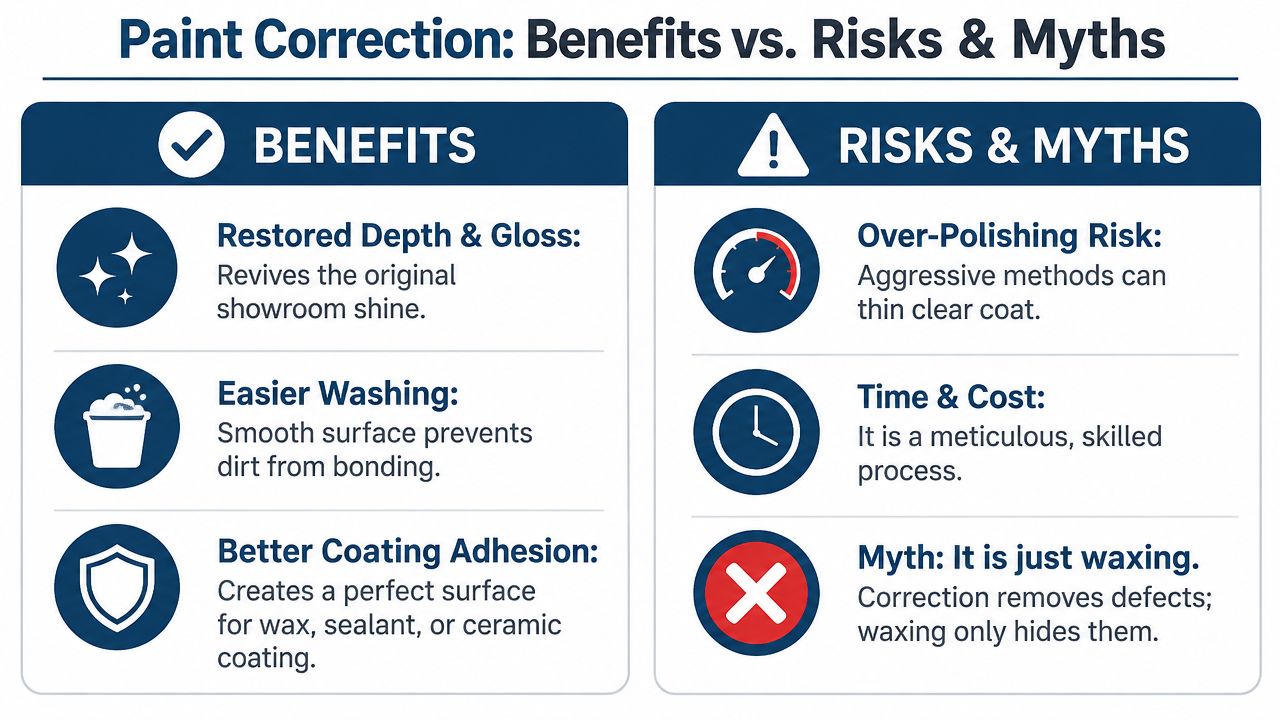
The biggest myth is simple: more correction is always better. It sounds logical, but paint isn't an endlessly renewable surface. Every polishing decision trades some clear-coat material for a cleaner reflection, so the technician has to decide which defects are worth pursuing.
Correction can restore depth, reduce haze, improve the way light reflects, and make the vehicle easier to maintain once the surface is smooth and protected. It can also create a cleaner foundation for wax, sealant, or ceramic coating. Those benefits are real, but they depend on preparation and restraint.
What correction can't safely solve
Deep scratches that pass through the clear coat may need touch-up or refinishing rather than repeated polishing. Chips, peeling clear coat, rust, and failed repaint work also sit outside ordinary correction.
The common risks include:
- Over-polishing: Aggressive work can reduce the remaining clear-coat safety buffer.
- Edge burn-through: Sharp edges and raised body lines need careful pressure and machine control.
- Haze or holograms: A heavy compound can leave a finish that needs refinement.
- Locked-in defects: Applying a coating over uncorrected marks preserves the surface underneath.
- False expectations: A vehicle can look dramatically better without becoming defect-free.
Newer cars, leased vehicles, and fleet units deserve special restraint. The aim is to improve presentation while protecting the finish for future washing, weather exposure, and reconditioning needs.
Myth check: Paint correction isn't just waxing. Wax can add gloss or hide fine defects, while correction changes the surface by controlled polishing.
A protective product won't prevent every future swirl, especially if the vehicle is washed with dirty tools or wiped while dusty. The lasting result comes from the combination of reasonable correction, protection, and a maintenance routine you can follow.
What to Expect From Paint Correction at Nanak Car Wash
A practical appointment starts with inspection rather than an automatic promise of maximum correction. The team can assess whether your vehicle needs decontamination, machine buff and polish, a more involved correction approach, or regular exterior maintenance.
Nanak Car Wash offers appointment-based interior and exterior detailing that includes machine buff and polish, alongside express and full-service wash options. Its published information also describes trained hand-finishing, 100% fresh water washes, and services available across multiple GTA-area locations. Those details matter because correction isn't a one-day substitute for washing, especially in an Ontario climate shaped by salt and repeated freeze-thaw exposure.
Match the service to your ownership routine
A commuter may benefit from a lighter polish followed by regular washing and protection. A work truck may need frequent exterior cleaning and underbody attention rather than a deep cosmetic correction. A vehicle being prepared for sale may justify focused improvement on the most visible panels instead of chasing every defect across the entire body.
Ask for a clear explanation of what the technician sees, what the selected process should improve, and which marks are too deep or risky to pursue. A transparent, tiered recommendation helps you compare appearance goals with long-term paint management without paying for a stage your vehicle doesn't need.
The strongest plan for many GTA daily drivers is straightforward: inspect first, choose the least aggressive correction that delivers a visible improvement, protect the finish, and maintain it with safe repeat washing.
Nanak Car Wash offers express and full-service washes, appointment-based interior and exterior detailing, machine buff and polish, and rust proofing options across GTA-area locations. Visit Nanak Car Wash to have your vehicle assessed and choose a practical correction and protection plan for the way you drive.

 6600 Finch Ave W, Etobicoke, ON M9V 3Z6
 647-703-8515
 MON – SUN 8 AM to 7 PM