
You've just opened the SUV after a weekend trip and found the familiar grey blanket across the cargo carpet. The vacuum made a convincing noise, filled its canister with crumbs and road grit, and somehow left the pet hair behind. A few strands are still wrapped around the seatbelt anchor, pressed into the mat's weave, and hiding in the seam where the rear seat meets the floor.
That's why choosing a pet hair remover for carpet isn't really about finding one magical gadget. Automotive carpet needs a sequence. You loosen the fibres, gather the fur, then extract what's been released. In Ontario, that sequence matters even more when damp winter conditions, salt residue, static, and heavy SUV carpeting turn a routine clean into a proper wrestling match.
| Tool type | Best use | Main limitation | Effort level |
|---|---|---|---|
| Rubber carpet rake | Loosening surface and embedded fur | Can't finish deep seams alone | Low to moderate |
| Rubber squeegee brush | Clumping loose hair on mats and low-pile carpet | Less precise around tight edges | Low |
| Vacuum with powered brush | Final extraction and fine debris | Often skims over anchored fur | Moderate |
| Crevice and upholstery attachments | Seat rails, seams, and cargo corners | Slow across large carpeted areas | Moderate |
| Adhesive lint roller | Small touch-ups on fabric | Inefficient for dense carpet and large volumes | Low |
Table of Contents
- The Embedded Pet Hair Problem
- Why Car Carpets Hold Onto Fur
- Comparing Top Removal Tools
- The Rubber Brush Advantage
- When to Call the Professionals
- Maintaining a Clean Interior
The Embedded Pet Hair Problem
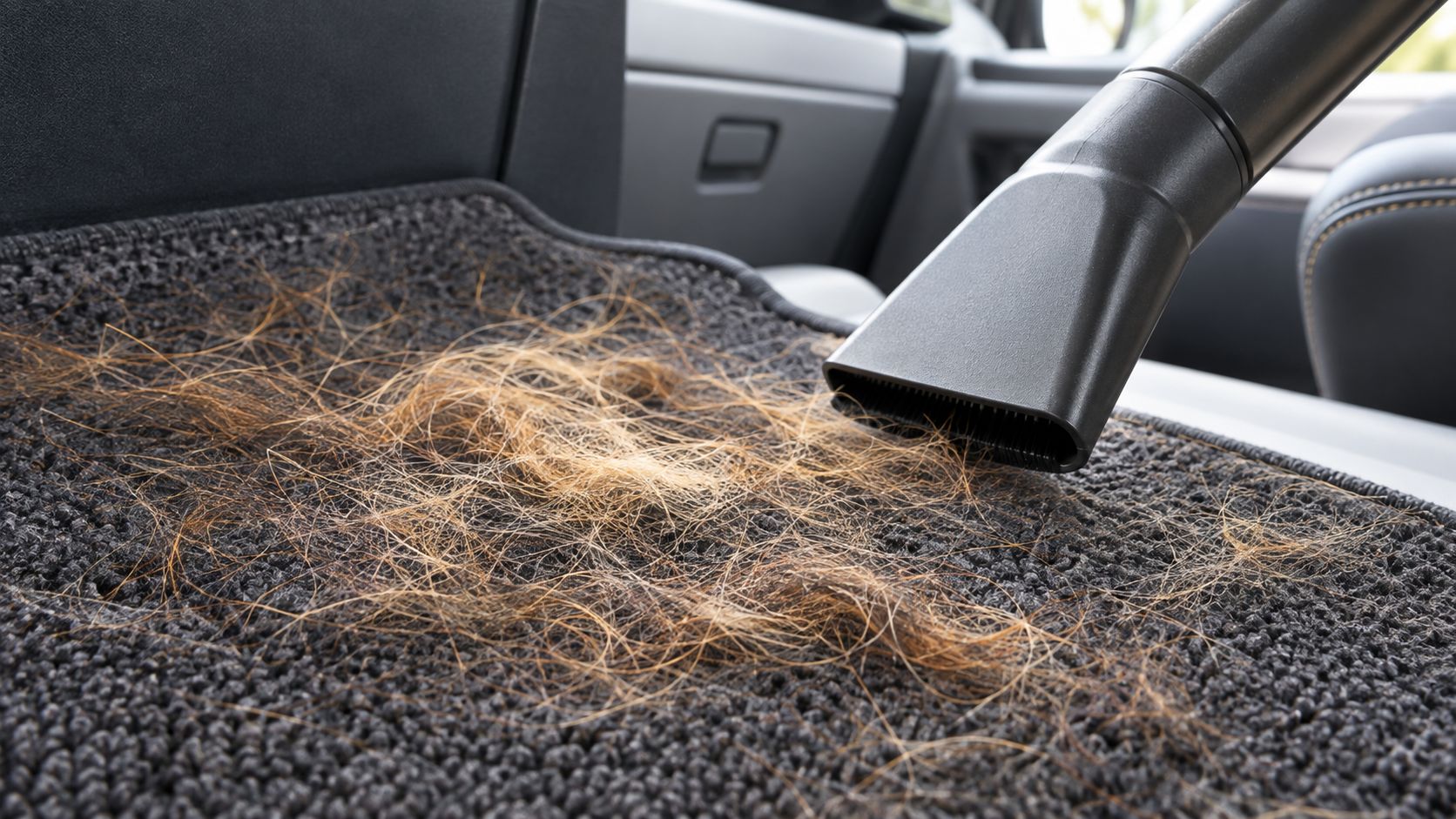
The usual scene starts after the vacuum has already had its chance. You run the nozzle over the rear floor, empty the bin, and expect a clean result. In daylight, the carpet still looks furry, especially around the dog's preferred side of the cargo area and along the raised lip of the floor mat.
Pet hair behaves differently from loose road dust. Dust rests on top of a surface and moves when air reaches it. Fur bends around individual fibres, catches on rough carpet, and becomes tangled where the pile changes direction. In a vehicle, repeated foot traffic and sliding cargo press those strands farther down, so a quick vacuum pass often removes the easy material while leaving the stubborn layer underneath.
Why the first vacuum pass disappoints
Automotive carpet is usually designed to tolerate abuse, not to release every contaminant on command. Its textured surface gives fur plenty of points to catch, while seat rails, cargo fasteners, seatbelt mounts, and folded-seat hinges create narrow areas where a wide vacuum head can't make proper contact.
The nozzle also has a practical limitation. Suction can lift hair that's already loose, but it can't always overcome the combination of friction, tangling, and pressure holding embedded fur in place. If you push harder without first agitating the carpet, you may flatten the fibres and polish the hair deeper into the surface.
Practical rule: If the vacuum keeps passing over the same dark patch without changing it, stop vacuuming and change the action. The carpet needs agitation before extraction.
The problem is larger than appearance
Ontario research published in 2012 found that 63.7% of respondents had one or more household pets, and 93% of those pet owners had cats or dogs. The same study found that 36% of all respondents had weekly contact with animals outside the home, a useful explanation for why animal debris can enter vehicles and homes repeatedly, even when the pet doesn't live in the car. The Ontario household pet research is available through BMC Public Health.
That fur can also carry dander, dust, and outdoor residue. Hair isn't automatically the allergen itself, but it gives debris a place to remain until brushing, vacuuming, or passenger movement disturbs it. A cargo carpet that looks merely untidy may therefore need a more methodical clean than a single suction pass.
The right response is layered, not aggressive. A carpet rake or scraper lifts and separates the fibres. A rubber edge gathers the released strands into clumps. A vacuum then removes the clumps and the fine debris left behind.
Why Car Carpets Hold Onto Fur
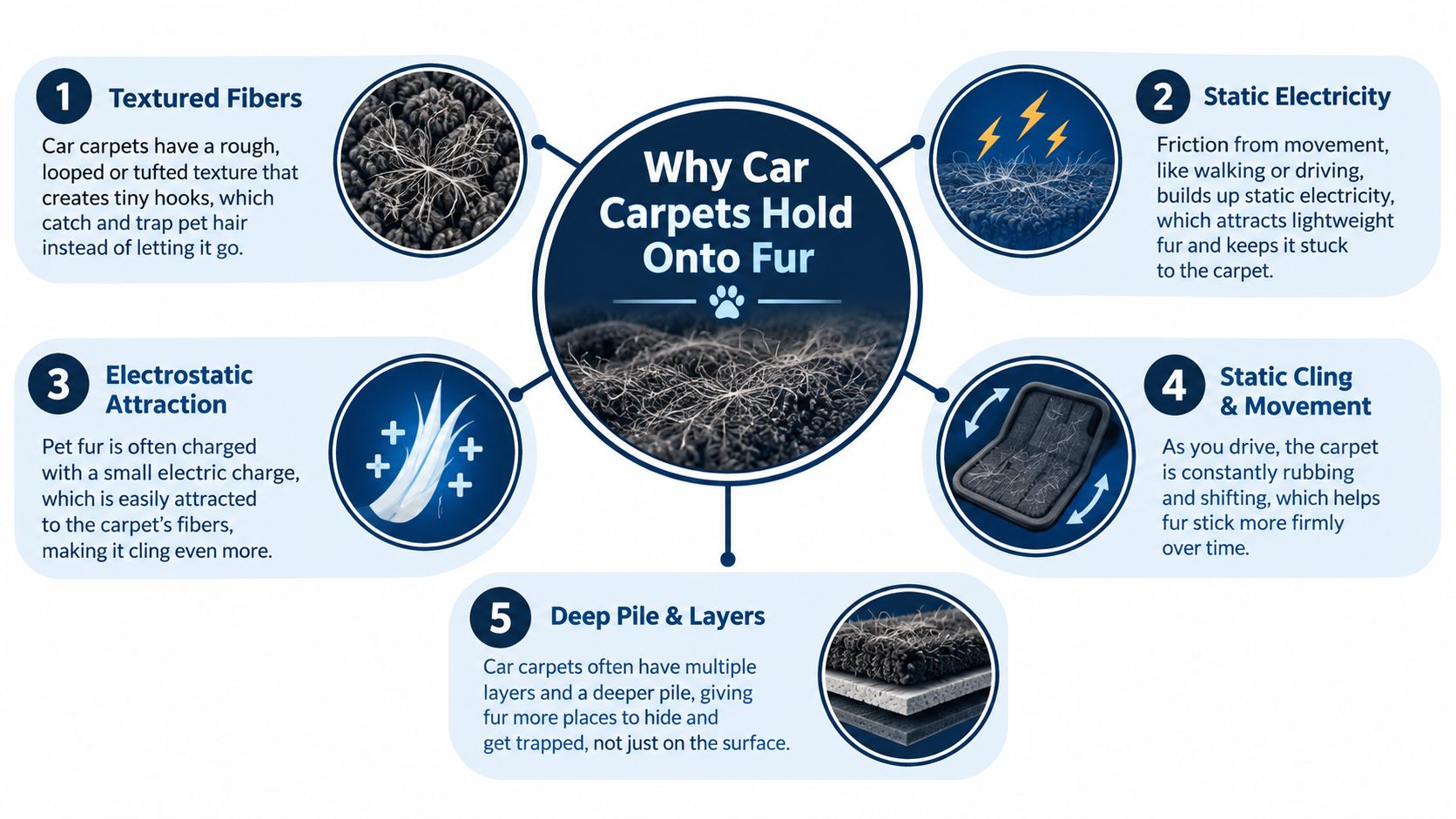
Static, moisture, and carpet texture work together to make automotive fur removal frustrating. Dry hair can cling to synthetic fibres through static, especially after repeated rubbing from a pet's coat, clothing, or cargo. Moisture adds another complication. Ontario winter slush and damp boots can press fur against the carpet, while salt and grit give the strands extra material to wrap around.
A car's carpet also has more trouble spots than a living-room floor. The front footwell narrows around pedals and trim. The rear floor meets plastic panels at awkward angles. An SUV trunk contains seams, anchor points, removable mats, and vertical side panels. Each transition interrupts the smooth movement of a vacuum head.
Hair is only part of the indoor exposure
Canadian allergy guidance explains that pet dander, rather than hair alone, is the main allergen, and that dander can accumulate in soft furnishings including carpets, mattresses, and pillows. One Canadian allergy source states that about 5% of Canadians are allergic to dogs, or more than 1.8 million people. The Canadian dog-allergy facts page explains the distinction between hair and dander.
That distinction changes the cleaning target. You're not just trying to make the carpet look black again. You're trying to remove the hair that traps dust and dander, then capture the fine material that becomes airborne when people climb into the vehicle or move the mats.
Hair length doesn't solve the problem either. A short-haired dog can leave fine strands that work into carpet, while longer hair may form visible clumps that are easier to collect. The visual size of the fur isn't a reliable guide to how much effort the carpet will require.
Ontario conditions make the attachment worse
Winter contamination creates a rough, damp surface that holds onto fur. Salt crystals and gritty road residue can settle around carpet fibres, and wet material tends to compact rather than lift cleanly. Once the vehicle dries, static can make the remaining strands cling again.
That's why dry agitation usually works better as the opening move. Let the rubber rake separate the fibres and gather the hair before applying moisture or shampoo. If you wet a heavily furred carpet first, you can turn loose hair into a matted layer that takes longer to remove.
For allergen-sensitive occupants, filtration matters during the final extraction. Canadian comparison guidance points to single-pass pickup on carpet as a more useful benchmark than motor wattage or handle length. The same guidance cites an RTINGS Pet Hair Pickup score of 7.5 or higher as good or better, and highlights testing where a model achieved 100% carpet hair pickup, with 100% carpet Cheerios and litter pickup, using a 1.25 L dustbin and HEPA filtration. The Canadian pet-vacuum comparison explains why carpet pickup and filtration deserve attention.
Comparing Top Removal Tools
A powered upright vacuum is valuable, but it shouldn't be your only tool. Its rotating brush can help with loose fur and fine debris, while a HEPA-equipped system is useful for containing what the carpet releases. In a vehicle, though, a full-size upright is awkward around pedals, seat rails, and trunk corners, and the head may bridge over hair that has wrapped around individual carpet fibres.
A compact shop vacuum or strong handheld vacuum is easier to manoeuvre. Add a crevice nozzle for seatbelt mounts and a narrow upholstery head for seat faces. The trade-off is that handheld units often rely on shorter runtimes, smaller bins, or less effective agitation. They're excellent finishers, but they aren't always the best first move on a dense cargo carpet.
| Tool type | Best for | Limitations | Effort level |
|---|---|---|---|
| Upright vacuum with powered brush | Large removable mats and broad floor areas | Bulky inside vehicles, may skim embedded hair | Moderate |
| Compact shop vacuum | Final extraction and mixed debris | Needs a separate agitation tool | Moderate |
| Handheld vacuum | Quick maintenance and tight spaces | Limited capacity and coverage | Low to moderate |
| Rubber rake | Embedded fur on carpet and mats | Requires cleaning between passes | Low |
| Rubber squeegee brush | Loose clumps and low-to-medium pile | Can miss deep seams | Low |
| Adhesive lint roller | Seats, trim, and isolated tufts | Picks up slowly and loses grip with debris | Low |
| Brass or stiff detail brush | Fine hair in stubborn patches | Can damage fibres if used too aggressively | High |
Match the tool to the carpet
For a low-pile sedan floor, a rubber squeegee edge can gather a surprising amount of loose fur quickly. A textured rubber rake gives you more bite when the hair is anchored. On an SUV trunk, use a wider rake over the open floor, then switch to a narrow brush or crevice attachment around tie-downs and seat hinges.
Lint rollers have a clear role, but it's a small one. They're handy for a few hairs on a fabric seat or a final pass over a removable mat. They're poor value for a full trunk because the adhesive surface loads quickly, and pressing repeatedly can push hair against the carpet rather than lift it.
A brass brush can remove fine hair from a stubborn patch, but it demands restraint. Use light pressure and work in one direction. If the fibres begin to fuzz, snag, or change texture, the brush is too aggressive for that surface.
The best single-pass tool is the one that actually contacts the pile. In a vehicle, that often means a small attachment or rubber edge, not the largest vacuum head available.
Judge performance by pickup, not marketing
For carpet work, look for evidence of single-pass pickup, effective debris separation, and filtration. Motor wattage alone doesn't tell you whether a nozzle will lift hair from automotive pile, and a long handle doesn't help if the head can't sit flat against the carpet.
A useful companion read for people managing carpet beyond the vehicle is this guide for busy homeowners, particularly when you're deciding whether dry agitation or a deeper cleaning process makes more sense. The same basic principle applies in a car: remove dry debris before introducing moisture, and don't expect one machine to perform every stage equally well.
The practical winner is usually a combination. Rake the fibres, clump the fur, vacuum the debris, then inspect the seams with directed air or a crevice tool. That approach takes more steps than a lint roller, but it prevents the common failure where the surface looks clean while the seatbelt edge and trunk corners remain packed.
The Rubber Brush Advantage
Rubber tools work because they create direct contact with the carpet. Their edge bends into the pile, catches loose strands, and rolls them into visible clumps. That gives you something a vacuum can remove efficiently instead of asking suction to pull individual hairs out of a tangled surface.
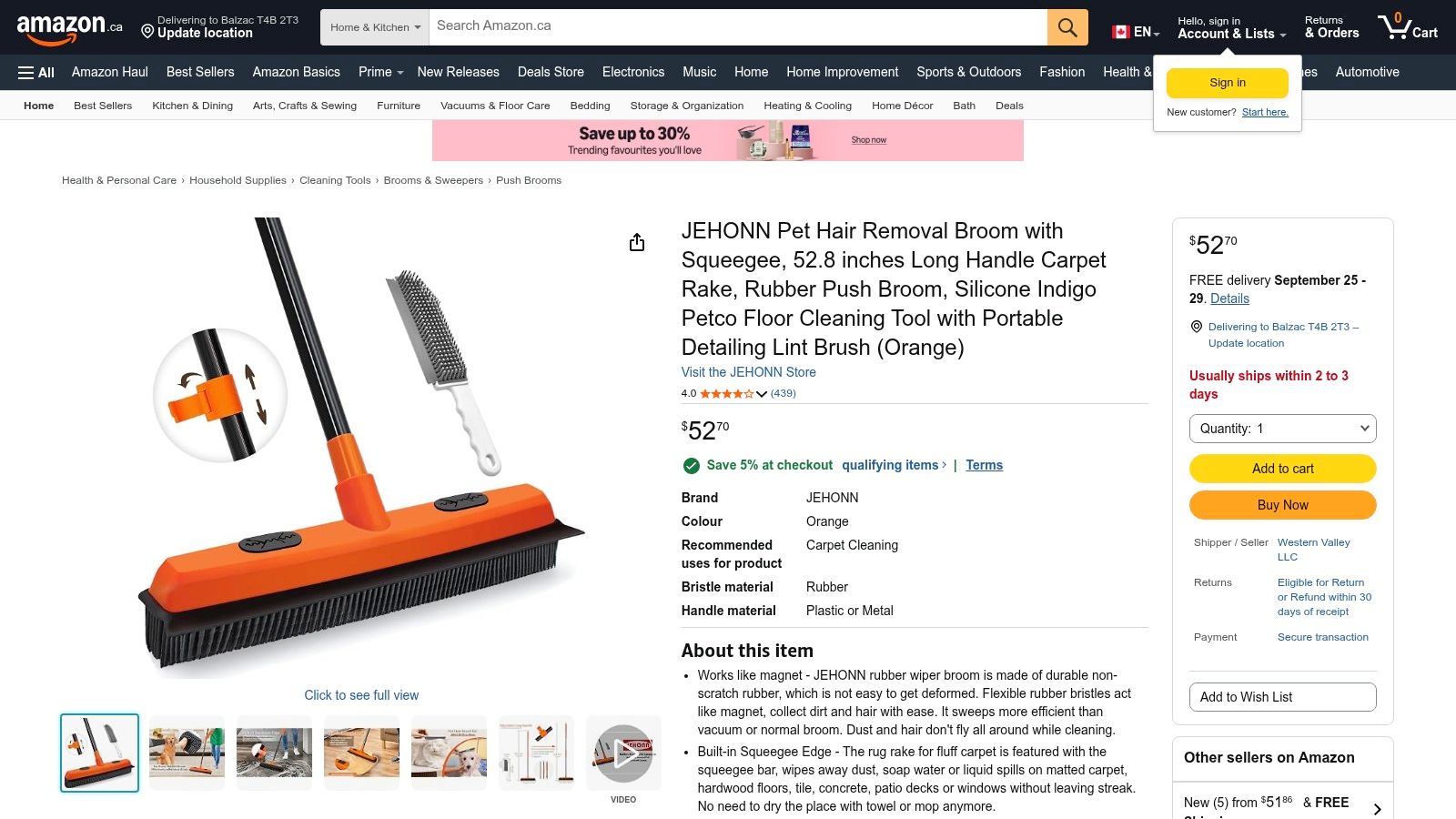
Canadian listings commonly describe rubber broom, rake, and squeegee designs for carpets, rugs, and vehicle interiors. Some combine a rake edge with a squeegee side, so the same tool can gather fur and wipe mixed dust or liquid from a matted surface. A Canadian listing for a rubber squeegee detailing tool shows this hybrid design.
Use the tool in three passes
Agitate the carpet. Start with dry mats outside the vehicle where possible. Pull the rake towards you with controlled strokes, changing direction only when the pile needs to be opened. On cargo carpet, work from the centre towards an edge so the fur has somewhere to collect.
Clump the release. Once the hair begins forming lines or tufts, use the rubber squeegee edge to push it into a small pile. Don't grind the edge into the fibres. A firm, shallow angle gathers fur; heavy pressure flattens carpet and can smear damp residue.
Extract everything. Vacuum the pile, then repeat the nozzle around the boundary where the clump formed. Follow with a crevice tool along seat seams, under-seat channels, and the carpet edge beneath the rear bench.
Adjust pressure for the surface
Low-pile carpet usually responds to a few steady strokes. Deep or worn carpet needs slower movement because the fur sits below the visible surface. Rubber also performs well on removable mats, where you can flex the mat slightly to open the fibres before raking.
Avoid using a hard plastic scraper as your default. It can lift compacted debris, but it may cut, snag, or permanently disturb the carpet texture. A rubber edge gives you friction without the same sharp contact, which is why hybrid rubber and rake tools make sensible pre-vacuum equipment for frequent interior detailing.
The rubber brush isn't a replacement for a vacuum. It's the tool that makes the vacuum's final job easier. If hair remains after two careful cycles, inspect for dampness, oily residue, or a seam that needs a narrow brush. More force won't solve a problem caused by contamination underneath the fur.
When to Call the Professionals
DIY removal works well when the hair is dry, accessible, and limited to mats or open floor sections. It becomes less attractive when the vehicle has months of buildup, strong odours, visible staining, or fur threaded into seat rails and trim. A family SUV can contain several different carpet surfaces, and each one may need a different brush angle, attachment, or extraction method.
Persistent smell is a warning that hair isn't the only issue. Pet oils, damp fabric, food residue, and winter contamination can remain after the visible fur disappears. Vacuuming removes loose solids, but it won't replace carpet shampooing when the fibres need a deeper clean.
Look for the signs of a deeper job
Call a detailing professional when:
- The hair returns after cleaning: Fur that reappears as the carpet dries may be lodged below the surface or inside seams.
- Odour survives dry removal: A lingering animal or damp smell points to contamination beyond loose hair.
- The carpet has salt or stain marks: Winter residue often needs controlled shampooing and extraction rather than more brushing.
- Seatbelt and hinge areas remain packed: These spaces are difficult to clean safely without the right narrow tools and positioning.
- The vehicle carries passengers frequently: Ride-hailing, delivery, and fleet interiors benefit from a repeatable process instead of occasional emergency cleaning.
Nanak Car Wash offers appointment-based interior and exterior detailing that includes carpet and seat shampooing, salt and stain removal, vent and crevice blowout, and pet-hair work, with SUV, van, truck, and pet-hair surcharges applying where the job requires additional labour. That's a different service from a quick vacuum, and it should be treated as such.
Decision point: Use a rubber tool when you need to release fur. Book professional cleaning when the carpet also needs odour control, stain treatment, or extraction from inaccessible areas.
Professional floor-care guidance, including this resource on Clean Space SA floor care experts, reinforces a principle that applies to vehicle interiors as well as buildings. The cleaning method has to match the material, the contamination, and the required finish. A carpet that's merely hairy needs agitation and vacuuming. A carpet that's wet, stained, and odorous needs a more complete process.
Don't shampoo a heavily furred interior before removing the loose hair. Wetting first can mat the strands and make the extraction stage harder. A trained detailer will normally clear the dry debris, work the affected areas, then use the appropriate cleaning and drying process for the carpet and upholstery.
Maintaining a Clean Interior
The easiest pet-hair job is the one you don't allow to become a packed layer. A short maintenance routine after trips is less unpleasant than attacking a winter's worth of fur from the trunk carpet, and it protects the fibres from repeated compression.
Start before the pet enters the vehicle. Brush loose fur outdoors, use a washable seat or cargo cover, and keep the animal's travel area consistent. A cover won't stop every strand from escaping, but it gives most of the debris a removable surface instead of letting it settle directly into the carpet.
Build a repeatable vehicle routine
After a pet trip, check the high-contact zones first:
- Cargo mat: Remove it, shake or brush it outside, then vacuum both sides.
- Rear seat crease: Run a narrow rubber edge through the fold before fur gets compressed.
- Seatbelt base: Use a small detailing brush or crevice tool without forcing the belt into a tight bend.
- Door-side carpet: Rake towards the open edge, then vacuum the gathered line.
- Front footwell: Clear grit and salt before brushing, so abrasive debris doesn't drag across the fibres.
A rubber tool is ideal for quick maintenance because it gathers visible strands without needing a large machine. A handheld vacuum then handles the pile, dust, and small clumps. Keep the final pass slow around seams, where speed leaves the most behind.
Static reduction can also matter in dry conditions. Use products only when they're labelled as suitable for the relevant carpet or upholstery, and avoid soaking automotive materials. Dampness trapped under mats can create a separate odour problem, especially when the vehicle is parked and closed.
Choose consistency over the “best” tool
There isn't one universal pet hair remover for carpet. A rake is better at opening fibres, rubber is better at gathering fur, and a vacuum is better at extraction. Adhesive rollers are convenient for finishing touches, but they're not a sensible primary tool for a large SUV trunk.
For broader household cleaning habits, this guide to an eco friendly home offers useful context around choosing repeatable, lower-waste routines. In the vehicle, the same thinking means using washable covers and durable rubber tools, then reserving deep detailing for the buildup that routine maintenance can't remove.
Schedule professional cleaning when the carpet develops odour, staining, or stubborn embedded fur. Nanak Car Wash provides interior detailing for GTA vehicles, including carpet shampooing, pet-hair work, salt and stain removal, and crevice cleaning, so visit Nanak Car Wash when a rake-and-vacuum routine no longer gets the interior back under control.
If your SUV, van, or car has fur packed into its mats, seams, or cargo carpet, start with a dry rubber rake, follow with a squeegee edge, and finish with a crevice-equipped vacuum. When winter residue, stains, odour, or deep embedded hair remain, book Nanak Car Wash for a focused interior detail and let the technicians handle the parts your home tools can't reach.


 6600 Finch Ave W, Etobicoke, ON M9V 3Z6
 647-703-8515
 MON – SUN 8 AM to 7 PM