
If your car right now has a white crust around the driver's mat, a few coffee drops in the console seam, and windows that haze up faster than they should, you're in a very normal GTA situation. Most interiors don't get wrecked in one dramatic spill. They get worn down by commutes, winter boots, snack crumbs, damp gloves, and the stuff that gets ignored because it's “inside, so it's fine.”
That's why auto interior cleaning in Southern Ontario isn't just about making a car look less embarrassing at a red light. It's maintenance. In this region, your cabin takes a beating from road salt, wet slush, stop-and-go traffic, and long hours spent sealed up with the heat running. A decent plan keeps fabrics from holding residue, trim from getting grimy, and the air inside the car from feeling stale.
Table of Contents
- Why GTA Drivers Treat Interior Cleaning as Seasonal Maintenance
- The Core Interior Cleaning Services Explained
- DIY Interior Cleaning Versus Professional Detailing
- Typical Pricing, Duration, and What Affects the Bill
- Targeted Cleaning for Pet Hair, Families, and Rideshare Use
- Cabin Air Quality, Allergens, and Why Vacuuming Is Only Half the Job
- Memberships and Prepaid Bundles for Predictable Cabin Care
- Your Auto Interior Cleaning Routine and Common Questions
Why GTA Drivers Treat Interior Cleaning as Seasonal Maintenance
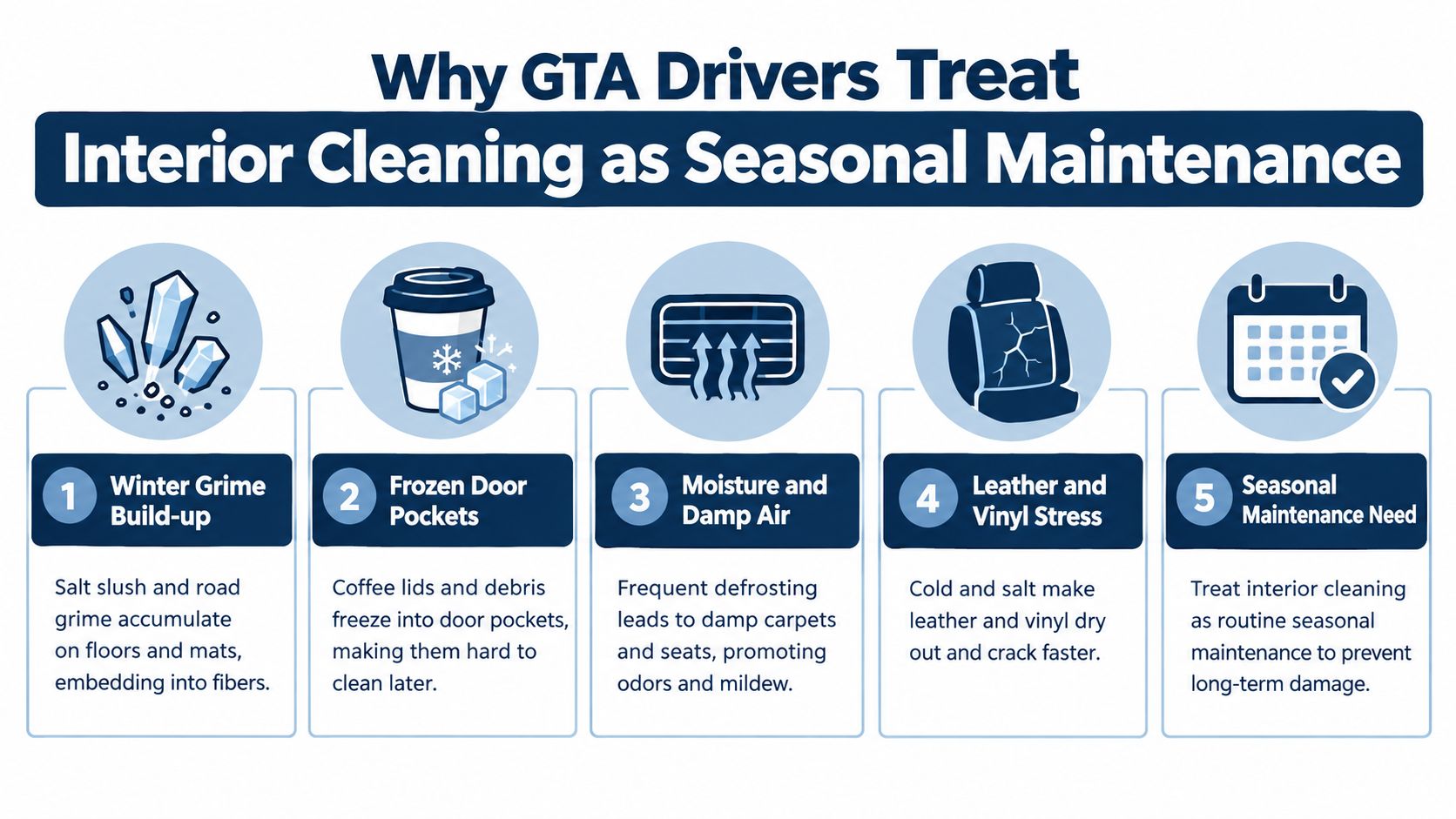
A lot of GTA drivers live the same winter loop. You knock slush off your boots in a plaza parking lot, climb into the car, drop a coffee lid into the door pocket, blast the defroster, and head into traffic. By the time that routine repeats for a few weeks, the floor mats are wet, the carpet edges are chalky, and the whole cabin starts feeling tired.
In Ontario, that buildup starts with salt. Independent Ontario summaries commonly estimate the province applies roughly 1.5 to 3 million tonnes of road salt each winter, and Toronto alone is often cited at about 130,000 to 150,000 tonnes annually. That salt doesn't stay outside. It gets tracked into the cabin on shoes, floor mats, lower trim, and around the door sills, which is why winter interior care in this region turns into repeat maintenance rather than a once-a-year cleanup (Ontario winter road-salt context).
What changes by season
Winter gets the attention because it's the messiest, but every season leaves its own interior problem.
- Winter means salt and dampness. Mats stay soaked, carpet edges trap residue, and lower trim collects grime you don't notice until it dries white.
- Spring means pollen and dust. A cabin can look decent and still feel stuffy because fine debris settles into fabric and vents.
- Summer means heat and odours. Any old spill that seemed harmless in March suddenly announces itself in July.
- Autumn adds leaf debris and moisture. Dirt from trunks, shoes, and cargo areas starts another cycle before winter even arrives.
Practical rule: If you drive through a real Ontario winter, interior cleaning belongs on the same mental list as tire swaps and underbody rinses.
Why this matters beyond looks
Salt residue isn't decorative dirt. It settles into the areas people touch and step on most. Families feel it first because kids grind snacks and slush into the back seat floor. Commuters feel it when the cabin never quite smells dry. Anyone thinking about resale feels it when the interior looks older than the odometer says it should.
The drivers who keep interiors in good shape usually aren't obsessives. They're just treating the cabin like part of the vehicle that needs seasonal care.
The Core Interior Cleaning Services Explained
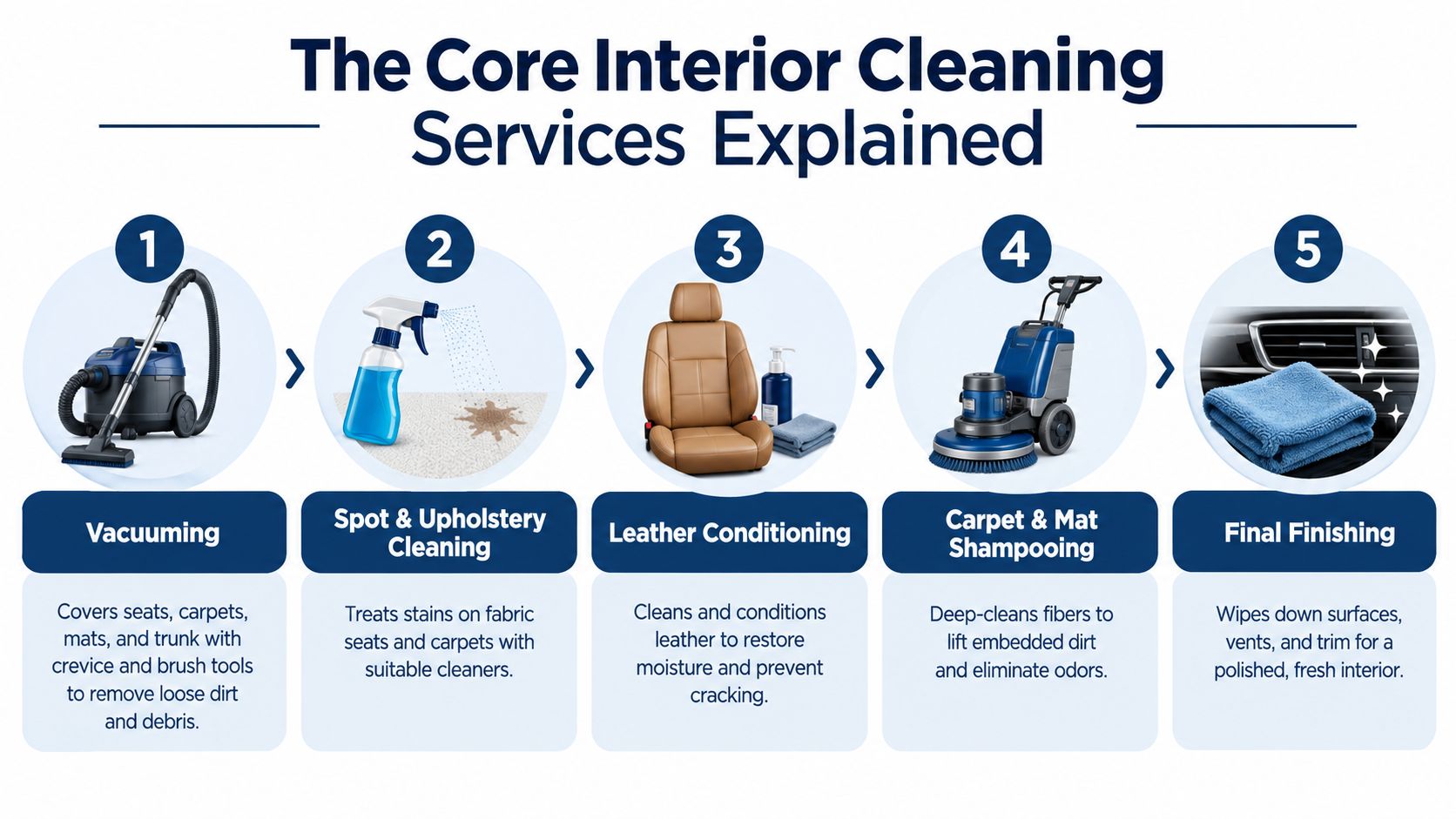
People often book “interior cleaning” as if it's one thing. It isn't. Good auto interior cleaning is a stack of separate jobs, and each one solves a different problem. A basic vacuum won't remove body oils from a steering wheel, and shampooing carpets won't fix dusty vents.
Vacuuming and dry debris removal
This is the foundation. Seats, carpets, mats, trunk, seat rails, and tight seams all get vacuumed with crevice tools and soft brushes.
What it does well:
- Removes loose dirt fast. Crumbs, gravel, dust, lint, and dry leaf bits come out efficiently.
- Preps the cabin for deeper work. You don't want to scrub mud into fabric when dry debris is still sitting on top.
- Improves the look quickly. For a lightly used car, this alone can make the cabin feel reset.
What it doesn't do well:
- It won't remove oily films. Console grime, sunscreen residue, and hand oils need cleaners, not suction.
- It won't pull out embedded contamination. Salt, pet dander, and set-in dirt often stay below the surface.
Spot cleaning and fabric work
Stains get assessed instead of attacked blindly. Coffee on cloth, old splash marks near cup holders, and dirty knee-contact areas need the right chemistry and agitation.
A decent technician treats the stain first, works it gently, and checks whether it's removable or only improvable. That sounds obvious, but plenty of DIY jobs make a stain bigger by over-wetting it or using the wrong spray.
If someone promises every stain will vanish, be careful. Some marks can be lifted. Some can be reduced. Some have already changed the material.
Shampooing and extraction
This is the step that is meant when a “real” clean is desired. Carpets and cloth seats get shampooed or extracted to lift residue from the fibres, then that dirty solution is pulled back out.
That matters because many Canadian drivers clean less often than the time they spend in the vehicle would suggest. A Canadian Tire survey of 1,003 Canadian adults found 73% cleaned their car interiors less than once every few months, 84% said they eat and drink in their vehicles, 18.7% didn't immediately clean spills, and respondents spent an average of five hours per week in their vehicles. CarGurus later reported that nearly one third of Canadians cleaned the interior less often than every four months (Canadian interior cleaning habits).
Leather, vinyl, trim, and glass
Leather and vinyl need their own approach. Use a pH-balanced cleaner, soft brushes where needed, and a conditioner or protectant that doesn't leave the seat greasy. Greasy leather looks “detailed” for about ten minutes, then it starts attracting dirt.
Hard surfaces follow next:
- dashboard
- console
- door panels
- cup holders
- switches
- vent faces
- interior glass
This is also where package confusion starts. A basic full-service wash usually includes vacuuming and a surface wipe on the dash and windows. A full interior detail usually goes deeper into stains, vents, carpet shampooing, leather cleaning, and crevice work. If you know that difference going in, the invoice makes a lot more sense.
DIY Interior Cleaning Versus Professional Detailing
For light mess, DIY is perfectly sensible. For deep grime, it usually turns into a half-day experiment followed by the booking.
Where DIY makes sense
If the car has dust on the dash, crumbs in the seat tracks, and light smudges on the console, you can do a lot at home with a decent vacuum, microfibre towels, an auto-safe interior cleaner, and some patience. For maintenance cleaning, that's enough.
DIY is also handy when:
- You want fast touch-ups. Ten minutes in the driveway beats waiting until the interior gets bad.
- The mess is fresh. New spills are easier to blot and clean before they set.
- You're managing between professional visits. Small upkeep jobs stretch the life of a detail.
Where DIY usually falls short
Household vacuums don't have the reach or airflow of proper detailing equipment. Consumer carpet machines can help, but they often leave moisture behind if the user gets aggressive. That's when cloth seats feel clean at first and then smell sour a day later.
Professional work tends to separate itself in four places:
| Factor | DIY Interior Cleaning | Professional Detailing |
|---|---|---|
| Tools | Household vacuum, brushes, towels, retail cleaners | Commercial vacuum, extractor, steam, compressed air, specialised chemistry |
| Time | Done on your schedule, but can eat a full afternoon | Drop-off convenience with less personal effort |
| Best for | Dust, crumbs, light surface grime, quick upkeep | Salt extraction, deep stains, pet hair, odours, fabric recovery |
| Main risk | Over-wetting, wrong chemicals, patchy results | Higher upfront cost, need to book ahead |
The honest trade-off
DIY wins on control and immediate cost. Professional detailing wins when the problem is below the surface.
One practical middle ground is simple. Handle weekly upkeep yourself, then book deeper work when the interior has one of these signs:
- the mats stay crusty even after vacuuming
- cloth seats still smell after wiping
- pet hair won't lift with normal brushing
- the glass hazes back up quickly
- the cabin looks clean but doesn't feel clean
That's usually the point where home tools stop being efficient.
Typical Pricing, Duration, and What Affects the Bill
A Corolla with winter salt packed into the mats is one kind of job. A three-row family SUV in March, with slush lines, snack debris, and sticky touch points, is another. GTA drivers usually feel that difference at the counter when one interior clean fits into a wash stop and another needs a booked detail.
That price gap is usually about labour, drying time, and the kind of dirt involved, not just the badge on the hood.
The service tiers GTA drivers usually book
At local wash and detailing shops, interior work tends to land in a few clear tiers. Nanak Car Wash lists full-service wash packages starting at $29.99 + tax. Those cover the lighter maintenance side: exterior wash, hand dry, interior vacuuming, dashboard cleaning, and window cleaning. Their interior and exterior detailing packages are appointment-based, usually taking 1 to 4 hours, with added charges noted for larger vehicles and pet hair in their service options.
For a practical GTA reference, the tiers usually break down like this:
| Service Tier | Sedan Price Range | SUV/Minivan Price Range | Typical Duration |
|---|---|---|---|
| Express vacuum and wipe-down | Entry-level service | Higher than sedan due to cabin size | Short visit |
| Full interior clean | Mid-range service | Higher due to extra seating and cargo area | Moderate visit |
| Shampoo and extraction | Above vacuum-only service | Higher for larger cabins and more fabric | Longer appointment |
| Leather-focused interior treatment | Varies by seat condition and coverage | Varies by seat count and surface area | Longer if seats need deeper cleaning |
For many Ontario drivers, the question is not "How much is an interior clean?" It is "Am I booking upkeep, or am I paying to reverse a season of buildup?"
What pushes the bill up
Vehicle size matters. Soil type matters more.
Dry crumbs and loose dust are quick. Salt residue ground into carpet, coffee in seat seams, sunscreen on door panels, and body oils on steering wheels all slow the job down because they need agitation, product dwell time, and more than one pass.
The biggest cost drivers are usually:
- Pet hair, especially when it is woven into carpet and cargo-area fabric
- Heavy staining, which may need separate spot treatment before any extraction starts
- Odours from smoke, food, or damp fabric, because odour treatment is a separate step from surface cleaning
- Child-seat areas, where access is tighter and the mess underneath is usually older and more compacted
- Three-row interiors, which add floor space, vents, cup holders, plastics, and drying time
Season also changes the bill. Winter and early spring jobs in the GTA often take longer because road salt gets dragged into carpet fibres and floor mat edges. Summer jobs often involve dust, pollen, and skin-contact grime on high-touch surfaces. Both matter. One is harder on fabric and carpet, the other matters more for cabin feel and contact-surface hygiene.
Why duration matters
Time on the schedule often tells you more than the service name.
A quick maintenance clean can be turned around during a regular wash visit. A proper interior reset, especially after winter, needs enough time for mats, carpets, seat fabric, trim, and glass to be cleaned without leaving moisture behind. Rushing that step is how a car leaves looking decent but still feels gritty or dries with lingering odour.
Before you book, ask three simple questions:
- What is included in the base interior price?
- Is stain treatment or pet hair extra?
- Is drying time built into the appointment?
That gets you closer to the real number than any menu headline.
Targeted Cleaning for Pet Hair, Families, and Rideshare Use
Not every dirty interior is dirty in the same way. A dog-hauling SUV, a family crossover, and a rideshare sedan can all need “interior cleaning,” but the work is completely different.
Pet hair needs tools, not optimism
Pet hair is one of those jobs that fools people. The cabin can look lightly soiled from the doorway, then turn into a full extraction of fur once you start brushing the cargo area, seat backs, and carpet edges.
The usual process is a mix of:
- rubber brushes
- hair-removal stones or specialty mitts
- compressed air to lift embedded strands
- multiple vacuum passes from different angles
A normal vacuum-only service often won't touch the hair buried in carpet loops. If you've got a dog that rides often, ask whether pet hair is a separate add-on before you book.
Family vehicles need crevice work more than glamour
Family cars aren't usually trashed everywhere. They're concentrated disasters. Cup holders, buckle receivers, seat seams, door pockets, under booster seats, and the back of the centre console take most of the punishment.
The useful add-ons here are:
- Stain treatment for juice, milk, chocolate, and muddy footprints
- Odour neutralising instead of just fragrance
- Seat-area access so the mess under child seats gets addressed
- Mat and carpet attention because snack debris and slush tend to mix
If your kids eat in the car, quick wipe-downs between deeper visits save a lot of labour later. Sticky residue is easier to remove before dust sticks to it.
Rideshare and high-turnover use changes the goal
For rideshare, delivery, fleet, and rental use, interior cleaning is less about a showroom look and more about fast resets between people. Publicly available swab studies on shared vehicles have shown bacterial loads concentrated on steering wheels, shifters, seatbelts, and window switches, which is why a quick vacuum alone misses the hygiene concern in shared-use cabins (shared vehicle hygiene findings).
That means the smart routine is different:
- Prioritise touch points. Steering wheel, handles, buttons, screen, shifter, and belt latch areas.
- Use quick-turn services between deeper cleans. Frequent light resets work better than waiting for a full interior collapse.
- Keep a recurring plan. High-use cars benefit from predictable cleaning intervals, not random panic bookings.
For private cars, appearance usually leads the conversation. For shared-use vehicles, hygiene and speed usually do.
Cabin Air Quality, Allergens, and Why Vacuuming Is Only Half the Job
A car can look clean and still have a breathing problem. That's the part many drivers miss.
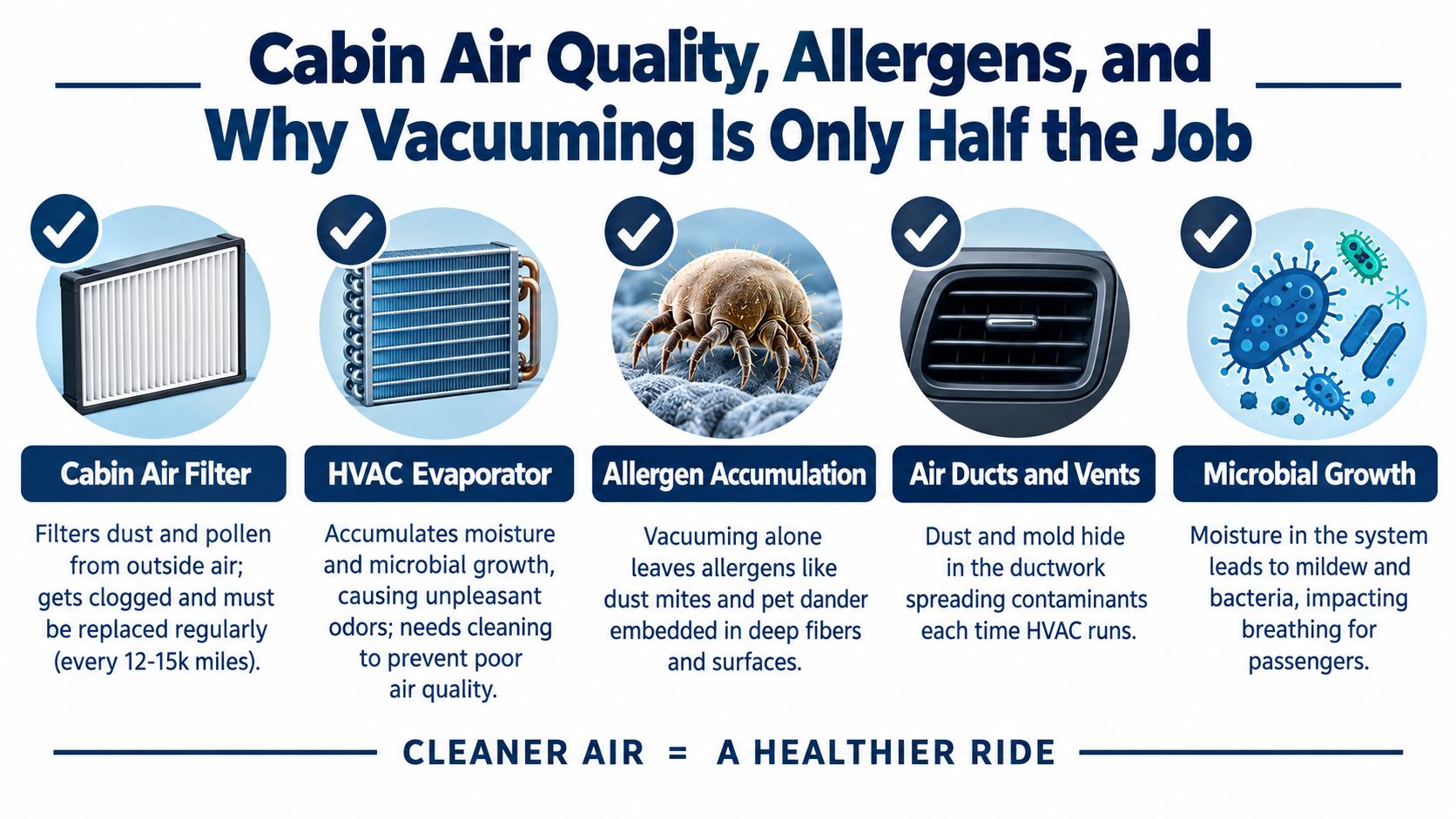
Vacuuming removes visible debris, but it doesn't deal with everything living deeper in the cabin system. Dust settles into seat fabric, carpet backing, and hard-to-reach seams. Moisture hangs around in the wrong places. Vents and filters keep circulating whatever the cabin keeps collecting.
What stays behind after a vacuum pass
Vehicle interiors can hold meaningful allergen loads. In a two-year study of homes, associated automobiles, and clothing, 23% of automobile seat dust samples exceeded 2 microg Der 1/g dust, with a mean of 1.3 microg/g, and the authors concluded that some automobile seats had Der 1 densities high enough to be risk factors for sensitisation and allergic reactions (automobile seat dust allergen findings).
That's why proper auto interior cleaning for allergy-prone drivers usually includes more than vacuuming:
- fabric seat cleaning or extraction
- crevice detailing
- vent-face dust removal
- careful drying so damp padding doesn't linger
A spotless dash doesn't tell you much about what's sitting in the seat foam and carpet backing.
Filters, airflow, and enclosed-space chemistry
There's also the air moving through the cabin. A Canadian randomised crossover study found vehicle cabin air filters reduced in-vehicle exposure to ultrafine particles by 26,232 particles/cm^3, PM2.5 by 6 μg/m^3, and black carbon by 1,348 ng/m^3, equal to about 28%, 30%, and 32% reductions. So if someone only talks about vacuuming mats, they're missing the filtration side of in-car air quality (vehicle cabin filter exposure reductions).
For drivers who spend hours in traffic, it helps to think beyond the cabin itself. If you're trying to understand how urban emissions and road-use policies affect what vehicles encounter in dense driving environments, this overview of clean air zone navigation gives useful context, even though it focuses on the UK.
Canadian indoor-air guidance also matters here. Health Canada notes that for most VOCs, levels found in indoor air in Canadian homes do not usually pose a significant health risk. In practice, that's a good reminder to use low-residue products, avoid overloading the cabin with heavy fragrances, and favour cleaning methods that dry quickly in enclosed vehicles (Health Canada VOC guidance context).
A thorough cabin hygiene checklist
A better cabin-air routine usually includes:
- Replace the cabin filter when due. Cleaning around a clogged filter only solves part of the problem.
- Wipe vent faces and trim. Dust at the vent opening keeps recirculating.
- Extract fabrics when needed. This matters more for cloth seats, commuters, and pet owners.
- Control moisture. Wet mats and damp carpet underlay create lingering odour issues.
- Keep chemistry light. Clean for removal, not perfume.
That's the difference between a cabin that looks fresh and one that feels easier to sit in.
Memberships and Prepaid Bundles for Predictable Cabin Care
Most interiors don't become expensive because one cleaning costs a fortune. They become expensive because drivers wait until every problem shows up at once.
Why routine beats rescue work
A membership or prepaid bundle works best when your vehicle gets dirty in a predictable way. Commuters track in salt. Families generate crumbs and spills. Rideshare drivers wear out touch points and mats fast. In all three cases, regular maintenance lowers the odds that a basic cleanup turns into a stain-removal appointment.
There's also a practical budgeting advantage. Instead of reacting to a bad mess with a bigger one-time bill, you spread the upkeep over repeated visits and keep the cabin from dropping too far.
Which plan fits which driver
The main choices usually look like this:
| Plan Type | Typical Frequency | Avg Cost Per Interior Visit | Best For |
|---|---|---|---|
| Pay-per-visit | Irregular | Highest when measured over time for neglected interiors | Light drivers, seasonal use, low-mess vehicles |
| Prepaid bundle | Planned visits across the year | Lower than one-off booking when used consistently | Families, commuters, drivers who want locked-in routine |
| Membership with interior discount or add-on | Frequent | Lower when combined with regular wash habits | Daily drivers, rideshare, delivery, messy winter use |
Where the savings actually happen
The break-even point isn't mysterious. If you're already washing the car often, adding light interior upkeep during those visits is usually easier than letting dirt build up and paying for heavier labour later. That's especially true in salt season, when mat and carpet contamination keeps coming back.
For example, some operators structure plans around unlimited exterior access and then offer discounted interior cleaning to members. Nanak Car Wash does this with its Unlimited Wash Club and also offers prepaid multi-wash tickets and combo deals. That setup suits drivers who want the outside maintained often and the inside touched up on a predictable schedule.
The best plan isn't the one with the most services on paper. It's the one you'll actually use often enough to stop the interior from getting behind.
Who should skip the plan
If your car is stored for long stretches, driven only occasionally, or kept unusually clean already, pay-as-you-go may be enough. Memberships and bundles help most when the vehicle sees regular life: school runs, work commutes, food deliveries, hockey bags, pets, and winter boots.
For everyone else, predictability is the whole point. You're not buying luxury. You're buying fewer catch-up jobs.
Your Auto Interior Cleaning Routine and Common Questions
A good routine is boring in the best way. It keeps the cabin under control so you're not booking a rescue every season.
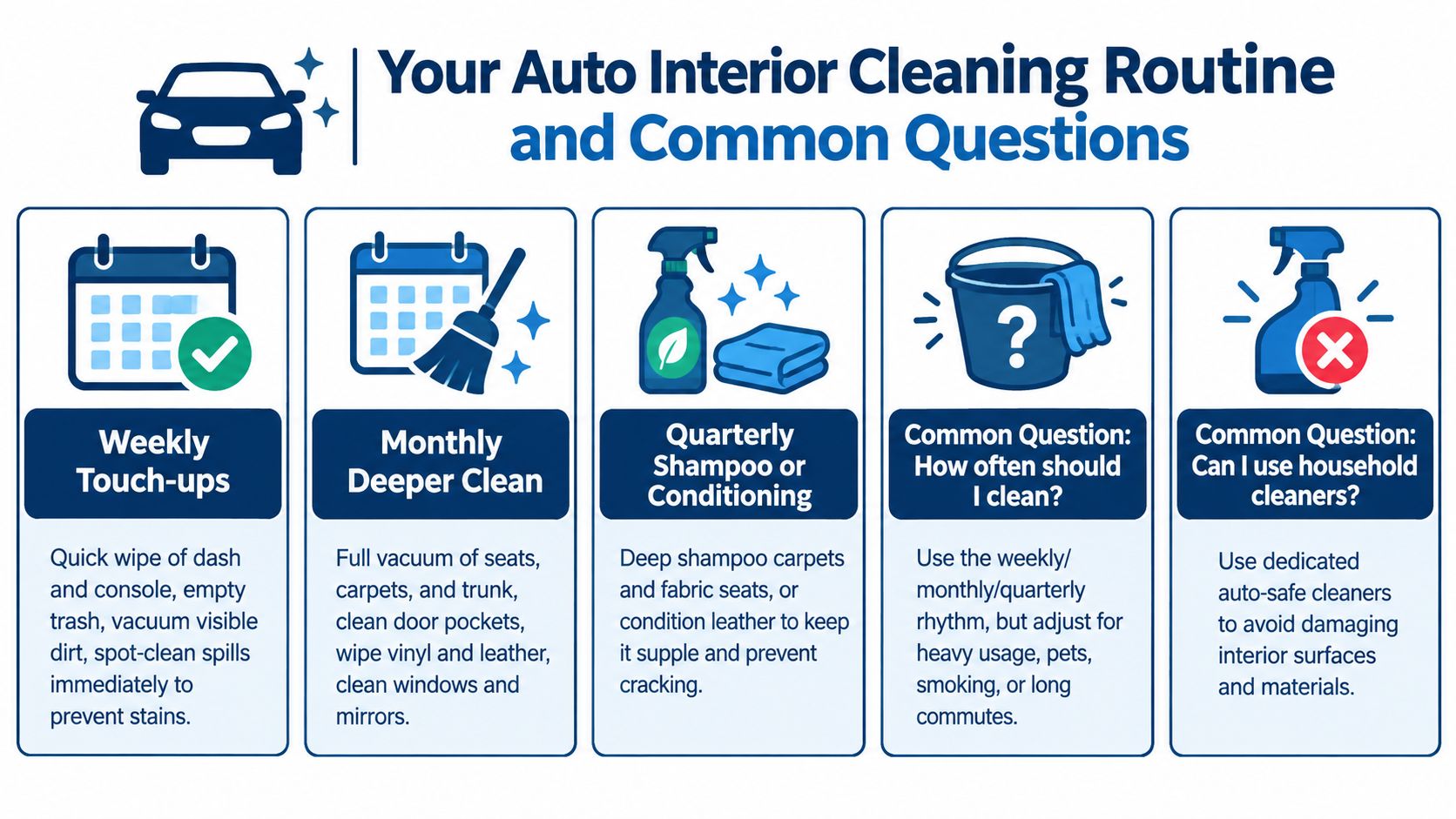
A practical rhythm for GTA drivers
Use this as a starting point, then adjust for pets, kids, long commutes, or shared use.
- Weekly touch-up. Empty trash, shake out mats, wipe the wheel and console, and deal with fresh spills right away.
- Monthly clean. Vacuum the seats, carpets, trunk, and seat rails. Wipe door pockets, cup holders, trim, and inside glass.
- Seasonal deep clean. Book shampooing, extraction, leather care, or odour work when the season changes and the car has built up real use.
What to do yourself and what to outsource
Do the fast maintenance yourself. That's where you save the most time and money.
Book professional work when:
- salt residue is set into carpets
- cloth seats feel dingy after wiping
- odours return quickly
- pet hair keeps surviving home cleanup
- the cabin needs a proper reset before allergy season, resale, or a lease return
Common questions
How long does a full interior detail take?
It depends on the package and how dirty the vehicle is. A light service can be quick. Deep shampooing, stain work, and leather treatment take longer.
Does a new car need interior cleaning early?
Yes. Newer vehicles still collect dust, food residue, oils, and winter moisture. Starting early is easier than correcting neglect later.
Can household cleaners work inside the car?
Sometimes, but they're a gamble. Auto-safe products are less likely to stain trim, strip coatings, or leave odd residue on touch surfaces.
What if the smell is already set in?
Masking it won't solve much. The source has to be cleaned first, whether that's fabric, mats, vents, or something trapped under a seat.
Can memberships be paused for winter storage?
That depends on the provider. Ask before signing up if your vehicle is stored seasonally.
If your cabin has reached the point where vacuuming isn't cutting it, Nanak Car Wash offers full-service interior cleaning, vacuuming, shampooing, stain removal, vent and crevice work, and detailing at GTA locations. If you want the inside of the car to match the way you use it in Ontario, book a visit with Nanak Car Wash and choose the level of interior work that fits your routine.


 6600 Finch Ave W, Etobicoke, ON M9V 3Z6
 647-703-8515
 MON – SUN 8 AM to 7 PM