
You know that sound your car makes after a February run down the 401. Not the engine. The hiss of slush packing itself into every nook underneath, followed by that gritty, sandpapery look along the rocker panels and wheel wells. You pull into the driveway, the body looks mostly fine, and the danger hides where you can't see it.
That's how underbody rust starts in Ontario. Not as some dramatic orange explosion, but as salty soup getting trapped on metal that stays wet longer than the paint you fuss over on top. The undercarriage is the basement of the house. Nobody admires it, but if it starts rotting, the whole place gets expensive in a hurry.
In the GTA, this isn't cosmetic fussiness. Ontario roads get heavily salted through winter. One Ontario winter maintenance overview says the province applies roughly 1.5 to 3 million tonnes of road salt each winter, while the City of Toronto alone uses about 130,000 to 150,000 tonnes annually. An Ontario road-salt archive also notes combined municipal and provincial use at about 2 million metric tons per year, with the MTO averaging 617,000 metric tons and Toronto about 135,000 metric tons in a referenced season (Ontario winter salt overview). That's a lot of chloride splashing around your brake lines, subframes, suspension hardware, and every seam that likes to stay damp.
Most drivers think rust proofing is a one-time spray. That's the part I'd happily retire. In real Ontario conditions, underbody rust protection works best as a timed winter system. You apply protection, then you support it with well-timed underbody rinses through salt season, especially during thaws when the brine wakes up and gets busy again.
Table of Contents
- Introduction Why Ontario Winters Eat Your Underbody
- What Underbody Rust Protection Really Does
- Types of Underbody Rust Protection and How They Compare
- Why Salt Chemistry and Wash Timing Matter More Than You Think
- Costs Frequency and Is It Worth It for Newer and Fleet Vehicles
- When and How to Get Underbody Rust Protection in the GTA
- Keep Your Underbody Protected Longer
Introduction Why Ontario Winters Eat Your Underbody
A typical GTA winter day doesn't look especially dramatic from the driver's seat. You leave work, traffic crawls, the lane beside you throws grey slush sideways, and by the time you reach Scarborough, Mississauga, Brampton, or Oshawa, the vehicle sounds like it's wearing a frozen backpack underneath. Everything down there has been sprayed, soaked, and lightly breaded in road grime.
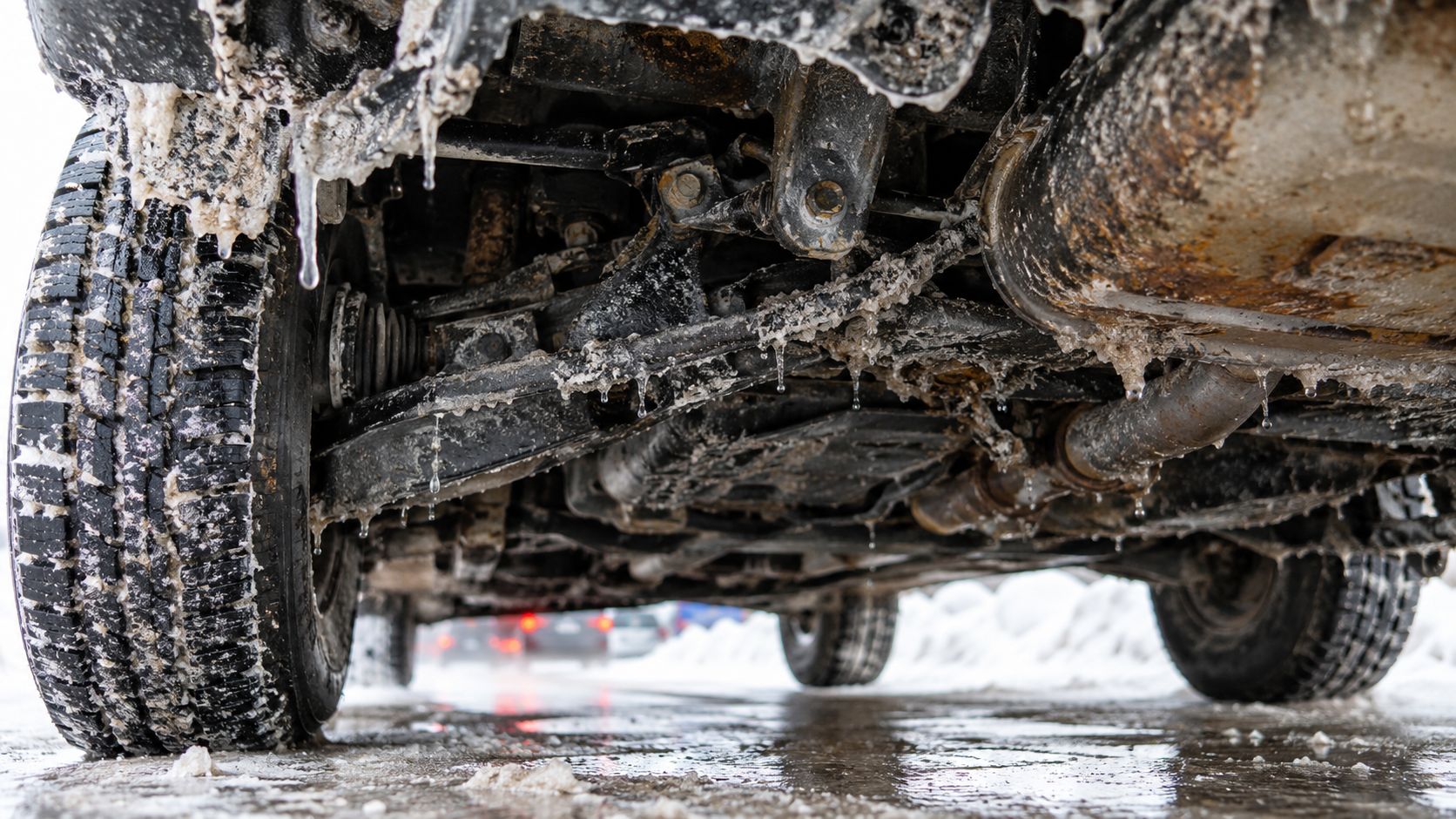
The trick is that the underbody doesn't dry like the hood or roof. It catches salt mist, dirty water, and packed snow. Then Ontario's weather does its little yo-yo act. Freeze overnight. Thaw by lunch. Splash again at rush hour. If you want a practical driving refresher during the ugly part of the season, this guide on how to survive winter behind the wheel is a good companion to the maintenance side of the conversation.
Why the underbody loses first
The visible paint gets attention. The undercarriage gets chemistry. Water, oxygen, and salt make a nasty team, and the underside of the vehicle is where that team rents an apartment.
A Toronto-area corrosion summary cited by Rust Check notes older Canadian research indicating about 50% of vehicle corrosion can be attributed to road salts, and Rust Check says the first Rust Check Centre opened in Hepworth, Ontario in 1973, which tells you this service didn't appear out of nowhere. It grew out of local conditions drivers had already been battling for decades (Rust Check history and Ontario corrosion context).
What drivers usually get wrong
A lot of people wait until they can see rust bubbles on a body panel. By then, the underside may have been taking the brunt of the damage for a long time. Brake lines, fasteners, mounting points, and hidden seams don't send polite reminders.
That's why this topic matters now, not after spring. If your vehicle still has a few winters ahead of it, or if you rely on it daily for commuting, deliveries, ride-hail, or family hauling, underbody rust protection is less like buying a shiny accessory and more like putting on boots before stepping into slush.
Ontario didn't invent winter, but it certainly perfected the art of marinating a car's underside in salty soup.
What Underbody Rust Protection Really Does
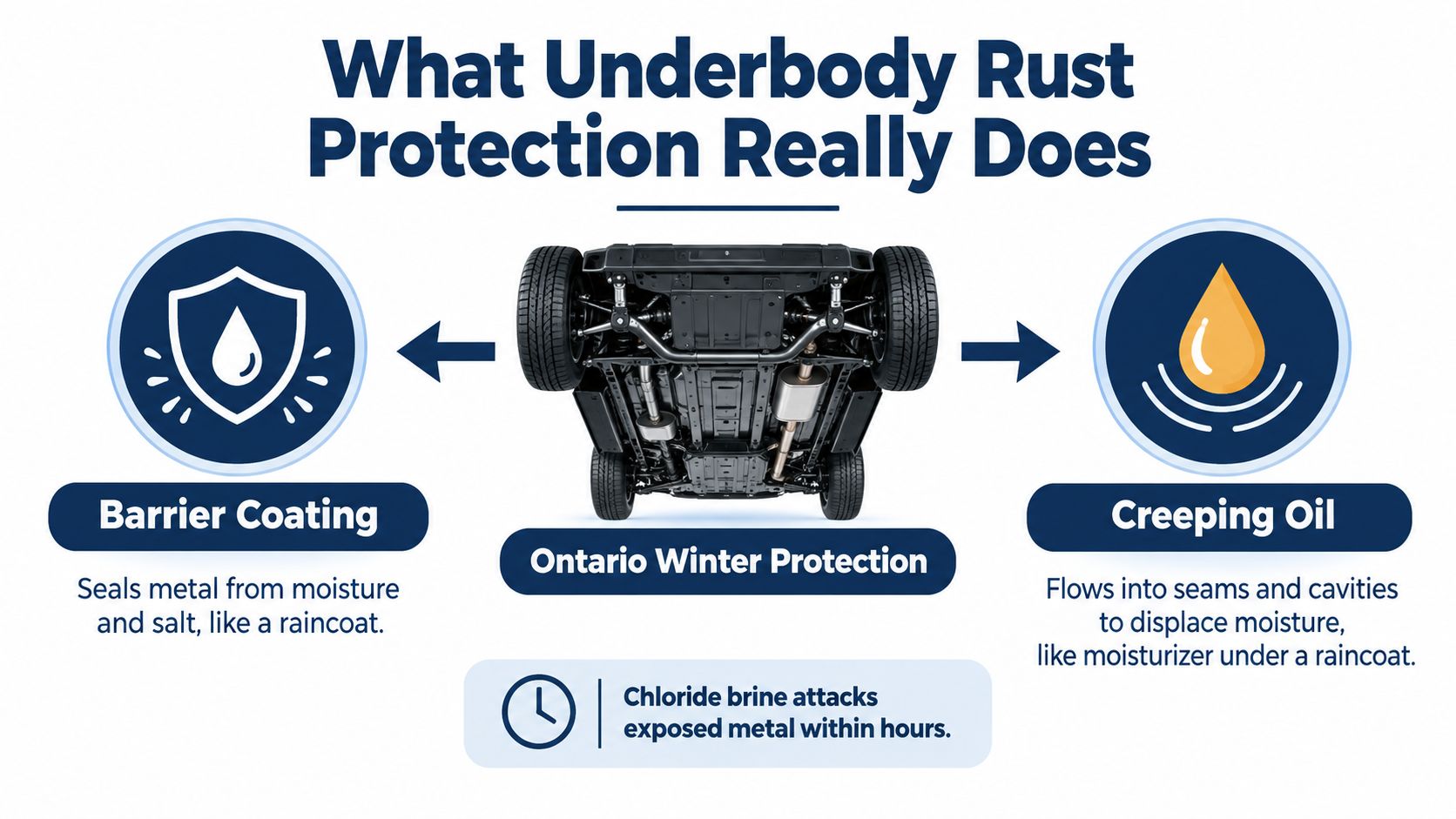
Underbody rust protection is easiest to understand if you think in layers.
One type behaves like a raincoat. It creates a barrier between metal and the wet, salty mess outside. Another behaves more like moisturiser under the coat. It creeps into seams, overlaps, and cavities where water likes to hide. Good protection systems often rely on one of those ideas more than the other, and sometimes a combination.
Why the undercarriage is the trouble zone
Body panels get washed by rain and dried by sun and airflow. The underside gets blasted by brine, then stays damp in cramped, shaded spaces. Salt doesn't have to look dramatic to be effective. It only needs moisture and contact time.
Ontario-specific corrosion research reported in a Toronto news release found that untreated vehicles had 6.8 times more visible corrosion on body panels than vehicles with rust-control treatment. On underbody parts exposed to dirt, gravel, water spray, and road chemicals, untreated vehicles showed 3.6 times more corrosion (Ontario corrosion research summary). That underbody number matters because the underside is where grime packs in and hangs around.
What it can do and what it can't
Underbody rust protection slows corrosion. It doesn't make steel immortal, and it doesn't magically reverse advanced structural rust. If a component is already badly compromised, coating over it is like spraying cologne in a hockey bag. You've changed the smell, not the problem.
A proper treatment can:
- Displace moisture: Creeping products work their way into seams and spot-welded joints where trapped water likes to live.
- Reduce salt contact: Barrier products limit direct exposure of metal to brine and spray.
- Protect hidden areas: The useful work often happens where your garden hose can't reach.
What it can't do:
- Undo serious decay: Flaking, perforated, or structurally weakened metal needs inspection and repair.
- Replace cleaning: Coating a vehicle that's wearing layers of old salt and grime isn't ideal.
- Stop every rust spot forever: Road debris, abrasion, and missed areas still matter.
Why a rinse alone isn't enough
Fresh water rinses help. They absolutely have a place. But rinsing is not the same thing as protecting. Washing removes contamination from accessible surfaces. Protection stays behind and keeps working after you drive away.
Practical rule: Washing removes what's on the metal. Rust protection helps defend the metal itself.
That's why I tell people not to think of this as wash versus coating. In Ontario, it's wash and coating. One clears the battlefield. The other leaves armour behind.
Types of Underbody Rust Protection and How They Compare
Walk into three shops and you'll hear four pitches. Oil spray. Dripless oil. Rubberized undercoating. Electronic rust modules. They're not the same tool, and they don't solve the same problem in the same way.
The short version
If your goal is reaching seams, overlaps, and hidden cavities, a creeping product usually makes the most sense. If your goal is a firmer external barrier on clean, sound surfaces, some drivers prefer a coating-style approach. If someone offers a tiny electronic box as the whole answer, keep your eyebrows active.
Underbody Rust Protection Types Compared
| Protection Type | How It Works | Pros | Cons | Best For |
|---|---|---|---|---|
| Oil-based creeping spray | Thin product creeps into seams, joints, and cavities, displacing moisture | Reaches hidden areas, self-healing feel, good for complex underbodies | Can drip after application, needs periodic reapplication, attracts dirt | Daily drivers, long-term owners, vehicles exposed to lots of spray |
| Dripless oil | Thicker version of oil-based protection that clings more and drips less | Cleaner after application, decent coverage, less mess in the driveway | May not creep as deeply as thinner products, still needs maintenance | Drivers who want oil-based protection with less initial dripping |
| Rubberized undercoating | Forms a more solid outer barrier on exposed surfaces | Good impact resistance, can help shield from splash and debris | If applied over rust or poorly prepped surfaces, it can hide trouble and trap moisture | Cleaner underbodies, owners focused on exposed lower surfaces |
| Electronic modules | Device claims to reduce corrosion electronically | Little mess, no wet coating | Limited real-world confidence for full underbody exposure, doesn't clean or physically coat surfaces | Drivers who want supplementary options, not a stand-alone answer |
Matching the chemistry to the driver
A compact commuter that sees the DVP, 401, and city slush every week usually benefits from a product that can creep into tight places. That's because salt rarely attacks only the broad, easy-to-see surfaces. It sneaks into folded metal, clips, brackets, and line mounts.
A truck or SUV that spends time on gravel, packed snow, and rough roads may need a strategy that also considers impact and abrasion. Harder external coatings can help in exposed zones, provided the prep work is right and the surface underneath is in healthy shape.
The honest trade-offs
Every method has annoyances.
- Oil-based products: Great at creeping. Messier at first.
- Dripless products: Tidier. Sometimes less eager to migrate into tiny seams.
- Rubberized coatings: Neat-looking barrier. Risky if someone applies them over existing corrosion or hides inspection points.
- Electronic systems: Convenient in theory. They don't remove salt, they don't wash the underside, and they don't coat exposed steel.
A rust product should make inspection easier or at least still possible. If it turns the underbody into a mystery novel, that's not my favourite ending.
If you're keeping the vehicle for years, I'd lean toward a system that gets into hidden spaces and can be renewed. If you're trying to preserve a newer vehicle from the start, the best result often comes from protecting early instead of waiting until the underside already looks like a shipwreck.
Why Salt Chemistry and Wash Timing Matter More Than You Think
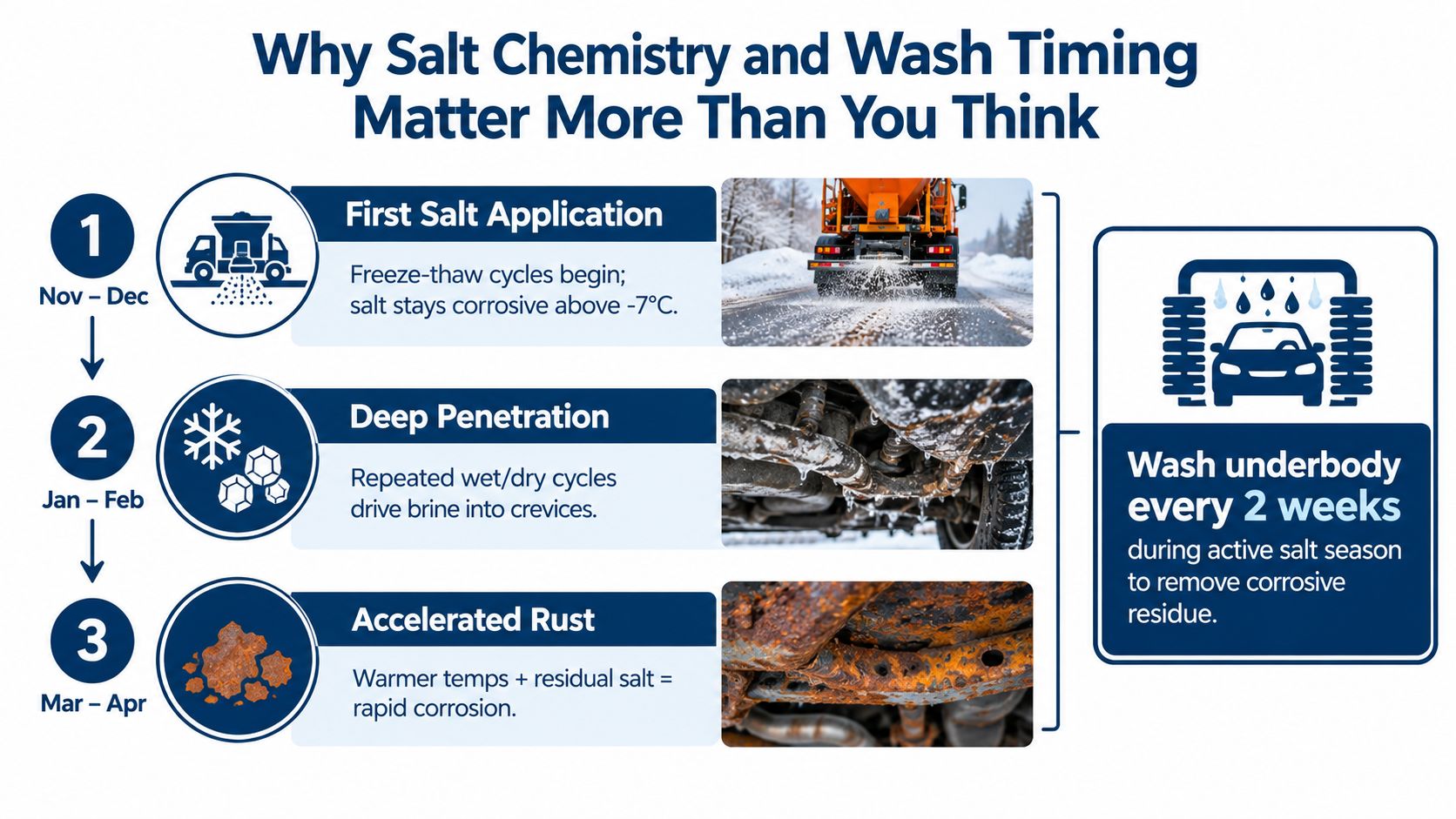
You drive home on a sloppy February afternoon, park, and the underbody looks like it survived a milkshake made of snow, grit, and salt. Two days later the temperature climbs above freezing. That is often the more corrosive moment.
The reason is simple. Rust needs moisture, oxygen, and time. Ontario winters keep supplying all three. The Canadian Automobile Association notes that freeze-thaw cycles keep re-wetting the undercarriage, and salt keeps helping corrosion along once it is sitting on damp metal (CAA winter rust guidance).
Why thaw days are sneaky
Frozen slush stuck to the underside is bad enough. A thaw makes it busier.
As that crust softens, it turns back into brine and starts creeping again. It follows seams like water under a door, works around fasteners, sits on brackets, and hangs along brake and fuel lines. A car can look less dramatic on a mild day than during a storm, while the chemistry underneath is getting a better chance to work.
That is why the highest-value wash is often tied to temperature, not just snowfall. A rinse right after the first warm-up can do more than a wash done while everything is still frozen solid.
Ontario road treatment is more than plain table salt
Drivers often hear “road salt” and picture one ingredient. Real winter roads are more like a recipe.
Municipal crews use sodium chloride, but they also use liquid brines and, in colder conditions, chemicals such as calcium chloride. CBC's reporting on winter road treatment explains why calcium chloride gets attention. It keeps working at lower temperatures and helps hold moisture on surfaces longer (Ontario salt-brine discussion). For your underbody, that means some residue stays chemically active during weather that does not feel especially harsh.
A technician sees the result all the time. The ugly rust is not always from one giant storm. It is often from repeated wet-salty-damp cycles that never quite let the underside dry out.
The better way to time winter washes
A lot of winter wash advice focuses on frequency alone. Frequency helps, but timing is what turns washing into part of a protection system.
Use this rhythm instead:
- After heavy salting or highway slush: Fresh contamination builds fast, especially behind wheels and along the centre tunnel.
- During the first real thaw: Residue becomes liquid again and starts travelling into places you cannot easily see.
- Before spring settles in: You do not want leftover brine spending warm March and April days pressed against steel, brackets, connectors, and hardware.
That last point matters even more for newer vehicles, EVs, and fleet units. Modern underbodies carry more lines, mounts, sensors, shields, and connectors than older cars did. For a personal vehicle, corrosion can mean ugly repair bills later. For a delivery van, service truck, or EV that needs to stay on the road, it can also mean lost uptime.
The short version is this. Underbody rust protection works best as a winter system. The coating slows the attack. Well-timed rinses lower the salt load when thawing turns dried residue back into active brine.
It works like shovelling before the snow gets packed into ice. The job is easier when you deal with it at the right moment.
Costs Frequency and Is It Worth It for Newer and Fleet Vehicles
A two-year-old SUV can look spotless on top and still be collecting trouble underneath. That catches a lot of Ontario drivers off guard, especially after a winter of highway spray, slush, and thaw days that keep re-wetting the same salty grime.
The practical question is simple. Is underbody rust protection worth paying for?
Usually, yes, if the vehicle will see real Ontario winters and you plan to keep it long enough for salt exposure to matter. The better way to judge it is by three things: how often the vehicle sees salted roads, how many winters you expect it to live through, and what a day off the road costs you.
A weekend car that rarely leaves the garage is one story. A GTA commuter, delivery van, contractor truck, ride-hail car, or family SUV is another. Those vehicles get sprayed from every angle, then parked wet, then driven again before the underside ever fully dries. Rust protection starts to make more sense when the use pattern looks like that.
The risk also changes on newer vehicles. Old-school rust talk used to focus on rocker panels and visible body rot. Modern underbodies carry far more hardware. You have brake and fuel lines, harnesses, clips, sensor mounts, fasteners, subframes, shields, and on some EVs, areas around the battery enclosure and related mounting points. Corrosion in those places can turn into reliability problems, not just cosmetic ones.
That matters for fleet units even more.
A fleet manager is not only paying for parts. They are paying for missed routes, reshuffled schedules, replacement rentals, technician time, and the general headache of a vehicle that should have been working instead of sitting in a bay. For EVs, uptime can be even less forgiving because the underbody houses expensive components and protective structures that are harder to ignore once corrosion starts around nearby brackets, fasteners, or connectors.
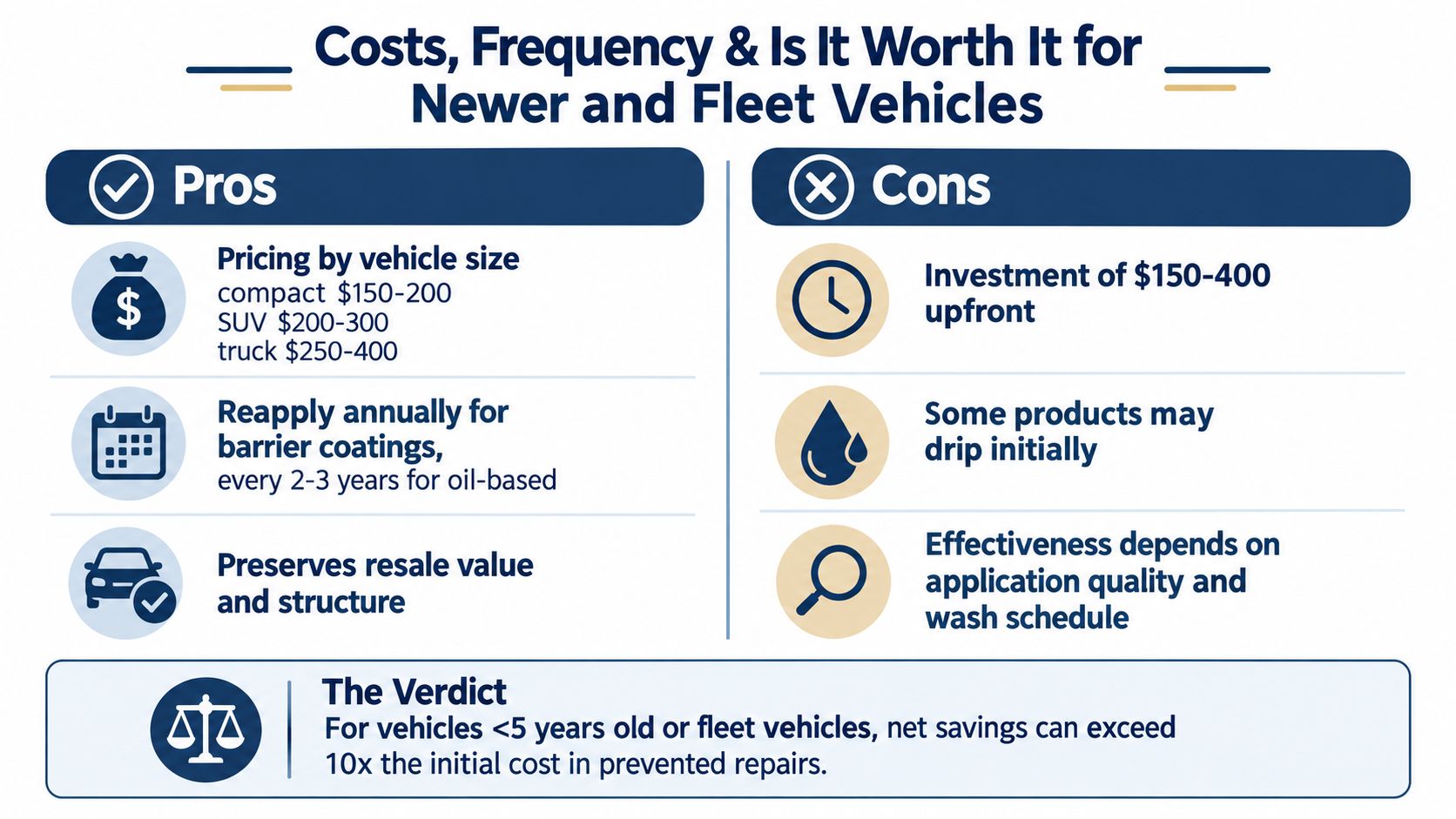
Cost and frequency depend on the product and the job size. Smaller cars usually cost less to treat than pickups, vans, and large SUVs because there is less underside to cover. Softer, oil-based products often need more frequent reapplication. Harder barrier coatings may last longer, but they still work best as part of a winter system, not as a one-and-done shield.
That distinction is where drivers save themselves from disappointment. The coating is the raincoat. The thaw-day rinse is wiping the salt off before it soaks through the cuffs and seams. Skip the rinse side of the system and you leave corrosive residue sitting on hardware, packed behind shields, and clinging around brackets and connectors for weeks.
For GTA drivers who want a combined routine in one place, Nanak Car Wash offers rust proofing with size-based pricing and also provides underbody wash options using 100% fresh water, which fits the timed-rinse approach well for local winter maintenance.
A useful rule of thumb is this. The shorter your ownership and the lighter your winter driving, the weaker the payoff. The longer you keep the vehicle, the more highway slush it sees, and the more costly downtime becomes, the stronger the value case gets.
For personal vehicles, that often shows up later as fewer seized fasteners, cleaner hardware, and a better resale story. For fleets, it shows up as fewer avoidable interruptions and less corrosion-related grief during the years when the vehicle is supposed to be earning its keep.
When and How to Get Underbody Rust Protection in the GTA
Timing makes a bigger difference than many realise. The ideal moment to protect the underbody is before the roads are heavily salted, not after the underside has spent months being basted in brine.
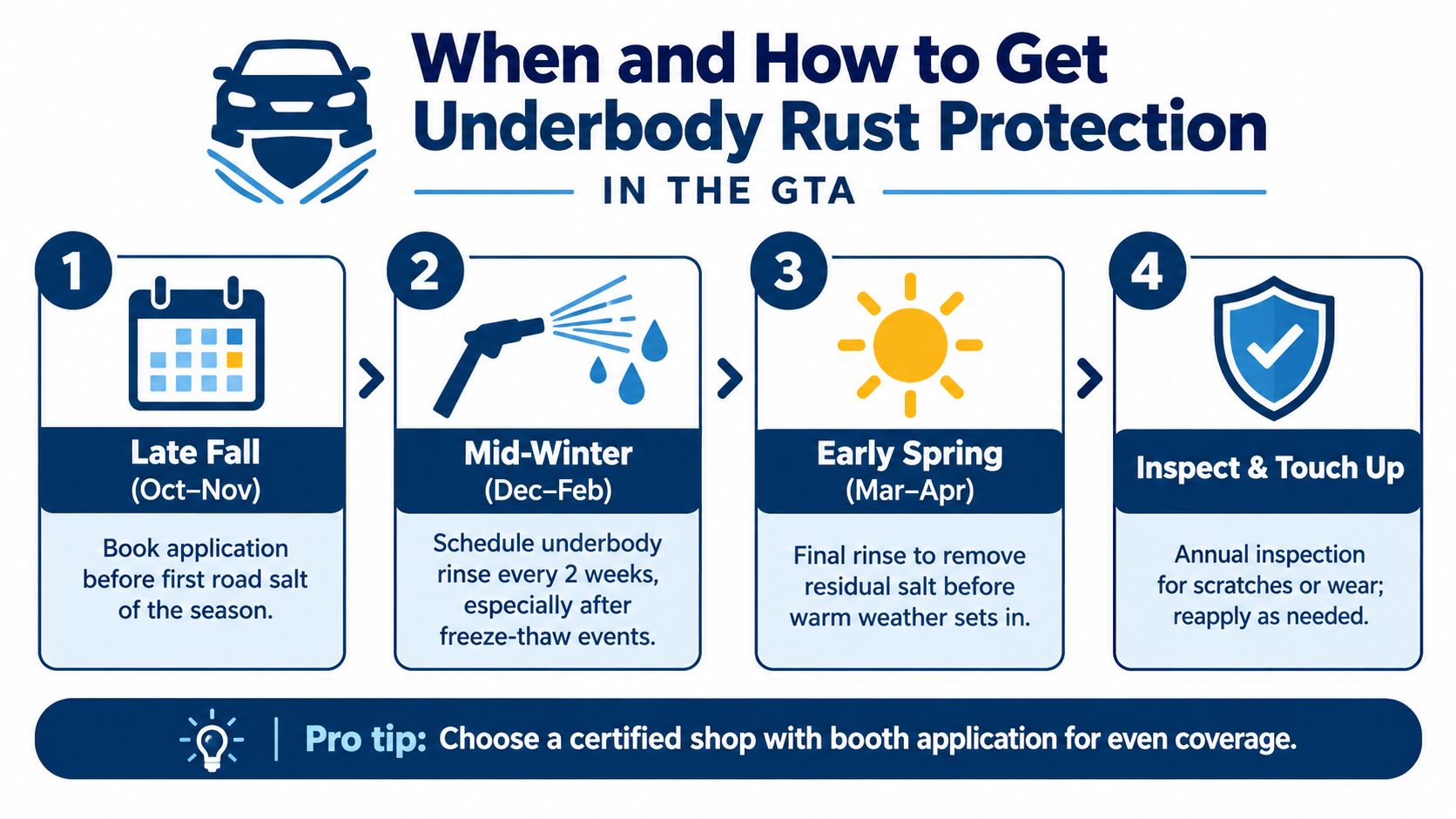
A simple seasonal calendar
Think of the year like this:
- Late fall: Book the treatment before sustained salt use begins.
- Mid-winter: Rinse the underbody regularly, with extra attention after thaw periods.
- Early spring: Do a final cleanup to remove lingering residue.
- Inspection time: Check for scraped areas, wear points, and any spots that need touch-up.
If you want another practical local read, these underbody rust prevention tips give a helpful owner-level overview of what to look out for.
What happens during a professional application
A decent shop doesn't just wave a spray wand around and call it a day. The vehicle should be assessed first. If the underside is caked with grime, it may need cleaning so the product can reach the metal and seams it's supposed to protect.
Then the technician applies the chosen product to exposed underbody areas and, where appropriate, to cavities and seams that tend to trap moisture. Sensitive components or areas that shouldn't be coated get avoided or masked. After application, some products need time to settle, and some may drip a bit at first. That's normal for certain oil-based systems.
Pairing washes with protection
The best routine is boring in the best way. Protect the vehicle before or early in the season, then keep the underside from carrying old salt around for weeks at a time.
A useful GTA checklist looks like this:
- Book early: Don't wait until the first ugly storm has already coated everything underneath.
- Use underbody rinses on thaw days: Those mild, sloppy days are high-value maintenance windows.
- Finish the season clean: Spring residue is still residue.
- Keep records: Helpful for your own maintenance memory and for future resale conversations.
You don't need to become an amateur corrosion scientist. You just need a rhythm that respects how Ontario winter behaves.
Keep Your Underbody Protected Longer
The big idea is simple. Underbody rust protection isn't a one-shot winter charm. In Ontario, it works best as a system made of two parts: a protective treatment and well-timed underbody rinses through salt season.
That approach matches the reality of GTA driving. Roads get salted heavily. The underside stays wet. Freeze-thaw cycles keep waking the chemistry back up. Newer vehicles add more expensive hardware underneath, and work vehicles don't have the luxury of surprise downtime.
If you want the practical version, do three things. Protect before or early in salt season. Rinse through winter, especially after warm spells. Inspect in spring before small trouble turns into expensive storytelling.
Your car doesn't need pampering. It needs strategy. Rust is patient, but you can be organised enough to make it work a lot harder.
If you want a local way to put this into practice, Nanak Car Wash offers GTA drivers both rust proofing and underbody wash options, which makes the coating-plus-rinse approach much easier to stick with. If your vehicle spends winter commuting, hauling kids, or earning money on salted roads, it's worth giving the underside the same attention you already give the paint on top.


 6600 Finch Ave W, Etobicoke, ON M9V 3Z6
 647-703-8515
 MON – SUN 8 AM to 7 PM