
A basic on-rim seasonal tire swap in the GTA typically runs $40 to $80 for a set of four, while a full mount-and-balance changeover usually lands between $80 and $160, before any add-ons. The final invoice depends on whether your tires are already mounted, your vehicle needs balancing or sensor work, and whether storage or disposal is included.
On a Saturday morning in mid-October, a Mississauga tire shop can look less like a service centre and more like an airport departure lounge. Cars spill onto the curb, drivers check their phones, and someone discovers that a $59 advertised tire change has become a much less cheerful quote after the advisor asks about balancing, valve stems, storage, and tire disposal.
That scene repeats every spring, usually after drivers decide winter is finally over. The rush is predictable, but the pricing often isn't. A headline rate may describe only the simplest wheel swap, while the work your vehicle needs sits elsewhere on the invoice.
This guide is a practical pricing map for GTA drivers. It explains what each service tier includes, which add-ons affect the total, how provider types compare, and where drivers can save without cutting corners. The perspective is the service-advisor side of the counter, not the marketing flyer.
Table of Contents
- The Twice-a-Year Tire Ritual in the GTA
- What a Tire Change Actually Includes
- Where the Extra Dollars Hide on Your Invoice
- How GTA Providers Stack Up on Price
- Why Your Vehicle Changes the Final Number
- When Mobile Tire Change Is Worth the Premium
- Smart Ways to Cut Tire Changing Prices
- Your Pre-Appointment Tire Change Checklist
The Twice-a-Year Tire Ritual in the GTA
A cold snap hits the GTA, appointment phones fill up, and the advertised tire-change price suddenly looks less useful. Drivers often book in October and return in April, when demand rises, same-day slots disappear, and the vehicle determines which services belong on the invoice.
Two complete wheel sets keep the job simple. The technician removes one set, checks the mounting surfaces, installs the other, torques the fasteners, and verifies pressure. Loose tires and separate rims require demounting, mounting, balancing, and wheel installation, so the labour and final price are higher.
Cansumer benchmarks place an on-rim swap at $40 to $80 for four tires and an off-rim mount-and-balance changeover at $80 to $160 for four. Its sample prices include Costco at $40, Canadian Tire at $75, Kal Tire at $52, and CAA Mobile Tire Change at $80 to $120, as outlined in Cansumer's Canadian tire-change pricing guide. Those figures are useful starting points, not guaranteed all-in totals. Balancing, valve stems, disposal, storage, taxes, or sensor service can raise the bill.
The practical savings move is to compare complete totals, not the largest number on a roadside sign. Ask whether balancing is included, whether valve service is extra, and whether the shop charges for disposal or seasonal storage. Drivers with two wheel sets can also avoid the recurring labour of moving tires between rims.
Practical rule: Compare quotes only after confirming that both shops are pricing the same job.
Use specific wording: “My winter tires are already mounted on rims. What is the total price, including tax, balancing, valve service, disposal if needed, and installation of all four wheels?” That question exposes the actual cost before you approve the work and helps separate a genuine low price from a low entry rate.
What a Tire Change Actually Includes
A driver arriving with two complete wheel sets is paying for an on-rim seasonal swap. The technician removes the winter wheel assemblies, installs the summer set, torques the fasteners, and checks tire pressure. The tires remain on their original rims, so the shop does not break the bead or move rubber between wheels.
A mount-and-balance changeover requires more labour. The technician removes each tire from its rim, lubricates and seats the bead on another rim, balances the assembly, and installs the wheel on the vehicle. The Canadian benchmark for this work is $80 to $160 for four tires, before extras, according to Cansumer's breakdown of seasonal tire-change costs.
Full new-tire installation starts with removing the old casings and fitting fresh rubber. Depending on the provider, the quoted service may also include balancing, valve hardware, TPMS servicing, final pressure adjustment, disposal, and a vehicle-side inspection. Drivers comparing broader tire replacement services should confirm whether the advertised rate covers those items or only the fitting labour.
The three service tiers
| Service Tier | What It Covers | Typical GTA Price (4 wheels) | Best For |
|---|---|---|---|
| On-rim seasonal swap | Wheel removal, wheel installation, torque check, pressure check | $40 to $80, before add-ons | Drivers with two complete wheel sets |
| Mount-and-balance changeover | Demounting, mounting, bead seating, balancing, wheel installation | $80 to $160, before add-ons | Drivers sharing one set of rims |
| Full new-tire installation | Old-tire removal, new-tire mounting, balancing, disposal, installation | Can reach $175 to $200 at some providers | New rubber or replacement tires |
The wording on the estimate matters. Removal refers to taking the wheel assembly off the vehicle. Mounting puts a tire onto a rim, while balancing uses equipment and wheel weights to correct uneven weight. Torquing tightens lug nuts to the vehicle manufacturer's specification. A final pressure check confirms the assembly is ready for the road.
GTA shops usually quote per vehicle, rather than per tire. Compare the complete job, including balancing, valve stems, disposal, and TPMS checks, before treating a headline rate as a bargain. Drivers with two wheel sets can also reduce recurring labour by avoiding tire transfers between rims. Ask for the total before approving the appointment.
Where the Extra Dollars Hide on Your Invoice
A seasonal rate can look reasonable until the invoice adds balancing, valve stems, disposal, storage, or shop supplies. Ask what the advertised price excludes before booking, because those small line items often determine the true cost of the visit.
Valve stems are one common add-on. Replacing four valve stems at $4 to $12 each adds $16 to $48, based on Ontario market pricing references for valve stems. A TPMS problem can cost considerably more when the sensor needs replacement instead of a simple re-sync. If the warning light is already on, ask the advisor to diagnose it before authorizing the tire service.
Disposal is another charge to check. Environmental tire disposal fees may run $3 to $8 per tire, while nitrogen upgrades can add $5 to $15 per wheel. Shop supplies or miscellaneous fees may add $5 to $15. These costs may appear separately from the seasonal rate, so GTA drivers should request an itemized quote and decline optional upgrades that do not solve a specific problem.
Read the invoice by function
| Line Item | What It Means | What to Ask |
|---|---|---|
| Balancing | Corrects uneven weight in the wheel and tire assembly | Is standard balancing included? |
| Valve stems | Replaces the rubber or valve hardware during service | Are replacement stems necessary today? |
| TPMS service | Re-syncs or replaces tire-pressure monitoring components | Is the warning light caused by a sensor or pressure? |
| Disposal | Handles old tire casings through the shop's waste stream | Is disposal included in the installation quote? |
| Storage | Keeps your unused seasonal set at the facility | Is the fee per season, vehicle, or set? |
| Shop supplies | Covers consumables or administrative charges | What specific work does this fee cover? |
Balancing is usually a legitimate charge when tires move between rims or the assembly produces vibration. It is less persuasive as an automatic add-on for a complete wheel swap that was already balanced and shows no issue. Disposal is a real handling cost when old tires leave the shop. Nitrogen is optional for most seasonal customers, and vague miscellaneous fees deserve a clear explanation before approval.
Ask for the all-in price, including tax and every expected fee, before the vehicle enters the bay.
Statistics Canada reported that passenger vehicle parts, accessories and supplies, including tires and installation, rose 8.6% year over year in October 2022 and remained up 1.5% year over year in September 2024. Its analysis also recorded an 8.1% year-over-year increase in factory-level prices for tires manufactured in Canada in September 2022, after 10.3% in August 2022. The Statistics Canada analysis of tire prices and tire changes helps explain why shops may adjust pricing across both parts and labour inputs.
How GTA Providers Stack Up on Price
Different provider types optimise for different things. A national chain may offer a visible seasonal promotion and broad appointment coverage. An independent shop may provide more direct advice and flexibility. A dealership knows your vehicle's specifications, while a big-box retailer can be attractive when membership pricing or tire purchase benefits apply.
The problem is that verified GTA comparisons don't provide a consistent, provider-by-provider all-in price for every chain, dealership, and independent shop. It would be misleading to invent a neat table of typical ranges for Active Green & Ross, Mr. Lube, dealerships, Walmart, or individual GTA locations. Their final quotes vary with rim status, vehicle, membership, storage, and seasonal demand.
The reliable comparison is the broader Canadian survey. Cansumer lists sample seasonal-swap prices of $40 at Costco, $75 at Canadian Tire, $52 at Kal Tire, and $80 to $120 through CAA Mobile Tire Change, with tire storage listed at $67. CAA South Central Ontario separately lists mobile pricing of $120 per vehicle for Basic and Everyday members, $100 for Plus members, and $80 for Premier members, plus HST, as shown on its Ontario mobile tire-change pricing page.
GTA tire-change pricing by channel
| Provider Type | Typical Price Range | Common Add-Ons | Typical Wait |
|---|---|---|---|
| National chain | Varies by service and vehicle | Balancing, disposal, valve hardware, storage | Demand rises sharply in peak season |
| Independent shop | Varies by quote and equipment | Shop supplies, storage, specialty handling | Often flexible, but depends on bay capacity |
| Dealership | Varies by make and package | Storage, premium labour, vehicle-specific parts | Seasonal appointments can fill quickly |
| Big-box service bay | Sample swap pricing includes $40 at Costco | Membership conditions, storage, availability | Booking access can be limited |
| Mobile service | $80 to $120 in listed CAA examples | Off-rim work, location, vehicle size | Convenience depends on route availability |
A low quote isn't automatically a bargain. Ask whether the provider is quoting a wheel swap or a full changeover, then request the same four details from every shop: labour, balancing, disposal, and storage. That comparison tells you more than the provider's logo.
Why Your Vehicle Changes the Final Number
A compact sedan with two complete wheel sets is the easiest vehicle to quote. The assemblies are usually manageable, access is straightforward, and the shop can complete the job without moving rubber between rims. The published on-rim benchmark applies most closely to this scenario.
A mid-size SUV changes the calculation. Larger and heavier wheel assemblies require more handling, and SUV or truck tires often carry higher service pricing because the equipment and labour demands are greater. The Ontario pricing reference supplied for this article specifically notes that standard car tires are generally cheaper than SUV, truck, or low-profile tires.
Low-profile and run-flat tires create a different kind of difficulty. Their sidewalls provide less working flexibility, so mounting equipment and technician technique matter more. A directional tire also has a fixed rotation direction, while an asymmetric tire has an inside and outside face. The technician must preserve that orientation, which limits rotation options during installation.
Check the vehicle details before booking
- Wheel and tire size: Confirm the size printed on the sidewall or door-jamb label. A larger wheel can require different equipment and more careful handling.
- Tire construction: Tell the advisor if the vehicle uses run-flat, low-profile, directional, or asymmetric tires.
- Wheel material: Aluminium wheels need correct torque procedures and careful contact with the mounting equipment.
- Locking nuts: Keep the locking-nut key in the vehicle. Without it, a routine removal can become a delay.
- TPMS equipment: Ask whether the vehicle requires a sensor check or relearn after installation.
Don't accept a made-up flat surcharge before the shop has the vehicle details. The useful approach is to ask which feature changes the quote and whether that change affects all four corners or only a specific operation.
A reliable advisor should be able to explain the premium in plain language. If the explanation is only “bigger tires cost more,” ask whether the difference comes from mounting difficulty, balancing requirements, heavier handling, sensor service, or a separate vehicle-class policy.
When Mobile Tire Change Is Worth the Premium
Mobile service makes economic sense when the vehicle's downtime costs more than the convenience premium. A ride-hailing driver, delivery worker, or small fleet operator may lose paid availability while travelling to a shop, waiting for a bay, and returning to work. For that customer, bringing the equipment to the vehicle can be a business decision rather than a luxury purchase.
CAA's Ontario figures show the convenience ladder clearly. Its mobile service lists on-rim changes at C$79.95 to C$99.95, while off-rim mobile changes are C$179.95 to C$199.95, depending on membership and service type, according to the Canada Drives guide to winter tire timing and mobile service. The same source explains that off-rim work costs more because the technician must remove, mount, balance, and secure the tires instead of just changing wheel assemblies.
When the premium works
Mobile service is easier to justify when:
- the vehicle supports paid work and must stay available;
- the appointment takes place at a workplace or fleet yard;
- the driver has several vehicles to coordinate;
- a missed booking would create a larger operational problem;
- the service includes the balancing or installation work the vehicle needs.
It makes less sense for a household vehicle at a rural address without level, paved access, or for a customer who also needs seasonal storage handled. The technician still needs safe working space, suitable ground, and access to the vehicle.
Convenience doesn't remove responsibility. Confirm whether the mobile provider supplies a written torque record, handles TPMS concerns, and offers a workmanship policy. A shop installation may be the better choice for complex wheels, damaged fasteners, specialty tires, or a vehicle with an unresolved warning light.
Smart Ways to Cut Tire Changing Prices
A GTA driver with separate winter and summer wheel sets can often cut the invoice before booking. The savings come from avoiding unnecessary mounting, balancing, storage, and disposal charges, not from arguing over a small labour line.
Choose complete wheel sets when practical. Keeping each seasonal tire on its own rim avoids repeated demounting and mounting. It also keeps the job in the simpler on-rim category. As noted earlier, the Cansumer benchmark for four on-rim tires covers the basic service before extras. Confirm whether balancing, valve stems, disposal, and tax are included before comparing that figure with a local quote.
Request a package quote. Ask for one written total covering the seasonal change, balancing if required, valve work, disposal, storage, and tax. A bundle may cost less than approving each add-on separately, but only if the shop lists what the package includes. A low advertised rate is not a saving if storage or balancing appears later.
Use memberships selectively. CAA's Ontario mobile rates vary by membership tier, with listed member pricing of $80 to $120 plus HST. Costco's sampled swap price is $40 in the Cansumer survey. A membership makes sense only when its benefit applies to the service you need and the value exceeds the membership cost. Check the actual service category, since an on-rim swap and an off-rim changeover are different jobs.
Book outside the rush. Mid-week and shoulder-season appointments usually give you more booking choice and time to compare complete quotes. Do not wait for the first serious cold snap if your tires and vehicle are ready. Rush scheduling can leave you choosing convenience over price.
Handle a basic on-rim swap yourself only if you're equipped. Use level ground, safe lifting equipment, a proper torque wrench, and the vehicle's specified torque setting. Check the final torque after installation. If you cannot support the vehicle safely or verify the work, pay a qualified shop instead.
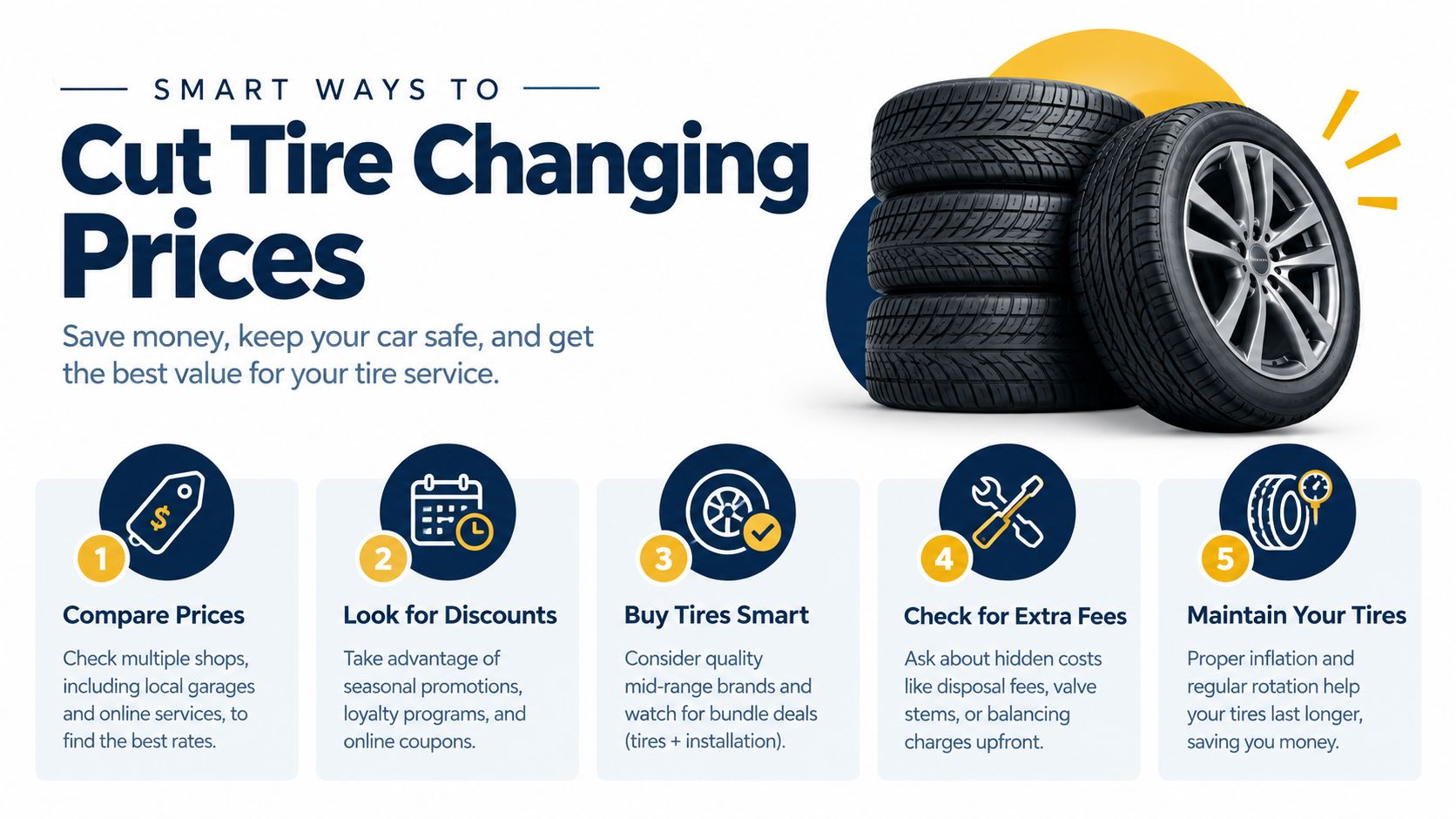
The strongest savings combine separate wheel sets, an off-peak booking, an applicable membership, and an all-in quote. Loose tires, premium wheels, storage, and same-day peak-season service create a higher total before the vehicle reaches the bay.
Your Pre-Appointment Tire Change Checklist
Use this one-minute check before you request a quote.
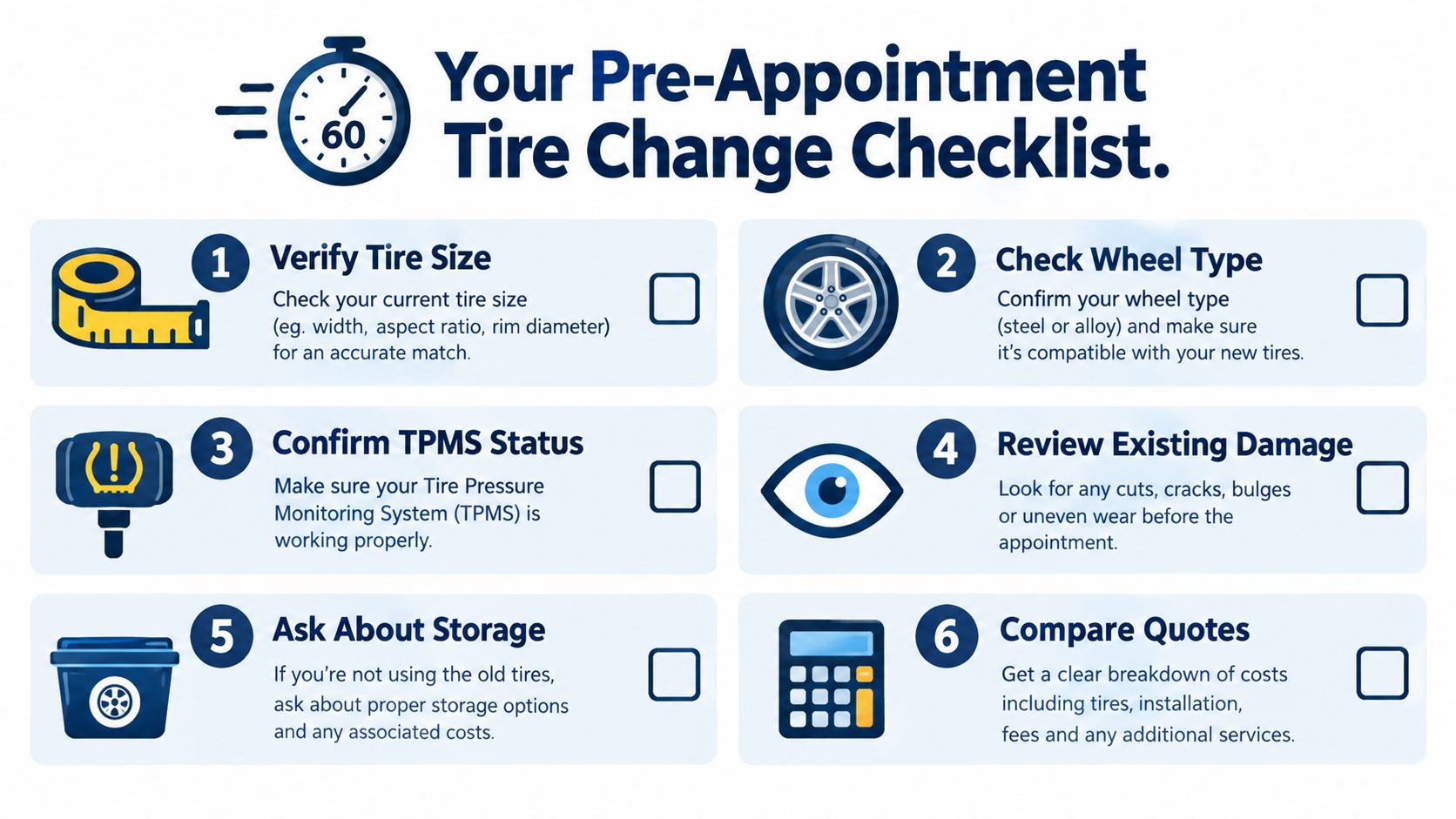
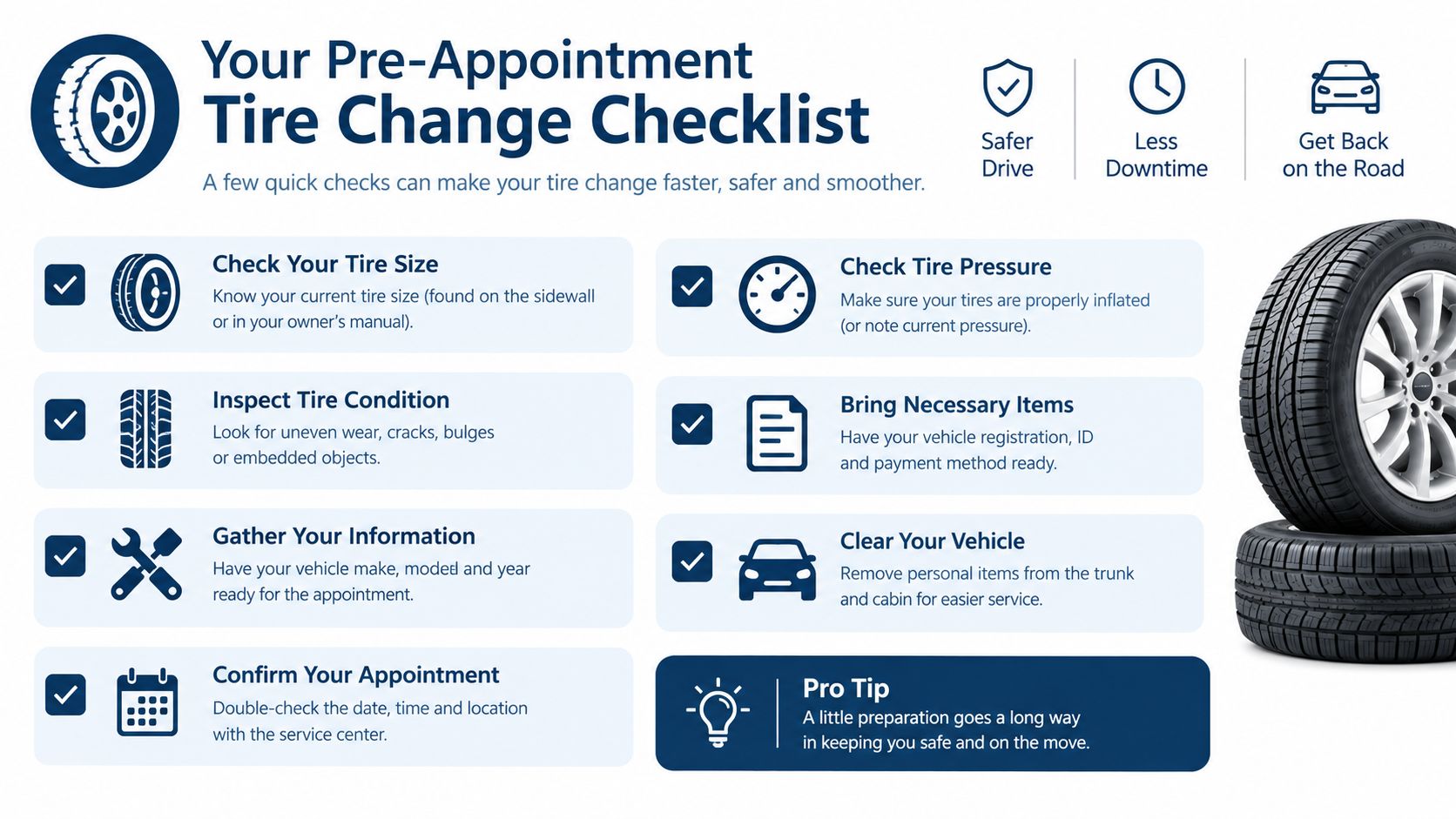
- Verify the tire size: Read the sidewall and tell the shop the exact size.
- Confirm the wheel type: Say whether the tires are already mounted on rims.
- Check TPMS status: Mention any warning light or previous sensor issue.
- Inspect existing damage: Note uneven wear, sidewall damage, missing caps, or bent rims.
- Ask about storage: Confirm the price, term, and whether the fee covers a full set.
- Compare complete quotes: Ask for labour, balancing, valve stems, disposal, tax, and storage in writing.
Bring the locking-nut key, membership card, and previous invoice if you want the shop to check a prior service history. Ask four direct questions before authorising work: Is balancing included? Are disposal fees included? Are valve stems required or optional? What is the final price after tax?
The pricing reality is simple. On-rim swaps cost less than off-rim changeovers. Add-ons decide whether a headline rate survives contact with the invoice. An all-in written quote is the most dependable saving tool.
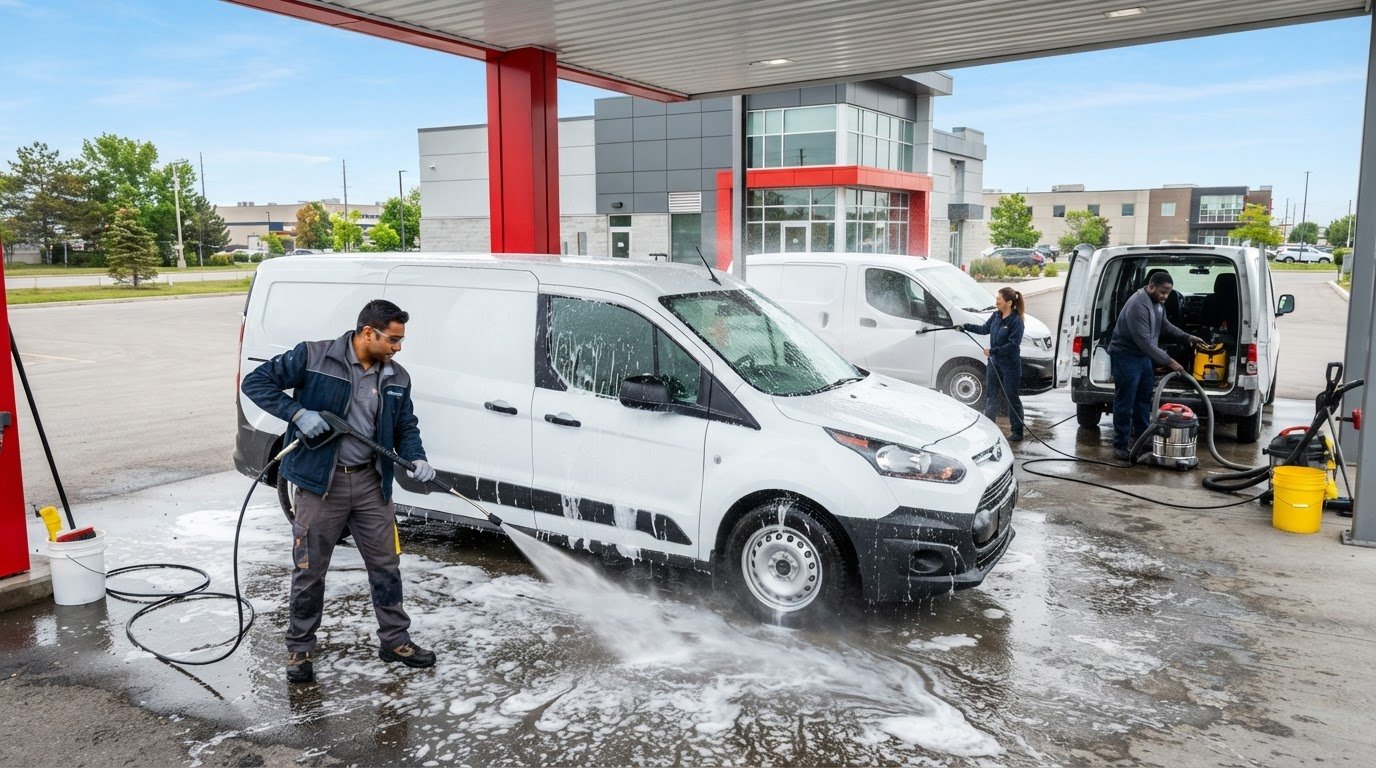
For the clean-up after a winter season, Nanak Car Wash offers express and full-service washes, interior cleaning, detailing, tire dressing, and rust proofing at GTA locations. Visit Nanak Car Wash to choose a service that fits your vehicle and keep your freshly changed tires and wheels looking presentable through the season.




 6600 Finch Ave W, Etobicoke, ON M9V 3Z6
 647-703-8515
 MON – SUN 8 AM to 7 PM