
Toronto directories list just 4 self-serve and 3 coin-operated wash listings, so a pure do-it-yourself wash routine is often impractical inside the city. For most GTA drivers, the sensible answer is a mix of occasional self-serve cleaning, express washes, and a membership that fits where they drive.
The popular advice is to “find the cheapest bay and wash every week.” That sounds sensible until you spend half an evening crossing the GTA for an unavailable stall, discover the underbody rinse is broken, or try to wash a salt-covered vehicle beside a storm drain. Self car wash in Toronto is a scarcity and feasibility problem before it's a price problem.
Toronto drivers need a strategy built around salt, parking, wastewater rules, and the fact that many vehicles have nowhere practical to be washed at home. A self-serve bay can still be useful, but it shouldn't be treated as the default answer for every wash.
Table of Contents
- Why Finding a Self Car Wash in Toronto Is Harder Than It Sounds
- Types of Self-Serve and Coin-Operated Wash Equipment
- How a Self-Serve Wash Bay Actually Works
- Real Costs of Self-Serve, Express, and Full-Service Washes in the GTA
- A Toronto-Specific Winter Wash Routine That Actually Works
- Toronto Bylaws, Wastewater Rules, and Why Self-Serve Sites Are Limited
- When a Self-Serve Bay Beats Every Other Option
- Using Multi-Location Wash Clubs to Fill the Self-Serve Gap
- Where GTA Car Washing Is Heading Over the Next Five Years
- Choosing the Right Wash Strategy for Your Vehicle and Budget
Why Finding a Self Car Wash in Toronto Is Harder Than It Sounds
Toronto's self-serve supply is thin, and the numbers show it. One 2026 dataset lists 71 car washes in Toronto overall, while another directory covering 151 Toronto-area locations identifies only 4 self-serve listings and 3 coin-operated listings. That is a narrow DIY footprint, not a city full of easy bays. Independent location data on Canadian car washes matches what local drivers run into: a search for a self car wash near me usually turns up general wash results, not a bay you can count on.
The urban lot problem
A proper self-serve site needs more than a pressure washer and a sign. It needs several usable bays, drainage, wastewater controls, vacuum space, equipment rooms, vehicle stacking space, and enough land so customers are not backing up onto a busy street. In Toronto, that land competes with retail, parking, housing, and drive-through businesses.
Express tunnels fit tighter sites better. Cars move through a fixed system and leave fast, while a self-serve customer needs room to park, wash, dry, vacuum, and sometimes wait for an open bay. That extra footprint is the reason you see more express setups than true DIY wash sites.
In Toronto, a self-serve bay is a destination you plan around. It is not a service you can assume is around the corner.
The city's wastewater rules add another hurdle. Commercial facilities must treat wash water and discharge it into the sanitary sewer system, while outdoor washing should avoid storm sewers. The City of Toronto also explains that permeable surfaces can absorb wastewater before it reaches the storm system, which makes drainage design a big part of any compliant operation. Toronto's guidance on washing cars outdoors makes clear why a legitimate bay needs more infrastructure than a hose beside a driveway.
A more useful way to search
| City or region | Self-serve bays | Coin-operated listings | Combined |
|---|---|---|---|
| Toronto area | 4 listed | 3 listed | 7 listed |
| Nearby cities | Not established in the provided data | Not established in the provided data | Not established in the provided data |
Search by equipment type, not just “car wash.” Check whether the listing confirms self-serve bays, underbody spray, vacuum access, payment method, operating hours, and vehicle clearance. If those details are not visible, call before driving across the city.
Types of Self-Serve and Coin-Operated Wash Equipment
A real self-serve bay gives you control over the wash sequence. You pull into an open stall, select a timed programme, and use a mounted wand to apply soap, rinse, wax, or a spot-free finishing cycle. Payment may involve coins, tokens, a card reader, or an app, depending on how recently the operator upgraded the equipment.
The wand normally offers several settings:
- Pre-rinse: Loosens salt, sand, and loose road film before contact.
- Soap or foam: Covers the vehicle and gives dirt time to soften.
- High-pressure rinse: Removes loosened grime from the roof down.
- Wheel or underbody spray: Reaches areas a normal side rinse misses.
- Wax or sealant: Adds a temporary layer of water-repelling product.
- Spot-free rinse: Uses treated water to reduce visible mineral marks.
The equipment matters more than the sign outside. A weak pump, clogged nozzle, broken timer, or contaminated brush can turn a cheap wash into a frustrating one. If you're comparing a home pressure-washer setup with commercial equipment, the hydraulic lance specification tips from MA Hydraulics Ltd. offer useful context on lance design, fittings, and safe handling.
Know which format you're entering
| Equipment type | How it works | Common GTA use | Best for |
|---|---|---|---|
| Open self-serve bay | You control a mounted wand and timed programme | Occasional DIY washing where a bay is available | Underbody rinses, muddy vehicles, careful pre-wax cleaning |
| In-bay automatic rollover | The vehicle stays stationary while a gantry moves around it | Quick automatic washing at compact sites | Drivers who want speed without leaving the car |
| Hybrid wash site | Wash equipment sits beside vacuums, mat cleaners, or finishing stations | Exterior wash followed by interior upkeep | Families, commuters, and drivers doing a complete reset |
Be cautious with shared brushes. Winter grit can remain in the bristles, and dragging that material across black paint or a matte wrap is a poor trade. Use high-pressure and touchless stages first. If the bay's brush looks dirty, skip it and bring a clean mitt only if the site permits hand contact.
How a Self-Serve Wash Bay Actually Works
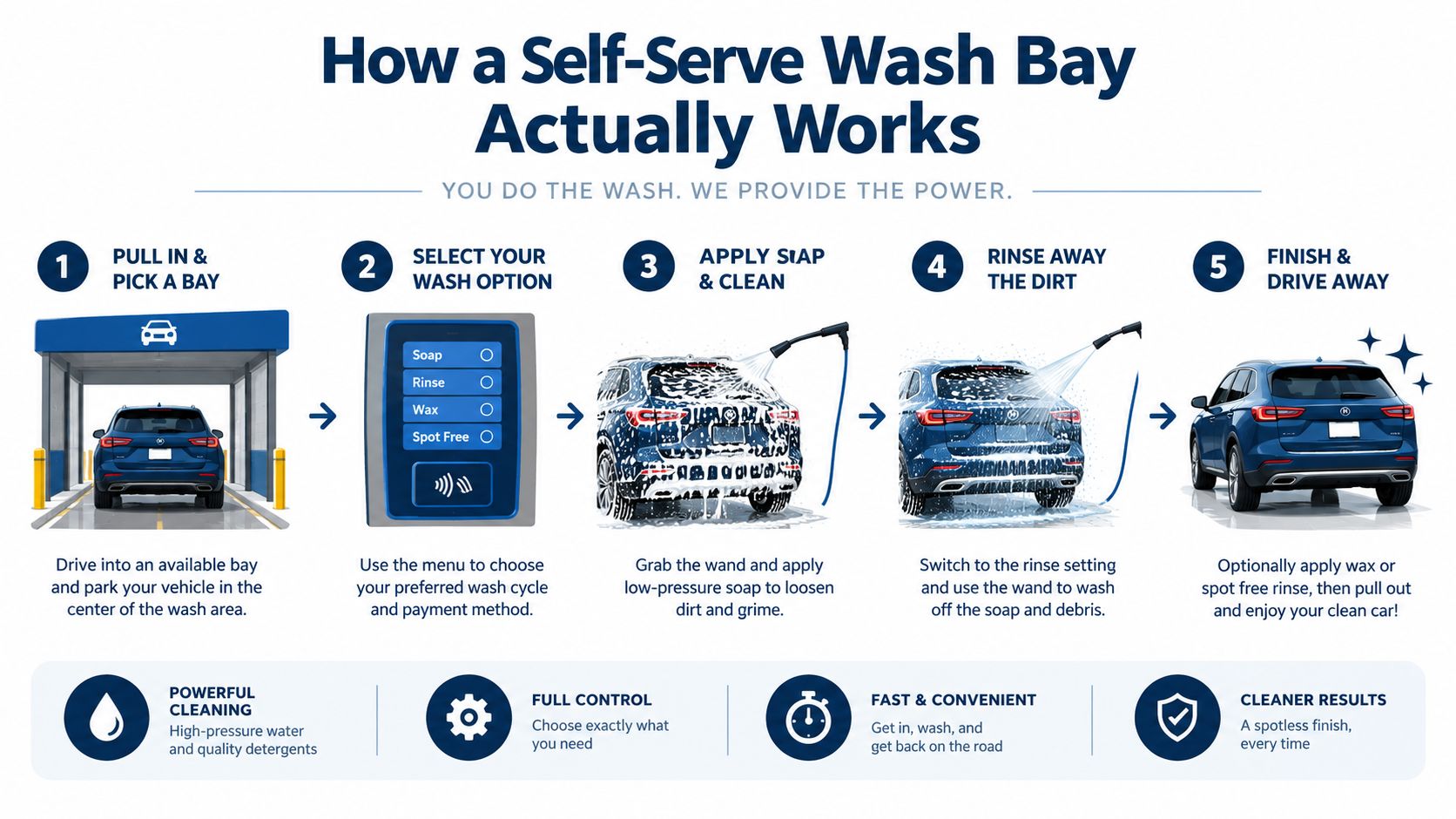
A self-serve visit is a timed workflow, not a leisurely detailing session. Park straight, close the doors and windows, inspect the wand, and decide your sequence before starting the timer. The worst way to spend money is standing beside an active bay trying to work out which button does what.
A sensible bay sequence
- Pre-rinse first. Start with the roof and glass, then move down the sides. Give the wheel arches, rocker panels, and underbody extra attention because salt and gritty slush collect there.
- Apply soap without rushing. Cover the vehicle evenly, but don't let foam dry on the paint. Keep the wand moving and avoid aiming directly at vulnerable trim or damaged seals.
- Rinse from the top down. Work methodically so dirty water doesn't run back over panels you've already cleaned.
- Clean wheels and wells. Use the pressure stream to flush behind the spokes, around the arches, and along the lower body.
- Finish with the treated rinse. Use wax or sealant only after the soap has been fully removed, then select the spot-free cycle if the site offers one.
The common money leaks are predictable. Drivers over-apply soap, leave the timer running while checking their phone, spend too long on already-clean panels, and skip the underbody because it's difficult to see. In Toronto, that last mistake matters most during active salting.
A full visit also takes longer than the wash itself. Allow time to queue, wash, move to a vacuum or drying area, remove mats, and deal with the interior. If you need a quick exterior reset before work, an express tunnel is often more practical. Use the bay when you need control, not just because the word “self-serve” sounds cheaper.
Real Costs of Self-Serve, Express, and Full-Service Washes in the GTA
The cheapest wash on a menu isn't automatically the best value. A self-serve bay charges you in two ways: the service fee and your time. You also supply the labour, towels, interior tools, and patience, while the operator supplies the equipment, water controls, chemicals, and a place to work.
Express washing reverses that trade. You spend less time managing the process, but you accept the tunnel's equipment, wash sequence, and finish. Full-service and detailing options cost more because staff handle labour-intensive interior or paint work.
Compare the trade-offs, not just the receipt
| Wash type | Single wash in CAD | Monthly plan in CAD | Best break-even frequency | Typical add-ons |
|---|---|---|---|---|
| Self-serve bay | Varies by site and timer | Usually unavailable | Low-frequency drivers who value control | Vacuum, mat cleaning, wax, underbody rinse |
| Express tunnel | Varies by operator and package | Available at some multi-location providers | Drivers washing regularly | Underbody wash, foam, wax, drying upgrades |
| Full-service wash | Varies by labour and vehicle size | Available at selected providers | Drivers who want interior work handled | Hand drying, dashboard cleaning, glass, tire dressing |
| Detailing | Quote-based | Some providers offer memberships | Neglected interiors or paint requiring restoration | Shampoo, stain removal, polishing, leather care |
Self-serve makes the most sense when you wash infrequently, want to control the sequence, or need to work on a specific problem such as mud in the wheel wells. It loses its edge when every visit becomes a long trip, the bay is occupied, or you need someone to clean the interior.
An express plan can suit a commuter who wants predictable access near home, work, or the highway. A full-service visit is more defensible after heavy family use, rideshare work, or a winter season that has left salt residue in the cabin. Detailing is a different category altogether. It's for embedded dirt, stains, odours, pet hair, and neglected surfaces, not routine rinsing.
My recommendation is simple. Don't buy a membership because it looks inexpensive on paper. Buy it only if the locations fit your weekly routes, the wash includes the underbody service you need, and you will use it often enough to justify the recurring charge.
A Toronto-Specific Winter Wash Routine That Actually Works
Ontario road salt changes the washing schedule. Environment and Climate Change Canada identifies Ontario as the country's heaviest road-salt user, and its reporting lists 135 public-road organizations, 1,679,395 tonnes of salt-related materials, and 36,198,084 lane-km of roadway in the 2020-21 data table. The same reporting shows Ontario municipalities accounted for the largest reported municipal use of solid salts, abrasives, and total liquids in the 2019 data. The federal road-salts annual report explains why GTA vehicles see repeated exposure rather than one isolated dirty day.
During active salting, aim to remove salt on a 7 to 10 day cycle, with extra underbody and wheel-well rinsing after major snow or heavily salted highway trips. GTA winter-driving guidance on salt removal supports that routine and puts the emphasis where it belongs, on rocker panels, wheel arches, and the undercarriage.
Use the right order
Start with a touchless pre-rinse before soap. Flush the underbody, suspension edges, wheel wells, door sills, and trunk lip. Then apply a pH-neutral soap, let it loosen road film without drying, and rinse from the roof downward.
Avoid abrasive contact while grit is still present. That means no brush across a heavily salted bonnet, no dry towel over road film, and no aggressive rubbing around the wheel arches. A spot-free final rinse helps reduce marks, while forced air is preferable to leaving water trapped around mirrors, handles, and trim.
Don't wash outdoors when temperatures make water freeze onto seals, handles, or the ground. If you can't dry the vulnerable areas safely, choose an indoor or heated facility. Inside the cabin, remove mats and vacuum salt before it turns into damp residue. A membership or express wash can handle routine exterior exposure, while a self-serve bay is useful for targeted wheel-well and underbody work when one is available.
Toronto Bylaws, Wastewater Rules, and Why Self-Serve Sites Are Limited
The shortage of self-serve bays in Toronto is a wastewater problem before it is a pricing problem. Wash water can carry detergent, oil, grease, sediment, and road residue. If it reaches a storm sewer, it can bypass the treatment process used for sanitary wastewater.
Commercial operators must control where that water goes. The City's guidance states that commercial wash wastewater must be treated and discharged to the sanitary sewer system. It also tells people washing outdoors to keep wastewater out of storm sewers and notes that permeable surfaces can absorb runoff before it reaches the storm system. Read Toronto's car-washing and sewer guidance before treating a driveway as your default wash location.
Three very different washing situations
A commercial self-serve bay is built for drainage, collection, and wastewater disposal. Proper floor channels, wastewater controls, and maintained equipment are part of the setup. An express tunnel handles the same concern through a fixed process, making water management easier to control at volume.
A home driveway wash creates a different risk. The owner may have no reliable way to capture contaminated water, and a sloped driveway can send runoff toward a catch basin. Residue can leave the property before anyone sees it.
Use a commercial facility designed for wash water, or wash only on a surface and in a manner that prevents runoff from reaching the storm system. That restriction helps explain why Toronto has fewer practical self-serve options than drivers expect.
Choose a permanent, maintained site over an improvised roadside operation. Posted operating information, visible drainage infrastructure, clean equipment, and a clear payment system are good signs. Price should come second. If staff cannot explain where the wash water goes, leave and use another facility.
When a Self-Serve Bay Beats Every Other Option
Self-serve still wins when the job needs your judgement. A tunnel is built for repeatable maintenance. It isn't ideal when you need to pause on a muddy wheel arch, rinse a roof rack from several angles, or prepare a vehicle for wax without letting brushes touch the paint.
Use a bay for targeted work
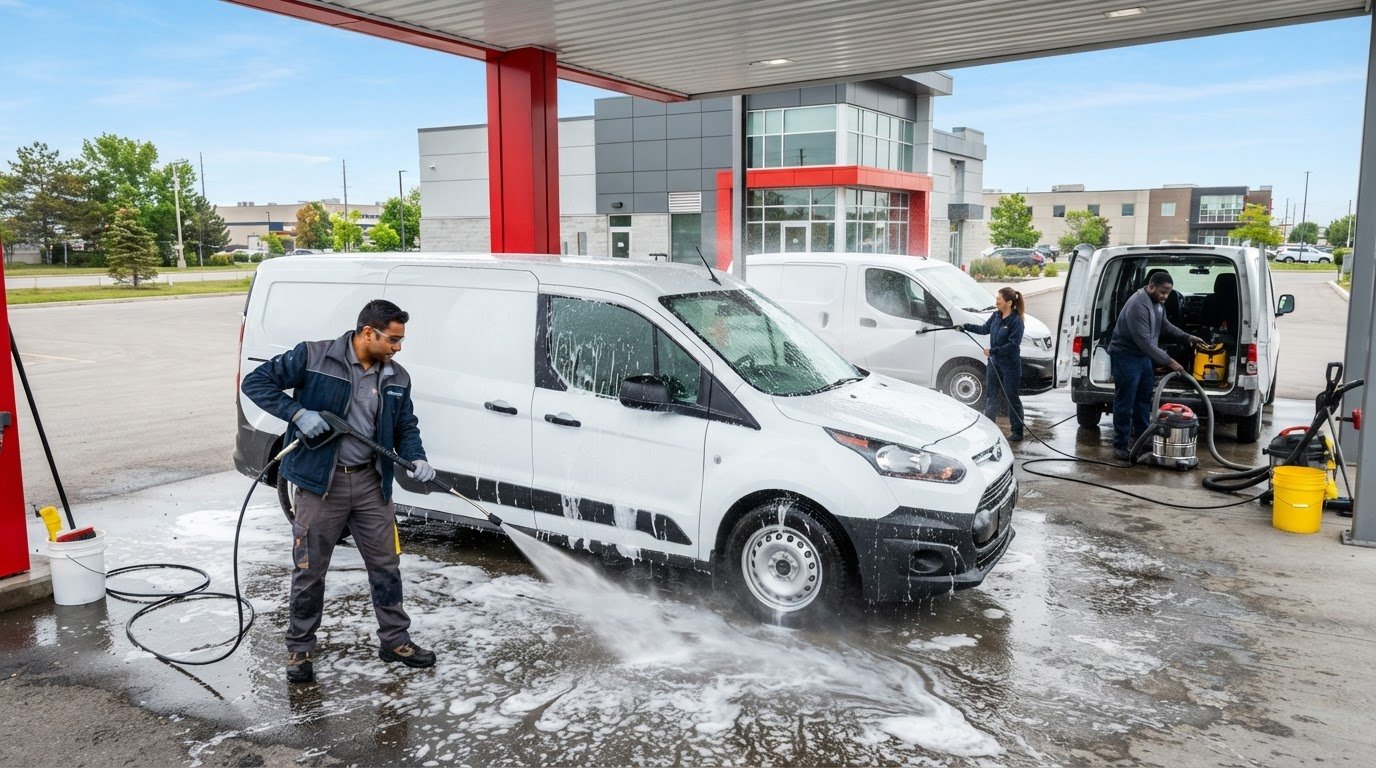
A self-serve visit suits a muddy weekend vehicle, a work van with concentrated grime, or a driver who wants to control the soap and rinse order. It's also useful before paint decontamination, provided you bring suitable towels and work only where the facility allows it.
Black paint and matte wraps need extra discipline. Use pressure and distance to remove loose grit, avoid shared brushes that look contaminated, and don't scrub a surface that still has winter residue on it. If the bay has a separate underbody programme, use it before the final exterior rinse rather than treating it as an optional extra.
The format also suits low-frequency drivers. Someone who washes only occasionally may get little value from a recurring plan, particularly if the nearest member location is inconvenient. A focused self-serve visit gives that driver control without creating another monthly bill.
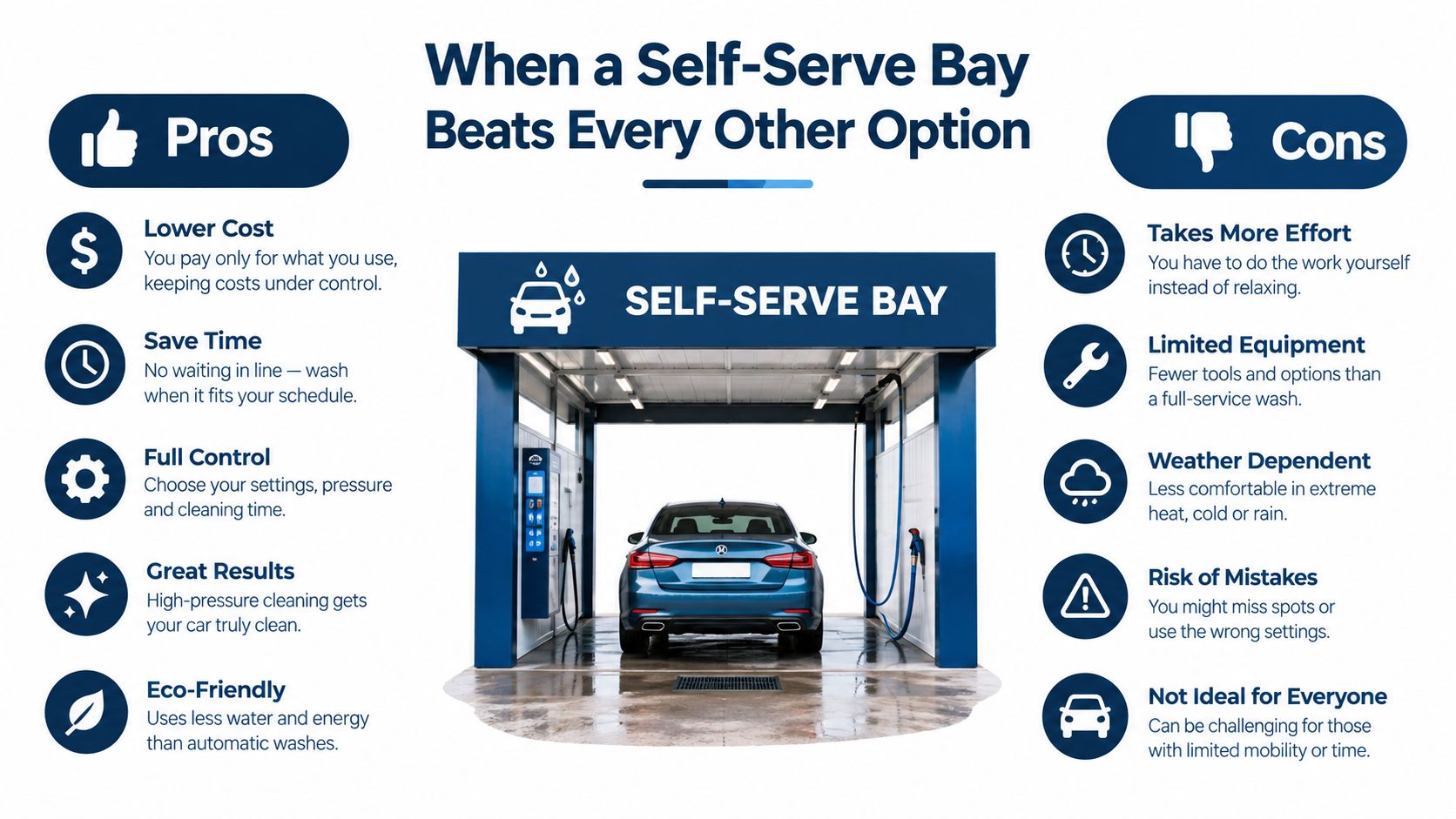
The drawbacks are equally clear. Bays can be cold, exposed, crowded, and poorly maintained. You may need to bring clean microfibre towels, interior tools, and a plan for drying. A self-serve bay is a specialised tool, not a lifestyle requirement.
Use it when control matters. Skip it when convenience, reliable availability, and repeatable underbody rinsing matter more.
Using Multi-Location Wash Clubs to Fill the Self-Serve Gap
A multi-location wash club solves the part of the problem that self-serve searches can't: access. You're not relying on one coin-operated bay near your home. You're choosing a network that may fit several parts of your routine, such as the route to work, a shopping area, or a highway corridor.
Start by comparing the actual service, not the membership label. Some plans offer unlimited express entry, while others provide discounted repeat visits. Check whether the underbody rinse is included, whether larger vehicles need an upgrade, and whether the plan works at every location or only the site where you enrolled.
Read the fine print before joining
- Location access: Confirm the locations you'll realistically use, not a long list of sites you'll never visit.
- Wash sequence: Check whether the plan includes presoak, foam, underbody spray, drying, and any finishing treatment you care about.
- Vehicle limits: Ask about lifted trucks, roof racks, vans, and oversized SUVs before paying.
- Peak periods: Look for queue rules, restricted hours, or locations where members still face long waits.
- Cancellation terms: Make sure the plan doesn't continue after your driving pattern changes.
| Provider type | Monthly price in CAD | Plan type | Key features |
|---|---|---|---|
| Multi-location express club | Varies by provider | Unlimited or recurring wash access | Multiple sites, app or account check-in |
| Single-site wash plan | Varies by provider | Location-specific membership | Convenient if one site matches your route |
| Prepaid wash bundle | Varies by provider | Fixed number of visits | Useful for irregular washing |
| Self-serve visits | Pay as used | Timed bay access | Control over rinse, soap, and underbody work |
The strongest hybrid is straightforward: use an express club for routine exterior maintenance, then book a self-serve or professional visit when the vehicle needs targeted attention. Treat the membership like a commuting tool. If you change jobs, move neighbourhoods, or stop driving regularly, reassess it.
Wash operators also need a similar operational mindset. Clear staff roles, maintenance responsibilities, and customer queues matter at busy sites. Businesses organising frontline groups can find useful coordination ideas through Pebb's frontline groups resource, though the same principle applies to drivers: choose a system that makes repeat behaviour easy.
Where GTA Car Washing Is Heading Over the Next Five Years
The GTA wash market is moving toward controlled, repeatable service. Operators face pressure to manage wastewater properly, reduce waste, maintain equipment, and process more vehicles in compact sites. Those pressures favour express tunnels, recycling systems, app-based payment, and memberships over large stand-alone self-serve footprints.
Ontario's scale reinforces that direction. Industry coverage cited in the verified brief describes rising water costs pushing operators toward recycling, greener operations, and cashless or contactless service models. Ontario also remains Canada's largest provincial car-wash market, with 2,208 businesses representing about 31.2% of the national total, according to the provided industry data. Those figures suggest strong demand, but they don't guarantee more neighbourhood self-serve bays.
What drivers should expect
Self-serve sites that survive will likely focus on a clear purpose, such as enthusiast washing, commercial vehicles, underbody care, or high-capacity vacuum access. Express facilities will keep expanding where land and traffic patterns support quick vehicle turnover.
Touchless equipment should become more useful for winter pre-rinsing, while operators continue adding foam, sealant, and paint-protection upgrades. EV owners may see more attention to low-contact processes, charging-area convenience, and packages designed around quiet, routine maintenance rather than heavy mechanical work.
Water handling will become a bigger part of the customer's decision. A cheap wash that ignores runoff is not a good bargain, and a legitimate facility has infrastructure costs that customers eventually fund through service pricing. Drivers should reward sites that explain their process clearly instead of chasing the lowest visible number.
The likely outcome isn't the return of a self-serve bay on every block. It's a blended GTA market where memberships handle frequency, express tunnels handle convenience, and specialised bays or detailers handle jobs that automated systems can't.
Choosing the Right Wash Strategy for Your Vehicle and Budget
Pick the system around your driving pattern, parking situation, and tolerance for doing the work yourself. Start with the question many owners skip: where does the car spend its time? A vehicle parked outdoors near the lake or on heavily salted routes needs a different routine from a weekend car kept under cover.
Use this decision framework
Choose a self-serve and express combination if you want control over occasional deep rinses but still need convenient routine washing. This fits a commuter who can reach a membership location during an existing trip and reserve self-serve work for wheel wells, underbody areas, or pre-wax preparation.
Choose an express membership if you drive daily, carry family members, work in the vehicle, or park outdoors. Frequency matters more than the satisfaction of handling every step yourself. Make sure the plan includes the underbody service and locations that fit your route.
Choose occasional self-serve visits if the vehicle is a low-mileage weekend car or an EV used mainly for local trips. You can focus on seasonal cleaning, careful rinsing, and interior upkeep without paying for access you won't use.
Choose full-service or detailing support when salt, stains, pet hair, odours, or embedded grime have moved beyond routine maintenance. A vacuum won't solve a contaminated carpet, and a tunnel won't replace paint correction or deep interior cleaning.
Finish with a five-minute check before you commit:
- Identify the nearest legitimate self-serve option.
- Confirm whether it has underbody equipment and working vacuums.
- Compare membership locations against your normal routes.
- Decide how often the vehicle needs salt removal.
- Pick one routine service and one deeper-cleaning option.
Don't build your plan around an imaginary abundance of Toronto self-serve bays. Build it around the sites you can reach, the wastewater rules you need to respect, and the winter contamination your vehicle encounters.
Nanak Car Wash offers express and full-service washes, interior cleaning, detailing, rust proofing, memberships, and free vacuum access at participating GTA locations. Visit Nanak Car Wash to choose a practical routine for salt removal, interior upkeep, and repeat washing.

 6600 Finch Ave W, Etobicoke, ON M9V 3Z6
 647-703-8515
 MON – SUN 8 AM to 7 PM