
You've washed the car, wiped the mirrors and finally stopped tracking slush onto the floor mats. From the driver's seat, everything looks respectable. Underneath, grey winter muck may still be packed around steel rails and tucked into seams. That's where a rust proofing undercoat belongs in the maintenance conversation, preferably before someone starts promising that black spray can fix damaged metal.
Table of Contents
- What a Rust-Proofing Undercoat Is and Why Ontario Cars Need One
- Which Underbody Parts an Undercoat Actually Protects
- How the Coating Stops Steel From Rusting
- Types of Undercoating and Which One Suits Your Car
- How to Prepare and Apply an Undercoat Step by Step
- When an Undercoat Is the Wrong Fix
- What the Evidence Says About Results Over Time
- Costs, Schedule and Booking Plan
What a Rust-Proofing Undercoat Is and Why Ontario Cars Need One
A rust-proofing undercoat is a protective film sprayed or brushed onto the underside of a vehicle to separate vulnerable steel from moisture, oxygen and salt. Think of it as outdoor clothing for metal, not replacement metal.
Your clean-looking car can still have a dirty underside. Frame rails, the long supporting sections beneath some vehicles, and rocker seams, the joints below the doors, aren't easy to judge from beside the petrol pump. An exterior wash doesn't necessarily reach every pocket underneath.
Ontario gives those pockets plenty to collect. During 2023–2024, 135 reporting Ontario organizations used 1,679,395 tonnes of road salt and 36,198,084 litres of liquid de-icing material across 104,187 kilometres of salted roads, according to the federal road-salt reporting data.
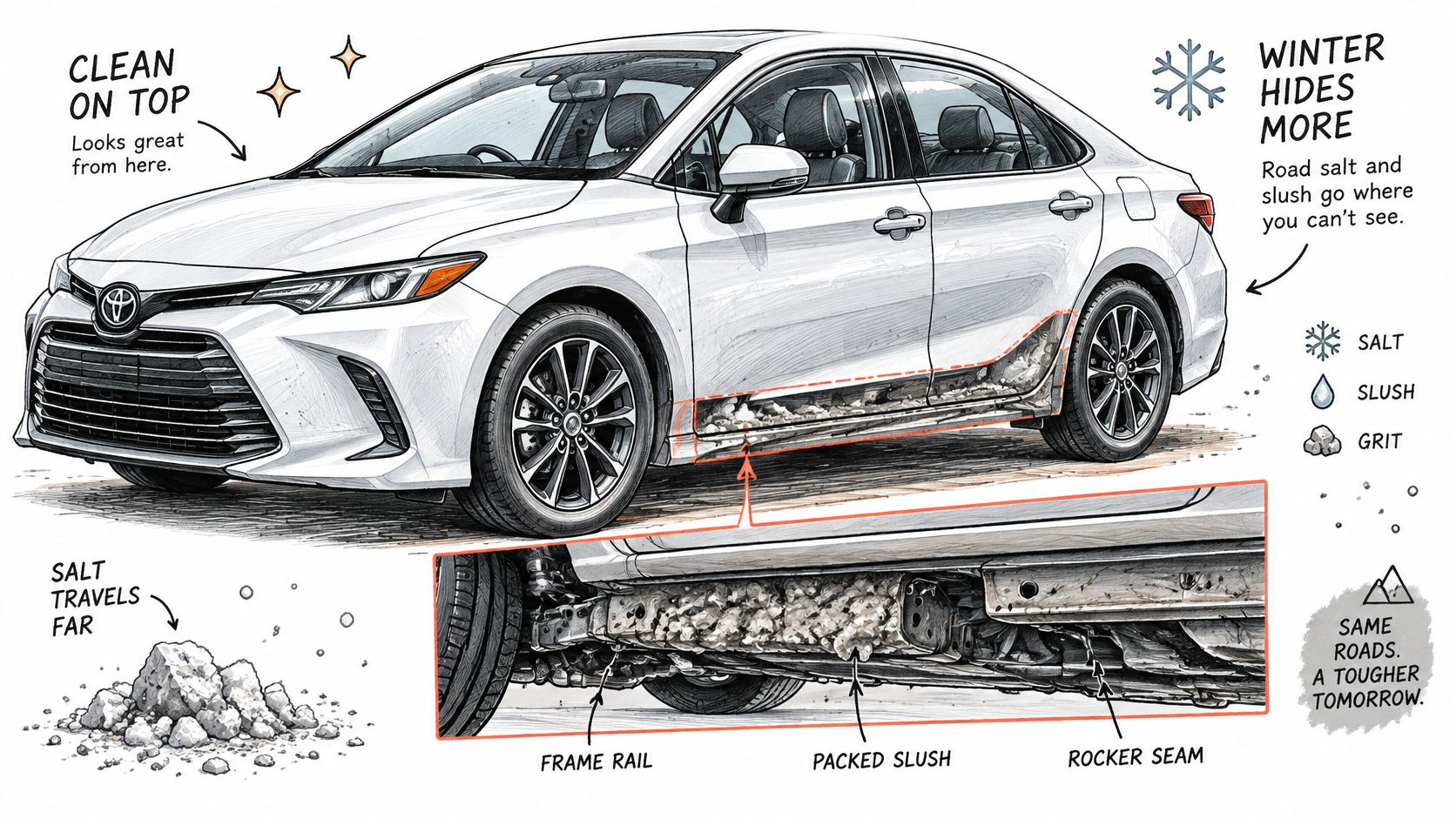
Clean paint isn't an underbody inspection
Drive home on wet, salted roads and you can collect fresh residue after leaving the wash bay. Road spray reaches beneath the car even when the bonnet still looks presentable. Salt is rather like a patient thief who hasn't left the building yet.
For GTA commuters, the useful question isn't whether the car encountered salt. It's where that residue remains, what condition the metal is in, and whether a protective film can be applied properly.
Start with the right expectation: An undercoat is a barrier, not a repair.
That distinction keeps the purchase sensible. A coating can help isolate suitable surfaces from their surroundings, but it can't replace steel already lost to corrosion. Nor do Ontario's salt-use figures establish that every product works equally well.
The practical priorities are less glamorous than a freshly blackened underside:
- Find the exposure: Look beyond visible bodywork to hidden joints and splash zones.
- Check the foundation: Establish whether the steel and existing coatings are sound.
- Choose deliberately: Match the compound and application method to the actual job.
A good service begins with those questions. The spray gun comes later.
Which Underbody Parts an Undercoat Actually Protects
The underside is a map of potential salt hiding places. Low points, overlapping panels and tight corners deserve attention, but they don't all need the same treatment.
| Underbody part | Where salt collects | Coating approach |
|---|---|---|
| Frame rails and crossmembers | Box sections and overlapping joints | Protect sound steel from moisture and chloride |
| Rocker panels and sills | Lower edges, seams and cavities | Treat hidden seams with a suitable cavity product |
| Wheel wells and inner fenders | Areas hit by slush and grit | Use an appropriate abrasion-resistant film |
| Suspension and subframe mounts | Around brackets, bolts and bushings | Protect fixed steel; keep moving parts clear |
| Floor pan and body seams | Overlapping panels and spot welds | Protect prepared seams without hiding damage |
| Brake and fuel lines | Routes beside the frame | Mask or avoid lines and fittings |
| Drain holes and door bottoms | Lower edges where water collects | Preserve drainage; coat surrounding metal selectively |
The places drivers tend to miss
Wheel wells deserve more than a quick glance over the tyre. They receive road spray and grit directly, so the condition of their existing protection matters. A patch that looks merely dirty may need cleaning before anyone can judge it.
Rocker panels and door bottoms present a different challenge. Their overlapping seams and enclosed spaces aren't equivalent to an open sheet of steel. Spraying the visible lower edge doesn't establish that a hidden joint has been reached.
Ask the technician to distinguish accessible surfaces from cavities they can't inspect completely. Honest limits are more useful than a promise to spray everything.
What should stay clear
Fixed, suitable metal is the target. Moving parts, brake components, fuel-line fittings, exhaust heat zones, tyres and sensors aren't an invitation for overspray.
A suspension mounting bracket and the nearby moving joint are different jobs, even if they're close enough to share the same muddy splash. Careful application means recognising that boundary rather than colouring the whole area alike.
- Keep drainage working: Door bottoms and other drain openings must remain unobstructed.
- Preserve service access: Don't bury fittings or inspection points beneath an indiscriminate layer.
- Prioritise hidden structure: Give prepared rails, mounting areas and seams attention before judging the finish.
The rule of thumb is simple: protect appropriate hidden steel without interfering with how the vehicle works. Shiny paint above it tells you very little about whether that happened.
How the Coating Stops Steel From Rusting
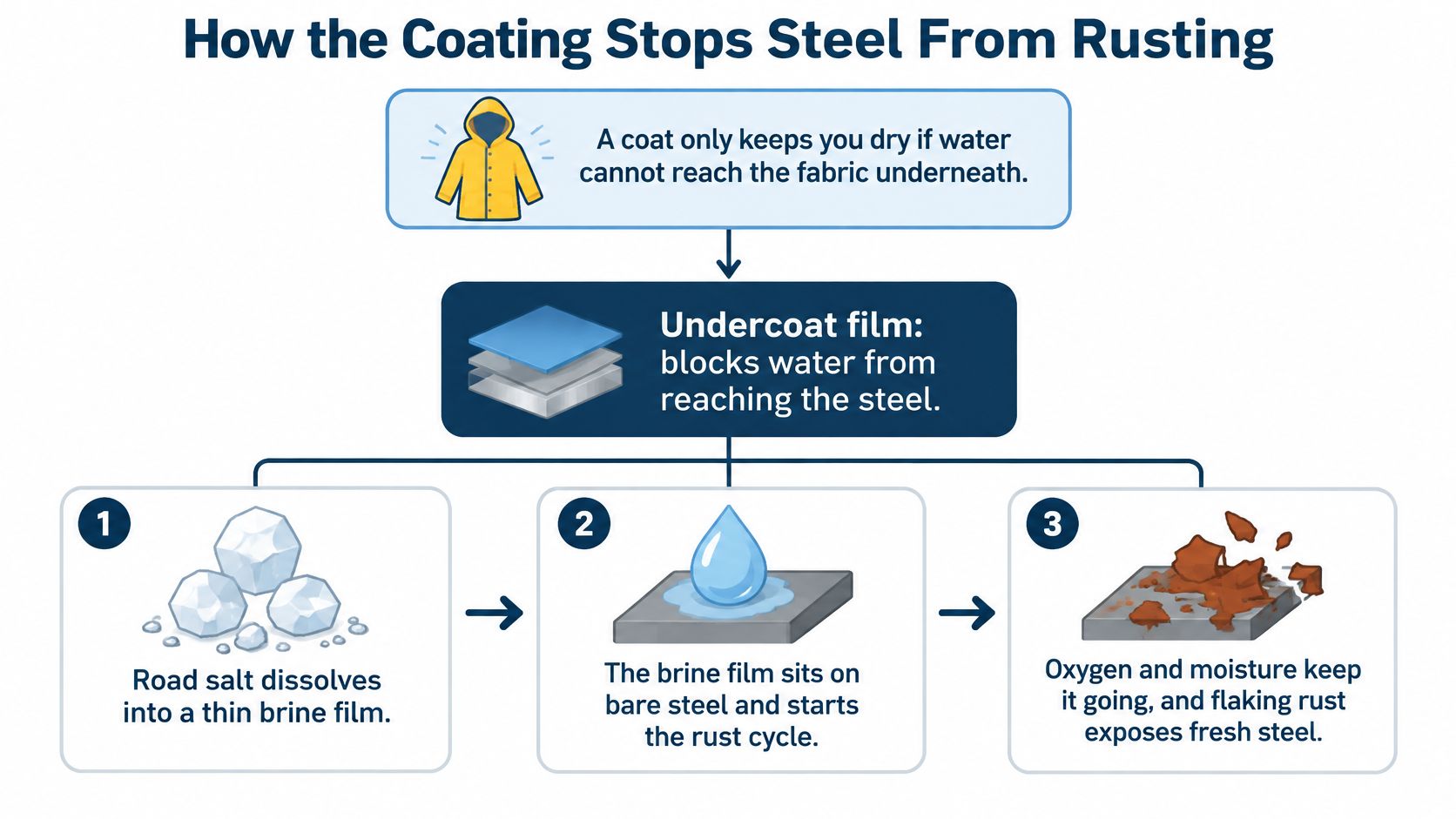
A raincoat only keeps you dry if water can't reach the clothes underneath. An undercoat follows the same basic idea, although steel's version involves chemistry rather than an unfortunate afternoon outdoors.
Rusting involves chemical reactions and the movement of electrical charge. That's what electrochemical corrosion means. No laboratory coat required.
The rust cycle in plain language
Road salt dissolves into water and makes brine, a salty solution. On exposed steel, that solution can carry charged particles between different reaction sites. At one site, iron loses electrons and oxidizes; elsewhere, oxygen takes part in the matching reaction.
The result is corrosion, not just dirt stuck to metal. Chloride can reach seams, fasteners, damaged factory finishes and joints between frame components, as described in the Canadian corrosion-research overview.
- Salt supplies the brine: A thin wet film can matter, even without a visible puddle.
- Brine connects reaction sites: It helps carry the charged particles involved in corrosion.
- Continued exposure sustains the problem: Moisture and oxygen remain important parts of the process.
A suitable, continuous coating helps interrupt that connection. It limits contact between vulnerable steel and the water, oxygen and salty residue around it.
Rust needs a connected pathway. An intact, suitable undercoat helps interrupt that pathway.
Why the hidden surface matters
The surface you can see isn't the interface that matters most. The key meeting point is underneath, where the product contacts the vehicle.
If contamination remains there, a handsome finish doesn't establish that the steel has been isolated properly. You wouldn't put on a raincoat over a soaking jumper and announce that you're dry.
This also explains why an exterior wash and underbody protection aren't interchangeable. Cleaning accessible surfaces removes residue; a suitable coating provides a protective film. Neither task proves that inaccessible seams are clean or protected.
The sensible objective is continuous coverage on a correctly prepared surface, not maximum thickness everywhere. Small gaps, poor contact and hidden contamination deserve more attention than how satisfyingly black the finished job looks.
Types of Undercoating and Which One Suits Your Car
A thick black film proves that someone applied a thick black film. It doesn't tell you whether the product suits the surface, reached the intended joints or bonded properly.
Product families provide a useful starting point. They aren't interchangeable recipes, and the actual product sheet should settle questions about compatibility and preparation.
| Type | Best suited for | Main strength | Main limit |
|---|---|---|---|
| Rubberized or asphalt-based formulations | Prepared bare or primed steel, where specified | Tough film for exposed areas | Can conceal contamination or corrosion beneath it |
| Wax-based cavity products | Enclosed cavities, rockers and seams | Soft film that can reach gaps | Can collect dirt and need refreshing |
| Oil-based penetrating products | Suitable lightly oxidized surfaces and difficult seams | Penetration and moisture displacement | Not a durable outer shell |
| Two-part epoxy or polyurethane systems | Thoroughly prepared restoration or heavy-use applications | Firm, strongly bonded protection | More demanding preparation and application |
Exposed surfaces versus enclosed spaces
Rubberized coatings are worth discussing where an exposed surface needs a tougher film. But don't assume every rubberized product is asphalt-based, or that every formulation accepts the same substrate. “Rubberized” isn't a universal permission slip to spray over whatever is there.
For an enclosed rocker cavity, the conversation changes. Cavity wax is intended for spaces and seams rather than making an accessible surface look finished. Ask how the applicator will reach the cavity and confirm that its drainage will remain usable.
A softer wax film may need refreshing. That isn't automatically a defect; it's part of choosing a maintainable system rather than expecting a permanent shell.
Maintenance films versus restoration systems
Penetrating oil-based products suit a different maintenance approach. Their ability to reach awkward joints is useful, but they shouldn't be mistaken for a hard, abrasion-resistant outer coating. Light surface oxidation still needs assessment and product-compatible preparation.
Two-part epoxy and polyurethane systems belong in a more demanding preparation discussion. They may suit restoration work where access and surface preparation can be controlled. A commuter receiving a maintenance treatment and a stripped vehicle undergoing restoration aren't equivalent jobs.
Before choosing, ask:
- What surface does it accept? Bare steel, primer and existing finishes may have different requirements.
- Where will it be used? An enclosed seam and an exposed wheel well need different consideration.
- How is it maintained? Find out how wear, damage and renewal will be handled.
Choose the system for the metal's condition first. The tin's impressive wording comes a distant second.
How to Prepare and Apply an Undercoat Step by Step
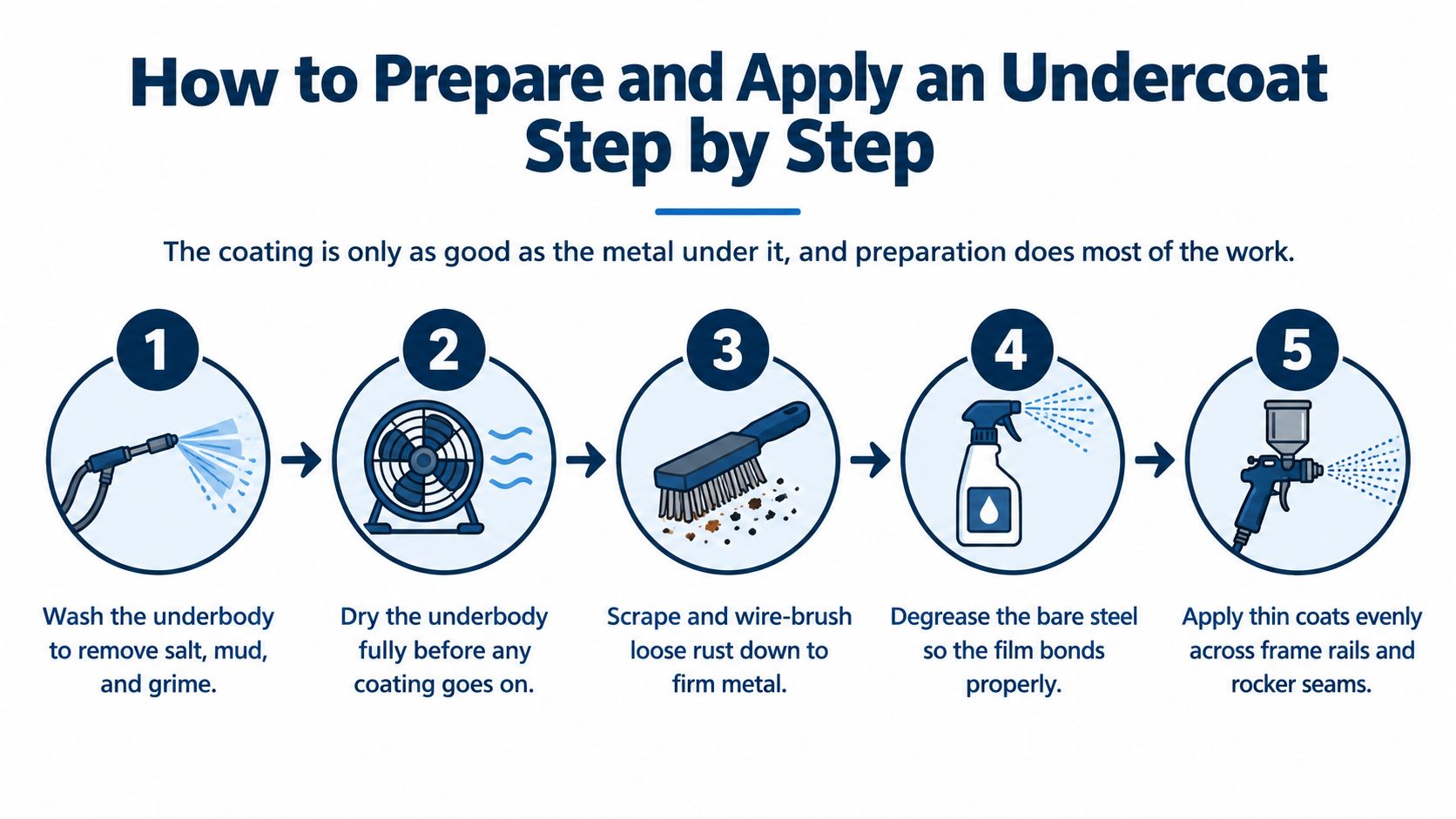
The coating is only as good as the surface beneath it. Preparation does most of the useful work, even though it's much less photogenic than spraying.
Existing rust needs classification before treatment. Light oxidation, loose scale and metal with holes aren't interchangeable conditions. Ontario's persistent salt contamination provides further reason not to judge cleanliness by the season alone, as discussed in the Ontario road-salt management presentation.
The preparation and application routine
Wash the underbody thoroughly. Reach the wheel wells, lower edges and accessible seams to remove salt, mud and grime. The common slip is washing the easy flat surfaces while leaving packed residue in corners.
Let it dry fully. Allow the areas intended for treatment to dry under suitable conditions and follow the product's requirements. Don't treat a dry-looking outer panel as proof that every recess is ready.
Inspect and document. Use a torch and inspection mirror to examine vulnerable areas, and photograph the condition before covering anything. Stop for further assessment if you find holes, questionable mounting areas or damage you can't evaluate.
Remove unstable material. A wire brush or scraper can remove loose scale and flaking finishes where appropriate; preparation must reach a sound, product-compatible surface. Clean or degrease as directed, rather than brushing rust and leaving the remaining contamination behind.
Mask the exclusions. Protect brakes, lines and fittings, exhaust heat zones, tyres, sensors and other areas excluded by the vehicle or coating instructions. Preserve drain openings instead of relying on careful aim alone.
Apply controlled, continuous coverage. Follow the product sheet for application method and film build across the intended steel, joints and wheel-well areas. Don't flood cavities or assume extra material compensates for missed preparation.
Check the work before release. Confirm that drains remain open and inspect excluded components for accidental contamination. A uniform-looking underside isn't sufficient if the application interferes with something beside it.
Follow the drying or curing directions. Some films remain soft, while others require curing, so use the instructions for that particular compound. Don't substitute a guessed waiting period for the specified process.
What a finished job should show
Look for consistent coverage appropriate to the product, without unintended exposed gaps in the treatment area. Clear products won't deliver a black finish, so colour alone isn't a useful acceptance test.
The before photographs should also remain available. They help distinguish the vehicle's original condition from the appearance of the new film.
If you can't safely access the underside, leave the work to a properly equipped professional. Enthusiasm isn't a vehicle support system.
When an Undercoat Is the Wrong Fix
An undercoat can't rescue steel that has already failed. The decision should follow the condition of the metal, not the owner's understandable wish to stop thinking about rust.
| Condition | Coating a good fit? | Better first move |
|---|---|---|
| Clean, sound steel | Yes, with a suitable product | Prepare and protect |
| Light surface oxidation | Potentially, after preparation | Remove loose oxidation and check compatibility |
| Flaking scale or bubbling paint | Not until assessed and removed | Expose and evaluate sound material |
| Perforated rust, meaning holes | No | Assess repair or replacement needs |
| Salt trapped in seams after winter | Not yet | Remove contamination and dry |
| Damaged factory coating over corrosion | Only after local correction | Assess and repair affected areas |
| Young car with no salt exposure | Optional | Inspect and assess actual exposure |
The middle cases need an honest answer
Light surface rust doesn't automatically disqualify a vehicle. The important questions are whether the underlying metal remains sound and whether the chosen product accepts the prepared surface. Step 3 identifies the condition; step 4 addresses unstable material.
Flaking scale is a different warning. Painting over a loose layer means relying on that loose layer to hold the new film. Before treatment, the technician needs to establish what remains beneath it.
Holes require repair assessment, not creative spraying. Perforation in a frame or mounting area can raise structural concerns; a hole in a body panel also requires an appropriate repair decision. Neither becomes intact metal after coating.
A useful refusal: “This needs repair before protection” is better service than hiding a problem you still own.
Thickness isn't the deciding factor
More material can't compensate for the wrong starting condition. Nor should a technician cover a component merely because leaving it visible makes the finish less uniform.
A young car that hasn't encountered salt may need an inspection and exposure-based maintenance plan rather than an immediate application. Preventive care should answer a real need, not manufacture one.
Ask what has been excluded and why. That question can reveal more about application quality than asking whether the whole underside will look black.
The decision rule is straightforward: if the technician can't establish a sound, suitable surface wherever the coating is intended to go, coating is the wrong first step.
What the Evidence Says About Results Over Time
A fresh black coating can look reassuring on day one. Rust prevention is a slower story: like a raincoat, an undercoat helps keep corrosive material away from metal, but it cannot repair damage or promise a rust-free car.
What the vehicle comparison found
A University of Windsor comparison examined photographs of 228 treated vehicles and 141 untreated vehicles. The road-salt report discussing the vehicle-corrosion research reports less visible corrosion among treated vehicles. Its summary does not explain enough about how corrosion was scored or how the groups were matched to treat a precise multiplier as a universal result. The comparison supports a cautious conclusion, not a guarantee for every vehicle or coating.
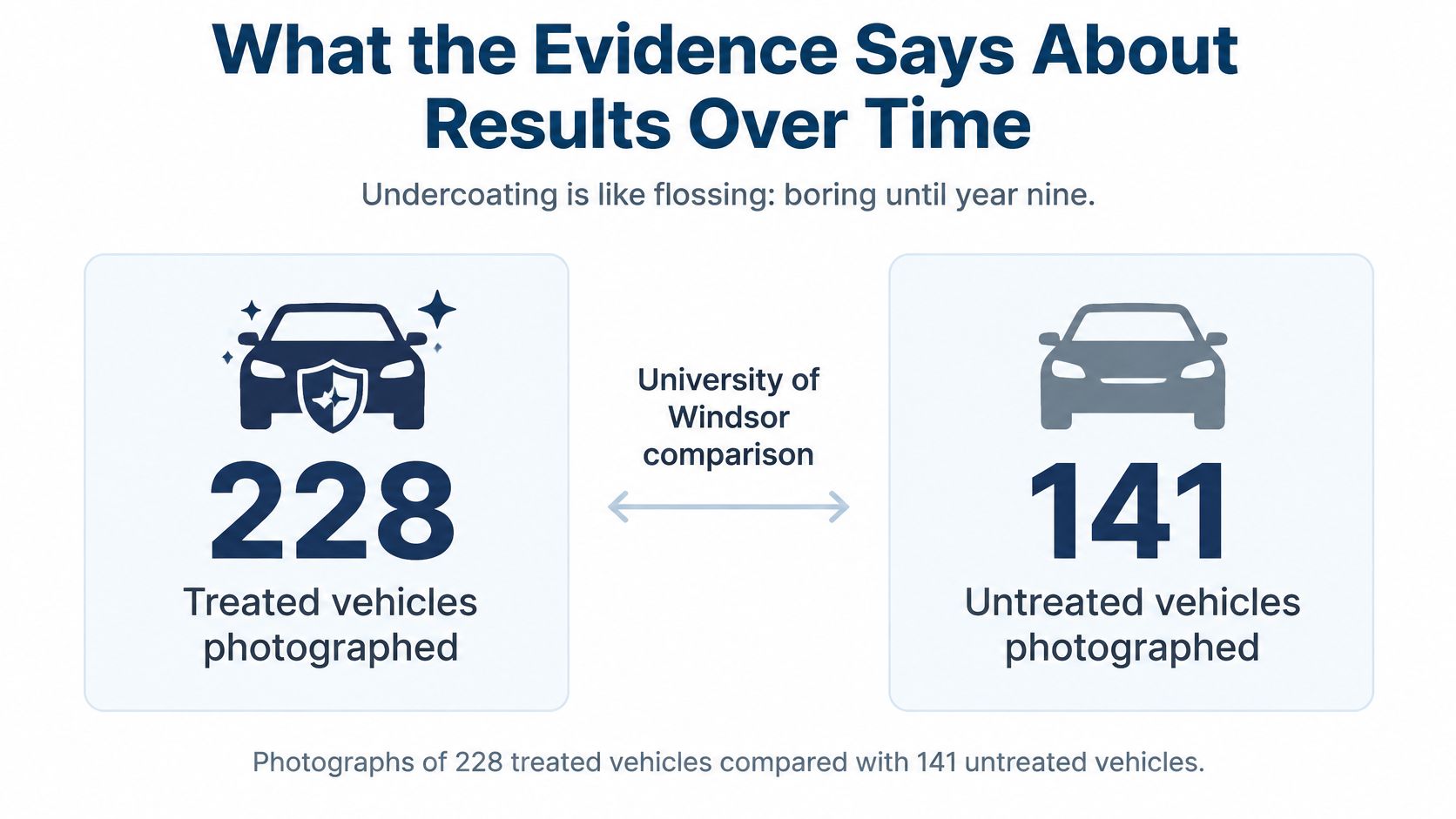
That difference is easier to understand as a long game than a quick transformation. The comparison concerns visible corrosion in vehicle photographs, not a controlled test proving that one product or application method prevents all rust. A coating is a barrier, and its value depends on the surface beneath it, where it is applied, and whether water can drain rather than sit trapped.
- Read the outcome correctly: The comparison looks at visible corrosion, not how a newly applied coating appears.
- Keep the treatment category broad: The findings do not establish that every undercoat performs equally.
- Avoid lifespan arithmetic: Less visible corrosion does not translate directly into extra years of vehicle life.
What the findings don't promise
The research does not show that a particular product, application method, or renewal schedule guarantees a specific lifespan. Nor does it establish that every treated vehicle began in the same condition or faced the same exposure.
That distinction matters when a broad comparison becomes a sales promise. “Rust-control treatment was associated with less visible corrosion” is not the same as “this application will keep your car rust-free indefinitely.” A thick coat cannot make up for poor preparation, blocked drainage, or metal that needed repair first.
For owners, the practical lesson is to think in terms of condition over time. Have the underside assessed before deterioration advances, keep a record of its condition, and maintain suitable protection where needed. The payoff may arrive late, in metal that has held up better after years of exposure, rather than in an impressive-looking underside today.
Costs, Schedule and Booking Plan
Salt exposure changes the booking plan, but a coating still needs clean, sound metal to cling to. Think of undercoating like a raincoat: it can shield the surface, but it cannot mend a tear or clear a blocked drain. Book an inspection and preparation before choosing the application.
The Lake Simcoe salt-pollution policy brief reports about 120,000 tonnes of road salt used in the Lake Simcoe watershed and an annual lake chloride increase of roughly 0.7 milligrams per litre. It also describes contamination persisting into summer. Those local figures do not establish how much salt Ontario uses overall, so they are not a basis for a provincial total.
Build a condition-based routine
Use this table as a planning guide, not a fixed service interval. Road exposure, inspection results and product instructions should guide washing and renewal.
| Driver profile | Underbody rinse | Inspection | Recoat trigger |
|---|---|---|---|
| Weekend driver, mostly dry roads | After salt exposure and spring melt | During seasonal maintenance | Worn-through exposed areas |
| Daily GTA winter commuter | Regularly during salt season and after slushy trips | Around seasonal changes | Worn or washed-off areas |
| Rideshare or delivery driver | Frequently during sustained winter use | Alongside regular servicing | Exposed metal or new corrosion |
| Fleet van or job-site pickup | After wet, salty or debris-heavy work | During scheduled fleet checks | Impact or abrasion damage |
| Older used car with existing rust | Before assessing treatment suitability | Before purchase and before treatment | Only after necessary preparation or repair |
Rinse after slushy drives, major freeze-thaw events and spring melt. Ask the wash facility how it handles wastewater. Salt residue belongs off the vehicle, but contaminated wash water needs proper handling too.
Compare the job, not just the price
Nanak Car Wash lists rust-proofing services, but the page does not provide a dated price tied to a specific vehicle size. Treat any listed amount as a starting point, then confirm current pricing, vehicle-size details and service inclusions with the provider before booking.
Compare the work, not only the quote. A DIY product still leaves you responsible for access, cleaning, drying, masking, application and later inspection. A thick coat cannot compensate for poor preparation or cover up corrosion that needs repair.
Before agreeing to treatment, ask:
- Preparation included: Does the quote cover cleaning, drying and removal of loose material?
- Product identified: What compound will be applied, and to which surfaces?
- Damage handled: Who decides whether corrosion needs repair first?
- Maintenance explained: What wear should prompt inspection or renewal?
- Results documented: Can you see the condition before and after treatment?
Book an assessment before coating questionable metal. Depending on its condition, the sensible choice may be repair, targeted protection or continued inspection. Ask Nanak Car Wash about its rust-proofing and underbody-wash options, along with preparation and wastewater handling. The coating's payoff is slow, and it is a barrier, not a repair.


 6600 Finch Ave W, Etobicoke, ON M9V 3Z6

 647-703-8515
 MON – SUN 8 AM to 7 PM