
You've washed the car, put the hose away, and stepped back to admire it. Then the low afternoon sun hits the wheels and lower doors, and suddenly your clean paint looks as though someone sneezed paprika over it.
That's usually when iron fallout remover enters the shopping basket. But orange is a colour, not a diagnosis. Before you spray anything, work out whether you're dealing with removable contamination, tree deposits, or rust that needs more than a dramatic purple rinse.
Table of Contents
- Is Your Orange Speck Really Iron?
- Why Toronto Cars Collect More Iron and Salt
- How the Purple Reaction Removes Embedded Iron
- Safety and Runoff Rules for Driveways and Shops
- How to Use Iron Fallout Remover Step by Step
- Building Iron Removal into Your Winter Care Routine
- Decide Between Fallout Removal and Professional Rust Repair
Is Your Orange Speck Really Iron?
Say your white hatchback has orange dots behind the front wheels. Your neighbour's SUV has a brown patch beside a stone chip. Both look rusty, but treating them identically would be like prescribing windscreen washer fluid for every dashboard warning light.
Don't assume every orange mark is iron fallout. Canadian Würth iron fallout remover directions identify rust particles and iron deposits as treatment targets, particularly around lower doors and behind wheels. That's a specific cleaning job, not permission to chemically interrogate every brown thing on the car.
Use the mark's location, texture, and surrounding paint to choose your next move.
| Symptom | Likely cause | Iron remover? | Next step |
|---|---|---|---|
| Gritty orange specks on paint or wheels that turn purple | Embedded iron from brake dust or rail dust | Yes, decontaminate | Wash, treat, clay if needed, then seal |
| White crusty film on lower doors and rockers | Road salt residue | No, wash and rinse underbody | Foam wash, underbody rinse, dry |
| Bubbling or blistered paint | Corrosion beneath the paint system | No, needs inspection | Book a rust assessment |
| Rust at chips, stone strikes or panel edges | Corrosion from exposed metal | No, address the damaged paint | Assess corrosion, repair and touch up, then consider rust-proofing |
| Brown stains after parking under trees | Sap or tannin deposits | Not usually | Use a suitable sap or organic-stain cleaner, then protect |
| Rust spreading under trim or inside panels | Corrosion extending beneath visible surfaces | No, professional job | Inspection and repair assessment before rust-proofing |
Make the test small and useful
First wash away loose grime. On a cool, inconspicuous lower panel, check that the product permits wet-surface application, wet the area, and apply a small amount using the safety precautions below.
Watch during the manufacturer's permitted dwell time, then rinse thoroughly. Purple reaction followed by disappearing specks supports a diagnosis of removable ferrous contamination. Photograph the clean, dry test area rather than judging it through coloured liquid.
No colour change isn't absolute proof that iron is absent. Product condition, dilution, temperature, or insufficient contact can affect the result, but it's a reason to reassess rather than keep spraying.
Practical rule: A purple reaction identifies accessible iron. It doesn't certify that the paint underneath is healthy.
A rusty chip can react too, because exposed corrosion contains iron compounds. The useful result is a mark that rinses away from intact paint, not merely a satisfying colour change. If the product can't solve the symptom, it shouldn't be the next step.
Why Toronto Cars Collect More Iron and Salt
Iron fallout is like party glitter with worse manners. It settles where you don't want it, hangs around after ordinary cleaning, and becomes much less charming once moisture enters the picture.
Toronto drivers also operate in a substantial salt environment. In winter 2021–2022, 138 Ontario organizations reported using 2,985,873 tonnes of road salt across 158,156 kilometres of salted roads, according to Environment and Climate Change Canada's road-salt reporting document.
Those figures describe regional winter maintenance, not how much salt lands on your particular bonnet or how often you need iron remover. They do explain why a GTA car deserves more attention than an occasional cosmetic wash.
Separate the iron problem from the salt problem
Braking creates metallic contamination, while winter maintenance adds salt and abrasive road material. They arrive together on a dirty vehicle, but they aren't interchangeable substances and don't require identical cleaning.
Historical Transportation Research Board corrosion testing reported that de-icing salt in the Toronto area approximately doubled the corrosion that would have occurred without salt exposure. That finding concerns corrosion under the study's conditions, not a prediction that every modern Toronto vehicle will corrode at precisely that rate.
On your car, inspect the places where wet road dirt lingers:
- Lower doors and rockers: Tyre spray repeatedly coats these areas.
- Wheel arches and rear quarters: Grime collects around edges, liners, and recesses.
- Horizontal panels: Settled particles can remain after loose dirt washes away.
A delivery vehicle crawling through traffic has a different exposure pattern from a weekend car that stays parked during storms. Distance matters, but so do braking, dirty-road conditions, and how long contamination remains wet.
Before choosing a maintenance plan, note your winter driving, photograph the panels that become dirty fastest, and compare them after washing. Heavy-looking road film doesn't necessarily mean heavy iron contamination. Let the clean surface and a controlled test tell you which problem you have.
How the Purple Reaction Removes Embedded Iron
Car shampoo is good at lifting ordinary dirt. Embedded metallic particles are a different assignment: you need chemistry that interacts with iron, not just more foam and optimism.
Many iron removers use thioglycolate-based chemistry. Think of the active ingredient as a small chemical claw: it binds iron into a complex that can be carried away during rinsing. The characteristic purple colour comes from that iron–thioglycolate interaction.
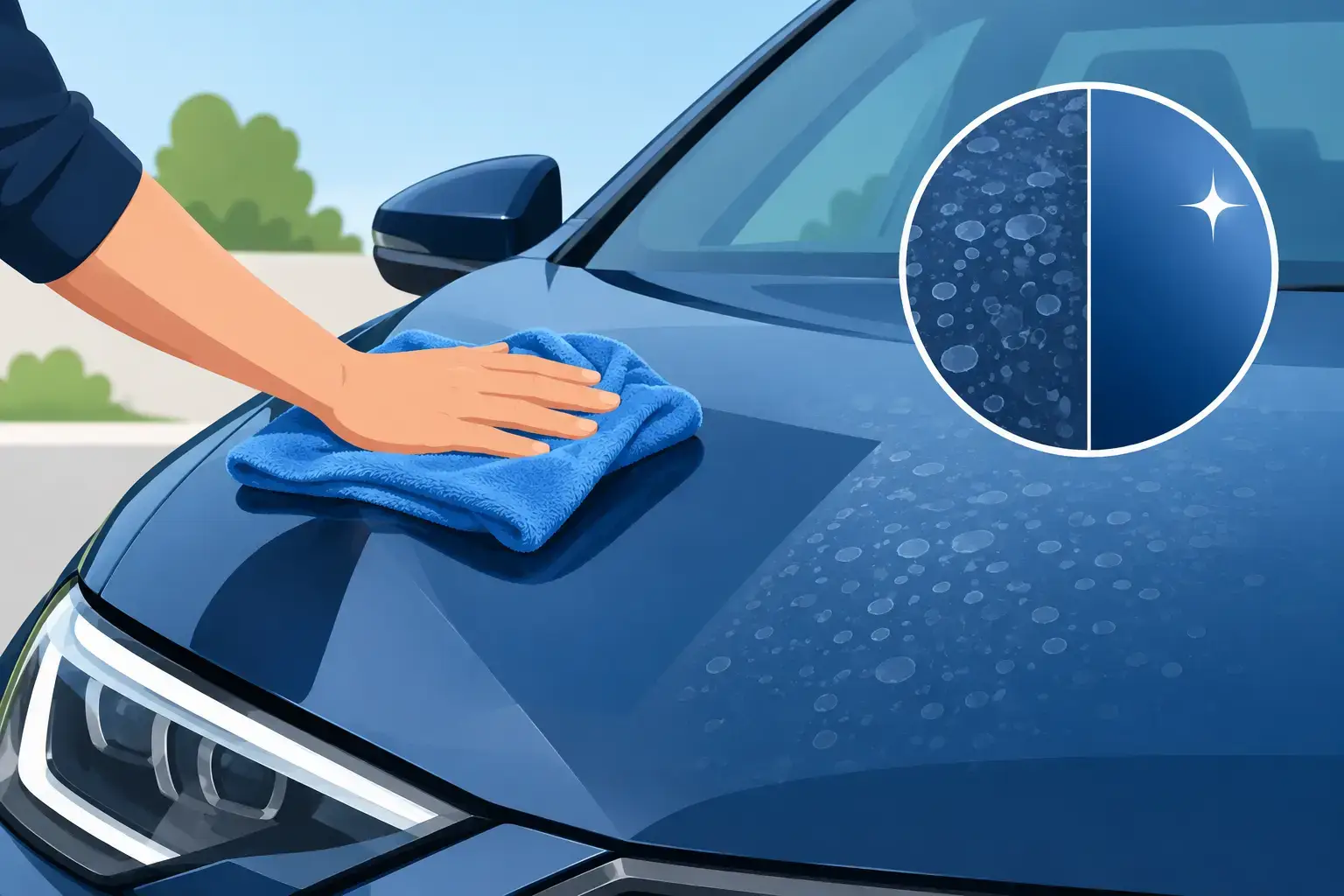
The difference between ordinary washing and targeted decontamination is illustrated below.
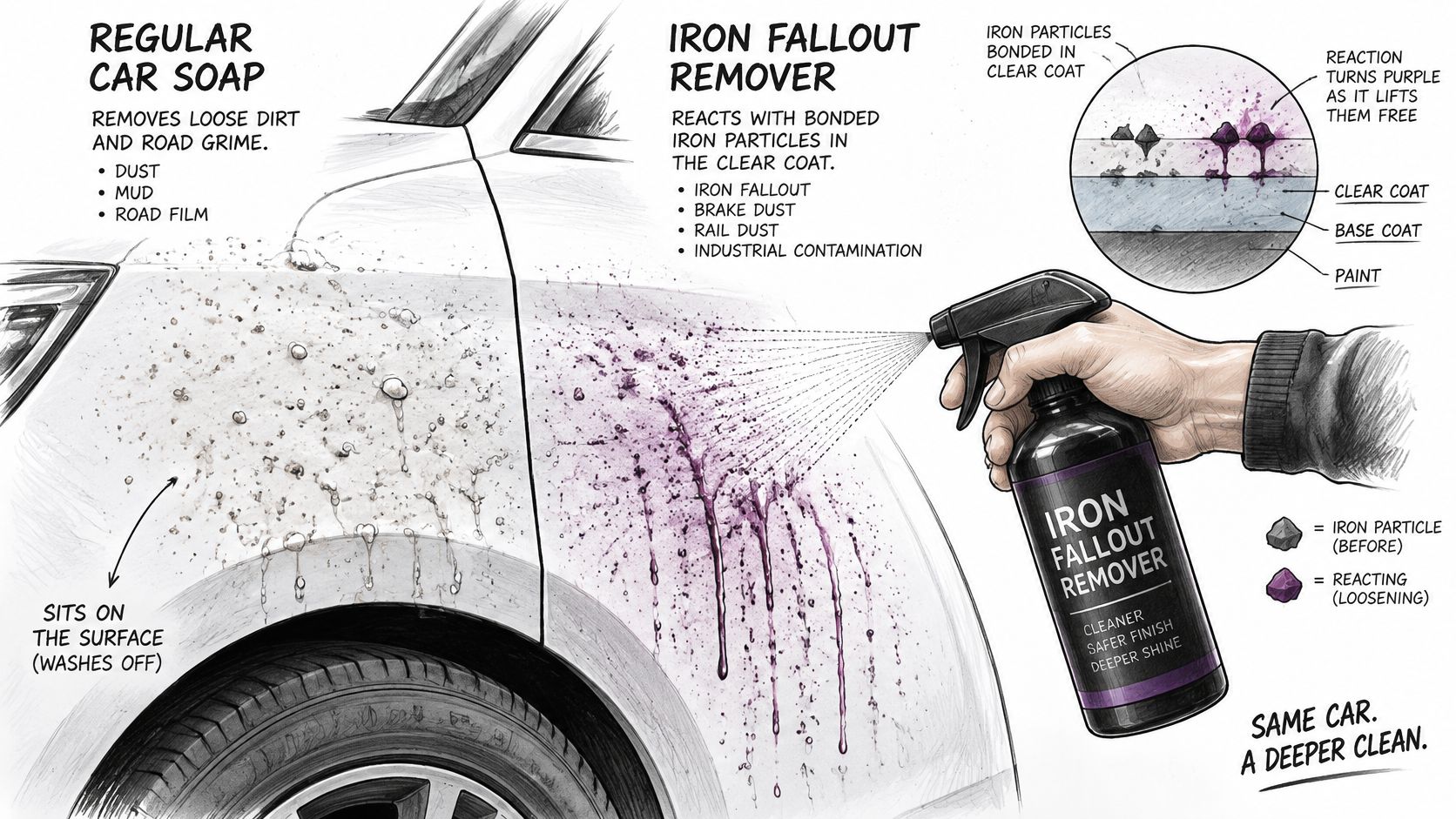
What purple does and doesn't tell you
University of Toronto researchers studying non-tailpipe pollution identify brake components as sources of heavy metals including iron, barium, and copper. On a car, accessible iron-containing deposits provide the target for a dedicated fallout treatment.
The product behaves a little like a bloodhound that marks the trail purple. It helps reveal where iron is reacting, but the intensity isn't a calibrated contamination meter.
Nor does fading colour prove that every particle has gone. Dwell time, surface condition, and a thorough rinse matter more than chasing the darkest possible purple. Never extend application until the panel dries just to get a more theatrical result.
Chemical cleaning comes before correction
Removing accessible ferrous contamination before claying or machine polishing reduces the hard material available to drag across the clear coat. Clay can then address remaining bonded contamination, while polishing addresses suitable paint defects.
That sequence doesn't rebuild metal already lost to corrosion. A cleaner surface and a repaired panel are different outcomes.
The same matching principle applies outside automotive paint: Ventura County Roof Cleaners' guide to fresh oil spill cleanup on driveways addresses an oil-and-concrete problem, not an iron-and-clear-coat problem. Don't transfer products between those jobs just because both involve an unwelcome stain.
After a successful fallout treatment, expect fewer visible specks and a cleaner-feeling surface. Remaining roughness calls for identification, not an automatic second chemical bath.
Safety and Runoff Rules for Driveways and Shops
A pH-neutral label isn't a permission slip to spray bare-handed in a closed garage. Surface temperature, mist, eye exposure, ventilation, and wastewater still need attention.
The Canadian Würth safety data sheet for iron remover calls for appropriate protective equipment and exposure controls, and advises against disposal into sewers, directing waste to an approved facility. Read the safety sheet for the actual bottle you buy, because formulations aren't interchangeable.
Set up the work area before opening the trigger. Keep children and pets away, have clean rinse water ready, and know how you'll capture the contaminated liquid.
Match your setup to the job
The following are practical operating controls, not a statement that every Ontario property has identical disposal requirements.
| Setting | Protection | Runoff handling | Surface caution |
|---|---|---|---|
| Home driveway, occasional use | Chemical-resistant gloves, eye protection, outdoor ventilation | Collect rinse water; don't pour it into sewers; arrange approved disposal | Test matte finishes, plastic trim, and mixed-metal wheels |
| Professional bay, daily use | Gloves, eye and face protection, ventilation or suitable extraction | Capture runoff and use an approved disposal route, not uncontrolled drain discharge | Prevent drying; shield sensitive trim and glass where required; test unfamiliar finishes |
| Fleet or high-volume shop | Documented PPE procedures and staff training | Arrange an approved waste service and retain disposal records | Standardize test areas, control temperature, and verify rinsing before subsequent work |
If you can't contain wastewater on your driveway, choose a suitably equipped professional setting. A hose running towards the kerb isn't a collection system, even if you stand beside it looking concerned.
For a broader illustration of why location matters, the Water Works Power Washing legality guide discusses driveway-washing concerns in its own jurisdiction. It isn't Ontario legal advice; confirm your municipality's requirements and your disposal facility's acceptance conditions.
Check the finish before full application
Anodized aluminium, matte paint, repaired panels, exposed metal, and mixed-material wheels deserve particular caution. Test an inconspicuous area, rinse, dry, and inspect for discolouration or changes in sheen before expanding coverage.
Don't assume a product safe for clear-coated wheels is safe for every wheel finish. If compatibility isn't established, stop. A driveway job requires the same exposure and disposal discipline as a shop job, just with a smaller collection setup.
How to Use Iron Fallout Remover Step by Step
Bring the car shampoo, clean wash mitt, dedicated wheel brush, microfibre drying towels, gloves, eye protection, and runoff-capture equipment together before starting. Keep wheel tools separate from paint tools; brake grime doesn't need a guided tour of your bonnet.
These opening preparations establish the conditions for controlled application.
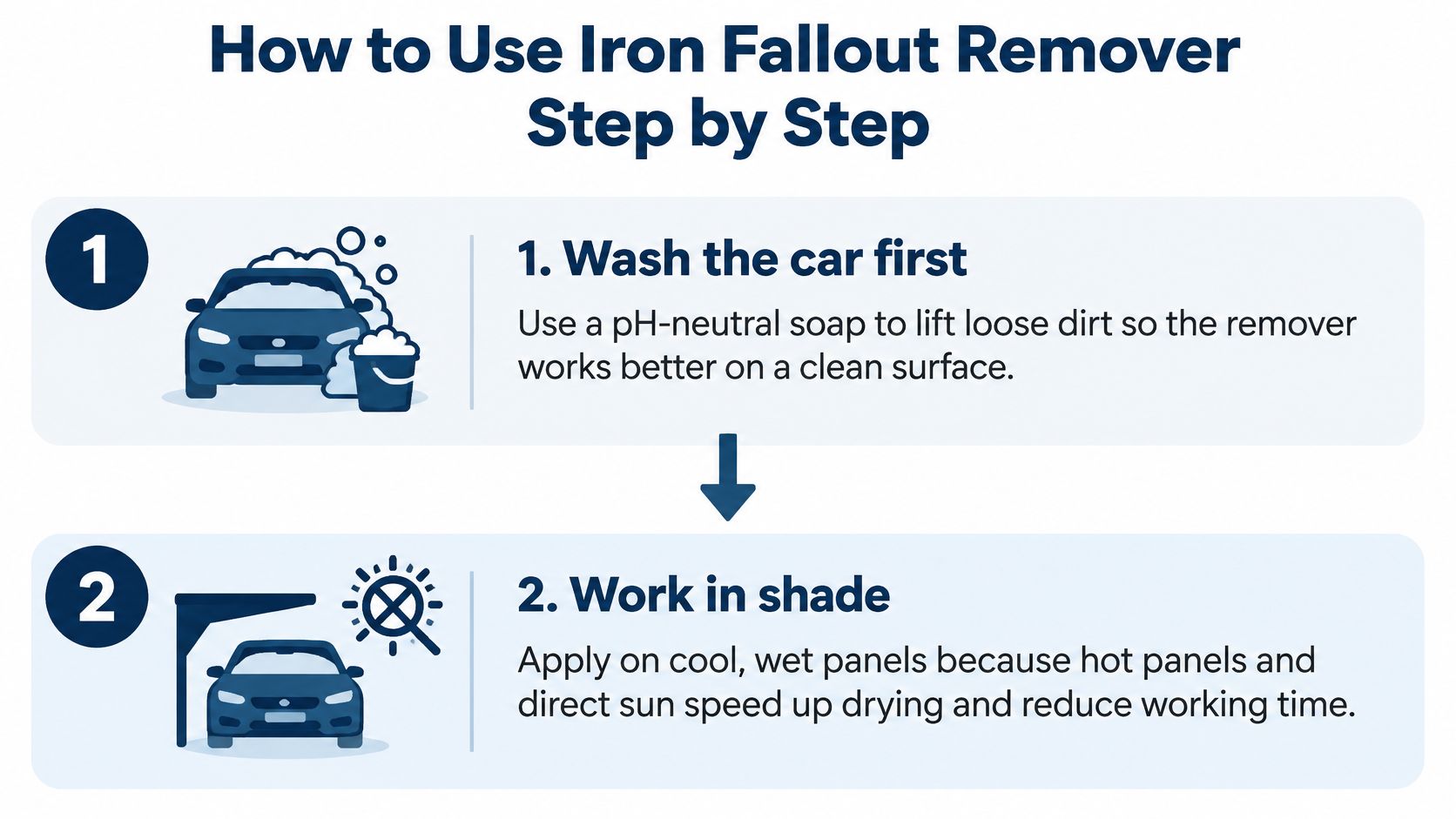
Prepare, apply, and rinse
Wash the car first. Use a pH-neutral automotive shampoo to remove loose dirt, then rinse away the soap so the remover can contact the deposits. Spraying straight onto winter road film wastes product and makes the result harder to judge.
Work in shade on cool panels. For a product that permits wet application, leave the surface wet but not streaming with water; if its directions require dry paint, dry it first. The common mistake is treating a sun-heated bonnet while assuming the outdoor air temperature tells you the panel temperature.
Start with wheels and lower panels. Treat manageable areas rather than coating the whole vehicle at once, keeping application away from surfaces the manufacturer excludes. Starting everywhere simultaneously creates a race between your rinse hose and drying chemical, and the chemical has no appointments afterwards.
Complete the hidden-spot test. Use the diagnostic test described earlier and inspect the rinsed, dried finish before committing to a larger area. Skipping this check turns an unfamiliar coating or repaired panel into an unnecessarily expensive experiment.
Apply evenly and control dwell time. Use enough product for coverage, start a timer for the bottle's stated application window, and watch the surface throughout. Rinse immediately if drying begins; don't extend contact because the colour looks exciting or the weather feels cold.
Agitate only where necessary. A soft wheel brush can help in wheel recesses, while compatible paint treatment calls for a clean, gentle applicator and minimal pressure. Aggressive scrubbing defeats the point of chemically loosening contamination before mechanical work.
Rinse thoroughly from the top down. Flush panel gaps, wheel recesses, and lower edges until coloured residue is gone, directing the liquid into your capture setup. A quick splash can leave product trapped where it dribbles out later.
Dry, inspect, and protect. Use clean microfibre towels, then clay only remaining suitable bonded contamination with ample lubricant; polish only if the finish needs correction. Finish with compatible wax or sealant rather than automatically adding abrasion to already clean paint.
Budget for the whole process
As a historical retail benchmark, TOC Supplies Canada listed CarPro Iron X Cherry at CAD 24.95 for 500 mL in 2025. That's a bottle price, not a complete DIY treatment cost or a current quotation.
Include your protective equipment, washing supplies, wastewater handling, and time when comparing home use with professional work. A successful job leaves no coloured streaks, fewer visible deposits, and a suitably smooth finish, not just an empty bottle.
Building Iron Removal into Your Winter Care Routine
A commuter gets home after wet highway driving and parks a salt-coated car until the weekend. A delivery driver washes frequently but never checks behind the rear wheels. Neither needs an automatic chemical subscription; each needs a routine that matches what remains after washing.
Start with underbody rinsing and a thorough exterior wash. Where inspection confirms iron contamination, decontaminate, rinse, and assess whether claying or polishing is needed before applying protection.
An NSERC-supported corrosion summary connects road-salt exposure with vehicle corrosion. The useful maintenance distinction is that surface decontamination and protection against ongoing salt-and-moisture exposure perform different jobs.
Use condition-based starting points
Fixed chemical-treatment intervals can encourage unnecessary use. These starting rules make the driving pattern useful without pretending every commuter accumulates identical contamination.
| Driver type | Wash frequency | Iron decontamination | Protection |
|---|---|---|---|
| Weekend driver | After salt exposure or visible buildup | Inspect after washing; treat confirmed deposits | Wax or sealant after treatment when compatible |
| Daily highway commuter | Regular winter washes, sooner after heavy salt exposure | Check wheels and lower panels during maintenance washes | Maintain sealant according to its condition and directions |
| Ride-hailing or delivery driver | Frequent washing matched to repeated road exposure | Target confirmed deposits on wheels and lower panels | Inspect protective coverage during cleaning |
| Small fleet or contractor van | Scheduled underbody rinsing and exterior washing | Record test results and treat affected vehicles | Include corrosion and rust-proofing inspections in maintenance |
Treat contamination when it's present, not because a calendar reminder has become emotionally invested.
Let the next inspection change the plan
Suppose the wheels react strongly but the doors remain clean after washing. Treat the wheels with a compatible product rather than spraying every painted panel for symmetry.
If a newly treated panel still reacts during a later test, don't conclude that the maintenance interval was too short. You may have residual deposits, newly accumulated iron, or a treatment that didn't fully contact the contamination.
Likewise, roughness without a useful reaction may call for a different cleaner or carefully lubricated clay. Claying isn't an automatic cure for persistent purple, and repeated chemical applications aren't a substitute for diagnosing the remaining mark.
Keep simple notes or daylight photographs for fleet vehicles and heavily used cars. Adjust washing and inspection to actual conditions, and keep the protection step in the routine rather than treating decontamination as the finish line.
Decide Between Fallout Removal and Professional Rust Repair
Choose DIY when you can control the conditions, confirm surface compatibility, contain the rinse water, and leave intact paint cleaner after the test. The sensible path is targeted decontamination, inspection, optional correction, and protection.
Choose professional help when the job requires something you can't safely provide. That might be wastewater capture, assessment of an unfamiliar finish, or access behind trim, not necessarily a more powerful bottle.
Book the right kind of professional
A detailer can clean contamination and assess the visible finish. A body-repair specialist handles damaged paint systems, metal loss, and repairs that require removing corrosion or refinishing a panel.
Rust-proofing protects against future exposure; it doesn't restore missing metal or repair failed paint. Where corrosion is already established, get the condition assessed before arranging a protective application.
At Nanak Car Wash, our rust-proofing team consists of certified professionals who use a unique chemical compound to protect vehicles. Small-car applications start at $119.95, while full-sized pick-up trucks and SUVs start at $149.95, plus tax; confirm the applicable vehicle category and current quote before booking.
An appointment should match the work needed. Don't treat a general detailing time estimate as a promise for corrosion assessment, body repair, or a particular vehicle's rust-proofing service.
Make the inspection easier
Before booking, prepare something more useful than “there's orange stuff somewhere.”
- Run a controlled test: Only on an appropriate, intact surface, with safe handling and rinse capture.
- Photograph in daylight: Take a close-up and a wider view showing the panel, chip, seam, or trim.
- Describe what changed: Explain whether washing removed the film, treatment removed the specks, or the same mark returned.
That gives the person assessing your car a clearer starting point. Your goal isn't to win an argument with a stubborn speck; it's to choose the work that leaves the vehicle better protected.
Nanak Car Wash offers washing, detailing, and rust-proofing to help GTA drivers manage winter grime and protect their vehicles. Photograph the marks in daylight, note what your safe test revealed, and visit Nanak Car Wash to arrange the appropriate service or discuss an inspection before spraying again.

 6600 Finch Ave W, Etobicoke, ON M9V 3Z6

 647-703-8515
 MON – SUN 8 AM to 7 PM