
Suds Car Wash in Cambridge is at 515 Hespeler Road, Cambridge, Ontario N1R 6J2, the phone number is (519) 740-8336, and the tunnel runs 8:00 a.m. to 7:00 p.m. Monday through Friday. It is not the Suds Car Wash, Inc. of El Dorado Hills, California, a separate business that shares the name and keeps turning up in the same search results.
Now the part that decides your evening. It's 6:40 on a Tuesday in February, Hespeler Road is a grey soup of sand and brine, and the car in your driveway has grown a chalky white skirt along the rocker panels. You don't want a brand story. You want a bay that's still open and a wash that reaches the underside instead of just polishing the hood.
So take this in the order you'd make the calls: hours first, then what the three wash names mean, then why salt hides where you can't see it, then which extra ticket is worth buying this week. The order matters, because a wash that closes before you arrive is a wash that never happened.
Table of Contents
- Suds Cambridge Hours and the Wash Menu
- What Basic Triple Action and PLUS Actually Mean
- Why Winter Salt Hides Under the Car
- Pick a Rinse a Cabin Clean or a Coating
- Where the Dirty Wash Water Actually Goes
- The Other Suds That Is Not in Cambridge
- Choose Tonight's Wash Before the Salt Dries
Suds Cambridge Hours and the Wash Menu
The Cambridge operation sits at 515 Hespeler Road, Cambridge, Ontario N1R 6J2, with (519) 740-8336 as the published telephone number, according to the Suds Car Wash Cambridge location page. That postal code is worth memorising, because it's the fastest way to tell this business apart from an American shop with a similar name.
Hours are where plans break. The published week runs 8:00 a.m. to 7:00 p.m. Monday through Friday, 8:00 a.m. to 5:00 p.m. Saturday, and 9:00 a.m. to 5:00 p.m. Sunday. Note the two quirks: Saturday closes two hours earlier than a weekday, and Sunday opens an hour later than everything else, which catches people who treat weekend mornings as interchangeable.
Practical rule: a 6:45 p.m. weekday arrival is a gamble on the queue. A 6:30 p.m. Saturday arrival isn't a gamble at all, because the tunnel has been closed for ninety minutes.
Three exterior rungs and one interior ticket
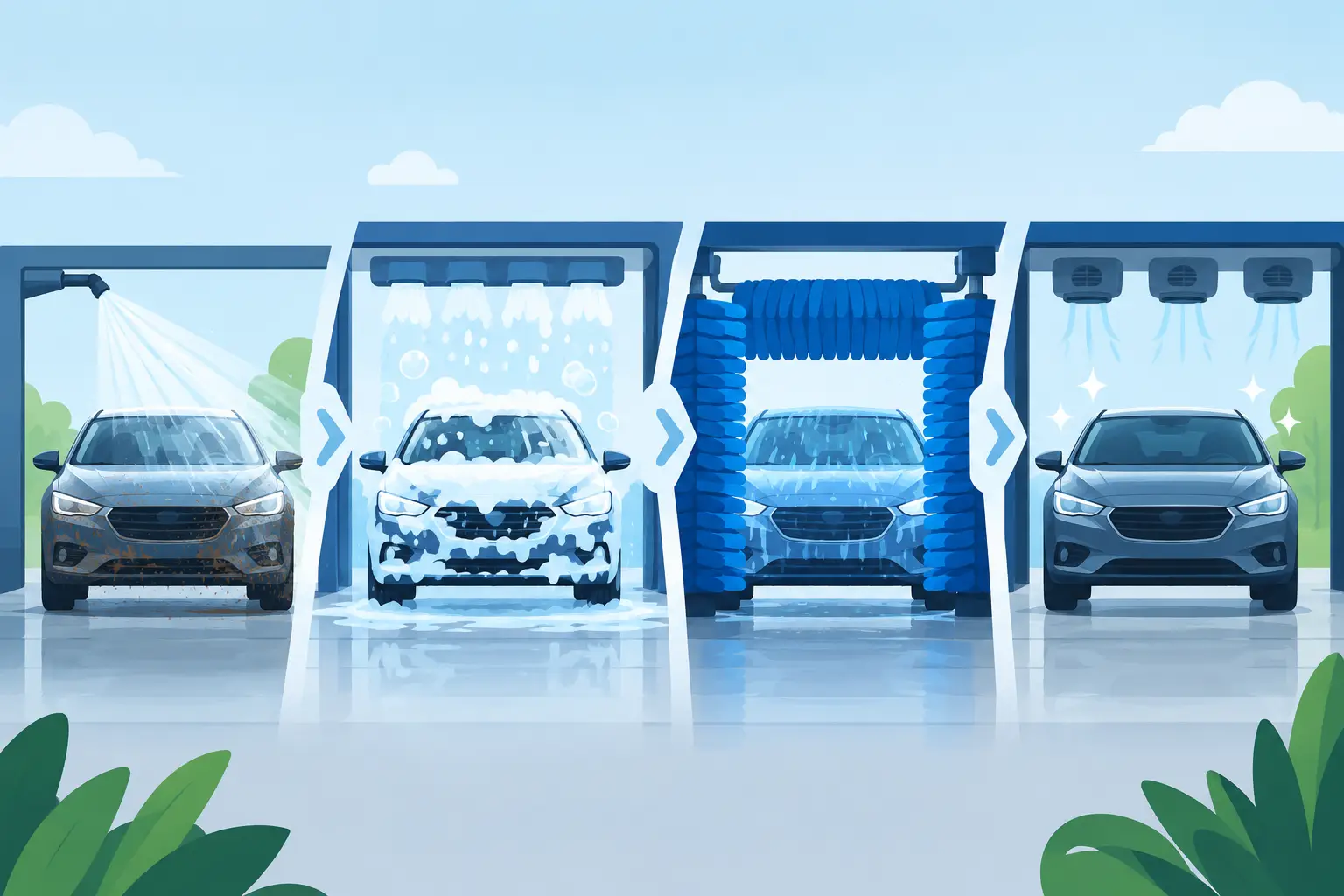
The site names three core exterior choices: Triple Action PLUS, Triple Action, and Basic. Each one is sold either as a single wash or as an unlimited monthly subscription, so you can buy a one-off before a road trip or stop thinking about it until the salt season ends. What the page doesn't do is publish a brush-by-brush breakdown of what each rung includes, which is why the next section sticks to what's confirmed.
Express interior is a separate ticket, not a side effect of the tunnel. The published list is dusting, wiping, vacuuming, window cleaning and rim wipes, which is cabin housekeeping rather than deep restoration. Book it when the mess is crumbs, salt stains on mats and a film on the inside of the glass. Skip it when the paint is the only problem.
| Item | What is published |
|---|---|
| Address | 515 Hespeler Road, Cambridge, Ontario N1R 6J2 |
| Phone | (519) 740-8336 |
| Monday to Friday | 8:00 a.m. to 7:00 p.m. |
| Saturday | 8:00 a.m. to 5:00 p.m. |
| Sunday | 9:00 a.m. to 5:00 p.m. |
| Exterior choices | Triple Action PLUS, Triple Action, Basic |
| How washes are sold | Single wash and unlimited monthly subscription |
| Express interior | Dusting, wiping, vacuuming, window cleaning, rim wipes |
Read that grid as a planning tool, not a receipt. Public pages confirm the names, the hours and the categories; they don't publish every add-on price, so the counter is where the final number comes from.
Here's the one-line match. Weekday commuters have until 7:00 p.m. Weekend drivers should aim to be there before 5:00 p.m. on either day, and Sunday gives you a slightly later start but the same early close.
What Basic Triple Action and PLUS Actually Mean
Picture a stack of dirty plates after a big dinner. One plate needs a rinse, another needs a proper wash, and the third needs washing plus a dry and a polish before it goes back in the cupboard. That's the three names in a nutshell, and it's a better mental model than trying to decode marketing language.
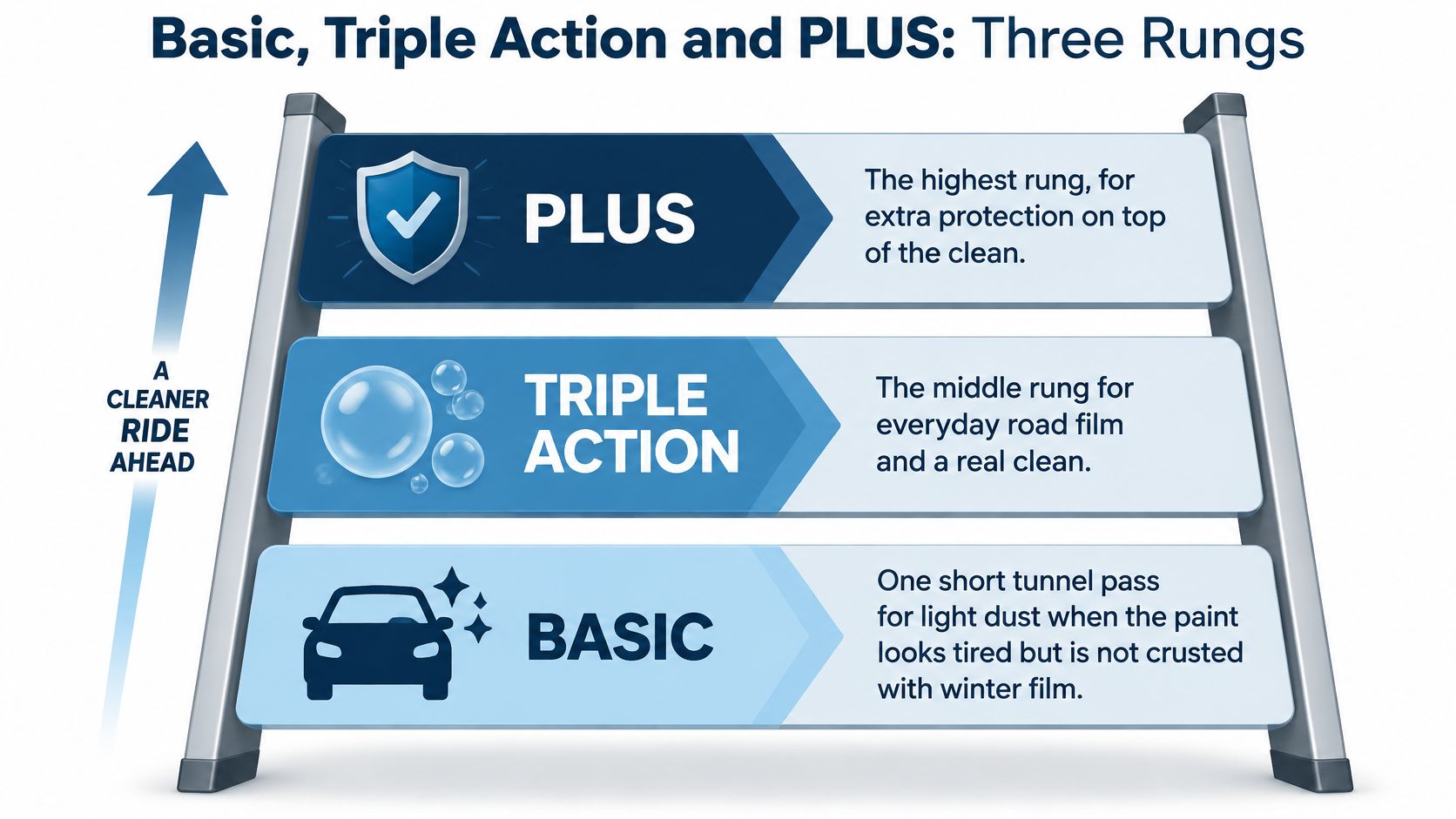
Basic is the short tunnel pass. It suits a car that looks tired but isn't crusted, the Sunday errand vehicle that sat in a garage all week and picked up a little dust on the way to the grocery store. If the paint feels smooth and the only complaint is a dull finish, this rung makes sense.
Triple Action is the middle rung and the one most daily drivers land on. It fits an ordinary week of highway film, brake dust on the wheels and the occasional bug speck on the bumper. Nothing dramatic, just the accumulated grime of a car that lives outside and commutes.
Triple Action PLUS is the fullest named tunnel choice, for the driver who wants every published exterior step in a single visit rather than splitting the job across two trips. Think of it as the plate that gets washed and finished, not just washed.
What the page confirms and what it leaves to the counter
The Cambridge listing confirms the three names and confirms that each can be bought once or as an unlimited month. It doesn't publish a step-by-step ingredient list, so anyone telling you exactly which waxes, sealants or soaps sit inside each tier is guessing. Treat tier descriptions you read elsewhere with a raised eyebrow.
| Choice | Best for | Billing | What the site confirms |
|---|---|---|---|
| Basic | Light dust and a quick clean | Single wash or unlimited month | Named as a core wash; step list not published |
| Triple Action | Ordinary weekly highway film | Single wash or unlimited month | Named as the middle core wash; step list not published |
| Triple Action PLUS | Fullest named tunnel visit | Single wash or unlimited month | Named as the top core wash; step list not published |
The unlimited month changes the arithmetic more than the chemistry. If you wash four times a month, a subscription turns a series of small decisions into one; if you wash once a month, pay per visit and keep the flexibility. There's no prize for buying a plan you won't use.
Match the rung to how fast the film returns, not to how much you like the car. A garage-kept weekend car can stay on Basic for years and look fine.
One habit worth building: decide the rung before you pull in. Drivers who arrive undecided tend to buy the middle option and then add an interior ticket they didn't need, which is how a fifteen-minute stop becomes forty.
Why Winter Salt Hides Under the Car
A shiny hood is a terrible report card. The panels you can see get rinsed by every rainfall and wiped at every wash, while the subframe, the seams and the brake lines sit in a permanent brine bath from November to March. Environment and Climate Change Canada reports that Ontario organisations covered by its road-salt management reporting used 1,679,395 tonnes of salt across 104,187 km of salted roadway, the largest provincial total in the reported dataset, per the federal road-salt code of practice data.
That volume meets a lot of vehicles. Ontario recorded 8.8 million light-duty vehicle registrations in 2024, which was 35.9% of all Canadian light-duty registrations, according to Statistics Canada. Around Cambridge, most of those vehicles are parking in the same spray.
Why the damage keeps going after the road dries
Chloride-bearing salt residue stays electrically conductive once it's dissolved in moisture, and that's what drives galvanic and crevice corrosion at seams, brake components, fasteners, subframes and exposed steel. The residue doesn't need to be wet in a puddle to do this. A humid garage and a damp February are enough.
Boots are the honest comparison. You can wipe the leather to a mirror shine and still track grit into the lining, where it grinds away all week. The car's underside is the lining.
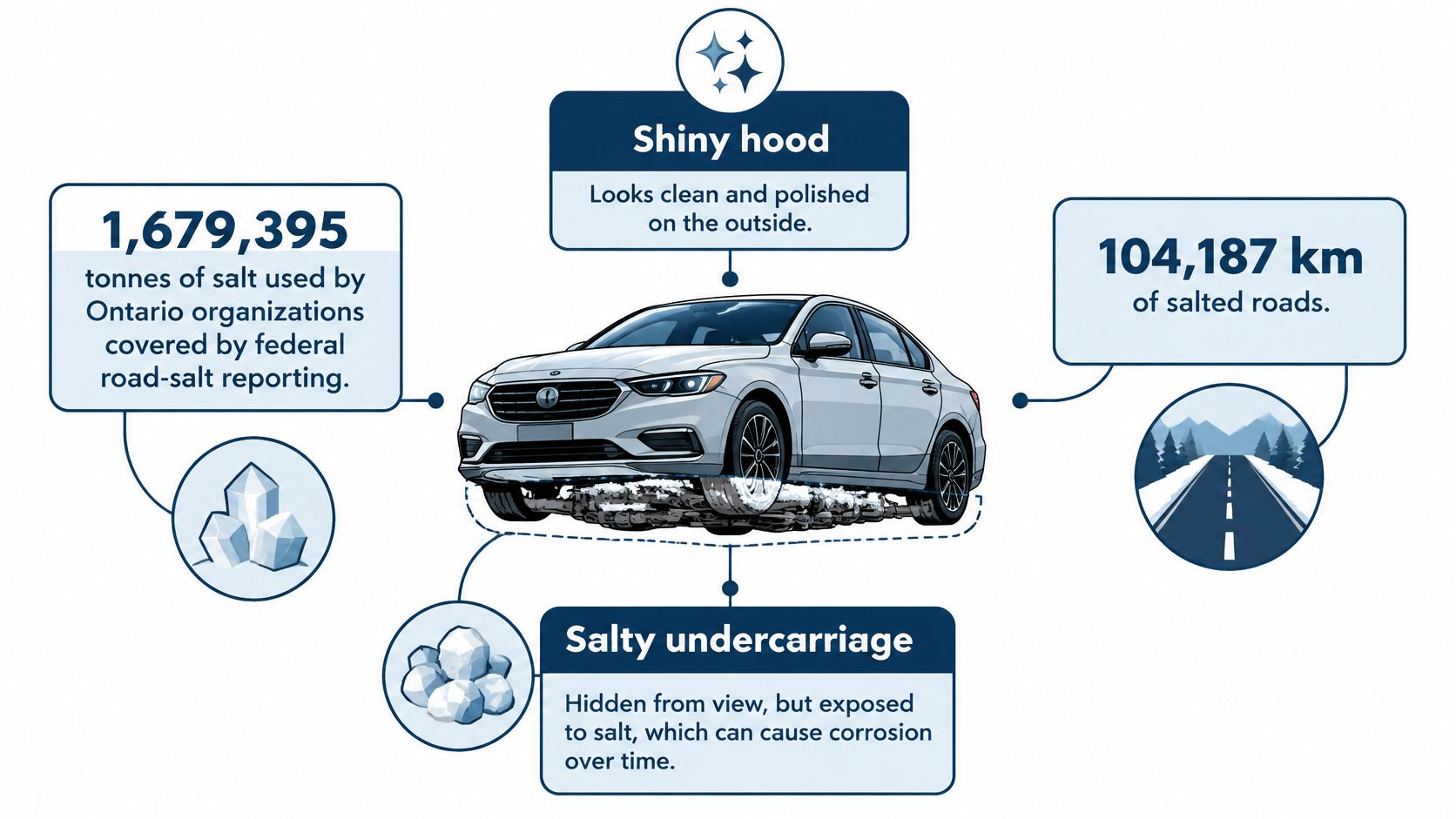
The practical response is unglamorous. Rinse the underbody soon after a heavily salted trip, before the slurry dries into concealed cavities that a later wash won't reach. Daily commuters, delivery vans and fleet trucks need that more often than a fair-weather car that spends most of the winter parked.
Wash the underside while the residue is wet and soft. A crust that has baked on for three weeks is a different job, and a rinse won't undo what it has already started.
Be clear about the limit. An underbody rinse removes loose salt and grime. It doesn't coat bare metal, and it doesn't reverse corrosion that has already begun at a seam or a fastener. A preventative coating can go on afterwards as a barrier, but it works on clean metal, not on a layer of chloride.
Winter freeze-thaw weeks are the ones to watch. Salt dissolves, refreezes, dissolves again, and each cycle pushes moisture deeper into the places a sponge will never reach. That's the argument for frequency over intensity: two modest rinses in a bad week beat one heroic wash in April.
Pick a Rinse a Cabin Clean or a Coating
The scene repeats all winter. You've just driven home from a salted commute, the wheel arches are white, and you're standing in the driveway weighing a wash against a vacuum against a tin of rust coating. Those three things solve three different problems, and buying the wrong one works like mopping the kitchen floor to fix a leaking pipe: the effort is real, the target is not.
Take the scenes one at a time.
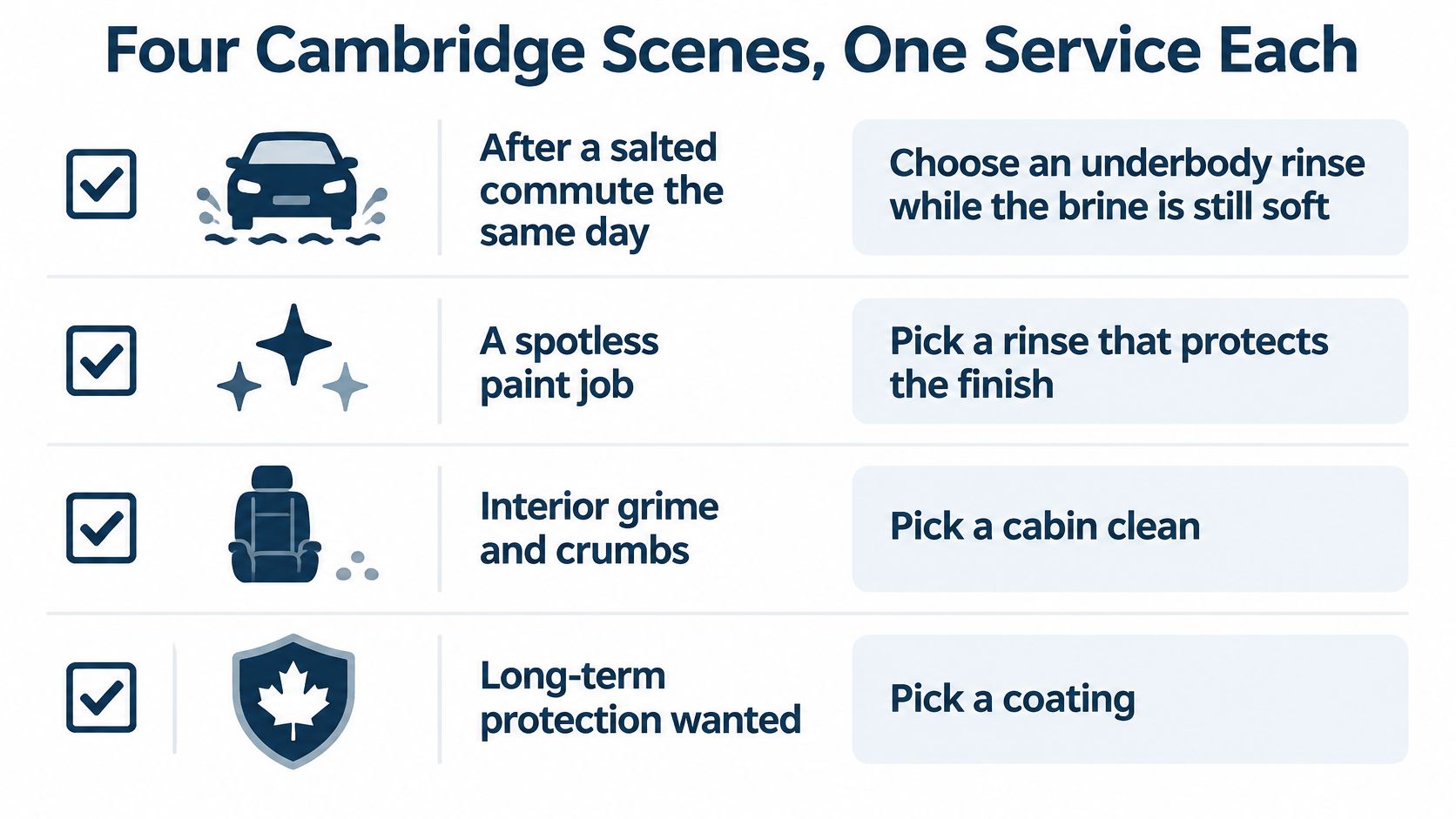
Salted commute, same day. Choose an underbody rinse while the brine is still soft. This sits in the same category as an oil change, routine maintenance rather than a shine upgrade, and a spotless paint job tells you nothing about the metal it hides.
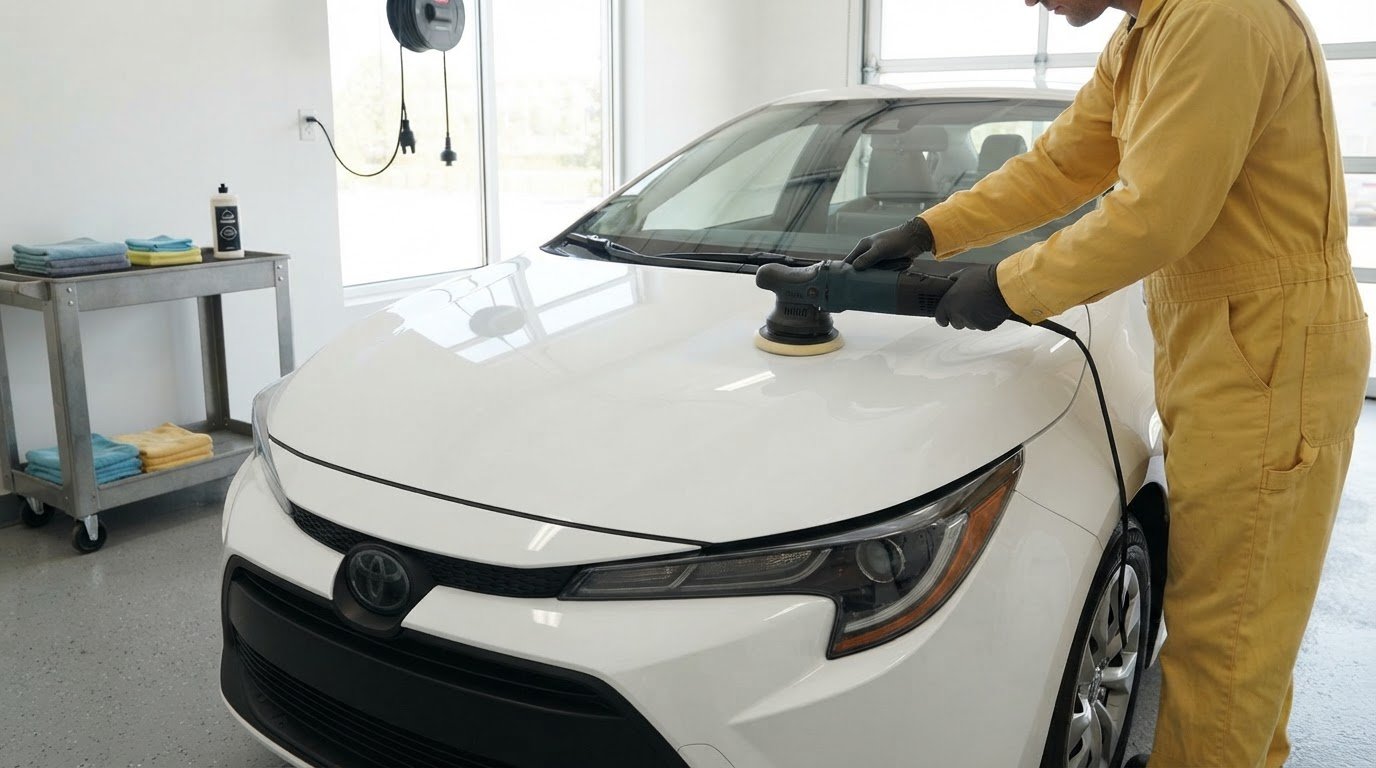
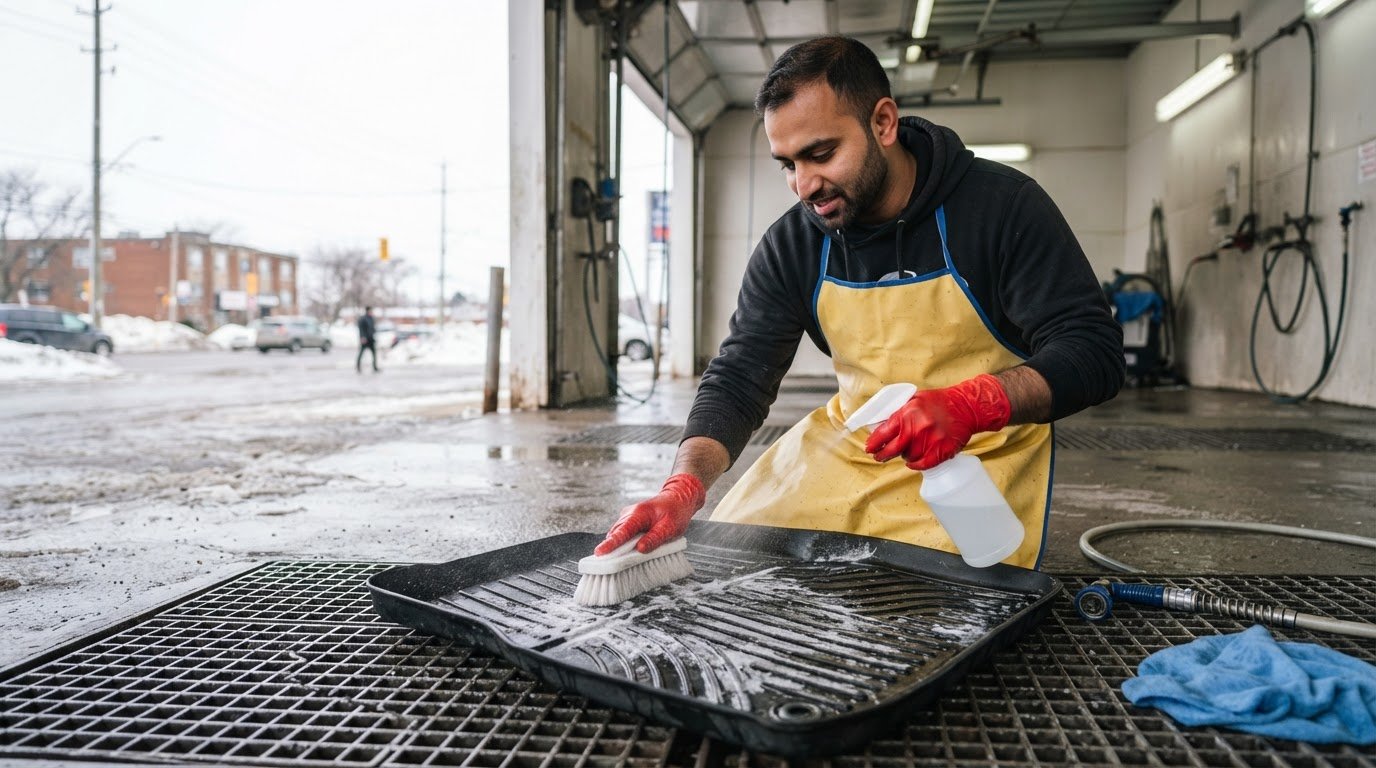
Slush on the floor mats. Choose express interior work: dusting, wiping, vacuuming, window cleaning and rim wipes. That's cabin housekeeping, and it earns its keep when grit is grinding under your heels every time you brake.
Smells and set-in seat dirt. That's detailing territory. Carpet and seat shampooing, vent and crevice work and leather care restore the cabin, and none of it touches a subframe. Nanak Car Wash does detailing by hand, and appointments can be booked online or by calling 416-749-0202.
Salt already washed off, barrier wanted. Rust proofing is a preventative coating laid over clean metal. Bubbling paint or an eaten fastener needs repair first, since a barrier seals in whatever sits beneath it.
| Service | What it does | Book it when | What it cannot do |
|---|---|---|---|
| Underbody rinse | Lifts loose salt and road film from the underside | After salted roads, before residue dries | Cannot coat metal or repair existing rust |
| Express interior | Dusts, wipes, vacuums, cleans windows and rims | Slush and grit are in the cabin | Not stain extraction or a full detail |
| Detailing | Deep-cleans carpets, seats, vents and stains | Odours or set-in dirt remain after a vacuum | Not a corrosion barrier |
| Rust protection | Adds a preventative coating | After salt has been physically removed | Not a fix for rust already underway |
The limits, in one breath
No wash or coating guarantees that corrosion will never start, especially where paint, seams, fasteners or underbody components are already damaged. Anyone promising otherwise is selling certainty nobody can deliver.
A rhythm that works looks roughly like this. Underbody rinse after the heaviest salt days, interior service when the cabin is the complaint, and a coating inspection or renewal only once the loose salt is gone. Then pick one row for this week's car rather than buying the whole menu. Most drivers need a single service, not four, and the right one depends on which of the three problems is sitting in your driveway tonight.
Where the Dirty Wash Water Actually Goes
Two ideas get glued together and shouldn't be. The water going onto your car can be perfectly fresh, and the water coming off it can still be filthy. Those are separate questions, and only the second one decides what reaches the Grand River.
Ontario municipalities warn that driveway wash water carries dirt, oil, grease, rust, road salt, antifreeze, detergents and metals into roadside catch basins, and that stormwater is generally discharged untreated into local waterways, as the City of Vaughan's car washing guidance explains. Commercial car washes are connected to sanitary sewers, where wastewater receives treatment. That drain connection is the practical difference, not the scent of the soap.
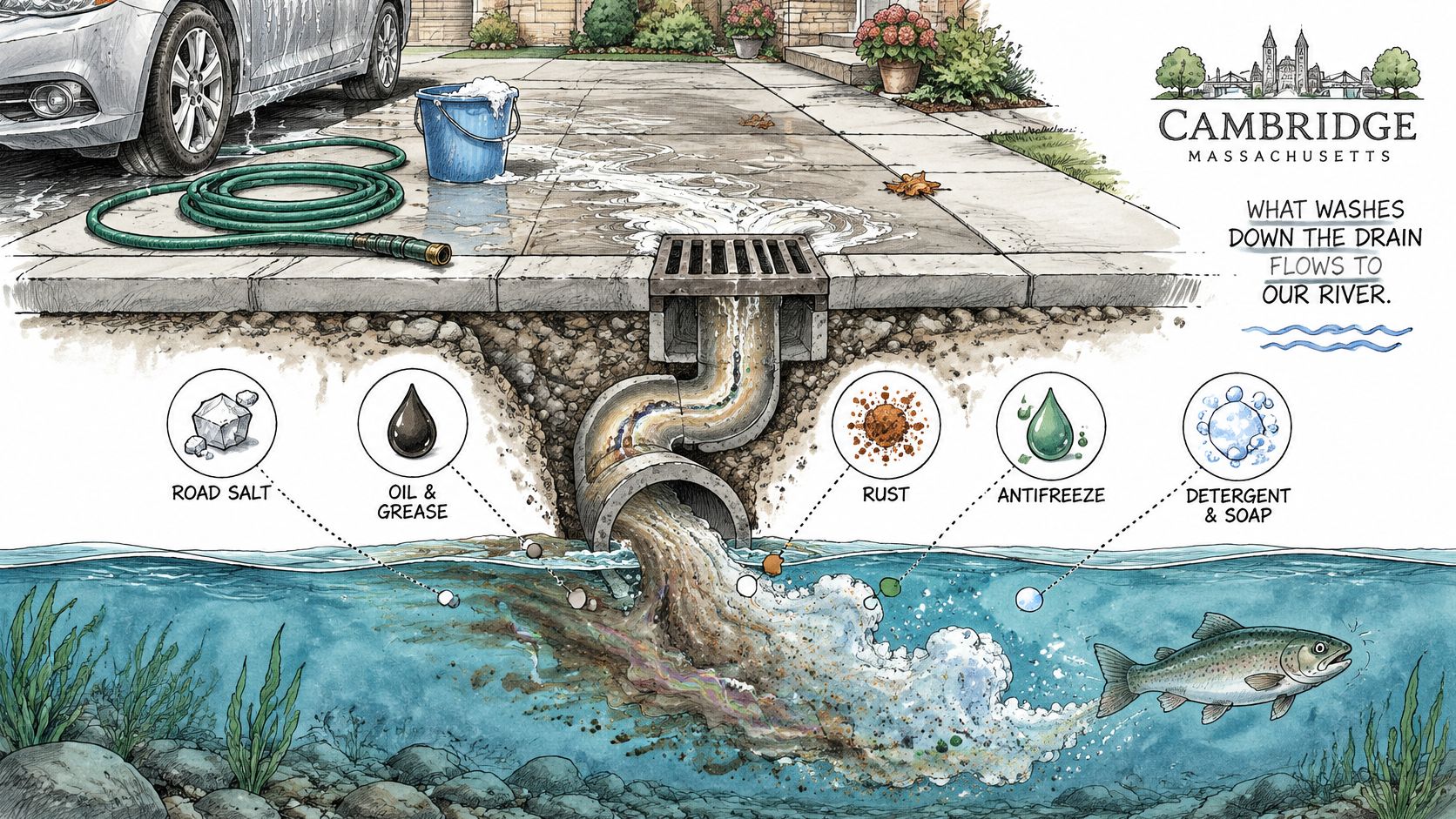
Scale makes the point sharper. Canada's federal assessment states that nearly 5 million tonnes of road salt are used annually nationwide, that chloride ultimately reaches the environment through runoff, soil or groundwater, and that Ontario and Quebec carry the highest road-salt loadings per unit of road length, per Environment and Climate Change Canada's road salt FAQ. The same document notes that Ontario organisations used 36,198,084 litres of liquid road-treatment products in the referenced dataset, so winter contamination isn't just grit. It's brine.
Fresh water on the car, dirty water in the drain
A "fresh water" claim describes what goes on. It says nothing about pits, sewer connections or chemical records. Both things can be true at once, and a wash that routes its runoff to treatment is doing more for the watershed than a driveway rinse with a bucket of gentle soap.
Worth asking at the counter: does your wash water go to the sanitary sewer, are solids removed from the pits, and which winter contaminants do you treat as the priority?
Road salt is the awkward one, because chloride is hard to strip back out once it's in runoff. That cuts both ways for a driver. Skipping the underbody rinse doesn't spare the watershed if the salt stays on the car until the next rain and washes off the nearest storm drain anyway.
So keep the winter washes frequent enough to cut corrosion, avoid washing beside a catch basin at home, and let a responsible tunnel handle the water. The drain, not the marketing line, is what does the environmental work.
The Other Suds That Is Not in Cambridge
Search the name and you'll meet a stranger. The Better Business Bureau lists a Suds Car Wash, Inc. at 4620 Post Street, El Dorado Hills, CA 95762-7102, and records that the business started on January 1, 2005, incorporated on October 24, 2005, and had its file opened on August 12, 2005, according to the BBB profile for the California company.
The same profile reports 20 years in business and a B- rating, states that the company was not BBB accredited, and notes that one complaint affected the rating because the business did not respond.
None of that belongs to 515 Hespeler Road.
Two checks that end the confusion
The Ontario location and the California company share a name and nothing else that the record shows. There's no corporate or geographic link between El Dorado Hills and Cambridge in the available material, so a timeline from a California file can't be used to make the Ontario tunnel sound older, accredited or troubled.
Run two checks before you trust any review, map pin or hours page:
- Postal code: the Cambridge address reads N1R 6J2.
- Phone: the Cambridge number is (519) 740-8336.
If a listing says California or 95762, it's the other shop, whatever the map pin claims. Close the tab and go back to the Cambridge clock and menu, and leave the American rating on the American file where it belongs.
Choose Tonight's Wash Before the Salt Dries
By now the menu is a short ladder, and the clock decides which rungs are even reachable. If the car still carries wet winter film and the time sits inside 8:00 a.m. to 7:00 p.m. on a weekday, or before 5:00 p.m. on Saturday or Sunday, drive to 515 Hespeler Road and match the rung to the dirt. Basic covers light dust, Triple Action handles a normal week of highway film, and Triple Action PLUS is the fullest named tunnel pass in one visit.
Add express interior only for dust, vacuuming, windows and rims. Leave detailing for set-in cabin dirt. Treat any rust coating as a barrier you apply after the salt has been rinsed off, never as a substitute for that rinse.
That ordering matters. A coating sprayed over a salty underbody traps the salt against the metal you meant to protect. Rinse first, coat second, and the barrier does its job.
If the bay is closed, or you want a monthly plan and interior add-ons compared in a single stop, that's a scheduling problem, and the fix is a schedule, not a stronger soap.
For that case, Nanak Car Wash counts Cambridge among its locations alongside Etobicoke, Brampton, Concord, Oshawa, Sheppard, Burlington and Guelph, and it has been operating since 2004. Its Unlimited Wash Club basic plan is $29.99 plus tax and includes foam bath and rinse, with discounted interior cleaning. Check that site's current hours before you drive, pay there if it's the nearer open bay, and skip the driveway bucket beside a catch basin either way.
Match tonight's dirt to one Suds rung while the tunnel is open, and reach for the Cambridge alternative only when hours or a monthly plan are the actual obstacle.
Nanak Car Wash runs express and full-service washes, hand detailing and rust proofing across the Greater Toronto Area, so the tunnel pass, the cabin and the underbody coating can all happen in one stop. If the week keeps eating the hours you meant to spend washing, an Unlimited Wash Club plan or a prepaid ticket bundle makes the decision once instead of nightly. Check the Nanak Car Wash website for current packages, or call 416-749-0202 to book a detailing appointment, and find the location nearest you.
 6600 Finch Ave W, Etobicoke, ON M9V 3Z6

 647-703-8515
 MON – SUN 8 AM to 7 PM