
It's a grey Guelph morning, and the car that looked respectable on Saturday now wears a uniform coat of road spray. Slush ticks inside the wheel wells, your coffee's cooling, and the wash queue looks just short enough to tempt you. The useful question isn't which wash costs least. It's whether today's visit will clean the parts your driving dirtied.
Table of Contents
- Why Guelph Drivers Need a Car Lane
- Pick the Right Lane for Your Week
- How a Car Lane Cleans and Which Lane to Pick
- Time the Underbody Rinse to the Thaw
- Short Commutes and Drivers Who Wash Often
- Book the Right Lane in Guelph
Why Guelph Drivers Need a Car Lane
A car lane is a drive-through wash bay where your vehicle follows a set path while equipment applies presoak, soap, rinse water, and drying air around it. Some systems move the car along a conveyor; others require you to stop while equipment moves. It's different from holding a wand in a self-serve bay or leaving the car for a booked detail.
Think of a typical cross-town workday. You leave the driveway, follow a damp arterial road, park, then repeat the journey with an errand attached. Nothing adventurous happens, yet the car collects road film outside and boot grit inside. You don't need a cottage trip to bring home a dirty vehicle.
According to Statistics Canada's 2021 Census profile for the City of Guelph, 45,645 employed residents, or 87.4% of those with a usual workplace or no fixed workplace address, commuted primarily by car, truck, or van. That's a substantial group of vehicles doing ordinary workday duty, not just weekend outings.
Routine driving deserves routine care
The practical distinction is between appearance cleaning and exposure cleaning. Dust on the hatch is easy to spot. Salty splash behind a wheel liner isn't nearly so obliging.
- Road film: A wash removes the dull coating left by traffic spray and everyday driving.
- Cabin debris: Vacuuming deals with grit, crumbs, and the small gravel collection beneath your floor mats.
- Winter contamination: Lower-body and underbody cleaning target areas an attractive bonnet can distract you from.
We opened Nanak Car Wash in 2004, but a useful wash decision still starts with the same basic question: what's on the vehicle, and where is it?
Practical rule: Choose the wash timing from your driving, then choose the service from the dirty area.
Use the timing chart below as a starting plan for your own week. The package name can wait until you've identified the job.
Pick the Right Lane for Your Week
| Driving pattern | Typical exposure | When to use the lane | Prioritize |
|---|---|---|---|
| Daily in-city commute | Road film and light salt splash | Use a weekly check as a starting routine, plus a check after a thaw | Exterior rinse and wheel wells |
| Repeated highway or rural driving | Heavy brine on rockers and underbody | After a major salt or slush event | Underbody rinse before residue dries |
| Ride-hailing or delivery shifts | Constant film plus interior debris | Plan repeat winter visits around dirty shifts and salt events | Fast express lane and a vacuum |
| SUV, van, or pickup | Splash around wells, lower panels, and exposed chassis areas | Use the route's triggers, not the calendar alone | Lower body, wheel wells, and rockers |
| Low-mileage fair-weather driving | Occasional dust | After dirty trips, rather than automatically | A single express wash |
| Heavy late-season storms | Repeated wet-salt cycles | Shorten the interval while salted roads remain wet and slushy | Underbody coverage and a proper dry |
Guelph car lane timing by driving pattern: Pick the row that matches last week's driving. These are practical starting routines, not tested maintenance intervals or a promise that every vehicle needs the same frequency.
The contrarian rule belongs beside the chart: extra washes aren't automatically wiser, and a standing membership isn't automatically cheaper. A low-mileage driver may spend less buying occasional visits than paying for access they barely use. Nobody needs a subscription to admire their clean car sitting in the driveway.
Choose the exposure, not your favourite package
Say your week involved short trips across town on mostly dry streets. A routine exterior wash may handle the film, with wheel-well attention when splash appears. There's little reason to turn a light dust problem into an elaborate restoration project.
Change the scenario to repeated highway journeys through wet slush, and the priority moves underneath. The important difference isn't how long you can tolerate looking at a grey tailgate. It's where contaminated spray has landed.
Commercial driving adds another consideration: the cabin is part of the working vehicle. A delivery driver may need to remove grit from the footwell while the exterior still looks acceptable. A ride-hailing driver may care more about clean passenger glass and seats than an optional finishing product.
Vehicle size deserves judgement rather than folklore. An SUV doesn't automatically need more frequent washing merely because it's tall. Its route, wheel spray, accessible underbody areas, and accumulated dirt should determine the response.
Give yourself a sensible trigger
Circle the closest row, then add the event that would change your plan: a slushy highway run, a muddy rural visit, or a messy shift. That gives you a reason to enter the queue beyond “the sun came out and everyone else is doing it.”
- Mostly dry local driving: Inspect before adding another wash.
- A dirty working cabin: Choose interior care, not just more exterior extras.
- A late storm: Reassess the vehicle even if you'd mentally declared winter finished.
A clean roof doesn't cancel a dirty underside. Equally, a dusty roof doesn't prove the underbody needs urgent attention.
How a Car Lane Cleans and Which Lane to Pick
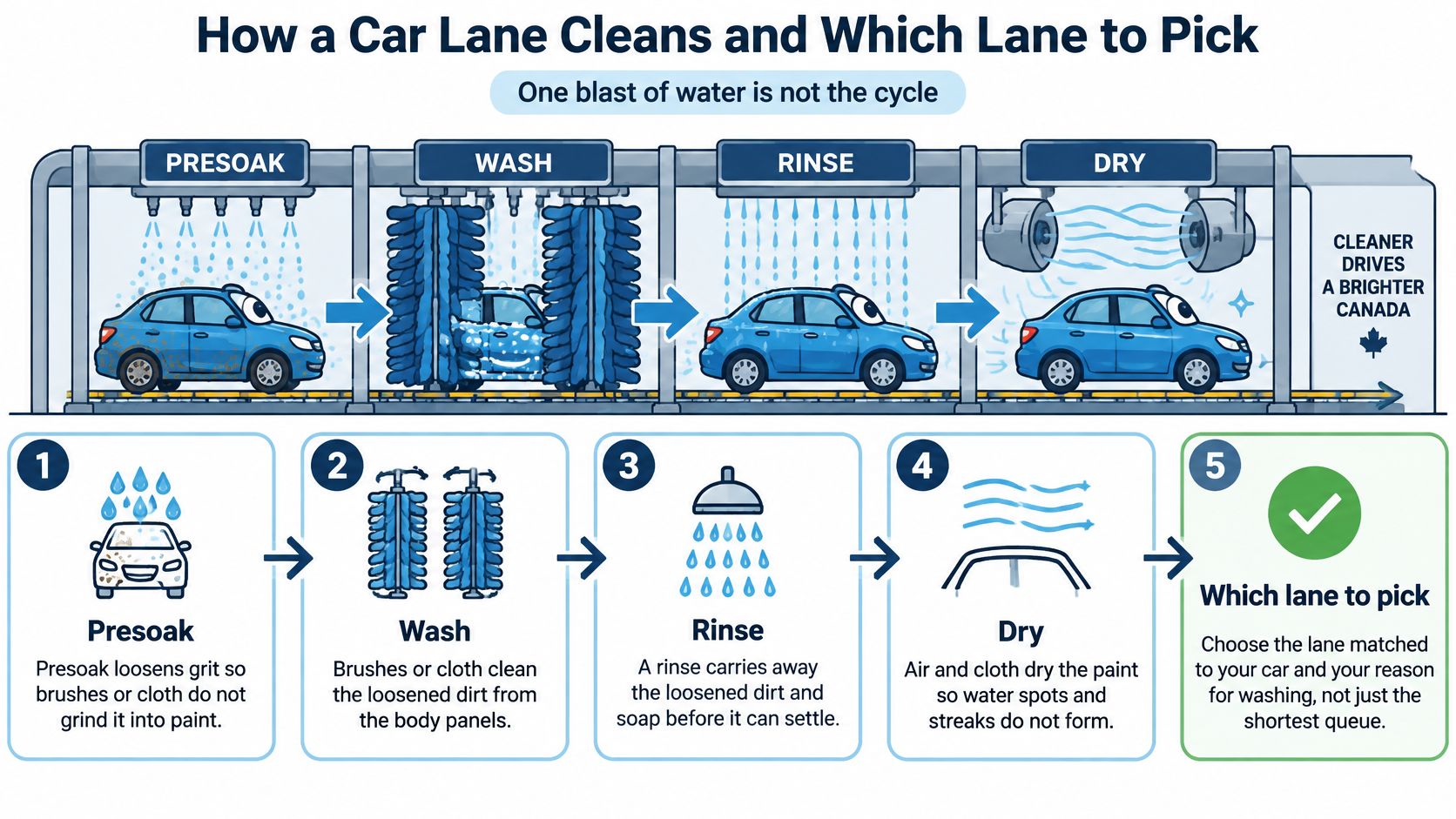
A car lane is rather like a dishwasher the dish drives through. One blast of water isn't the whole cycle, and spraying the shiny side doesn't guarantee you've reached the awkward bits.
The sequence helps explain why the right wash matters more than the most theatrical foam colour.
What happens around the car
Presoak loosens attached dirt. This prepares gritty surfaces for cleaning rather than asking cloth or brushes to drag dry contamination across the paint. Caked-on mud may need preliminary attention before the regular cycle.
Soap and washing remove road film. Foam helps wet and loosen contamination; the system's cleaning action does the removal. A mountain of bubbles is entertaining, but it isn't a useful performance measurement by itself.
Rinsing carries contamination away. Body rinsing and underbody coverage serve different areas, so don't assume every exterior wash includes both. The Ontario highway winter-maintenance guide says road salt melts snow and ice until temperatures fall below approximately −12°C, after which crews increasingly use sand for traction. Vehicles can therefore encounter both dissolved deicer and abrasive road material.
Drying removes remaining surface water. Drying agents help water release from surfaces, and blowers move it away; some services include a hand dry. Drying reduces spotting and lingering exterior moisture, but it doesn't mean every enclosed seam is bone-dry.
Optional wax or sealer adds a finishing layer. Think of it as surface protection after cleaning, not a treatment for salt left on exposed metal. It can't make an omitted rinse happen retroactively.
Match the lane to the unfinished job
| Lane type | Best for | Covers |
|---|---|---|
| Express exterior | Lunch-break queue and routine film | Presoak, foam, rinse, and dry |
| Underbody-capable wash | Post-thaw and highway weeks | Adds underbody and wheel rinse |
| Full service | Cabin needs vacuuming and windows | Exterior plus interior |
| Booked detail | Salt stains, pet hair, and carpets | Deep interior and exterior work |
Car lane types and what each one covers: These are service categories. Check the included tasks rather than assuming every operator uses the names identically.
A fast visit isn't automatically careless. Water supply, maintained equipment, suitable chemistry, and staff attention all matter more than a stopwatch alone. Fresh water helps avoid reapplying dirty wash water, while trained staff can identify areas needing hand attention.
Before entering, close windows, secure loose accessories, and follow the attendant's instructions for your vehicle and that particular system. Don't copy the transmission setting of the car ahead; conveyor and stationary-bay instructions can differ.
Choose the service that reaches the area you identified. An exterior-only lane won't vacuum yesterday's cracker crumbs, however persuasive the foam looks through the windscreen.
Time the Underbody Rinse to the Thaw
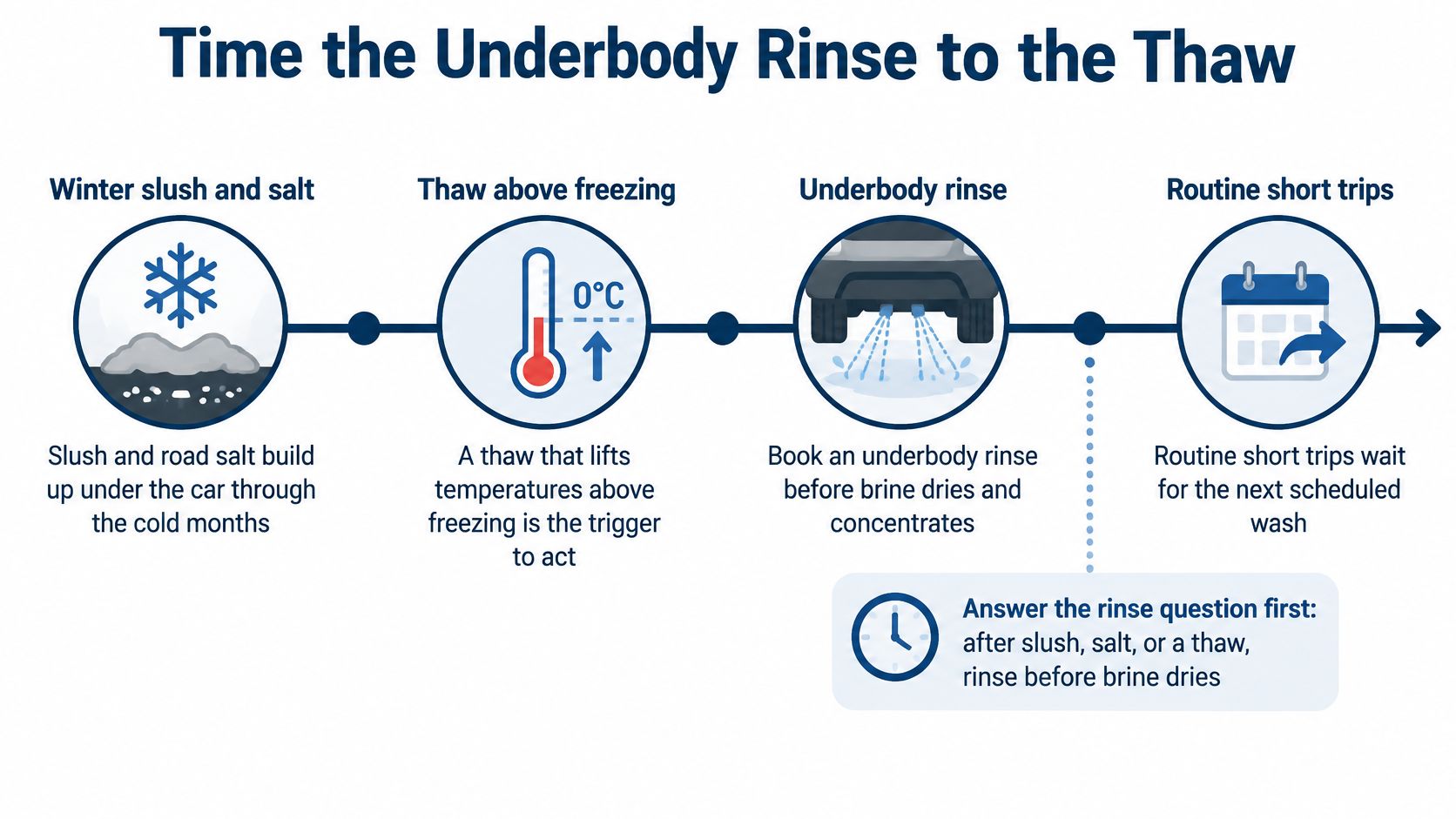
After substantial slush or salt exposure, use an underbody rinse when conditions allow, ideally before contaminated water dries into deposits. A thaw is a useful prompt because frozen contamination becomes mobile again. Light, dry local driving doesn't call for an emergency wash after every errand.
Guelph's climate-adaptation plan identifies primary and secondary salt routes and discusses freeze–thaw impacts on winter roads. When chloride dissolves in water, the resulting brine conducts electricity and can enter seams, fasteners, and underbody cavities. Where vulnerable metal, moisture, and chloride meet, corrosion becomes a concern.
The point isn't to chase an impossible salt-free winter. It's to remove accumulated contamination from places that stay damp or trap splash.
What local salt evidence can tell you
The City of Guelph's annual water reporting records average sodium and chloride concentrations of 670 milligrams per litre at a groundwater monitoring location in 2025, in the context of road-salt impacts. That's evidence of local environmental exposure, not a measurement of the brine on your vehicle. It supports paying attention to salted driving conditions without pretending a groundwater sample sets your wash schedule.
The mechanism matters more than a dramatic laboratory number: the Transportation Association of Canada paper on road-salt corrosivity examines corrosion of steel exposed to deicing materials. For a driver, the useful response is to address chloride-bearing moisture rather than wait until spring because the painted panels still look decent.
Focus on wheel wells, rocker panels, subframes, and drain areas. Those are practical inspection targets after wet, salted driving.
| What you notice | What is likely happening | Lane response |
|---|---|---|
| Paint looks clean after a salted week | Brine may remain underneath | Choose underbody coverage based on the exposure |
| White crust on rockers or wheel lips | Dried deicer residue may be present | Rinse the affected lower areas when conditions allow |
| Bubbling or stains at drain holes | Trapped moisture or existing corrosion may need investigation | Clean accessible areas, then arrange an inspection before rust-proofing |
| Fresh coating over dirty metal | Contamination may have been trapped beneath the coating | Have preparation and coating condition assessed; don't simply add more |
Clean first, then decide about protection
A glossy bonnet isn't an inspection of the subframe.
Rust-proofing complements washing; it doesn't replace preparation or repair. A coating needs appropriate surface preparation, and existing bubbling deserves inspection rather than another layer applied over the evidence. Avoid aggressive scraping around brake lines, wiring, protective coatings, or unfamiliar drain openings.
Winter washing also needs a sensible exit plan. Choose conditions that allow safe operation, dry accessible door seals and edges, and don't leave obvious water pooled around closures before parking in freezing conditions. A wash is maintenance, not an invitation to wrestle a frozen door handle.
For a fleet or working vehicle, record salted shifts, slush exposure, and whether the wash included the underside. That creates a more useful maintenance record than a spring reminder labelled “deal with winter.”
Short Commutes and Drivers Who Wash Often
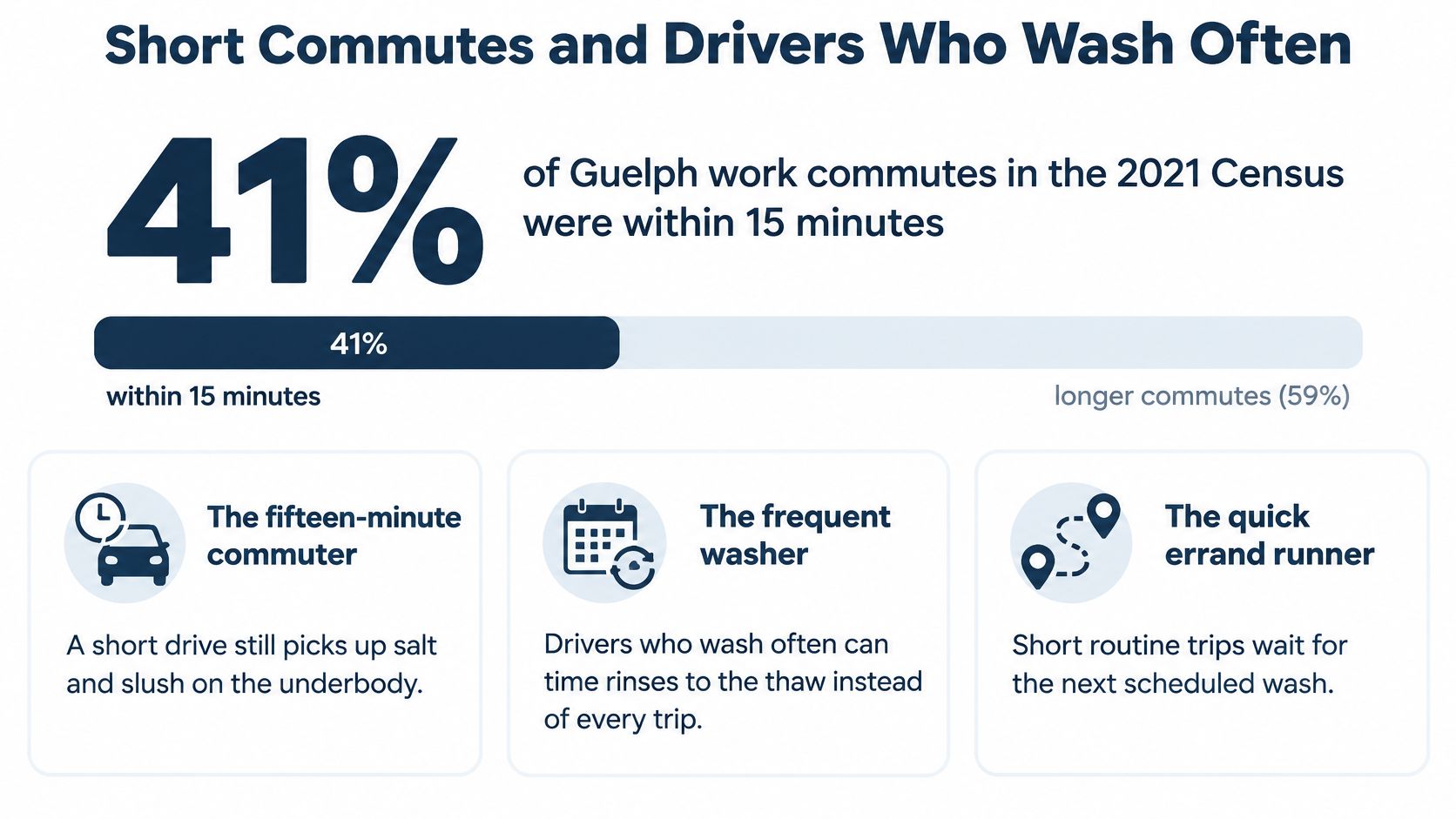
The short-distance commuter gets home before the cabin has properly warmed up, then finds another pale stripe along the doors. According to the City of Guelph transportation background report, approximately 41% of work commutes were within 15 minutes in the 2021 Census. Short trips are an important local use case, but journey length alone doesn't reveal how much salt a car encountered.
For that commuter, the useful habit is a quick inspection when unloading the car: lower doors, wheel lips, mats, and glass. If the drive was dry and the vehicle remains tidy, there's no prize for joining a wash queue anyway.
Different workdays create different cleaning bills
Now consider a delivery shift with wet boots, repeated stops, and spray from busy roads. The driver's priority may be dependable access to a suitable wash and somewhere to vacuum, not an elaborate exterior finish. The vehicle needs to be ready for another working day.
The family hauler presents a different scene. Its upper panels look fine, but the sliding-door sill holds grit, the mats are damp, and the lower body carries the week's splash. A targeted interior clean or lower-body wash can be more useful than paying to make an already-clean roof shinier.
Neither example means commercial drivers always need a pass or larger vehicles always need a premium package. Choose a plan from actual visits and included work.
| Plan | Best for |
|---|---|
| Single express wash | Low-mileage or short-commute weeks |
| Repeat weekly washes | Ride-hailing or delivery shifts during dirty winter conditions |
| Prepaid bundle | Steady mid-frequency driving |
| Monthly membership | High-frequency commercial drivers |
Wash plan cost comparison by driver profile: This compares likely fit, not prices. Confirm current charges and inclusions before choosing.
Do the wallet test without optimistic arithmetic
Compare the cost of visits you realistically expect to make with the total pass cost. Include any interior work or underbody coverage you'd still pay for separately. A pass that excludes your main cleaning need can be poor value even when its headline sounds generous.
- Count real visits: Use your recent routine, not the sparkling future version of yourself who washes whenever the weather changes.
- Compare equivalent work: Exterior-only access isn't the same purchase as a visit with cabin cleaning.
- Allow for seasonality: Your winter working routine may bear little resemblance to summer errands.
Prepaid access can suit a predictable middle ground. Occasional purchases can suit a car that spends more time parked than travelling. The economical choice is the one you use for a genuine cleaning need, not the one with the most impressive theoretical savings.
Book the Right Lane in Guelph
Before booking, turn your cleaning need into a short description: what happened, which area needs attention, and whether the vehicle has anything unusual attached. “Wet highway driving, underside needs rinsing, roof carrier fitted” is far more useful than “the biggest wash, please.”
For a straightforward dusty exterior, keep the visit straightforward. If the cabin is the problem, name the problem: loose grit, stained carpet, pet hair, or dirty interior glass. These aren't interchangeable jobs, and a quick vacuum won't remove an established salt stain from carpet.
Make the booking useful
You can book online for our Guelph location at 20 Woolwich St, Guelph, ON N1H 3T9. We're open Monday to Sunday, from 8 AM to 7 PM. Use the Guelph location's booking option and describe any deeper cleaning needs so the visit matches the work.
Our monthly passes and prepaid wash tickets are options for frequent users, not the default purchase for everyone. Choose them only after comparing your likely visits and the service you need.
If you're calling, have the vehicle type and main concern ready. For automotive businesses organising these enquiries, Dial Milo on automotive call handling offers context on handling service calls. From the driver's side, the useful principle is simple: clear job details help staff direct the enquiry appropriately.
Arrive ready for the work
A little preparation keeps the appointment focused on cleaning rather than sorting your belongings.
- Remove personal items: Clear valuables, bags, and loose objects from areas that need vacuuming.
- Identify stubborn areas: Point out carpet salt stains, pet hair, or a spill rather than assuming they're included in routine cleaning.
- Mention accessories or damage: Flag loose trim, racks, and any concern that could affect machine washing.
- Separate corrosion from dirt: Bubbling paint or a damaged coating needs assessment, not just a stronger wash.
For the next salted drive, make the decision before you reach the queue: identify the contaminated area, choose coverage that reaches it, and leave optional finishes optional. Check tomorrow's forecast. If a thaw follows wet, salted driving, arrange the appropriate rinse instead of waiting for the outside to look embarrassing.
Nanak Car Wash offers exterior washing, interior cleaning, detailing, and rust-proofing, so you can match the work to what your Guelph driving has left behind. Visit Nanak Car Wash to book at our Guelph location, and choose underbody coverage after wet-salt exposure rather than letting a shiny roof make the decision.


 6600 Finch Ave W, Etobicoke, ON M9V 3Z6

 647-703-8515
 MON – SUN 8 AM to 7 PM