
You walk out to your car in February, coffee in one hand, scraper in the other, and the lower doors are wearing that familiar grey-white crust of salt. The wheel wells are packed. The slush behind the mud flaps looks like cement. If you drive in Ontario, that scene isn't dramatic. It's Tuesday.
Most drivers start thinking about rust proofing when they spot the first bubble on a fender, a flaky seam under a door, or orange dust on suspension parts during a tire swap. By then, the question isn't “Do I need rust proofing?” It's “What works in Canada, and what's just expensive false comfort?”
The short answer is simple. For most Canadian drivers, annual oil spray rustproofing is the standard that makes the most sense. The trick is knowing why, knowing what to skip, and knowing whether an older vehicle is still worth treating. That's where people get tripped up.
Table of Contents
- Why Your Car Hates Canadian Winters
- A Head-to-Head Comparison of Rust Proofing Methods
- The Real Cost of Rust Proofing Your Car
- Can You Save a Car That Already Has Rust
- How to Choose a Rust Proofing Service in the GTA
- Our GTA Pick Nanak Car Wash Rust Proofing
- Frequently Asked Questions About Car Rust Proofing
Why Your Car Hates Canadian Winters
Canadian winters don't rust cars with one big event. They do it with repetition. Salt, slush, meltwater, overnight freezes, daytime thaws, then another layer of salt. A small paint chip from a highway stone starts as a cosmetic annoyance. Add moisture and road salt, and that little chip becomes an opening.
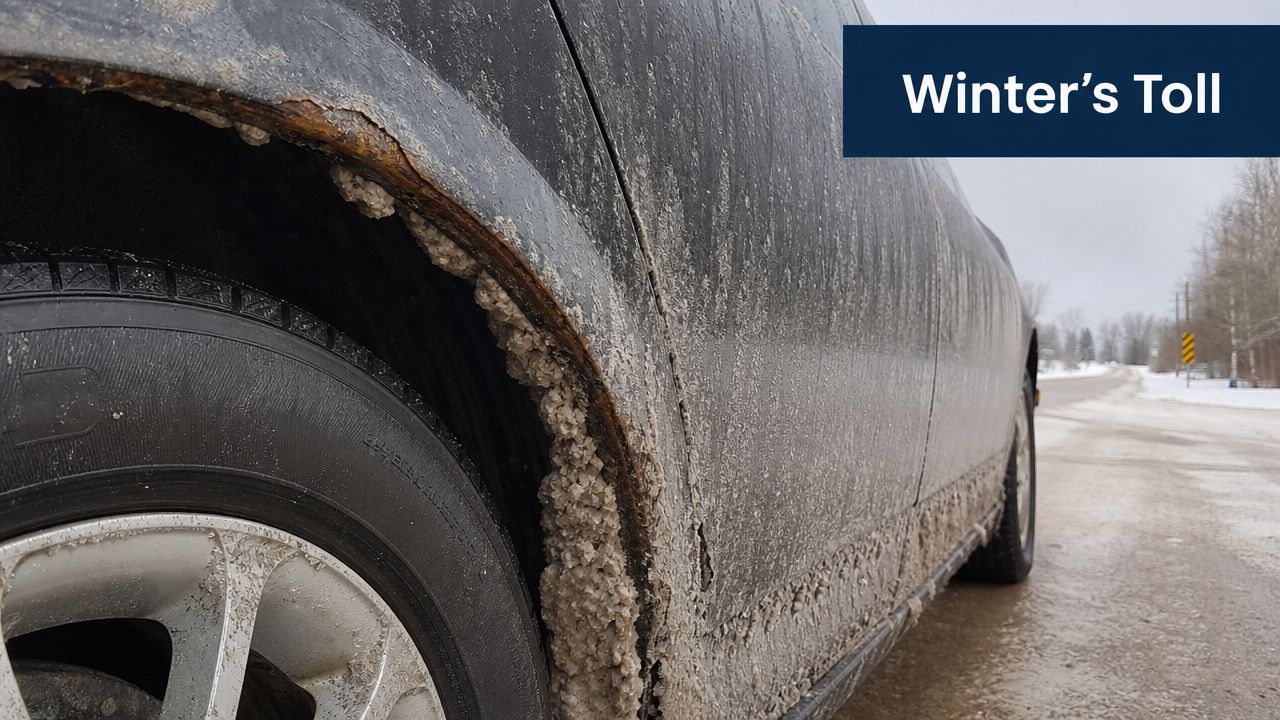
The ugly part is where rust starts. Not the obvious spots you can see while washing the car. It starts in seams, pinch welds, rocker panels, inner door cavities, around wheel arches, and anywhere salty moisture can sit longer than it should. Once water gets into a tight area and freeze-thaw cycling keeps reopening tiny gaps, steel doesn't get much of a break.
The problem isn't just body panels
People often focus on visible rust because it's easy to spot and depressing to look at. Fair. But hidden corrosion is the one that costs sleep. Undercarriage components, welds, lines, mounting points, and the bottoms of doors take a pounding long before the outside of the vehicle looks rough.
I've seen plenty of vehicles that still looked respectable from ten feet away, while the underside told a much grimmer story. Salt doesn't care how much you love your car. It only cares where the moisture sits.
Canadian winter driving turns the underside of your vehicle into a chemistry experiment. Rust proofing is what keeps that experiment from getting expensive.
Why Ontario drivers get hit harder
Ontario roads see heavy salt use, and that means the attack isn't occasional. It's seasonal routine. You can wash your vehicle regularly, and you should, but washing alone won't reach every cavity where corrosion starts. That's why best rust proofing for cars in Canada isn't really a cosmetic topic. It's a durability topic.
If you plan to keep your vehicle for years, rust proofing isn't pampering. It's defence.
A Head-to-Head Comparison of Rust Proofing Methods
You pull into a rust proofing shop in October, and the menu sounds simple until it isn't. One option drips. One looks cleaner. One gets marketed like spaceship tech. One puts the whole job on your back in the driveway. For a Canadian daily driver, the right choice comes down to one question: which method still protects the spots you cannot see after another salt season?
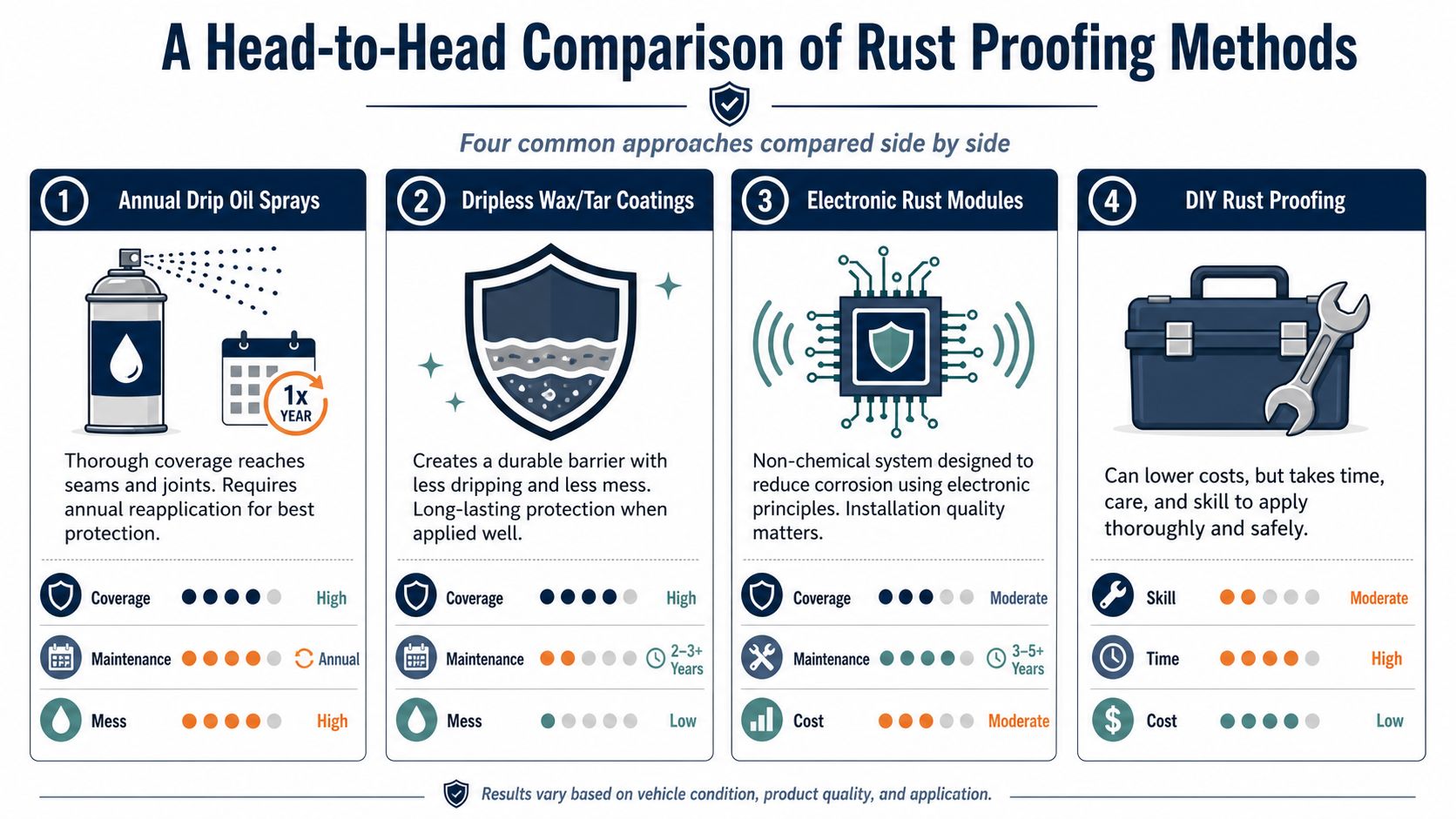
Rust Proofing Methods At a Glance
| Method | Average Cost (Annual) | Effectiveness | Mess Level | Best For |
|---|---|---|---|---|
| Annual drip oil sprays | Moderate annual cost | High for Canadian use, especially in seams and cavities | Higher | Daily drivers in salt-heavy climates |
| Dripless wax or tar coatings | Higher upfront cost | Mixed. Performance depends heavily on prep and what is already happening underneath | Low after cure | Owners who care most about a cleaner finish |
| Electronic rust modules | High for the benefit offered | Poor fit for road vehicles in real-world Canadian use | None | Drivers drawn to the sales pitch more than the results |
| DIY rust proofing | Lower cash outlay, higher effort | Varies a lot by product choice, access, and skill | Varies | Touch-ups and hands-on owners |
Official reality check: In Canada, the CAA and the APA have endorsed annual oil spray rustproofing as the most effective aftermarket method for corrosion prevention, and the APA's independent testing found electronic rust modules produced no measurable corrosion reduction on road vehicles. The APA recommends traditional oil-based sprays instead. See the APA rustproofing recommendation and testing summary.
That point clears up one of the biggest myths in this category. Electronic modules get sold as modern, clean, and maintenance-free. Nice pitch. It still does not make them a smart bet for a car that lives through Ontario slush, brine, and freeze-thaw cycles.
What each method actually does
Annual oil sprays remain the practical winner for long-term ownership in Canada. They creep into seams, folds, spot welds, rocker panels, and inner cavities where corrosion usually starts first. That mess people complain about is tied to the thing that makes the product useful. It moves.
Dripless wax or tar coatings can work on the right vehicle, especially one that is still very clean underneath and has been prepped properly. The trade-off is access. Thick coatings do not travel deep into tight spaces the way fluid oils do, and on an older vehicle they can make inspection harder if rust is already starting in hidden areas.
DIY products have their place. I like them for maintenance, small touch-ups, and owners who are willing to get under the vehicle and do the work carefully. I do not treat them as equal to a proper cavity treatment unless the owner has the tools, time, and patience to cover the vehicle properly.
The method I would not buy for a Canadian commuter
Electronic modules are the easy cut.
APA testing found no measurable corrosion reduction on road vehicles, which is the whole job. If a product does not show real-world benefit where Canadian drivers need it, the clean install and futuristic branding are just decoration. Save that money for a proven treatment and a few extra underbody washes through the winter.
Heavy rubberized or tar-style coatings need more judgment. On a newer vehicle with a clean underside, they can serve as a barrier. On an older car with scaling, bubbling, or mystery spots around welds and seams, they can cover a problem without solving it. I have seen plenty of ugly surprises hiding under coatings that looked tidy from the outside.
Here's the practical call:
- Choose oil spray if you want the best shot at protecting hidden cavities and plan to keep the vehicle.
- Choose oil spray again if the car is older and has only light surface rust. It is usually the safer play than sealing everything under a hard coat.
- Skip electronic modules if you want evidence instead of marketing.
- Use DIY products as backup, not as a full substitute for professional application.
For Canadian drivers, this is less about picking the fanciest product and more about matching the method to the life your vehicle lives. Salt, slush, trapped moisture, and years of ownership punish the wrong choice fast.
The Real Cost of Rust Proofing Your Car
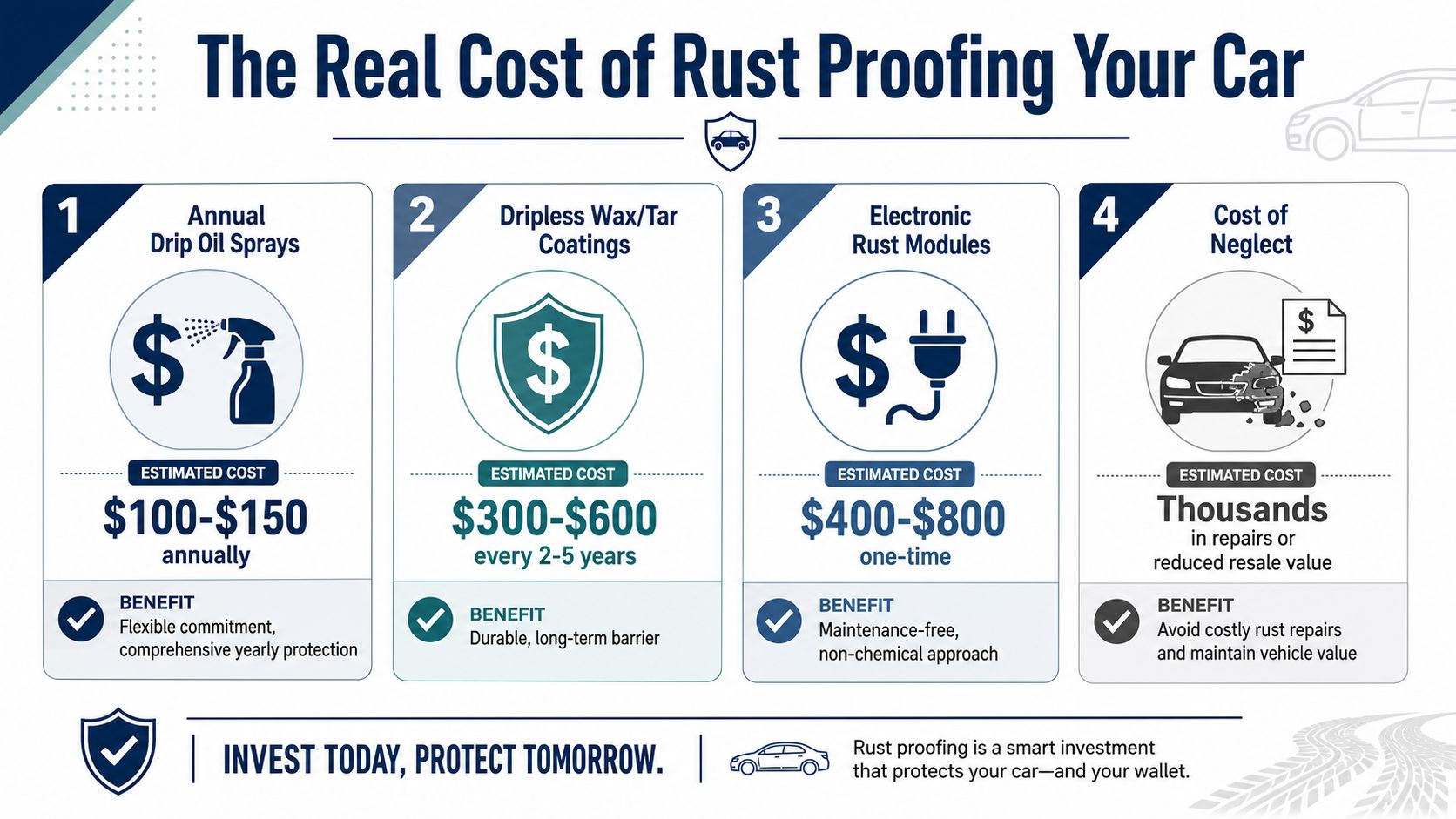
A lot of GTA drivers hesitate at the counter because rust proofing feels like one more car bill. Then winter does what winter does. By the time rocker panels start bubbling or a brake line area looks rough, the cheap option is gone.
What the yearly spend actually means
Annual oil spray is usually a modest maintenance cost, not a major repair decision. For most Canadian drivers, it lands in the same category as seasonal tire swaps, a battery before it dies on a cold morning, or a couple of good underbody washes during salt season.
The useful question is not “How much does rust proofing cost?” It is “How long am I keeping this vehicle, and what will salt do to it in that time?”
If you plan to keep the car for only another year, the math is different. If you want three, five, or seven more winters out of it, rust proofing starts to look a lot less like an extra and a lot more like cheap insurance against ugly bodywork and underbody corrosion.
What you are paying for
You are paying for access to the places rust starts winning. Inside doors, seams, welds, rocker panels, frame pockets, and other spots road spray reaches long before your wash mitt ever will.
That matters in Ontario, where salt brine gets into everything and stays there.
A proper application also buys time for the rest of the vehicle. It helps preserve resale value, keeps small rust spots from turning into body-shop conversations, and gives an older vehicle a fair shot at aging like a used car instead of a farm gate.
Practical rule: If the annual price feels annoying, price out rust repair once. That usually ends the debate.
Timing changes the value
Cost is not just about the invoice. Timing matters.
Book before the rush, ideally before steady winter salt hits the roads, and you get the full benefit of the treatment plus a better chance of finding a shop that is not trying to cram half the city into the same two weeks. Wait until the first nasty storm and you are joining the annual panic line with everybody else who just remembered what Canadian roads do to steel.
That is also why this decision should match the vehicle, not the marketing. A newer car with years left in it usually justifies regular treatment. An older car can still be worth doing if the structure is sound and the rust is still at the manageable stage. If the vehicle is already near the end of its useful life, you may be better off spending selectively and keeping expectations realistic.
That is the cost side in plain English. You are not buying a miracle. You are buying time, and in Canada, time away from rust is worth plenty.
Can You Save a Car That Already Has Rust
Yes, sometimes. No, not in the magical internet sense where a spray turns rot back into healthy steel.
That's the myth that keeps older-car owners from acting. They assume rust proofing is only for brand-new vehicles, and once a vehicle has a few problem spots, the ship has sailed. That's not how oil-based treatment works.
Rust proofing can slow rust, not reverse it
Professional services such as Rust Check state that their process includes “inhibiting existing rust to slow it down” by treating seams, joints, and welds, as explained in Rust Check's article on extending rust protection life. That matters for the kind of vehicles a lot of GTA drivers own. Not fresh-off-the-lot machines, but everyday cars, SUVs, and trucks that have already seen several winters.
That doesn't mean a rust proofing appointment fixes perforation, severe scaling, or structural damage. It means fluid treatment can still be a useful move when the corrosion is minor to moderate and you want to slow progression.
When an older car is still worth treating
A lot of 5 to 10-year-old vehicles still have plenty of useful life left, especially if the engine, transmission, and general maintenance history are solid. If the rust is just starting in common areas, rust proofing can be part of a sensible keep-it-going plan.
Signs it may still be worth it:
- Surface rust is present, but not severe: You're seeing early corrosion, not metal failure.
- The vehicle still serves your needs well: It starts, runs, and isn't otherwise on its last legs.
- The trouble is concentrated in seams and hidden areas: Those are exactly the places fluid products are meant to reach.
- You want to buy more usable years: Not forever. Just longer.
If the car already has minor rust, don't ask whether rust proofing can make it new. Ask whether it can stop a manageable problem from becoming a scrapyard argument.
What's “too late”? When the metal is structurally compromised, perforated, or beyond sensible repair. Rust proofing is prevention and intervention. It isn't resurrection.
How to Choose a Rust Proofing Service in the GTA
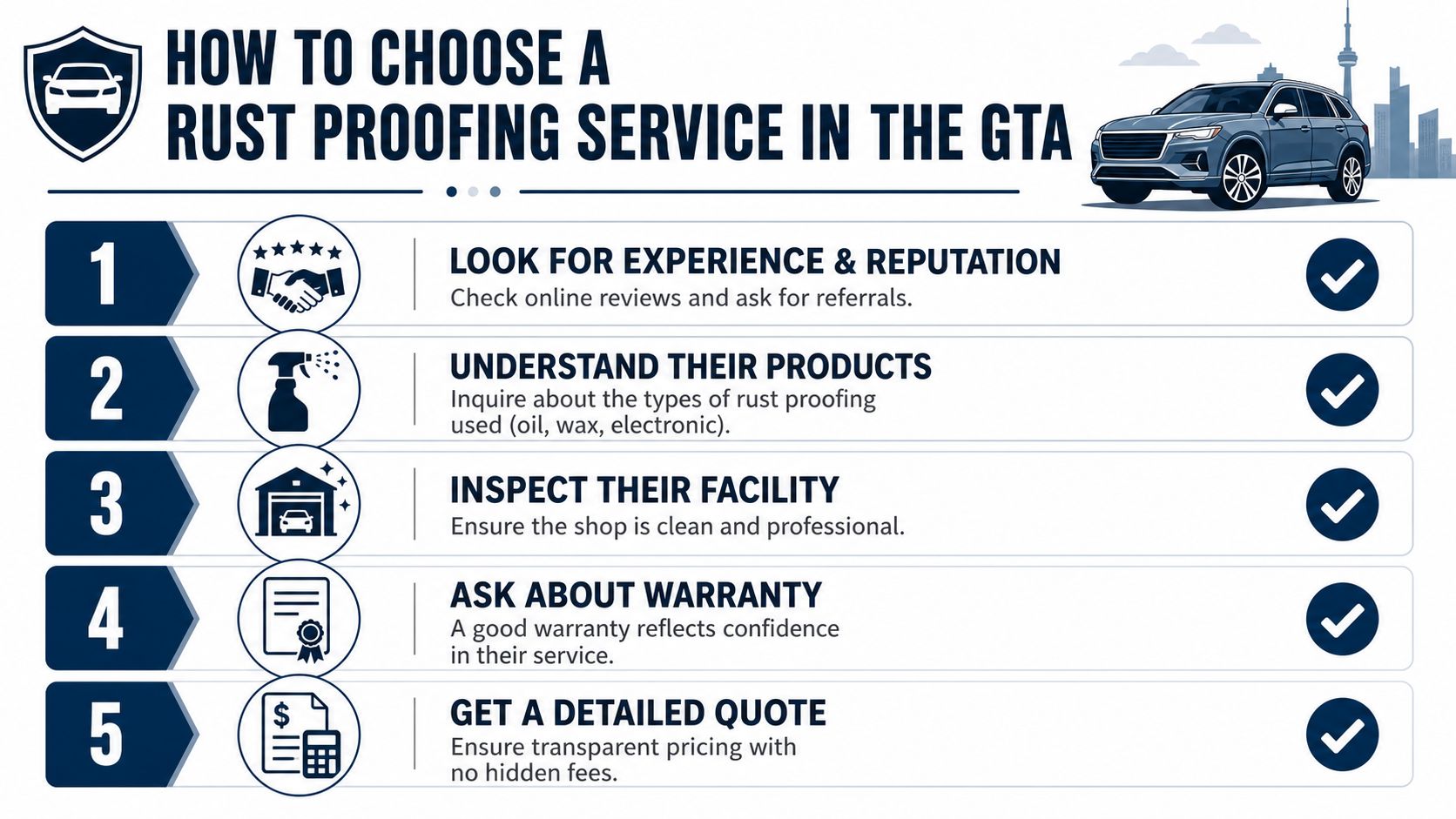
The product matters, but the shop matters almost as much. A good material applied lazily is still a lazy job. If a provider doesn't reach the right cavities, skips prep, or can't explain the process clearly, you're paying for hope.
Questions worth asking before you book
Use the conversation to find out whether the shop understands corrosion control or just sells a menu item.
- Do you access body cavities, doors, rocker panels, and other enclosed areas? If the answer is vague, that's a problem.
- How do you handle a vehicle that already has undercoating or minor rust? Different starting conditions need different judgement.
- What does your warranty cover? A warranty sounds nice until you realise it only covers a narrow worst-case outcome.
- Do you explain where access points are used? A professional shop should be able to describe the process without dodging.
- How long should I expect the treatment to last, and when should I return? The answer should line up with annual maintenance logic for Canadian winters.
A proper rust proofing service should sound boringly competent. That's a compliment.
Red flags that should make you leave
If the entire pitch is “lifetime,” “maintenance-free,” or “no mess, no follow-up, no downside,” keep your wallet in your pocket.
Watch for these:
- Electronic modules pitched as equal to oil spray: They're not supported by the official testing discussed earlier.
- No discussion of seams, joints, or welds: That's where corrosion loves to begin.
- No inspection mindset: Good shops want to know what they're working with.
- Only the lowest price gets attention: Cheap and incomplete is still incomplete.
A clean facility helps. Clear pricing helps more. Straight answers help most.
Our GTA Pick Nanak Car Wash Rust Proofing
A GTA driver usually wants a simple answer to one question. Is this yearly rust proofing bill buying real protection, or just a cleaner receipt?
Nanak Car Wash is a reasonable local pick for drivers who want an annual treatment from a shop with a long service history, clear size-based pricing, and a process that fits normal car maintenance instead of feeling like a one-off upsell.

Why it earns a spot here
The pricing is posted by vehicle size, which matters more than many drivers think. Rust proofing gets sketchy fast when the quote only appears after the car is already in the bay. Clear pricing makes it easier to compare the job against the annual oil-spray cost range discussed earlier, and easier to decide whether it makes sense for your vehicle's age and how many winters you plan to keep it.
The business has also been around since 2004. In this trade, longevity does not guarantee quality, but fly-by-night operators rarely last when customers deal with salt damage every winter and remember who wasted their money.
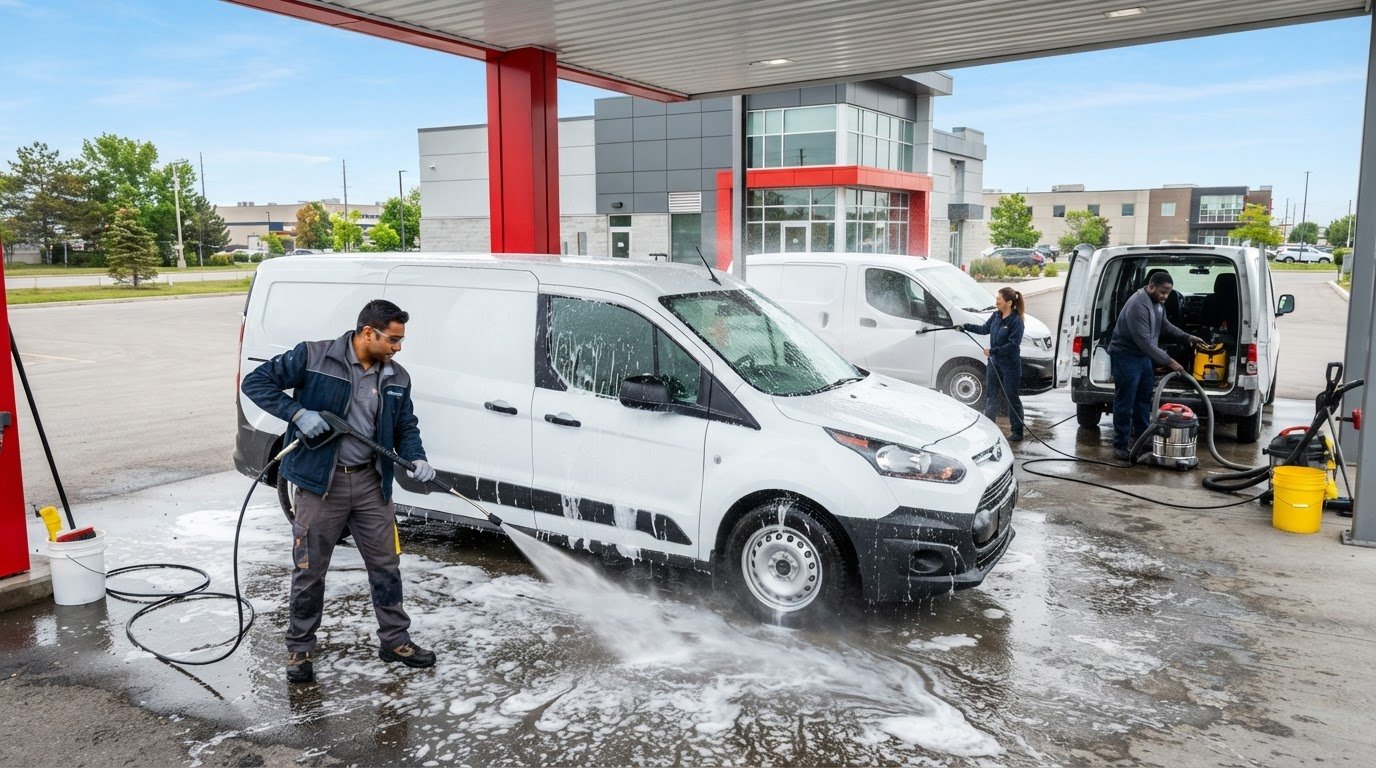
There's another practical advantage. They already handle washing and detailing, so the service fits neatly into the routine of people who maintain their vehicles instead of only thinking about rust after a blister shows up on a rocker panel.
Who should consider it
This pick makes the most sense for daily drivers in the GTA who want a straightforward annual appointment and do not want to gamble on gimmicks. That includes commuters, family SUVs, work vehicles, and older cars that still have enough life left to justify protection.
That last group gets ignored too often. Plenty of owners assume rust proofing is pointless once a car has some age on it. That is not always true. If the vehicle has surface rust but the structure is still sound, slowing corrosion can still be a smart money decision. The goal is not perfection. The goal is buying more usable years before Ontario salt starts chewing through expensive metal.
No shop is the right answer for every car. A ten-year-old beater with advanced rust in the usual death zones may not justify repeated treatments. A six-year-old SUV you want to keep for another five winters probably does. That is the decision Canadian drivers need to make, and a shop with simple pricing and a familiar annual service model makes that call easier.
Frequently Asked Questions About Car Rust Proofing
Does rust proofing void a warranty
It depends on the manufacturer's corrosion warranty language and the method used. If a shop drills access holes, ask how they seal them and ask your dealer what your warranty specifically says. Don't guess. Get the answer before the appointment.
How should you prep the vehicle
Bring it in reasonably clean, especially underneath if it's caked in old mud or heavy salt. Remove valuables, and don't pack the cargo area with loose gear if the shop may need access around interior panels or openings.
After treatment, follow the shop's wash guidance. If it's an oil-based application, expect some dripping for a short period. Cardboard on the garage floor is cheaper than regretting your decorative paving stones.
Dealer package or independent shop
Ask one question first. What product are they applying?
If the dealership package is an electronic module, the earlier evidence gives you a clear reason to pass. If it's a thick permanent-style undercoating, ask harder questions about coverage, inspection, and future maintenance. If it's a recognised oil-based annual treatment, then compare the details with an independent shop and pick the provider that gives you the clearest process and the least nonsense.
Is annual treatment overkill
Not for a Canadian daily driver. Salt-heavy winters aren't a one-time event, so rust protection shouldn't be a one-time thought. Annual maintenance makes sense because winter keeps showing up, whether your budget likes it or not.
If your car spends winter in the GTA, rust protection is one of the smarter maintenance jobs you can book before the salt really starts flying. Nanak Car Wash offers rust proofing alongside regular wash and detailing services, which makes it a practical option if you want to handle protection and cleanup in one stop.

 6600 Finch Ave W, Etobicoke, ON M9V 3Z6
 647-703-8515
 MON – SUN 8 AM to 7 PM