
The popular advice is simple: collect three car detailing quotes and book the cheapest one. That's poor advice in the Greater Toronto Area. A low number can exclude underbody work, pet-hair removal, serious stain extraction, wastewater management, or the labour required for a large SUV. You may save at booking and pay more later through rushed work, repeat cleaning, paint correction, or avoidable corrosion exposure.
A useful quote is not merely a price. It's a written agreement about scope, vehicle condition, labour, products, runoff handling, and expected results. For a ride-hailing driver or fleet operator, that distinction matters even more because every hour off the road and every neglected surface affects operating costs.
| Quote factor | What a clear estimate should state | Why it matters in the GTA |
|---|---|---|
| Vehicle class | Sedan, SUV, pickup, van, or fleet vehicle | Size changes surface area, interior volume, and labour |
| Condition | Salt, stains, pet hair, tar, iron particles, and paint defects | Heavy contamination requires separate processes |
| Exterior work | Wash, wheel cleaning, decontamination, polishing, and protection | A wash doesn't equal paint correction |
| Interior work | Vacuuming, extraction, stain treatment, leather care, and crevice cleaning | “Interior detail” can mean very different things |
| Winter protection | Underbody rinse, wheel-well cleaning, and rust proofing | Road salt needs its own line items |
| Water handling | Facility washing, contained runoff, or another compliant method | Toronto restricts contaminated discharge to catch basins |
| Repeat economics | One-off restoration, prepaid visits, or membership | High-use vehicles usually need maintenance, not occasional rescue |
Table of Contents
- Why the Cheapest Detailing Quote is Often a Trap
- Decoding the Standard Detailing Estimate
- How Vehicle Size and Type Change the Price
- Quoting for Winter Salt and Corrosion Control
- The Hidden Environmental Costs of Mobile Detailing
- Memberships vs One-Off Restorations for High-Use Drivers
- Your Pre-Booking Checklist for Accurate Estimates
Why the Cheapest Detailing Quote is Often a Trap
The cheapest detailing quote is often the least complete one. A provider can produce a low total by treating every vehicle as a sedan, replacing deep cleaning with a quick vacuum, calling spray wax “protection,” and leaving difficult contamination outside the package. That price looks attractive because you're comparing a partial job with a properly scoped one.
Ask what happens when the vehicle arrives with embedded salt, pet hair woven into carpet, tar on the lower panels, or stains that need extraction. If the answer is “that may cost extra,” the quote hasn't solved the pricing problem. It has postponed it until you've handed over the keys.
What a low quote may leave out
A vague “full detail” can conceal several separate jobs:
- Vehicle size: A three-row SUV or work van has more floor, glass, trim, and exterior surface than a compact sedan.
- Condition surcharge: Heavy soil, smoke odour, food residue, pet hair, and staining take more labour than routine maintenance.
- Paint decontamination: A foam wash removes loose dirt. It doesn't necessarily remove bonded iron, tar, or grit.
- Underbody access: A standard exterior wash may not include wheel wells, rocker panels, or the undercarriage.
- Wastewater handling: A mobile operator may not explain where contaminated wash water goes.
Toronto prohibits soaps, oils, automotive fluids, and other wash water from entering outdoor catch basins. The city identifies commercial car washes as a safer option because they follow wastewater-handling practices and discharge to the sanitary sewer for treatment, as explained in Toronto's outdoor car-washing guidance.
Practical rule: If the quote doesn't describe the work, assume the price describes less work than you expect.
There's also an operational issue that private owners often miss. A reputable provider needs a reliable booking and customer-response process, especially when drivers, dealerships, or fleets need schedule changes handled quickly. Businesses that manage a high volume of service calls may find a 24/7 receptionist for dealers useful for capturing appointments and keeping customer communication organised.
A higher quote from a controlled, established facility can protect you from two kinds of waste. First, it reduces the risk of paying for a rushed job that needs correction. Second, it makes environmental responsibilities visible instead of pushing them onto your driveway, property, or municipality. Compare the work completed and the risks managed, not just the number at the bottom.
Decoding the Standard Detailing Estimate
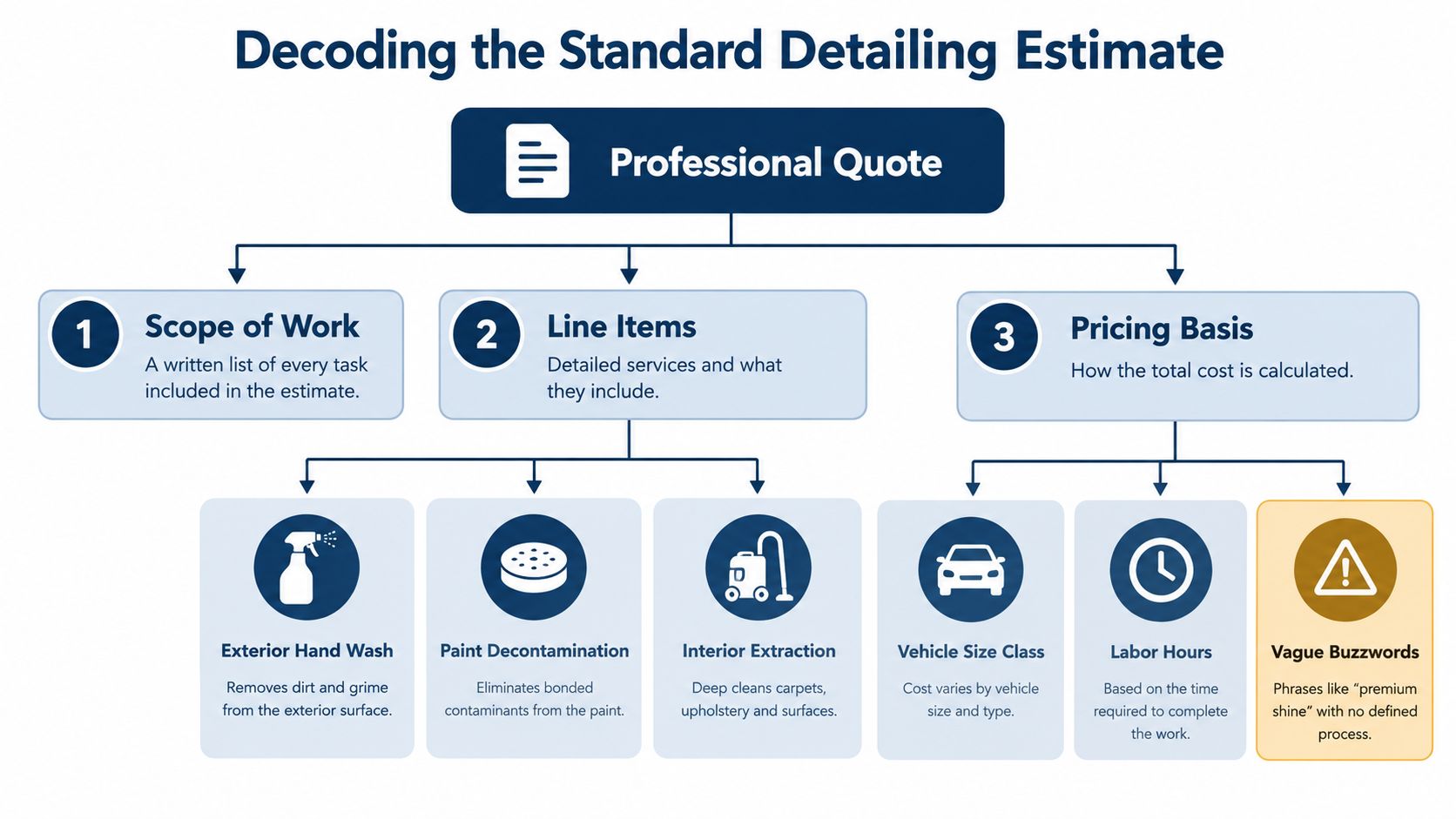
A professional estimate should read like a scope of work. It should tell you what the technician will do, what condition triggers extra labour, and which parts of the vehicle receive protection. Words such as “premium,” “deluxe,” and “showroom finish” mean very little unless the provider defines the process behind them.
Exterior work needs process detail
A basic exterior package may include a pre-rinse, foam bath, hand wash, wheel cleaning, rinse, and drying. That can be appropriate for a vehicle already maintained regularly. It isn't the same as paint decontamination, which may use chemical iron removal, tar treatment, clay media, or a controlled hand-applied process to remove bonded contaminants.
Machine polishing is another separate category. Polishing addresses paint defects such as haze, oxidation, and some surface-level defects. A wash or wax may improve gloss temporarily, but it doesn't perform the same corrective work. Your quote should identify whether the technician is cleaning, decontaminating, polishing, or applying protection.
Look for wording that answers these questions:
- Does wheel cleaning include the faces only, or also barrels and wheel wells?
- Does drying include hand drying and crevice blowout?
- Is paint decontamination chemical, mechanical, or both?
- Is polishing included, and what defects can it realistically address?
- Does the quoted protection involve a spray sealant, hand-applied wax, or another product?
Interior descriptions should be equally precise
“Interior cleaning” could mean a vacuum and dashboard wipe, or it could mean carpet extraction, stain treatment, vent blowout, leather deep cleaning, and detailed work in the console and door pockets. Those processes have different labour demands and different outcomes.
If you carry passengers, transport food, or use the vehicle for deliveries, ask whether the estimate includes the areas that accumulate residue fastest. A professional quote should identify seats, carpets, mats, headliner, vents, cup holders, door jambs, trunk space, and odour treatment where relevant.
A quote earns trust by naming the dirty work, not by decorating it with premium-sounding labels.
The pricing basis should also be visible. A credible estimate can use vehicle class, condition, estimated labour, and selected add-ons. If the provider refuses to itemise anything and can't explain what changes the price, you aren't comparing quotes. You're comparing marketing language.
How Vehicle Size and Type Change the Price
A flat rate for every vehicle is convenient for the seller and risky for the buyer. A compact sedan, a pickup with textured trim, and a cargo van don't present the same cleaning problem. They differ in paint area, glass area, floor space, roof height, wheel-well access, and the amount of product and labour required.
California offers a useful illustration of why size-based quoting matters. The state recorded 1,759,141 new light-vehicle registrations in 2024, including 480,892 cars and 1,278,249 light trucks, according to the California New Car Dealers Association's registration report. Light trucks represented approximately 72.7% of new light-vehicle registrations, a record share in that data.
That isn't a GTA market count, and it shouldn't be presented as one. It does show why modern detailing menus need a serious larger-vehicle category rather than treating SUVs and pickups as occasional exceptions.
| Vehicle class | Surface area and complexity | Common surcharges | Estimated time addition |
|---|---|---|---|
| Compact sedan | Smaller cabin, lower roof, simpler access | Usually base scope | Quote should state the baseline labour |
| Mid-size SUV | More panels, glass, cargo space, and floor area | SUV size, cargo-area soil, pet hair | Provider should state the added labour assumption |
| Pickup truck | Large bed, exposed lower panels, textured trim, wheel wells | Truck size, bed cleaning, heavy road film | Confirm whether the bed and underbody are included |
| Three-row SUV | Multiple seating rows, extra mats, deep cargo area | XL vehicle, stain extraction, pet hair | Ask whether the third row is part of the interior scope |
| Commercial van | Large interior volume, work debris, hard-use surfaces | Van size, cargo contamination, heavy soil | Require inspection or photographs before a firm price |
Condition can outweigh the badge
Vehicle type is only the first modifier. A clean pickup used for commuting may need less work than a compact sedan used for food delivery. Soil, odour, pet hair, spilled drinks, embedded grit, and neglected paint should appear as condition notes, not as surprises at checkout.
The same applies to protective work. Textured plastic, roof rails, cargo mats, and large wheel arches need careful cleaning, but they may also slow access. A quote that includes only “SUV package” still leaves too much unsaid.
Ask for transparent add-ons
The right surcharge isn't a penalty for owning a larger vehicle. It pays for the extra physical work. Ask whether the quote changes for:
- Pet hair: Especially when fibres are embedded in carpet or seat seams.
- Stain extraction: Different from wiping or surface vacuuming.
- Cargo areas: Important for contractors, delivery drivers, and families.
- Heavy salt or mud: Often concentrated around lower panels and wheel wells.
- Paint correction: Separate from washing and standard protection.
For California's broader vehicle-registration base, the Federal Highway Administration recorded 30,940,652 registered vehicles in 2024, including 30,256,558 passenger vehicles, as shown in the FHWA motor-vehicle registration table. The point is not to transfer that denominator to Toronto. It's to recognise that vehicle populations are broad and mixed, so quote systems should segment by vehicle type, usage, and service frequency instead of using one universal price.
Quoting for Winter Salt and Corrosion Control
A winter wash is not automatically a corrosion-control service. If a quote says “exterior clean” but doesn't mention wheel wells, rocker panels, underbody access, or salt removal, it may leave the dirtiest areas untouched.
Road salt deserves separate attention because it creates conductive chloride brine that accelerates electrochemical corrosion. An NSERC/CRSNG research summary attributes approximately 50% of vehicle corrosion to road salts, as reported in the research project summary on vehicle corrosion. That figure explains why GTA drivers should treat salt removal as a defined service rather than an incidental benefit of a glossy wash.
Read the winter line items
A useful winter quote should answer four practical questions:
- Does it reach the underbody? Confirm whether the process includes an underbody rinse, not just a hose directed at visible side panels.
- Are the wheel wells included? Salt and wet grit collect behind liners and around suspension components.
- What happens to bonded contamination? Chemical decontamination may be needed when ordinary washing leaves residue behind.
- Is rust proofing separate? Cleaning removes contamination. Rust proofing applies a protective compound. They aren't interchangeable.
This distinction matters for ride-hailing and delivery vehicles because repeated winter mileage creates a different service pattern from a vehicle that stays parked. A high-use driver may need regular salt removal while reserving deeper paint correction for a later appointment.
Don't confuse cleaning with a promise
A quote should describe the method and the expected scope without promising that rust proofing will prevent a specific amount of damage. Inspection matters. The technician should note salt crusting, tar, iron particles, embedded grit, staining, trim condition, and visible paint defects.
Toronto's atmospheric corrosion exposure has also been reported at 5,108 mg/dm² over 19 months in a Transportation Research Board study summary, as referenced in Nanak Car Wash's vehicle paint protection information. That is an environmental benchmark, not a measurement of detailing results or a guarantee of treatment life.
Winter quoting rule: Put routine washing, salt removal, underbody access, and rust proofing on separate lines. If they're bundled together, ask the provider to split them before you approve the work.
Fresh-water rinsing, hand drying, wheel-well cleaning, and access to the underside all affect the scope. A serious quote makes those variables visible. It also identifies exclusions, such as severe corrosion, damaged underbody components, inaccessible areas, or mechanical repairs. Detailing can clean and protect surfaces. It cannot repair structural corrosion or replace damaged parts.
The Hidden Environmental Costs of Mobile Detailing
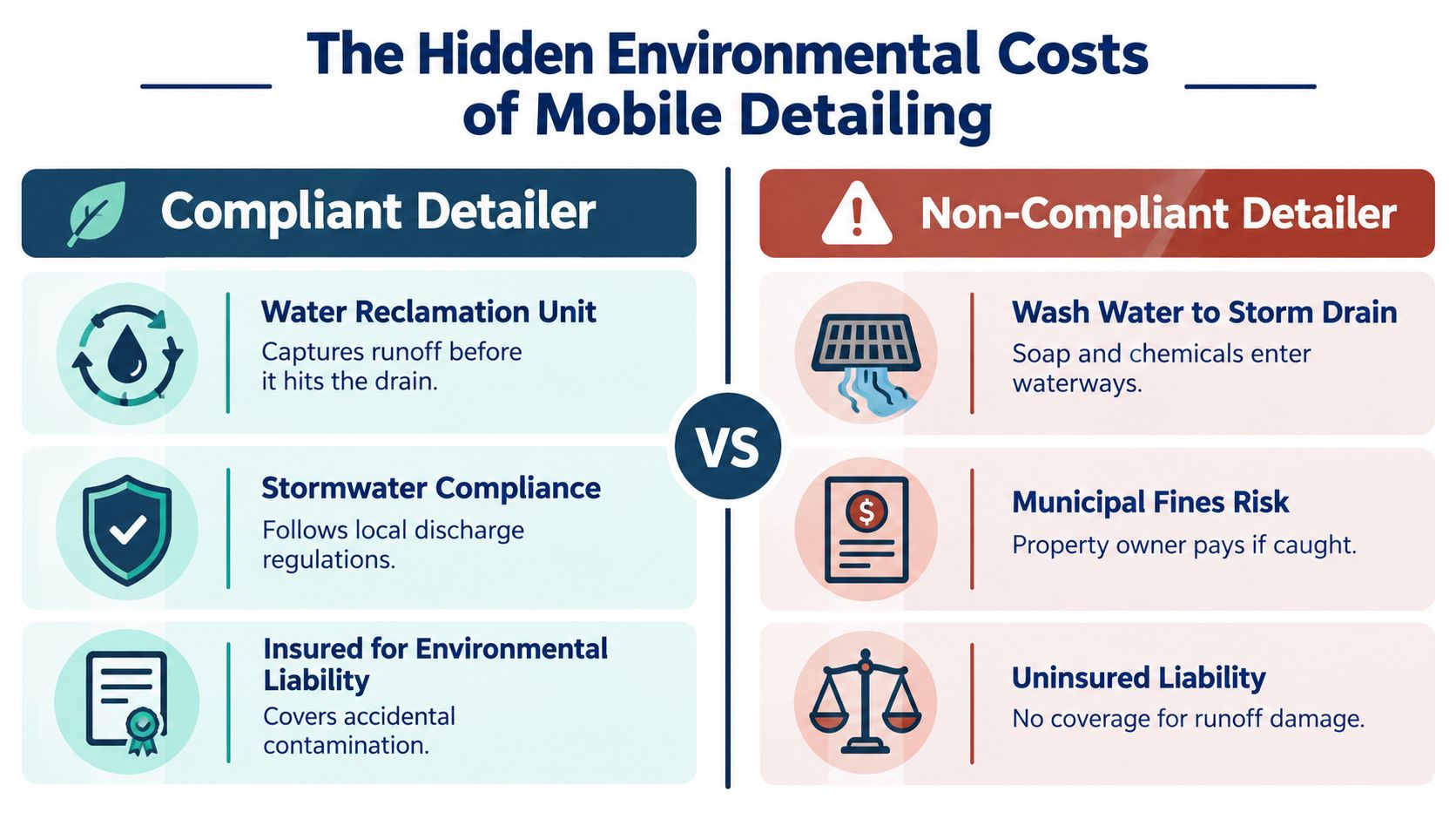
Mobile detailing saves travel time, but the cheapest quote can shift cleanup costs onto your driveway, workplace, or fleet yard. Soap, oils, road salt, and automotive residue leave the vehicle with the rinse water. The provider must explain where that water goes before you approve the appointment.
Because mobile operators often wash on unpaved ground without a sanitary connection, containment is the only responsible setup. Ask the detailer to describe in writing whether they use a wash mat, berms, or a capture-and-haul system. Confirm how much rinse water the equipment can hold before overflow becomes a risk.
Treat runoff as part of the service
A responsible quote should identify:
- Service location: Facility, driveway, workplace, or fleet yard.
- Runoff controls: Whether wash water is captured, contained, or otherwise managed.
- Drain protection: What prevents contaminated water from reaching a catch basin.
- Underbody implications: How salt and chemical residue affect collection and disposal.
- Insurance position: Whether the provider carries coverage for accidental property or environmental damage.
Toronto's rules for washing cars and outdoor surfaces make wastewater handling part of the customer's risk assessment. Do not treat a polished social-media feed, branded van, or pressure washer as proof of compliance.
Facility versus driveway
A controlled facility usually gives winter and heavy-contamination work a stronger operating setup. Fixed drainage, better lighting, dedicated bays, and repeatable equipment make salt removal and runoff control easier to manage. Mobile service still works for light maintenance when the operator has a documented water-management process.
For a fleet manager, the decision is direct. Request the wastewater procedure in writing and keep it with the service record. If the provider cannot explain its containment method, choose another provider. A sound detailing quote protects the vehicle, the operating site, and the recurring maintenance budget, rather than making booking convenient at any price.
Memberships vs One-Off Restorations for High-Use Drivers
A weekend driver can tolerate a dirty vehicle for a while. A ride-hailing driver can't. Passengers notice odours, crumbs, stained seats, dusty vents, and neglected exterior surfaces, while delivery and contractor vehicles accumulate a different mix of grit, salt, tools, and cargo residue.
The financial question isn't “How cheaply can I restore this vehicle?” It's “What cleaning rhythm prevents expensive restoration from becoming routine?” Frequent maintenance keeps the scope controlled. Waiting until the interior needs aggressive extraction and the paint needs correction creates longer appointments, more downtime, and a less predictable bill.
Match the plan to vehicle use
Choose a one-off restoration when the vehicle has changed hands, suffered a spill, accumulated serious pet hair, or gone without meaningful care. The point is to establish a clean baseline. Ask for a written list of restoration tasks, not a promise that the vehicle will look “like new.”
Choose recurring maintenance when the vehicle works every day. A maintenance visit may focus on vacuuming, wipe-downs, glass, exterior washing, wheel areas, and targeted salt removal. It won't replace every deep clean, but it stops minor contamination from becoming a larger project.
The J.D. Power Canada Customer Service Index study reported that owners of four- to twelve-year-old vehicles averaged 1.8 dealership service visits annually, as described in the 2025 Canada Customer Service Index study. That statistic concerns mechanical service, not detailing. It still supports a useful ownership principle: aging, heavily used vehicles need planned attention rather than sporadic rescue work.
Compare the payment models
| Option | Best fit | What to inspect in the quote |
|---|---|---|
| One-off restoration | Neglected vehicle or major interior event | Exact tasks, exclusions, and condition-based extras |
| Prepaid bundle | Driver who wants predictable repeat visits | Expiry terms, transferable use, and included services |
| Monthly membership | High-use vehicle needing regular maintenance | Visit limits, interior discounts, cancellation terms, and size rules |
| Ad hoc maintenance | Low-use vehicle with occasional needs | Whether each visit remains fairly scoped as condition changes |
Don't buy an unlimited plan just because the word “unlimited” sounds economical. Check whether the plan covers only exterior washing, whether interior services cost extra, and whether larger vehicles or severe contamination have different rules. A prepaid bundle can be easier to evaluate because you can compare the included visits with your actual driving pattern.
For fleets, record downtime as carefully as the service price. A slightly higher visit cost may make sense if it keeps the vehicle in service and prevents a long restoration appointment. The best plan is the one that matches usage, not the one with the loudest discount.
Your Pre-Booking Checklist for Accurate Estimates
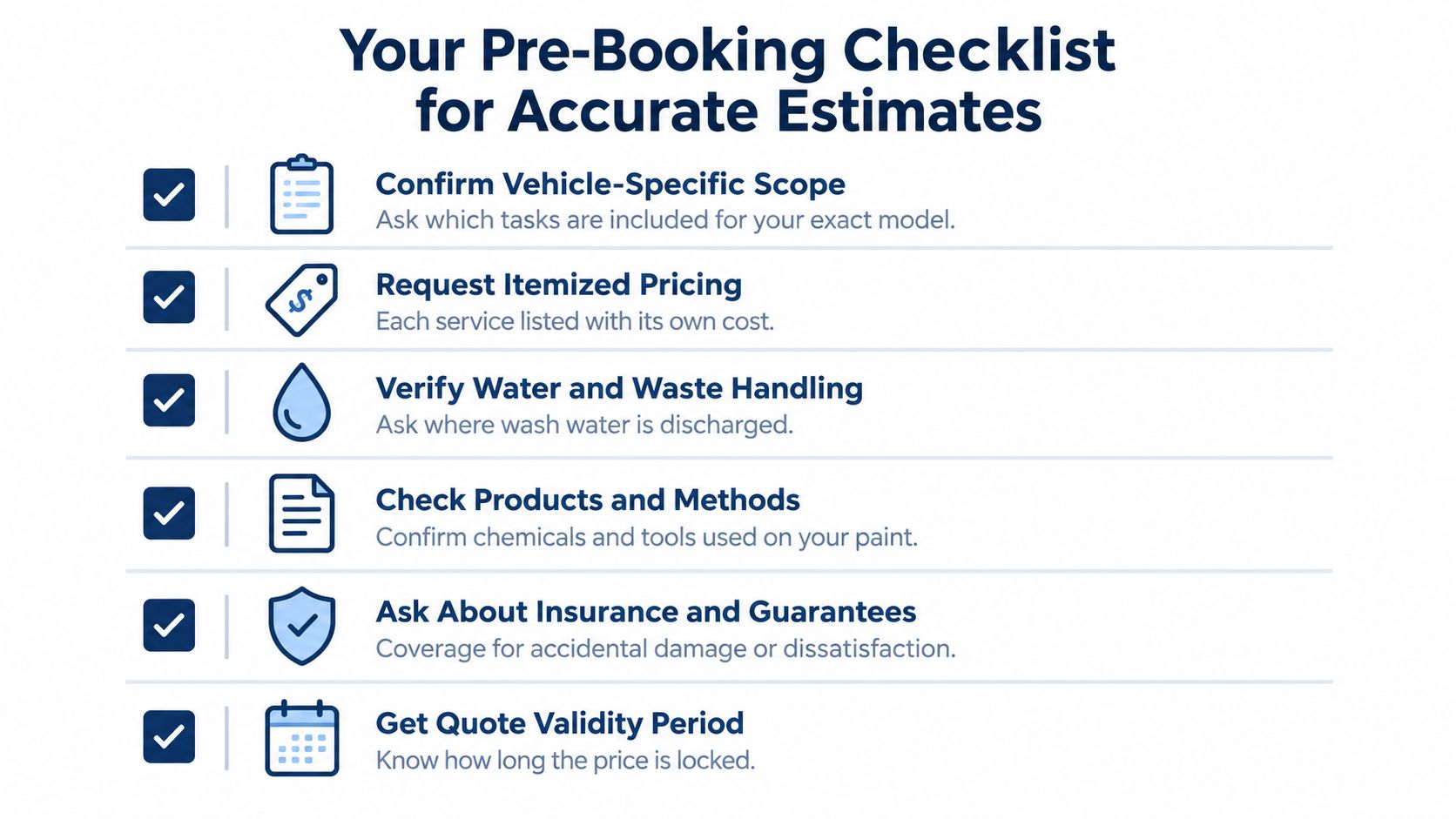
Before you approve a quote, send current photos of the front, rear, both sides, cabin, cargo area, wheels, and lower body. Tell the provider whether the vehicle carries passengers, pets, tools, food, or deliveries. A clear description helps the detailer identify labour risks before the appointment instead of negotiating beside your vehicle.
Ask these questions before booking
- What vehicle class did you quote? Confirm sedan, SUV, pickup, van, or fleet vehicle.
- Which tasks are included? Separate wash, decontamination, polishing, extraction, leather cleaning, and odour treatment.
- What condition creates an extra charge? Ask specifically about pet hair, stains, salt, tar, heavy soil, and cargo debris.
- Does winter service include the underside? Confirm underbody rinsing, wheel wells, salt removal, and rust proofing as separate items.
- Where does the wastewater go? Get a plain-language explanation of containment, drainage, and storm-drain protection.
- How long will the vehicle be unavailable? A ride-hailing driver should plan around actual downtime, not a vague “same day” promise.
- Which products and tools will touch the paint? Ask whether the provider uses chemical decontamination, clay media, machine polishing, wax, or sealant.
- What happens if the result misses the agreed scope? Confirm the satisfaction process, insurance position, and any written guarantee.
- How long is the quote valid? This matters for fleet scheduling and prevents unexpected changes at booking.
Before handing over the keys: Make sure the final estimate names the vehicle, the condition, the included tasks, the exclusions, and the total price.
Save the quote, photographs, appointment confirmation, and final invoice together. For a private owner, that record prevents confusion. For a fleet, it creates a service history that shows when salt removal, interior restoration, and protective work occurred.
Nanak Car Wash offers express exterior washing, full-service wash packages, appointment-based interior and exterior detailing, rust proofing, prepaid wash options, and monthly memberships across GTA communities. Review the scope carefully and visit Nanak Car Wash to choose a service that fits your vehicle's condition, winter exposure, and driving schedule.

 6600 Finch Ave W, Etobicoke, ON M9V 3Z6

 647-703-8515
 MON – SUN 8 AM to 7 PM