
Most car wash water recycling advice starts with the same promise: save water, help the environment, and lower the utility bill. That's part of the story, but it isn't the part that keeps an Ontario wash open on a busy January day. For operators in the Greater Toronto Area, recycling is also a wastewater-control system, a way to manage grit and oil before discharge, and a practical defence against winter contamination loads.
A well-designed system captures used wash water, separates solids and hydrocarbons, treats the usable portion, and sends it back to selected wash stages. It still needs maintenance, testing, controlled discharge, and a clear understanding of local sewer rules. The operator who treats recycling as a tank purchase may struggle. The operator who treats it as part of the site's plumbing, compliance, and uptime plan has a much better chance of making it work.
Table of Contents
- Why Car Wash Water Recycling Matters More Than Most People Think
- How a Reclamation System Actually Works
- Service Types and How Their Water Needs Differ
- Ontario Permitting and Sewer-Discharge Rules
- Costs, Savings, and Payback
- Winter Demand and What It Does to Recycled Water
- Maintenance Habits That Keep Systems Compliant
- FAQs for Operators and Customers
Why Car Wash Water Recycling Matters More Than Most People Think
The popular advice says to install recycling because it's the responsible thing to do. In Ontario, the stronger argument is operational: recycling helps a facility control what enters the sanitary sewer while reducing the amount of fresh water it draws.
A wash bay collects more than soap and rinse water. It receives sand, road film, oil, grease, detergent residue, and, during colder months, salt-laden grit. Sending that mixture directly toward a drain without proper treatment can create problems for the site, the sewer system, and the operator's permit or discharge agreement. Ontario and Canadian guidance points to interceptors and treatment works because heavier solids settle while lighter oil and grease separate by flotation. Some municipal standards use 50 mg/L or less for oil and grease as a performance benchmark, as outlined in the Ontario vehicle-wash sewer standard.
Toronto's public guidance makes the distinction especially clear. Commercial car washes must treat wastewater and send it to the sanitary sewer, while outdoor washing runoff must not enter storm sewers, according to the City's guidance on washing cars and outdoor surfaces. Recycling doesn't remove those obligations. It changes the volume and quality of the stream that leaves the site.
Freshwater savings still matter
The conservation case remains substantial. A well-maintained self-serve wash may use about 60 litres per vehicle without recycling, while automatic systems with recycling can use less than 30 litres per vehicle. Canadian guidance also says advanced reclamation can reduce fresh municipal water demand by 50% to 90%, with some systems reducing water use by 80% or more, as documented in Canadian car wash water-efficiency guidance.
The historical comparison is useful too. The City of Toronto cited an average driveway wash at 440 litres per vehicle, while professional tunnel guidance later used a target of about 150 litres per wash. The difference helped establish professional wash infrastructure, sanitary-sewer discharge, and water reclamation as normal parts of responsible vehicle washing.
Practical rule: Treat water recycling as a compliance and uptime project first, then measure its freshwater benefit.
Operators who want a broader explanation of reuse technologies can also consult the WaterJobsIntel guide to water reuse. The useful takeaway is that reuse works best when collection, treatment, storage, monitoring, and discharge are designed as one system rather than purchased as isolated equipment.
How a Reclamation System Actually Works
A reclamation system is easier to understand if you compare it with a kitchen sink. The drain doesn't make dirty water disappear. It catches the flow, removes what it can, carries the remainder to treatment, and supplies clean water back through a tap. A car wash system follows the same basic logic, only with larger flows and heavier contamination.
Collection starts below the bay
Water leaves the wash surface carrying grit, soap, oil, and road film. A trench drain receives that flow and directs it into a collection pit. The drain and pit act like the sink strainer and basin, giving the system a controlled place to catch surges instead of allowing wastewater to spread across the site.
From the pit, the flow usually moves through a grit chamber or settling zone. Heavy material, such as sand and small stones, drops out because gravity pulls it downward. This first separation matters because pumps, valves, filter media, and spray nozzles don't tolerate abrasive solids well.
Separation removes the obvious contaminants
The next stage is commonly an oil-water separator. Think of a jar left undisturbed on a counter. Heavy particles sink to the bottom, while lighter oil and grease rise to the top. A separator uses that difference in density to retain solids and collect lighter hydrocarbons for removal.
The water then moves through filtration. Depending on the design, this may include bag filters, media filters, or carbon treatment. Filtration removes remaining suspended material, while optional chemical treatment can help adjust pH or manage surfactants. Operators need to choose treatment around the actual wash chemistry, not just install the most elaborate filter available.
A practical explanation of sampling and testing concepts is available in this water-quality testing methods guide. Testing doesn't replace equipment maintenance, but it helps show whether the system is producing a stable stream.
Storage and reuse complete the loop
After treatment, a holding tank stores reclaim water. A booster pump raises pressure and sends the water back to approved wash stages, often where appearance and final-rinse quality are less sensitive. Fresh water may remain important for final rinsing, depending on the equipment design and the operator's quality requirements.
The loop can't run forever without a controlled bleed. Dissolved salts and other substances accumulate as water is reused, even after solids and oil are removed. Periodic blowdown, sometimes called a bleed stream, sends a portion of the water to an approved sanitary-sewer route or off-site disposal. That small controlled release prevents dissolved contaminants from concentrating until the reclaimed water damages equipment, creates residue, or fails discharge testing.
Service Types and How Their Water Needs Differ
A recycling system should match the service model. A high-volume tunnel has rapid, predictable flow and large cumulative demand. A self-serve bay has irregular use and wastewater quality that can change sharply from one customer to the next. Full-service washing introduces additional products, including waxes, polishes, and interior-cleaning chemicals.
The basic water context is clear. Self-serve operations without recycling can use about 60 litres per vehicle, while automatic systems with recycling can use less than 30 litres per vehicle, according to Canadian car wash guidance at CCentral. Those figures are useful benchmarks, but they don't replace site measurements.
| Service Type | Litres per Vehicle | Typical Reuse Rate | Reclaim Suitability |
|---|---|---|---|
| Express tunnel | Less than 30 litres with recycling | Site-specific and equipment-dependent | Strong fit where flow is high and wastewater is consistent |
| Self-serve bay | About 60 litres without recycling | Site-specific and highly variable | Suitable when pits, separators, and controls are sized carefully |
| Full-service | Varies by equipment and service mix | Site-specific | Suitable, but chemical loading requires closer treatment control |
Express tunnels
Tunnels usually benefit most from reclaim infrastructure because every operating cycle moves a substantial volume through the collection and treatment train. Their predictable conveyor flow also makes tank sizing and pump selection easier than in a facility where customers control the wand.
The trade-off is scale. A tunnel needs enough settling, storage, pumping, and filtration capacity to handle peak flow without backing up the bay. A system that works well at average demand may still struggle during a rush if the collection pit or clarifier is undersized.
Self-serve and full-service sites
Self-serve customers may pre-soak wheels, concentrate detergent on one area, or wash unusually dirty vehicles. That creates variable contaminant loads, even if the total water demand per visit is lower. Operators need accessible pits and simple inspection points because inconsistent inputs make early detection more valuable.
Full-service sites face another challenge. Waxes, polishes, and specialty chemicals can increase treatment demand and make discharge quality harder to predict. The right question isn't “Can this system recycle water?” It's “Can the system handle this service menu while producing a discharge the local sewer authority accepts?”
Ontario Permitting and Sewer-Discharge Rules
Ontario operators should begin with the discharge route, not a reclaim-tank catalogue. Recycling changes how much wastewater leaves the property, but it does not remove the need for controlled handling. Wash water carrying grit, oil, detergents, or other contaminants must stay out of storm sewers. A sanitary sewer is acceptable only when the site meets the applicable municipal requirements.
Start with the receiving authority
Map every water stream before selecting equipment. The system should separate clean stormwater from wash wastewater, then move used water through treatment in a defined sequence:
- Collection water from the bay enters a trench drain and pit.
- Pretreatment removes settleable grit and floating oil or grease.
- Reclaim water returns to selected wash stages.
- Blowdown and excess wastewater move through an approved sanitary-sewer connection or licensed disposal route.
- Stormwater remains separate from wash wastewater.
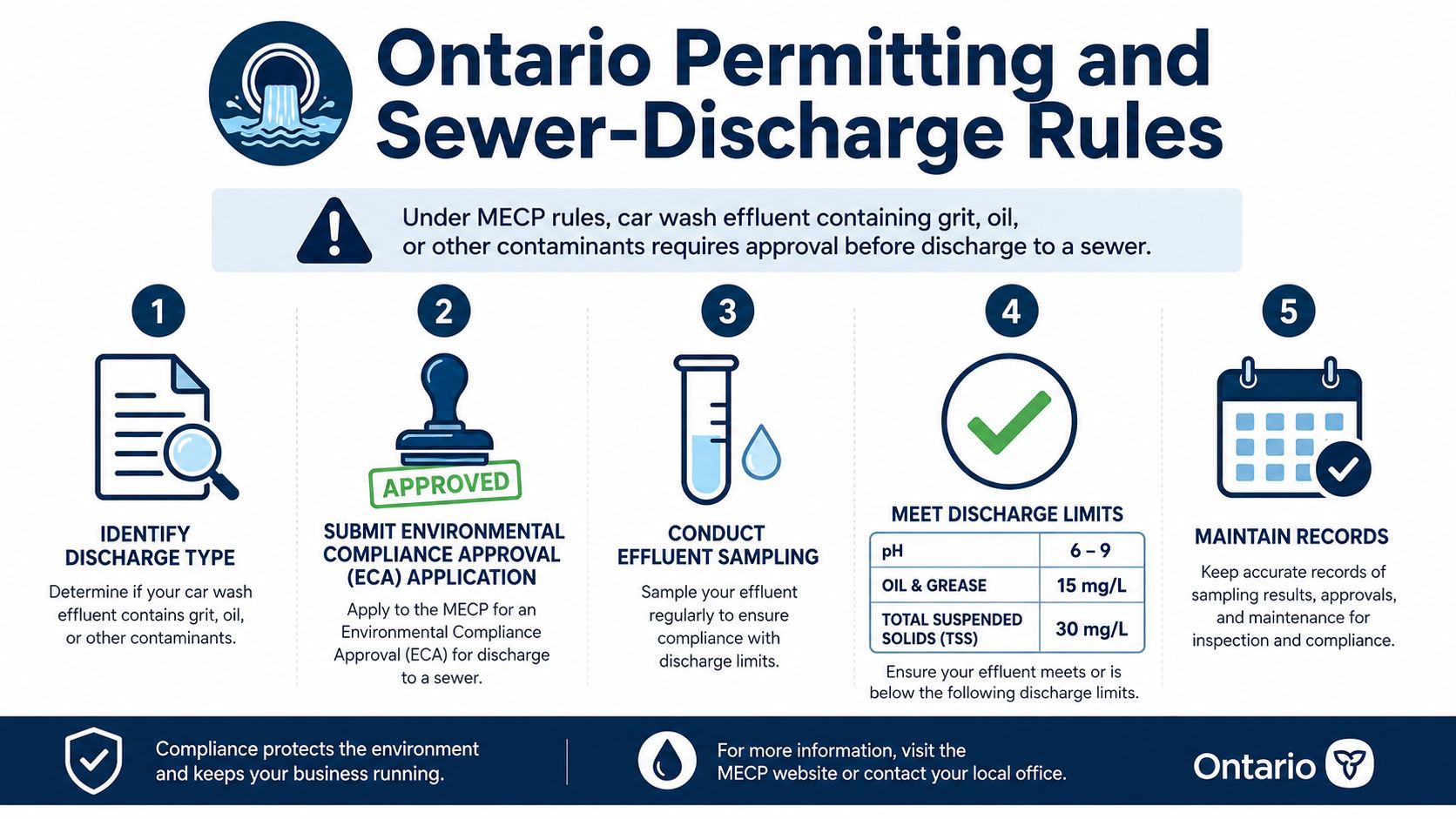
Toronto's sewer guidance establishes the basic rule. Commercial washes must treat wastewater before sanitary-sewer discharge, and outdoor washing runoff cannot enter storm sewers. Municipal standards may also address oil-water separator performance, including a 50 mg/L oil-and-grease benchmark, as described in the Ontario code reference linked above.
Toronto details require careful verification
Toronto requirements can include limits for suspended solids, oil and grease, and pH. A site with substantial discharge may also need a Site Management Plan. The approval process can require effluent information, engineering documents, and operating records. The exact obligation depends on the property, discharge arrangement, and municipal interpretation, so an equipment supplier's generic checklist cannot replace confirmation from the local authority.
A reclaim tank reduces the volume discharged per vehicle. It does not eliminate documentation for the water that still leaves the site. Keep interceptor sizing information, equipment specifications, detergent safety documentation, sampling results, pump-out records, and recycling or disposal receipts together.
The sewer authority needs to understand not only what the system can do, but also what the operator actually does each day.
Requirements can differ across Mississauga, Brampton, Vaughan, Hamilton, and other municipalities. A pre-design call with the local sewer-use or wastewater officer can identify constraints before construction fixes the layout. For general context on drainage infrastructure and contractor terminology, this drain cleaning service guide from MG Plumbing Services may help explain industry terms. It is not Ontario guidance, so operators must confirm requirements with their own municipality. five permit-related resources also need local verification before being presented as Ontario authorities.
Costs, Savings, and Payback
Recycling pays for more than reduced freshwater use. Its value also comes from managing sewer discharge, reducing disposal demands, keeping wash capacity available, and preventing failures caused by uncontrolled solids and oil. A storage tank alone does not create savings. The system must match the site's traffic, layout, discharge arrangement, and maintenance capacity.
Capital costs commonly include collection pits, settling chambers, oil-water separation, reclaim storage, pumps, filters, controls, electrical work, plumbing connections, and engineering. Underground construction can make excavation more difficult. Above-ground tanks use operating space, while treatment equipment needs clear access for inspection and servicing.
| Line Item | Self-serve Bay | Express Tunnel | Full-service |
|---|---|---|---|
| Collection and settling | Compact pits suited to intermittent flow | Typical pit volume is often 2 000–5 000 L, with capacity for peak flow | Sized for the combined wash menu and traffic pattern |
| Separation | Grit and oil control | Higher flow requires accessible separation equipment | Chemical and solids loading guide separator selection |
| Filtration | Serviceable media may be sufficient | Multiple treatment stages can support steady throughput | Media must tolerate waxes, polishes, and changing chemistry |
| Controls and monitoring | Basic alarms and testing points | Automation can help staff respond before flow is interrupted | Monitoring should reflect variable chemical use |
| Maintenance burden | Irregular use can make routines inconsistent | High flow loads pits and media quickly | Chemical mix can increase cleaning and replacement needs |
Savings arrive in several forms
Fresh municipal water is only one bill. Review sanitary-sewer charges, interceptor capacity, disposal frequency, pump energy, and revenue lost during shutdowns. Lower discharge can simplify sewer management, but it does not remove blowdown or separator pump-outs.
The conservation case also includes heated water. Natural Resources Canada has estimated that an average commercial car wash uses 260 litres of heated water per vehicle and about 1,300 gigajoules per year to heat water, as reported in Canadian car wash sustainability guidance. Those figures show why water reclamation became an important efficiency strategy in Canada, while the financial result still depends on each facility's operating conditions.
Calculate payback from site records
Build the model from invoices and meter readings rather than a standard industry promise. Track vehicles washed, freshwater intake, sewer discharge, chemical use, separator servicing, filter replacement, disposal, and system maintenance. Compare those recurring costs with the installed equipment and any required construction.
Payback will vary. A busy tunnel facing high sewer costs may support advanced treatment sooner. A low-volume rural self-serve site with permissive sewer arrangements may gain more from effective pretreatment and disciplined water management than from a complex reclaim loop. The useful question is whether the system reduces total operating risk and expense while meeting the site's discharge obligations.
Winter Demand and What It Does to Recycled Water
Winter changes the operating problem. Salt, grit, mud, and de-icing residue arrive together, and Ontario customers often want frequent washes to remove contamination from paint, wheels, and underbody areas. Recycling can still support that demand, but the system's water quality depends on how quickly operators remove the material entering the wash stream.
Public Canadian guidance recognises water conservation in commercial washing, but it doesn't provide Ontario-specific winter performance data for reclaim systems. That gap matters. Operators shouldn't turn a general savings claim into a promise that every system will perform identically through a GTA winter.
Contaminants load the system faster
In a representative tunnel operation, salt-heavy vehicles can push more grit and dissolved material into the pits than cleaner summer traffic. Settling chambers fill sooner, oil-separation components need closer attention, and polishing filters can load rapidly. The result may appear first as reduced reclaim pressure, cloudy water, foaming, residue on vehicles, or an unstable discharge sample.
The system may still be recycling water, but its practical value is now a throughput question. If staff must stop frequently to clean a pit or replace blocked media, headline water savings don't compensate for lost wash capacity.
Seasonal adjustments protect uptime
Experienced operators treat winter preparation as a planned service period rather than an emergency response. They inspect collection points more often, remove accumulated grit before it migrates through the treatment train, review detergent dosing, and confirm that alarms and pumps work under the expected load.
A winter checklist might include:
- Inspect collection pits: Remove settled grit before it reduces usable capacity.
- Review chemical dosing: Excess detergent can increase foam and complicate separation.
- Watch filter behaviour: A rapid pressure change signals loading or a flow problem.
- Track water quality: Compare observations with sampling results and discharge requirements.
- Schedule service early: Don't wait for a failed pump or blocked separator during peak demand.
A well-tuned system can help maintain compliant operation under difficult conditions. A poorly maintained one can turn a treatment asset into a bottleneck. Operators should also decide openly how winter preparation enters pricing, membership economics, fleet contracts, and staffing plans.
Maintenance Habits That Keep Systems Compliant
Maintenance is the part customers don't see and inspectors eventually do. A reclaim system can be correctly designed and still fail because staff ignore a rising tank level, leave a trench drain packed with grit, or postpone separator service until the pump stops.
The schedule should be simple enough for a shift supervisor to follow and specific enough to create a useful record.
A workable service rhythm
Every day, staff should inspect tanks, pits, alarms, pumps, visible oil accumulation, unusual odours, foam, and reclaim pressure. Record observations rather than relying on memory. Where the site's plan requires testing, carry out the scheduled pH, turbidity, or other checks with calibrated equipment.
Every week, clean accessible trench drains and inspect the pit for sediment buildup. Check separator performance, confirm valves are in their intended positions, and review whether filters are loading faster than usual.
Every month, service filters and pumps according to the equipment manufacturer's instructions. Review sensor calibration, inspect tank fittings, confirm blowdown arrangements, and file sampling and disposal records in one location.
Troubleshoot symptoms, not just equipment
Foamy water may indicate excessive detergent, poor separation, or a change in the chemical programme. A foul odour can point to stagnant water, organic buildup, or inadequate turnover. Reduced reclaim pressure may come from a blocked filter, failing pump, closed valve, or low tank level.
A sudden rise in suspended solids, visible oil carryover, an overflow alarm, or a discharge result outside the approved limits deserves immediate attention. Stop or isolate the affected stream when necessary, notify the responsible operator, and document what happened. The right response depends on the site's approval and municipal direction, but ignoring the signal is never a maintenance strategy.
Record the correction, not just the failure. A useful log shows the date, reading, observation, action taken, person responsible, and follow-up result.
FAQs for Operators and Customers
Does recycled water scratch paint?
Reclaimed water does not scratch paint because it has been reused. The concern is abrasive grit or other solids that reach the vehicle after poor settling, overloaded filters, or neglected wash equipment. Operators should keep final-contact equipment clean and check water quality so residue is caught before it becomes a customer complaint.
How often do filters and separators need service?
There is no universal interval. Vehicle volume, wash chemistry, pit capacity, flow, and seasonal contamination all affect service needs. Use pressure changes, tank observations, sampling results, and manufacturer instructions together. During salt season, inspect sooner when solids or filter loading increase rather than waiting for a fixed calendar date.
What permits does a GTA wash need?
Requirements depend on the municipality, site design, discharge route, and treatment equipment. Commercial wash water generally requires treatment before sanitary-sewer discharge, while outdoor runoff must stay out of storm sewers under Toronto guidance. Before design work starts, contact the local sewer-use authority. Keep engineering documents, chemical safety information, sampling logs, and disposal records available.
Can recycling handle winter salt?
A reclaim system can manage winter operations when salt, grit, and concentrated dissolved contaminants are handled as part of the operating routine. Follow the winter checklist from the earlier section: inspect pits more often, watch filter loading, confirm blowdown, and record water-quality changes. Operators in Brampton report pit cleanout every 3–5 days during the January salt season, which illustrates why winter service intervals cannot follow a quiet-season schedule.
Is reclaimed water suitable for every wash stage?
Usually, the water supply is divided by task. Reclaimed water may serve stages with greater tolerance for variability, while fresh water is reserved for final rinsing or other applications where spotting and finish matter most. The right split depends on treatment quality, equipment design, chemistry, and the operator's quality standard.
When does recycling make the most sense?
Use a simple decision tree:
- If the site has frequent sewer-management concerns, confirm discharge requirements and treatment space before comparing equipment.
- If winter closures, tank limits, or wastewater handling interrupt production, assess reclaim as an uptime tool rather than only a water-saving purchase.
- If the site has modest volume and little discharge pressure, improve grit and oil pretreatment first, then compare the cost of a reclaim loop with simpler controls.
- If customers or staff report spotting, odour, or inconsistent wash quality, test the water and identify the cause before installing recycling equipment.
For customers, ask whether the facility treats wash water, keeps runoff out of storm drains, and maintains its equipment. For operators, car wash water recycling pays when it solves a real intake, discharge, or uptime problem, not when it supports only a sustainability slogan.
Nanak Car Wash offers express exterior washes, full-service cleaning, detailing, and rust proofing across communities in the GTA, with wash-water recycling identified as part of its environmental efforts. Visit Nanak Car Wash to choose a convenient wash or ask the team how its process helps manage Ontario road salt and vehicle-wash wastewater.



 6600 Finch Ave W, Etobicoke, ON M9V 3Z6
 647-703-8515
 MON – SUN 8 AM to 7 PM