
You're scraping a white salt haze from the fenders before work, watching slush drip from the rocker panels and wondering whether a ceramic coating service would have prevented the mess. It wouldn't. Your car would still be dirty, the underbody would still collect brine, and the coating wouldn't stop a stone from cracking the paint.
What it can do is make the mess less stubborn. Properly prepared coated paint sheds salt-laden water more readily, releases road film with less scrubbing, and gives contaminants less opportunity to bond tightly to the clear coat. For a GTA commuter, that makes ceramic coating a maintenance tool, not an invisible suit of armour.
Table of Contents
- The Winter Morning That Starts the Whole Question
- What Ceramic Coating Actually Does to Your Paint
- Ceramic Coating Compared to Wax Sealant and PPF
- What a Real Ceramic Coating Service Costs in the GTA
- What Happens During the Appointment and Why Prep Matters
- Honest Myths Worth Dropping Before You Buy
- Maintenance That Actually Protects the Coating
- Picking a Detailer and Knowing If It Is Right for You
The Winter Morning That Starts the Whole Question
A Mississauga driver sees the same scene after a March commute: frozen fenders covered in white residue, slush dripping from the rocker panels, and dirty spray coating the 401. The car looks clean after a rinse, then the next trip covers it again.
Salt still lands on coated paint. Slush still reaches the doors, mirrors, wheels, and undercarriage. Leave that contamination in place and no coating can protect the finish indefinitely. Ontario-focused guidance identifies road salt as a major environmental stressor for vehicle finishes, with sodium chloride and magnesium chloride brines commonly used from roughly November through March, as explained in this Ontario coating guide.
The benefit shows up during washing. At a coin wash, a properly maintained coating usually helps grime release with less effort because the surface remains highly water-repellent. You still need a thorough rinse and contact wash, but you reduce the chance of dragging bonded salt and grit across the clear coat.
My rule for GTA commuters: buy a coating for easier, safer maintenance. Ignore any salesperson promising spotless paint through an Ontario winter.
Ontario conditions challenge every protectant. Road salt, wet brine, freeze-thaw cycles, road grit, and delayed washing create the test. Ontario-focused ceramic coating service guidance describes the province's heavy salt exposure, but the exact tonnage matters less to an owner than the repeated contamination reaching the paint every week.
A coating works best as part of a maintenance routine. Rinse the car before salt dries hard, wash without grinding grit into the panels, and clean the lower doors and wheels instead of focusing only on the hood.
The useful question is not whether ceramic coating stops salt. Ask whether it reduces the cleaning effort and contamination load enough to justify its price. For a daily driver parked outside, often yes. For an owner who rarely washes the car, no protectant will rescue the finish.
What Ceramic Coating Actually Does to Your Paint
A professional ceramic coating cures into a thin, silica-based layer bonded to the clear coat, rather than a thick physical barrier. It does not replace paint, fill deep scratches, or stop impact damage. Proper preparation lets the coating attach evenly and create a harder, more chemically resistant surface than ordinary wax.
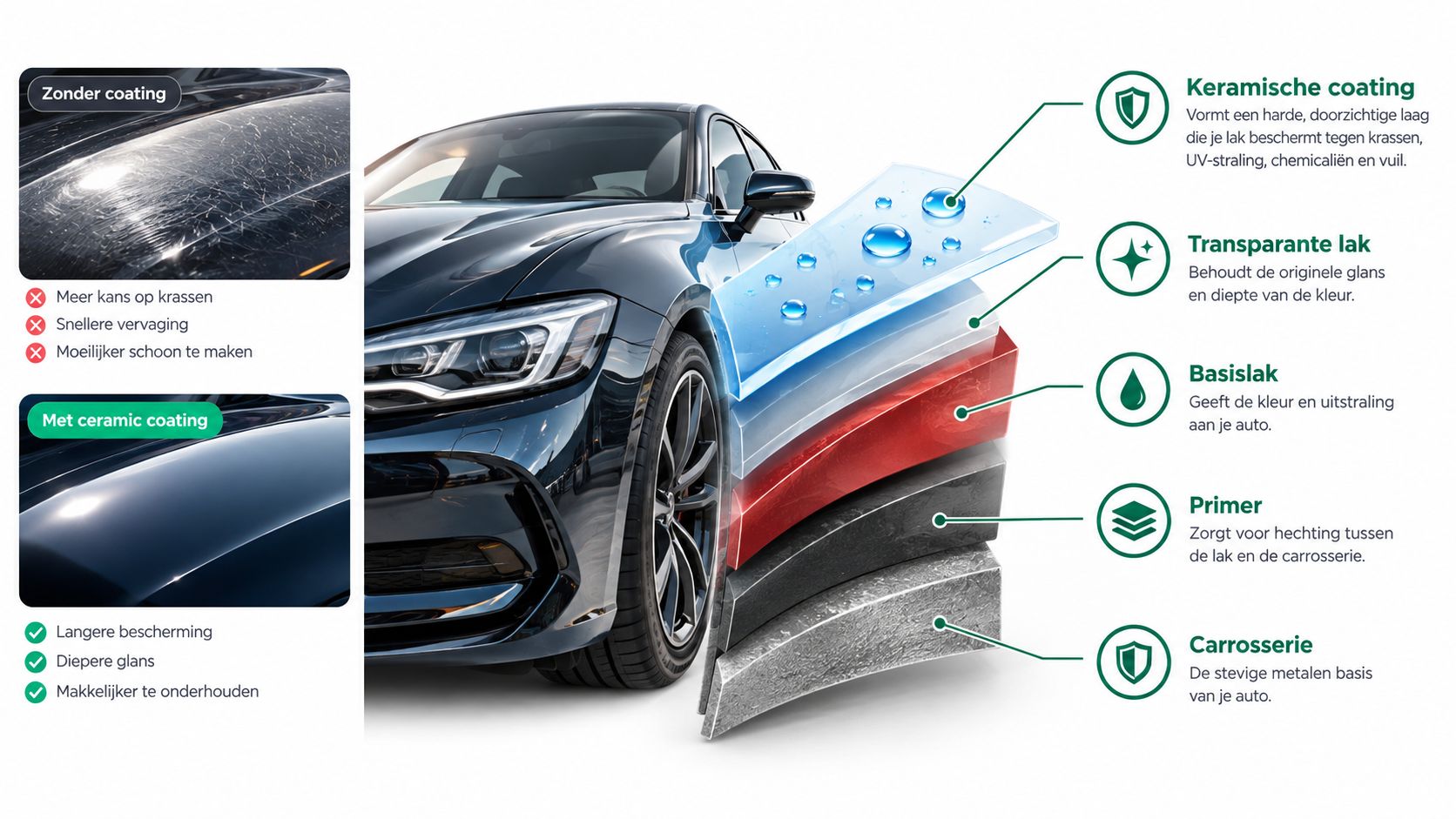
The practical advantage is easier contamination management. Water beads or sheets away more readily, while dirt, brine residue, and organic contamination have less grip. A strong pre-rinse can therefore remove more loose material before a wash mitt reaches the paint. Bird droppings, bug residue, and tree sap also get a better chance of coming off before they etch the clear coat.
The protection you're actually buying
A professional coating delivers useful protection, but its limits matter:
- Hydrophobic behaviour: Water and salt-laden spray leave the panel more readily instead of sitting across the surface.
- Chemical resistance: Manufacturers typically claim tolerance across a wide range, often around pH 1 to 13, and in some formulations pH 14. Treat that as product guidance, not permission to leave winter chemicals on the car.
- Simpler washing: Less bonded contamination can reduce the aggressive agitation needed during routine cleaning.
- Gloss and clarity: A clean, corrected surface looks deeper and sharper under controlled lighting.
- More reaction time: Bird waste, insects, and sap may be easier to remove before permanent etching begins.
The coating does not eliminate contamination. Ontario salt still needs to be removed, and repeated exposure can wear down the coating's top layer. Poor maintenance, embedded dirt, and harsh washing can reduce performance even when the product and installation are sound.
Wax, sealant, and coating are different products
Carnauba wax sits over the paint and provides warm gloss with short-term sacrificial protection. A synthetic polymer sealant forms a tougher film and generally delivers stronger water behaviour. A professional coating chemically bonds to a properly prepared surface and keeps its intended characteristics through a longer service interval.
Retail spray products can work as maintenance layers, but they are not automatically equivalent to a professional-only coating. Product chemistry, paint preparation, application conditions, cure time, and aftercare all affect the result. Ceramic coating still won't stop rock chips, prevent key scratches, or replace careful washing. For GTA owners, its strongest case is easier maintenance through salt, slush, and repeated contamination, not miracle-level paint protection.
Ceramic Coating Compared to Wax Sealant and PPF
The right protection depends on the damage your car faces. Ceramic coating makes contamination easier to manage and washing less demanding. Paint protection film handles impact. Wax and sealant suit owners who accept regular refreshes in exchange for lower commitment.
| Option | What drives cost | Lifespan | Protection Type | Best For |
|---|---|---|---|---|
| Traditional carnauba wax | Product and hand-application time, with no correction | Short-term | Surface gloss and sacrificial protection | Weekend cars and owners who enjoy frequent detailing |
| Synthetic polymer sealant | Product, preparation, and application time, usually without major correction | Longer than wax, but still requires regular renewal | Chemical and environmental surface protection | Budget-conscious daily drivers |
| Paint protection film | Coverage area, such as partial front versus full front, film brand, and installer labour | Long-term | Impact barrier against chips and abrasion | Highway cars, track cars, and high-value front ends |
| Professional ceramic coating | Paint correction, coating tier, number of layers, vehicle size, and warranty terms | Multi-year protection when maintained | Hydrophobic and chemical-resistant surface layer | Daily GTA commuters seeking easier washing |
Ask for an itemized quote covering correction, layers, included surfaces, curing, and warranty. A package name alone does not tell you how much preparation or product the vehicle receives.
Match the product to the driver
A weekend garage car does not need a multi-year coating to look excellent. Quality wax suits an owner who enjoys hand application and regular upkeep. A synthetic sealant gives a daily driver a longer refresh interval without the preparation and commitment of a professional coating.
Daily GTA commuters face salt, slush, and road film repeatedly. A professional coating can make that contamination easier to remove, which matters when winter washing already demands extra care. It does not prevent paint damage, and it does not make neglected washing safe.
PPF belongs on impact zones. Highway driving, a new luxury vehicle, or concern about stone chips justify film on front-facing panels. Ceramic coating can be applied over the film and remaining paint to support easier cleaning, but ceramic coating is not a substitute for PPF.
Budget-focused owners should choose a good synthetic sealant and spend the rest on consistent washing. Matching the product to your driving, storage, cleaning habits, and tolerance for maintenance beats buying the most expensive package in the shop. A GTA winter commuter may gain more from correctly prepared coating and disciplined rinsing than from a premium product applied over neglected paint.
What a Real Ceramic Coating Service Costs in the GTA
A legitimate quote starts with the paint, not a menu name. Two identical vehicles can need very different work because one has careful wash history and the other has years of tunnel-wash swirls, iron fallout, tar, and water spotting.
The verified Ontario market data supports a broad picture of an established service category. Independent estimates place Canada's ceramic coating market at about USD 0.50 billion in 2026, representing 10.1% of the North American market, while another estimate values the Canadian market at USD 0.68 billion in 2025 and projects continued growth through the following years in this Canadian market estimate. Those figures describe the market, not what your vehicle should cost.
What the invoice should reveal
A useful quote separates the work into visible line items:
- Decontamination: Wash, chemical fallout treatment, tar removal, and clay treatment.
- Paint correction: State whether the shop plans a single-stage polish or multi-stage correction.
- Product: Name the coating brand, product tier, expected service interval, and installer requirements.
- Application: Clarify the number of layers and whether wheels, glass, trim, or plastics are included.
- Curing: Identify the indoor curing conditions and vehicle handover timing.
- Aftercare: Include maintenance instructions, recommended products, and any warranty registration.
If the quote says “full ceramic package” with no explanation of the correction process, you're buying a label. A shop should inspect the paint and explain what it can safely improve.
How to judge package tiers
Entry-level spray-infused sealants can make sense when the owner wants better cleaning and water behaviour without a major correction appointment. Mid-tier coatings may suit a reasonably clean vehicle whose owner wants a more durable layer. Higher-priced professional packages become reasonable when they include substantial preparation, controlled application, documented product coverage, and meaningful aftercare.
Be suspicious of a quote below the local market that promises multi-year durability without describing prep. An unnecessary engine-bay coating on a daily driver is also a common way to inflate the invoice. Spend the money on paint correction, wheels, and proper maintenance instead.
Pricing can vary between Mississauga, Markham, downtown Toronto, and Hamilton because rent, labour, shop capacity, vehicle size, and correction difficulty differ. The cheapest quote often reflects less preparation or a different product, not a better deal.
What Happens During the Appointment and Why Prep Matters
A proper appointment is a controlled process, not a quick wash followed by a spray bottle. Many GTA shops need one to two days for inspection, preparation, correction, coating, and curing, depending on vehicle condition and package scope.
The appointment starts before the coating
The detailer should inspect the vehicle under strong lighting, record existing defects, and take paint-thickness readings where appropriate. That information helps determine whether the paint can tolerate aggressive correction or needs a conservative polish.
Preparation normally includes:
- A thorough wash to remove loose dirt and road film.
- Chemical decontamination for iron fallout and tar.
- Mechanical clay treatment to remove bonded particles.
- Masking around trim, rubber, badges, and sensitive edges.
- Machine polishing to improve the paint surface.
- An alcohol-based panel wipe to remove polishing oils.
- Coating application in controlled lighting.
- Curing indoors, sometimes with infrared assistance.
The correction stage deserves the most attention. Compound removes more material than finishing polish, so the detailer must balance defect removal against remaining clear-coat thickness. A single-stage polish may improve light swirls, while deeper defects can require multiple stages, but more cutting isn't automatically better.
The coating preserves the preparation. If the paint looks hazy, swirled, or stained before application, the coating can make that finish more obvious rather than hiding it.
Curing is part of the service
After application, the coating needs time to settle and harden. The vehicle should remain protected from water, dew, road grime, and accidental contact during the initial cure window. Your shop should explain exactly when you can drive the car, wash it, and expose it to winter weather.
A rushed handover creates avoidable risk. Ask whether the shop has an enclosed, clean space for application and curing, and whether infrared lamps are used as part of that shop's process. Equipment alone doesn't guarantee quality, but uncontrolled dust, moisture, and temperature make consistency harder.
Honest Myths Worth Dropping Before You Buy
Ceramic coating has a job, not superpowers. It can make washing easier and help protect prepared paint, but GTA winter exposure still sets limits.
Myth one, lifetime means forever
No silica-based coating lasts forever. Properly maintained professional coatings commonly run about three to five years. Entry-level professional products may last one to two years, while consumer spray coatings often reach six to eighteen months. In daily-driven, outdoor-parked GTA use, especially through salt and slush, expect the lower end of each range. Garage-kept summer cars can trend higher.
A “lifetime” promise may refer to a warranty period, controlled test conditions, or a package that assumes strict maintenance. Ask the detailer to define the term in writing and explain what voids coverage.
Myth two, the car becomes maintenance-free
Salt, pollen, brake dust, sap, and road film still settle on the surface. Stop washing, and contamination builds up, masking the coating's water behaviour and making removal harder.
Myth three, the finish becomes scratch-proof
A coating can reduce wash friction and resist light marring. It will not stop keys, branches, shopping carts, or dirty brushes. Physical impact still reaches the paint, so PPF remains the better choice for high-impact areas.
Myth four, hydrophobicity eliminates washing
Beading proves water is behaving differently, not that the vehicle is clean. Hydrophobicity helps contamination rinse away, but salt left on the paint continues exposing the surface to winter chemistry.
Myth five, a retail kit equals professional work
A consumer kit can provide useful protection when applied carefully. It does not automatically match a professional formula or installation. Without proper decontamination and polishing, the product bonds over existing stains, swirls, and bonded grime.
Maintenance That Actually Protects the Coating
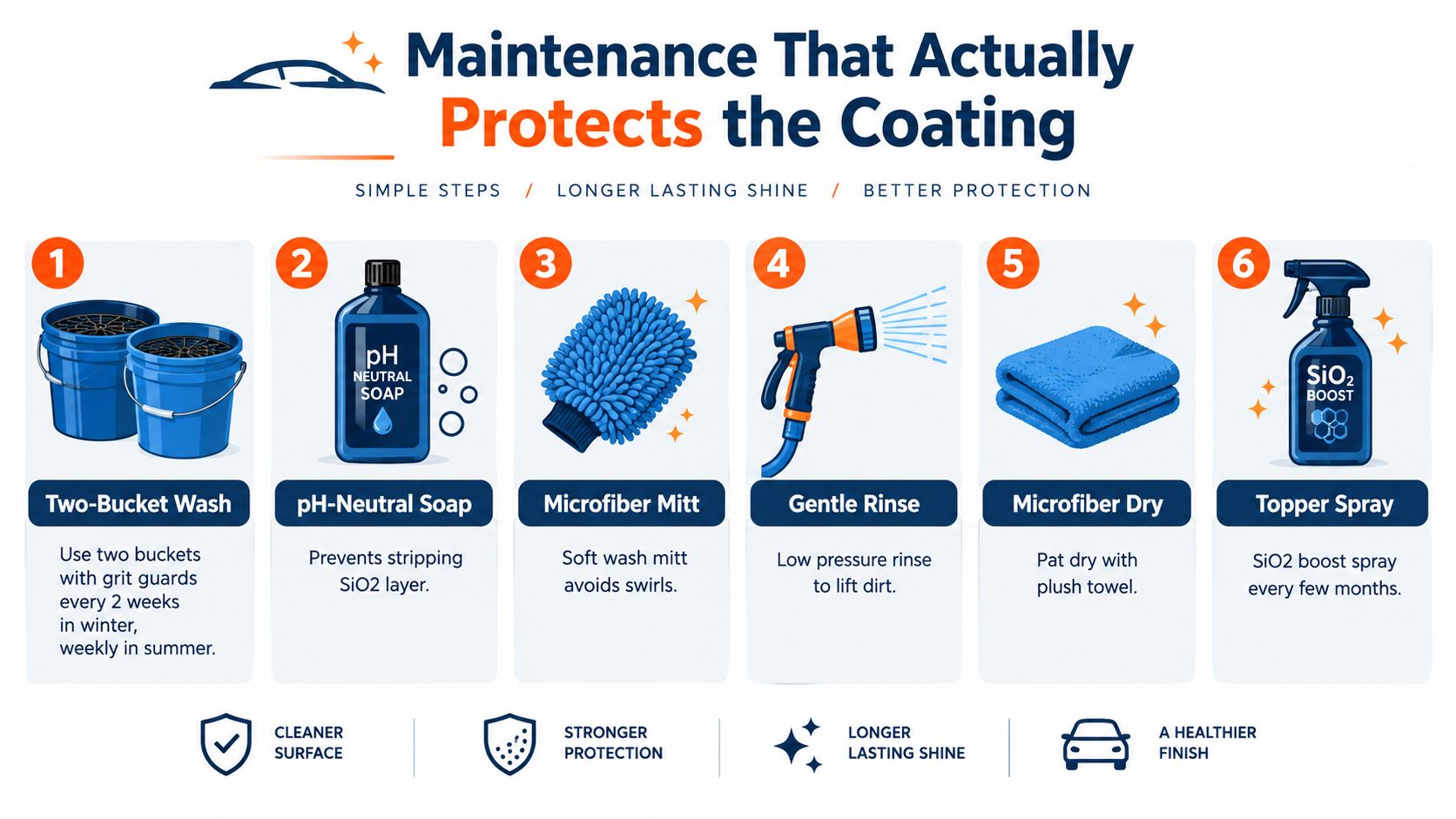
A ceramic coating rewards disciplined washing, not neglect. In Ontario, salt-laden water still reaches the vehicle, although a hydrophobic surface helps it bead and run off. Leave salt, road film, and mineral deposits in place, and they can mask the coating's water behaviour while shortening its useful life. Ontario guidance explains the failure mechanism.
Use a two-bucket wash with grit guards. Keep pH-neutral shampoo in one bucket and clean rinse water in the other. A soft microfiber mitt reduces the chance of dragging grit across the paint. Rinse the vehicle thoroughly before touching it, especially around rocker panels, wheel arches, and lower doors where GTA slush collects.
During winter, make washing a regular shop recommendation rather than waiting for a heavy crust. Wash about every two weeks while salt is active, and move sooner when white haze or visible road film appears. In summer, weekly washing is a sensible routine because pollen, insects, bird waste, and dust can sit on the surface between visits. These intervals are practical maintenance guidance, not a guaranteed service schedule.
Avoid the wrong kind of convenience
Brush-equipped automatic washes can mark any corrected finish. Rotating brushes collect debris, then drag it across the paint. Ceramic protection does not make that contact safe.
A touchless wash is the better emergency choice when hand washing is impossible. Its stronger chemicals may be harder on maintenance products, and the spray cannot replace careful contact washing. Rinse thoroughly, then inspect the lower panels instead of treating a quick tunnel visit as complete coating care.
Use a coating-compatible topper or silica spray sealant when the installed system allows it. Follow the product directions. Random waxes and incompatible layers can leave residue, reduce predictable water behaviour, and complicate later maintenance.
Read the surface before it fails
Look for three warning signs:
- Loose beading: Iron fallout or other contamination may be sitting above the coating.
- A grabby feel: Bonded road film or mineral deposits may be hiding the coating's performance.
- Dullness in direct light: Contamination may need removal, or the surface may require a maintenance polish.
Match seasonal care to the contamination. Spring calls for salt and underbody residue removal. Summer brings pollen, insects, and bird waste. Autumn adds sap, wet leaves, and debris that should not remain on the paint.
A coating is easiest to preserve when contamination is removed gently and early.

Picking a Detailer and Knowing If It Is Right for You
Interview the detailer before you hand over the keys. A polished website and dramatic before-and-after photos don't prove that the shop can prepare your particular paint safely.
Ask these questions directly:
- Which exact coating will you install? Get the brand, product name, expected service interval, and installer certification level in writing.
- Is paint correction included? Ask whether the quote covers a single-stage polish, multi-stage correction, or no correction at all.
- What does preparation include? You should hear about washing, chemical decontamination, clay treatment, inspection, and panel wipe.
- Where will the vehicle cure? Confirm that application and curing happen indoors in a controlled, clean space.
- What does the warranty cover? Ask what maintenance is required, what voids coverage, and whether registration is included.
- Are customer vehicles insured? Request proof of commercial liability and ask how the shop handles accidental damage.
The answers matter more than the package name. A detailer who explains limitations clearly is usually easier to trust than one who promises permanent gloss, scratch-proof paint, and zero washing.
Red flags that should stop the booking
Walk away from vague product descriptions such as “premium nano ceramic” with no named manufacturer. Be cautious if the shop can't show corrected paint under direct lighting, pushes you to book immediately, or refuses to separate correction from coating in the quote.
A dramatically undercut quote deserves scrutiny. It may use a lower-tier product, skip correction, rush curing, or reduce labour. None of those choices automatically makes the service worthless, but they should be disclosed before payment.
Who should buy and who should pass
A coating suits GTA drivers who park outdoors, commute through salt and slush, keep vehicles beyond the shorter ownership cycle, or enjoy hand washing and want that work to be easier. It can also suit a leased vehicle that needs to remain presentable through its ownership period, provided the package cost makes sense against the planned use.
Skip it if you never wash your car, need the lowest possible ownership cost, plan to sell within a short period, or expect protection from rock chips. Put that money into regular washing, paint sealant, rust proofing, or PPF on impact areas instead.

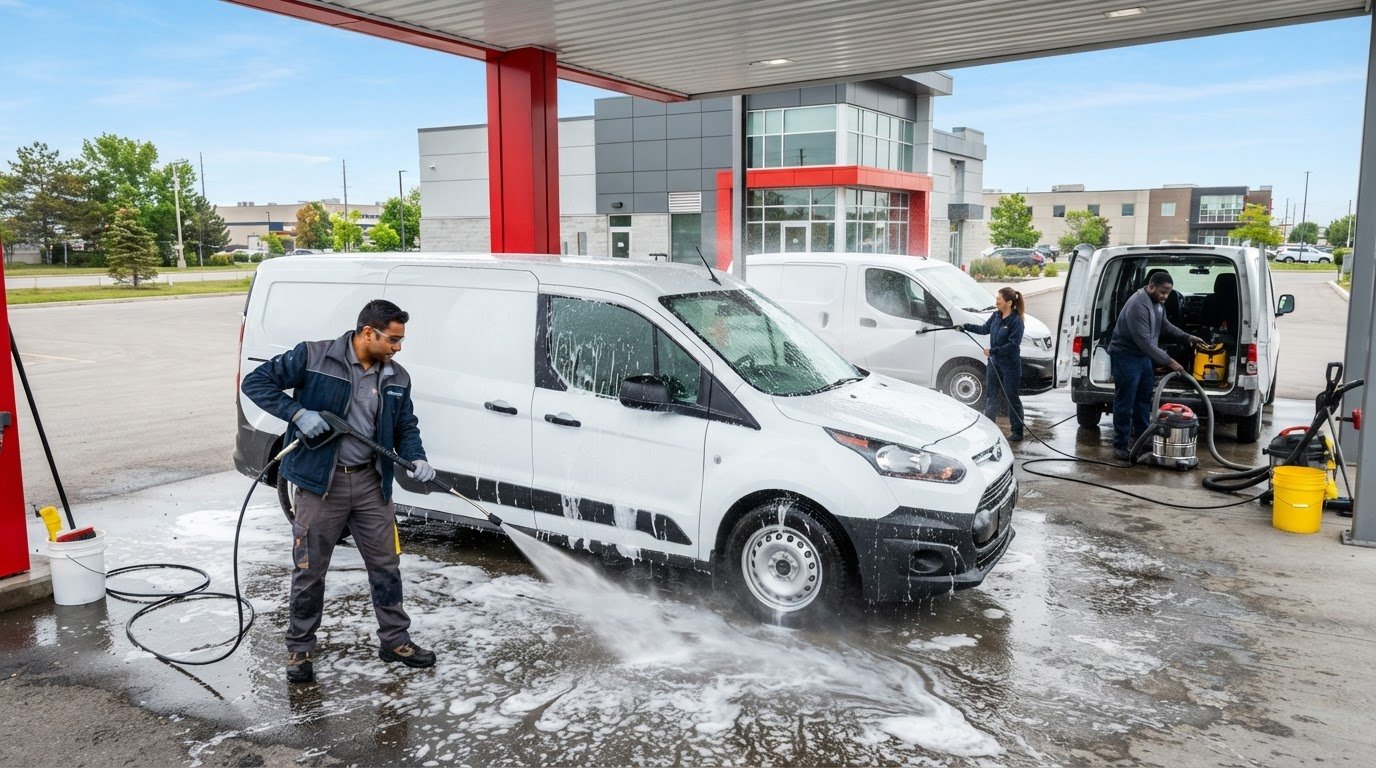
Nanak Car Wash offers express and full-service washes, interior and exterior detailing, and automotive rust proofing across GTA locations, which can help owners keep salt and road film under control between larger protection appointments. Review the available services and maintenance options at Nanak Car Wash before deciding whether a full ceramic coating service fits your vehicle and washing habits.

 6600 Finch Ave W, Etobicoke, ON M9V 3Z6
 647-703-8515
 MON – SUN 8 AM to 7 PM