
Most GTA comparison articles crown ceramic coating before asking the only question that matters: will you maintain it properly, and will you keep the vehicle long enough to justify it? If you already wash your car every Saturday, park it in a garage, or plan to return a lease soon, a premium coating can be an expensive way to buy protection you were already providing yourself.
Ontario roads still make ceramic coating valuable. Salt, slush, road film, bug splatter, bird droppings, UV exposure, and repeated washing punish unprotected paint. But ceramic isn't magic, and wax isn't automatically foolish. The right choice depends on your ownership horizon, wash habits, parking situation, vehicle condition, and resale timing.
| GTA owner profile | More sensible choice | Why |
|---|---|---|
| Long-term owner parking outdoors | Professional ceramic coating | Less frequent full reapplication and stronger resistance to seasonal contamination |
| Weekend vehicle stored indoors | Wax or sealant | Low exposure makes a premium coating harder to justify |
| High-mileage driver washing constantly | Ceramic, if maintenance is disciplined | Easier cleaning and longer protection can offset the higher entry cost |
| Older vehicle with worn clear coat | Wax or sealant | Coating won't repair failing paint |
| Short-term owner or lease return | Wax or sealant | Lower commitment and easier cost control |
Before approving any quote, review a practical guide to ceramic coating costs explained, then compare that investment with how you use the car. The sections below separate the chemistry from the sales pitch, then deal with Ontario durability, ownership cost, real maintenance, and the situations where ceramic is overkill.
Table of Contents
- Why the Ceramic Coating vs Wax Question Is Trickier Than It Looks
- What Ceramic Coating and Wax Actually Do on Your Paint
- Durability and Protection Compared in Ontario Conditions
- The Real Cost Over Time for GTA Drivers
- Matching the Option to Your Driving Reality
- What Maintenance Looks Like After You Choose
- A Simple Decision Checklist for Your Vehicle
Why the Ceramic Coating vs Wax Question Is Trickier Than It Looks
The popular advice is simple: wax lasts weeks, ceramic lasts years, so ceramic wins. That advice leaves out the maintenance tax. A coating can reduce how stubborn dirt feels during a wash, but it still needs the right wash chemistry, safe drying, and regular attention. If you apply a premium coating and then send the vehicle through brush tunnels every week, you haven't bought a low-effort ownership experience. You've bought a product that demands a different routine.
The first deciding factor is how long you'll own the vehicle. A driver keeping a car for several years has more time to benefit from a durable application. Someone selling, trading, or returning a lease relatively soon may not recover the upfront expense, especially if the paint already has visible defects or the next owner won't value the documentation.
Your Saturday wash changes the calculation
A GTA owner who washes every week already removes salt, grime, and contamination before they sit for long periods. That habit reduces some of the practical difference between a coating and a sacrificial product. Ceramic can still make each wash easier, but the financial break-even point becomes less obvious when the owner is already spending time or money on regular cleaning.
Parking matters just as much. A vehicle kept outdoors in East York faces more direct exposure to tree sap, bird droppings, weather, and road contamination than a car stored indoors in Mississauga. An outdoor daily driver has a stronger case for durable protection than a sheltered weekend car.
Used paint deserves an honest assessment
Ceramic coating doesn't turn tired paint into new paint. Professional installation requires proper preparation, and coating over heavy swirls, oxidation, or clear-coat wear can preserve those flaws under the cured layer. For an aging SUV, work van, or commuter with an uncertain resale date, frequent washing plus a lower-commitment wax or sealant may protect the budget better.
My GTA rule: Don't buy ceramic because the product sounds more advanced. Buy it when your driving, parking, ownership period, and maintenance habits give the coating enough time to earn its premium.
What Ceramic Coating and Wax Actually Do on Your Paint
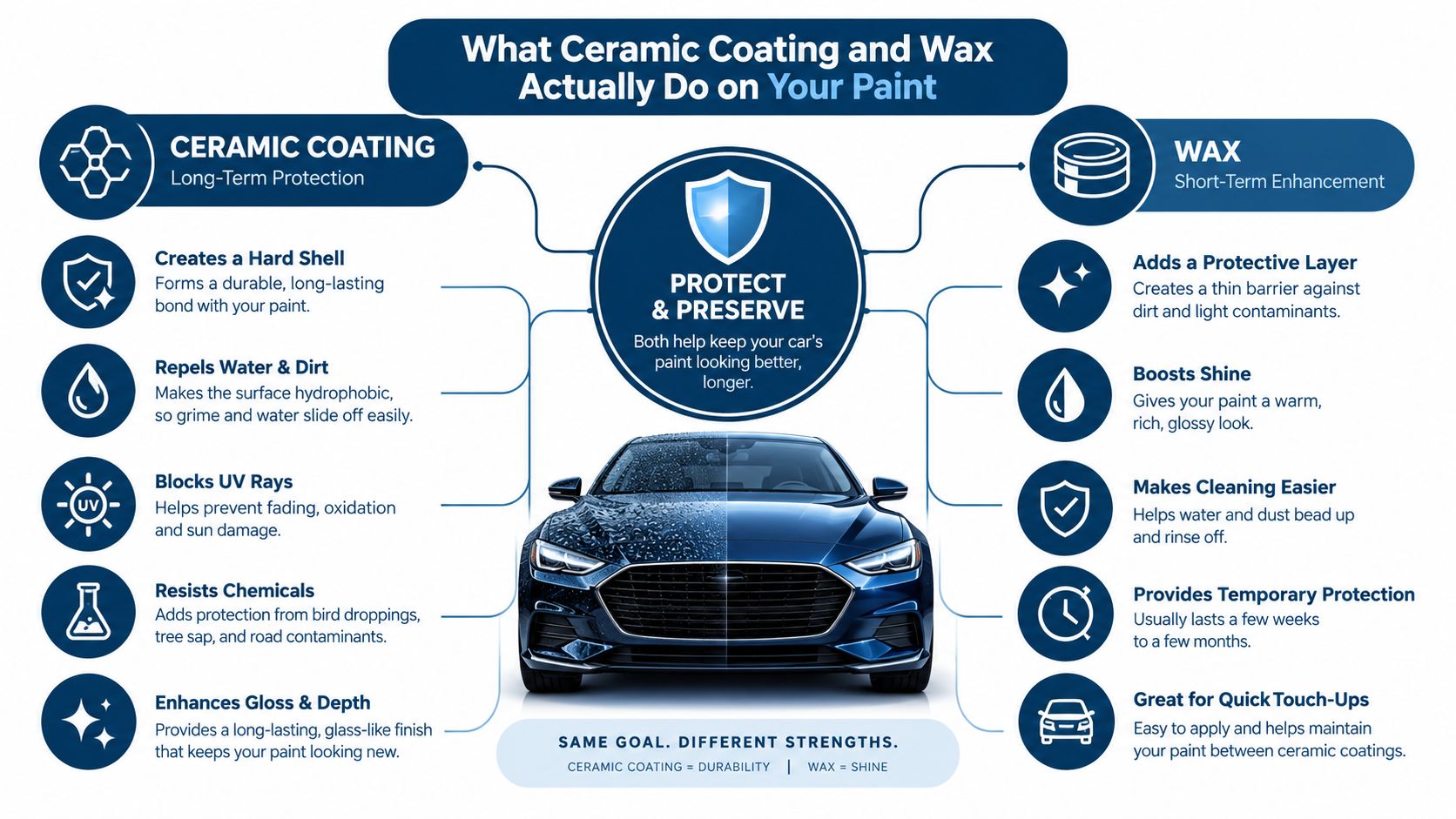
Wax and ceramic coating protect paint in different ways. Traditional wax is a sacrificial layer that sits over the clear coat. It creates gloss, improves water behaviour, and takes some environmental abuse before it wears away through heat, washing, and exposure.
That temporary role is also wax's strength. You can apply it to reasonably clean paint without committing to extensive preparation, and it can soften the appearance of minor surface imperfections. The protection is easy to refresh, easy to remove, and easy to replace when your priorities change.
Ceramic changes the bond
A professional ceramic coating is a liquid, silica-based protection product that chemically bonds with the clear coat and cures into a semi-permanent film. It doesn't behave like wax sitting loosely on top of the finish. That bond is why ordinary soap doesn't remove a properly applied coating, and why the product remains relevant across multiple seasons.
The bond also raises the preparation standard. A detailer needs to wash and decontaminate the surface, inspect the clear coat, and correct paint where necessary. If the surface contains swirls or dullness, the coating won't erase them. It can lock them into the appearance until a later correction removes both the defects and the coating in that area.
Spray products sit between the two
Consumer ceramic sprays and hybrid sealants offer a middle ground. They can provide more convenient water behaviour than traditional wax, but they shouldn't be treated as equivalent to a professionally prepared and installed coating. Their appeal is practical, especially for owners who enjoy doing their own maintenance and want a refresh product rather than a long-term installation.
That distinction prevents a common mistake. A coating isn't a thicker wax, and wax isn't a failed ceramic coating. They're different tools for different ownership patterns.
Durability and Protection Compared in Ontario Conditions
Ontario gives paint a demanding workload. Winter salt and slush leave a persistent film, spring adds grit and contamination, summer brings strong sun and sticky biological debris, and regular tunnel washing introduces repeated contact. The product that looks excellent in a showroom can behave differently after months of GTA driving.
Regional guidance commonly places traditional wax at roughly 4 to 8 weeks of useful protection, while professional ceramic coating is often presented in the 3 to 5 year range for suitable applications. Ontario detailing guidance also frames that difference as fewer full reapplications for ceramic, not fewer washes.
Side-by-side performance
| Attribute | Carnauba/Synthetic Wax | Spray Ceramic | Professional Ceramic Coating |
|---|---|---|---|
| Bond to paint | Sits as a sacrificial surface layer | More durable surface protection than wax | Bonds with the clear coat |
| Water behaviour | Strong at first, then fades as the layer wears | Convenient refresh protection | Persistent hydrophobic behaviour when maintained |
| Salt and grime | Provides a temporary barrier | Helps with routine cleaning | Better suited to repeated seasonal exposure |
| Chemical resistance | Limited once contamination sits on the surface | Moderate, depending on product | Higher resistance than wax, but not immunity |
| Preparation | Relatively forgiving | Requires a clean surface | Decontamination and paint preparation are critical |
| Reapplication | Frequent | Periodic | Occasional maintenance products, with no regular rewaxing |
| Ontario fit | Budget-friendly and flexible | Useful middle option | Stronger fit for long-term outdoor daily use |
Ceramic's advantage is endurance and resistance, not invulnerability. Road salt can still sit on a dirty vehicle. Bird droppings and bug residue can still etch paint if ignored. Poor preparation can also reduce the useful life of a coating substantially, while incompatible toppers can interfere with performance. GTA reporting describes properly applied systems as lasting about 18 to 36 months in some applications, with mid-tier and premium pricing varying by system and preparation. Regional coating guidance makes the important point that installation quality is part of the product.
Ceramic gives you a stronger surface. It doesn't give you permission to leave salt and contamination sitting on the car.
The Real Cost Over Time for GTA Drivers
Ceramic wins the first invoice comparison only if you ignore the invoice. Wax is cheaper to start, easier to apply in stages, and less painful when your vehicle's plans change. Ceramic costs more because the service includes inspection, preparation, correction where needed, controlled application, and curing.
Ontario service materials show ceramic packages starting around $299 at some installers, while other regional examples place applications in broader mid-tier and premium ranges. The practical question isn't whether ceramic costs more. It does. The question is whether the extra spend replaces enough repeated effort and reapplication over your ownership period.
A simple five-year view
| Cost factor | Ceramic coating | Traditional wax |
|---|---|---|
| Initial outlay | Higher, with regional packages ranging from entry-level options to premium systems | Lower per application |
| Preparation | May require decontamination and paint correction | More forgiving of minor surface defects |
| Reapplication pattern | One principal installation with periodic maintenance | Repeated applications as protection wears |
| Wash requirements | Careful washing with coating-compatible products | Regular washing plus renewed protection |
| Best financial fit | Long-term ownership and outdoor exposure | Shorter ownership, low exposure, or tight upfront budget |
| Main financial risk | Paying for a coating the vehicle or owner won't support | Spending repeatedly on products or services over time |
Avoid inventing a break-even point from a generic quote. Your real calculation depends on whether you apply wax yourself, pay a detailer, use a wash membership, and how often you replace the vehicle. A driver who washes weekly may already have a recurring cost, while a driver who rarely cleans the car may not realise that ceramic still requires regular care.
Preparation is where budgets get surprised
A coating applied over neglected paint can look disappointing from day one. Swirls, oxidation, and bonded contamination don't disappear under ceramic. They remain visible, and correcting them later can mean removing the coating first.
That makes ceramic a poor rescue plan for an older vehicle with failing clear coat. It also makes the cheapest quote a risky benchmark if the installer can't clearly describe preparation, product, curing conditions, and aftercare. A lower initial price isn't a bargain if the surface wasn't prepared properly.
Resale doesn't automatically repay the spend
Ceramic coating may help a private seller present a clean, well-maintained vehicle, but it doesn't guarantee a meaningful resale premium. Used-car buyers and dealers usually judge the whole vehicle, including service history, mechanical condition, body damage, tyre condition, and paint health. Keep your invoice and aftercare records, but don't treat ceramic as an investment that automatically increases the vehicle's value.
Matching the Option to Your Driving Reality
A winter commuter, a garage-kept weekend car, a rideshare vehicle, and an aging SUV shouldn't receive the same recommendation. The product has to match the punishment the paint receives and the owner's willingness to maintain it.
The outdoor winter commuter
Take the driver who crosses the GTA daily, parks outside, and deals with salt, slush, road film, and heavy traffic. This owner has the strongest practical case for professional ceramic. The coating's more durable bond and resistance to grime can make decontamination and routine cleaning less frustrating across a long Ontario season.
The coating still doesn't cancel weekly washing. If salt remains on the vehicle, the owner still needs to remove it. Ceramic earns its keep by making the surface more resilient and easier to clean, not by creating a force field.
The garage-kept weekend car
A weekend vehicle stored indoors sees less UV, less road salt, and less contamination. If the owner drives it mainly in favourable weather and enjoys hands-on care, wax or a quality sealant is the sensible choice.
This driver can refresh the finish when needed without paying for protection designed for constant outdoor exposure. Ceramic may still be worthwhile for the deep gloss and convenience, but it isn't the automatic financial winner.
The rideshare or delivery vehicle
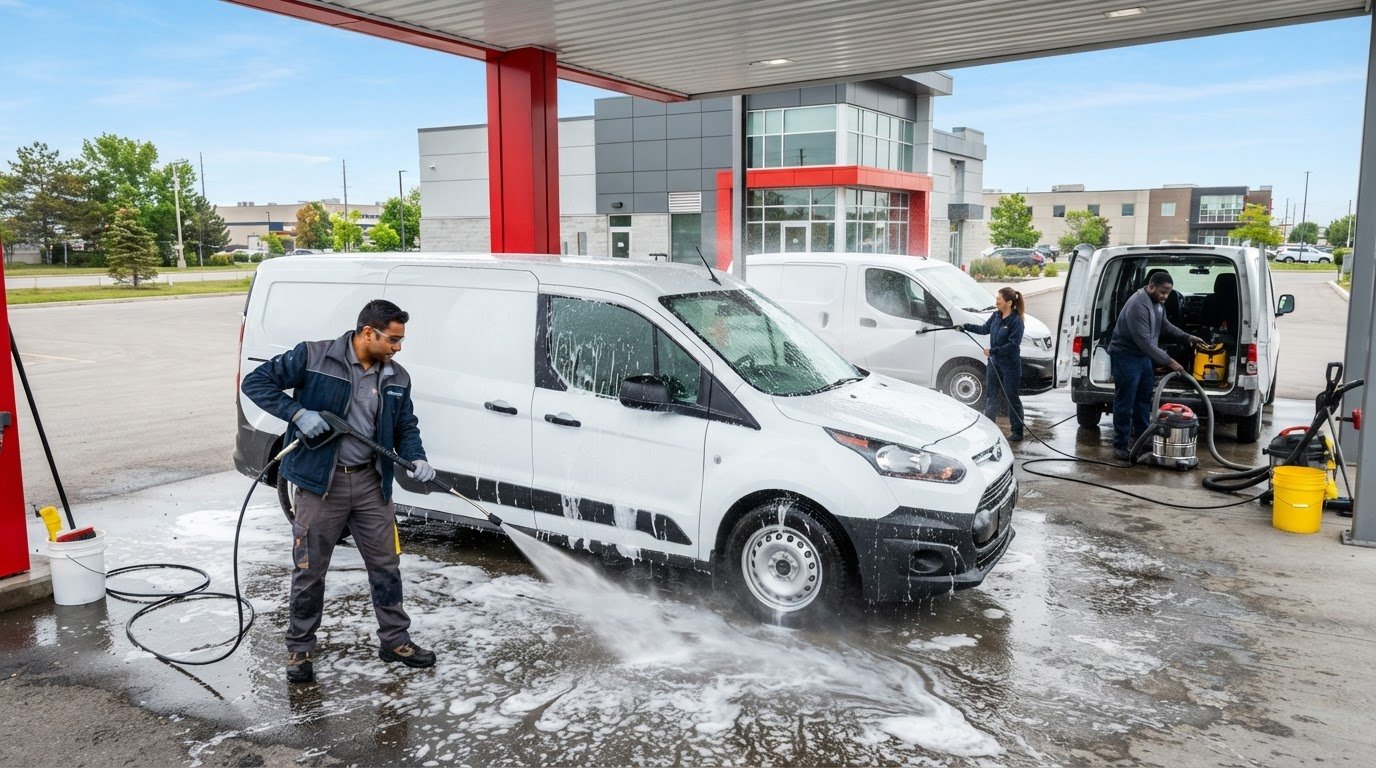
High-mileage commercial use changes the calculation. Frequent passengers, repeated stops, road grime, and regular washing create a constant appearance-management problem. Ceramic can help the exterior release dirt more readily and preserve a consistent presentation between cleanings.
The catch is wash method. A vehicle that receives frequent brush contact or harsh chemicals may lose the coating's hydrophobic performance faster than an owner following proper aftercare. For a fleet, the right choice depends on whether staff can follow the maintenance protocol consistently.
For commercial vehicles, operational discipline matters more than the product label. A well-maintained sealant can outperform a neglected coating in day-to-day appearance.
The aging SUV
An older SUV with faded or compromised clear coat is where I tell customers to slow down. Ceramic can't restore failing paint, and it shouldn't be used to disguise defects that need correction or repair.
Wax offers a cheaper, more flexible way to improve gloss and keep the surface cleaner. Pair it with regular washing and rust protection where appropriate, especially if the vehicle's main purpose is dependable transportation rather than long-term cosmetic preservation.
What Maintenance Looks Like After You Choose
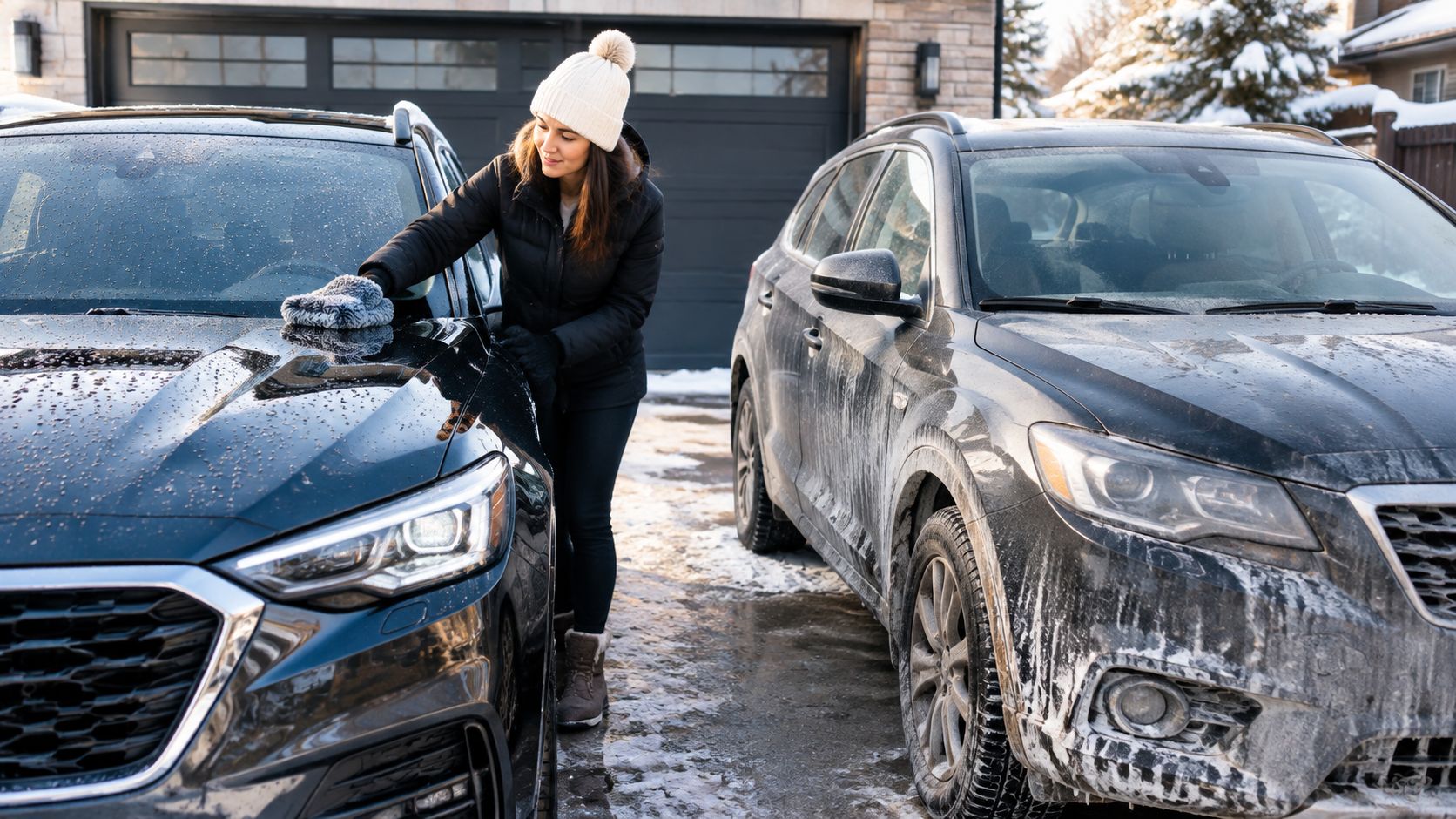
Ceramic coating is low reapplication, not maintenance-free. Ontario owners still need to wash through winter, especially when road salt and slush build up on the body and lower panels. The coating helps contamination release more easily, but it doesn't prevent contamination from arriving.
For a coated vehicle, use pH-neutral shampoo, clean microfibre drying towels, and a careful hand-wash process. Toronto-area detailing guidance specifically advises avoiding automatic brushes and choosing pH-neutral soap for coated vehicles. Local ceramic aftercare advice reflects the key difference from a traditional wax routine.
The coated-car routine
- Rinse first. Remove loose salt and grit before a mitt touches the paint.
- Use coating-safe soap. Avoid treating the coating like a surface that needs aggressive degreasing every wash.
- Wash gently. A two-bucket method or a reputable touchless process reduces unnecessary contact.
- Dry with clean microfibre. Don't allow mineral-heavy water to sit and evaporate on the panels.
- Decontaminate when needed. Iron and road film can still collect on the surface.
- Use compatible maintenance products. Ceramic aftercare documents state that wax shouldn't be applied over the coating because it won't bond correctly. Ontario aftercare and coating services also position maintenance around pH-neutral washing and coating-compatible protection rather than traditional rewaxing.
A coating owner who skips washes because the car “repels dirt” creates a different problem. Contamination can bond to the surface, dull the finish, and eventually require more aggressive correction. The coating makes washing easier. It doesn't make cleaning optional.
Wax is simpler, but it asks for repetition
Wax is more forgiving when your technique isn't perfect. You can wash, dry, apply a fresh layer, and accept that the protection will gradually wear away. That flexibility suits owners who want a predictable, low-commitment finish.
The trade-off is repeated reapplication. Ontario guidance places wax's useful protection at 4 to 8 weeks, so owners need to watch for fading water behaviour and refresh the surface rather than relying on one seasonal application. Ceramic owners perform fewer full protection applications, but they must respect the coating's wash rules.
A Simple Decision Checklist for Your Vehicle
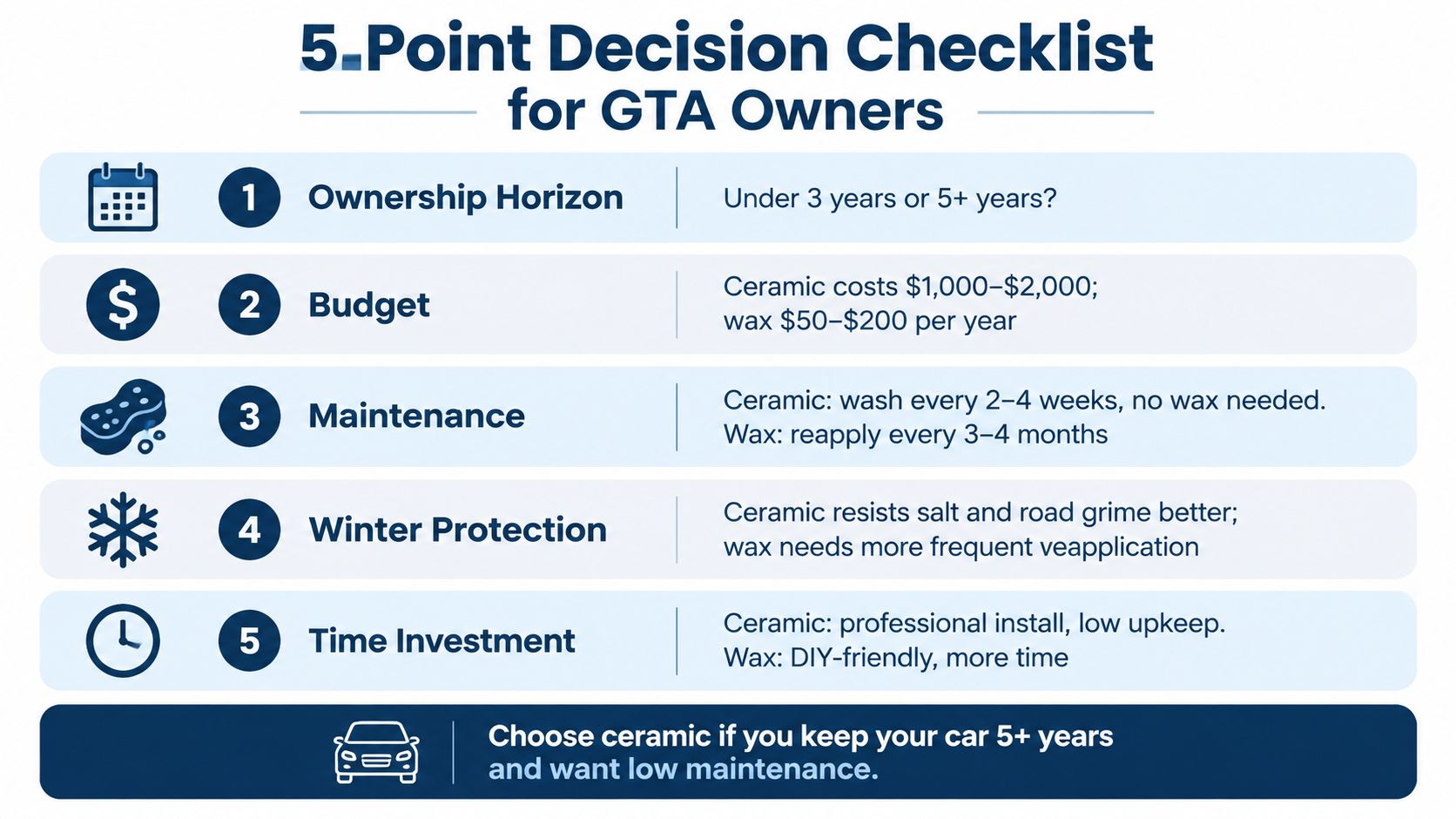
You can make the choice quickly if you stop comparing products in the abstract. Answer these five questions.
- How long will you keep the vehicle? If your ownership period is short, wax or sealant keeps your spending flexible. If you're keeping the car for several years, ceramic has more time to justify its initial cost.
- How often do you wash? Weekly washing already removes contamination regularly. Ceramic may still save effort per visit, but don't assume it will replace that routine.
- Where does the vehicle live? Outdoor parking increases exposure to UV, sap, bird droppings, salt, and grime. Indoor parking reduces the punishment and strengthens the case for a simpler product.
- What condition is the paint in? Sound paint can support a professional coating after proper preparation. Failing clear coat, heavy oxidation, or extensive defects make wax, sealant, correction, or repair more rational.
- Will you follow the aftercare? If you won't use pH-neutral soap, avoid brush washes, dry carefully, and maintain the surface, skip ceramic. The product can't compensate for an unsuitable routine.
Who should skip ceramic
Skip it for a short-term lease, a low-value vehicle, a work truck you won't maintain, or any car with clear-coat failure that needs correction rather than surface protection. Wax remains the rational choice when you want a repeatable, affordable treatment and don't mind refreshing it.
Choose ceramic when you own a sound vehicle, plan to keep it for years, park outdoors, and value easier maintenance enough to follow the rules. For everyone else, start with a thorough wash, assess the paint, and use wax or sealant until your ownership situation changes.
If your GTA vehicle needs frequent salt removal, interior cleaning, detailing, or rust proofing, visit Nanak Car Wash to compare express washes, full-service cleaning, detailing, wax protection, and rust-proofing options. Choose the repeatable maintenance plan you can follow, whether that means regular wash visits for a coated vehicle or scheduled protection refreshes for waxed paint.

 6600 Finch Ave W, Etobicoke, ON M9V 3Z6
 647-703-8515
 MON – SUN 8 AM to 7 PM