

You've scraped the ice, warmed the cabin, and pointed your vehicle toward the nearest touchless wash. The paint gets a quick rinse, the windshield clears, and the car looks respectable again. Then sunlight catches the trim around the windows, or the wheels, and you notice the dull haze, white spotting, or tiny brown marks that weren't there last season.
That's the trouble with chrome. It often gets ignored until the damage becomes obvious. A safe chrome car wash routine isn't a smaller version of paint care. Chrome trim and wheels need different chemistry, gentler contact, and more attention to salt trapped around edges and seams.
Table of Contents
- Why Chrome Is the Surface Most GTA Drivers Forget About
- What Chrome Trim Is and Why It Behaves Differently
- The Threats to Chrome in Ontario Winters
- A Safe Chrome Car Wash Routine You Can Follow
- Common Chrome Car Wash Mistakes That Cause Permanent Damage
- Which Nanak Wash Packages Make Sense for Chrome Owners
- A Year-Round Chrome Care Calendar for Salt Belt Drivers
- The Bottom Line on Keeping Chrome Shiny in the GTA
Why Chrome Is the Surface Most GTA Drivers Forget About
On a winter morning in Mississauga, the routine is straightforward. Clear the windshield, turn on the defroster, check the road, and reach a wash before salt hardens into another crust. The bright strip around the windows can wait, and so can the wheel lips. Later, sunlight reveals a cloudy haze, white spots, or small brown marks that seemed to appear overnight.
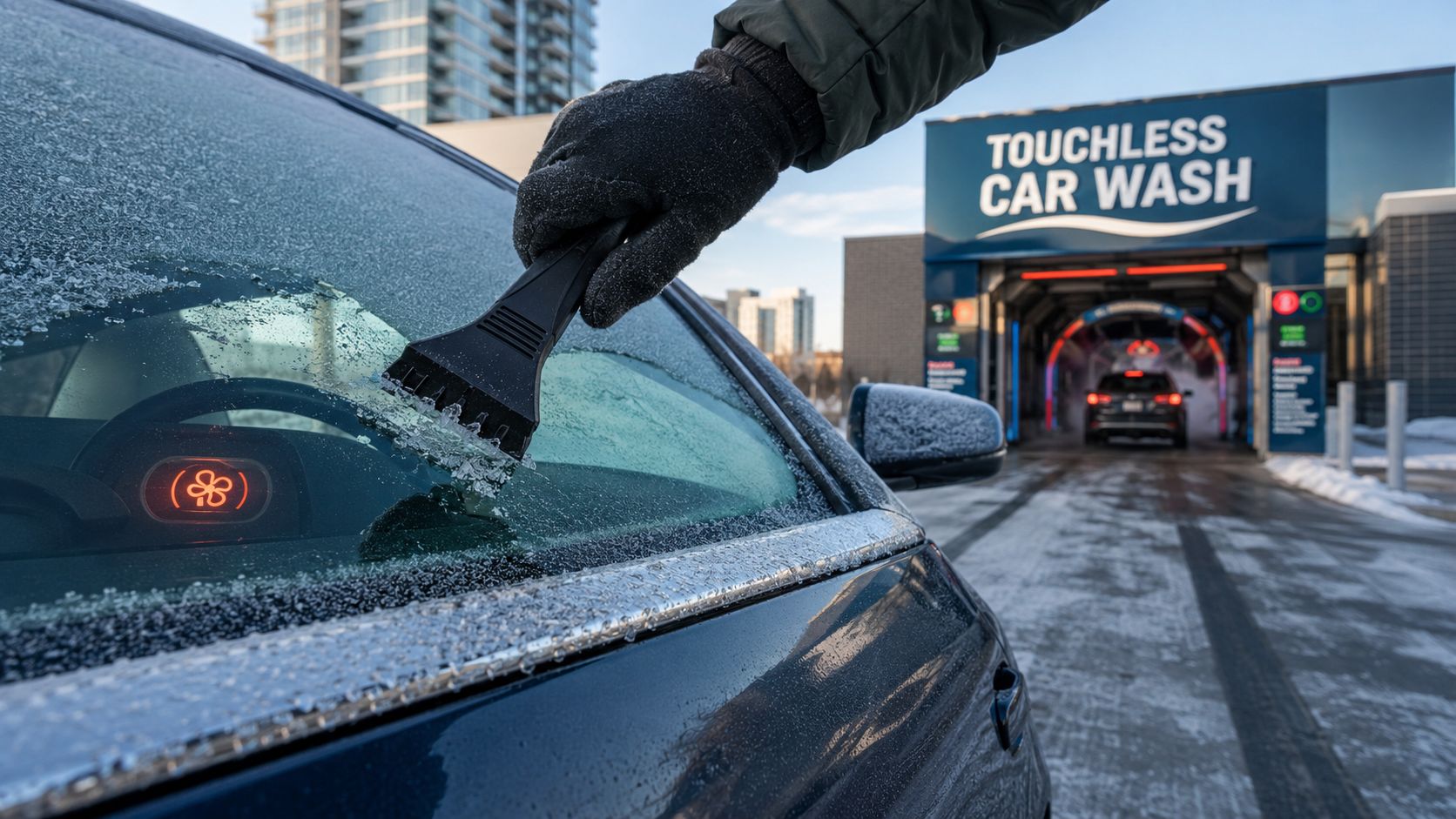
Paint receives the care because it is the largest, easiest-to-see surface. Owners ask about wax, sealants, and ceramic protection. Chrome trim, bumpers, grille bars, and wheels sit in the same weather but rarely receive the same plan. Salt spray reaches them, brake dust bonds to them, and tunnel brushes or dirty mitts can pull grit across the reflective finish.
Chrome also needs different chemistry from paint. A product designed to loosen grime from a painted panel may leave brightwork stained or etched if it dries there. Wheels bring another complication: heat, brake dust, and salt collect around spokes, lips, lug areas, and seams. A quick rinse can leave the residue that causes trouble.
Ontario winters make that neglect harder to ignore. The province uses an estimated 1.5 to 3 million tonnes of road salt each winter, while Toronto is cited at roughly 130,000 to 150,000 tonnes annually on city streets. Those figures are discussed in this Ontario road-salt corrosion guide. Year-round vehicles in the GTA can show visible undercarriage rust within 3 to 5 years, with structural rust risk emerging in about 8 to 12 years without protection, according to the same source.
What owners notice too late
Chrome failure may begin before obvious rust appears:
- Dull patches: Reflections become grey or hazy instead of sharp.
- Pinpoint pits: Small craters hold moisture and road residue.
- Cloudy spotting: Mineral or chemical marks remain after a normal rinse.
- Peeling or lifting: The finish separates and exposes the material underneath.
Treat brightwork as its own surface category. Use suitable products, controlled contact, and tools that are not carrying grit from rocker panels. That approach protects both the reflective finish and the plated layers beneath it.
What Chrome Trim Is and Why It Behaves Differently
Chrome trim, often called brightwork, is a layered plating system rather than a solid block of chrome. Decorative plating commonly sits over nickel and copper, applied to a substrate such as steel or plastic. The visible chromium layer creates the bright reflection, while the underlying layers determine how the part responds when moisture, salt, or chemicals reach a weak spot.
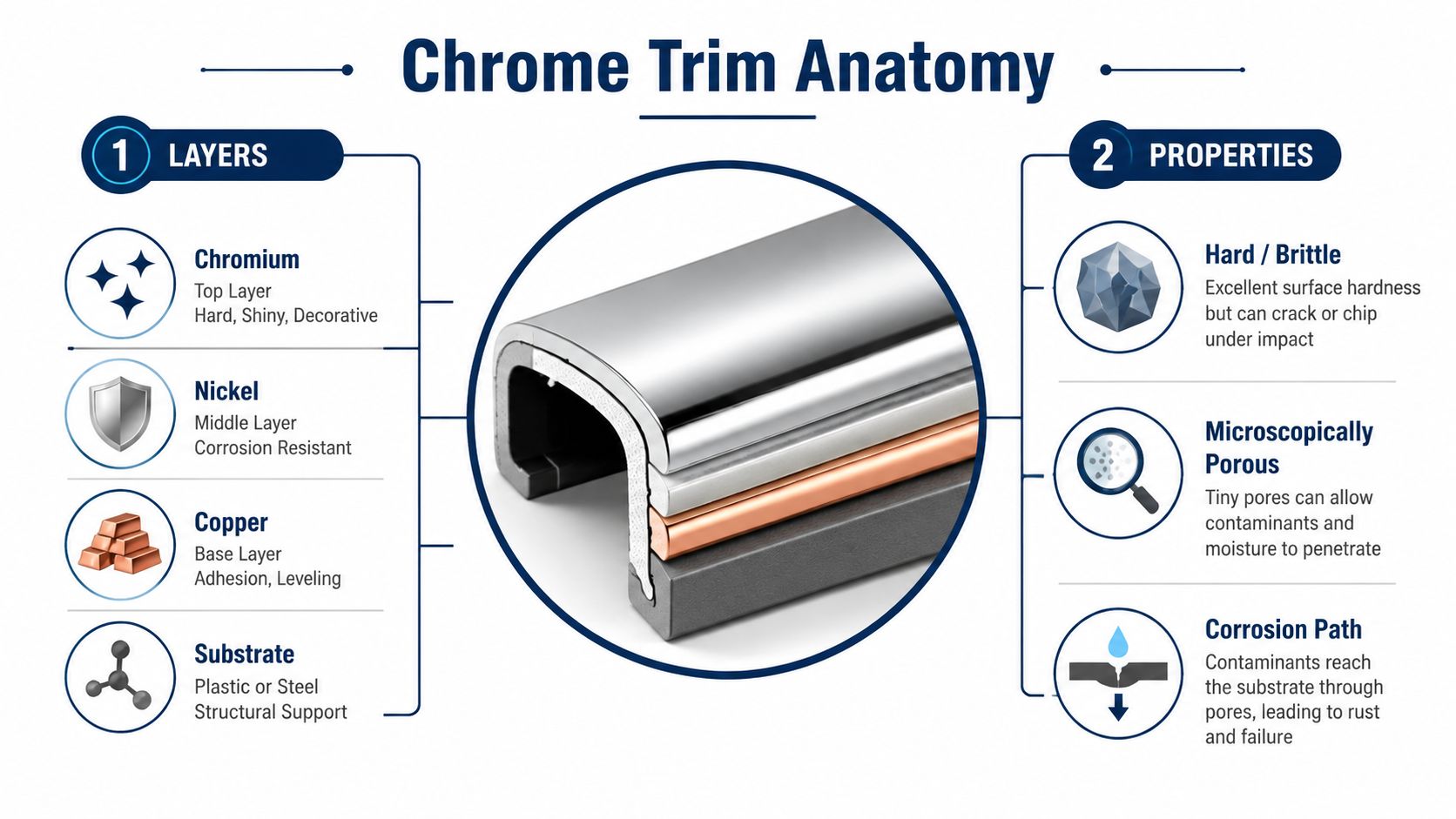
Chrome plating is a thin, rigid skin bonded to a different material underneath. That construction explains why it can feel hard under your fingernail yet fail after a stone strike, stiff brush, or gritty wash mitt. Paint has some flexibility and thickness to absorb minor abuse. Brightwork has less room for that kind of mistake.
Hard does not mean indestructible
The chrome surface is hard, but it can be brittle and microscopically porous. Small irregularities give winter residue places to stay damp. If the surface is scratched or chemically etched, moisture can reach the nickel or base material below.
Pressure, friction, and product dwell time all matter. A cleaner suitable for a painted panel may be too aggressive for brightwork. A wheel brush that feels soft can still carry grit from an earlier job. Even a clean-looking mitt can drag abrasive road film across chrome when the surface has not been rinsed first.
Match the method to the material
Start with a cool pre-rinse, then use a non-acidic or pH-gentle cleaner and tools reserved for chrome and wheels. Work on a cool surface, clean one area at a time, and rinse before the product dries. A product labelled “wheel cleaner” is not automatically safe for chrome. Read its compatibility guidance.
The layered construction also limits what polishing can fix. A suitable non-abrasive product may improve light haze, while pitting, flaking, and plating failure indicate deeper damage. Once the finish lifts, aggressive polishing can remove surrounding material and make the defect easier to see.
The Threats to Chrome in Ontario Winters
A chrome wheel can look spotless after a wash and still be carrying the ingredients for damage. GTA winter driving leaves two forces on the surface: road film creates mechanical abrasion, while salt and unsuitable cleaners create chemical stress. Calcium chloride and other residues stay damp inside wheel openings, around trim joints, and behind decorative pieces. Rub them before rinsing, and the mixture works like sanding paste.
Chrome needs different chemistry from painted panels. Federal service guidance warns against hydrofluoric, oxalic, and most other acid-based cleaners because they can disturb the finish and cause staining or etching, especially when calcium chloride is present. The chrome-care service bulletin supports using non-acidic, pH-gentle products and removing winter road film promptly.
Why residue turns into pitting
Chloride residue can be hard to notice. It settles in a seam or wheel recess, holds moisture against the plating, and gives corrosion time to work through vulnerable points. You may later see tiny pits, cloudy patches, or bubbling, often described as chrome lift.
Highly alkaline presoaks bring their own risk. Tunnel systems may use strong chemistry to cut road film quickly, but a product made for fast cleaning across several surfaces is not automatically suitable for brightwork. If foam dries on a hot surface, staining becomes more likely. The surface may appear clean while its finish has already been marked.
For broader seasonal preparation, keeping your car winter ready includes more than paint care. Underbody areas, wheel wells, door seams, and chrome each need attention that removes salt without adding unnecessary chemical or mechanical stress.
| Threat | Source | How It Damages Chrome |
|---|---|---|
| Chloride residue | Road salt and calcium chloride | Holds moisture against vulnerable areas and contributes to pitting |
| Grit and road film | Winter traffic and slush | Scratches the finish when rubbed before rinsing |
| Acidic cleaner | Acid-based wheel or metal products | Can etch, stain, or disturb the plated surface |
| Strong alkaline presoak | Aggressive wash chemistry | May dull or mark brightwork if misapplied or left to dry |
| Trapped moisture | Wheel recesses, seams, and trim joints | Keeps residue active after the wash is finished |
The safe order is straightforward: rinse away loose residue first, then use gentle contact only where water has not done enough. Chrome and wheels should be treated as their own cleaning category, not as painted panels with extra shine.
A Safe Chrome Car Wash Routine You Can Follow
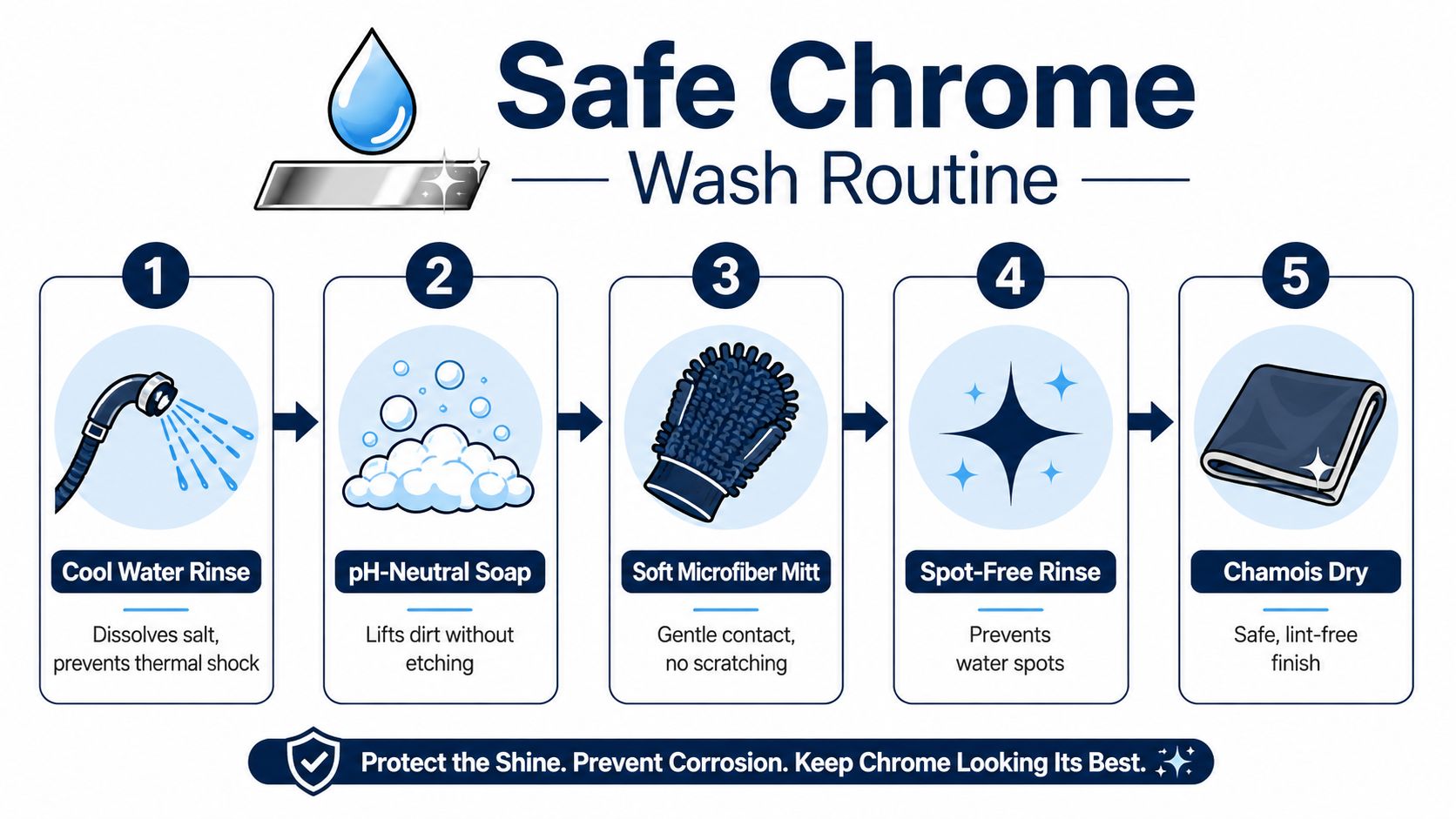
A good chrome wash is controlled rather than complicated. Whether you're working in the driveway or choosing a tunnel, the order matters because every later step depends on removing loose grit first.
Start with the rinse
Use cool water on the chrome. Flush the wheel face, barrel openings, lug area, grille, window trim, and lower brightwork. The aim is to dissolve and carry away salt before a mitt touches the surface.
Choose a pH-neutral soap. Apply it with a clean microfiber mitt reserved for chrome and wheels. Keep the surface wet, allow roughly 30 to 60 seconds of dwell time, and never let the soap dry.
Agitate only where necessary. A soft boar-bristle brush can reach wheel lips and tight trim gaps. Use light strokes, not pressure. If the brush catches grit, rinse it before continuing.
Keep tools separated
Your painted-panel mitt shouldn't share duty with the wheels. Chrome sits close to brake dust, road grit, and metal particles, so cross-contamination is an easy way to create fine scratches.
A tunnel wash can be convenient, but inspect what the package does. An underbody rinse and gentle exterior wash may be more useful for a winter commuter than an appearance-focused upgrade that never addresses the wheel wells or brightwork.
Practical rule: If you can feel grit under the tool, stop rubbing and rinse again.
Rinse, dry, protect
Rinse with a gentle flow or sheeting stream, then dry chrome before water spots form. Use a dedicated microfiber towel for wheels and trim, and clear water from seams, door sills, and drain areas. A blower can help remove water from lug recesses and trim joints, but finish with a towel so droplets don't evaporate in place.
Apply a non-abrasive metal sealant in a thin coat. Follow the product instructions, but a short cure period of roughly 2 to 3 minutes is the working window specified for the routine described here. Buff gently with a clean towel.
Before leaving, inspect the underside of the trim, the wheel lips, lug recesses, grille corners, and the area behind decorative bars. If salt remains visible, rinse it again. The goal isn't just a bright reflection. It's a clean, dry surface with no residue hiding in the places you can't see from the driver's seat.
Common Chrome Car Wash Mistakes That Cause Permanent Damage
Chrome myths survive because the damage often arrives later. A home remedy may make a part look brighter for a few minutes, then leave fine scratches or chemical marks that catch the light every time you walk past the vehicle.
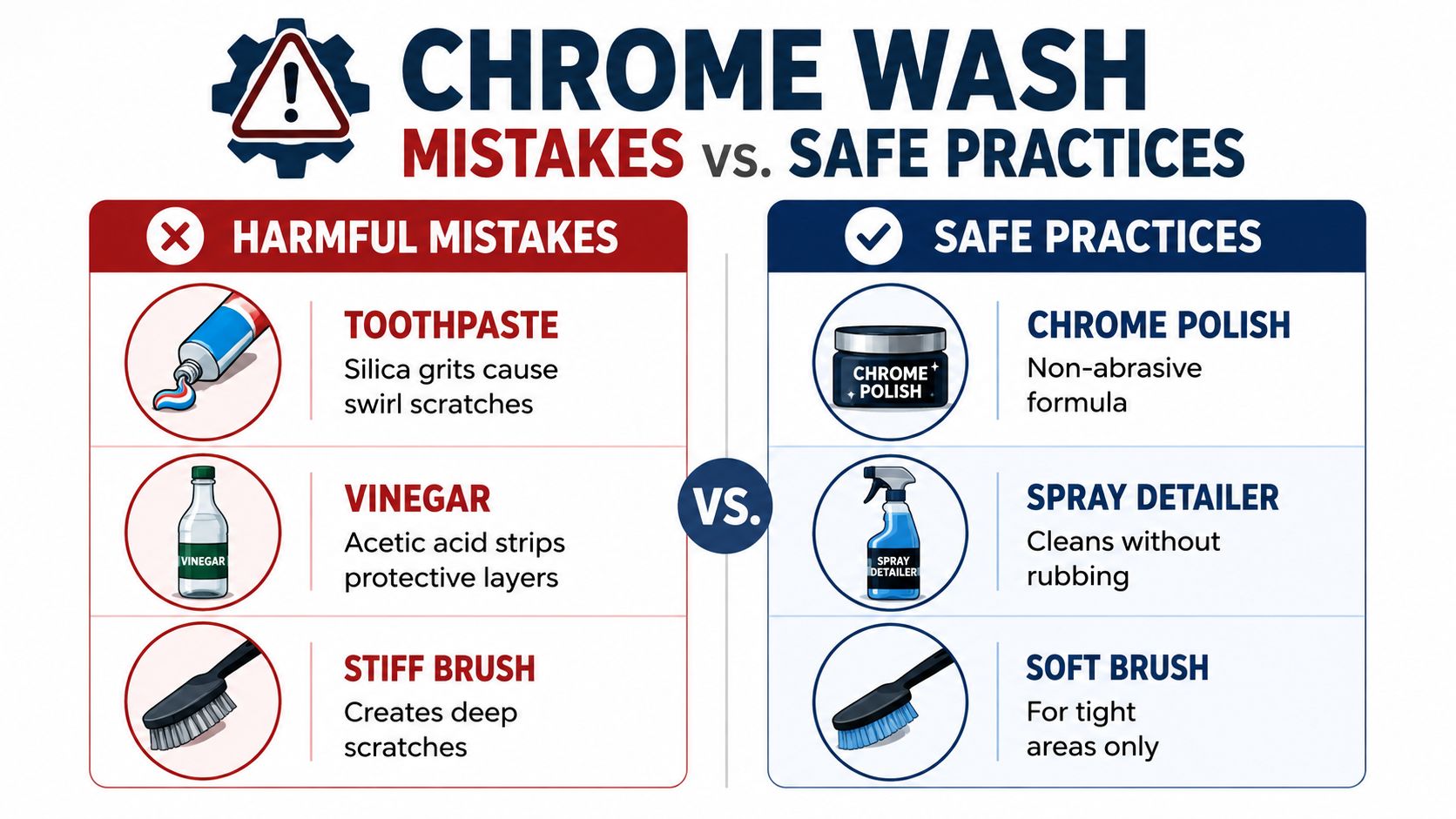
Toothpaste is a common example. Its polishing particles can act like a mild abrasive, and repeated rubbing can leave swirl marks across the reflective surface. Use a product specifically labelled as non-abrasive and compatible with chrome instead.
The household cupboard is not a detailing shelf
Straight vinegar is acidic, and it isn't a safe default for plated trim. Household ammonia glass cleaner can strip or weaken protective products and may leave chrome looking flat. Dishwasher tablets dissolved in a bucket are worse still, because they're formulated for food residue and dishes, not delicate automotive finishes.
The federal guidance linked earlier rules out acid-based chemistry as a sensible chrome routine. That includes the habit of reaching for a strong cleaner because winter dirt looks stubborn.
Friction creates its own damage
Even the right product fails if the tool is wrong. Brushing dry chrome pushes dust across the finish. Reusing a dirty wheel mitt transfers abrasive particles. A stiff brush can scratch polished wheel lips, especially around edges where the plating may already be vulnerable.
A foam cannon also isn't permission to walk away. Work one area at a time and rinse before the product dries. Heat and sunlight make dried residue harder to remove without additional rubbing.
| Mistake | What you may see | Safer replacement |
|---|---|---|
| Toothpaste polishing | Fine swirls and reduced clarity | Non-abrasive chrome-safe product |
| Straight vinegar | Haze or etching | Non-acidic cleaner and prompt rinse |
| Ammonia glass cleaner | Dull reflectivity or stripped protection | Product approved for chrome |
| Dry brushing | Scratches and dragged grit | Cool-water pre-rinse |
| Dirty wheel mitt | Random micro-marring | Dedicated, clean microfiber tools |
The shop-floor answer is simple: don't experiment on the most visible part of the vehicle. Chrome doesn't reward improvisation.
Which Nanak Wash Packages Make Sense for Chrome Owners
Nanak Car Wash offers several service formats, but chrome owners should judge them by process rather than package names. Ask whether the wash includes an underbody rinse, whether brightwork receives a hand dry, and whether the staff use a product suitable for plated surfaces. A full-service package that includes exterior washing and hand drying may make more sense for delicate trim than a friction-heavy shortcut.
The right choice depends on how the vehicle is used.
Match the service to the driver
A daily commuter travelling through Etobicoke, North York, Brampton, or Oshawa needs repeatable salt removal. That driver may benefit from an express package with an underbody wash, provided the chrome is rinsed and dried properly.
A weekend vehicle with real brightwork needs less frequent cleaning but more controlled contact. A hand-dry service and occasional professional wheel attention can protect the finish better than repeatedly sending polished lips through equipment designed for general exterior cleaning.
A leased SUV with plastic-clad “chrome” trim needs a different conversation. Some bright-looking parts are coated plastic rather than plated metal. Don't apply metal polish until you know what you're treating.
| Wash Tier | Soap Chemistry | Chrome Drying Method | Recommended Add-Ons |
|---|---|---|---|
| Express exterior | Confirm that the wash chemistry is suitable for brightwork | Drying agent and air blowers, with inspection afterward | Underbody wash for winter salt |
| Full-service exterior | Ask for pH-gentle treatment on chrome areas | Hand dry included in the service format | Hand attention to wheels and brightwork |
| Professional detailing | Surface-specific product selection | Detailed hand drying around seams and wheel recesses | Wheel polishing or non-abrasive protection |
| Rust proofing service | Separate corrosion-protection treatment | Not a substitute for wash drying | Consider for vehicles facing long-term salt exposure |
Nanak's listed service lineup includes express washes, full-service washes with hand drying, detailing, wheel polishing, rust proofing, prepaid options, and monthly wash memberships. The practical decision rule is this: choose the least aggressive service that reliably removes salt, then pay for hand attention when the chrome is valuable, fragile, or already showing damage.
A Year-Round Chrome Care Calendar for Salt Belt Drivers
Chrome care works better as a rhythm than as a rescue mission. The GTA's salt season demands frequent rinsing, while warmer months create different problems, including pollen, dust, water spotting, and sun exposure.
Ontario winter guidance recommends washing every 1 to 2 weeks during active salt season, with an underbody rinse included, as described in this GTA winter corrosion guide. After a thaw, rinse promptly if possible. Melted brine is mobile, so it can move into wheel wells, rocker panels, suspension cavities, seams, and trim gaps.
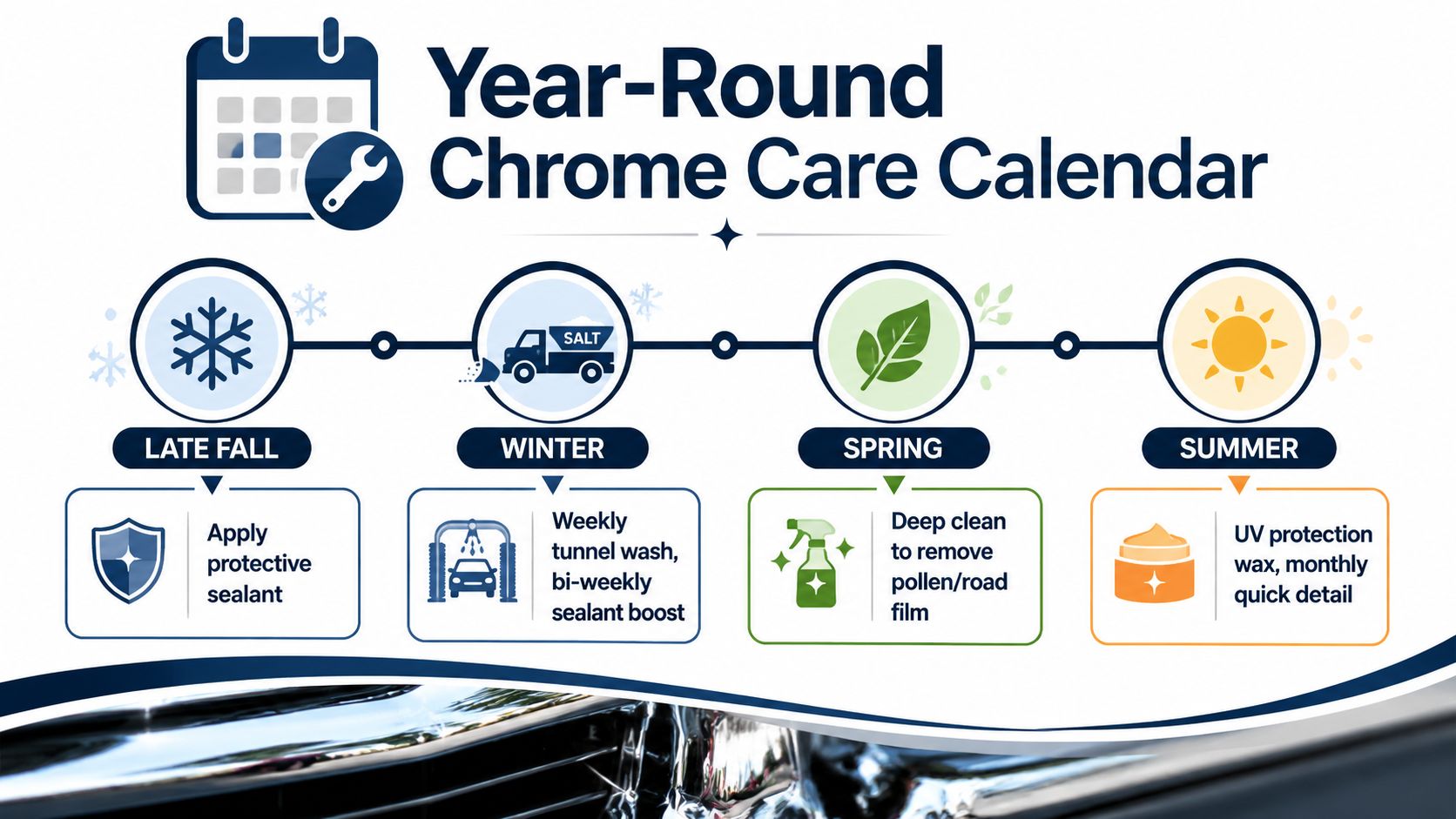
Late fall and winter
Before regular salting begins, clean the wheels and trim thoroughly and apply a compatible protective sealant. This gives you a cleaner starting point, though it won't replace washing once salt accumulates.
During active winter driving, use an express wash for routine rinsing and select the underbody option. After storms, thaw events, or visibly heavy slush, don't wait for the vehicle to look dirty. Salt can remain active even when the body appears merely damp.
Spring and summer
Spring deserves a deeper wash because winter residue often hides behind wheel spokes, around lug nuts, and along lower trim. If the surface feels rough after washing, ask for a careful decontamination approach rather than reaching for an abrasive pad at home.
Summer maintenance can be lighter. Dry chrome after washing, top up protection when the surface stops shedding water cleanly, and remove bird droppings or road film without rubbing a dry surface. Nanak locations listed for GTA-area drivers include Etobicoke, Brampton, Concord, Oshawa, Sheppard/North York, and Burlington, with additional locations in Cambridge and Guelph.
Easy cadence: Protect before salt season, rinse regularly through winter, deep-clean in spring, and refresh protection before the next fall.
For high-mileage commuters and rideshare drivers, a membership or prepaid wash bundle can make routine rinsing easier to maintain. For show chrome or early pitting, schedule a full detail instead of trying to correct plating failure with repeated polishing.
The Bottom Line on Keeping Chrome Shiny in the GTA
Chrome care in the GTA comes down to a short list of disciplined habits:
- Rinse salt before rubbing. Cool water removes the abrasive layer that causes avoidable micro-scratches.
- Use gentle chemistry. Avoid acid-based cleaners and unapproved household products.
- Reserve your tools. Keep a clean microfiber mitt and soft brush for wheels and brightwork.
- Dry completely. Water trapped around lug nuts, trim joints, and seams leaves residue behind.
- Protect after cleaning. Use a non-abrasive sealant or a professionally applied coating suitable for the surface.
- Prioritize the underbody in winter. A simple wash with salt removal can matter more than an expensive appearance add-on.
Regular express washes can handle routine salt removal when the process includes the right rinse and the chrome is checked afterward. Vehicles with genuine brightwork, polished wheel lips, or early signs of pitting deserve occasional hand drying, wheel polishing, or professional detailing. Rust proofing addresses a different part of the vehicle, but it belongs in the same long-term maintenance conversation for salt-belt driving.
Treat chrome like a cast-iron skillet. Don't attack it with harsh chemicals, don't scrub it dry, and don't leave it wet with residue. Clean it gently, dry it properly, and maintain the protective layer before the finish starts asking for help.
If your vehicle is carrying winter salt today, visit Nanak Car Wash and ask about an exterior wash with underbody rinsing or a full-service hand-dry option for brightwork. For pitting, dull wheels, or neglected trim, book a detailing or wheel-polishing service so the surface gets the right treatment instead of another aggressive scrub.

 6600 Finch Ave W, Etobicoke, ON M9V 3Z6
 647-703-8515
 MON – SUN 8 AM to 7 PM