
You know the moment. You pull out of the bay on a bright Saturday, the paint looks like it just left the showroom, and then the sun swings around the roofline and there they are: pale grey rings, evenly spaced across the hood, as if someone set down a dozen wet teacups and wandered off.
By the time you reach the Gardiner, the roof has its own constellation. The gloss you paid for has become a map of dried mineral water, and the wash you bought to make the car look good has made the paint look worse.
The fix is unglamorous and mostly mechanical. Get the water off the paint before the minerals in it dry in place, then let the gloss sit on a surface that's clean. Everything else, the beading, the deep black tires, the wet-look finish, depends on that one step being done properly.
Table of Contents
- What a Dry and Shine Service Includes
- Why Drying Matters More Than the Shine
- How to Run a Dry and Shine Step by Step
- Winter Salt, Shine and Rust in the GTA
- Drought Rules and When to Skip the Hose
- Book Your Dry and Shine Before the Next Salt Storm
What a Dry and Shine Service Includes
A car leaves a wash bay wet in places you can't see. The panels look dry from three metres away. The mirrors are holding a mouthful of water, the grille is dripping into the front bumper, and the door seams have trapped a small reservoir that will empty itself down the paint the second you reach the on-ramp.
A Dry and Shine service is the finishing stage that deals with exactly that. After the main wash and rinse, the team takes the standing water off the car, then adds a light gloss and a little short-term protection. Drying is the towel after a bath; shine is the moisturiser you put on afterwards. Use the moisturiser without the towel and you've sealed a mess under a nice-smelling layer.
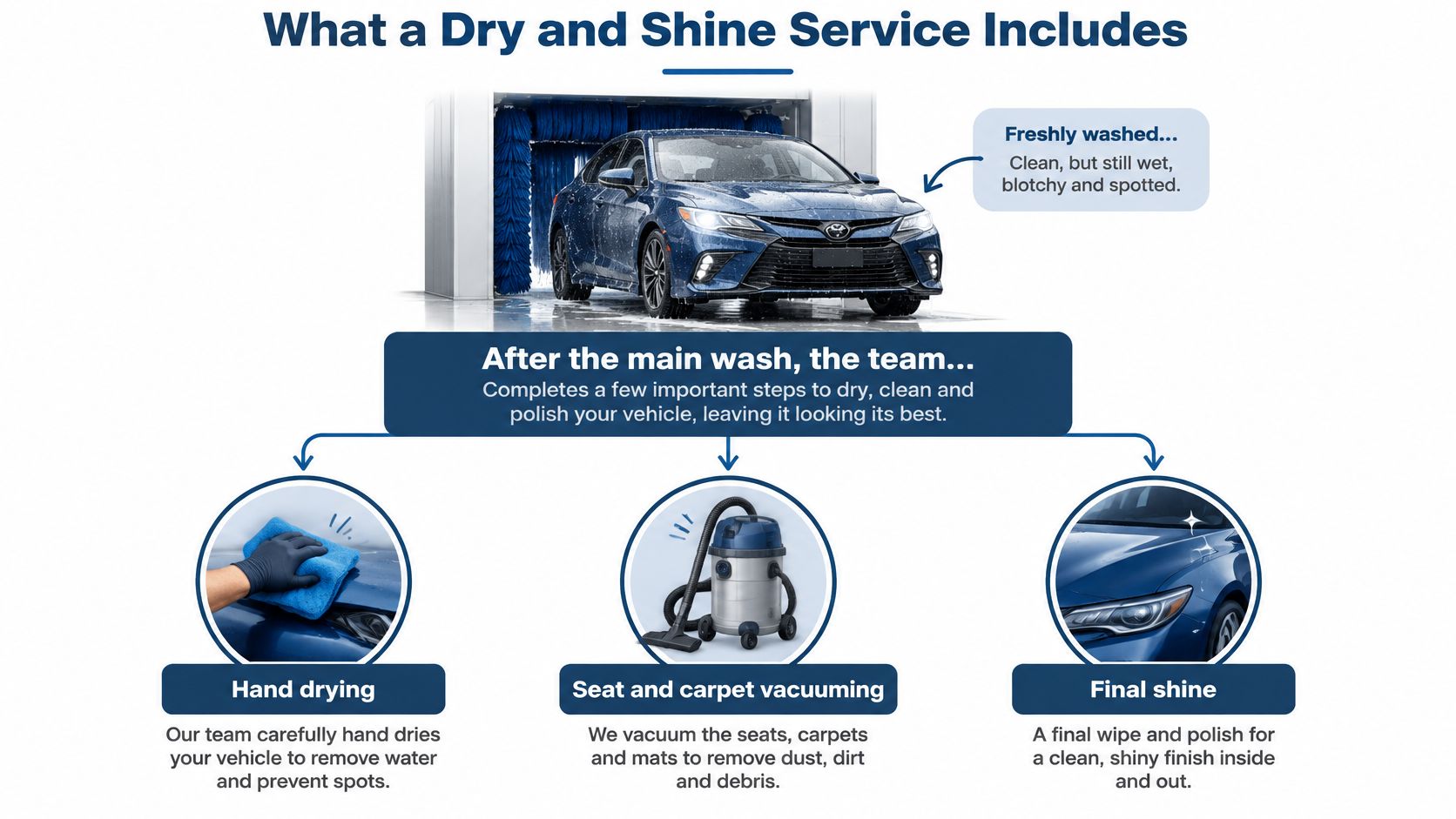
The sequence runs in a fixed order, and the order is the whole trick. A forced-air blow drives water out of mirrors, grilles and door seams so nothing runs out later. A hand dry with a clean microfibre towel lifts what the blower pushed loose before it can dry in place. A drying aid goes on while the panels are still wet, so the remaining water leaves in a hurry instead of sitting in droplets.
Then come the two steps drivers notice: a spray shine or sealant for gloss and short-term beading, and tire dressing to darken the rubber and finish the back of the car.
Dry and shine components at a glance
| Component | What It Does | What You Notice |
|---|---|---|
| Forced-air blow dry | Pushes water out of mirrors, grilles and door seams | No drips running out later |
| Hand drying with microfibre towel | Lifts remaining droplets before they dry | Streak-free panels |
| Drying aid | Helps water sheet off so less is left behind | Faster drying and brighter paint |
| Spray shine or sealant | Adds gloss and short-term water beading | Gloss that lasts weeks, not months |
| Tire dressing | Darkens tires and gives a finished look | Neat, uniform finish at the back of the car |
None of this is a full detail. Detailing is hours of paint correction, interior shampooing and trim work. Dry and Shine is the twenty-minute finish that makes a wash hold up in daylight. Keep that table in mind the next time two nearby washes list different prices for something that sounds identical.
Why Drying Matters More Than the Shine
Set a wet glass down on a wooden coffee table and come back in an hour. The glass is gone, the water is gone, and there's a pale ring left in the finish that you'll be sanding out all afternoon. Car paint isn't wood, but the mechanism is close enough to be useful.
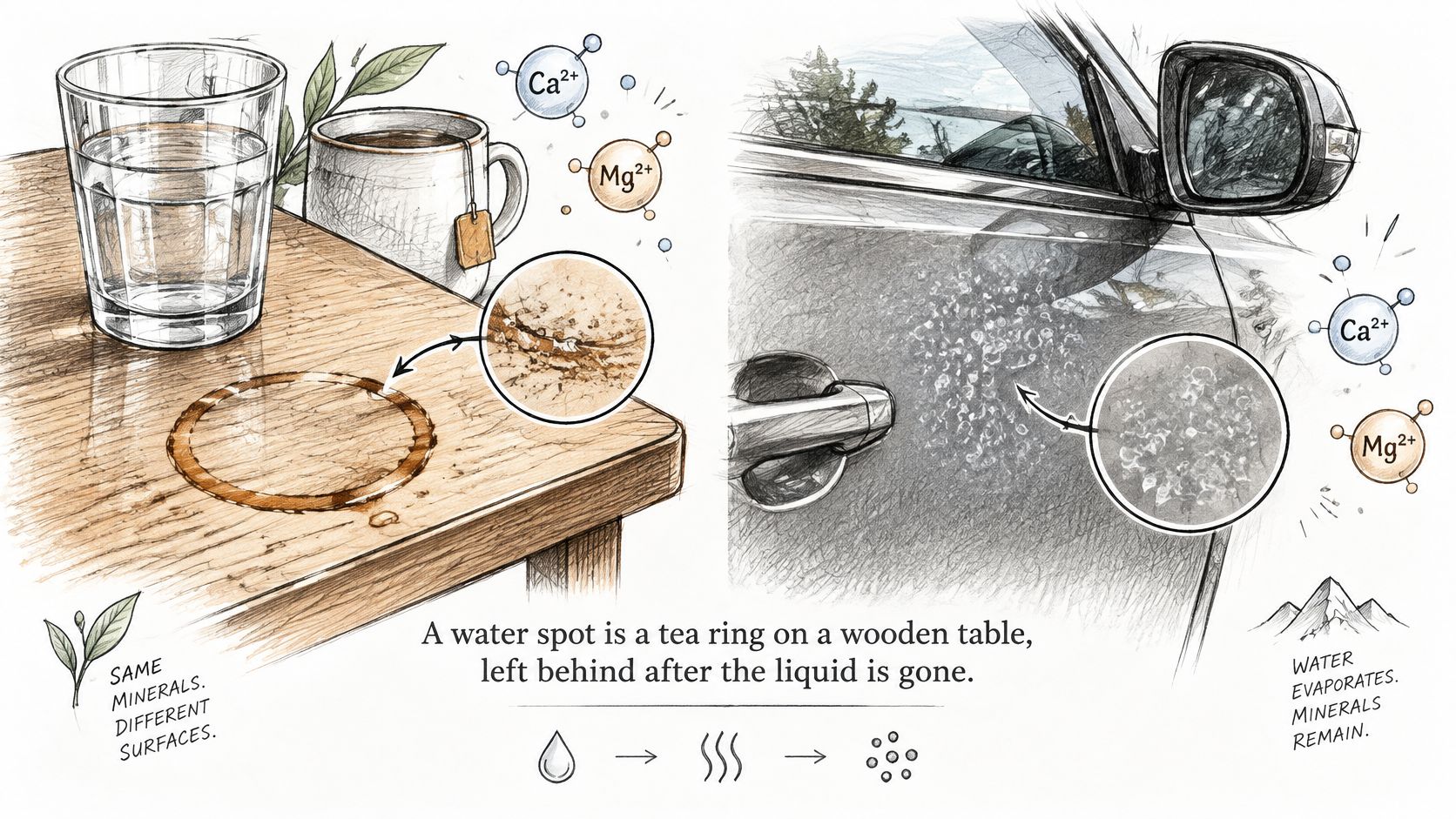
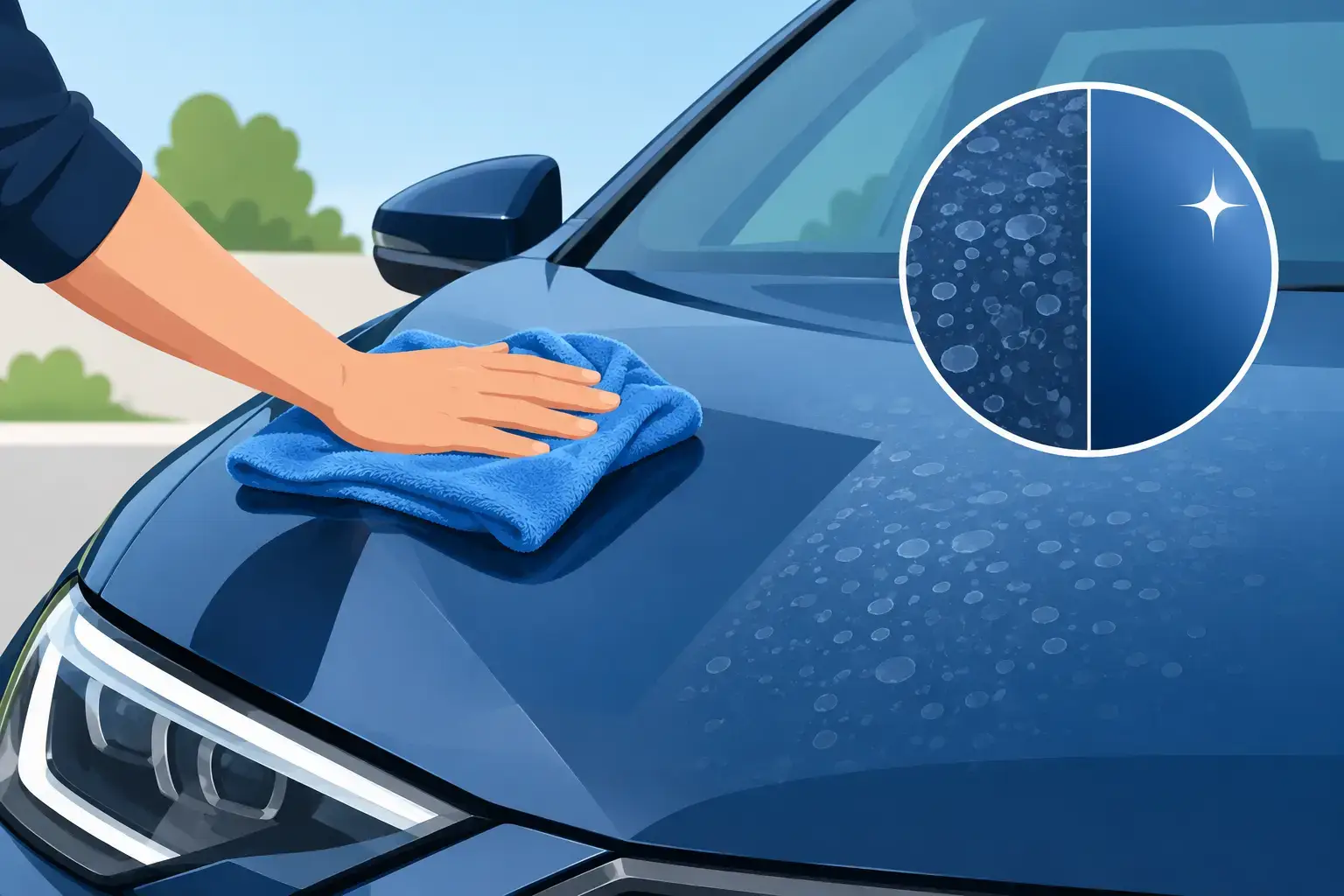
Gloss loss after a wash usually isn't the soap's fault. It's residue drying. Water carries dissolved calcium and magnesium, and as it evaporates those minerals stay behind as concentrated deposits that show up first as rings or speckles. Sunlight and heat make it worse by pushing localised concentration, and once minerals etch the clear coat, the mark stops being something you wipe off and becomes something you polish out, as this guide to removing water spots from car paint explains.
The rule that prevents most spotting: dry the car before the last droplet evaporates, not after. Once the water is gone, the minerals don't leave with it.
So shine depends on controlling the final water film, not on the bottle you bought. That means a clean rinse, a hydrophobic drying aid to speed up sheeting, and drying finished before mineral-rich droplets evaporate on horizontal panels. Hood and roof first, because they're flat, warm and facing the sky, which is exactly where spotting starts.
Where Water Hides After the Main Wash
Hand drying earns its keep in the awkward places: mirrors, emblems, handles, glass edges and body seams. All of them hold water after the main wash and release it once the car is moving or once the sun reaches them. That's how a car can look perfect in the bay and speckled by the time you're home.
The test takes ten seconds. Once the car is dry, stand at the front and sight along the hood with the light at an angle, then do the same across the roof. Rings and faint speckles mean the drying came too late. They don't mean the shine product failed, and upgrading to a more expensive spray won't fix the cause.
A spot is a timing problem, not a product problem. Change the order of your steps before you change what you buy.
There's a second cost, quieter than the first. Wax and sealant bond to a clean, dry surface. Apply either over chloride film, grit or mineral residue and you've trapped the contamination under a layer that now has to be stripped off before you can start again. A dry surface is what makes a protectant look good and last.
How to Run a Dry and Shine Step by Step
Say a car rolls in after two days of slush on the 401. The lower panels are grey-brown, the wheel arches are packed like a slushie machine gave up, and the owner wants it gleaming by five. The sequence below gets there without grinding grit into the clear coat, and it works the same in a wash bay or your own driveway. Get the order wrong and you end up with a glossy car wearing spots.
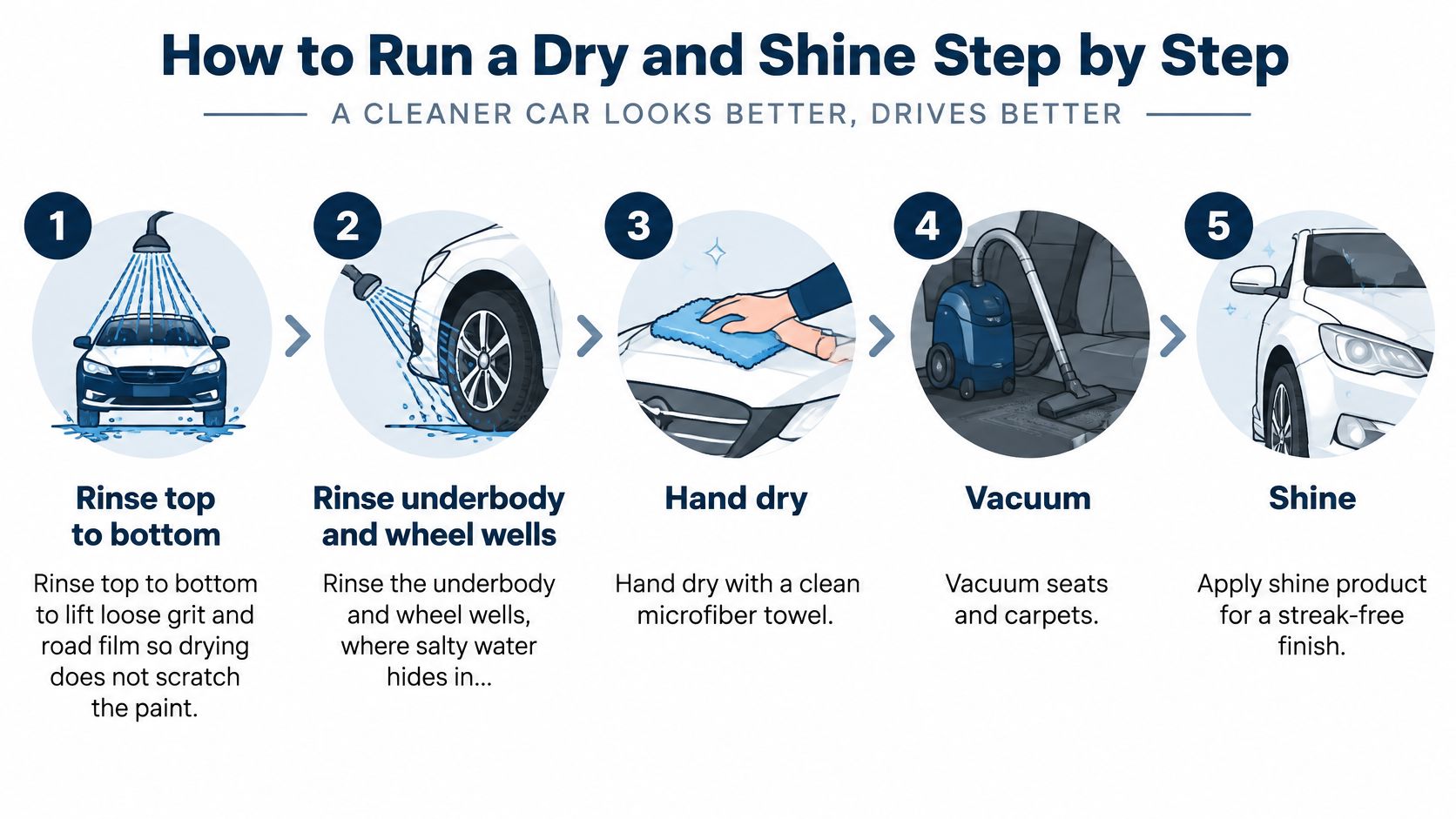
Rinse top to bottom. Start at the roof so loosened grit and road film run downhill instead of back onto clean panels. If the lower half was filthy, rinse it twice. A drying towel dragged over grit is a scratch you will be polishing out next weekend.
Rinse the underbody and wheel wells. Organisations reporting under Environment and Climate Change Canada's road-salt program used 1,679,395 tonnes of salt and 36,198,084 litres of liquid de-icer across 104,187 km of salted roads, and some of that brine is now sitting in your seams and cavities, conducting electricity and keeping metal wet. No spray removes it. Water and mechanical action do.
Blow the traps out with forced air. Mirrors, door handles, the grille, badges and window seals are little reservoirs that hold their water until you drive off, then release it as streaks down clean paint. Chase the water out at an angle so it lands on the ground rather than on the door you just dried.
Hand dry from the roof down, one panel at a time. Use a clean microfibre towel folded into quarters and flip to a fresh face for each panel. One towel for the whole car is a grit delivery service by the time you reach the sills, and the sills are where swirls are born.
Mist the drying aid onto the still-wet panels. The towel takes the bulk, but a thin film of water always clings to flat panels, and that film is what dries into spots. Spray the aid onto it so the remaining moisture beads and sheets off. The common slip is doing the opposite: spraying onto a warm, fully dry panel, where the product flashes and streaks instead of sheeting.
Apply a light spray shine to dry paint. Thin coat, spread evenly, panel by panel. A heavy coat leaves a hazy film that catches the light and looks like smudged glass.
Buff, then inspect under angled light. A clean dry towel, straight passes rather than circles, then walk the car with the light behind you. You're checking the roof for streaks, the mirror caps for spots and the door jambs for drips.
A finished car has nothing running out of the jambs, no speckles on the mirror caps, and an even gloss that looks dry rather than greasy. Run a finger along the bottom of a door and it should come away clean, not chalky with salt film. If it fails the finger test, the fix is earlier in this list, not a more expensive bottle.
Winter Salt, Shine and Rust in the GTA
Does a glossy car resist rust? Plenty of GTA drivers pay for wax in November and assume they've bought corrosion protection. What they've bought is appearance, and the two get confused every single winter.
Shine Is an Appearance Outcome, Not a Rust Guard
The road salt system is uneven, which is the part nobody tells you. Environment and Climate Change Canada's road salt annual report notes that 250 road organisations submitted data for winter 2023–2024, only 34% had identified salt-vulnerable areas, and 63% used pre-wetting or pre-treated salts, below the program's 95% target. Your underbody doesn't care which municipality salted the road it just drove on.
Salt-prone areas and the dry and shine action for each
| Area | Why Salt Lingers | Dry and Shine Action |
|---|---|---|
| Underbody and subframe | Brine collects in cavities and stays wet | Underbody rinse, then forced-air blow |
| Wheel wells | Splash keeps chloride wet and active | Rinse thoroughly, then blow out |
| Brake components | Salt-laden grit sits near heat | Rinse and inspect for build-up |
| Door jambs and trim gaps | Water drains slowly from these gaps | Hand dry and wipe the edges |
| Mirrors, emblems and seams | Trapped water releases after the wash | Blow out, then hand dry |
| Painted panels | Film and grit sit under wax | Wash clean before any shine product |
Brine sits in cavities and seams long after the road looks clear and dry. By the time you see a rust bloom on a wheel arch, the salt has been working that area for weeks.
Shine tells you the car looks clean. It says nothing about whether the salt is gone.
Keep paint protection and rust prevention in separate boxes. A wax or sealant makes grime easier to see and easier to wipe away, and it does nothing about a cavity full of chloride. A glossy exterior doesn't replace an underbody rinse or a proper inspection, no matter how convincingly it beads.
That matters most for the vehicles doing high winter mileage: SUVs, pickups, delivery vans and fleet cars that see salted pavement six days a week. If that's your week, an underbody rinse after every salted-road trip is the cheapest corrosion insurance you can buy.
Drought Rules and When to Skip the Hose
Picture a hot Thursday in August. The hose is out, the bucket's full, and your neighbour's Camry is gleaming in the driveway while yours wears three weeks of highway film. Then a notification lands and car washing is on the list of things you're being asked not to do.
That isn't hypothetical in Ontario. In summer 2025, Peterborough-area authorities declared Level 1 drought conditions and recommended a 10% voluntary reduction in water use, naming car washing among non-essential uses. Durham Region went further during extreme heat in July 2025, imposing mandatory restrictions in parts of the region that required residents to stop non-essential activities such as washing cars.
Rules vary by municipality and by drought stage, so the advisory for your address is the only one that counts. Check it before the bucket comes out.
Where a wash is allowed, method matters as much as timing. Reporting from San Diego during California's drought, NBC San Diego's car wash report cited Western Car Wash Association estimates of about 9 to 15 gallons of water per vehicle at a commercial wash, against roughly 25 to 125 gallons for washing at home. That's a wide range, and every gallon of it comes out of the same regional supply.
Here's the decision framework worth keeping on your phone.
- Check your municipal advisory. Look up the current drought stage for your area before you plan a wash.
- If restrictions apply, skip the hose. Keep lights and licence plates clean for safety and leave the rest.
- Don't chase shine with repeat rinses. A second and third pass over an already-wet panel wastes water and adds nothing to the finish.
- Use a managed wash where local rules allow it. A fixed facility recaptures and controls its water in ways a driveway never will.
- Schedule the full Dry and Shine for when restrictions lift. Appearance can wait a week; a regional reservoir can't be refilled in one.
The honest balance sits between three things that all matter: how the paint looks, how much road film sits on it, and what your region can spare this month.
Book Your Dry and Shine Before the Next Salt Storm
The best time to book isn't the day after the first big snowfall, when every bay in the GTA has a lineup out to the sidewalk. Book before winter arrives, then again after any heavy salt week when the wheel arches are packed and the door jambs look frosted.
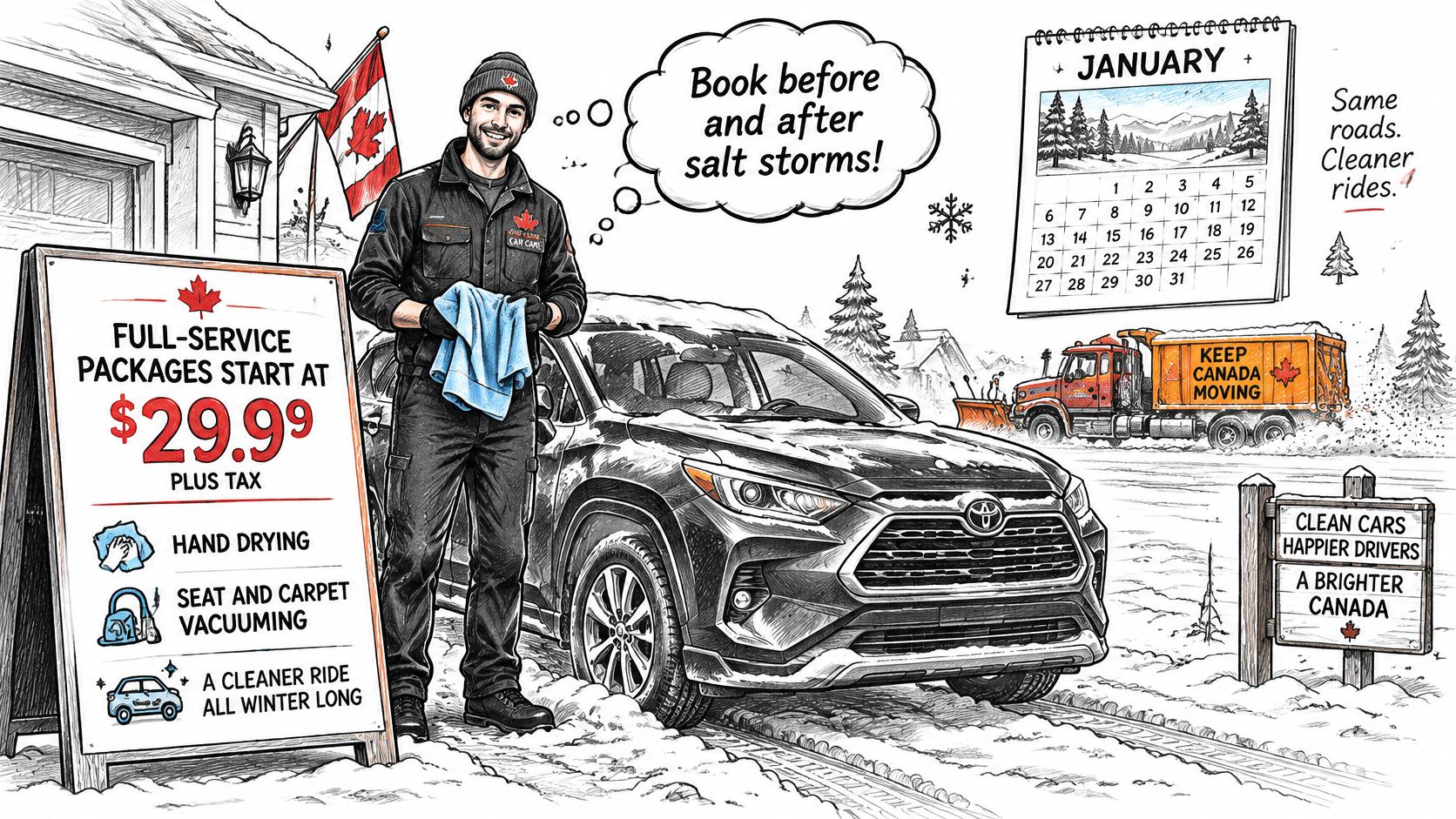
Start with the level that includes the hand dry. Full-service packages start at $29.99 plus tax and include hand dry, seat and carpet vacuuming, dashboard cleaning, and inside and outside window cleaning, so the step this whole article is about comes as standard rather than as an upsell. Want more gloss on top? A Quick Express Wax can be added to any full-service package for an extra $25. Book online or call 416-749-0202.
Before you arrive, think about how often you drive salted roads during a typical week. That answer decides whether you ask for an underbody rinse when you check in. Before you leave, do the two-second handover check: look for drips at the door jambs and spots on the mirror caps. Then set a reminder for the week after the next heavy salt run.
Nanak Car Wash runs express and full-service washes, hand-dry finishing and rust proofing across the Greater Toronto Area, so the drying step that decides how your paint looks in daylight is part of the process rather than something you have to ask for twice. If your car has spent the winter wearing road salt, book a session that clears the underbody and finishes the panels dry before the next storm rolls through. Visit Nanak Car Wash to pick a location and book your visit.

 6600 Finch Ave W, Etobicoke, ON M9V 3Z6

 647-703-8515
 MON – SUN 8 AM to 7 PM