
Rust proofing in Ontario typically runs about $119.95 to $149.95 + tax for standard vehicles, with SUVs and trucks usually closer to $150 to $170, and complete treatments reaching $450 to $750. If you're staring at winter roads, salty slush, and a wheel well that already looks suspicious, that's the price reality you're dealing with.
By the time a GTA driver starts asking about rust proofing, something has usually annoyed them first. Maybe it's bubbling paint, maybe it's a neighbour's rusty rocker panel, maybe it's a repair quote that made the dealership look cheap by comparison. Either way, Ontario isn't gentle on metal, and the bill for prevention is usually a lot easier to swallow than the bill for repair.
Table of Contents
- Why Ontario Drivers Are Searching for Rust Proofing Prices Right Now
- Typical Rust Proofing Prices by Vehicle Size
- Rust Proofing Methods Compared
- What Actually Drives the Price Up or Down
- What Nanak Car Wash Charges and What You Get
- Rust Proofing Versus the Cost of Rusting
- Smart Questions to Ask Before You Book
- How to Get the Best Value Without Skimping
Why Ontario Drivers Are Searching for Rust Proofing Prices Right Now
A lot of people don't start shopping for rust proofing on a calm afternoon. They start after a brutal Ontario winter, when the car wash bay is full, the salt is still crusted into the wheel wells, and a mechanic points out corrosion that wasn't there last year. That's when the question becomes real, and the first thing most drivers want is a plain number.
For a standard car, independent Canadian consumer research puts rust proofing at about $130 to $150 CAD, while SUVs and trucks usually sit around $150 to $170 CAD. Cansumer's Canadian rust proofing guide also shows examples like Rust Check at $130 for a car and $160 for an SUV/truck, Krown at $140 to $160 depending on vehicle class, and Corrosion Free at $170 to $180. That's everyday rust proofing, the kind most Ontario drivers buy.
Why the timing feels urgent in Ontario
Ontario is hard on vehicles because the problem isn't just snow. It's the mix of road salt, freeze-thaw cycles, wet slush, and grime sitting in seams, seams, and more seams. That combination turns underbody protection into routine maintenance, not a vanity add-on.
A lot of drivers wait too long because the car still looks fine from the outside. That's the trap. Rust usually starts where you don't stare, under the vehicle, inside cavities, around fasteners, and behind panels that trap moisture.
Practical rule: if you live in the GTA and you plan to keep the vehicle, annual protection is cheaper than pretending Ontario weather will be kinder next year.
The market is blunt on this. Ontario pricing has settled into a workable spread, but the service you buy matters more than the sticker on the door. A light annual spray and a deeper complete treatment are not the same thing, and the price gap tells you that immediately.
Typical Rust Proofing Prices by Vehicle Size
Ontario pricing is easiest to judge when you split it into two buckets. One bucket is the annual spray-style service. The other is the complete treatment, which costs far more because it covers more of the vehicle and usually takes more preparation and labour.
Krown's published flat-rate pricing is a solid benchmark because it shows how providers price by vehicle class. It lists $149.95 for a sedan or small car, $159.95 for minivans and standard SUVs, and $169.95 for XL SUVs and crew-cab pickups. The Automobile Protection Association's Canadian pricing reference puts a complete rustproofing treatment at $450 to $750, with the initial base treatment at $275 and retouching after three years at $120 to $150. The APA rustproofing reference makes the gap between a routine spray and a full treatment impossible to miss.
If you're comparing vendors for business use, the same logic applies. A service with simple, size-based pricing is easier to forecast than a quote that shifts after inspection. For teams that price services across multiple jobs, pricing for ecommerce brands is a useful example of how clear pricing structure reduces friction. Rust proofing is not ecommerce, but buyers still want to know the number before they book.
| Vehicle Class in Ontario | Annual Spray | Complete Treatment |
|---|---|---|
| Car, sedan, small car | About $130 to $150 | About $450 to $750 |
| SUV, standard minivan | About $150 to $170 | About $450 to $750 |
| Truck, crew-cab, XL SUV | About $150 to $170 | About $450 to $750 |
Why larger vehicles cost more
Bigger vehicles usually cost more because there is more metal to cover, more underbody area to reach, and more labour involved in getting the product where it needs to go. An XL SUV or pickup is not just a taller version of a car, it often has more underside complexity and more access points to deal with.
That is why the market does not price every vehicle the same way. The smaller the vehicle, the less material and time the job usually requires. The larger the vehicle, the more the quote tends to climb.
A sedan should land at the lowest common price band. A truck or SUV should carry a modest premium. If a shop is selling you a complete treatment, you are not shopping for a basic annual spray, you are shopping for a much more involved service. A GTA shop that is easy to reach saves you time when you need the work done before winter gets ugly.
Rust Proofing Methods Compared
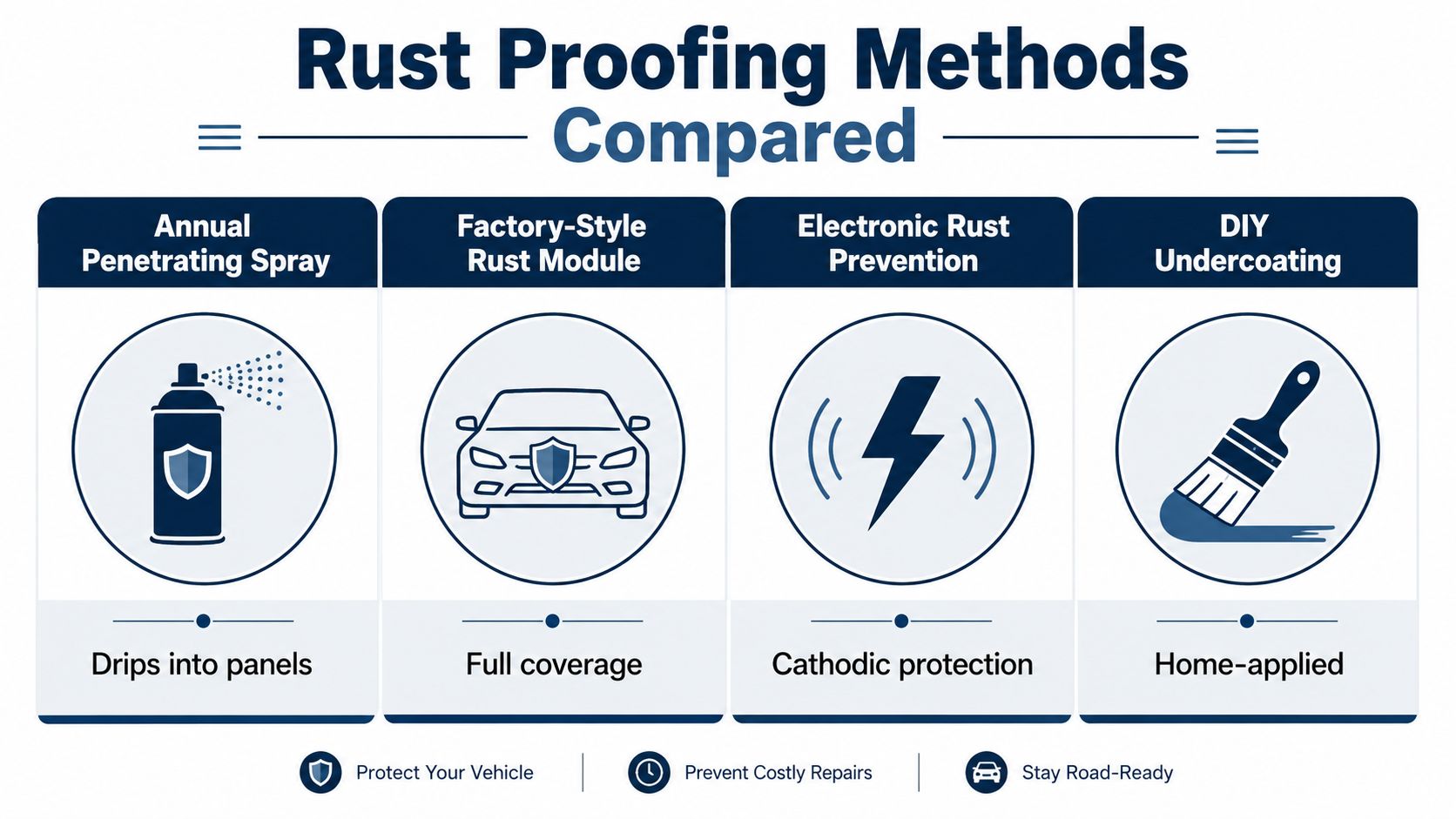
The biggest mistake Ontario drivers make is comparing every rust proofing quote as if it's the same product. It isn't. A penetrating spray, a complete factory-style treatment, an electronic rust-inhibition module, and DIY undercoating live in different price and coverage categories.
The four main options
Annual penetrating spray is the everyday choice. It's the lower-cost option, and it's what most Ontario drivers mean when they ask how much rust proofing costs. It works by getting into panels and vulnerable areas where salt and moisture collect.
Complete treatment is the bigger-ticket option. It covers more of the vehicle, usually involves deeper preparation, and carries the higher price band shown in the Canadian pricing references above. If you're protecting a long-term keeper, this is the category that usually deserves a serious look.
Electronic rust prevention gets sold as a separate category, but it's not the same as a physical coating. You're buying a different concept, not just a different package. Drivers should treat it as a separate product class, not a substitute for a proper spray or treatment.
DIY undercoating is the cheap route, at least on paper. The problem is consistency. A bad DIY job can miss critical areas, and missed coverage is exactly where rust starts doing damage.
If the quote sounds too cheap, ask what part of the vehicle they're not touching.
How I'd rank them for real Ontario use
For most GTA commuters, annual spray is the cleanest value play. For a vehicle you want to keep a long time, a complete treatment can make sense if the coverage is thorough. DIY is for people who know what they're doing and don't mind crawling under the car. Electronic modules should be treated carefully, because they're not a physical barrier against salt and moisture.
The smart move is to match the method to the vehicle and your ownership horizon. Don't buy a top-shelf treatment just because the upsell sounds impressive. Don't cheap out on a truck you plan to keep for years. Buy the method that fits the job.
What Actually Drives the Price Up or Down
Two drivers can bring in the same vehicle and get quotes that are miles apart. That's not random. The quote is usually shaped by five things, and once you know them, the price stops looking mysterious.
Size, coating, and labour are the obvious ones
Vehicle size changes the job immediately. A sedan is faster to cover than a full-size pickup, and that shows up in both material use and labour. Coating type matters too, because not every product behaves the same way once it's applied.
Labour time is another big lever. A clean, newer vehicle with easy access underneath is simpler to service than an older one with stubborn grime, hidden seams, and awkward access points. A technician charging for careful work has to account for that time.
Age and condition can change the quote fast
A one-year-old lease return and a 10-year-old truck with surface rust are not the same job. The older truck may need more cleaning and prep before anyone can apply protection properly. If the underside is already dirty, flaky, or corroded, the service takes longer and usually costs more.
Reapplication and warranty affect the bill too
Some services are priced around an annual visit. Others are built around a longer interval, like the three-year retouching mentioned in the APA pricing reference. If a provider includes a stronger warranty or deeper coverage, don't act shocked when the price climbs. You're paying for more service, not just more marketing.
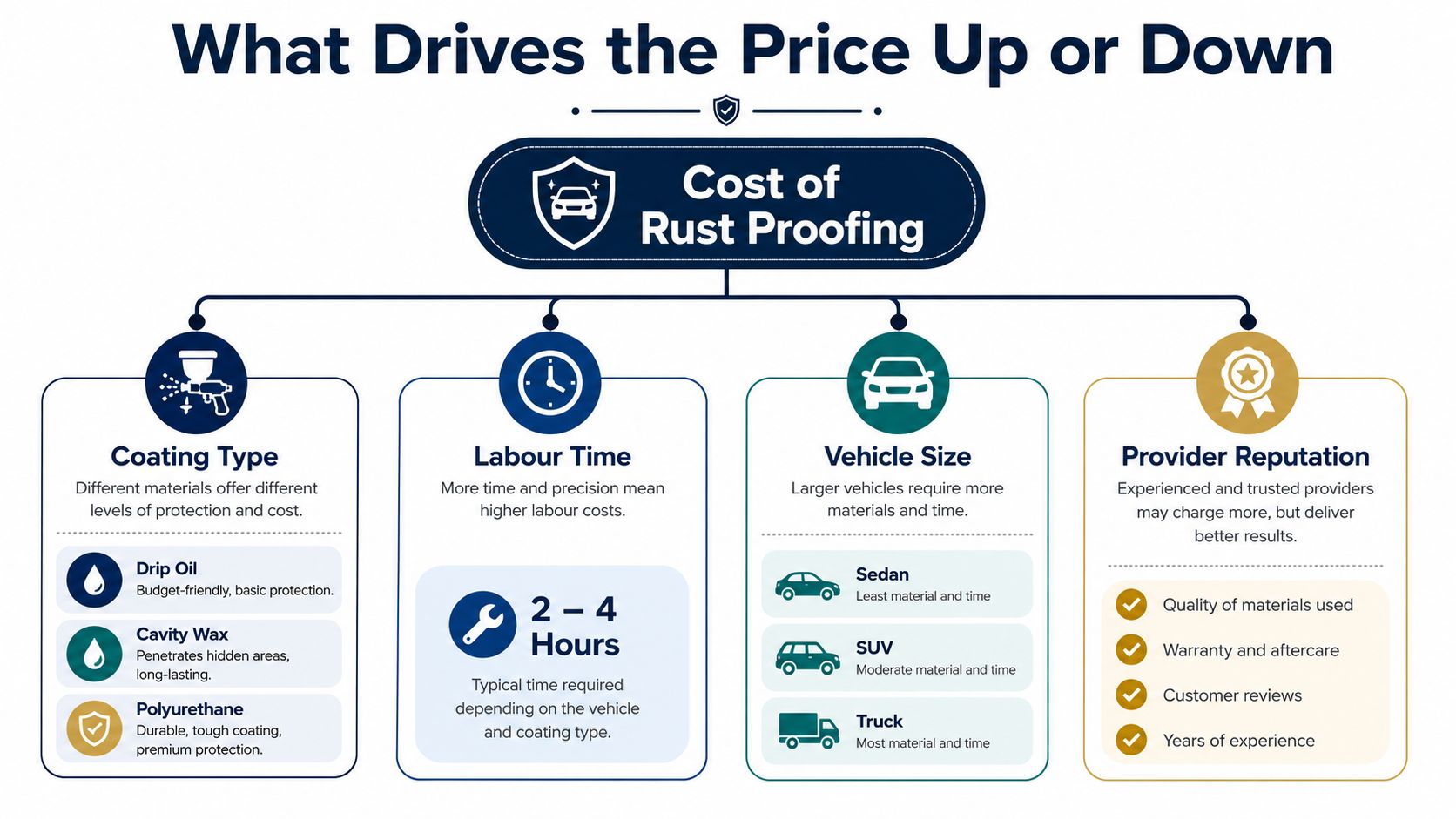
The rule is simple. A quote is a function of vehicle size, coating type, labour, condition, and reapplication schedule. If a shop won't explain those five inputs, they're asking you to buy blind.
What Nanak Car Wash Charges and What You Get
Nanak Car Wash lists rust proofing in the $119.95 to $149.95 + tax range, tiered by vehicle size. That puts it right in the everyday Ontario market, where a standard vehicle usually lands in the low-hundreds instead of anywhere near a major repair bill.
The service uses a dedicated rust-proofing chemical compound and is applied to vulnerable underbody and cavity areas. That matters because those are the places Ontario salt likes best. The nice part, from a practical point of view, is that you can deal with rust protection and a wash or detail at the same GTA location instead of making a second stop.

What the visit usually looks like
You show up, the vehicle gets assessed by size, and the rust proofing is applied to the relevant areas. That's the sort of appointment most Ontario drivers want, straightforward, repeatable, and easy to combine with another service. If you're already using an Unlimited Wash Club or doing a regular wash run, the spending feels more predictable because you're keeping salt and grime from hanging around in the first place.
Nanak also lists locations across Etobicoke, Brampton, Concord, Oshawa, North York, Burlington, Cambridge, and Guelph, which makes it a practical option for a lot of GTA and nearby drivers. That kind of access matters when you're trying to get protection done before winter gets ugly.
A lot of people overcomplicate this. You don't need a lecture. You need a service that covers the right spots, charges a fair size-based price, and doesn't force you to drive all over the region for one appointment. That's the actual value test.
Rust Proofing Versus the Cost of Rusting
Rust proofing only looks expensive if you compare it to doing nothing. Compare it to rust repair, and the math changes fast.
A yearly $119.95 to $169.95 spend is scheduled maintenance. Rust repair is a different animal because once corrosion starts spreading, the labour gets invasive and the bill climbs with it. That is why smart owners treat rust proofing like an oil change, a recurring cost of owning a vehicle in Ontario.
Practical rule: pay a little on purpose, or pay a lot after the fact.
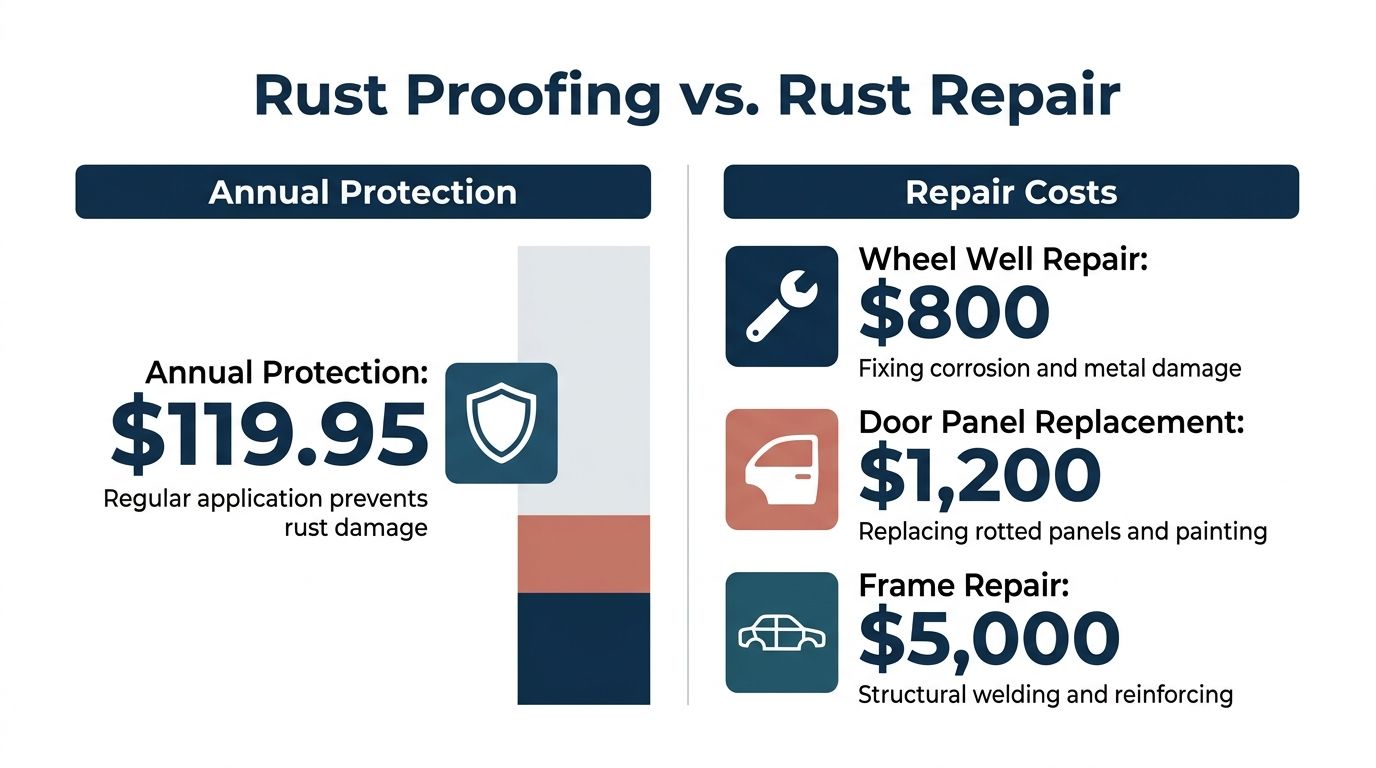
The better comparison is maintenance versus repair
If you plan to sell later, rust also affects how buyers and insurers value the car. That is why it helps to keep your paperwork tidy, and why assessing diminished value becomes more relevant once body damage or corrosion enters the picture. A clean maintenance trail is easier to defend than a vague story about “it was fine last winter.”
Skipping rust protection can look like savings for one season. Then a wheel well starts bubbling, a bracket turns ugly, or a component needs more work than the car should need at that age. By then, the original savings do not look smart anymore.
The blunt takeaway is simple. Rust proofing is cheap enough to schedule and expensive enough to skip. That is why Ontario drivers keep asking about it.
Smart Questions to Ask Before You Book
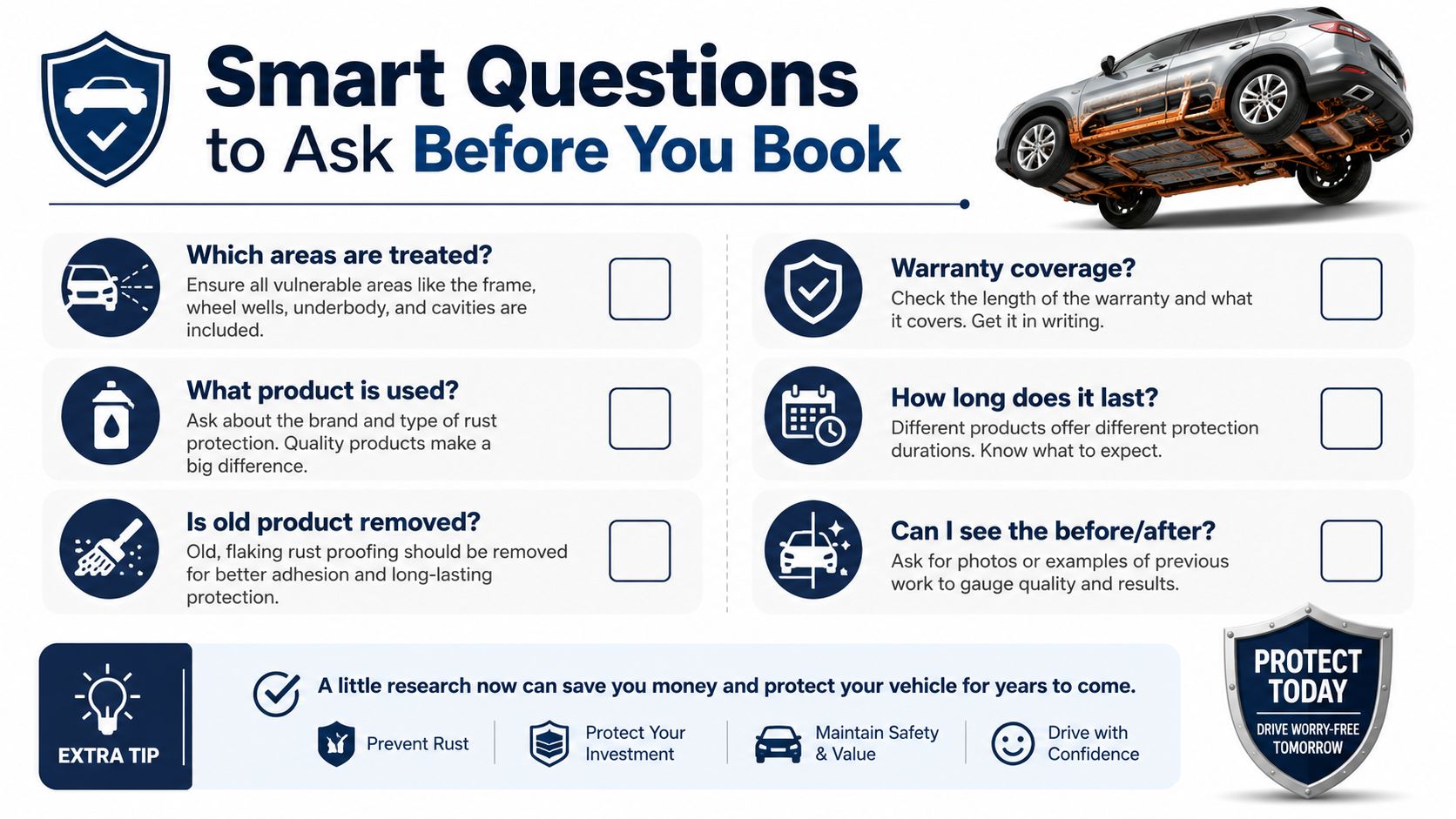
Don't let a quote stay vague. Ask the provider exactly what you're buying, because “rust proofing” can mean very different things depending on the shop.
- Which areas are treated? Ask whether they cover the underbody, cavities, doors, fenders, and other vulnerable points.
- What product is used? Name the compound. If they won't say it, that's a problem.
- Is old product removed first? Some jobs need prep before new protection goes on.
- How often does it need reapplication? Annual service and longer-interval service are not the same promise.
- What does the warranty cover? Read for exclusions, not just the headline.
- Is the price flat or inspection-based? Don't assume the first number is final.
- Do you treat surface rust or only clean metal? That answer tells you a lot.
- Can I see the treated areas after the job? A reputable shop should be able to show you.
- Are upsells optional or mandatory? If the price changes mid-conversation, ask why.
- What changes the quote for my vehicle specifically? Size, condition, and access should all be explained.
Red flags that waste your time
A vague “lifetime” promise without clear terms is not a decision tool. Refusal to name the product is another one. Pressure to upgrade before you've even approved the base service is the third.
A good quote is specific. It says what's covered, what's excluded, how long it lasts, and what happens next. If you still can't tell whether you're buying a spray, a full treatment, or a sales pitch, walk away.
How to Get the Best Value Without Skimping
If you're booking rust proofing in Ontario, timing matters. Get it done before winter road salt really settles in. You start with a cleaner vehicle, and you avoid paying extra just to fight through built-up grime. If you're already stopping for a wash, combine the visit so the underbody is clean when the protection goes on.
Keep the reapplication interval on your calendar, not just the odometer. Rust does not care how low your mileage is if salt and moisture are still sitting on the vehicle. Save the receipt as well, because a clean service record helps when you sell.
The best value isn't the cheapest quote, it's the one that covers the right areas and gets repeated on schedule.
Use bundle pricing or membership pricing where it makes sense, but do not let a discount distract you from coverage. A cheap job that misses key areas is still a bad job. A fair-priced service that is done properly is the one that pays off.
For Ontario drivers, the typical price band is still the same one you saw at the top, about $119.95 to $170 for an annual spray on most vehicles, and $450 to $750 for a complete treatment.
If you want a straightforward rust proofing appointment in the GTA, Nanak Car Wash offers size-based pricing, underbody and cavity application, and the convenience of getting it done at the same location as your wash or detail. Book it before the salt season gets worse, keep the receipt, and stop paying for preventable rust later.


 6600 Finch Ave W, Etobicoke, ON M9V 3Z6
 647-703-8515
 MON – SUN 8 AM to 7 PM