

You open the driver's door after a week of GTA winter driving and see the usual evidence: a pale ring of salt around the mat, damp grit pressed into the carpet, and an odour that returns whenever the cabin warms up. A quick vacuum removes the loose debris, but the floor still looks tired. Worse, the carpet may feel dry on top while the padding underneath remains wet.
That's why choosing an interior carpet cleaner isn't just a matter of buying the strongest spray on the shelf. The right method must lift salt, soil, hair, and spills without flooding the backing, trapping contaminated moisture, or leaving the vehicle with a deeper odour problem. For most Ontario vehicles, controlled moisture and proper extraction matter more than aggressive scrubbing.
| Cleaner type | Best use | Main strength | Main risk |
|---|---|---|---|
| Portable extractor | Salt, slush, embedded soil | Rinses and removes contamination | Over-saturation |
| Spray-and-scrub cleaner | Small surface stains | Fast and convenient | Can redistribute dirt |
| Enzymatic formula | Organic stains and odours | Targets biological residue | Not the first choice for road salt |
| Machine rental | Larger, heavily soiled interiors | More power and capacity | Requires careful operation |
Table of Contents
- Why Your Car Carpets Need More Than a Quick Vacuum
- The Four Main Types of Interior Carpet Cleaners
- Comparing Performance Across Real-World Conditions
- The Moisture Trap That Ruins DIY Cleaning Jobs
- Choosing the Right Method for Your Situation
- When Professional Detailing Becomes the Smart Choice
- Your Action Plan for Cleaner Car Carpets
Why Your Car Carpets Need More Than a Quick Vacuum
Ontario winter doesn't leave a vehicle interior with ordinary dirt. Road salt, slush, and grit arrive on boots, coats, bags, and floor mats, then work their way into carpet fibres, seams, and underlays. Public transportation literature places Ontario's winter road-salt use at roughly 1.5 to 3 million tonnes each season, while Toronto alone uses about 130,000 to 150,000 tonnes annually. Canada-wide usage is commonly cited at about 5 million tonnes per year. These figures are summarised in the Transportation Association of Canada corrosion research.
That same environment explains why a floor mat can look clean after a surface wipe and still produce a salty, stale smell later. Meltwater carries dissolved minerals below the visible stain. As the water evaporates, crystals remain behind, while grit continues rubbing against the fibres every time someone presses a foot down.
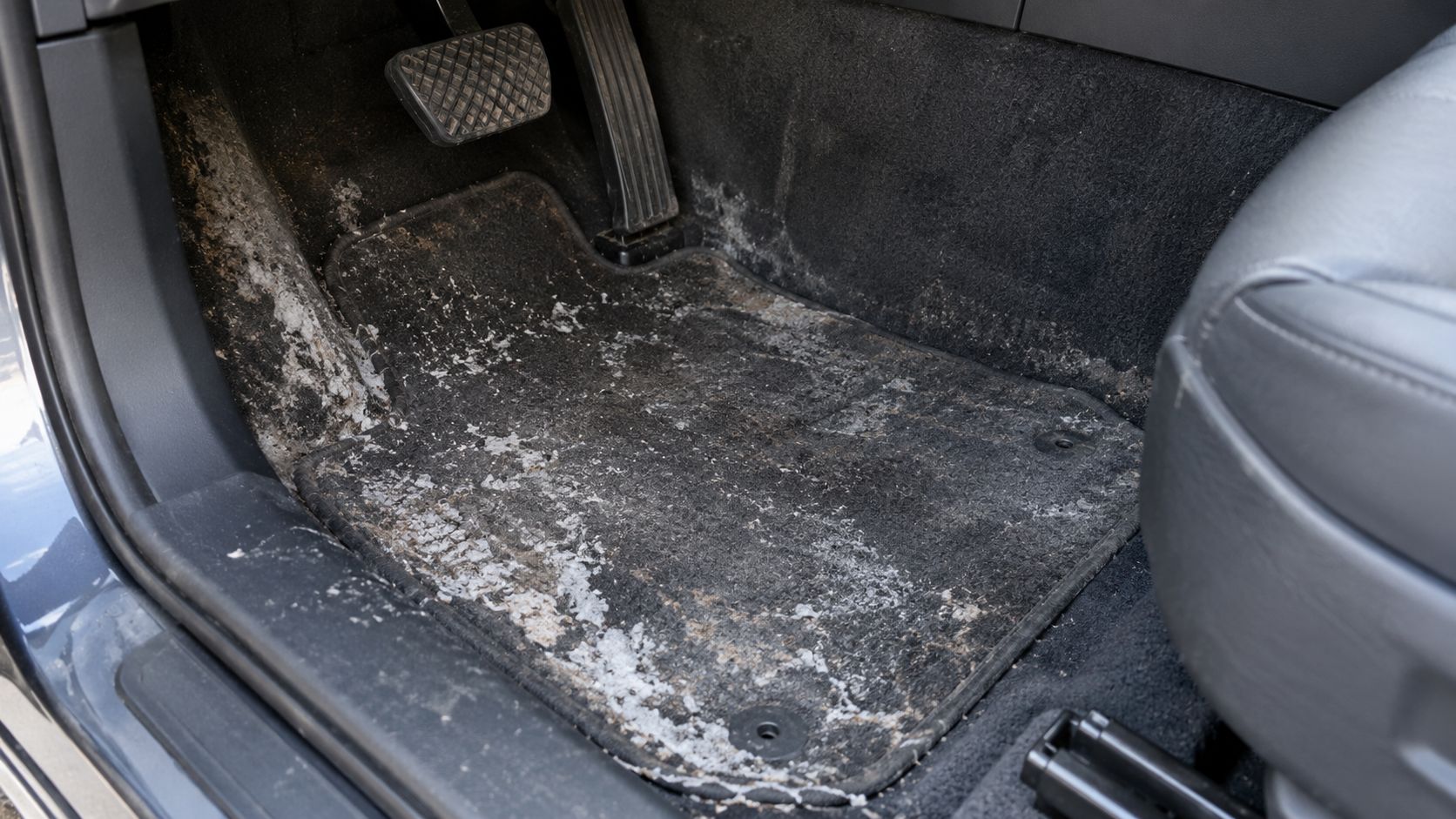
Surface appearance can be misleading
A spray bottle and microfibre cloth may improve the visible ring. They won't necessarily rinse the dissolved salt out of the carpet structure. Scrubbing without extraction can also spread the contamination outward, leaving a larger but lighter mark.
Vehicle preservation adds another reason to take the job seriously. A Transportation Research Board paper identified Toronto among the highest-corrosion locations in its study, recording 5,108 mg/dm² over 19 months. The research also noted that, under a model assigning half of corrosion to road salt and half to natural conditions, inhibitors could reduce total corrosion by about 25%, not eliminate it. The broader lesson is simple: winter contaminants are persistent, and cleaning the areas that collect them is part of sensible vehicle care.
Practical rule: If salt has reached the carpet backing, wiping the surface is a cosmetic repair, not a complete clean.
The right interior carpet cleaner removes loose material first, dissolves residue with a controlled amount of solution, agitates only as much as the fibre needs, and extracts the dirty liquid immediately. That sequence protects the appearance of the carpet while reducing the chance that you'll bury the problem underneath it.
The Four Main Types of Interior Carpet Cleaners
Interior cleaners fall into four useful categories. They overlap, but they don't perform the same job.
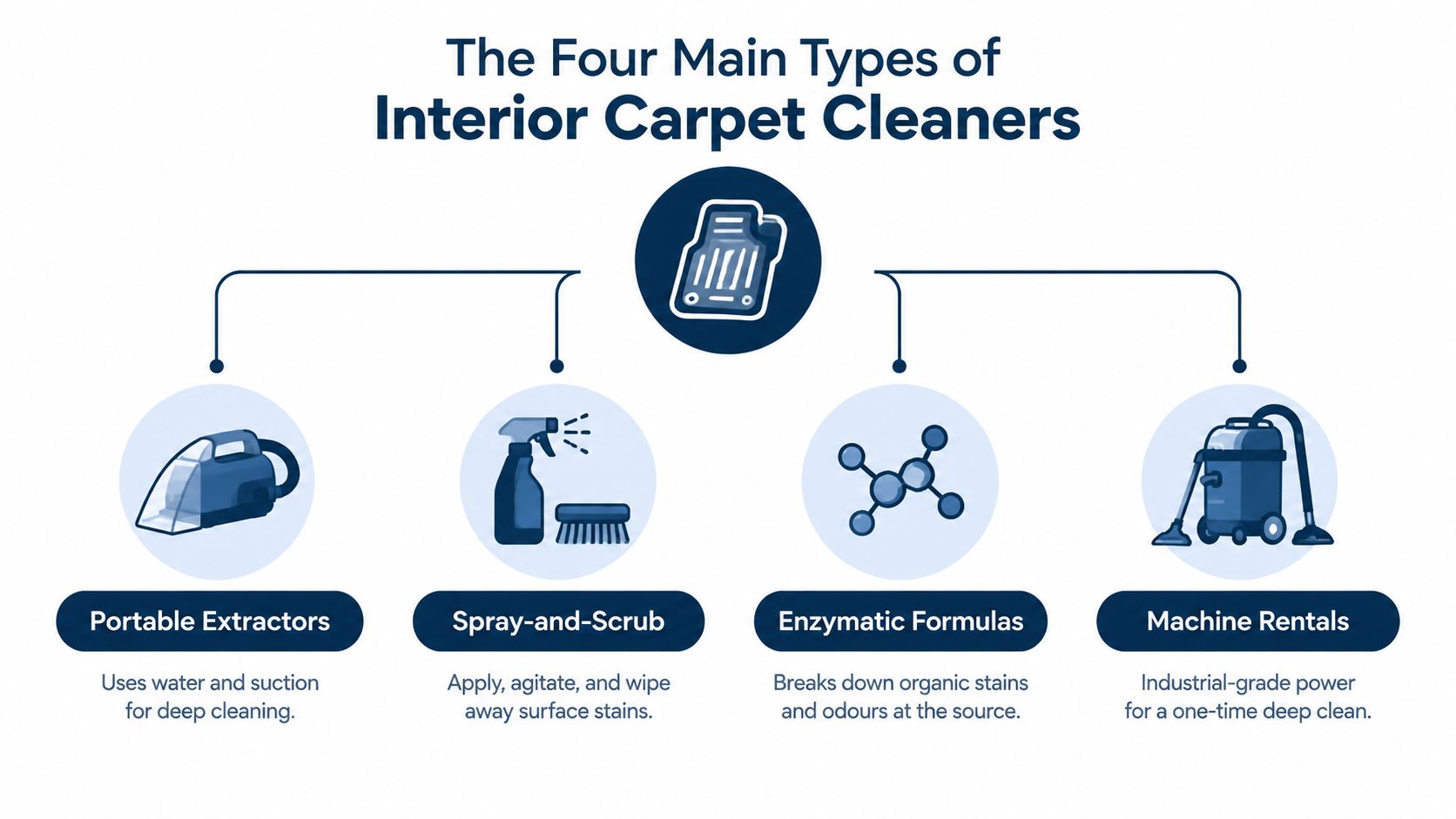
Portable extractors
A portable extractor sprays cleaning solution into the fabric and immediately pulls the dirty liquid back through a vacuum head. This is the most suitable category for winter mats and carpet because it combines cleaning with removal. The machine doesn't just loosen salt and soil. It carries that contamination away, provided you don't oversaturate the area.
Kärcher's Canadian Puzzi 10/1 lists 12.5 PSI spray rate, 22 kPa vacuum, 1 L/min spray volume, 1 bar spray pressure, and 20 to 25 m²/h area performance in the product information cited by Car and Driver's tested carpet-cleaner guide. The same source reports a manufacturer claim that carpets dry up to 63% faster than comparable products, a useful benchmark for detailing workflows where drying affects turnaround.
Spray-and-scrub products
A dedicated carpet spray, such as P&S Carpet Bomber, works well as a pre-treatment or for a small isolated spill. You mist the product, agitate gently with a soft or medium interior brush, and wipe or extract the loosened soil. This approach is efficient for coffee marks, light grime, and areas that don't need a full rinse.
It's the wrong tool for heavily salt-loaded padding if you have no way to remove the moisture and dissolved residue.
Enzymatic formulas
Enzymatic cleaners target organic contamination, including food residue, biological messes, and some odours. They have a place in vehicles with pet accidents or decomposing food stains. They aren't a universal answer for mineral residue, so don't reach for an enzyme product first when the primary problem is white winter salt.
Machine rentals
A rental extractor can make sense when an entire interior needs attention and you're comfortable controlling water volume, recovery passes, and drying. It offers more capacity than a small spot cleaner, but the larger machine doesn't automatically make the operator more skilled.
For a useful explanation of deeper extraction work and the difference between surface cleaning and soil removal, see this resource on professional deep soil removal. The important distinction is not machine size alone. It's whether the process removes contaminated liquid instead of forcing it farther into the underlay.
Comparing Performance Across Real-World Conditions
A cleaner earns its place in a GTA vehicle by handling the mess that appears on the floor. Dried salt rings need rinsing and recovery. Ground-in grit needs mechanical agitation followed by extraction. Pet hair needs thorough dry removal before any liquid touches the carpet. Coffee and food stains need a suitable pre-treatment, while mystery odours require investigation rather than perfume.
| Cleaner Type | Best For | Drying Time | Skill Level | Cost Range |
|---|---|---|---|---|
| Portable extractor | Winter salt, slush residue, embedded soil, recurring mat cleaning | Usually faster when operated with controlled spray and strong recovery | Moderate | Varies by machine and purchase or rental option |
| Spray-and-scrub | Small spills, light marks, quick maintenance | Often short when lightly applied and wiped thoroughly | Low | Varies by product |
| Enzymatic formula | Organic stains, pet-related contamination, biological odours | Depends heavily on application and removal | Moderate | Varies by formula |
| Machine rental | Large interiors and heavy overall soiling | Depends on water control, extraction passes, and ventilation | Moderate to high | Varies by rental provider |
Salt and embedded grit
For salt, the extractor has the clear advantage because it can flush and recover dissolved minerals. A spray-and-scrub product may brighten the mark, but without a recovery step, some residue stays in the carpet or moves into nearby fibres.
Grit requires a dry first pass. Use a crevice tool and vacuum slowly around seat rails, mat edges, and footwell seams. Liquid cleaning before that step turns loose grit into muddy slurry and makes the carpet harder to clean.
Pet hair and organic stains
Pet hair doesn't belong in the wet-cleaning stage. Rubber brushes, a pet-hair tool, and patient vacuuming work better before you introduce water. Once the loose hair is gone, an enzymatic formula may suit an organic stain or odour, but test it in an inconspicuous area and follow the label instructions.
Coffee marks often respond to a lightly applied interior-safe pre-spray, gentle agitation, and extraction. Don't attack them with a stiff brush just because the stain looks dramatic. Aggressive brushing can roughen fibres and leave a visible patch.
Mystery odours
Odour is a diagnostic clue. A stale smell after cleaning often means the product masked the contamination or moisture remains below the surface. If the odour strengthens after the cabin heats up, stop adding fragrance and inspect the padding, mat underside, and surrounding seams.
The best cleaner is the one that removes the dirty liquid and leaves the carpet genuinely dry, not the one that creates the most foam.
For compact mobile work, Kärcher's Canadian Puzzi 8/1 C lists 12 to 18 m²/h area performance, 61 L/s airflow, 23 kPa vacuum, and 8 L/7 L fresh and dirty water tanks in its Canadian product information. Compare that with the Puzzi 10/1's higher listed coverage. The smaller unit suits focused interior jobs and portability, while the larger model makes more sense when coverage and workflow speed take priority.
The Moisture Trap That Ruins DIY Cleaning Jobs
Most DIY instructions focus on what to spray. That's the easy part. The dangerous mistake is using so much liquid that the carpet looks clean on top while the padding underneath holds a contaminated, slow-drying mixture.
Salt removal requires moisture, but it doesn't require flooding. A heavily soaked carpet can push dissolved salt into the underlay, where it becomes difficult to see and harder to recover. The GTA and Ontario winter-salt cleaning guidance stresses the practical sequence: vacuum first, use a lightly misted vinegar and water solution where appropriate, and extract moisture immediately rather than soaking the area.
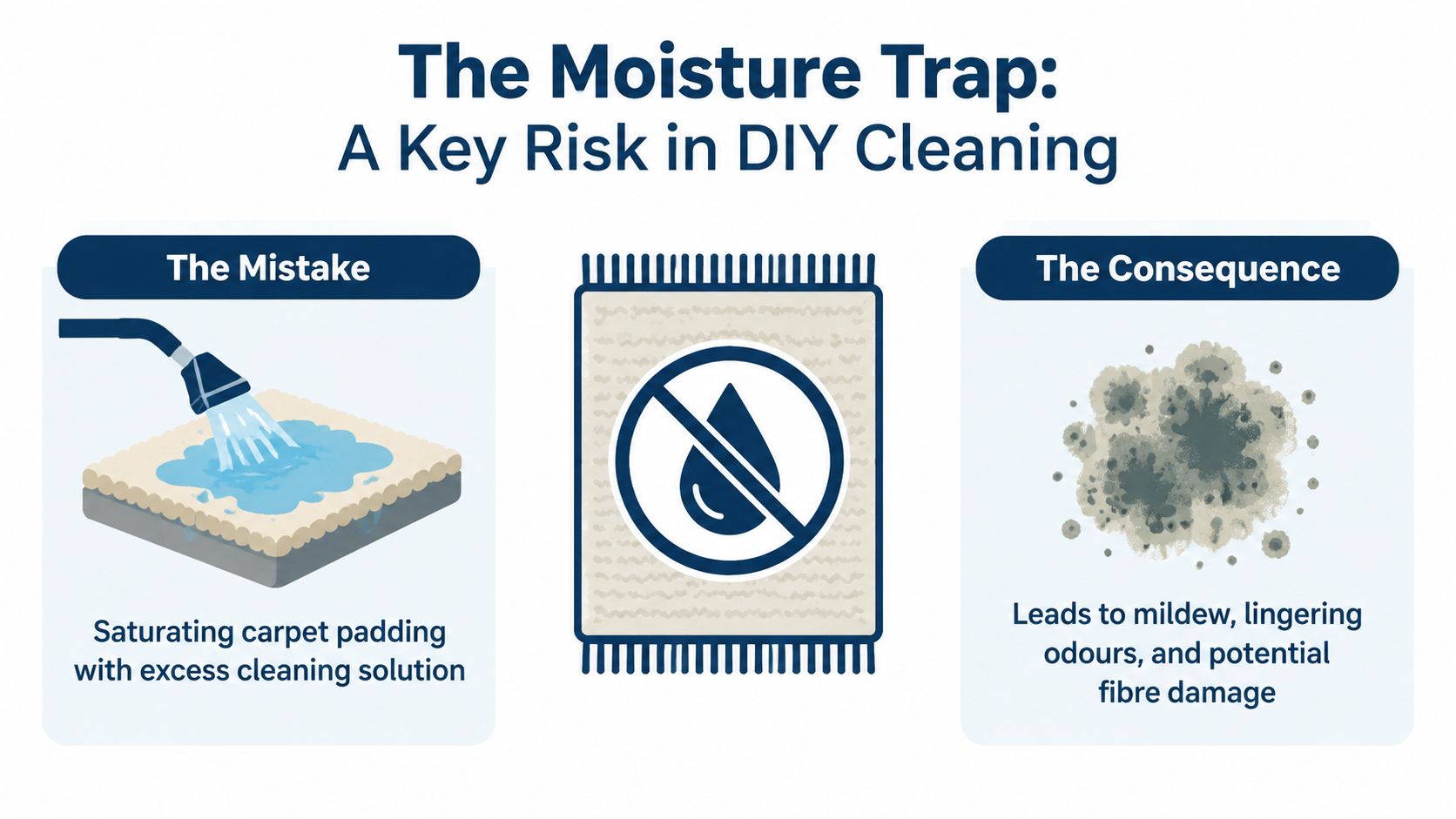
Why flooding creates a second problem
Carpet has layers. The visible pile is only the part you can inspect easily. Beneath it sit backing materials and padding, and those layers can retain water after the surface feels merely damp.
A soaked area may develop a lingering odour, slow drying, or a cold, clammy feel when you press down. You might also notice that the smell returns after the vehicle sits closed. That's not a sign that you need a stronger fragrance. It's a sign that the cleaning process hasn't removed enough moisture or contamination.
The safer extraction sequence
Use a disciplined order:
- Vacuum dry debris first. Remove salt crystals, sand, grit, hair, and loose soil before applying any liquid.
- Mist, don't pour. Apply enough product to work the stain, not enough to saturate the whole footwell.
- Agitate selectively. Match the brush to the carpet and work the affected area without grinding grit deeper.
- Extract immediately. Use an extractor or wet-dry vacuum with slow recovery passes.
- Ventilate the cabin. Open doors when conditions allow, lift removable mats, and direct airflow across the carpet rather than trapping humid air inside.
A wet-dry vacuum can remove liquid, but it isn't automatically equivalent to a spray extractor. It may recover moisture effectively after pre-treatment, yet the cleaning result depends on how evenly you apply the solution and how thoroughly you rinse the contaminated area.
Moisture check: Press a clean, dry towel firmly into the carpet after extraction. If it picks up dampness or the carpet feels cool and heavy, keep extracting and increase airflow.
Never ignore electronics and seat mechanisms. Avoid spraying around wiring, powered seat tracks, airbag connectors, and control modules. If the carpet around these areas needs deep cleaning, controlled professional extraction is safer than pouring solution into a confined footwell.
Choosing the Right Method for Your Situation
Start with the stain, not the product label. A small coffee spill on a removable mat and a winter-soaked driver's footwell may both look brown, but they require different levels of intervention.
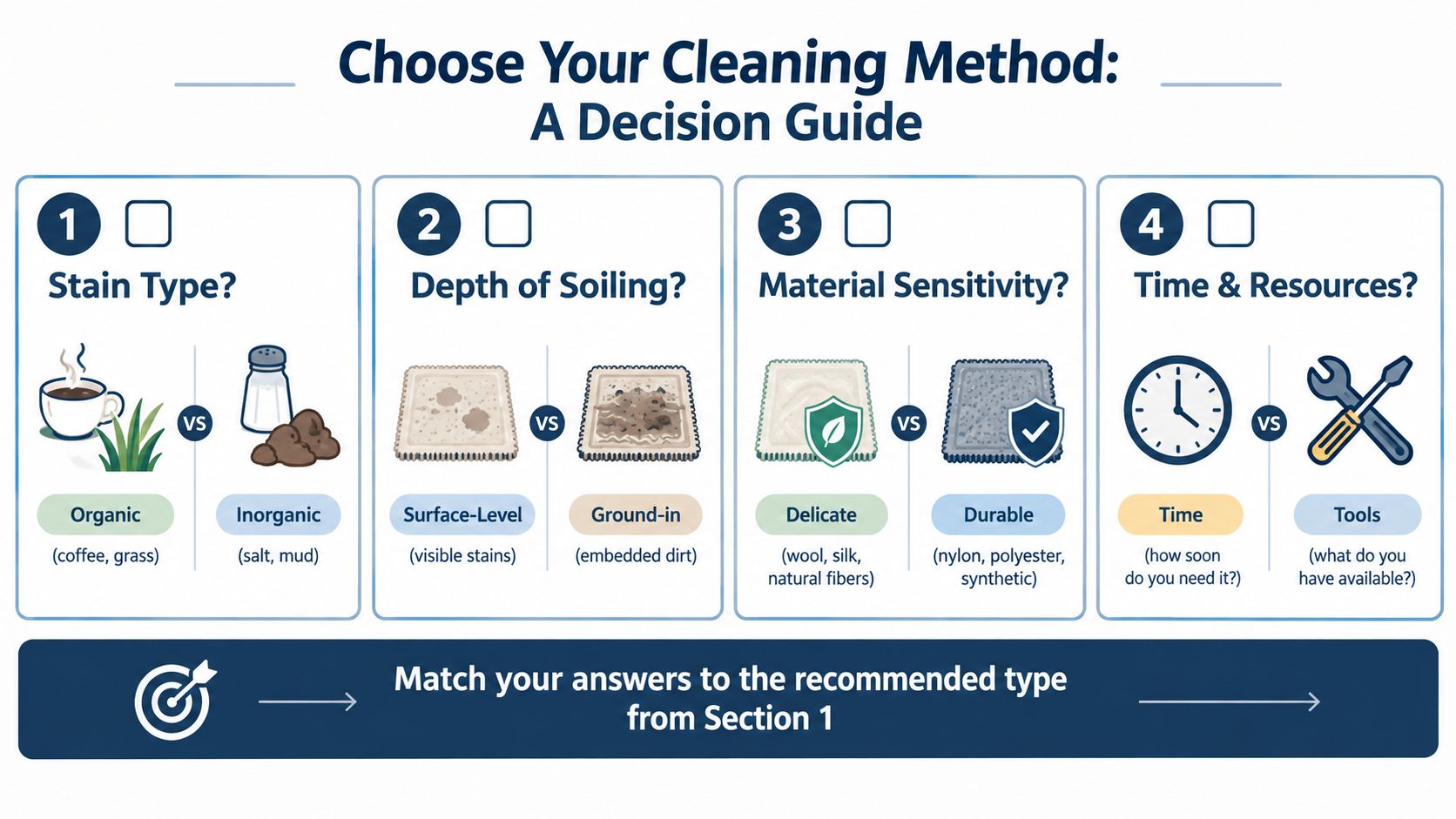
Use a spray for contained surface marks
Choose a spray-and-scrub cleaner when the contamination is localised, the carpet isn't saturated, and you can remove the loosened residue with a towel or wet-dry vacuum. This is the sensible option for a fresh drink spill, a light scuff, or maintenance cleaning after vacuuming.
Test first in a hidden area. Apply a light mist, agitate gently, and inspect the towel for transferred colour. If dye transfers, the carpet changes texture, or the mark spreads, stop and change your approach.
Choose extraction for winter contamination
A portable extractor is the better match for salt rings, slush residue, and repeated winter buildup. You'll get the best result from a dry vacuum pass, controlled pre-treatment, measured spray, and immediate recovery. Keep removable mats outside the vehicle when possible so you can clean both sides and inspect the underside.
Rent or book help for a full interior
A machine rental makes sense when the vehicle has widespread soiling and you have enough time to manage setup, extraction, and drying. It's a poor choice if you're rushing, unfamiliar with the equipment, or unable to ventilate the vehicle properly.
Book professional service when the carpet is heavily saturated, odours persist after careful extraction, contamination surrounds powered seats, or the job includes a large SUV, van, or truck. The cost of a mistake is not only a disappointing appearance. It can include trapped moisture, damaged trim, and a repeat cleaning job.
When Professional Detailing Becomes the Smart Choice
DIY cleaning stops being economical when you're spending hours repeating the same treatment and still smelling the problem. Professional detailing earns its keep when the contamination is widespread, the underlay is involved, or the vehicle has areas you can't safely flood and recover.
Severe salt saturation is the obvious GTA example. If the driver's carpet has repeated white deposits, wet edges, gritty seams, and a returning odour, a quick spray has already failed. The technician needs to remove dry debris, select a suitable pre-treatment, control the rinse, and recover the liquid without soaking adjacent areas.
Situations that justify professional equipment
- Persistent odours: A returning smell points to contamination or moisture below the visible surface.
- Large interiors: SUVs, vans, and trucks contain more carpet area and more seams, so uneven DIY drying becomes easier to create.
- Sensitive interior zones: Powered seats, wiring, seat anchors, and trim gaps require careful water control.
- Heavy ground-in soil: Embedded grit needs more than a surface wipe and often benefits from coordinated agitation and extraction.
- Limited drying conditions: A closed garage, cold weather, or a tight schedule makes moisture management harder.
Nanak Car Wash offers appointment-based interior and exterior detailing that includes carpet and seat shampooing, salt and stain removal, vent and crevice blowout, and leather deep cleaning. Its stated detailing duration is typically 1 to 4 hours, with SUV, van, truck, and pet-hair surcharges applying according to the vehicle and job. The business also provides regular interior cleaning through its full-service wash packages, which include interior vacuuming, dashboard and window cleaning, with higher tiers adding door panels, consoles, and cup holders.
What a professional process changes
A professional isn't just applying a stronger chemical. The value is in the workflow, equipment, and judgement. The operator can identify whether a stain is mineral, organic, oily, or dye-related, choose a compatible product, and adjust the amount of liquid to the carpet condition.
That matters because deep cleaning without recovery is incomplete cleaning. If your home method leaves the padding wet, a professional service can be the smarter option before the odour becomes a recurring interior problem.
Your Action Plan for Cleaner Car Carpets
A clean result starts before you buy an interior carpet cleaner. Assess the material, identify the contamination, and decide whether you can remove and dry the moisture you're about to add.
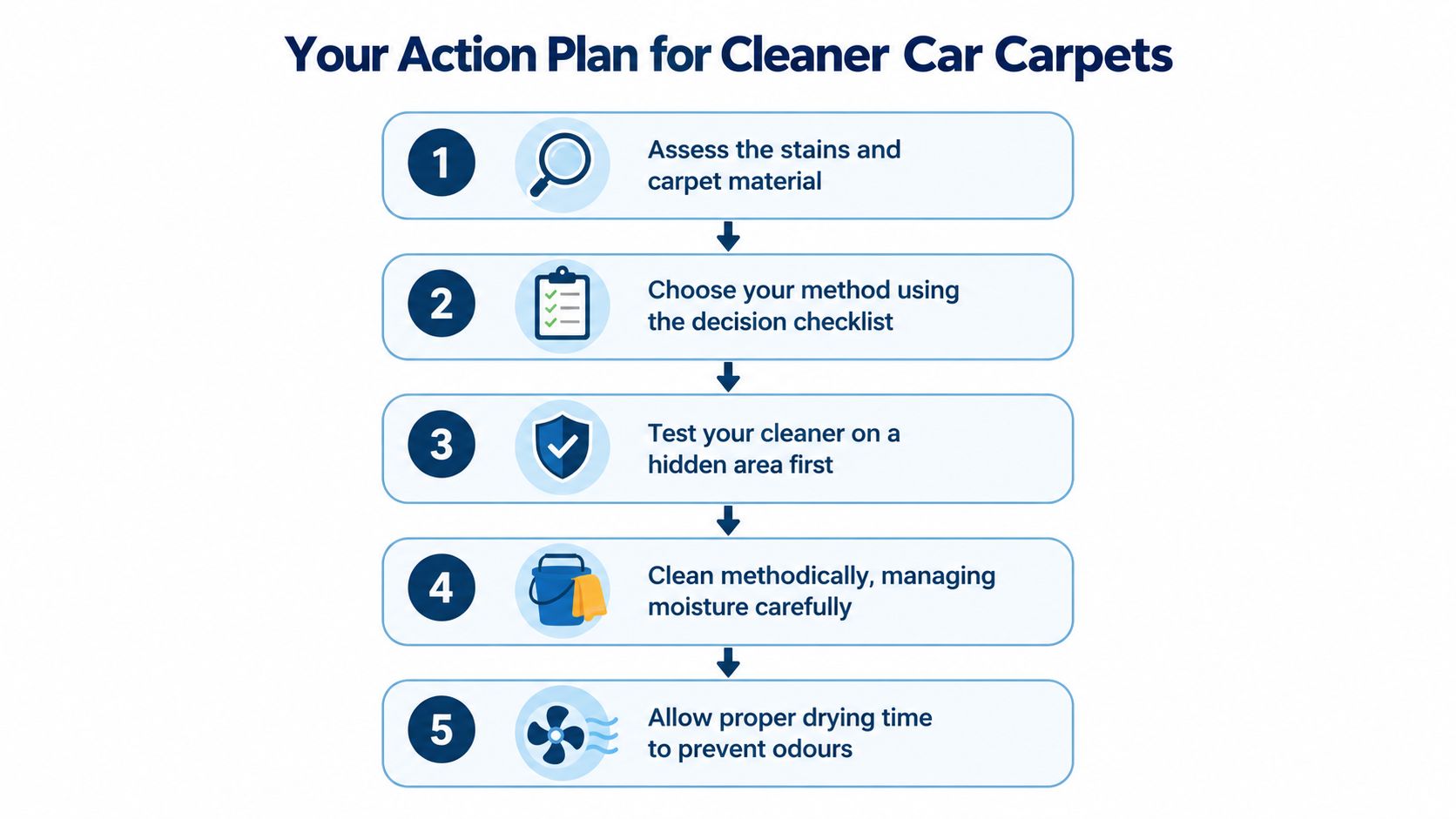
- Inspect the carpet and mats. Look for salt crystals, greasy marks, pet hair, dampness, odour, and staining around seams.
- Vacuum thoroughly. Use a crevice tool and slow passes before introducing solution.
- Match the method. Use a spray for a contained surface stain, an enzymatic formula for organic contamination, and an extractor for winter residue or deeper soil.
- Control moisture. Mist lightly, agitate carefully, extract immediately, and keep air moving through the cabin.
- Recheck after drying. If the odour returns, the carpet feels heavy, or the stain wicks back, stop repeating the same DIY treatment.
For a basic job, keep a soft interior brush, quality microfibre towels, a crevice vacuum tool, and a wet-dry vacuum available. For regular winter cleaning, a portable extractor is more useful than a shelf full of sprays because it can remove the liquid carrying dissolved salt and soil.
Don't wait for the carpet to look ruined. Ontario's salt and slush return every winter, so short, controlled maintenance sessions are easier to manage than one heavily saturated rescue job. If you can't confidently control extraction and drying, book the service before moisture gets trapped under the carpet.
Nanak Car Wash provides interior detailing with carpet and mat shampooing, salt and stain removal, vacuuming, and vent and crevice cleaning for GTA vehicles. Visit Nanak Car Wash to review the available wash and detailing options and choose the right next step for your vehicle.

 6600 Finch Ave W, Etobicoke, ON M9V 3Z6
 647-703-8515
 MON – SUN 8 AM to 7 PM