
In Ontario, a partial-front PPF package typically runs CAD $499–$1,500, a full-front package CAD $1,299–$2,500, and a full-vehicle wrap CAD $3,999–$8,000+. The total is driven far more by labour and coverage scope than by film material alone.
You've just driven a new SUV out of a Mississauga or Vaughan dealership, and the first winter grime is already clinging to the bumper. The 400-series highways are still throwing salt, brine, and gravel at the front end, while the first PPF quote on your phone looks less like a simple service price and more like a menu.
That's normal. Paint protection film cost in Ontario depends on what gets covered, how difficult the vehicle is to install, and how much preparation the paint needs. A small partial-front job and a full-body installation aren't comparable purchases, even if both are advertised as “PPF.”
Table of Contents
- What Paint Protection Film Actually Costs in Ontario Right Now
- What PPF Is and Why It Costs What It Costs
- The Four Coverage Levels Every GTA Quote Will Offer
- How Vehicle Size and Film Grade Change the Bill
- PPF Compared With Vinyl Wraps and Ceramic Coatings
- Is PPF Worth the Money in Ontario Winters and Salt
- How to Compare PPF Quotes Without Getting Burned
- The Short Version for GTA Drivers Ready to Decide
What Paint Protection Film Actually Costs in Ontario Right Now
The Ontario price ladder is straightforward once you ignore vague package names. A partial-front installation generally covers the most exposed leading areas and sits around CAD $499–$1,500. A full-front package usually costs CAD $1,299–$2,500, while a full-vehicle wrap commonly lands between CAD $3,999 and $8,000+. These regional ranges are supported by Ontario PPF pricing guidance from Carmedics Autowerks and Toronto coverage-zone examples from Nascar Auto Care.
Luxury, exotic, and heavily contoured vehicles can move beyond those bands because installers spend more time fitting film around sensors, vents, grilles, tight recesses, and complex edges. The shop isn't charging only for the urethane coming off the roll. It's charging for preparation, pattern fitting, installation, inspection, curing, and the risk of correcting a difficult panel.
| Coverage level | What's included | Typical Ontario price (CAD) | Typical time on vehicle |
|---|---|---|---|
| Partial front | Leading hood edge, partial fenders, mirrors, bumper impact zone | $499–$1,500 (Express Mobile Tint, Carmedics Autowerks) | Varies by vehicle and shop |
| Full front | Full hood, full fenders, bumper, mirrors, headlights, sometimes A-pillars | $1,299–$2,500 (Express Mobile Tint, AutoBoss) | Varies by prep and complexity |
| High-impact or track package | Front protection plus rockers and other debris zones | $1,999–$4,500 (Express Mobile Tint, Nascar Auto Care) | Varies by panel count |
| Full vehicle | Broad or complete coverage across painted panels | $3,999–$8,000+ (Express Mobile Tint, Carmedics Autowerks) | Varies substantially |
Practical rule: If a quote doesn't list the panels, “full front” and “partial front” are marketing labels, not useful specifications.
For most GTA daily drivers, the full-front tier deserves the closest look. It protects the areas that take the punishment without asking you to fund a complete wrap on panels that may rarely see direct road impact.
What PPF Is and Why It Costs What It Costs
Paint protection film is a clear thermoplastic urethane layer applied over painted surfaces. Think of it as heavy-duty SPF 50 for your paint. It sits between the clear coat and the road debris, helping absorb the small impacts, abrasion, bug contamination, and winter grime that would otherwise mark the finish.
PPF isn't the same product as vinyl wrap. Vinyl is primarily a colour and finish product. PPF is engineered around impact resistance, optical clarity, surface protection, and, in some grades, self-healing behaviour. That different job explains why a clear protective installation can cost more than a basic appearance-focused wrap.
The material is only one line on the invoice
Film grade changes the material choice, but labour usually determines whether a quote feels reasonable. Canadian pricing guidance places standard PPF material around CAD $2–$5 per square foot, premium material around CAD $7–$10 per square foot, and labour frequently around CAD $50–$100 per hour. Those figures are outlined in Carmedics Autowerks' Canadian PPF cost guide.
The installer must wash and decontaminate the car, inspect the paint, position the pattern, manage the slip solution, stretch the film correctly, and finish the edges without trapping contamination. A larger SUV or truck uses more material, but its geometry also creates more fitting work. Bumpers with large grilles, parking sensors, cameras, and sharp transitions can consume time quickly.
Preparation separates a clean install from a temporary fix
A film installer can't hide every defect underneath clear film. Swirl marks, oxidation, old touch-up work, and contamination may remain visible or interfere with adhesion. Good shops explain the preparation step before presenting the final number, rather than adding it after the vehicle arrives.
Warranty terms and shop overhead also matter. A controlled workspace, trained labour, pattern software, inspection time, and post-installation support all contribute to the bill. Paying less can make sense when the scope is smaller. It's false economy when the saving comes from rushed prep or exposed edges.
The Four Coverage Levels Every GTA Quote Will Offer
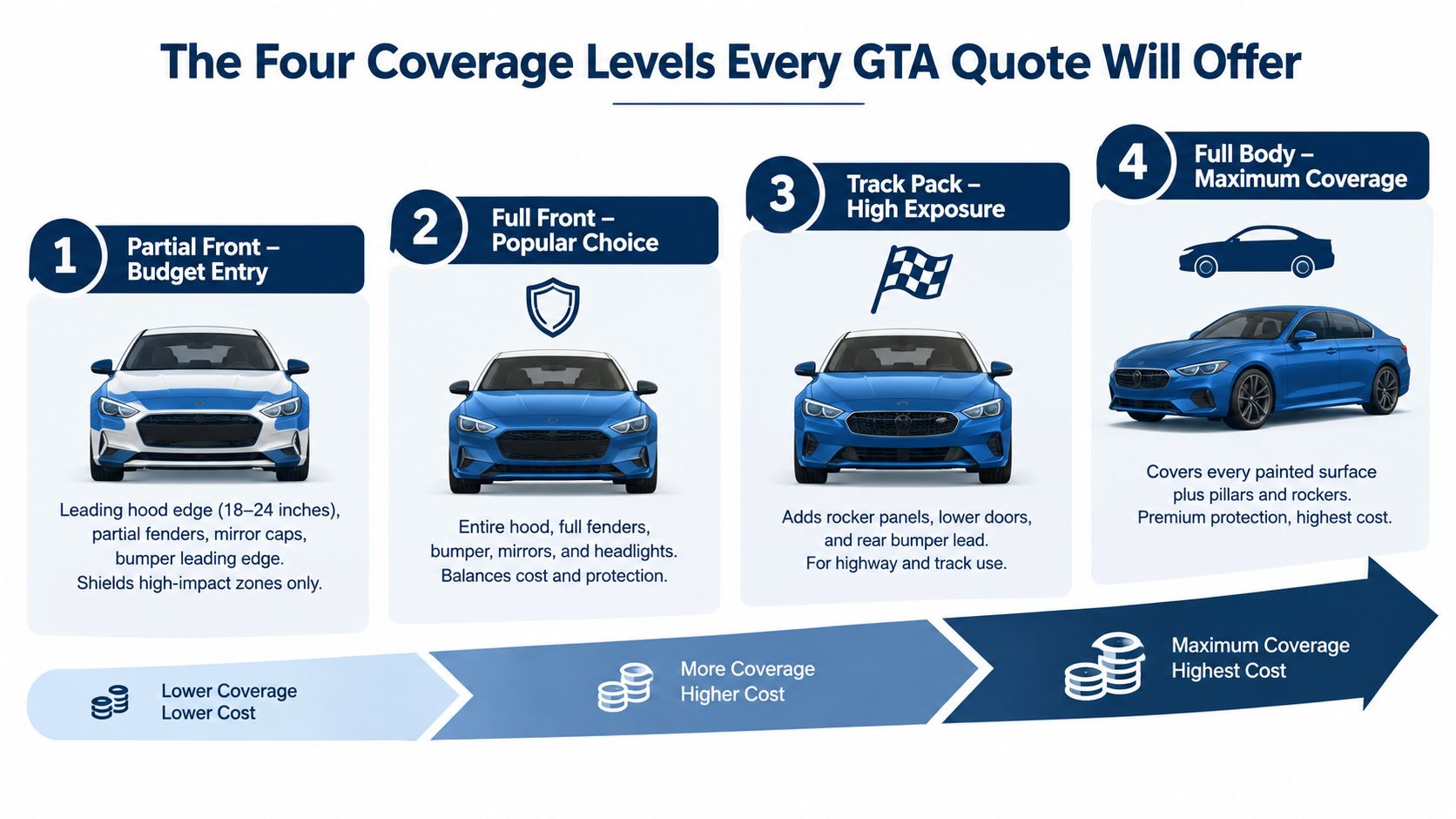
GTA installers generally organise PPF quotes into four practical tiers. The labels vary, but the protection logic stays consistent. Start with the panels you want to save, then compare the package price.
Tier one covers the immediate impact edge
A partial-front package usually includes the leading section of the hood, partial fenders, mirror caps, and the bumper's leading area. Some shops describe the hood coverage by inches, while others rely on a pattern name. It leaves the upper hood, most fender paint, doors, roof, and rear panels exposed.
This is the budget entry point, generally CAD $499–$1,500 according to Express Mobile Tint's Ontario package guide. It suits a driver who wants to reduce visible chips on the most vulnerable edge but accepts a noticeable transition line and unprotected paint behind it.
Tier two is the sensible daily-driver choice
A full-front package normally adds the complete hood, full fenders, full bumper, mirrors, and headlights. Depending on the shop, it may also include A-pillars or the leading roof section. This leaves doors, rocker panels, rear quarters, roof, and liftgate outside the package.
Ontario full-front examples commonly fall around CAD $1,299–$2,500, with AutoBoss' regional pricing overview showing how vehicle size and film selection influence the final quote. For commuters, leased vehicles, and cars regularly driven on the 401, this is usually the strongest balance between exposed area and spend.
Tier three extends protection into the debris path
A track pack or high-impact package keeps the full-front protection and adds panels that catch debris from the tyres and traffic. Those additions can include rocker panels, lower doors, wheel arches, rear bumper leading areas, and door edges. It protects more of the car's sides, but it still doesn't create a sealed exterior.
Expect pricing to climb toward the higher package bands, especially on SUVs and trucks. This tier makes more sense for highway-heavy driving, gravel roads, performance driving, or vehicles with broad lower bodywork than it does for a lightly used city car.
Tier four removes most exposed painted surfaces
A full-vehicle wrap aims to cover every painted panel, often with wrapped and tucked edges. It can include pillars, rockers, door edges, rear quarters, roof sections, mirrors, bumpers, and the liftgate. The objective is maximum consistency, not merely front-end defence.
Regional full-body guides place the investment around CAD $3,999–$8,000+, as shown by Ontario market pricing from Express Mobile Tint. It's a premium decision for an exotic, a long-term keeper, or an owner who values uniform preservation across the entire vehicle.
How Vehicle Size and Film Grade Change the Bill
Two full-front quotes can differ sharply even when the package title is identical. A compact sedan has less hood and bumper surface than a full-size pickup, and it usually presents fewer difficult openings for the installer to work around. An SUV or truck also tends to have larger mirrors, taller fenders, more sensor hardware, and more complicated bumper geometry.
Material pricing helps explain the difference. Canadian guidance places standard film around CAD $2–$5 per square foot and premium film around CAD $7–$10 per square foot, while installation labour often adds CAD $50–$100 per hour. Carmedics Autowerks explains the relationship between film grade, surface area, and labour.
Read film descriptions as performance categories
Installers may offer economy, mid-grade, and premium self-healing products. Economy film can make sense for a limited partial-front installation where the goal is basic barrier protection. Mid-grade film typically offers a stronger balance of clarity, adhesive performance, and surface behaviour. Premium self-healing film is aimed at owners who care about finish quality, maintenance, and long-term appearance.
Don't pay for the premium tier automatically. Ask what changes in the product line, whether the film is gloss, matte, or satin, how the warranty is written, and whether the installer has experience with it. A recognisable brand name doesn't compensate for poor preparation or careless edge finishing.
Paint condition is the quiet quote escalator
The car's condition before installation often matters more than the sales conversation suggests. A new vehicle can still arrive with dealer-installed swirls, transport contamination, or light oxidation. If the installer needs to decontaminate, polish, or correct the paint before applying film, the work becomes a preparation project as well as a film installation.
A useful quote names that preparation separately. If the estimate combines correction, installation, and aftercare into one vague “premium package,” you can't tell whether you're paying for better film or fixing avoidable paint defects.
| Vehicle class | Economy film | Mid-grade film | Premium self-healing film | Paint correction add-on |
|---|---|---|---|---|
| Compact sedan | Quote varies by coverage and shop | Quote varies by coverage and shop | Quote varies by coverage and shop | Quoted after inspection |
| Mid-size SUV | Usually higher than a sedan because of surface area | Higher material and labour exposure | Highest product and fitting tier | Quoted after inspection |
| Full-size truck or complex luxury vehicle | Can approach the upper package band | Increases with body complexity | May exceed standard regional ranges | Quoted after inspection |
Use the table as a quote-reading framework, not a promise of fixed add-ons. The verified Ontario guides support broad package ranges, but they don't provide a reliable, universal price adder for each film grade or a fixed paint-correction fee.
PPF Compared With Vinyl Wraps and Ceramic Coatings
GTA drivers often compare PPF, vinyl, and ceramic coating as though they're competing versions of the same service. They aren't. Each one solves a different problem.
PPF is the impact product. It's the right choice when your concern is stone chips, road abrasion, and preserving factory paint on exposed panels. It can provide a clear or altered finish depending on the product, but its core purpose is physical protection.
Vinyl wrap is the appearance product. It gives you the widest colour and finish choice, from gloss and satin to textured or specialty looks. A full-body vinyl wrap commonly falls around CAD $2,500–$5,500, based on Quote My Wall's DIY vinyl wrap guide, but it offers limited protection against serious stone impacts. If you're considering doing small sections yourself, the same guide is useful for understanding surface preparation, handling, and application technique.
Ceramic coating is the maintenance product. Installed pricing commonly sits around CAD $500–$1,500, according to Carmedics Autowerks' Ontario PPF and coating cost discussion. It adds slickness, water behaviour, gloss, and easier cleaning, but it won't stop a 401 stone from chipping the clear coat.
| Product | Best at | Weakest point | GTA verdict |
|---|---|---|---|
| PPF | Impact and abrasion protection | Colour customisation | Choose it for paint preservation |
| Vinyl wrap | Colour and finish changes | Stone-chip defence | Choose it for appearance |
| Ceramic coating | Easier washing and gloss | Physical impact protection | Choose it for low-maintenance ownership |
PPF and ceramic coating work well together. The film handles impacts, while the coating can make the protected surface easier to clean. Vinyl and PPF can sometimes be combined in specialised builds, but applying one broadly over the other can create adhesion and removal complications. For a normal daily driver, pick the product that matches the problem you're trying to solve.
Is PPF Worth the Money in Ontario Winters and Salt
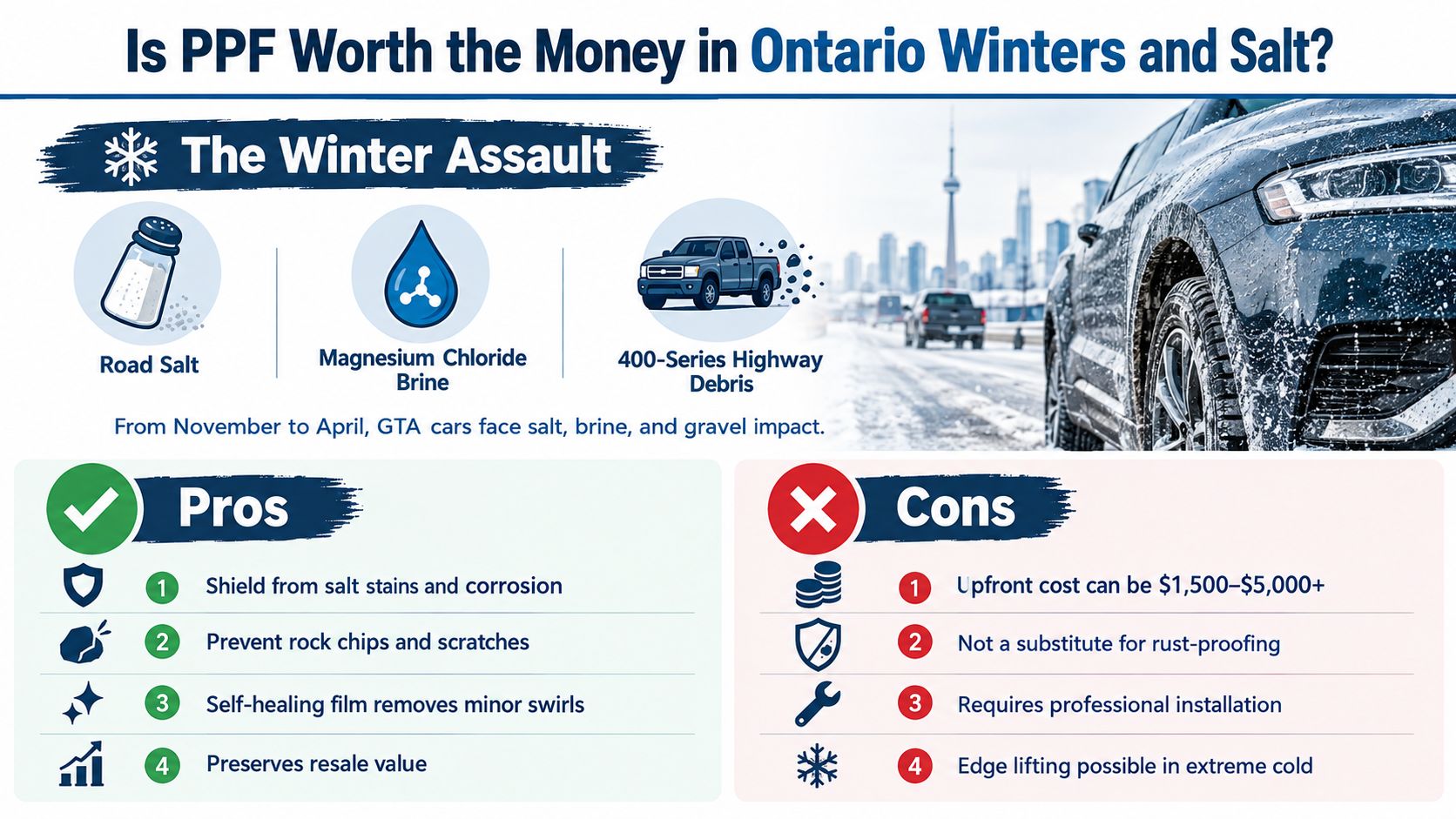
Ontario winter gives PPF a credible job description. Salt, brine, slush, sand, and gravel collect around the front bumper, hood edge, mirrors, wheel arches, and rocker areas. On the 400-series highways, the vehicle ahead can turn loose road material into a steady stream of small impacts.
That doesn't mean every GTA vehicle needs a full-body installation. The strongest value case is usually a daily-driven vehicle that sees regular highway use, parks outdoors, or needs to look presentable through repeated winter exposure. A targeted front-end package concentrates the budget where the road does the most damage, while a complete wrap can become difficult to justify on panels that rarely take direct impact.
Match the spend to the way you drive
- Outdoor commuter: Choose at least targeted front protection, especially if the car spends its week on major highways.
- Lease driver: Favour full-front coverage if preserving the original finish matters at return time.
- Garage-kept weekend vehicle: Skip PPF unless the car still sees frequent highway or performance driving.
- Luxury or long-term owner: Consider broader coverage if repainting or preserving factory panels carries high personal value.
- Neglected vehicle: Fix the maintenance routine first. Film won't replace washing, inspection, or sensible winter cleaning.
PPF also isn't rust-proofing. It protects the painted surface where it's installed, but it doesn't treat hidden seams, underbody components, or internal cavities. Drivers concerned about salt exposure should consider regular washing and a dedicated rust-protection service separately.
PPF makes the most sense when you protect the impact zones first, then expand coverage only when your vehicle use justifies it.
How to Compare PPF Quotes Without Getting Burned
A cheap quote can be perfectly fair if it covers less. The problem starts when two shops use the same package label for different panel lists.
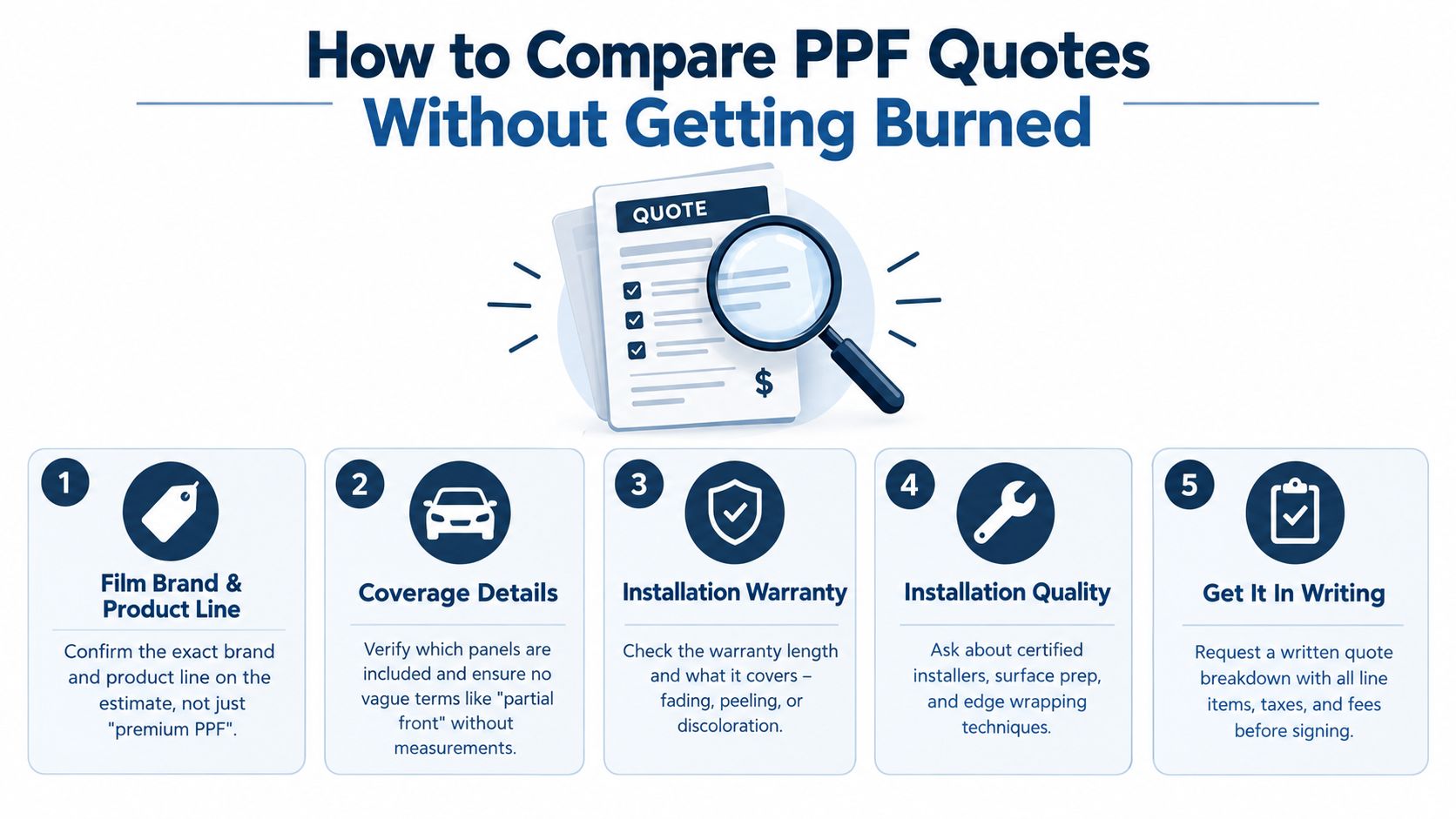
Use this checklist before you approve any work:
- Confirm the film. Get the exact manufacturer and product line in writing. “Premium PPF” isn't a product specification.
- List every panel. The estimate should name the hood, bumper, fenders, mirrors, headlights, rockers, pillars, or other included areas.
- Ask about edges. Find out which edges are wrapped and tucked, and which are cut flush. Edge treatment affects the finished appearance and durability.
- Separate preparation. Confirm whether decontamination, polishing, paint correction, or removal of old film is included.
- Read the warranty. Ask what covers yellowing, peeling, bubbling, lifting, or discolouration, and who handles the claim.
- Inspect finished work. Ask to see a completed vehicle with similar curves, sensors, and trim before paying a deposit.
A proper quote should also explain installation timing, curing instructions, cleaning restrictions, and any travel or mobile-service fee. One Toronto-area mobile provider lists a fixed CAD $10 travel fee, so even small extras deserve a written line item. You can compare that structure with Express Mobile Tint's published Ontario PPF packages.
The Short Version for GTA Drivers Ready to Decide
For most GTA commuters, partial-front coverage at CAD $499–$1,500 is the sensible minimum. It targets the leading impact zones without turning paint protection into a major vehicle investment.
The practical sweet spot is full-front coverage at CAD $1,299–$2,500. It protects the hood, fenders, bumper, mirrors, and often headlights, making it the strongest fit for highway commuters and lease vehicles.
Full-vehicle coverage at CAD $3,999–$8,000+ makes better sense for exotic cars, carefully stored vehicles, or owners planning to keep the car long term. Don't buy it because the car is new.
The paint protection film cost comes from coverage, labour, vehicle geometry, preparation, and film grade. Match the package to how the vehicle is used, then verify the exact panels, film, edge work, warranty, and maintenance requirements before signing.
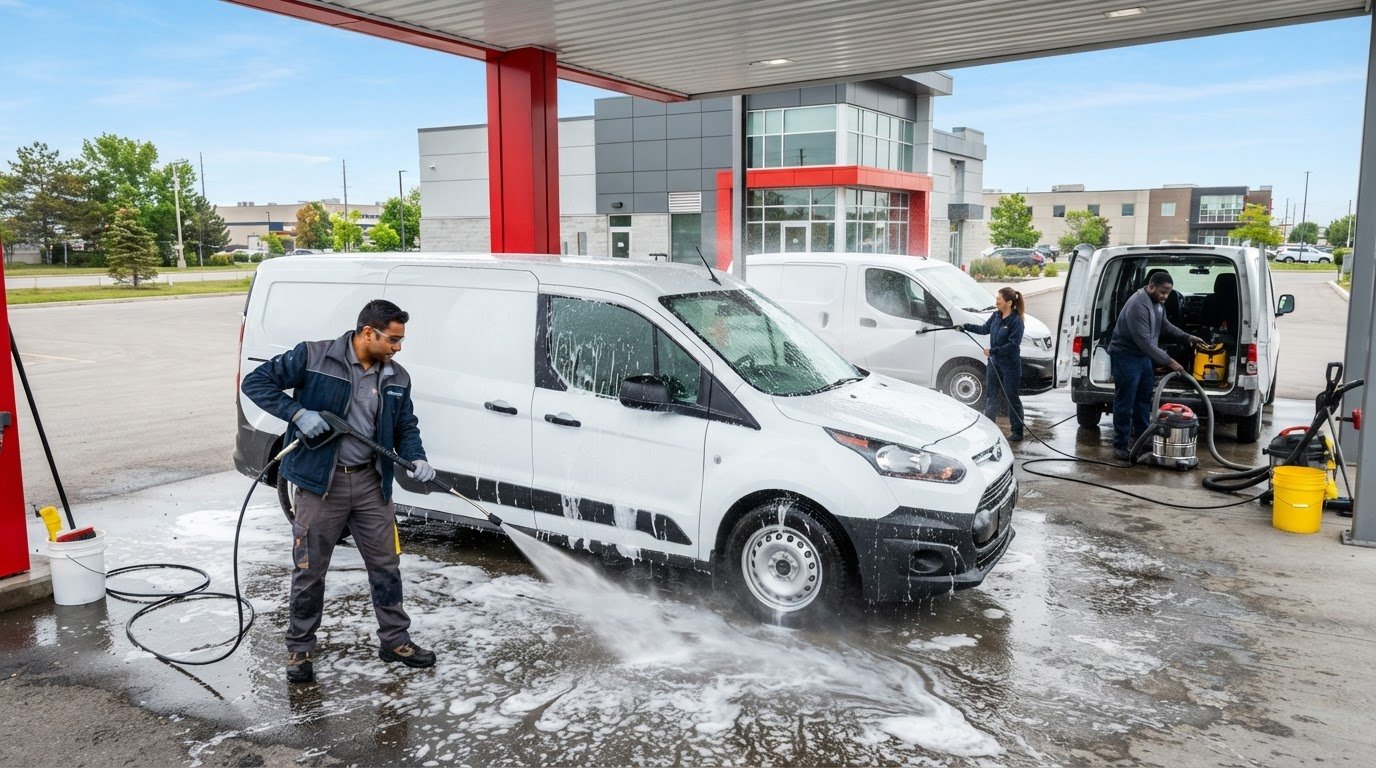
Nanak Car Wash offers GTA drivers regular exterior washing, underbody wash options, detailing, and rust proofing, all useful parts of keeping a PPF-treated vehicle clean through Ontario's salt season. Visit Nanak Car Wash to review the available wash, detailing, and rust-protection services before or after you arrange your PPF installation.

 6600 Finch Ave W, Etobicoke, ON M9V 3Z6
 647-703-8515
 MON – SUN 8 AM to 7 PM