
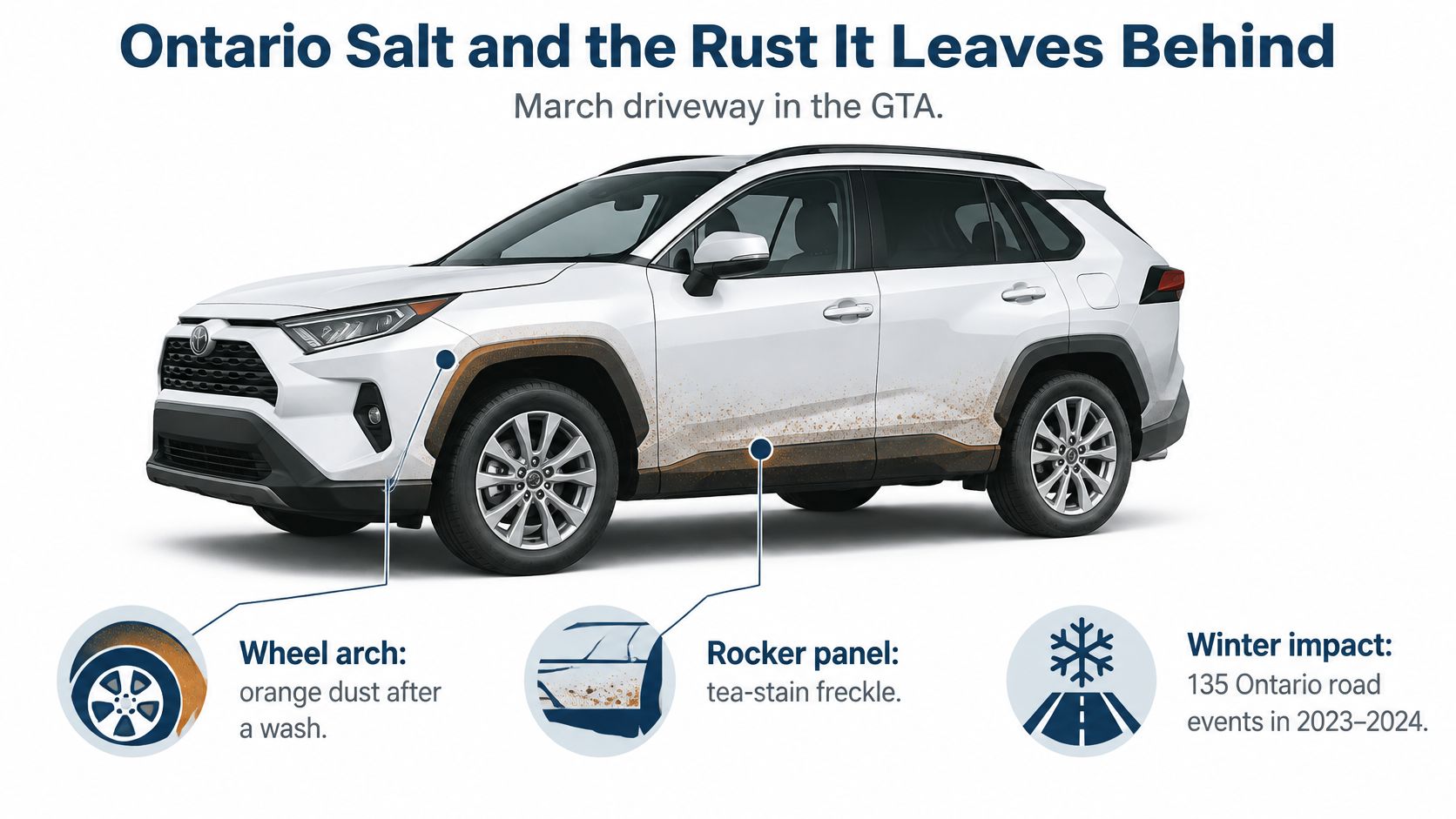
In a March driveway in the GTA, a car can look freshly washed while orange dust still clings inside the wheel arch and a tea-coloured freckle marks the rocker panel. During the 2023–2024 winter season, 135 Ontario road organizations reported using 1,679,395 tonnes of road salt across 104,187 kilometres of salted roads, according to Environment and Climate Change Canada's winter maintenance report. That's a lot of salt for one tidy driveway to argue with.
Table of Contents
- Ontario Salt and the Rust It Leaves Behind
- Methods Worth Buying Against the Rust You Have
- Paint Metal and Time Side by Side
- Spots You Can Treat and Spots You Must Not
- From Dirty Undercarriage to a Dry Bare Surface
- Why Clean Metal Still Needs a Winter Coat
- Choose DIY Touch-Up or a GTA Proofing Visit
Ontario Salt and the Rust It Leaves Behind
A wash can take away the grey film and still leave the evidence: orange powder behind a wheel, a rusty pinprick at a paint chip, or a rough patch along the lower body. The wheel arch catches spray and grit. The rocker panel collects muck along its seam. Neither spot is impressed by a clean hood.
The scale of the winter exposure is bigger than one salty slush puddle. Ontario's road organizations also reported 36,198,084 litres of salt-treatment liquids and 791,365 tonnes of abrasives in the same season, adding chloride residue and rough debris to repeated freeze–thaw conditions. Chloride isn't just dirt sitting on top of paint. It helps create an electrolyte film, and when moisture stays trapped against steel, corrosion can work into seams, wheel arches, brake-line clips and exposed underbody parts.
That's why rust remover for cars is a stage-specific prep product, not a universal fix. A wash removes salt before scale takes hold. A brush or sandpaper can clear loose surface rust. A chemical remover may help on compatible bare metal. A body or mechanical shop is the right call when the metal is bubbling, perforated or part of a safety-critical component. Whatever removes the rust, a compatible inhibitor or proofing coat has to follow on clean, dry metal if you want to slow its return.
Before you shop: Take a wide photo, a close-up, and a note of the part's location. A rusty speck on an outer panel and corrosion on a brake line may share a colour, but they don't share a sensible repair.
Methods Worth Buying Against the Rust You Have
Say a neighbour rolls his hatchback onto your driveway in late March, points at an orange freckle above the rear wheel, and asks which bottle to buy. The honest answer is a question back: how deep does it go? A rinse handles salt film. Abrasives handle loose surface oxidation. Chemical removers handle compatible bare metal. Structural trouble belongs in a shop, where the repair involves steel rather than spray.
| Method | Best rust stage | Cost level | Main risk | Leaves you with |
|---|---|---|---|---|
| Wash and underbody rinse | Salt film before scale | Low, the price of a wash visit | Misses rust already under paint | Clean metal you can inspect |
| Sanding, wire brush or pad | Light surface rust on paint or bare steel | Low, abrasive supplies | Clear-coat swirls and thinned metal | Feathered metal that can flash-rust if left bare |
| Acid or chelating rust remover | Surface oxidation on compatible bare metal | Moderate, a retail product | Etched trim and residue trapped in seams | Clean surface that still needs a coating |
| Rust converter | Tight rust that can't be fully removed | Moderate, a retail product | Active rust sealed under a failed film | Converted layer, with no new steel |
| Body or mechanical shop | Bubbles, holes, frame, brake lines, seams | High, after a shop assessment | Waiting lets corrosion spread | Repaired or replaced metal |
| Rust-proofing after prep | Clean, dry underbody and cavities | Priced by vehicle size | Coating over wet salt or loose scale fails | Inhibitor film for the next winter |
Circle one row and read its limits before comparing bottles. If that orange speck is iron fallout sitting on intact clear coat, a bare-metal rust remover is the wrong tool entirely. A useful overview of preventing corrosion on exterior surfaces can help distinguish surface protection from repairs that need paint or metalwork.
Start with the failure, not the product
If the car is dirty but you can't yet tell whether the mark is rust, wash the area and look again. Intact paint that only feels gritty often means contamination resting on the surface rather than corrosion growing out of the steel. A chip that has exposed metal, with oxidation confined to that spot, is a candidate for a small repair once loose material comes off.
Bubbles change the conversation. They often mean corrosion has spread under the paint, so sanding the visible dome may only uncover a larger problem. Holes, soft metal, frame corrosion and brake-line rust are hard stops for a DIY remover.
Match the clean-up to the finish
A converter and a remover do different jobs. A converter is meant for rust that remains after loose scale has been removed and the surface can't be cleaned fully back to bare metal. A remover suits a compatible substrate and still needs careful rinsing, drying and protection afterward. Neither one puts back metal that has already disappeared.
Rust-proofing comes last, laid over a dry underbody rather than a muddy one. A coating sprayed across salt or loose flakes can hide the evidence without giving the metal sound protection, which is why the prep rows matter more than the product rows. At Nanak Car Wash, proofing starts at $119.95 for a small car and runs to $149.95 for full-sized pick-up trucks and SUVs, with medium and full-sized cars, minivans and compact trucks priced in between. If you're stuck between two rows, pick the one that leaves the area visible and inspectable until you know what you're dealing with.
Paint Metal and Time Side by Side
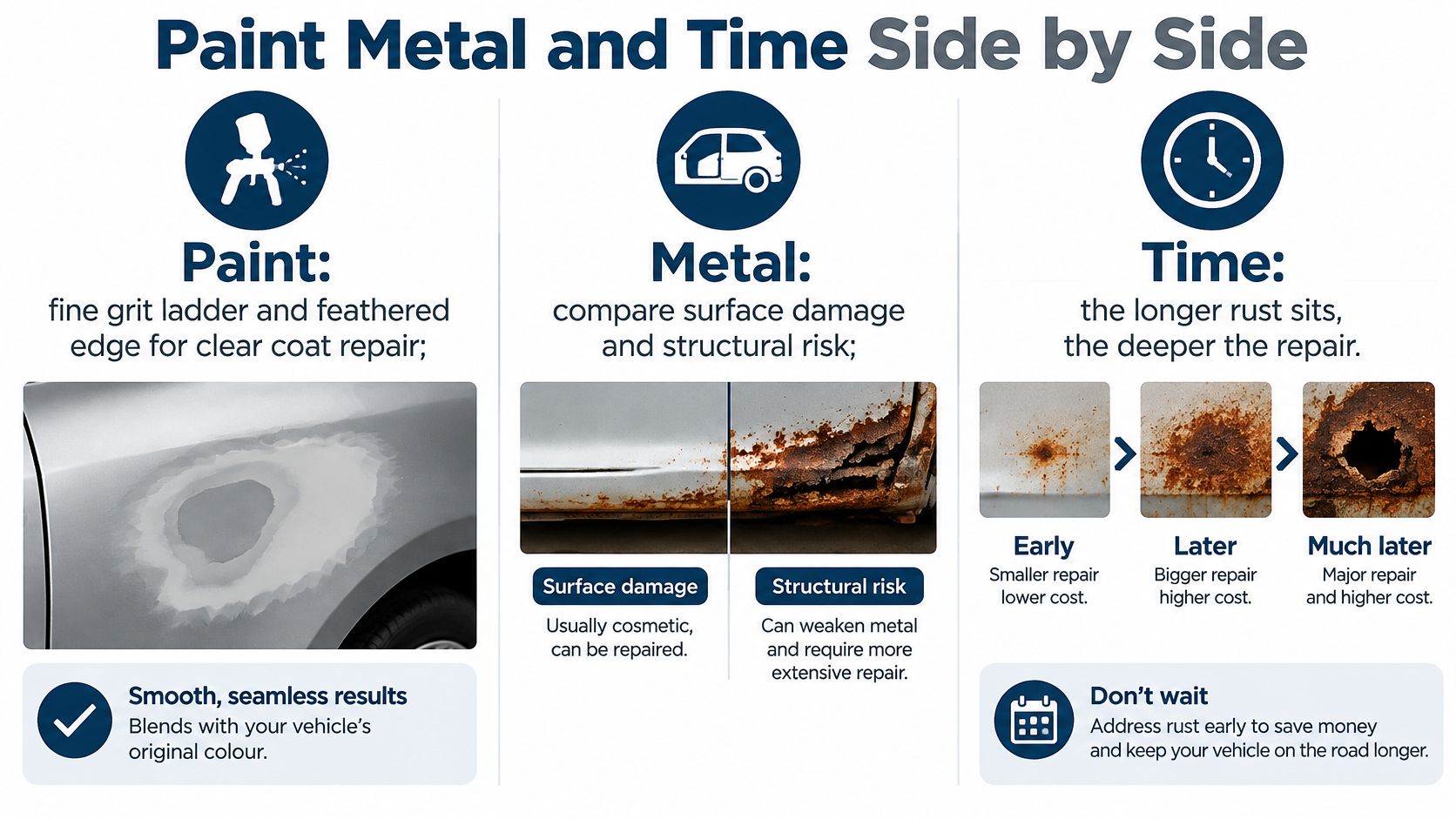
A tiny rusty mark can be an easy paint touch-up or the visible tip of a bigger metal repair. The difference comes down to what you're willing to disturb. Abrasion can level a small spot, but a sanding block doesn't know where the paint ends and the clear coat begins. Mask around the repair and work carefully toward a feathered edge, rather than scuffing a broad halo that looks worse than the original speck.
Chemical removers call for their own restraint. Many are made for bare metal, not every surface they might reach. Mask nearby paint and trim, keep the product out of rubber seals and glass edges, and use it only on the substrate named by the manufacturer. A glossy panel is not proof that a chemical was safe for its finish.
Paint and metal have different limits
The choice between sanding and chemistry isn't only about appearance. Sanding and grinding remove steel along with oxide, which matters on thin panels and underbody metal. A chelating or phosphoric-style gel can lift oxidation with less abrasion, but it can't rebuild the metal's original thickness. If the surface is perforated, pitted or soft under pressure, stop and get a professional assessment.
A historical Canadian vehicle-corrosion study found that an inhibitor used in testing reduced corrosion by approximately 50%. Observations from the Toronto area suggested de-icing salt doubled the corrosion that would have occurred without salt exposure, according to the Canadian vehicle-corrosion study. The useful lesson isn't that one modern product will deliver the same result. It's that protection can matter once the metal is sound, while salt exposure makes leaving sound steel unprotected a poor bet.
Time is part of the repair
A rinse is a straightforward clean-up. A small panel spot takes longer because you need to remove loose rust, treat or abrade the metal, rinse and dry it, then apply a suitable primer or coating. A perforated rocker is a shop repair, not a free Saturday project. The more hidden metal the corrosion has reached, the less useful it is to count only the time spent applying a product.
Think about cost per result, not cost per bottle. A modestly priced remover can be good value if it helps prepare a sound, accessible spot. The same bottle is wasted money if a panel needed metal repair before any coating could work. Product claims should tell you the substrate limits, dwell time and rinsing instructions; “fast acting” without those details is a slogan, not a repair method.
Spots You Can Treat and Spots You Must Not
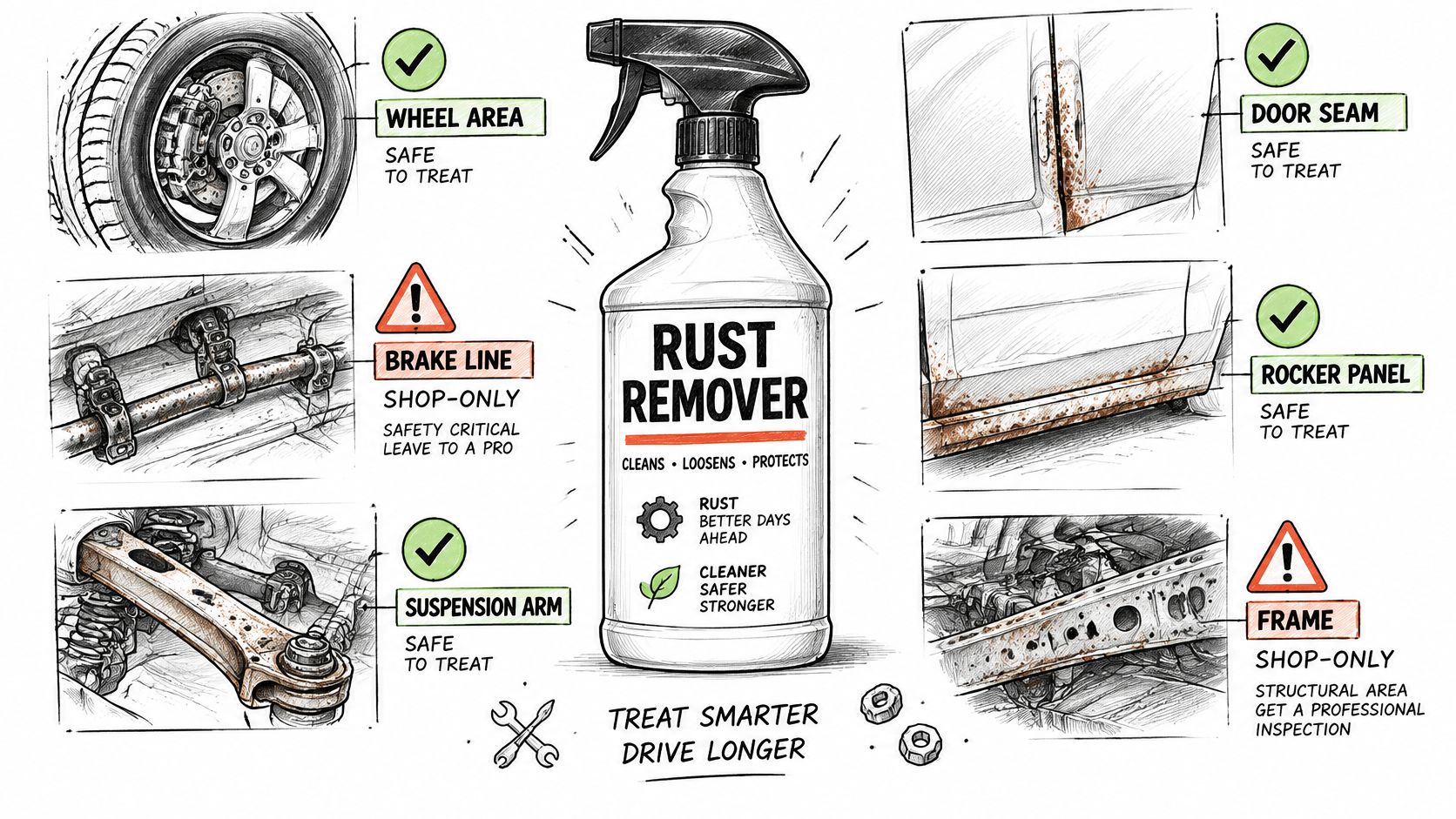
Say a driver rolls onto the driveway after a thaw, slides a look under the car and finds a brake line gone brown and rough. A consumer rust remover is not the answer there. A cleaner might change the surface colour, but it cannot put back lost metal or prove the line still holds pressure. The same caution covers corroded steering parts, suspension mounts, frame rails and seams welded shut at the factory.
De-icing salt is a major driver of vehicle corrosion through an Ontario winter, and it works hardest in spots a garden hose never reaches. That is why a little orange at a seam is not automatically a little problem. Rust remover is a prep step for sound metal in an open, visible spot, never a substitute for the metal itself.
Three driveway scenes
The stone chip: A small chip on a hood exposes bare metal, but the paint around it sits flat and firm. Wash it, lift the loose oxidation, treat the spot and follow with touch-up paint, so the bare steel does not meet the next load of road salt unprotected. If the mark is orange speckling on top of intact paint instead, it may be iron fallout rather than rust; AVOTTO Mobile explains orange paint specks and why the distinction matters.
The bubbling wheel arch: The paint has lifted and the edge feels rough and spongy. Grinding the bubble flat leaves the corrosion working underneath, where it often runs further than the blister suggests. Have a body shop open it up and inspect, because an arch that looks like a weekend patch can hide a rusted inner lip.
The crusty brake line: A brake line is a pressure component, not a detailing target. Skip the chemical experiment and book a mechanical inspection.
When in doubt, photograph the whole area plus a close-up, then answer three questions: is the part structural, does it belong to a braking or steering system, and does the rust sit inside a closed seam. One yes puts the job past a bottle of remover.
From Dirty Undercarriage to a Dry Bare Surface
This workflow is for a small, visible spot you've already judged non-structural. If the rust affects a frame, brake line, suspension mount or other safety-critical part, don't start sanding under the car. For the DIY spot, the aim is to leave no salt, loose scale or chemical residue behind before you protect the metal.
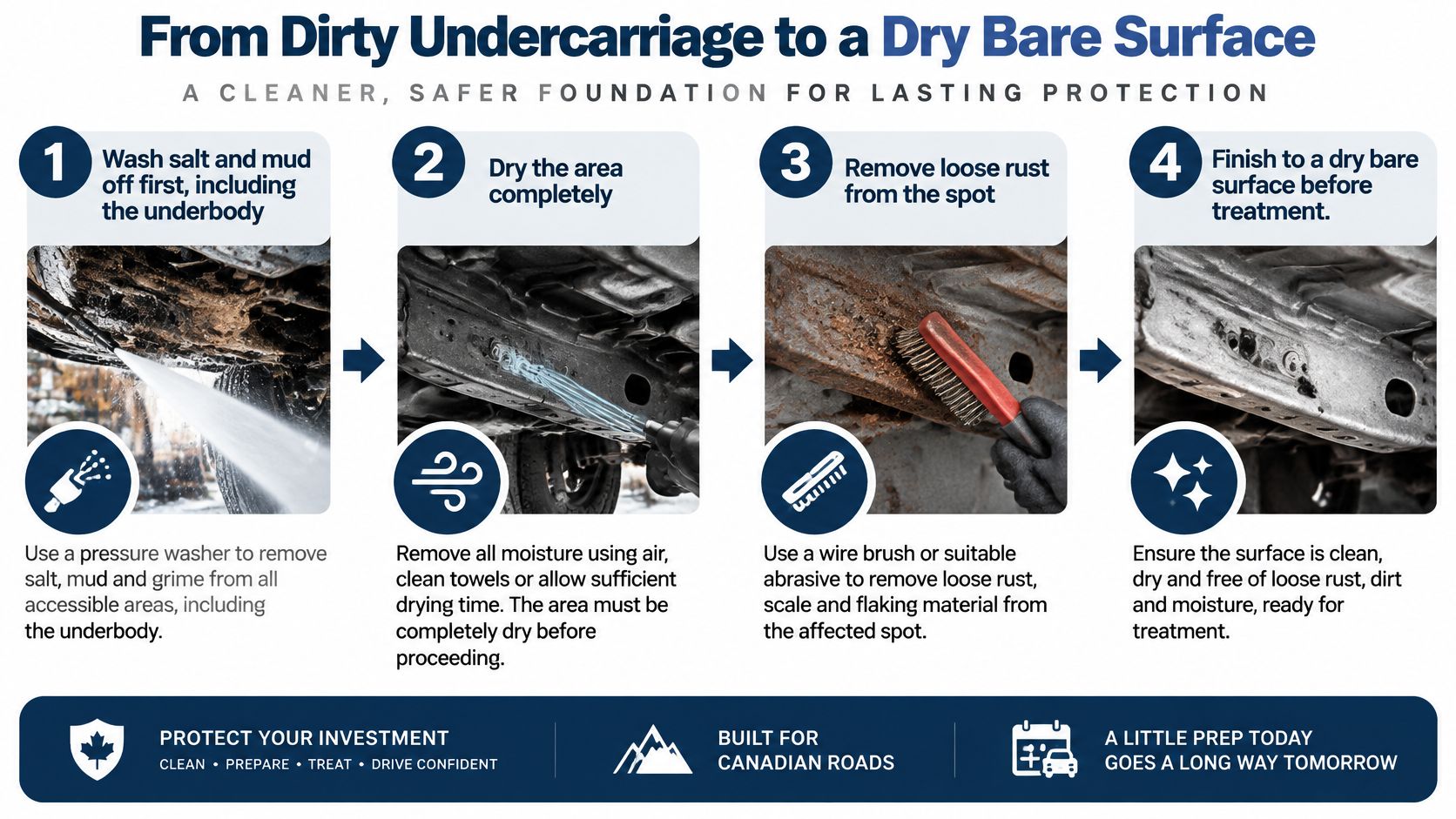
Work in a clean sequence
Wash salt and mud off first, including the underbody. This removes chloride contamination before it gets trapped beneath a treatment layer. If you skip this, you're coating a dirty surface rather than preparing metal.
Dry the area completely. Give yourself a clear view of the actual rust and its edges. Moisture left in a seam or crease can linger after the easy-to-see surface looks dry.
Remove loose rust from the spot. Use a hand wire brush, abrasive pad or sandpaper suited to the area, and stop when the loose flakes are gone. A remover applied over loose scale can't make that scale into sound steel.
Mask nearby paint, glass and rubber, then apply the product only to a compatible substrate. Keep it away from brake components and don't flood door seams or cavities. Use the label's dwell time rather than leaving a chemical on longer because it seems to be working slowly.
Rinse thoroughly until coloured or slippery residue is gone. Check reachable edges and clips, because residue left behind can hold moisture or create fresh corrosion trouble. Don't assume a quick wipe is the same as a proper rinse.
Dry the metal fully and inspect it in good light. Use clean, dry air where you can reach safely, then look for pits and any remaining orange dust. If the surface still sheds rust or the metal looks thin, stop and reassess rather than coating over it.
Prime or apply a compatible corrosion-inhibiting layer the same day. Bare steel shouldn't be left exposed while you move on to other jobs. The repair isn't finished until the clean surface is protected.
Choose products by test information
For GTA driving, look for published performance under cyclic wet–dry salt exposure, not just a claim based on continuous salt spray. Canadian corrosion laboratories identify SAE J2334 and ASTM G85 as relevant automotive test methods because they include changing humidity, salt, drying and temperature conditions. The Canadian corrosion-testing overview explains those methods and the kinds of coating breakdown that testing can assess.
A product sheet should say which substrates it suits, how long it stays on, what residue it leaves and how to rinse it. When the instructions are vague, the safe move is to choose a different product. Before you call the job done, check for orange dust on a clean cloth, damp seams and any bare metal still waiting for a protective coat.
Why Clean Metal Still Needs a Winter Coat
In an Ontario field comparison of treated and untreated vehicles, untreated body panels showed 6.8 times more measurable corrosion, while untreated underbody components showed 3.6 times more corrosion. The University of Windsor engineering study examined aftermarket-treated and untreated vehicles at three Ontario facilities, as summarized in this Ontario rust-proofing overview. That's the practical case for treating rust remover as preparation, not the final protection.
The salt film comes back with the next dirty winter drive. If clean steel goes straight back into that cycle without an inhibitor, you've done the careful work and skipped the part meant to slow the next round of corrosion. Think of it as drying the floor while the tap still drips.
Pick protection that suits the vehicle
A small chip on a painted panel needs a compatible primer and touch-up paint after preparation. If the repair is near a cavity or seam, the surrounding area still needs protection suited to that location. A neat dab of colour on the outside doesn't shield hidden metal.
A daily driver that sees winter roads needs protection on the underbody and in appropriate cavities, not just a tidy exterior. A rideshare or delivery vehicle spends more time meeting salt, spray and grit, so regular underbody rinsing helps keep contamination from sitting on the car. A fleet manager can make inspections easier by recording visible rust condition, underbody findings, treated-area coverage and when orange marks reappear after exposure.
Recheck the treated areas after spring rains and the thaw. Look for coating that has lifted, missed spots, or orange returning around an edge. Track what happens to the metal, not whether the hood still shines.
The choice is plain: if the metal is sound and the rust is a small surface spot, prepare it and protect it. If the panel is bubbling or the corrosion reaches structural or mechanical parts, get the metal assessed before anyone puts a coating over it.
Choose DIY Touch-Up or a GTA Proofing Visit
If the photo shows a small patch of surface rust on a non-structural panel, DIY can be reasonable: wash it, remove loose scale, use a compatible treatment or light abrasion, then prime and touch up the spot. If paint is bubbling, the metal feels soft, or rust reaches a brake line, frame, suspension part or enclosed seam, skip the bottle and book a body or mechanical inspection first. Proofing over failing metal hides a problem; it doesn't repair it.
For the prevention part, Nanak Car Wash has certified professionals who use a dedicated chemical compound to protect vehicles. Rust proofing starts at $119.95 for a small car and $149.95 for a full-sized pick-up truck or SUV. Confirm which vehicle category applies before booking.
If you drive rideshare, delivery or fleet kilometres through winter, pair protection with regular underbody rinsing so salt doesn't sit on the car for months. The remover is preparation; it's the coating that has to face the next winter's roads.
Nanak Car Wash offers automotive rust proofing alongside car washing and detailing, so you can plan the protection step after a proper clean. Match the service to your vehicle and visit Nanak Car Wash to arrange a GTA visit before road salt starts collecting again.


 6600 Finch Ave W, Etobicoke, ON M9V 3Z6

 647-703-8515
 MON – SUN 8 AM to 7 PM