
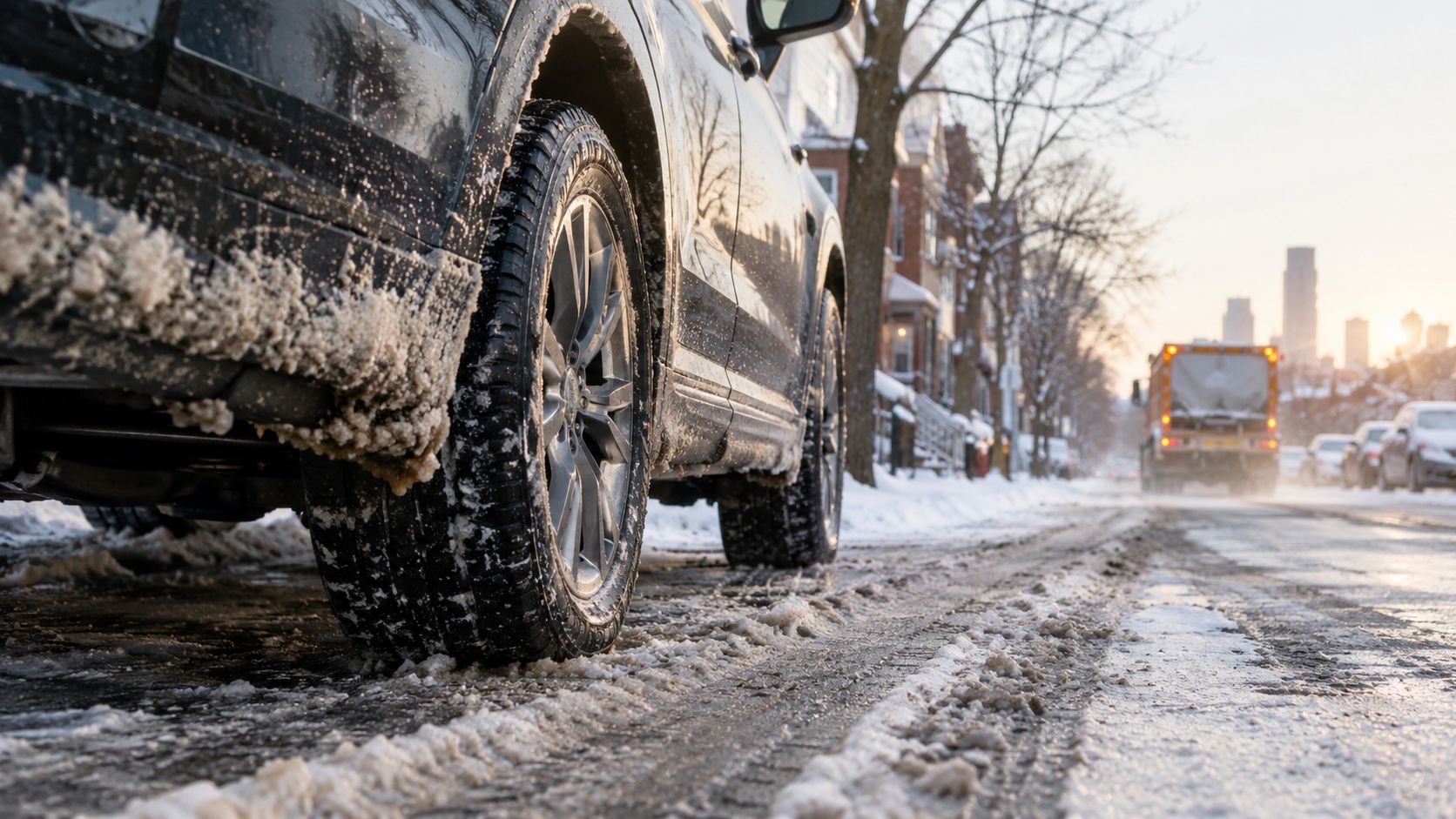
You've just driven through the first serious GTA snowstorm of the season. The roads look wet, the wheel wells are packed with brown slush, and a quick rinse makes the car look clean again. Underneath, though, salty water may still be sitting inside frame seams, around suspension mounts, behind plastic liners, and against brake-line brackets.
That's why undercarriage rust protection isn't only about making an older car look respectable. It's about slowing corrosion in places you can't inspect from the driveway, especially when Ontario's freeze-thaw cycle keeps turning road salt into a mobile, persistent electrolyte. The practical question for many owners is harder: does a newer vehicle with factory coatings still need extra protection?
The answer depends on how the car is used, what its underside looks like today, and how much salt exposure it receives. A newer factory-coated vehicle has a real advantage, but no coating can make hidden steel immune to chloride brine, stone chips, trapped moisture, and years of winter driving.
Table of Contents
- Why Ontario Winters Eat Undercarriages
- How Rust Actually Forms Under Your Vehicle
- The Ontario Salt Timeline and What It Means for Your Car
- Comparing DIY and Professional Rust Protection Methods
- Do Newer Vehicles Still Need Undercarriage Rust Protection
- A Year-Round Undercarriage Maintenance Schedule
- When to Book a Professional Rust Proofing Service
Why Ontario Winters Eat Undercarriages
At 4 a.m., salt trucks move through GTA neighbourhoods before most drivers have made coffee. By morning, the road is a grey-brown slurry. It fans behind the front wheels, sticks to the plastic liners, and sprays across the frame, exhaust hangers, control arms, and subframe.
Ontario spreads roughly 1.5 to 3 million tonnes of road salt each winter, while the City of Toronto uses about 130,000 to 150,000 tonnes annually, according to this Ontario road-salt and vehicle-rust overview. That material doesn't stay neatly on the driving surface. Traffic turns it into brine and spray, then your tyres carry it into every exposed corner underneath the car.
The wet-dry cycle keeps restarting the problem
Road salt lowers water's freezing point. A thin salty film can remain liquid during conditions where fresh water would freeze, which leaves metal wet during repeated temperature changes. The car warms while you drive, cools when parked, and passes through thawing and refreezing conditions that repeatedly reactivate the damp film.
The most troublesome areas are rarely the broad, visible panels. Salt-laden slush works into seams, spot welds, drain holes, boxed frame sections, brake-line mounting points, suspension brackets, and fuel-tank straps. A wheel-well liner may protect a component from stones while also creating a shaded pocket where salty moisture takes longer to dry.
Garage rule: If salt can enter a seam but air and sunlight can't reach it, treat that location as a corrosion risk.
Older or unprotected vehicles can show visible undercarriage rust within 2 to 3 winters, and serious structural-rust risk can emerge after roughly 8 to 12 years of year-round driving without rustproofing, according to the same Ontario-focused source. Those are not expiry dates for every vehicle. They're reminders that exposure, construction, maintenance, and existing coatings all matter.
How Rust Actually Forms Under Your Vehicle
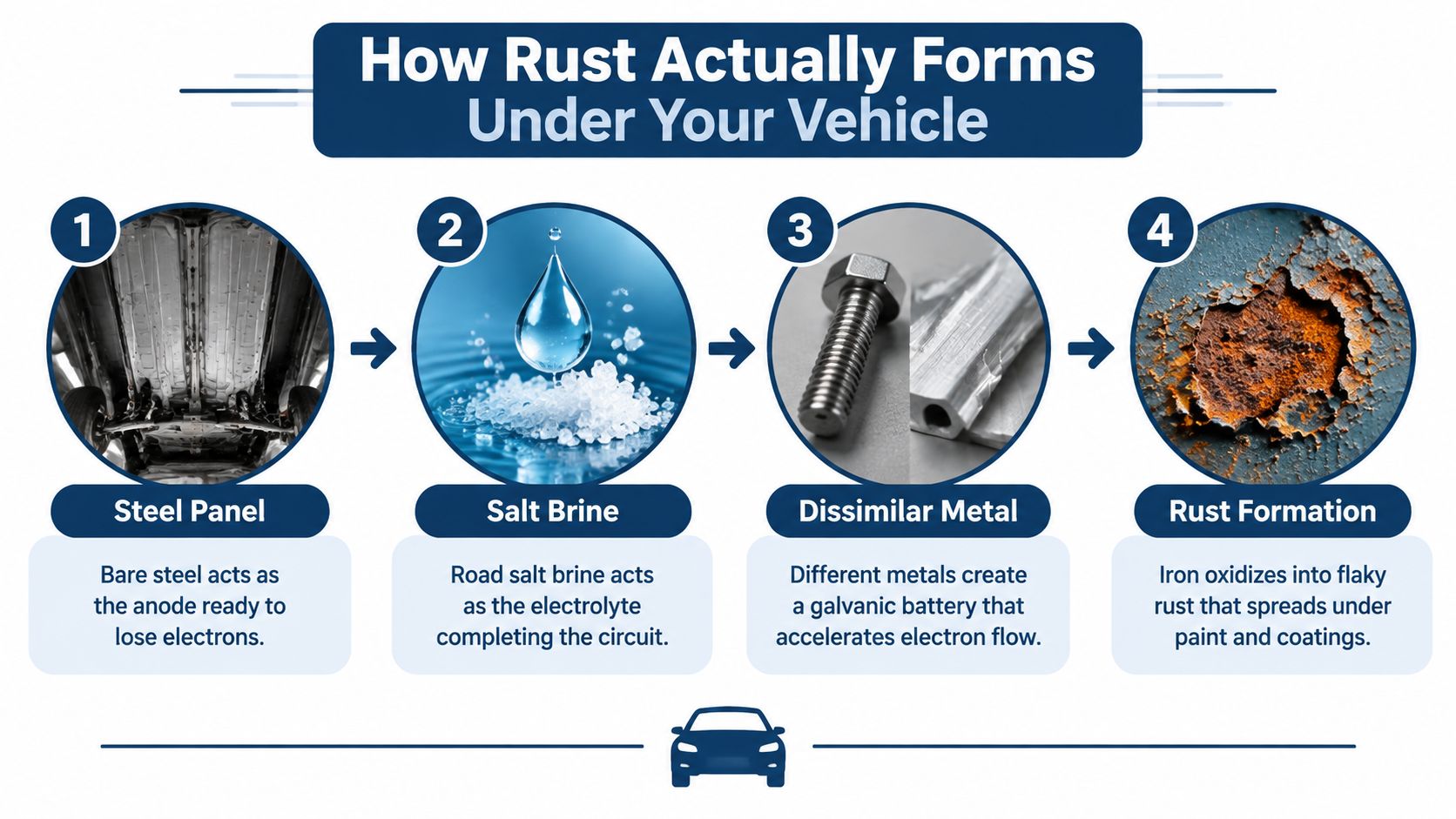
Rust is easier to understand if you think of the underside as a crude battery. You need a metal surface, a conductive liquid, and a path for electrons to move. Road-salt brine supplies the conductive liquid, while different areas of the vehicle's metalwork provide the chemical imbalance that drives the reaction.
Steel at an anodic area gives up electrons. Another metal surface, or another region of the same assembly, receives them at the cathodic area. An aluminium bracket, a copper-containing brake component, a steel fastener, and a protective coating that has been chipped can all create conditions where corrosion accelerates.
Salt turns dampness into an active circuit
Fresh rainwater can allow corrosion, but chloride-containing brine makes the process more aggressive. NSERC's project summary attributes about 50% of vehicle corrosion to road salts, as described in this NSERC corrosion research summary. The salt isn't merely sitting on the metal like dirty dust. It helps the moisture conduct charge and keeps the corrosion cell working.
The progression usually looks something like this:
- Deposits appear first. You may see pale or whitish residue after the water evaporates. That crust can hold moisture against the surface.
- Orange or red oxide blooms next. A stone chip, exposed fastener, or thinly coated edge begins to develop visible rust.
- Pitting follows. Corrosion removes metal unevenly, leaving small cavities rather than a simple surface stain.
- Flaking and perforation become the serious stage. When load-bearing sections lose enough material, cleaning and coating alone can't restore their strength.
The underside also contains oxygen-rich and oxygen-poor pockets. A boxed frame rail may hold damp salt water inside while its outer surface looks merely dusty. That uneven supply of oxygen creates different electrochemical zones, which is one reason rust can spread beneath an apparently intact coating.
Deep pitting matters more than orange colour alone. A rusty exhaust hanger may remain serviceable for a long time, while a corroded brake-line bracket, subframe mount, or fuel-tank strap deserves immediate inspection. The mechanic's question isn't just, “Is there rust?” It's, “How much sound metal remains, and where is the corrosion located?”
The Ontario Salt Timeline and What It Means for Your Car
A typical Ontario corrosion season starts when road crews begin treating surfaces before and during sustained winter conditions. The first applications cling to damp roads, then January thaws create fresh spray. By March, warmer daytime temperatures combine with leftover salt, mud, and meltwater, producing a final wave of underbody contamination before spring cleaning.
The visible timeline varies by vehicle, but the broad pattern is useful. An older or unprotected car can develop surface oxidation early, while hidden corrosion continues before the driver notices anything from above. The Ontario history of rust protection includes a notable milestone: the first Rust Check Centre opened in Hepworth in 1973, following development work that began in 1970. A Canadian rust-proofing summary also reports that untreated vehicles showed 6.8 times more visible body rust and 3.6 times more corrosion in underbody parts than treated vehicles, as documented in this automotive rust-proofing history and research summary.
Read the timeline as a risk pattern
The table below isn't a promise that every car follows the same calendar. It's a way to match visible clues with sensible inspection decisions.
| Timeframe | Unprotected Undercarriage | Treated Undercarriage |
|---|---|---|
| First winter | Salt film, white deposits, and early oxidation appear around chips, fasteners, and exposed brackets. | Protective film limits direct contact in treated areas, but chips, wash wear, and untreated cavities still need inspection. |
| Around the third winter | Surface rust may become obvious around wheel wells, suspension hardware, and seams. | Corrosion can remain less visible where treatment was applied correctly and refreshed as needed. |
| Around the fifth winter | Bubbling coatings, scaling hardware, and rust around brake-line supports deserve a lift inspection. | The vehicle may still present a manageable maintenance issue, provided the coating has been checked and cleaned. |
| Around the eighth to twelfth year | Structural areas such as subframes, mounts, and boxed sections may face serious corrosion risk, especially with year-round driving. | Treatment can slow exposure, but it doesn't eliminate the need to inspect load-bearing metal and repair existing damage. |
A treated vehicle doesn't age on a different planet. Its advantage comes from reducing the time salt water spends directly against vulnerable metal and helping protect seams that factory coatings may not fully cover. Regular underbody rinsing also matters because a protective film can't compensate for thick, repeatedly renewed salt deposits.
Inspection habit: A used-car inspection in Ontario should include a lift check, not just a glance at the wheel arches. Brake lines, fuel straps, subframe mounts, and suspension attachment points can tell a very different story from the painted body.
Comparing DIY and Professional Rust Protection Methods
Ontario owners usually choose between a quick aerosol application, a yearly drip treatment, or a professional pressure-fed service. None is magic, and the product category matters less than preparation, access, and whether the operator can reach hidden cavities without contaminating brakes, belts, exhaust components, or moving parts.
What each approach can realistically do
Aerosol oil or wax sprays are convenient for touch-ups. They work well on accessible fasteners, exposed seams, and small areas where a coating has been disturbed. A can with a flexible extension can reach narrow gaps, but it won't provide the same access as a lifted vehicle with a wand designed for cavity application.
Driveway drip treatments generally use an oil-based or waxy corrosion inhibitor that creeps into seams. They're useful for annual maintenance, especially on a vehicle that already has sound metal and a known treatment history. The limitations are preparation and coverage. Without proper lifting, cleaning, drainage checks, and masking, the operator may miss boxed sections and brake-line runs.
Professional applications can use a pressure-fed wand to cover frame rails, weld seams, suspension mounting areas, wheel-well edges, and fuel-tank strap zones. A credible shop should inspect the underside first and avoid coating over loose scale or active mechanical problems. A hard asphaltic or bitumen-style coating can create a barrier, but applying it over damp or rusty metal can hide trouble rather than solve it.
For owners researching marine-grade corrosion inhibitors for small touch-ups, this CRC spray for marine use offers useful product information. Marine exposure isn't identical to GTA road salt, but the application principles are relevant: clean the surface, follow the label, and keep protective products away from braking and moving surfaces.
| Method | Typical Cost (CAD) | Coverage of Boxed Frame and Brake Lines | Durability | Warranty |
|---|---|---|---|---|
| DIY aerosol spray | Not stated | Usually limited to visible and reachable areas | Requires regular inspection and touch-ups | Usually none |
| Annual drip treatment | Not stated | Better seam penetration, but access varies by operator | Commonly treated as recurring maintenance | Depends on provider |
| Professional pressure-fed application | Not stated | Can reach more hidden underside areas when the vehicle is lifted and prepared correctly | Needs inspection after winter exposure | Depends on provider and package |
The important distinction is not “DIY bad, professional good.” A careful owner can maintain a sound car effectively. Professional work becomes more valuable when the underside has complex shielding, boxed rails, extensive exposure, or areas you can't safely reach.
Do Newer Vehicles Still Need Undercarriage Rust Protection
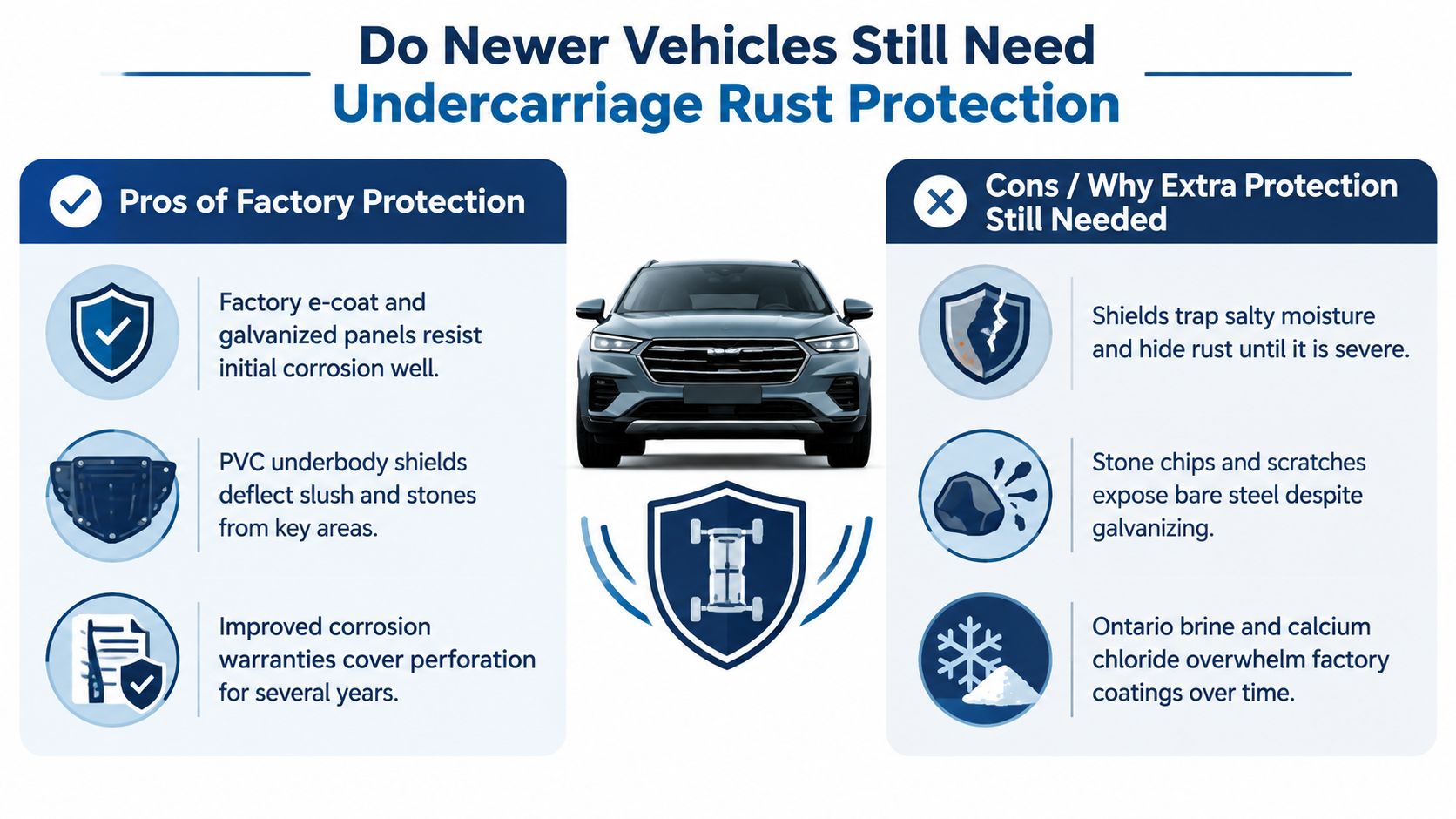
Modern vehicles are better protected than many older cars. Factory e-coat, galvanised panels, seam sealers, and plastic underbody shields give new vehicles a stronger starting point than the bare, lightly protected steel seen on older equipment.
That advantage doesn't make the underside invulnerable. Factory protection is applied during manufacturing, before years of stone impacts, jacking contact, exhaust heat, road debris, winter washing, and salt accumulation. Plastic shields can deflect spray from one area while allowing salty moisture to collect along their edges or behind their fasteners.
The right question is condition, not model year
A newer crossover with an intact factory coating may need little or no additional treatment immediately, especially if it's driven lightly, washed underneath, and stored indoors. Another vehicle of the same age may have chipped brackets, damaged shield fasteners, or exposed seams after heavy commuting on salted roads.
Ontario-specific evidence still leaves an important consumer gap. Research summaries indicate road salt accounts for roughly 50% of vehicle corrosion, and Toronto atmospheric corrosion was measured at 5,108 mg/dm² over 19 months, as reported in this Transportation Research Board corrosion document. That evidence shows the local environment is aggressive, but it doesn't establish a universal age or trim level at which every newer vehicle needs extra treatment.
Use a simple inspection-based decision:
- Leave factory protection alone when the coating is intact, drains are clear, and the underside shows no active rust or impact damage.
- Consider supplemental treatment when you commute daily, park outside, drive through heavily salted routes, or see exposed metal around brackets and seams.
- Avoid blind sealing when loose scale, trapped mud, leaks, or structural corrosion already exists. Clean and assess the metal first.
- Check the corrosion warranty before applying anything that could affect inspection or claim requirements.
Supplemental undercarriage rust protection should complement factory engineering, not replace it. The newer the vehicle, the more valuable a careful inspection becomes, because early treatment can preserve sound factory protection without burying problems under a new layer.
A Year-Round Undercarriage Maintenance Schedule
Rust prevention works better as a rhythm than as a single appointment. The GTA driver who rinses salt away, checks the underside, and refreshes protection at sensible intervals has more control than the owner who waits for bubbling rocker paint.
Spring exposes what winter concealed
During the March thaw, look for white salt crust, orange bloom on suspension components, peeling coating, and damp debris around plastic shields. Use a touchless or wand-only wash to rinse the underbody, then let the vehicle dry before inspecting it. Don't direct high-pressure water into electrical connectors or damaged seals at close range.
April is a useful time for a deeper check. A professional can distinguish light surface oxidation from scaling, perforation, or corrosion around a critical mounting point. If a coating has lifted, the correct response may involve cleaning and repair rather than just spraying over it.
Summer is the quiet inspection season
Warm, dry weather gives you a better chance to see chips and early bubbles before the next salt season. Check the front suspension, rear control-arm brackets, rocker seams, subframe edges, exhaust hangers, and the areas where shields meet the body.
Apply a corrosion inhibitor only to suitable surfaces and keep it off brake rotors, pads, belts, tyres, steering joints, and hot exhaust components. Summer touch-ups are most useful when they follow an inspection rather than acting as a blanket application.
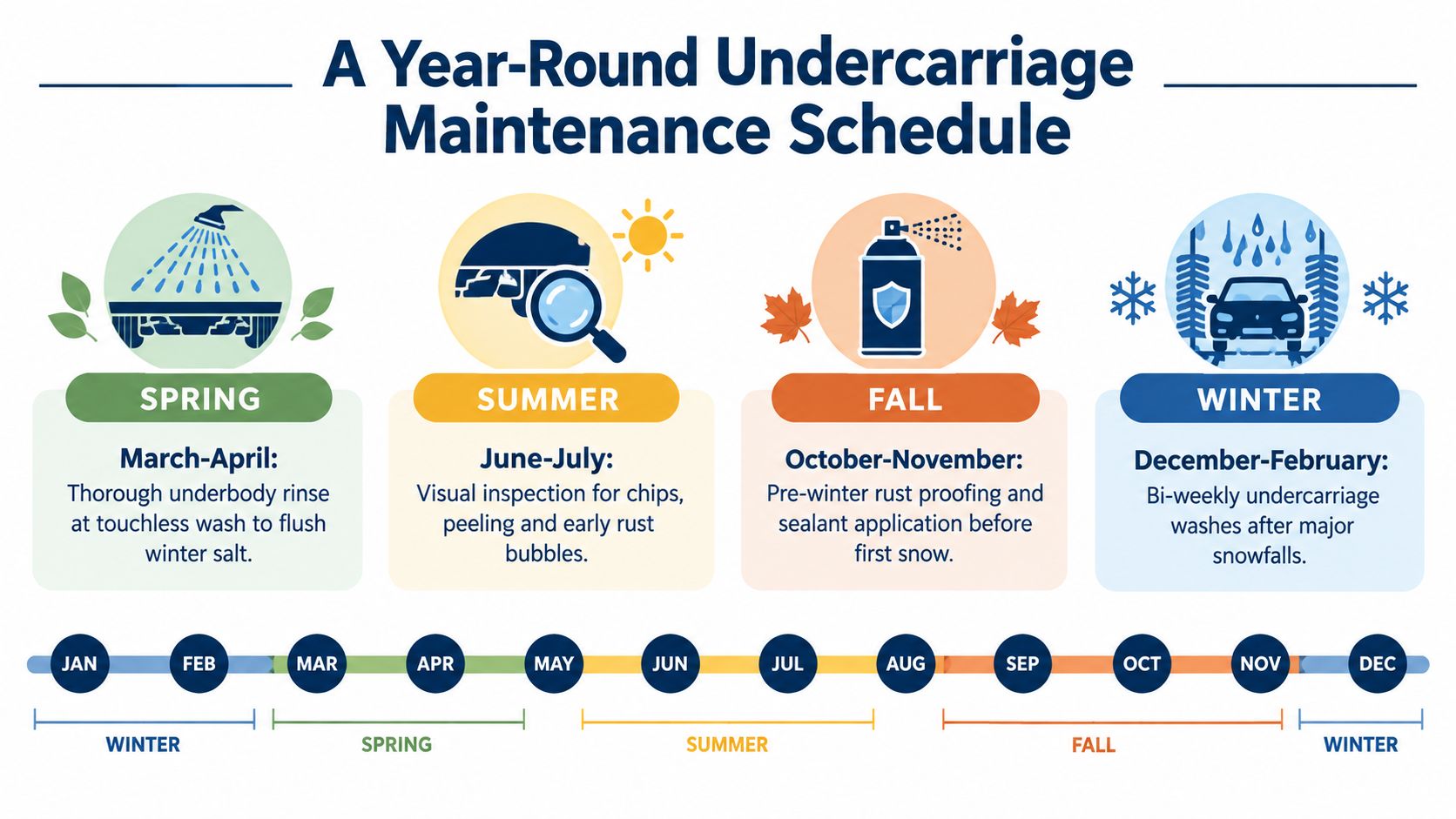
Fall preparation buys you a cleaner starting point
Before the first sustained snowfall, rinse away summer road film and arrange rust protection if the vehicle's condition warrants it. Treating a dirty, damp undercarriage makes it harder to see defects and can trap contamination against the metal.
From December through March, rinse the underside after major salt events and during active application periods. A strict schedule isn't practical for everyone, but repeated underbody cleaning matters most after wet driving, slushy commutes, and thaw cycles.
A yearly coating cannot undo a winter spent carrying a thick layer of salt in the frame rails. Washing and inspection remain part of the protection system.
When to Book a Professional Rust Proofing Service
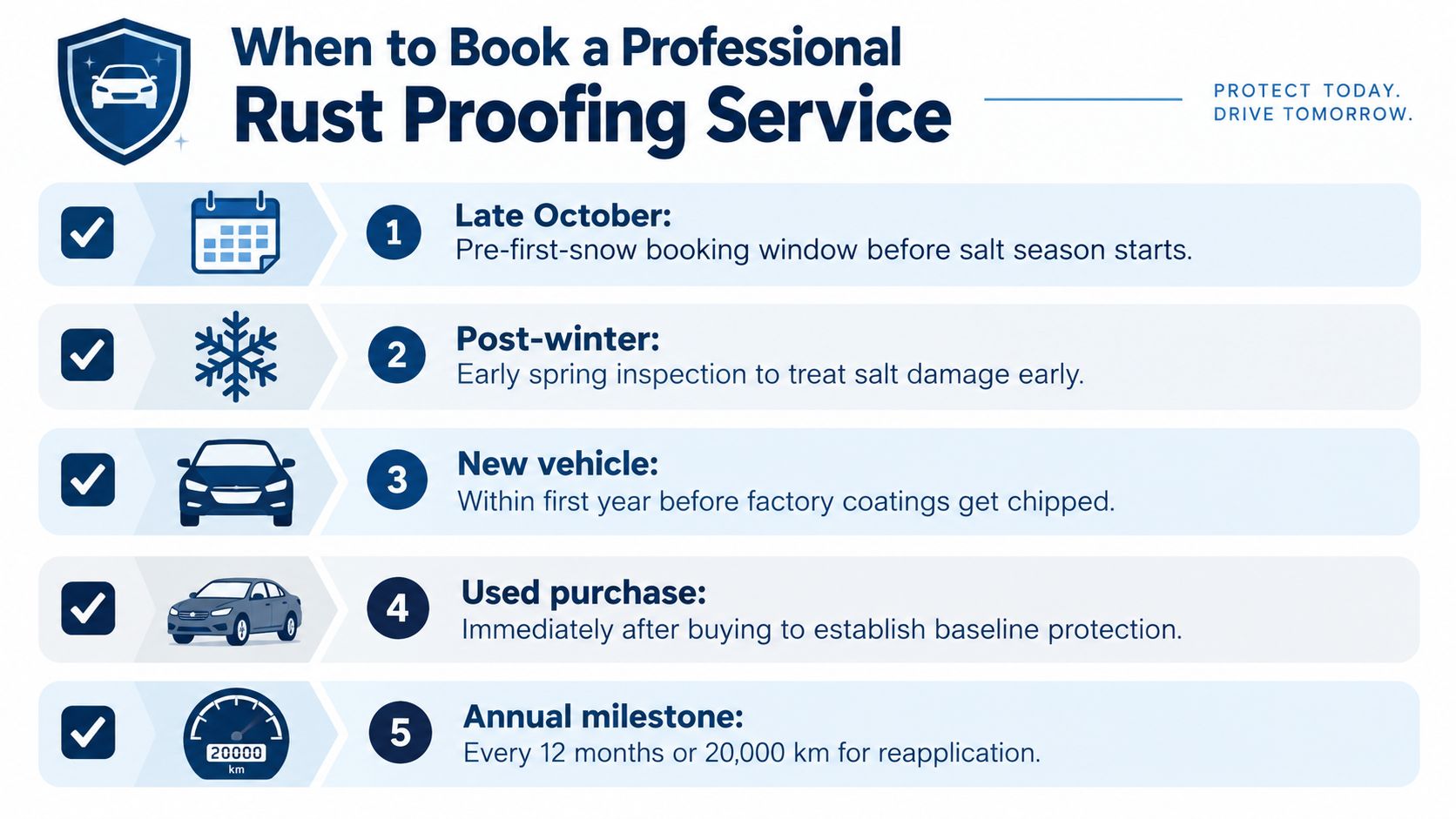
Book service before the first sustained snowfall if you want to begin winter with a clean, inspected underside. Late October is a practical planning window because shops are less likely to be dealing with weeks of accumulated salt, but the correct date depends on availability and the vehicle's current condition.
Early spring is another valuable appointment point. A post-winter inspection can identify damaged coating, fresh surface rust, packed debris, and areas where repeated spray has removed protection. Treating a small exposed seam is a different job from trying to stabilise a heavily scaled frame later.
Use ownership changes as decision points
A newly purchased used vehicle should receive an underside inspection before you assume its previous treatment history is reliable. Service records may show that a product was applied, but they don't prove that the installer reached internal seams, avoided blocked drains, or covered areas later damaged by repairs.
A new vehicle deserves a different approach. Don't automatically cover an intact factory system, and don't assume the factory finish will remain perfect after years of salt, stone impacts, and service work. Ask for an inspection that identifies exposed metal and vulnerable cavities rather than accepting a generic application without looking underneath.
Visible warning signs should move the appointment forward:
- Brake-line surface rust: Have the lines and their mounting points assessed, especially where corrosion appears flaky or pitted.
- Bubbling rocker paint: Treat bubbling as a possible underside problem, not just a cosmetic blemish.
- Loose or peeling undercoating: Find out whether moisture and rust are developing underneath.
- White salt crust in seams: Clean the area and check whether the residue returns after washing.
- New rattles or weakened brackets: Inspect exhaust hangers, shields, suspension hardware, and subframe attachments.
Ask what the service includes
A professional service should explain its preparation and coverage. Ask whether the vehicle is lifted, whether the underside is inspected and cleaned, how boxed sections and cavities are reached, and which areas are masked. Brake components, exhaust surfaces, belts, tyres, and moving joints should be protected from overspray.
Some packages focus on an exposed underbody film. Others add penetrating cavity wax for internal seams or a harder barrier for selected high-impact areas. Product selection should reflect the existing coating, corrosion level, drainage design, and how the vehicle is driven. No product is permanent, and a hard coating can make future inspection more difficult if applied over active corrosion.
Nanak Car Wash lists tiered rust-proofing applications by vehicle size, with published pricing of approximately $119.95 to $149.95 plus tax on its service information. Owners who manage a busy fleet or service schedule may also find a guide to automotive answering service 24/7 useful when evaluating how a shop handles appointment calls and customer communication, although it doesn't replace checking the actual technical scope of the treatment.
Use this checklist before booking:
- Inspect before applying. Confirm whether the metal is sound, lightly oxidised, scaled, or structurally compromised.
- Match the treatment to the vehicle. A new factory-coated crossover may need targeted protection, while an older daily commuter may need more extensive cavity coverage.
- Schedule around exposure. Heavy winter commuting, outdoor parking, salted rural routes, and fleet use all justify closer inspection.
- Confirm protected areas. Ask specifically about frame seams, wheel wells, suspension mounts, brake-line brackets, and fuel-tank straps.
- Plan the follow-up. Rust protection works best when paired with underbody washing and periodic checks, not treated as a one-time purchase.
Nanak Car Wash offers rust-proofing applications alongside exterior washing and detailing, making it practical to combine underbody cleaning with a corrosion-protection appointment. Visit Nanak Car Wash to review the available service options and book a treatment before Ontario's next salt cycle gets underway.

 6600 Finch Ave W, Etobicoke, ON M9V 3Z6
 647-703-8515
 MON – SUN 8 AM to 7 PM