
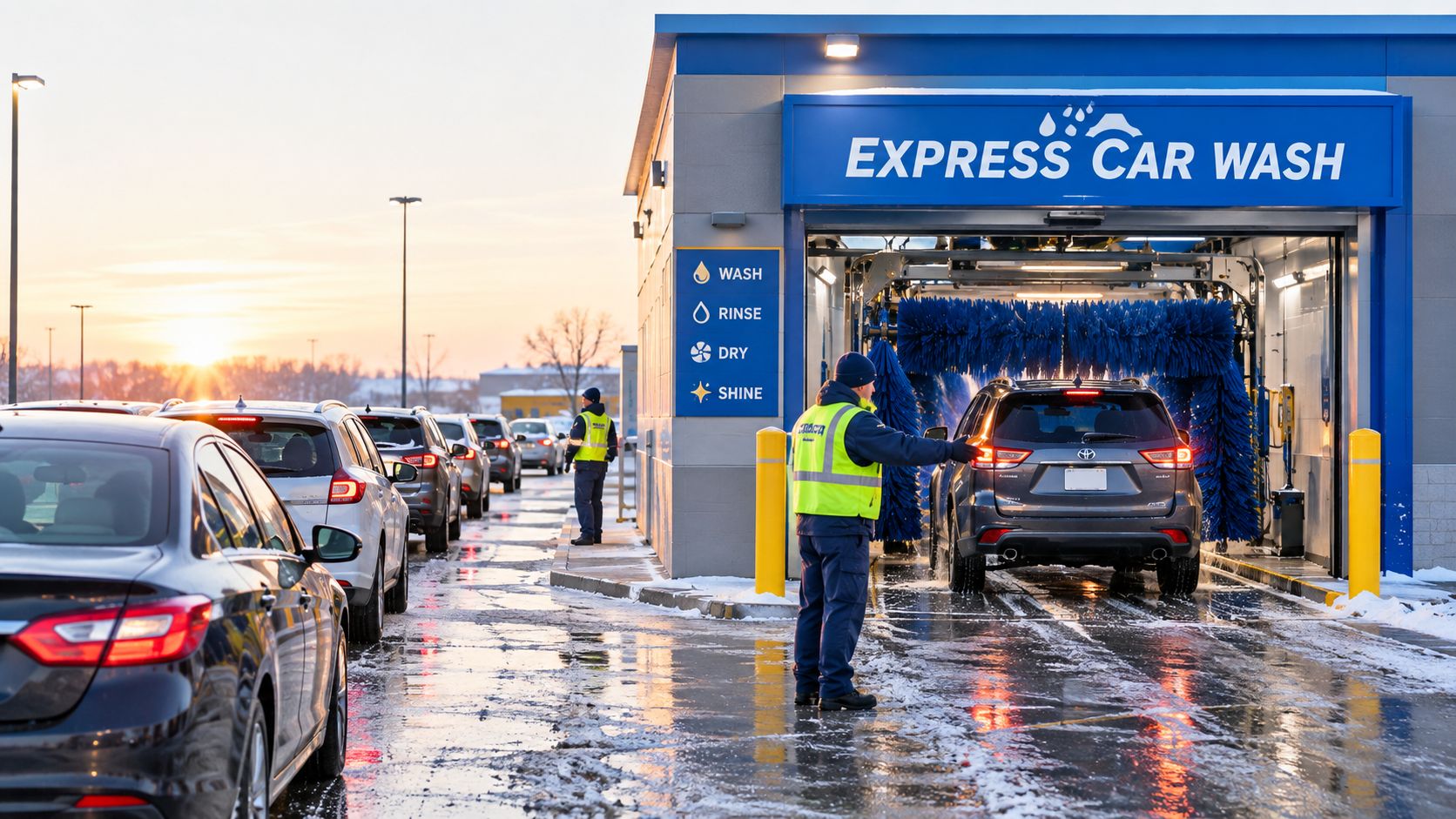
You're standing beside a conveyor on a slushy February morning, trying to keep your gloves dry while a steady line of drivers waits for a clean car. The vehicle at the entrance is coated in grey road film. The one behind it has salt packed into the wheel wells. Your job is to guide each car safely onto the track, keep the equipment moving, and help the next customer before the previous one has disappeared into the tunnel.
That's the part people see. They don't always see the hand-dry team, interior crew, detail technicians, rust-proofing applicators, equipment checks, customer questions, or water-management systems behind the wash. Wash car jobs can be a first step into detailing, vehicle care, customer service, or site supervision, but the work is physical, fast, and more technical than many job descriptions suggest.
Table of Contents
- Why Wash Car Jobs Deserve a Second Look
- The Different Roles at a Modern Car Wash
- Pay, Demand, and the Ontario Job Market
- Skills and Training You Pick Up on the Job
- Shift Structures and What the Workweek Really Looks Like
- How to Apply at a Multi-Location Operator Like Nanak Car Wash
- The Real Benefits and Honest Drawbacks of the Trade
- Your Next Steps Into Wash Car Jobs
Why Wash Car Jobs Deserve a Second Look
At a busy GTA express wash, the morning rush has a steady pattern. One person checks the wash selection. Another signals the driver forward. A tunnel attendant watches the vehicle's position while foam, brushes, rinses, and dryers do their work. At the exit, hand-dry staff catch the places machines miss, including mirrors, door edges, trim, and water trapped around the licence plate.
Nobody has time to stare at the clock. The crew uses short instructions and hand signals, keeps customers moving, and spots problems before they slow the line. A loose floor mat, a misaligned wheel, or a customer who is unsure which service to choose can affect everyone behind them. It is a lot like a busy kitchen line, where one missed step ripples through the rest of the shift.
The honest description: A car wash shift is part traffic control, part equipment operation, part customer service, and part repeated physical work.
The stereotype says these are temporary outdoor jobs with little room to grow. Some positions are entry-level, and many employees start without specialised experience. A modern site can still lead into interior restoration, machine polishing, rust protection, equipment operation, or team leadership.
For job seekers, the useful questions are practical. Which role fits someone who likes speed, careful hands, or customer contact? What skills can a new hire learn on the floor? Are winter shifts available? How should an applicant approach a multi-location operator? Employers have their own questions too, especially how to structure training and explain advancement clearly.
The sections that follow walk the vehicle from the pay station to the finishing bay, then examine Ontario's winter-salt demand, the day-to-day rhythm of shift work, the skills that matter, and the difference between a quick express wash and a slower appointment-based detail.
The Different Roles at a Modern Car Wash
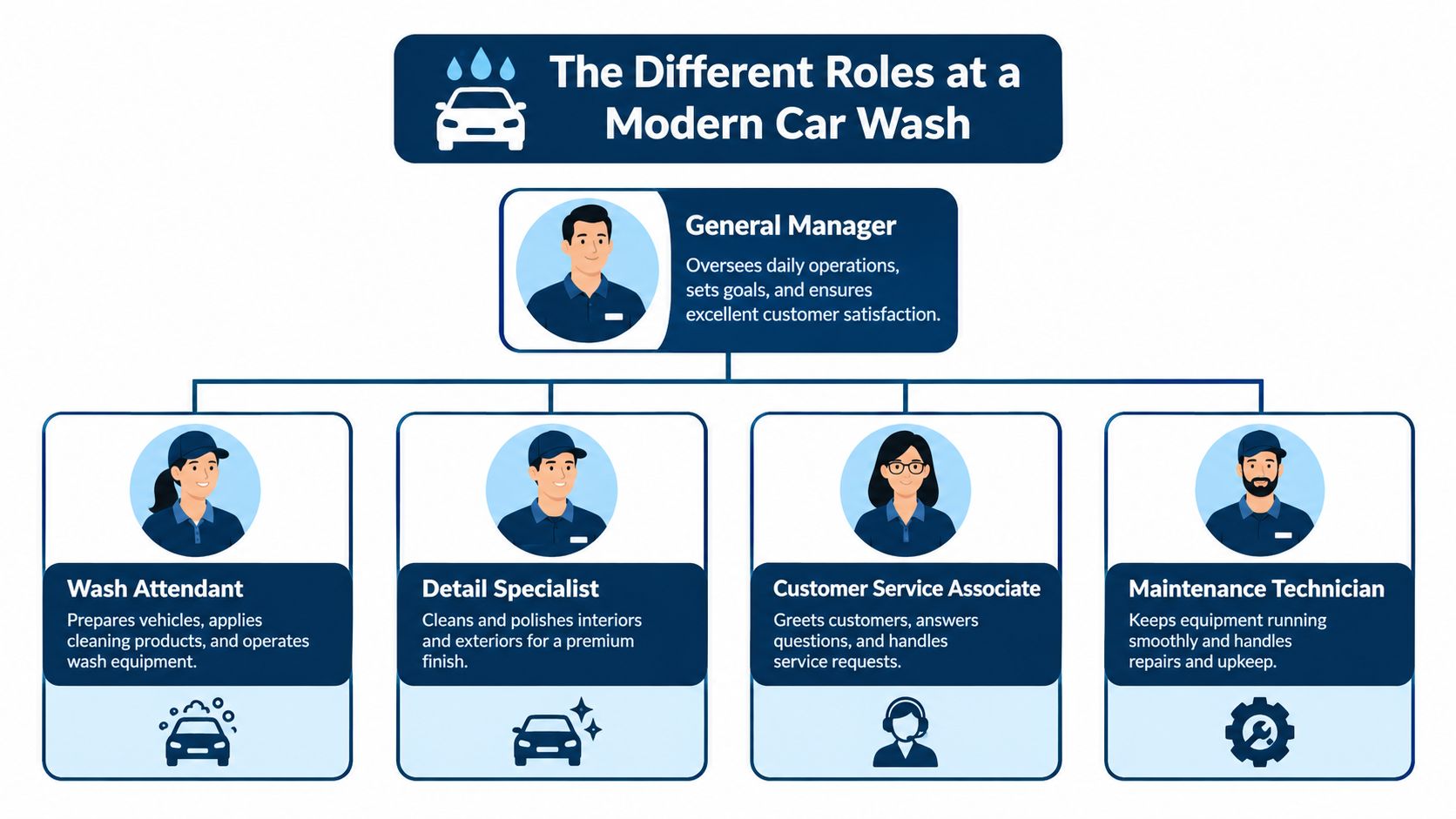
A customer's visit works like a relay race. Each employee receives the vehicle, completes one part of the job, and passes it to the next person without compromising safety or quality.
At the entrance and tunnel
The greeter or pay-station attendant helps the customer choose a service, answers questions about exterior washes, interiors, memberships, or add-ons, and confirms any special instructions. This role suits someone who can stay friendly while making quick decisions.
The tunnel attendant guides vehicles onto the conveyor, checks spacing, watches for safety issues, and operates or monitors wash equipment. The work is alert rather than passive. You're reading the position of tyres, mirrors, doors, and bumpers while communicating with the rest of the team.
An express site depends on consistent movement. A full-service location may give the crew more time to coordinate hand-dry work or interior cleaning, but the safety responsibility remains the same.
At the finishing area
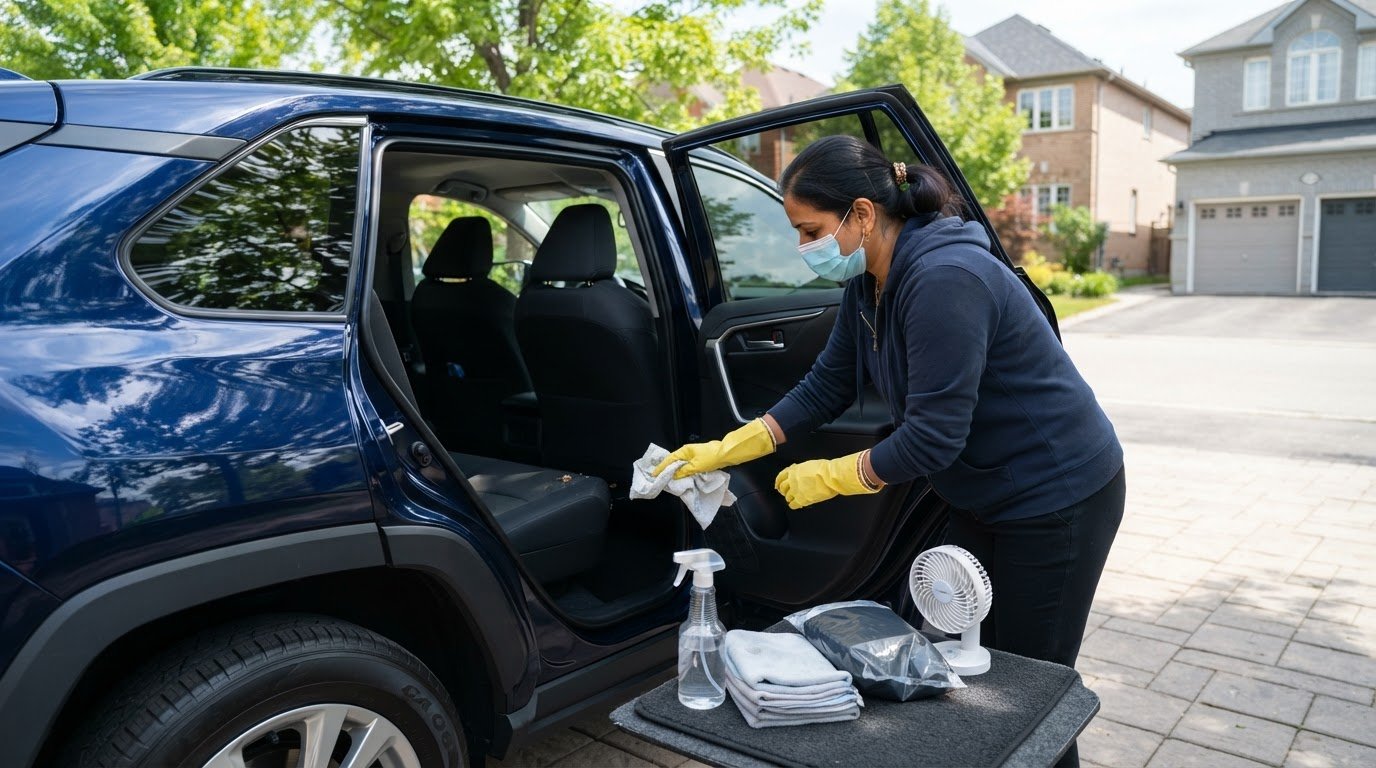
The vacuuming and interior-cleaning crew handles floor mats, seats, carpets, dashboards, windows, cup holders, and other reachable surfaces. This work has a physical rhythm of bending, stretching, kneeling, lifting mats, and moving around tight spaces. It rewards employees who notice small details instead of just moving quickly.
Hand-dry staff use towels and air tools to remove water from mirrors, trim, handles, grilles, and seams. Their work prevents the “almost clean” finish that customers notice when water drips down after the car leaves.
In the detailing and rust-protection bays
Detailing technicians work more slowly and methodically. They may shampoo carpets and seats, remove salt and stains, clean leather, blow out vents and crevices, or use a machine polisher to improve the finish. This role is a better match for someone who enjoys diagnosis and careful repetition.
Rust-proofing applicators prepare a vehicle and apply a dedicated protective compound to relevant areas. The job requires safety discipline, coverage control, and respect for product-handling instructions. It's less about making the car sparkle and more about protecting vulnerable metal from Ontario's winter environment.
Pay, Demand, and the Ontario Job Market
Job seekers often search for a wage first, but wash operators don't all use the same pay structure. Rates can vary by location, experience, shift availability, responsibilities, and whether the role includes detailing or supervisory work. Since the verified information available here doesn't provide a reliable wage figure, applicants should ask directly about the hourly rate, guaranteed hours, overtime rules, training pay, and any service-related incentives.
The broader market is substantial. Ontario had 2,208 car wash businesses, representing about 31.2% of Canadian car washes as of August 2026, according to the Ontario car wash and auto detailing industry profile. The same profile projects 8,146 Ontario workers in 2026, rising to 9,625 by 2031, and estimates that the province's establishments grew to 1,478 locations over the prior five years, with a projection of 1,736 locations by 2031.
Those figures help explain why the GTA is a dense labour market for attendants, detailers, and support staff. Wash sites tend to cluster around busy roads, commercial areas, and commuter corridors, so applicants may find several potential employers within a practical travelling distance.
What the sector's size means for applicants
Canada employed 21,167 people in car wash and auto detailing in 2025, with employment projected at 22,584 in 2026, while the same Canadian employment source reports an average business size of 5.6 workers. It also describes a slight employment decline from 2020 to 2025 and projected average annual growth of 4.4% from 2021 to 2026.
The small-team structure matters. You may work closely with the owner or site manager and take on responsibility quickly, but there may not be a formal corporate ladder. Your strongest bargaining tools are dependable attendance, useful availability, safe work habits, and a clear interest in learning higher-skill services.
For a plain-language explanation of how employers and applicants interact in a labour market, the HR Management 365 labour market guide provides helpful context.
Ontario Car Wash Sector at a Glance
| Metric | Figure |
|---|---|
| Ontario car wash businesses as of August 2026 | 2,208 |
| Ontario share of Canadian car washes | About 31.2% |
| Projected Ontario employment in 2026 | 8,146 workers |
| Projected Ontario employment in 2031 | 9,625 workers |
| Average Canadian business employment | 5.6 workers |
Skills and Training You Pick Up on the Job
Almost nobody arrives knowing how to run a wash site. A good first shift is less about proving you're an expert and more about showing that you can listen, repeat a safe process, and ask before guessing.
Your first skills are practical
New attendants usually learn how to direct vehicles, identify safe spacing, use clear hand signals, handle towels, lift and shake out mats, and operate a commercial vacuum. A supervisor may demonstrate a task, watch you perform it, then correct one detail at a time. That could mean changing the angle of a towel, keeping a hose away from a customer's path, or approaching a vehicle without startling the driver.
Customer service develops alongside the physical work. At the pay station, you learn to explain the difference between an exterior wash, an underbody option, a full-service clean, and an appointment-based detail without overwhelming the customer.
Chemistry and equipment come next
Presoak products, detergents, foam applications, waxes, drying agents, and rinses each serve a different purpose. The lesson isn't “use more chemical.” It's to apply the right product in the right sequence, follow site instructions, and understand that dwell time, surface condition, and water pressure affect the result.
Equipment training can include conveyor controls, air blowers, vacuums, pressure equipment, extractors, polishers, and water-reclamation or process-control systems. That technical exposure is easy to miss in a job advertisement, yet it can make an employee more valuable at a modern operation.

Specialist work rewards patience
A detailer learns to inspect before choosing a method. A ground-in salt mark may need controlled cleaning rather than aggressive scrubbing. Leather needs different care from cloth. Machine polishing requires steady movement and careful product control, not just pressing harder.
Rust-proofing adds another layer of training. Ontario road salt creates a serious corrosion challenge because chloride brine can remain electrically conductive after visible slush dries. Canadian and Ontario-focused guidance recommends underbody washing every one to two weeks during salt season, with an extra wash after thaw events when brine is mobile, as described in CAA's winter rust guidance.
The employee who learns why a process works can move into more responsibility faster than the employee who only memorises buttons.
Shift Structures and What the Workweek Really Looks Like
Wash work isn't automatically a summer-only job. In the GTA, winter creates a different kind of demand. Road salt, slush, and thawing conditions send drivers back for exterior and underbody cleaning, especially when grime has collected in wheel wells and underneath the vehicle.
A high-volume site may open early for commuters, build through the morning, and reach its strongest customer flow later in the day or on weekends. A part-time employee might take weekend blocks or rush-period shifts. A full-time employee may combine opening duties, customer service, tunnel work, interior cleaning, and closing procedures.
Match the schedule to the operation
Express sites supported by memberships and repeat customers can offer steadier activity across the year. A wand-wash format may be more affected by weather and customer volume, while a full-service or detailing bay often schedules work around appointments.
Salt season and spring thaw can create predictable surges. Those periods may offer more opportunities for employees who can cover weekends, early starts, or short-notice demand. They can also expose weak staffing plans quickly, because a small team has fewer people available to absorb a sudden line.
The basic categories of shift planning are similar across customer-service businesses. A plain-language guide to first, second, and third shifts can help applicants understand how employers label schedules, even though a car wash may use its own opening, peak, and closing terminology.
Water knowledge is part of the workweek
Water use depends heavily on the wash format. A Canadian government publication gives typical figures of 230 to 320 litres per vehicle for tunnel washes and 90 to 140 litres for wand washes, as shown in this Canadian water-use publication.
That doesn't mean the employee should merely spray for less time. It means modern operations need controlled application, appropriate chemistry, equipment checks, and reclamation knowledge. Staff who understand those systems can contribute to both service quality and responsible site operation.
How to Apply at a Multi-Location Operator Like Nanak Car Wash
Start with the location, not the generic application. A multi-location operator serving Etobicoke, Brampton, Concord, Oshawa, Sheppard and North York, Burlington, Cambridge, and Guelph may give you more than one practical route into the industry. Choose the site you can reach reliably, then ask whether nearby locations are also hiring.
Visit during a quieter weekday period rather than arriving during a weekend line. Bring a simple résumé, dress for a clean and active workplace, and be ready to explain your availability without making the manager extract every detail from you.
What to say when you introduce yourself
A manager needs to know whether you'll show up, work safely, and learn the process. Give concrete answers:
- Reliability: Explain how you'll get to the site and whether you can consistently cover your proposed shifts.
- Winter availability: Say whether you can work weekends, early openings, or salt-season rushes.
- Learning interest: Mention if you'd like to develop skills in interior cleaning, detailing, equipment operation, or rust proofing.
- Customer comfort: Describe any experience helping customers, handling payments, or staying calm during a busy period.
- Physical readiness: Be honest about your ability to stand, bend, reach, lift mats, and work around water and temperature changes.
Don't claim experience you don't have. “I haven't used a machine polisher, but I'm interested in learning and I follow instructions carefully” is stronger than an inflated answer that becomes obvious on the first shift.
Treat the first week as a working audition
Training may begin with vehicle direction, towel technique, vacuuming, safety procedures, and service explanations. You'll be evaluated on whether you listen, repeat the correct sequence, protect the customer's vehicle, and keep working when the line gets busy.
For employers, the best screening questions are practical rather than theatrical. Ask about attendance, transportation, schedule flexibility, comfort with outdoor work, and examples of learning a hands-on task. Then describe the path clearly. Someone who starts at the entrance may later learn interior restoration, detailing, rust protection, or team coordination.

The operator's service mix includes express and full-service washing, interior cleaning, professional detailing, and rust-proofing. That variety matters because employees can see how a quick wash connects to more specialised vehicle-care work instead of treating every customer visit as the same task.
The Real Benefits and Honest Drawbacks of the Trade
The strongest benefit is visible progress. You start with a dirty vehicle and finish with a cleaner one. That immediate result gives new employees useful feedback, especially when a supervisor can point to a missed mirror edge, a streaked window, or a seat stain that needs another pass.
The work also builds transferable habits. You practise customer communication, payment handling, safe equipment use, time awareness, teamwork, and quality control. Those skills can support future work in detailing, automotive service, fleet operations, or other fast-moving service environments.
Why the job can suit the right person
- Low entry barrier: Many skills are trainable on site, so a lack of detailing experience doesn't automatically exclude you.
- Visible craftsmanship: Careful vacuuming, stain removal, leather cleaning, or polishing produces a result customers can see.
- Varied setting: You may move between the pay station, tunnel, finishing area, interior bay, and detailing space.
- Technical exposure: Water control, equipment handling, chemistry, and wastewater practices add depth beyond manual cleaning.
- Advancement potential: Employees who become dependable at core tasks can ask to learn specialised services.
The drawbacks deserve equal attention. You'll stand for long periods, bend into footwells, reach across vehicles, handle wet tools, and work through temperature swings. Busy periods can feel repetitive because the same safe sequence must be performed accurately again and again.
Water efficiency also shows why the industry is changing. Independent Canadian guidance cited by the Natural Resources Canada wash-water discussion places an average commercial wash at about 260 litres per vehicle, while automated systems with recycling can use below 30 litres per vehicle, compared with about 450 litres for one driveway wash in a cited study. The comparison is useful, but it doesn't remove the physical demands of the job.

Your Next Steps Into Wash Car Jobs
Choose the work style that sounds sustainable. If you like quick decisions and constant movement, start with the entrance or tunnel. If you prefer careful, visible improvement, ask about interiors or detailing. If winter vehicle protection interests you, ask how employees learn underbody washing and rust-proofing procedures.
Prepare three answers before you approach a manager: when you can work, how you'll arrive reliably, and which skill you want to learn first. Visit a nearby site during a quieter weekday morning, introduce yourself clearly, and ask who handles hiring. Don't wait for a perfect résumé. A clean presentation, useful availability, and a willingness to follow safety instructions can say more than a long list of unrelated jobs.
If you're exploring detailing as a practical route without a university credential, this overview of detailing roles that skip a degree can help you compare possible directions. Employers can use the same thinking in reverse by writing job postings that name the actual tasks, explain the training path, and state which shifts need coverage.
Ontario's projected employment growth gives the sector room to develop, but applicants still need to earn trust one shift at a time. Learn the basic process, protect the customer's vehicle, ask for feedback, and volunteer for the next skill when you're ready. The satisfying moment comes at the end, when a spotless car rolls out of the tunnel and you know exactly which part of that finish you helped create.
Nanak Car Wash offers express and full-service washes, interior cleaning, professional detailing, and automotive rust proofing across its GTA and surrounding locations. Visit Nanak Car Wash to explore its services and find a location where you can see modern wash car jobs in action.


 6600 Finch Ave W, Etobicoke, ON M9V 3Z6
 647-703-8515
 MON – SUN 8 AM to 7 PM