
Car detailing is a thorough interior and exterior deep clean plus a protective coating process designed to restore and preserve a vehicle, not just rinse off surface dirt. Ontario had approximately 8.8 million light-duty vehicle registrations in 2024, representing 35.9% of Canada's total, so this kind of care matters to a very large number of GTA drivers.
You may have noticed the problem after a salty winter commute. The paint looks flat even after a quick rinse, white residue sits around the wheel wells, and the cabin still smells stale because dirt has settled into the carpets, vents, and seams. That's exactly where detailing earns its keep.
Table of Contents
- What Is Car Detailing Service
- Car Wash vs Car Detailing Differences
- Common Car Detailing Services Explained
- Why Detailing Matters for Ontario Drivers
- Car Detailing Pricing Factors and What to Expect
- How to Book and Prepare for a Detailing Appointment
- Common Misconceptions About Car Detailing
What Is Car Detailing Service
A professional car detailing service is a systematic process for cleaning, restoring, and protecting both the inside and outside of a vehicle. It can include deep vacuuming, salt and stain removal, upholstery or carpet shampooing, glass and dashboard cleaning, paint decontamination, polishing, waxing, and surface protection.
A quick car wash removes loose dirt from accessible exterior surfaces. Detailing goes further by treating contamination according to where it sits and how strongly it has bonded. A detailer may use chemical pre-treatment, controlled agitation, extraction equipment, compressed air, brushes, polishing machines, and protective products to deal with each surface appropriately. The technical process also needs environmental controls, because vehicle-wash water can contain pollutants such as metals, oil, grease, solvents, and fuel-related compounds. California stormwater guidance for automotive businesses recommends containing wash water and routing it to an approved sanitary-sewer or treatment system rather than allowing it to enter a storm drain.
Think of a basic wash as rinsing a dish. Detailing is hand-scouring the dish, treating the stuck-on residue, drying it properly, and applying a finish that makes the next mess easier to remove. It is not just waxing the outside, and it is not an automated tunnel wash with a more impressive name.
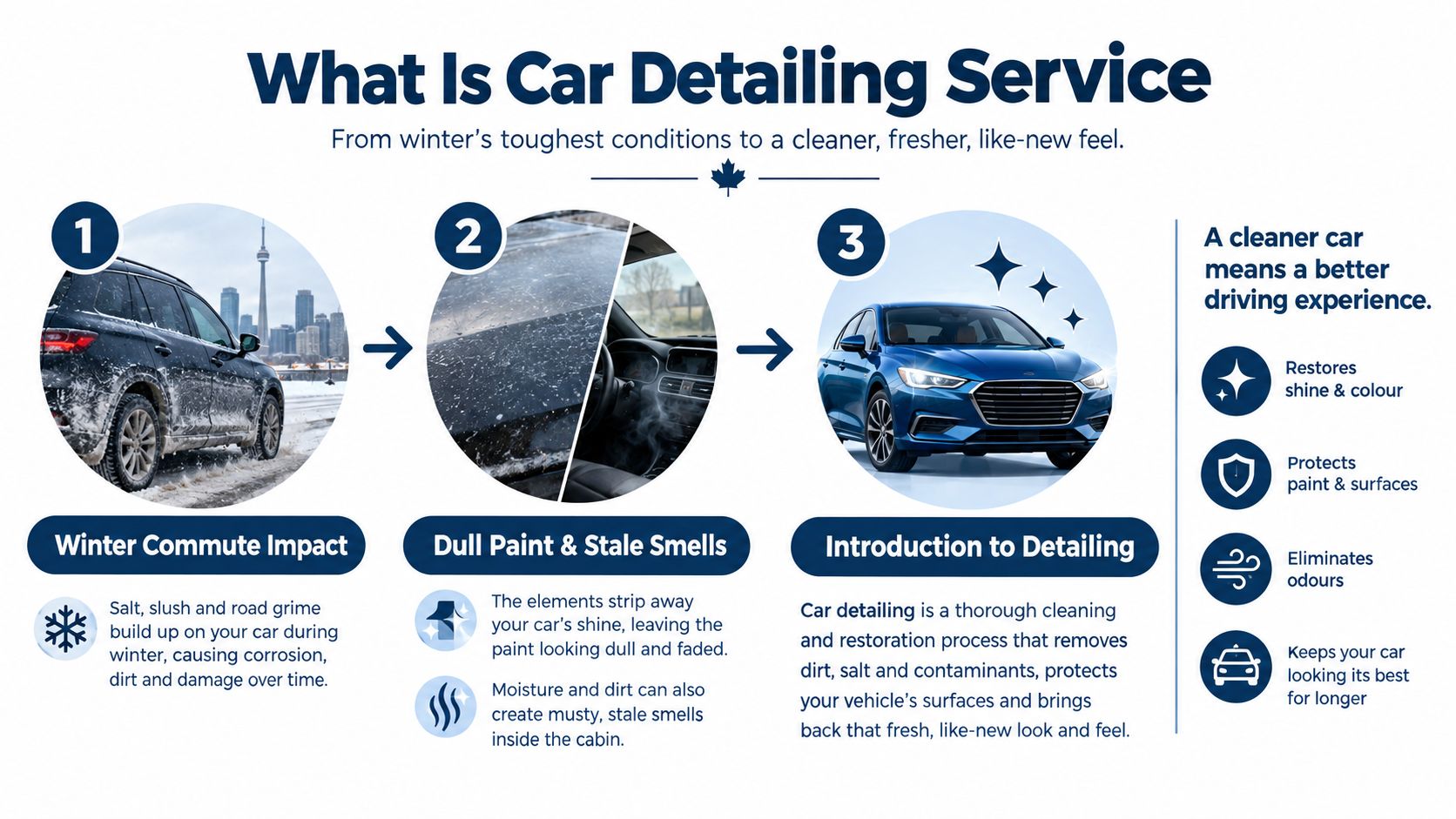
The preservation element matters in the GTA. A vehicle used for commuting, delivery work, school runs, or ride-hailing collects road film and salt repeatedly. Detailing removes that material from places a rinse can't reach, then adds protection to help slow future soiling and moisture exposure.
Car Wash vs Car Detailing Differences
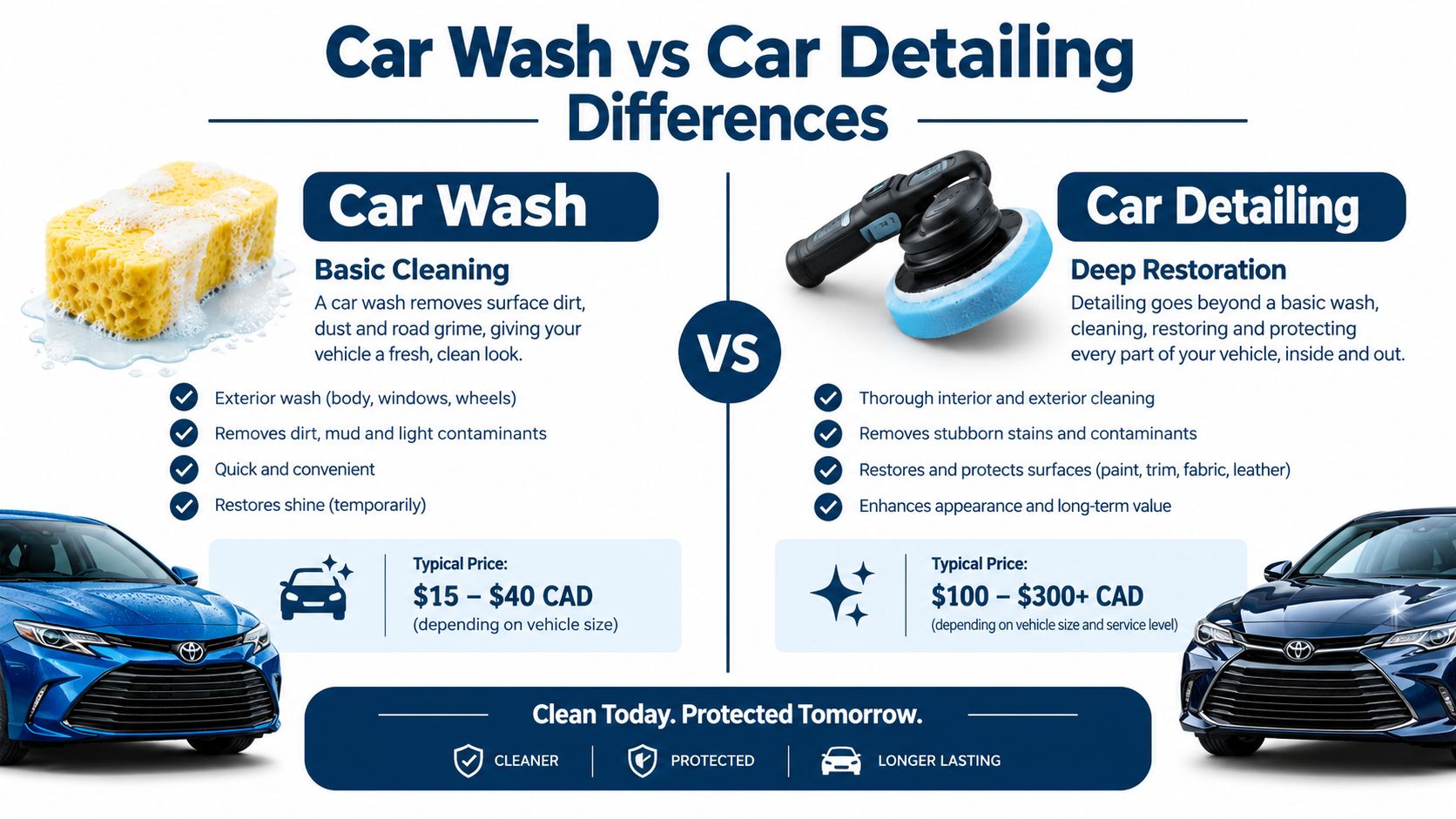
The simplest distinction is this: washing removes loose dirt, while detailing cleans, restores, and protects more thoroughly.
A standard exterior wash is useful after a dusty drive or a mild layer of road grime. It usually focuses on the vehicle's outside, works quickly, and leaves the car visibly cleaner. It won't normally address embedded salt in carpet fibres, residue inside vents, bonded paint contamination, fine scratches, or dull trim.
Detailing takes a different approach:
- Cleaning depth: A wash targets accessible exterior dirt. Detailing reaches wheel wells, seams, vents, cup holders, upholstery, carpets, leather, dashboards, and other neglected areas.
- Time required: A wash is designed for a short visit. Detailing may involve several hours because products need time to loosen contamination, fabrics may need extraction and drying, and paint correction requires controlled machine work.
- Protective value: A wash cleans the current mess. Detailing may add a wax, sealant, or coating that creates a more water-repellent surface and makes later cleaning less aggressive.
- Typical outcome: A wash gives you a cleaner vehicle. Detailing aims for a cleaner, more presentable, and better-protected vehicle, subject to the condition of its paint, fabric, trim, and coatings.
Ontario weather makes the difference easy to see. A wash may remove the visible salt from the doors, but detailing can include underbody rinsing, wheel-well cleaning, carpet extraction, and protective finishing. If the vehicle only has loose dirt, choose the wash. If it has stale odours, embedded stains, dull paint, salt buildup, or neglected surfaces, it needs the deeper process.
Common Car Detailing Services Explained
Detailing appointments vary, but most services fit into three groups: exterior restoration, interior cleaning, and preventive protection. A responsible detailer doesn't use the same aggressive method everywhere. Paint, leather, plastic, carpet, and glass each require different products and levels of agitation.
Exterior work
The exterior often starts with a pre-treatment to soften road film, followed by a careful wash and rinse. A detailer may then remove bonded contamination with a clay treatment or another suitable decontamination method. If the paint has fine defects or oxidation, machine polishing can refine the surface, but polishing isn't a magic eraser for deep scratches that have cut through the finish.
Wheel faces, tires, plastic trim, door jambs, badges, and fuel-filler areas need separate attention. GTA vehicles often carry salt residue around wheel wells and lower panels, where a quick sponge pass misses it.
Interior work
Interior detailing is more than vacuuming the obvious floor area. A methodical appointment can include:
- Loose debris removal: Seats are moved, mats are lifted, and dust is removed from seams and under-seat areas.
- Fabric treatment: Carpets and upholstery may receive shampooing or extraction for spills, salt, and embedded soil.
- Crevice cleaning: Compressed air and small brushes can reach vents, switches, seat rails, console gaps, and stitching.
- Leather care: Leather is cleaned with a compatible product before conditioning, rather than being coated with a greasy dressing.
- Odour-source removal: A detailer should remove residue causing the smell instead of relying on fragrance to cover it.
The technical objective: remove contaminants by type and adhesion mechanism, rather than hiding dirt beneath perfume, shine, or dressing.
Protection and preservation
Protection may include a wax, paint sealant, coating, interior protectant, or rust-prevention treatment. These products can reduce the adhesion of future road film and help shield surfaces from moisture, ultraviolet exposure, and everyday soiling. The provider should explain compatibility, drying or curing requirements, and which areas were treated.
For an Ontario commuter, the most useful package isn't always the one with the glossiest name. It may be an underbody rinse, salt removal, fabric extraction, paint decontamination, or a protective finish selected for the vehicle's actual condition.
Why Detailing Matters for Ontario Drivers
A vehicle is an expensive asset, even before you add financing, insurance, repairs, and fuel. The median price of a new vehicle in Canada reached $65,219 in December 2024, compared with $40,386 in 2019, while the median used-vehicle price reached $34,445, compared with $18,900 in 2019, according to Statistics Canada's federal publication on automobile expenses and revenues. Those figures are national, but Ontario contributed the most to national automobile expenses and revenues because it had the largest number of households and vehicle registrations.
That context changes the question from “Do I want my car to look shiny?” to “How do I keep an expensive, heavily used machine in sound condition?” Interior cleaning protects the surfaces you touch every day. Paint decontamination and polishing remove material that can dull the finish. Sealants and coatings make later cleaning easier, while rust-prevention work addresses a concern that a glossy hood can't solve.
Salt changes the maintenance problem
Ontario vehicles face winter moisture, road grime, and salt residue. Salt can remain in wheel wells, seams, carpets, door jambs, and underbody areas even when the vehicle looks clean from the driver's seat. Environment and Climate Change Canada's road-salts report identifies road salt as a major environmental concern in Canada and documents Ontario as a significant user.
That doesn't mean every driver needs the same package or a rigid calendar. A vehicle that spends most of its time on treated highways needs different attention from one parked indoors and driven occasionally. Rust proofing can support preservation, but it doesn't replace washing salt away from exposed and hidden surfaces.
The same principle applies to presentation and trust. A clean, organised vehicle matters to a delivery driver, a fleet operator, a dealership, and a private owner preparing for resale. Businesses thinking about visibility can also learn from plumber SEO strategies, particularly the value of answering specific local service questions clearly. In both cases, practical information helps people choose the right service instead of buying an attractive but unsuitable label.
Car Detailing Pricing Factors and What to Expect
There isn't one honest GTA detailing price because providers aren't all doing the same job. A compact car with light dust and clean fabric requires less labour than a large SUV with pet hair, ground-in salt, stained upholstery, and neglected trim. The quote should reflect the work, not just the word “detail.”
Several factors usually change the scope:
- Vehicle size: SUVs, vans, and pickup trucks have more glass, carpet, seats, exterior panels, and underbody area to clean.
- Condition: Mud, salt, food residue, smoke odour, and long-neglected grime require additional treatment.
- Materials: Leather, delicate trim, fabric seats, rubber mats, and textured plastics need different products and techniques.
- Pet hair: Hair caught in carpet and upholstery can take far longer to remove than ordinary loose debris.
- Protection level: A basic clean costs less than a package that includes paint decontamination, machine polishing, sealant, or rust prevention.
- Vehicle use: High-mileage cars, delivery vehicles, and work fleets often need more corrective cleaning than lightly used personal vehicles.
A typical detailing appointment can take about one to four hours, depending on scope and vehicle condition, according to the service information provided by Nanak Car Wash. A basic exterior refresh sits at the lower end of that range, while a full interior-and-exterior restoration takes longer.
Ask whether the quote includes shampooing, stain treatment, pet-hair removal, underbody cleaning, polishing, drying time, and protection. Providers may also offer prepaid bundles or membership options for recurring washing, but compare what those plans really include. Predictable spending is useful only when the service matches your driving pattern.
How to Book and Prepare for a Detailing Appointment
Start with the problem, not the package name. Tell the provider whether you need salt removal, pet-hair extraction, a stale-odour assessment, paint polishing, rust prevention, or a complete interior and exterior clean. Ask what the quoted service includes and whether the appointment is suitable for the vehicle's current condition.
Before booking, confirm four practical points:
- Scope: Ask which surfaces will be cleaned and which defects the provider won't attempt to correct.
- Products: Check whether the detailer uses materials compatible with your paint, leather, vinyl, fabric, and existing coatings.
- Water controls: Ask whether wash water is captured and directed to an approved treatment or sanitary-sewer system, rather than a storm drain.
- Timing: Discuss winter conditions, drying requirements, and whether the vehicle can remain protected from freezing moisture after interior shampooing.
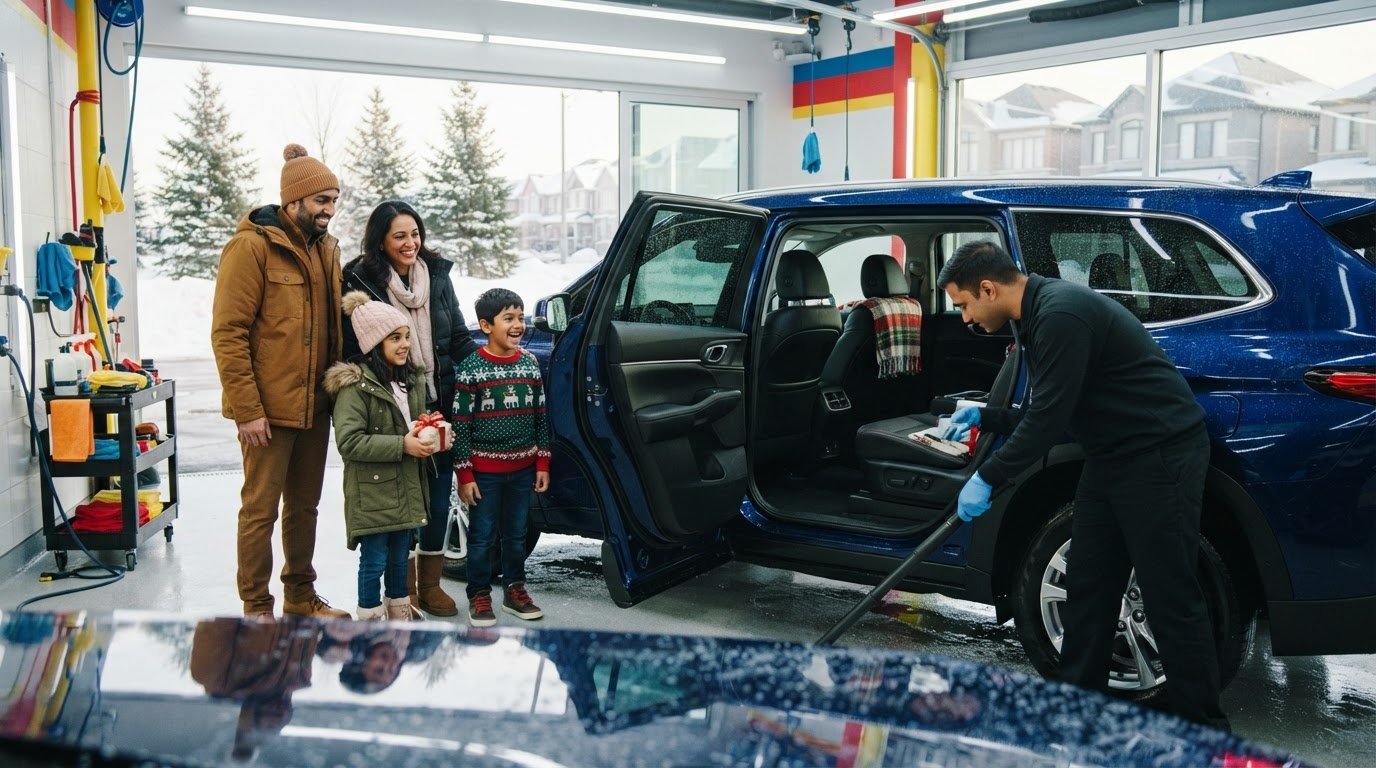
Remove personal items, child seats if practical, rubbish, and anything loose in the boot. Point out specific stains, previous repairs, warning lights, damaged trim, pet odours, and areas where water has entered. Clear information prevents a disagreement when a permanent stain turns out to be a dye change or when a smell comes from the HVAC system rather than the upholstery.
A careful provider should document the areas treated, product compatibility, drying or curing time, and any inspection notes. Afterward, ask how to maintain the finish. Gentle washing, prompt removal of heavy salt, proper ventilation, and timely follow-up protection will preserve the result better than harsh scrubbing or an overpowering fragrance.
Common Misconceptions About Car Detailing
The biggest misconception is that detailing is only a very thorough car wash. That description misses the interior restoration, paint correction, contamination removal, protective chemistry, drying control, and preservation decisions that make detailing different.
Another misunderstanding is that professional cleaning automatically damages paint. Poor technique can create problems, but a competent detailer controls water pressure, chemical strength, agitation, towel use, pad selection, and machine speed. Polishing should be measured and appropriate to the paint condition, not treated as an aggressive routine step.
A single appointment also won't solve every problem forever. Detailing can remove accumulated soil and improve the condition of many surfaces, but it can't reverse every deep scratch, repair rust holes, replace a damaged cabin filter, or fix an HVAC leak. The vehicle still needs sensible washing and inspection afterward.
Clean smell isn't the same as clean air
Fragrance causes another common mistake. A strong “new car” smell may only mean that fragrance has been added. Health Canada's research compilation reports that cabin air filtration reduced in-vehicle particulate exposure by approximately one third, while the accompanying research context highlights the importance of keeping vehicle interiors clean and avoiding indiscriminate chemical or fragrance use.
Interior detailing can remove dust, soil, spilled residues, allergens, and embedded odour sources. It isn't a substitute for replacing a cabin filter, inspecting HVAC contamination, or addressing mould and persistent chemical smells. Wet upholstery must also dry fully, or the attempted cure can create a new odour problem.
Ask what the detailer will remove, what they will protect, and what they won't promise. Those answers tell you more than a package name.
When comparing providers, look for specific procedures rather than vague claims such as “deep clean” or “like new.” Ask how salt will be removed, whether the underbody is included, how fabric will be dried, what protection is applied, and how wastewater is controlled. That conversation will help you choose a service that treats your vehicle as an asset, not just a surface waiting to be made shiny.
Nanak Car Wash offers express and full-service washes, interior and exterior detailing, and automotive rust proofing for GTA drivers who need anything from routine salt removal to a more complete restoration. Visit Nanak Car Wash to review its detailing, wash, rust-proofing, prepaid, and membership options, then book the service that matches your vehicle's condition.

 6600 Finch Ave W, Etobicoke, ON M9V 3Z6

 647-703-8515
 MON – SUN 8 AM to 7 PM