
You're in a Mississauga driveway on a Sunday morning, scraping ice from the windshield while white salt crust flakes off the bonnet. Brine is still dripping from the door panels, and you're wondering whether a quick touchless wash will handle it or whether the car needs a proper detail.
That's the question behind how often to detail a car. The answer depends less on the calendar than on how far you drive, where you park, and how much Ontario winter your vehicle absorbs. A weekend car stored in a garage has a completely different cleaning burden from a daily commuter travelling the 401, QEW, DVP, or Lake Shore.
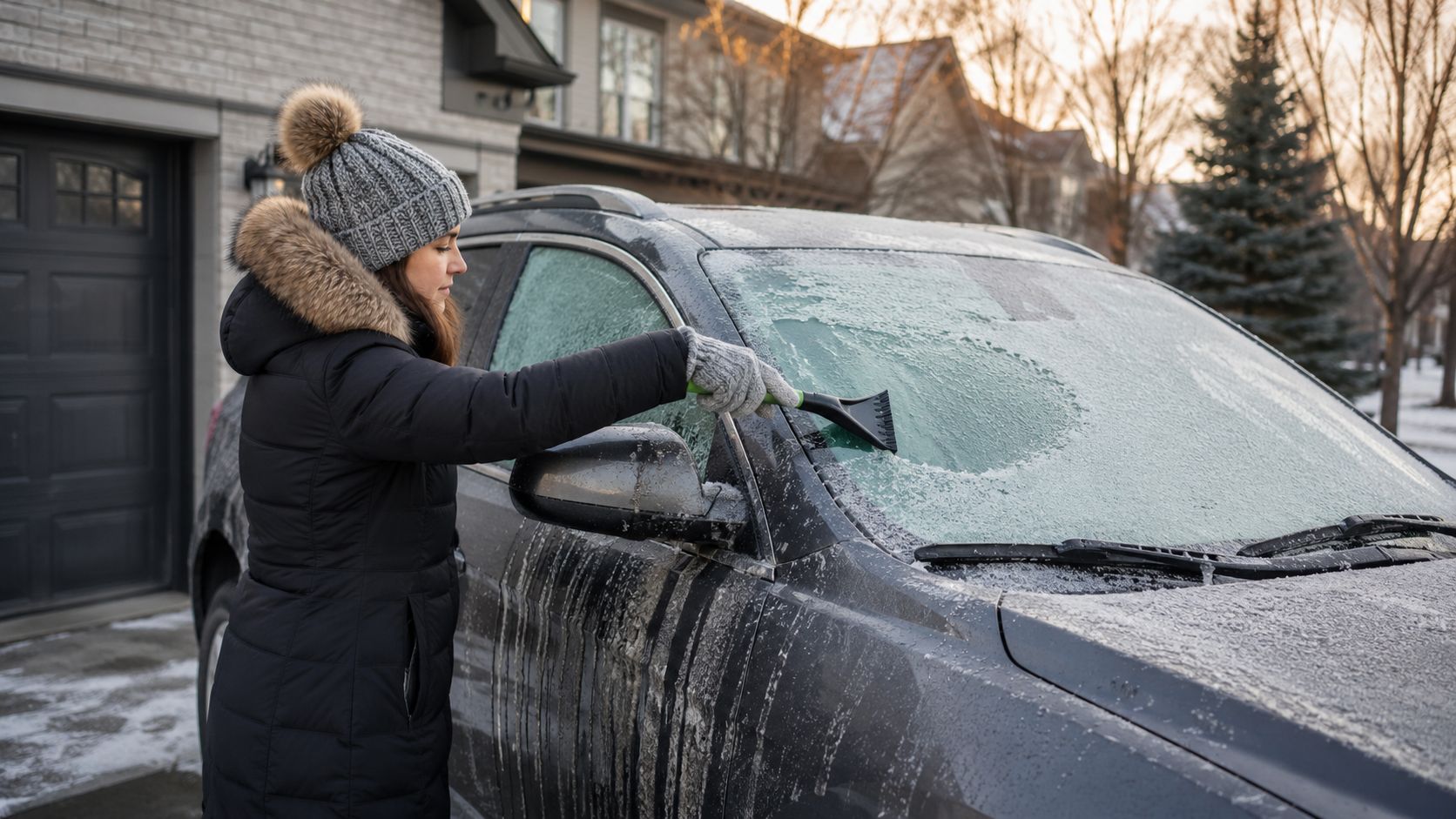
Table of Contents
- Why Ontario Drivers Ask This Question So Often
- What Detailing Actually Covers
- Ontario Salt and Corrosion Reality
- Baseline Detailing Schedule for GTA Drivers
- High-Mileage and High-Exposure Drivers
- Membership, Prepaid, and One-Time Options
- Warning Signs a Detail Is Overdue
- Putting It All Together
Why Ontario Drivers Ask This Question So Often
Ontario drivers clean their vehicles frequently because Ontario vehicles get dirty frequently. An Ipsos survey found that Canadian households with a car washed their vehicles 3.03 times per month, while Ontario households reported 4.06 washes per month. That works out to approximately 48.7 washes per year in Ontario, compared with about 36.4 nationally, or roughly 12 additional washes annually. (Ipsos vehicle-washing survey)
That behaviour makes sense in the GTA. A commuter travelling through slush, road spray, construction dust, and stop-and-go traffic collects a fresh layer of contamination almost every day. The salt doesn't stay neatly on the road. It reaches rocker panels, wheel wells, door seams, suspension parts, and the lower edges of the paint.
Your parking spot changes the answer
A car parked outdoors on a salted arterial remains exposed after you've shut the engine off. Snow melts, refreezes, and leaves damp salt deposits in areas that don't dry quickly. A vehicle kept in a garage still needs care, but it gets a break from continuous exposure between trips.
That's why generic advice such as “detail every few months” can be misleading in Ontario. It may suit a lightly used vehicle in a protected parking space, but it's too relaxed for a car that spends every weekday on salted highways.
My rule for GTA neighbours: schedule around exposure, not pride. A filthy car tells you it's overdue, but salt can be doing damage before the vehicle looks dramatically dirty.
Spring brings its own workload. Once the snow disappears, road film, sand, construction dust, tar, and winter residue remain on the body and undercarriage. A spring detail isn't just about making the car presentable again. It removes contamination that has had months to settle into seams and textured surfaces.
What Detailing Actually Covers
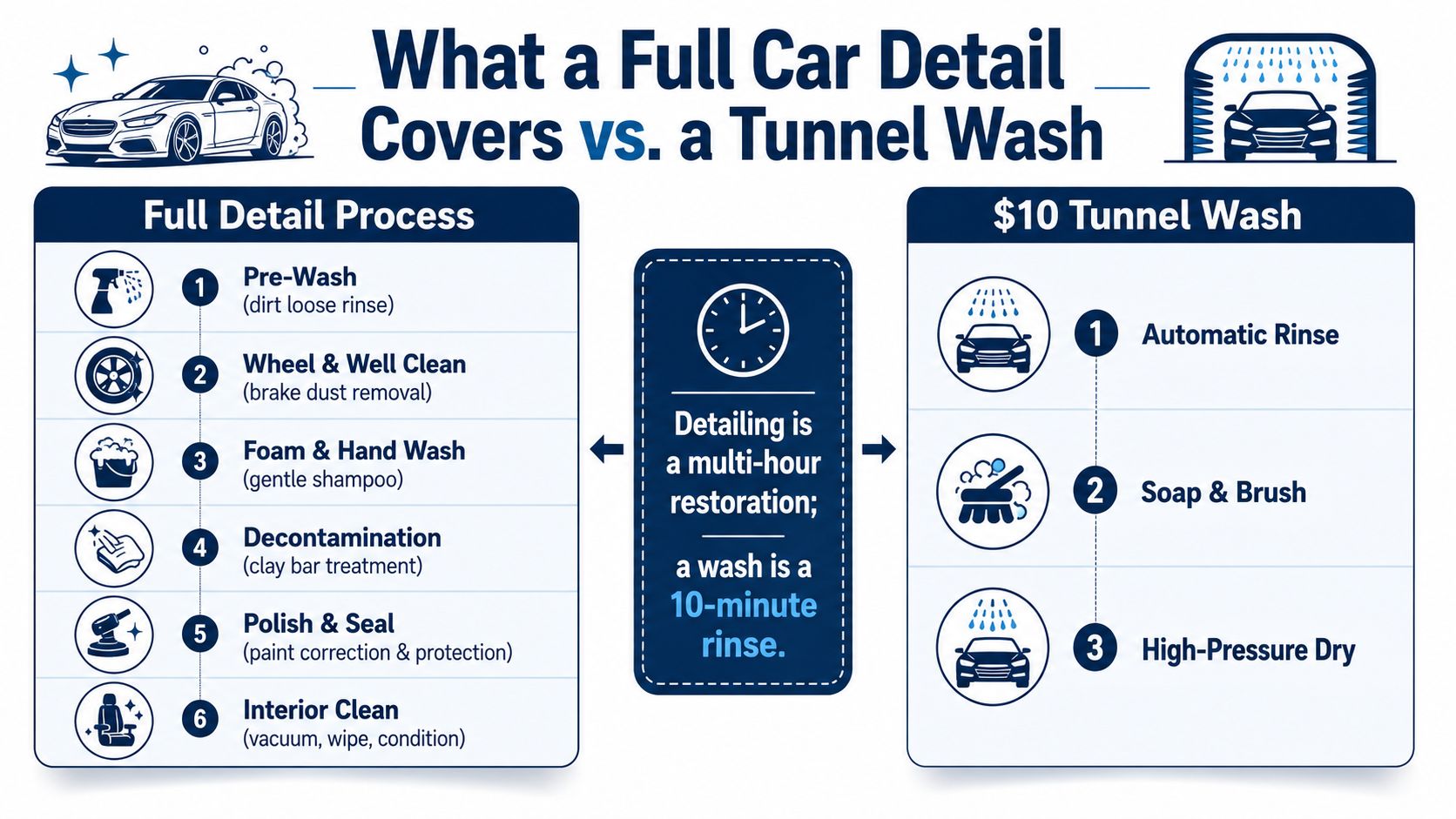
A full detail is not a more expensive version of a tunnel wash. It's a deeper cleaning and protection service that addresses bonded contamination, neglected surfaces, and the interior areas a quick wash cannot reach.
A standard exterior process usually starts with a pre-wash to loosen grit before contact cleaning. The technician then works on wheels and wheel wells, removes iron fallout and tar, and may use a clay bar to lift contamination that shampoo cannot remove. Depending on the paint's condition, polishing can improve gloss and reduce light defects before a sealant or wax is applied.
The interior needs its own treatment
Interior detailing goes beyond running a vacuum over the carpets. A proper service may include:
- Vacuuming and crevice cleaning: Dirt, salt, crumbs, and grit are removed from seats, mats, rails, vents, and console gaps.
- Steam or extraction cleaning: Fabric seats and carpets receive deeper treatment when ordinary wiping can't lift stains or odours.
- Leather care: Leather surfaces are cleaned carefully, then conditioned where appropriate.
- Trim and dashboard cleaning: High-touch surfaces are cleaned rather than coated with a shiny dressing.
- Glass cleaning: Interior film is removed so the windshield doesn't haze or smear in low winter sun.
- Odour treatment: Persistent smells require source cleaning, not a fragrance sprayed over the problem.
Choose the service level honestly
A maintenance detail keeps an already-cared-for vehicle in shape. It's suitable when the paint is protected and the interior only needs a controlled refresh. A full detail resets a vehicle after accumulated dirt, salt, stains, and neglect.
A paint correction package is different again. It uses machine polishing to address paint defects and requires more time, skill, and care than routine detailing. Don't book correction work when what you really need is salt removal and protection.
The schedules below assume a full detail when they say “detail.” A basic wash still belongs between those appointments. Nanak Car Wash lists express exterior washes, full-service cleaning, interior and exterior detailing, and rust proofing as separate service options, which reflects the difference between routine maintenance and deeper restoration.
Ontario Salt and Corrosion Reality
Ontario's salt problem is large enough that vehicle cleaning should be treated as preventive maintenance, not decoration. A Transportation Research Board corrosion study recorded atmospheric corrosion in Toronto at 5,108 mg/dm² over a 19-month exposure period, placing Toronto among the highest-corrosion locations examined. (Transportation Research Board corrosion reference)
Road salt and brine create trouble because they keep moisture active around metal. Salt lowers water's freezing point, increases electrical conductivity, and allows damp contamination to remain in seams, fasteners, rocker panels, and underbody components. Repeated freeze-thaw cycles make the problem worse by moving brine into hidden spaces and then trapping it there.
The GTA exposure is not a minor seasonal inconvenience
Independent Ontario-focused summaries report that the province uses approximately 1.5 to 3 million tonnes of road salt in an average winter, while Toronto uses roughly 130,000 to 150,000 tonnes annually. Those figures include the road-treatment environment that vehicles encounter across municipal and regional routes. (Ontario road-salt and corrosion overview)
The result is a vehicle that can look acceptable from standing height while carrying salt-packed residue underneath. Wheel wells, exhaust hangers, brake components, suspension hardware, and exposed electrical connections deserve attention because a surface rinse alone may not reach them.
| Region | Annual road salt usage | Peak salt months | Visible corrosion risk timeline |
|---|---|---|---|
| Ontario and the GTA | Ontario uses approximately 1.5 to 3 million tonnes in an average winter; Toronto uses roughly 130,000 to 150,000 tonnes annually (Ontario corrosion reference) | Winter salt season, especially after storms and heavy brine application | Risk builds through repeated salt exposure. Toronto recorded 5,108 mg/dm² of atmospheric corrosion over 19 months in a Transportation Research Board study (corrosion study reference) |
| Milder Canadian climates | Not specified in the verified data | Not specified in the verified data | Generic national schedules may understate GTA exposure |
The practical takeaway is simple. Ontario vehicles need regular exterior cleaning, underbody rinsing, and seasonal protection because salt remains active long after the road appears clear.
Baseline Detailing Schedule for GTA Drivers
A typical GTA daily commuter should book a full exterior detail every 8 to 10 weeks during winter salt season, including a salt-neutralizing underbody rinse. From late spring through autumn, extend the cycle to every 12 to 14 weeks when the paint stays smooth, protected, and free of heavy buildup.
That schedule does not replace regular washing. Ontario households already report washing their vehicles more often than the national average, a behaviour the local winter environment explains.
Set the exterior schedule first
Use this decision rule:
- Daily GTA commuter: Full exterior detail every 8 to 10 weeks in winter, then every 12 to 14 weeks in warmer months.
- Weekend driver: Stretch the interval substantially when mileage is low and the vehicle stays clean between trips.
- Garage-kept vehicle: Add roughly two weeks when exposure is light.
- Street-parked vehicle: Subtract roughly two weeks if the car sits beside a salted arterial, trees, or construction dust.
- After a major salt event: Wash promptly instead of waiting for the next appointment. Ontario winter washing guidance recommends an exterior wash every 7 to 10 days, or within 24 to 48 hours after a major salt event. Heavy highway use calls for the shorter interval.
A basic wash removes loose contamination. A detail removes bonded residue and restores protection. Use the wash between appointments, then book the deeper service when the paint loses smoothness or the underbody carries visible salt buildup.
Keep the interior on a separate clock
Daily drivers carrying children, pets, food, or work equipment should get a vacuum and wipe-down about monthly. Schedule a deeper interior shampoo and leather treatment around every six months, or sooner when stains, odours, or heavy use appear.
Recurring service also benefits from matching the schedule to actual usage. These frequency examples for small businesses illustrate the same principle: service frequency should reflect demand. A lightly used, garage-kept car can wait longer. A vehicle driven daily through GTA traffic needs attention sooner, especially during salt season.
High-Mileage and High-Exposure Drivers
A car that runs the 401, QEW, or 407 daily needs a tighter detailing plan than a vehicle used for weekend groceries. Long commutes increase exposure to salt spray, brake dust, tar, bugs, and abrasive grit. Distance matters, but route matters too. Highway spray and salted GTA roads can load the paint and underbody quickly.
For a high-mileage commuter, book the deeper exterior detail about every six weeks during winter. Use roughly 10 weeks as a summer starting point. Keep washing between appointments. The detail handles bonded contamination and protection, while regular washing removes loose salt before it settles into seams and underbody surfaces.
Rideshare, taxi, and delivery vehicles need a business-asset schedule because passengers and cargo wear the cabin as heavily as the road wears the exterior. Schedule the exterior detail every four to six weeks, with a steam clean or equivalent interior service every six to eight weeks. An engine-bay cleaning can follow a quarterly rotation when the operator and technician agree it suits the vehicle.
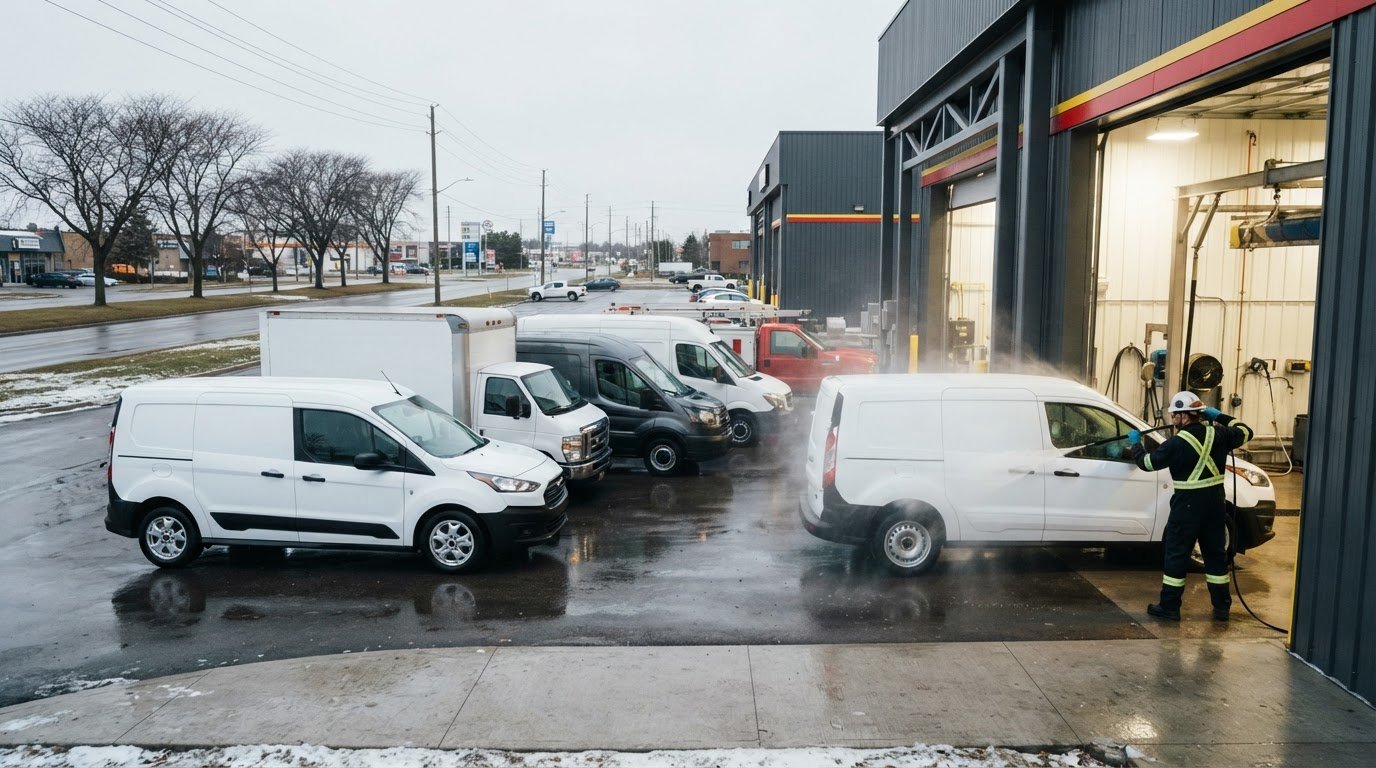
Fleet and delivery vehicles working in Brampton, Vaughan, and the industrial Mississauga corridor face curb time, loading-area dust, and constant road spray. During the harshest salt period, use touch washing twice monthly and a full detail monthly. Set the exact service around the vehicle's condition, body style, cargo, and route.
| Driver profile | Exterior detail | Interior detail | Winter adjustment |
|---|---|---|---|
| Daily GTA commuter | Every 8 to 10 weeks in winter, every 12 to 14 weeks in warmer months | Monthly maintenance, deeper service around every six months | Add underbody rinsing and shorten the cycle after major salt events |
| Long highway commuter | About every six weeks in winter, about every 10 weeks in summer | More often if the cabin carries work gear or passengers | Use the shorter end of every wash interval |
| Rideshare or taxi driver | Every four to six weeks | Steam clean about every six to eight weeks | Treat salt removal and odour control as operating costs |
| Fleet or delivery vehicle | Monthly full detail during peak exposure | Set according to cargo, passengers, and contamination | Combine frequent touch washes with underbody cleaning |
| Weekend or garage-kept vehicle | Extend well beyond the commuter cycle when condition allows | As needed, with seasonal deep cleaning | Pre-storage and spring refresh matter more than frequent winter visits |
Use the shortest interval when the vehicle is driven daily, parked outdoors, or carries passengers. A winter beater stored from November through April still needs a pre-storage detail and a spring commissioning detail. Clean and dry it before storage, then remove accumulated residue before regular service resumes.
Rustproofing guidance also recommends applying protection in late autumn to a clean, fully dried vehicle, then pairing it with weekly or biweekly underbody rinses during salt season. (Ontario rustproofing guidance)
Membership, Prepaid, and One-Time Options
The right payment model follows the schedule you'll keep. A one-time service is sensible when you're preparing for winter, selling the car, returning a lease, or correcting a neglected interior. It's a poor fit if you already know the vehicle needs regular visits throughout the year.
| Option | Typical cost | Best for | Watch out for |
|---|---|---|---|
| One-time detail | No verified price provided | Seasonal preparation, low-mileage ownership, or a one-off reset | Add-on charges for heavy salt, pet hair, oversized vehicles, or severe staining |
| Prepaid bundle | No verified price or discount provided | Drivers who have a clear recurring schedule | Expiry rules, transfer restrictions, and services excluded from the bundle |
| Monthly membership | No verified price provided | High-frequency commuters, rideshare operators, and families using the car daily | Whether interior cleaning, underbody care, protection top-ups, or larger vehicles cost extra |
Don't choose a membership because the monthly fee sounds small. Choose it because the included service matches your exposure. A plan built around exterior washes may be useful for a commuter, but it won't replace periodic interior extraction, salt removal, decontamination, or rustproofing.
Read the fine print before committing
Ask four direct questions:
- What counts as a visit? Confirm whether the membership includes only an express wash or a more complete exterior service.
- What costs extra? Check for pet hair, deep stains, undercarriage work, oversized SUVs, vans, and trucks.
- Can you transfer it? Ask whether the plan follows the vehicle if you sell it.
- What happens to protection? Find out whether sealant or ceramic maintenance is included or charged separately.
Prepaid tickets can work well for owners who prefer predictable visits without a recurring commitment. Memberships make more sense for vehicles that need frequent service, especially when the driver would otherwise postpone cleaning until salt and interior grime are already difficult to remove.
Pick the operator first, then the plan. A cheap package at a shop you don't trust is still a bad arrangement.
Warning Signs a Detail Is Overdue
The calendar gives you a starting point. Your vehicle gives you the final answer. If these signs appear before the planned appointment, move the service forward.
Exterior clues
- Rough paint: After washing and drying, lightly run clean fingers over the paint through a thin plastic bag. Grit or roughness points to bonded contamination that a basic wash hasn't removed.
- Weak water behaviour: Dull paint with poor beading often means the protective layer is depleted or buried under residue.
- Salt lines: White crust along rocker panels, door seams, wheel wells, and lower bumpers means the vehicle needs more than a quick bonnet rinse.
- Dirty wheels: Brake dust that no longer rinses away easily usually needs dedicated wheel cleaning rather than another pass through an automatic wash.
- Packed underbody: Visible salt and slush residue around suspension or underbody parts is a reason to request a thorough undercarriage rinse.
Interior clues
Persistent odours, sticky steering wheels, greasy touchpoints, foggy glass, and cloth stains that survive vacuuming all signal that surface cleaning is no longer enough. A cabin can look tidy while holding residue in mats, seat seams, vents, and carpet padding.
Don't ignore corroded hatch hardware or salt lodged around the lower body. Those signs don't automatically mean mechanical failure, but they justify closer inspection and more deliberate cleaning. A detail won't repair damaged metal, yet it can remove the contamination that keeps the area damp and obscures developing problems.
Putting It All Together
Use three checks before booking.
First, classify exposure. A daily highway commuter, rideshare vehicle, delivery van, and street-parked car belong on a shorter cycle than a garage-kept weekend vehicle. Second, check the season. Winter salt exposure calls for tighter washing, underbody rinsing, and protection than a clean summer week. Third, inspect the vehicle instead of blindly following the calendar.
A practical Ontario rhythm looks like this:
- Before salt season: Detail the exterior, clean the interior, and apply rustproofing to a clean, dry vehicle where appropriate.
- During winter: Wash frequently, rinse the underbody after major salt events, and schedule the deeper exterior service before crust and bonded residue become entrenched.
- After winter: Book a spring decontamination and interior reset. Salt, sand, and road film should not remain on the vehicle as warmer weather arrives.
- Through summer and autumn: Use the longer maintenance cycle if the paint remains smooth and protected, then prepare the vehicle again before the next salt season.
The answer to how often to detail a car isn't found in a universal calendar reminder. It's set by Ontario exposure, mileage, parking, passengers, and warning signs. Once your vehicle needs roughly six or more exterior detail visits annually, compare a membership or prepaid arrangement. Otherwise, book one-time seasonal services and keep up with routine washes between them.
If your GTA vehicle is carrying winter salt, interior grime, or underbody buildup, visit Nanak Car Wash for express washing, interior and exterior detailing, and rustproofing options. Bring the car in before the contamination becomes a repair problem, and ask for the service level that matches how you drive.


 6600 Finch Ave W, Etobicoke, ON M9V 3Z6
 647-703-8515
 MON – SUN 8 AM to 7 PM