
Professional rust proofing in the GTA typically costs about CAD 119.95 to CAD 149.95 plus tax, while broader Canadian pricing for cars, SUVs, and pickups is often around CAD 149.95 to CAD 169.95. Because oil-spray protection is usually reapplied annually, the rust proofing car price is best understood as a recurring maintenance cost, not a one-time purchase.
You notice the warning signs after a typical Ontario drive. The roads are wet with slush, the car ahead throws a grey mist over your bonnet, and the underside of your vehicle collects a cocktail of salt, grit, and dirty water. By spring, the snow is gone, but the residue remains in seams, cavities, and exposed metal.
That's why GTA drivers ask about rust proofing differently from drivers in places with milder winters. The useful question isn't “What does the treatment cost today?” It's, “What will protecting this vehicle cost while I own it, and what am I getting for each application?”
This guide breaks down the rust proofing car price in Ontario, explains why quotes vary, compares annual oil spray with one-time undercoating, and shows how to judge value over a longer ownership period. Nanak Car Wash is one local provider that publishes size-based rust proofing pricing, but the broader lesson applies to any shop you're considering.
Think of rust proofing like winter tires. You don't buy them because one snowy trip is expensive. You buy them because repeated winter conditions make ongoing protection sensible. In Ontario, rust prevention works best when you treat it as part of the vehicle's maintenance rhythm.
Table of Contents
- Introduction Why Rust Proofing Price Matters in Ontario
- How Rust Proofing Protects Your Car
- What Rust Proofing Typically Costs in the GTA
- Understanding Different Rust Proofing Coverage Types
- Key Factors That Affect Your Final Rust Proofing Price
- DIY Versus Professional Rust Proofing Value Compared
- Deciding When Rust Proofing Is Worth the Investment
Introduction Why Rust Proofing Price Matters in Ontario
A first Ontario winter can change how you look at your car. In the autumn, the underside seems like an abstract place that belongs to mechanics. After a few months on the 401, Gardiner Expressway, or any salted suburban road, it becomes the quiet target of every splash, spray, and frozen clump of road grime.
A driver might wash the visible body every week and still miss the areas where corrosion begins. Salt-laden water reaches the underbody, frame edges, fasteners, door cavities, and seams. It hides behind panels and stays active after the pavement looks dry.
The headline price only tells part of the story
Ontario pricing guides commonly place standard professional rust proofing at roughly CAD 119.95 to CAD 149.95 plus tax, depending on vehicle size, according to the Ontario rust proofing price guide from EE Auto. Broader Canadian pricing often places cars, SUVs, and pickups around CAD 149.95 to CAD 169.95, with annual oil-spray services described within a wider CAD 130 to CAD 200 range in the same regional pricing discussion.
Those figures help you set a realistic budget, but they don't tell you whether a quote offers useful protection. A low price may cover a lighter application or fewer areas. A higher price may reflect a larger vehicle, more involved access, or a different product and maintenance schedule.
Practical rule: Compare the treatment area and reapplication plan, not just the number at the bottom of the quote.
A compact car used for occasional errands has a different exposure pattern from a pickup that spends every weekday on salted highways. Ride-hail vehicles, delivery cars, and fleet vans also accumulate more road spray and chip damage because they spend more time outside and on the move.
That's the central idea for this guide. Rust proofing is recurring maintenance in Ontario, much like seasonal tyre changes or underbody washing. Once you understand that, the price becomes easier to judge. You're not buying a magic shield. You're paying for a barrier that needs the right coverage, application, and renewal pattern.
How Rust Proofing Protects Your Car
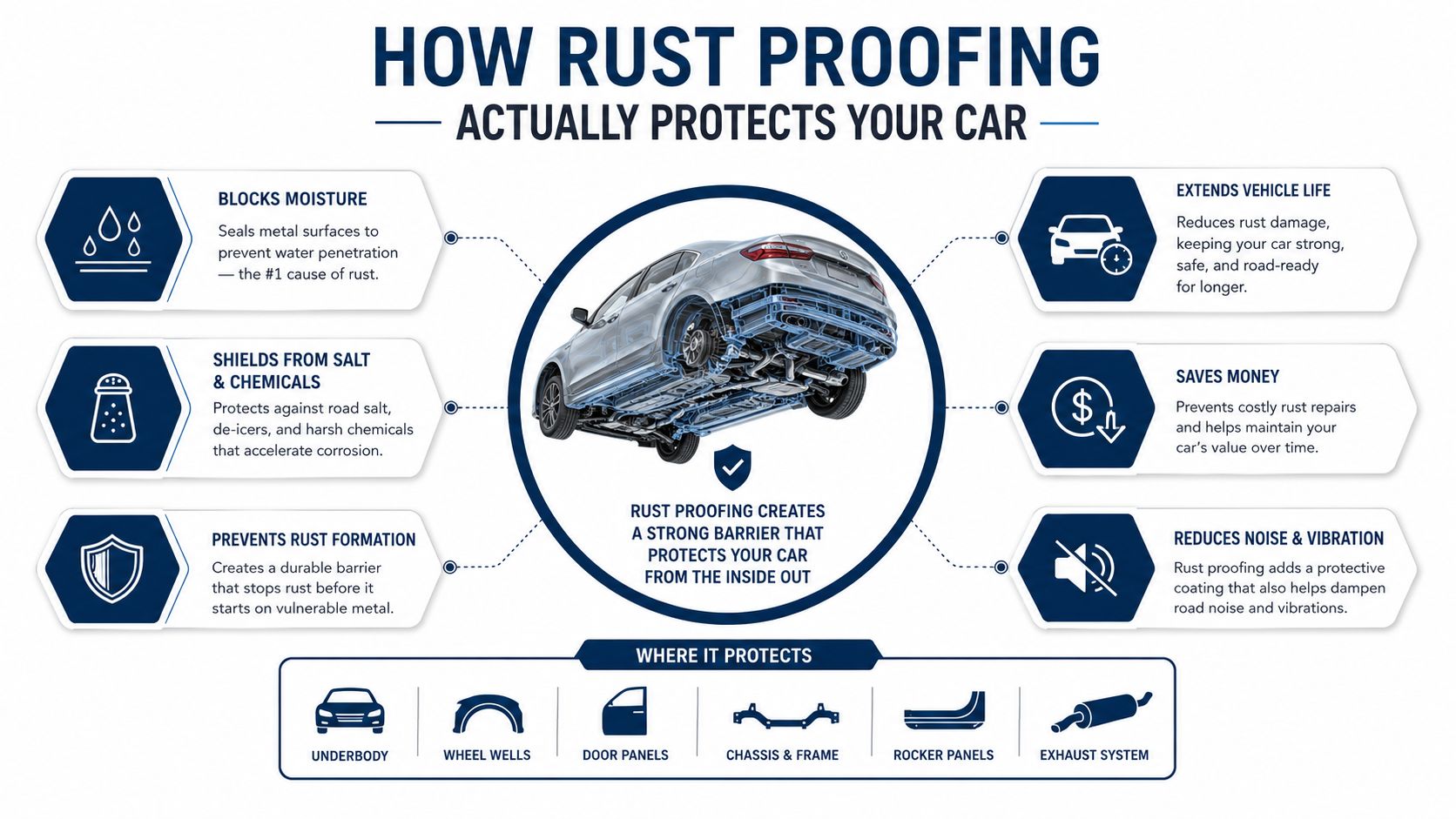
After a GTA snowstorm, the road can look merely wet. Underneath, melted snow mixed with salt can cling to seams, dirt, and the underbody. That salty moisture keeps metal exposed to oxygen, allowing corrosion to begin even when the car looks clean from the driver's seat.
Rust forms when metal, moisture, and oxygen interact. Ontario's winter brine makes the reaction more aggressive because it can remain in hidden areas after the snow has disappeared. Rust proofing works by placing a barrier between vulnerable metal and that mixture.
An oil-spray treatment works like sunscreen. It spreads across exposed metal, creeps into narrow spaces, and leaves a flexible protective film. The film is sacrificial, so road spray and grime wear against the coating before they reach the metal underneath. Because the film can move and flow, it suits areas where water may enter through small gaps.
A hard undercoat is closer to a raincoat. It creates a thicker shell that helps shield the underside from water, grit, and debris. That protection depends on preparation. If moisture is trapped underneath or the coating cracks, corrosion can continue out of sight.
Where the protection needs to reach
A visible coating on the underbody is only one part of the treatment. Rust prevention should also account for:
- Frame and cross-members: These areas receive salt spray, gravel, and standing moisture.
- Door and rocker cavities: Enclosed spaces can hold dampness that is hard to inspect from outside.
- Seams and joins: Water can collect where panels overlap or components meet.
- Exposed fasteners and brackets: Chipped protective finishes leave small metal parts vulnerable.
Professional application often uses access points and specialised spraying equipment to reach these locations evenly. A brush or household aerosol may cover open surfaces while missing cavities and recessed sections.
The key difference is an active, flexible barrier versus a hard shell. One creeps into spaces and moves with the surface, while the other provides a thicker shield.
Rust proofing does not repair structural corrosion, replace damaged metal, or restore neglected surfaces. It protects sound metal and can limit further exposure when the vehicle is suitable for treatment. A responsible shop should inspect the vehicle's condition before promising a result.
Over five to ten years of Ontario ownership, that distinction affects the annual lifecycle cost. A yearly oil spray may require repeated visits, while a one-time undercoating can need repairs or additional attention if its shell cracks. Understanding the application, coverage, and renewal pattern is what turns a quote into a comparison you can judge.
What Rust Proofing Typically Costs in the GTA
A GTA winter can turn a simple quote into a longer ownership calculation. Salt, slush, and repeated washing wear down protection, so the useful question is not only “What does today's application cost?” It is “What will this protection cost each year I keep the car?”
For a single professional treatment, vehicle size is a practical starting point. Nanak Car Wash publishes size-based pricing of approximately CAD 119.95 to CAD 149.95 plus tax in its Nanak rust proofing service information. Larger vehicles generally need more product and more time around the wheels, underbody, and other exposed components.
A quick GTA pricing reference
| Vehicle Type | Nanak Car Wash Price Range | Broader Canadian Market Range |
|---|---|---|
| Standard or smaller car | CAD 119.95 to CAD 149.95 plus tax | About CAD 130 to CAD 150 |
| Larger car or SUV | Size-based pricing within the published range | About CAD 150 to CAD 170 |
| Pickup or larger utility vehicle | Size-based pricing, commonly toward the upper end | About CAD 150 to CAD 170 |
Use the table for budgeting, not as a guaranteed shop quote. Two treatments with similar labels can cover different areas, use different materials, and follow different return schedules. Ask whether the price includes inspection, access to enclosed areas, and advice about the next application.
Annual spending changes the comparison
Oil-spray protection is commonly sold as a recurring service. An Ontario guide describes annual rust protection around CAD 145 to CAD 175 and explains why repeat treatments may be part of the maintenance plan. That pattern matters because the first invoice shows only one slice of the cost.
For example, three annual oil sprays at CAD 150 total about CAD 450 over five years. That may be less than many one-time undercoating quotes, even before considering future inspection or repair needs. Over five to ten years, yearly service can therefore be the lower lifecycle cost when the vehicle remains suitable and the owner follows the recommended schedule.
A one-time coating changes the timing rather than removing the cost question. Public Canadian pricing places dealer-style undercoating around CAD 500 to CAD 1,500 as a one-time service, while some premium packages reach CAD 800 or more, according to CarMedics Autowerks' Ontario cost discussion.
Before comparing quotes, confirm three details:
- Which areas are included?
- What product or coverage method is being used?
- When should the vehicle return for inspection or reapplication?
A low upfront price may become less attractive if it requires frequent correction, while a higher initial quote may make sense only when its preparation, coverage, and upkeep are clearly explained. In salty Ontario winters, annual lifecycle cost gives the quote its proper context.
Understanding Different Rust Proofing Coverage Types
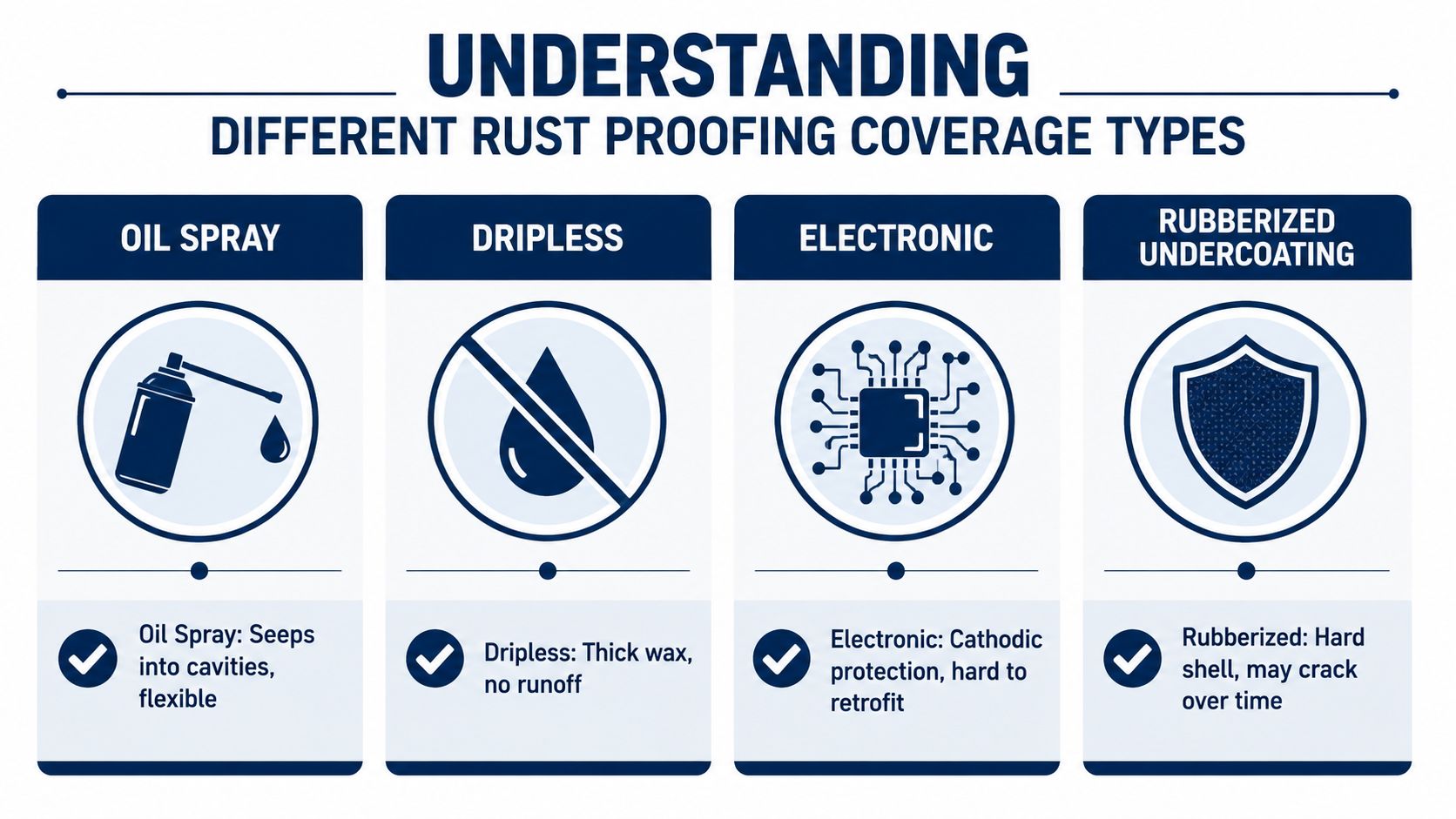
The label on a quote can hide important differences. “Rust proofing,” “undercoating,” “dripless,” and “electronic protection” don't all describe the same mechanism or coverage pattern.
Oil spray is the familiar annual option in salty climates. The product remains flexible, can move into seams and cavities, and is intended to keep a protective film active on exposed metal. Its trade-off is that the vehicle usually needs repeat attention because road spray and washing gradually reduce the coating.
Dripless treatment generally uses a thicker wax-like material designed to stay in place rather than run after application. It may feel neater for owners who dislike visible runoff, but the key question remains whether the material reaches enclosed cavities and whether the shop explains its maintenance interval.
Electronic protection uses an electrical approach rather than a sprayed film. It can be difficult to retrofit effectively, and it shouldn't be treated as an automatic substitute for physical coverage on exposed, salty surfaces.
Rubberized undercoating forms a harder shell. It can help resist impact from debris, but hard coatings bring a different inspection and maintenance conversation. If the surface cracks or preparation was incomplete, the owner needs to know how the shop will identify and address problems.
Match the method to the vehicle
A daily commuter on the 401 often benefits from a system designed for repeated salt exposure and access to hidden cavities. A weekend classic may need a more careful inspection-led approach, especially if its underside already has old coatings or surface corrosion.
| Coverage type | Main strength | Main question to ask |
|---|---|---|
| Oil spray | Flexible film and cavity reach | What is the recommended reapplication schedule? |
| Dripless | Thicker, cleaner application | Does it cover enclosed seams and access points? |
| Electronic | No sprayed coating on the surface | How is the system fitted and maintained? |
| Rubberized undercoating | Harder impact-resistant shell | How are cracks and trapped moisture inspected? |
The cheapest label can create the wrong expectation. An owner may choose a hard shell expecting no future maintenance, then discover that inspection and repair planning still matter. Another may choose an oil spray expecting a permanent coating, even though the system is designed around repeat application.
The best quote describes where the product goes, how it behaves, and when it needs attention. Coverage matters more than marketing language.
Key Factors That Affect Your Final Rust Proofing Price
A salt-covered GTA commuter may receive a higher quote than a lightly driven sedan, even when both look similar from the outside. The difference usually comes from vehicle size, access, preparation, coverage, and the time needed to apply the product properly. Price becomes easier to judge when you connect it to the vehicle's winter use and expected ownership period.
Vehicle size and complexity
A small sedan has less underside to cover than a full-size pickup or SUV. Larger vehicles may also include more frame sections, wheel-well surfaces, cavities, and awkward access points. A long-wheelbase van or heavily equipped truck can require more preparation and product than a compact hatchback.
Over five to ten winters, a clear application schedule can matter more than a low first-year quote. Ask whether the price follows a vehicle-size tier and whether the quote identifies your vehicle category.
Coverage type and thoroughness
A quick spray over visible metal does not provide the same scope as treatment that reaches cavity openings, seams, frame areas, and exposed underbody components. Product choice also affects application time and future maintenance.
Ask: Which areas receive treatment, and which areas are intentionally excluded?
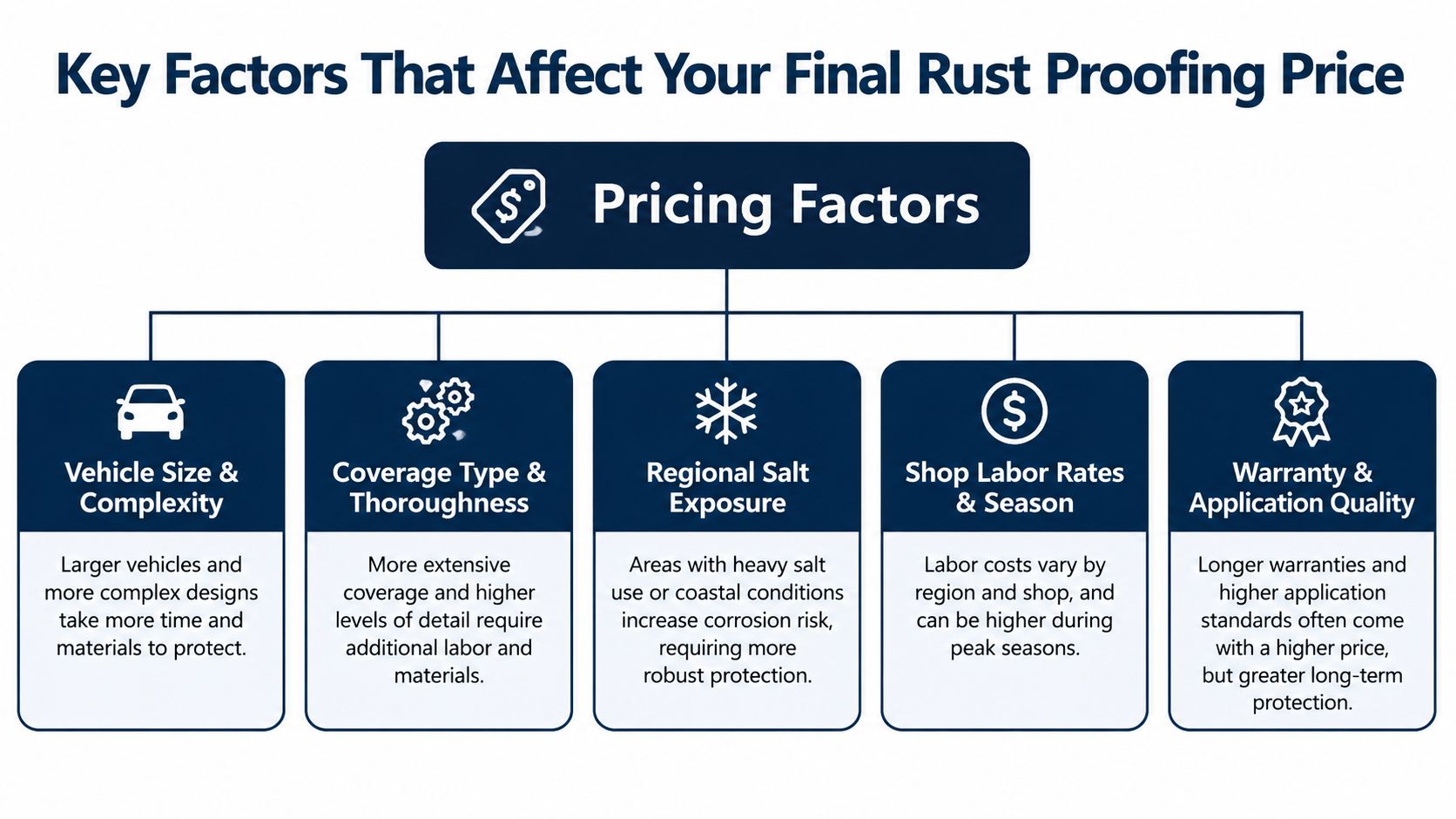
Salt exposure and mileage
A driver making short local trips still encounters winter brine. A high-mileage commuter adds more road spray, grit, and stone impact. Fleet vehicles, delivery cars, and ride-hail vehicles face these conditions repeatedly, so a recurring inspection plan may provide better long-term value than treating rust proofing as a one-time purchase.
Chloride-rich brine can continue affecting exposed metal after snowfall. That makes the protection schedule part of the price decision. Annual or semi-annual service may cost more over one winter, but repeated oil applications can spread spending across the ownership period and suit a vehicle that faces salty routes each season.
Ask: Does the recommended interval reflect my mileage, parking situation, and winter route?
Vehicle condition and preparation
A newer vehicle may need less preparation than one with old undercoating, dirt buildup, or visible surface rust. Cleaning, drying, inspection, or work around existing damage can add labour. Spraying over contamination will not produce the same result as treating a prepared surface.
Ask: What preparation is included, and will someone inspect the underside before application?
Shop expertise and warranty
Application quality affects whether the product reaches intended areas without covering drain holes, brake components, exhaust parts, or other components that must remain clear. Warranty terms also vary. A repeat-treatment promise may depend on continued ownership or a specific schedule, so read the conditions before comparing totals.
Ask: What does the warranty cover, and what must I do to keep it valid?
A useful quote makes the scope easy to find. Compare the expected yearly cost, not only the first visit. A lower one-time undercoating price may look attractive, while yearly oil spray may better suit salty Ontario winters across five to ten years of ownership.
DIY Versus Professional Rust Proofing Value Compared
A GTA commuter can spend a Saturday preparing the driveway, raising the vehicle, and spraying each accessible area. That hands-on route may suit an owner with a safe workspace, suitable equipment, and patience. It also removes shop labour from the bill and lets you choose the product and timing.
The trade-off is coverage. From the ground, a DIY application may reach broad surfaces while missing enclosed cavities, seams, and sections hidden behind components. Overspray, cleanup, and keeping product away from brake parts, exhaust components, and drain holes add work. A consumer aerosol kit can be inexpensive compared with a shop visit, but its label price does not include your labour or access equipment.
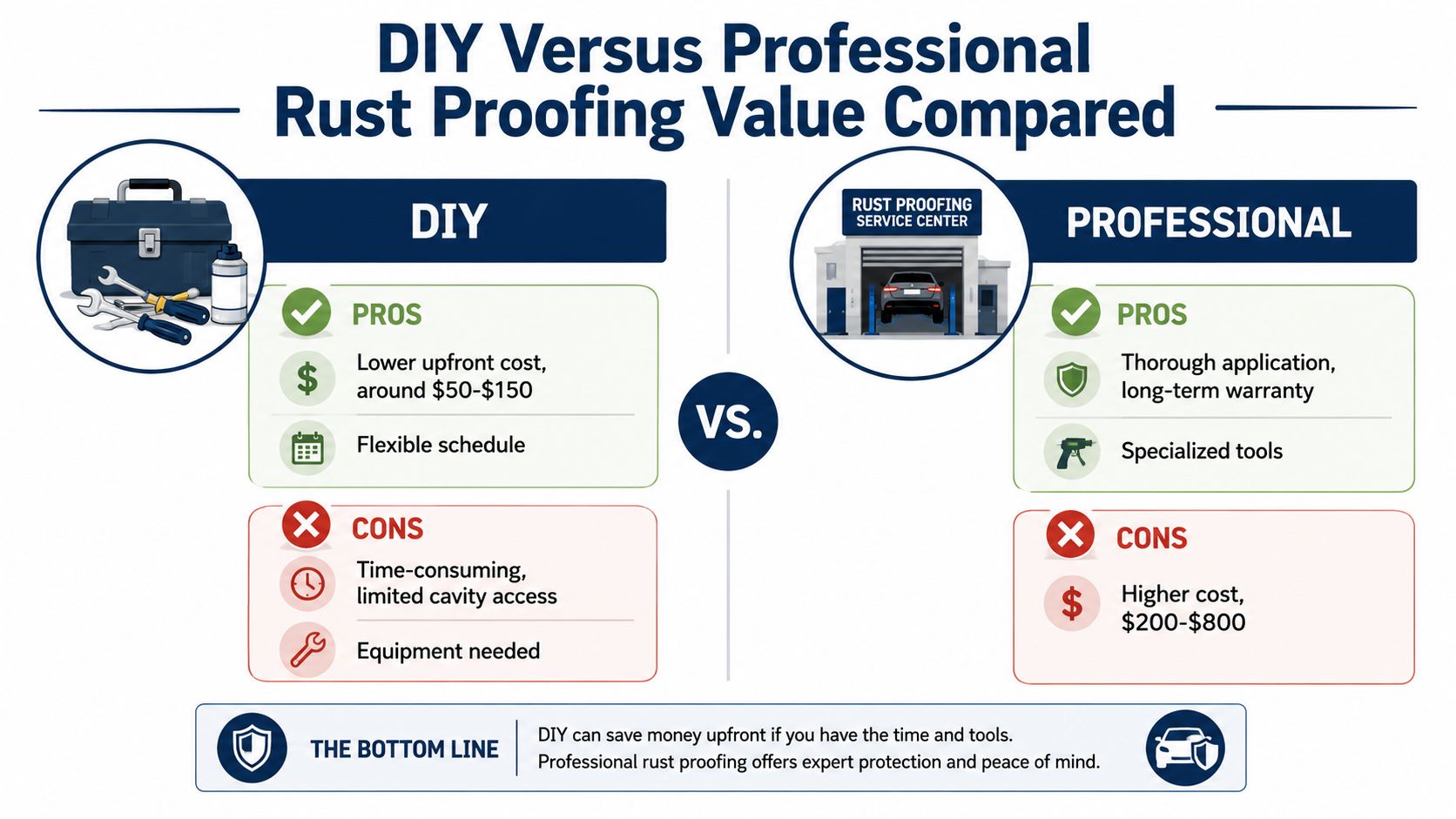
A professional shop brings lift access, application equipment, and a repeatable process. The technician can inspect the underside more easily and spread the material consistently, although the quality still depends on the shop's preparation and coverage. Ask what areas are treated before comparing the invoice.
Compare the ownership effort, not only the product
DIY work often means several hours of cleaning, lifting, spraying, and allowing the coating to settle. A professional visit transfers that effort to trained staff and makes yearly scheduling easier. For a commuter whose vehicle earns income, avoiding driveway preparation has practical value.
Over five to ten winters, compare the full ownership pattern rather than one container or one appointment. Yearly oil spray can spread the cost across salty Ontario winters, while a one-time undercoat may require a larger upfront payment and later inspection. The better value depends on whether you prioritise repeated coverage, long-term ownership, or doing the work yourself.
DIY suits an owner who enjoys the job and can safely reach the required areas. Professional treatment becomes more useful when the vehicle is driven heavily, the underside is difficult to access, or consistent service records matter.
Value is the combination of coverage, time, access, and repeatability. A low shelf price measures only the product, not the protection routine.
Deciding When Rust Proofing Is Worth the Investment
A GTA driver planning six more winters with an SUV might spend about CAD 960 on yearly oil spraying at CAD 160 per year. That total should be weighed against the vehicle's resale value and the cost of visible rust. Over five to ten winters, an annual service can spread protection across each salty season, while one-time undercoating places more cost upfront and may still require inspection.
Rust proofing generally makes more sense when you will keep the vehicle for several winters, drive often on salted roads, or own a model with a broad exposed underbody. Be more cautious if serious corrosion is already present, you plan to sell soon, or the shop cannot explain what its treatment covers.
Ask four questions before choosing:
- How long will I keep it? Preventive maintenance has more time to provide value during longer ownership.
- How much winter exposure does it receive? Daily commuting and outdoor parking call for a dependable protection routine.
- What is its current condition? Start with an honest inspection. Rust proofing will not erase existing damage.
- What does the quote include? Confirm the vehicle size, treated areas, preparation, renewal schedule, and warranty terms.
SUV, pickup, fleet, and high-mileage owners should compare the treatment with their full ownership plan, not just the appointment total. The better option depends on whether you value repeated coverage, lower driveway effort, long-term ownership, or resale condition.
Nanak Car Wash has operated since 2004 and offers size-based rust proofing at GTA locations, along with washing and detailing. Pairing salt removal with a protection appointment may be convenient, but ask for the same coverage and preparation details you would request from any provider.

Before booking, confirm the product, included areas, preparation steps, recommended return interval, and warranty conditions. After treatment, washing and underbody rinsing remove salt and road film. Rust proofing works best as part of that routine, not as a replacement for cleaning.
For a GTA vehicle facing salty roads each winter, ask Nanak Car Wash for a size-based quote and confirm exactly what the application covers and when renewal is recommended. Visit Nanak Car Wash to find a location and pair corrosion protection with regular washing.

 6600 Finch Ave W, Etobicoke, ON M9V 3Z6
 647-703-8515
 MON – SUN 8 AM to 7 PM