
March in the GTA does something unkind to car owners. The sun finally appears, you pull into a station, the canopy lights rake across the hood, and there it is: a chalky grey film of dried brine, a spider web of fine swirls, and one scratch you'd swear wasn't there in November. You think a polish will sort all of it out.
Sometimes it will. Sometimes it absolutely won't, and your money belongs with touch-up paint or a rust proofing appointment instead.
I'd rather tell you which defects a polish erases than sell you a three-stage correction for a scratch that needs paint. So here's the whole subject sorted the way a detailer sorts it, by depth. Once you know how deep a mark sits, the rest of the decision makes itself.
Table of Contents
- Which Paint Problems a Polish Can Fix
- Winter Salt and Why Polish Alone Falls Short
- What Happens During a Professional Polish
- Service Levels, Time and Price Compared
- Questions to Ask About Water and Runoff
- Keeping the Finish Between Visits
- Book the Polish Before Spring Salt Sets In
Which Paint Problems a Polish Can Fix
A polish is a fine abrasive paste. Think of it as liquid sandpaper with better manners. A machine pad works it against the clear coat, and the abrasives shave off a few microns of that top layer so the surface levels out and starts reflecting light in a straight line again. Anything living inside the clear coat can be flattened. Anything below it, in the colour layer, the primer or the steel, stays exactly where it is.
A polish doesn't add paint. It removes a very small, very controlled amount of it.
That single idea sorts every defect you'll find on a GTA car in March.
The quick sort, by depth
| Defect | What it looks like | Can a polish fix it? | What it needs |
|---|---|---|---|
| Road film and dust | Gritty, dull film after a drive | No, a wash removes it | Decontamination wash and clay bar |
| Light swirl marks | Fine circular lines visible in sunlight | Yes, usually | Finishing polish |
| Haze and oxidation | Chalky look on dark or older paint | Often, if the clear coat is intact | Compound, then finishing polish |
| Scratch that catches a fingernail | Fine line you can feel | Partly, deeper ones need touch-up | Inspection, then correction or repaint |
| Stone chip | Small pit down to primer or metal | No | Touch-up paint |
| Rust bubble | Raised paint with brown spots | No | Body repair, not polishing |
The fingernail test and the sunlight check
Run a fingernail lightly across the mark at right angles and trust your fingertip over your eyes. If the nail glides over, the scratch sits in the clear coat and a polish has a real chance. If it clicks or catches, the damage has gone deeper than the clear coat, and no pad will pull it back.
Then do the sunlight check. Park so the sun rakes across the panel at a shallow angle, or use a bright inspection light, and look along the surface rather than straight at it. Swirl marks appear as a fine spider web, haze makes the paint look like it's holding its breath, a stone chip shows a small crater with a lighter ring, and a rust bubble sits proud with brown staining underneath.
Expectations should match the row. Light swirl marks usually disappear almost completely after a finishing polish. Haze and oxidation often improve a great deal when the clear coat is intact and there's enough film thickness to work with. A scratch that catches a fingernail typically improves only partway and stays visible at certain angles, so plan for a partial fix rather than a repair.
Ontario winters push that depth check from useful to routine. The BrokerLink guide to rust proofing in Canada notes that Ontario and Quebec account for more than half of Canada's road-salt use, which means GTA cars sit in brine for months and any exposed metal stays damp. Polishing that already-thinned paint, or a panel that has been cut hard two or three times before, can make the finish look worse rather than better, because clear coat doesn't grow back.
If you want to calibrate what a single machine stage can realistically achieve before you commit to a multi-stage job, this explanation of what one-step paint correction fixes is worth ten minutes. There are also cases where the honest answer is no polish at all: thin paint, a panel with nothing left to give, or a car where a protective coating would deliver more value per dollar.
Winter Salt and Why Polish Alone Falls Short
Salt doesn't just look bad on paint. It keeps working on the metal underneath long after the car looks clean.
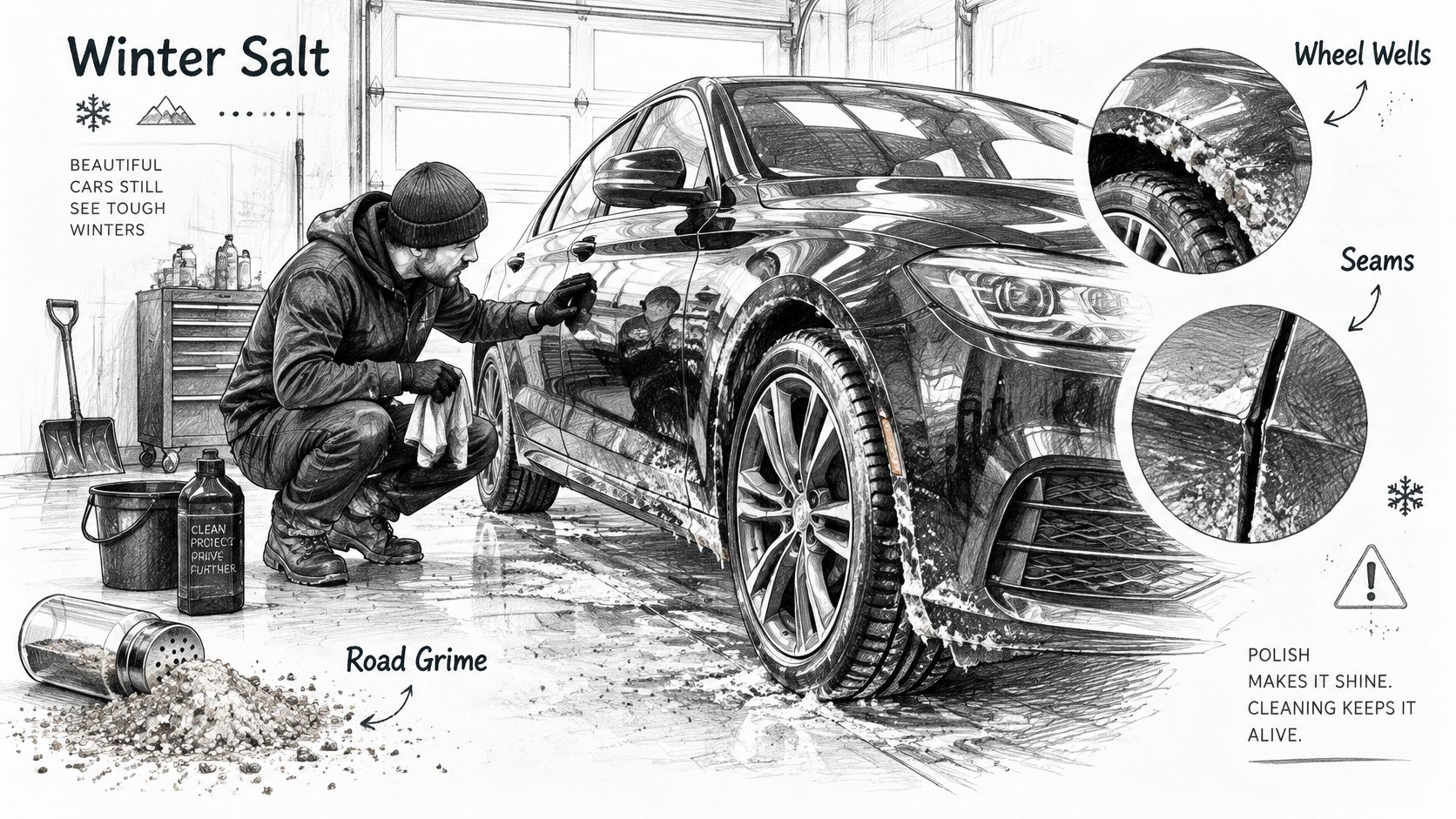
The volume explains why. During the 2023-2024 winter season, road organizations in Ontario used 1,679,395 tonnes of road salt across 104,187 kilometres of salted roads, plus 36,198,084 litres of liquid salt treatment and 791,365 tonnes of abrasives, according to a Nanak Car Wash guide to road salt and rust. Abrasives pit and contaminate the finish. Chloride settles where a sponge never reaches, in wheel wells, panel seams, rocker panels and the lip of the trunk, and stays damp there.
That guide also gathers the Canadian corrosion research worth knowing. De-icing salt doubled corrosion in the Toronto area compared with conditions without salt exposure, and in a Canadian vehicle-corrosion study, treated vehicles showed about 6.8 times less visible body-panel corrosion and 3.6 times less underbody corrosion than untreated ones.
Now the part most polishing pages skip. A polish improves the appearance of paint. Rust proofing targets vulnerable metal and underbody areas. They're different jobs on different materials, which is why a car polished faithfully every spring can still rot from inside a rocker panel.
The rule I'd use: polish when the paint is the problem, rust proof when the metal is exposed to salt, and do both for a car that lives on winter roads.
The two are priced separately for that reason. Our rust proofing starts at $119.95 for a small car, with pricing stepping up by vehicle size, and it's a distinct line item from any detailing package. Treating one as a substitute for the other is how people end up with a glossy hood and a soft floor pan.
One checkpoint before you book anything. After a heavy salting spell, rinse the wheel arches and underbody at a self-serve bay so the chloride isn't sitting there for another week, then let a shop handle the paint.
What Happens During a Professional Polish
Side light three months later is a harsh critic. A proper polish is a sequence, not one heroic pass with a spinning pad. Skip a stage and the finish shows the shortcut.
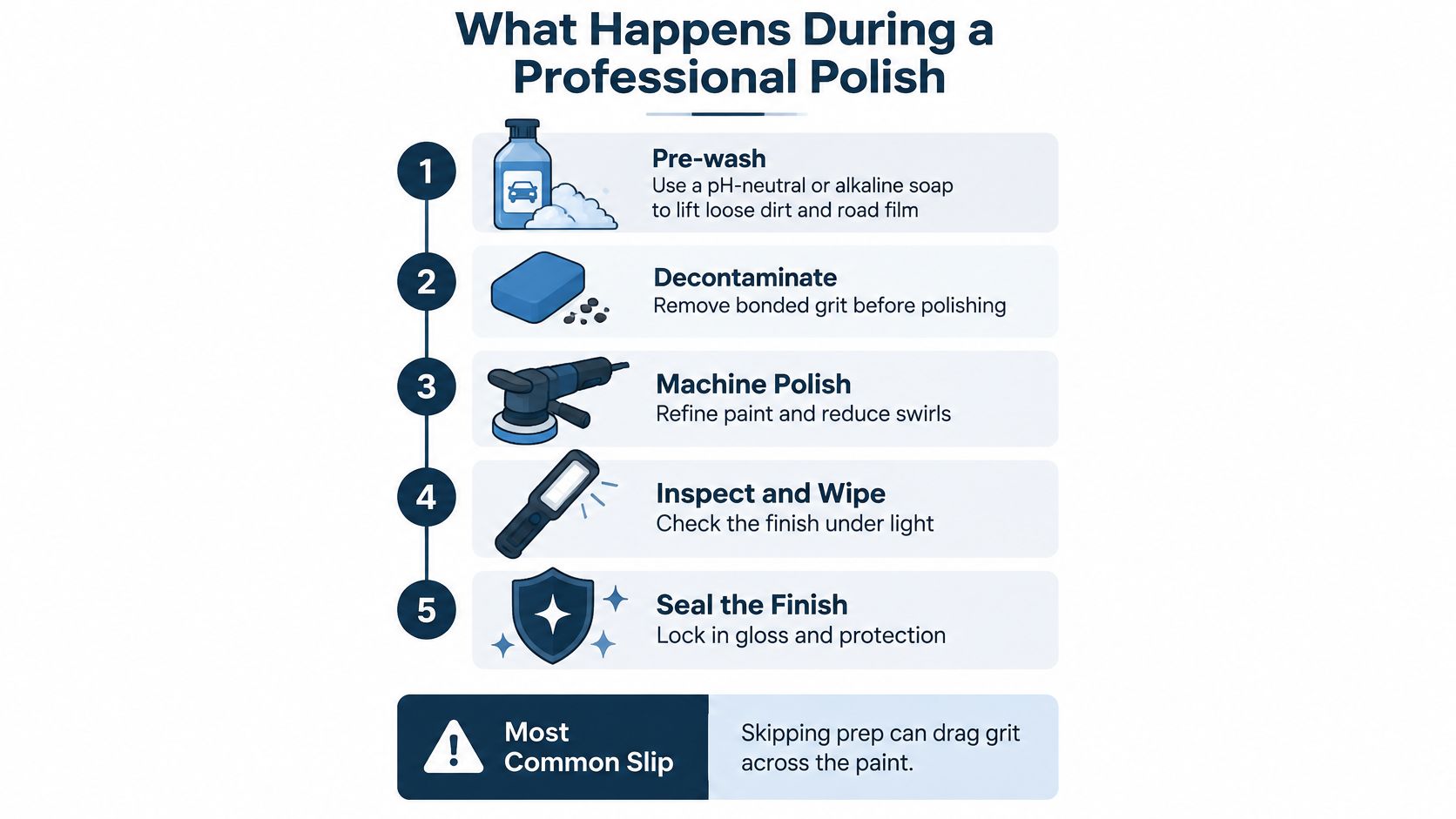
Each stage exists because the next one fails without it. Rush the wash and you polish dirt. Rush the refine and you leave holograms that only show up after dark.
Six steps, six reasons
- Pre-wash with a pH-neutral or alkaline soap. Loose dirt and road film need to leave before anything touches the paint. Dragging grit across a panel is the fastest way to add marks you will pay to remove later.
- Rinse lower panels, wheel wells and rocker panels properly. Salt crystals and packed grit sit low on the car, right where a pad can pick them up and drag them. The Transportation Research Board study of atmospheric corrosion measured corrosion in Toronto at 5,108 mg/dm² over 19 months and noted that chloride retained on chips, seams and arches forms a conductive electrolyte that speeds oxidation of exposed steel. For the polish itself, that same residue is an abrasive you do not want on the pad.
- Decontaminate with iron remover and a clay bar. Bonded contamination stops a polish from cutting evenly, because the pad skates across grit instead of levelling paint. A baggie test after washing tells you whether the surface still has texture. If the paint feels like fine sandpaper through the plastic, it is not ready.
- Inspect under a bright light and mark every defect. Depth decides the pad, the compound and the number of stages. Polishing first and inspecting afterwards is the most common order-of-operations mistake in the trade. A light scratch and a deep one do not want the same cut.
- Compound where needed, then finishing polish. Each stage removes less than the one before, which is how you go from a coarse cut to a mirror without haze. Pad and abrasive selection carry as much weight as the liquid in the bottle. A firm pad with a heavy compound and a soft pad with a fine polish are different jobs, chosen the way accessories for smoothing and finishing surfaces are chosen by grit, not by the label on the bottle.
- Apply wax or sealant. Bare clear coat is open to salt and UV the moment you stop, so protection is the last step of the job.
Polishing before the salt is gone drags abrasive contaminants across the clear coat and adds fresh micro-marring. A salt-focused pre-treatment and lower-panel rinse belong in the written specification, not on an optional extras list.
What to ask for, and what a finished panel looks like
Nanak Car Wash's Shine & Protect package includes machine buffing and polishing. Detailing at the shop is done by hand, so trim, badges, panel gaps and the tight areas near glass get attention a machine cannot reach.
A finished panel has an even reflection across its whole width, no holograms or buffer trails when you look along it in side light, and clean seams with no white residue dried into them. Faint arcs under a streetlight a week later mean the refine stage was rushed. I would rather pay for a slower second pass than live with those arcs until the next correction.
Service Levels, Time and Price Compared
Four levels, four distinct jobs. Matching the level to the defect is the whole skill of quoting.
| Service level | What it includes | Typical time |
|---|---|---|
| Decontamination wash | Pre-wash, iron and tar removal, clay bar | About 1 to 2 hours |
| Single-stage polish | Light polish with wax or sealant | About 2 to 4 hours |
| Two-stage correction | Compound, finishing polish, protection | About 6 to 10 hours |
| Full paint correction | Multi-stage defect removal, inspection, protection | 1 to 3 days |
Time depends on three things: how many panels need work, how deep the defects run, and how much painted surface the vehicle carries. Size isn't a sales trick. Statistics Canada reported 24.6 million light-duty vehicles registered in Canada in 2024, 91.6% of all registrations, and multipurpose vehicles have now outsold passenger cars for four consecutive years, with the passenger car share falling from 45.0% to 33.3%, according to the Statistics Canada vehicle registration release. More SUVs, vans and pickups in GTA driveways means more roof to reach, more painted area to work and more machine hours per car.
Concrete reference points help. Our $120 detailing package runs 3 to 4 hours and is listed with a saving of $65. SUVs, vans and pickups carry an extra charge, and pet hair removal or heavier soiling costs more again, because those jobs take longer and consume more product. The limited-time special at $99 includes one free exterior wash, which shifts the maths on a maintenance clean but doesn't turn a single-stage polish into a correction.
Ask for this in writing: which service level is included, whether the price changes with vehicle size, whether protection is part of the job, and what the time estimate assumes about condition.
A quote given without anyone looking at the paint is a guess, and guesses get revised once the car is in the bay.
Questions to Ask About Water and Runoff
Polishing has an environmental cost that most service pages leave out, and it's fair to ask about it at the counter.
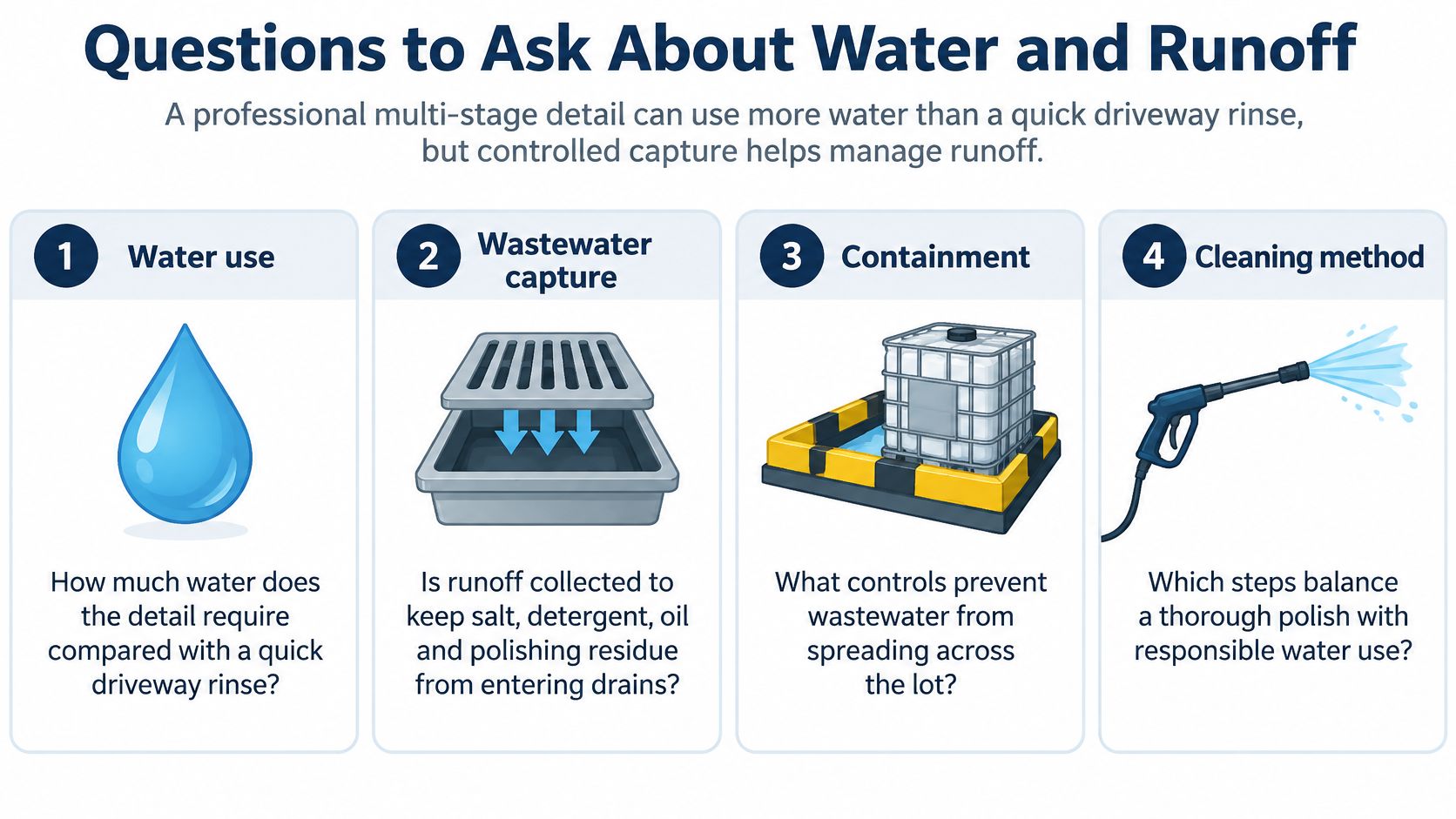
Canadian car wash operations can use 38 to 50 or more gallons of water per vehicle, water-reclamation systems can cut usage by up to 90%, and closed-loop systems recycle nearly all wash water, per Canadian industry reporting on car wash operations and environmental focus. Ontario holds the highest concentration of car wash operations in the country, so GTA drivers have more choice here than most.
The honest trade-off is that a multi-stage detail can use more water than a quick driveway rinse, yet captured and treated wastewater keeps salt, detergent, oil and polishing residue out of storm drains. The important question isn't professional versus do-it-yourself. It's managed water use versus uncontrolled runoff down the gutter on your street.
We use 100% fresh water for washes, which answers the fresh-versus-reclaimed question but says nothing about where the water goes afterwards, so ask that separately. Our soaps and waxes are made for automotive surfaces, and any provider should be able to name the products it puts on your paint.
What to ask at the counter
- Fresh or reclaimed water? Both can be responsible choices, but you should know which you're paying for.
- How does wastewater leave the site? A capture tank, a treatment connection or a storm drain are three very different answers.
- Do the drains on the lot reach storm sewers? If nobody can tell you, assume the worst and choose elsewhere.
Keeping the Finish Between Visits
A polish removes a layer, so the result lasts exactly as long as whatever protection sits on top of it. Maintenance is cheaper than restoration, every time.
The maintenance rhythm
- Winter rinses: every one to two weeks, and after any heavy salting, focusing on arches and lower panels.
- Washes: pH-neutral shampoo, top down, with a clean mitt and a second bucket for rinse water.
- Protection: reapply sealant or wax on the schedule its label states, not on a hunch about how shiny it still looks.
- Quarterly check: look along the panels in daylight and note anything new.
Some habits undo a good polish. Automatic brush washes carry grit from the car ahead, drying with a dirty towel grinds that grit into fresh clear coat, and parking under trees that drop sap or berries turns a finish into a sticky mess that gets wiped off too late.
Two-minute check: after a wash, stand at the front corner and look along the hood in direct sun. If the reflection is sharp and the water pulled into tight beads, the protection is still working.
When water stops beading and starts sheeting, when light swirls return, or when the paint looks dull straight after a wash, that's your signal. As a rough guide, a well-protected car may need a light polish once or twice a year, while a car parked outside through every Ontario winter may need correction sooner.
Book the Polish Before Spring Salt Sets In
Late winter and early spring are the right window. The last serious salting has passed, the roads have stopped spraying brine, and the grime hasn't yet baked onto the finish in the first warm week.
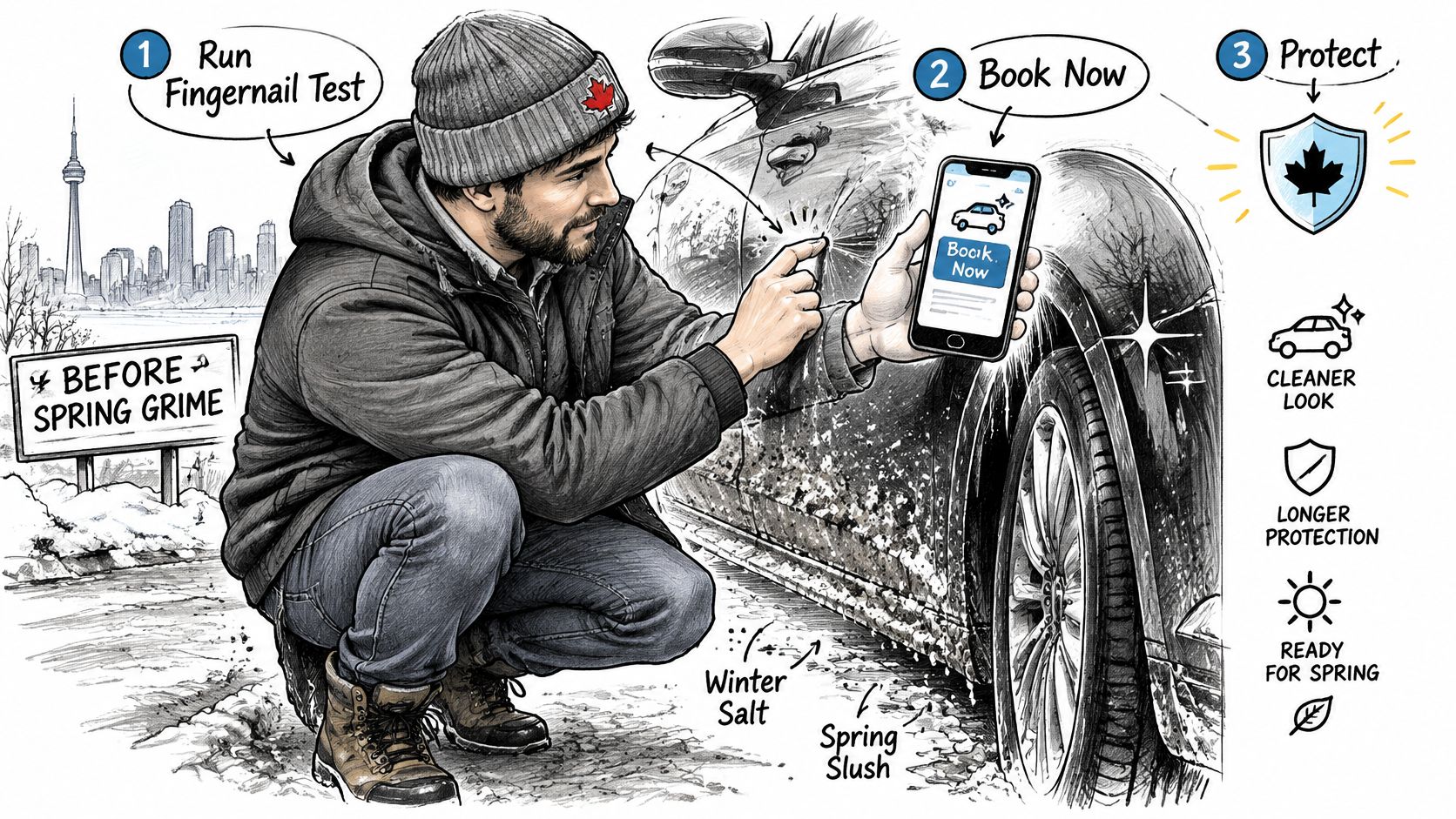
Run the fingernail and sunlight checks on one panel. Then pick the service level that matches the deepest defect you found, not the shiniest package on the menu. If the car has spent the winter on salted roads and you can see brown staining at a wheel arch or a rocker panel, add rust proofing to the booking rather than hoping a polish covers it.
Appointments are taken online or by calling 416-749-0202, and it's worth asking whether a current special suits the size of your vehicle before you confirm. Get the price in writing and have any SUV, van, truck or pet hair surcharge stated before the car goes into the bay. Nobody enjoys a total that grows while they wait.
This week's action is small. Photograph each panel in daylight, list what you see against the defect table, and book with that list in hand. A shop can work far more precisely from "hood has swirls, driver door has a scratch I can feel, rear arch has a bubble" than from "make it look new".
Nanak Car Wash handles the parts of this that need a machine, a lift and a proper rinse sequence, from a single-stage polish on a daily driver to rust proofing for the car that lives outdoors all winter. Across our Greater Toronto Area locations we run exterior and full-service washes, interior and exterior detailing, and rust protection, so the salt comes off the paint and the underbody in the same visit. Book a detailing appointment at Nanak Car Wash online or by phone, and bring your defect list with you.


 6600 Finch Ave W, Etobicoke, ON M9V 3Z6

 647-703-8515
 MON – SUN 8 AM to 7 PM