
You pull into the driveway after a GTA commute and see the familiar winter film: grey salt spray along the doors, gritty wheels, and a pale crust tucked behind the licence plate. A quick rinse might improve the appearance, but it may leave the most important contamination underneath the vehicle. That's why understanding a Crystal Clean Car Wash visit means looking beyond shine. Each stage has a job, from loosening abrasive grit on the paint to flushing chloride-rich brine from the underbody.
Ontario gives drivers a practical reason to wash regularly. The province uses roughly 1.5 to 3 million tonnes of road salt each winter, while Toronto alone uses about 130,000 to 150,000 tonnes annually, according to this Ontario road-salt and rust overview. The right service isn't necessarily the most expensive one. It's the one that matches where your car spends its time, how much salt it collects, and whether the dirt is on the paint, below the doors, or inside the cabin.
Table of Contents
- What Happens During a Crystal Clean Car Wash Visit
- Express vs Full-Service Washes and Which One You Actually Need
- Underbody Rinse, Waxes and Science-Backed Rust Defence
- Detailing Beyond the Wash Line
- One-Time Wash, Prepaid Bundle or Unlimited Monthly Pass
- Choosing the Right Wash Plan for Your Driving Life
- Common Questions GTA Drivers Ask Before They Book
What Happens During a Crystal Clean Car Wash Visit
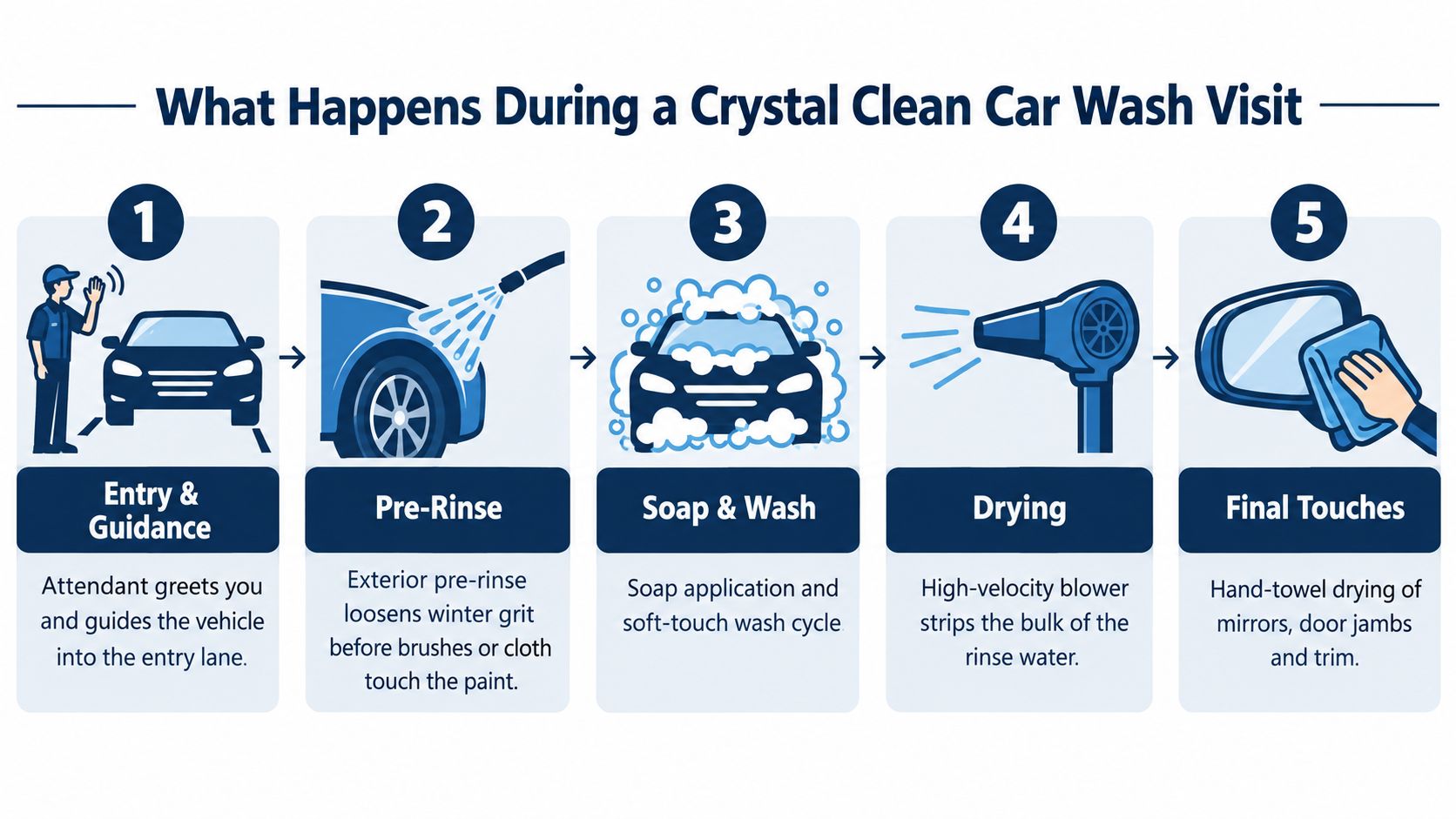
The wash starts before the vehicle enters the tunnel. An attendant greets you, confirms the selected service, and guides the tires into the entry lane. That positioning matters because the conveyor and wash equipment need the vehicle centred before the first spray reaches the body.
A pre-rinse follows. Water loosens winter grit, road film, and loose salt before brushes or cloth mitters contact the paint. Think of it as removing the material most likely to drag across the clear coat. It won't remove every bonded contaminant, but it reduces the loose abrasive load.
The chemistry does different jobs
The tunnel sequence usually combines more than one cleaning solution:
- High-pH presoak helps break down greasy road film and traffic grime.
- Low-pH soap targets mineral deposits and other alkaline residue.
- Brushes or cloth mitters provide the physical agitation needed to lift softened soil.
- Wheel cleaner works on brake dust and grime concentrated around rims and spokes.
- Spot-free rinse removes remaining soap and reduces mineral spotting as the vehicle dries.
The chemistry isn't there for decoration. A soap loosens contamination, while the moving wash material carries it away. Neither stage replaces a careful detail, but together they handle the routine dirt that accumulates between deeper cleanings.
After the rinse, high-velocity blowers strip away much of the surface water. Staff may then hand-dry mirrors, trim, door jambs, and other areas where water collects. A towel-down or air blow around door seams is especially useful in winter, since trapped moisture can freeze after you leave.
Practical rule: A tunnel wash removes surface contamination efficiently. It won't correct scratches, extract embedded stains, or replace a paint-safe detailing process.
You drive away with a cleaner exterior, drier seams, and a better view of what still needs attention. That last part is useful. Once salt film disappears, you can spot chipped paint, damaged trim, or early corrosion before those issues hide beneath another layer of grime.
Express vs Full-Service Washes and Which One You Actually Need
The simplest choice is about what happens while the vehicle is being washed. An express tunnel wash keeps the visit focused on the exterior, and you generally remain in the vehicle as it moves through the equipment. A full-service wash adds staff time inside the cabin, with vacuuming, dash and glass cleaning, and other hand-finished touches.
Express suits the driver who needs a quick reset before work, school pickup, or an evening appointment. It's also practical for a commuter who washes regularly and doesn't need interior attention every visit. Full service makes more sense when floor mats are gritty, the dashboard has collected dust, or passengers have left crumbs and marks behind.
| Feature | Express Tunnel | Full-Service |
|---|---|---|
| Main purpose | Fast exterior cleaning | Exterior wash plus interior cleaning |
| Customer routine | Stay with the vehicle through the wash process | Leave the vehicle with the service team |
| Exterior finish | Presoak, soap, rinse, drying and selected protection options | Exterior wash with additional hand-finished work |
| Interior work | Usually limited or self-serve, depending on location | Vacuuming, dash, windows and other selected interior tasks |
| Best match | Busy commuters and frequent maintenance washing | Families, rideshare drivers and vehicles needing a cabin reset |
| Price driver | Equipment and selected wash upgrades | Added labour and interior service |
A rideshare driver may choose express after a day of road grime, then book full service when passenger traffic has affected the interior. A parent hauling sports equipment may get more value from full service because the cabin, not just the paint, is the problem.
Pricing for a Crystal Clean Car Wash reflects that labour difference. Exterior equipment can process vehicles consistently, while interior cleaning depends on staff time and the condition of each cabin. Large vehicles, pet hair, heavy staining, and accumulated debris can also change the work involved, so ask how the location handles size or condition-based charges before selecting a package.
The useful question isn't “Which wash is better?” Ask, “What needs cleaning today?” If the answer is salt on the lower panels, choose an exterior service with the relevant rinse options. If the answer is sand in the carpets and fingerprints on the glass, full service earns its place.
Underbody Rinse, Waxes and Science-Backed Rust Defence
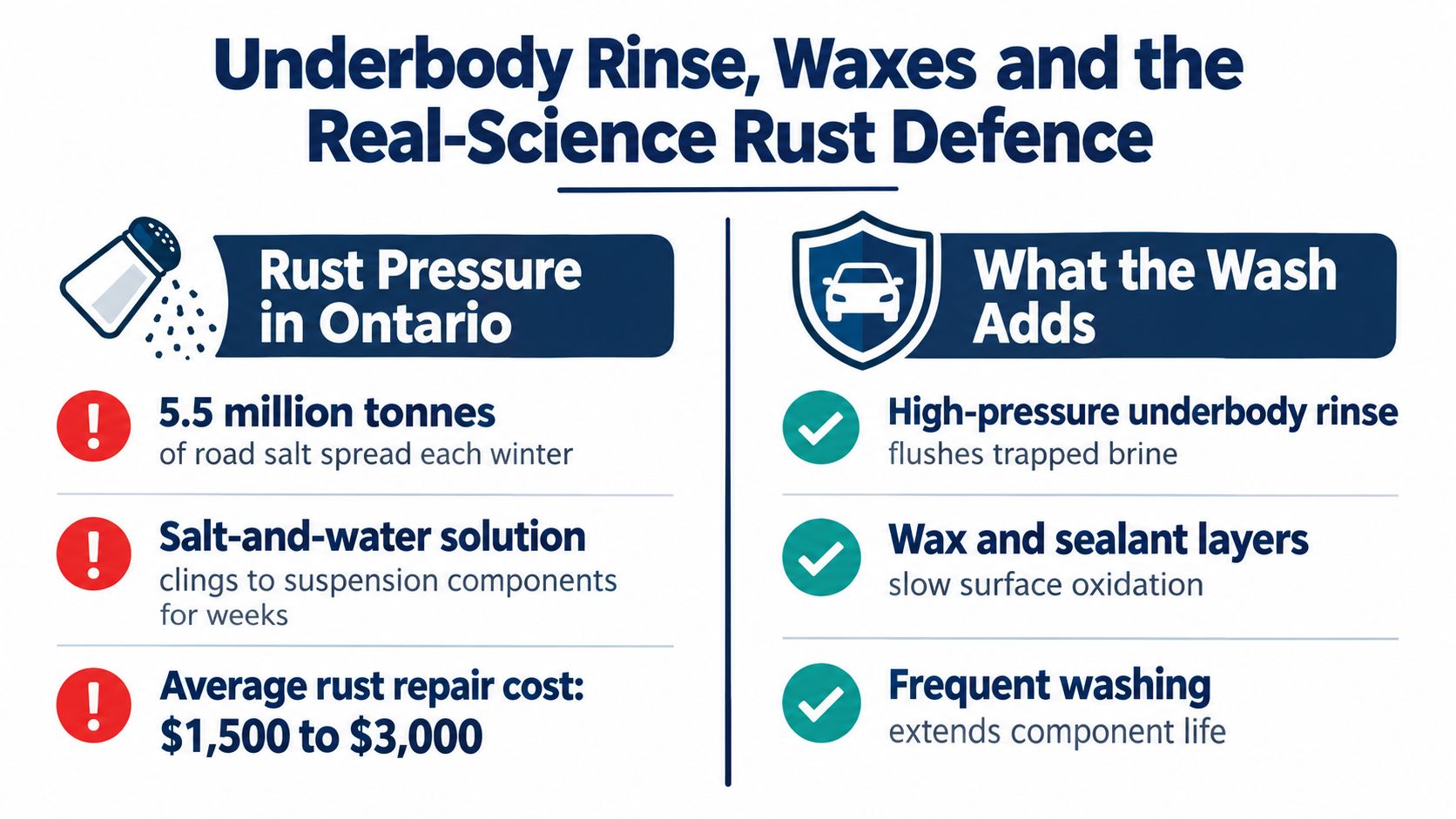
After a salted GTA commute, the paint may look merely dusty while the underbody carries wet brine. Freeze-thaw cycles keep chloride-rich residue active, allowing it to reach suspension components, frame rails, fasteners, brake areas, and seams that a side spray may miss.
Underbody cleaning therefore protects more than appearance. Corrosion research summaries attribute about 50% of vehicle corrosion to road salts, as described in this underbody rust-protection explanation. A University of Windsor engineering study cited in the Ontario rust overview found that untreated vehicles showed 6.8 times more visible body-panel corrosion and 3.6 times more underbody corrosion than treated vehicles.
Match each add-on to the threat
An underbody rinse directs water beneath the vehicle to flush brine from suspension parts and other exposed surfaces. One visit cannot remove salt picked up on the next drive, so repeat rinsing during salt season makes more sense for vehicles using salted arterials, wet parking garages, or short routes where residue stays on the car.
Wax and sealant address the painted exterior instead. Their protective film helps water and grime release more easily, reducing direct contact with exposed panels. Wax does not repair stone chips or stop corrosion inside a structural cavity, but it can make routine cleaning easier and help the finish shed winter contamination.
Rust proofing serves another purpose. An oil-based or creeping compound can enter seams and sheltered metal surfaces that wash products are not designed to protect. It is a longer-term treatment, applied separately rather than automatically by a rinse cycle.
GTA driving reality: If your route includes salted arterials, parking garages with wet slush, or frequent short trips, the underbody may deserve more attention than another layer of shine on the hood.
Water use also belongs in the comparison. Natural Resources Canada has cited commercial car washes using about 260 litres of heated water per vehicle on average, while efficient operations are often benchmarked below 151.5 litres, and recycling systems can bring use under 30 litres per vehicle, according to this commercial wash water-use guide. A professional wash may use water efficiently, but heated water still involves energy. Compare the full service and its rinse method instead of assuming every commercial wash has the same environmental impact.
Detailing Beyond the Wash Line
A standard wash is a maintenance visit. Detailing is a reset. The difference shows up in time, hand technique, and the products used to deal with contamination that ordinary tunnel chemistry can't remove.
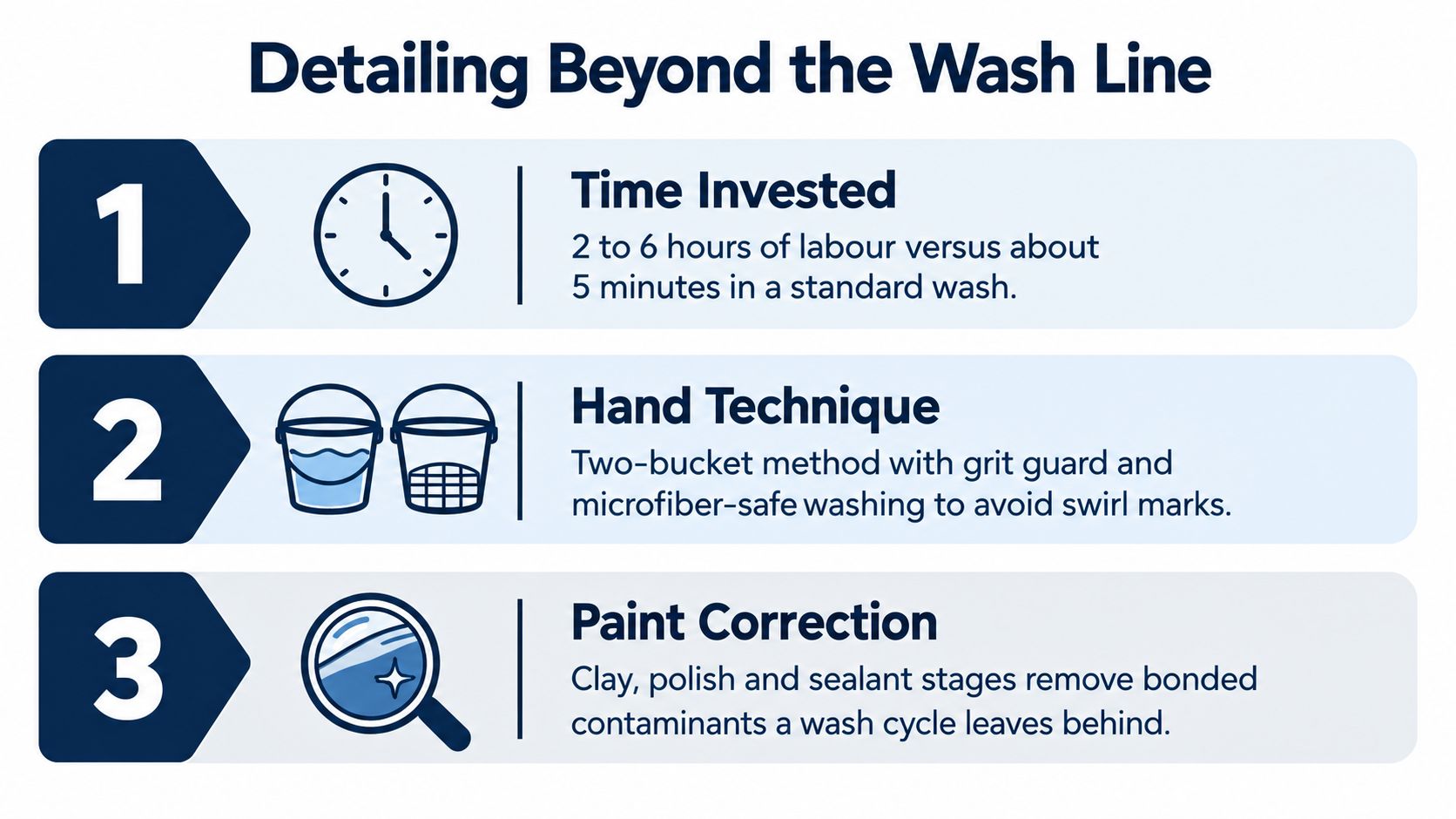
A wash cycle is built for throughput. Professional detailing may take one to four hours, depending on the selected service and vehicle condition, as reflected in Nanak Car Wash's service information. Detailers work more slowly, inspect surfaces closely, and use methods such as microfiber-safe washing, separate buckets, controlled agitation, and careful wheel cleaning.
What deeper work actually solves
- Embedded brake dust: Wheel cleaners and brush-safe tools reach the barrel and spoke areas where a quick pass may leave dark residue.
- Sap and bonded film: Clay-bar decontamination can remove contamination stuck to the paint after washing.
- Salt-white staining: Stain removal and careful hand cleaning target lower panels where winter residue dries repeatedly.
- Pet hair and food odours: Vacuuming, shampooing, crevice blowout, and fabric treatment address material trapped in seams and carpets.
- Dull paint: Polishing can improve clarity by refining the surface, while a sealant helps preserve the cleaner finish.
A two-bucket method helps separate wash solution from collected grit. Microfiber tools reduce the chance of dragging coarse material across the finish, and dedicated wheel tools keep brake dust from spreading to painted panels. These details explain why a detail costs more than an express wash. You're paying for inspection, labour, product selection, and controlled handwork.
If your daily driver has gone several weeks without a deep clean, a detail can restore the baseline. After that, routine washing becomes easier because the surface starts cleaner and the interior has fewer embedded contaminants to fight.
One-Time Wash, Prepaid Bundle or Unlimited Monthly Pass
Payment choice should follow your actual washing pattern, not the excitement of a discounted sign at the entrance. A one-time wash gives maximum flexibility. A prepaid bundle lowers the effective cost per visit when you already know you'll return. An unlimited monthly pass makes sense only when the number of visits you'll use outweighs the recurring fee.
Because wash prices vary by location, vehicle size, package and promotion, compare the posted rates rather than relying on a generic industry average. The useful calculation is straightforward:
Monthly pass cost ÷ single-wash price = breakeven visits.
If the result is two visits, a driver who washes once may prefer pay-per-wash, while someone who reliably washes twice or more can consider the pass. Check whether the plan limits use to one wash per day, excludes detailing, or renews automatically. Those conditions can matter more than the headline price.
| Plan Option | Average Price | Breakeven Visits | Best For |
|---|---|---|---|
| One-time express wash | Location and package dependent | Not applicable | Occasional drivers and visitors |
| One-time full-service wash | Location, vehicle and interior work dependent | Not applicable | Drivers needing cabin cleaning |
| Prepaid bundle | Discount depends on the ticket offer | Based on the bundle's effective per-wash price | Regular but not high-frequency users |
| Unlimited monthly pass | Depends on the selected club and location | Monthly fee divided by single-wash price | High-mileage drivers who wash repeatedly |
A prepaid book can be the middle ground. You commit to future visits without committing to monthly renewal. It suits a weekend driver who wants a cleaner vehicle through winter but doesn't drive enough to justify frequent memberships.
The same comparison logic applies to other recurring services. If you're evaluating subscription pricing for a small café or restaurant alongside your vehicle expenses, this pricing for cafés and restaurants offers a useful example of how recurring plans can be compared by usage and business need. The principle remains the same: calculate the value you'll consume.
Choosing the Right Wash Plan for Your Driving Life
You can make the decision quickly by starting with exposure rather than package names. Ask how often you drive, where the vehicle sits, and whether the main problem is exterior salt or interior mess.
A daily commuter travelling 25 to 40 kilometres on GTA highways and salted arterial roads, as illustrated in the supplied planning guide, is a strong candidate for a repeat exterior routine. Choose an underbody rinse during salt season and consider rust proofing if the vehicle will remain in service for years.
Use this quick decision path
- Daily commuter: Select a repeat-wash plan, prioritise underbody cleaning in winter, and add surface protection when the paint needs easier maintenance.
- Weekend driver: Pay per visit or use a small prepaid bundle. A garage-kept sedan may need less frequent washing, but salt should still be removed after meaningful exposure.
- Rideshare or delivery operator: An unlimited plan may fit frequent exterior visits. Add interior cleaning when passengers or deliveries affect the cabin.
- SUV, truck, or family hauler: Choose full service when mats, cargo areas, and seat seams are dirty. Book detailing when routine vacuuming no longer removes the odour or staining.
A premium wax is most useful when you care about keeping exposed paint easier to clean. Underbody service is more relevant when slush and brine are the recurring concern. Interior detailing belongs on the calendar when the cabin has accumulated stains, hair, or odours that a quick vacuum won't resolve.
Nanak Car Wash offers express and full-service washes, detailing, rust proofing, prepaid options and monthly memberships across GTA communities. Before committing, check the closest location for its current offer, then ask whether a free first wash or trial month is available.
Common Questions GTA Drivers Ask Before They Book
How much water does a professional wash use?
There is no single answer. Commercial systems can use very different amounts of heated water, depending on their rinse design, equipment and reclamation process. The previously cited commercial car-wash water benchmark shows why the system matters. A driveway wash may also waste water when a hose runs continuously, so home washing is not automatically the more efficient choice.
How long will the visit take?
An express wash suits a short stop, although line length, staffing and the selected service affect the total. Full service takes longer because staff vacuum, wipe surfaces and clean glass by hand. Detailing requires a separate appointment and substantially more labour.
If your vehicle is carrying winter road film, a few extra minutes for the right service can cost less than leaving salt packed around trim and the lower body.
Do SUVs, trucks or vans cost more?
They may. Larger vehicles can require more labour, product or handling, while detailing providers may use size-based pricing or add charges for pet hair and heavy contamination. Confirm the policy before paying, particularly with a three-row SUV, pickup or work van.
Is touchless safer than a soft-touch wash?
Neither label settles every paint-care question. Touchless systems avoid physical contact but depend more on water pressure and cleaning chemicals. Soft-touch systems use cloth or brushes, so the quality of the pre-rinse, equipment condition and maintenance matters. A gritty vehicle should have loose contamination rinsed away before contact, regardless of wash format.
How often should I wash during a salt-heavy winter?
Wash after salt and brine have built up, especially following repeated slush exposure. As noted earlier, underbody rinsing helps remove material that stays out of sight beneath the vehicle. Do not wait for the exterior to look dramatically dirty when the underside is repeatedly exposed on GTA roads.
Do memberships renew automatically?
Ask before enrolling. Check the renewal timing, cancellation instructions, daily-use limits, vehicle eligibility and exclusions for detailing or oversized vehicles. A membership earns its place in your budget only when its rules match how often you drive and wash.
Automotive businesses also need accurate location details online. This guide to local SEO for auto dealers explains how service information and nearby locations can be presented to local customers.
Nanak Car Wash offers express and full-service exterior washing, interior cleaning, detailing and automotive rust proofing for GTA drivers dealing with salt, slush and road film. Visit Nanak Car Wash to find a nearby location, compare current wash options, and ask about a first-wash offer or trial membership that suits your driving routine.

 6600 Finch Ave W, Etobicoke, ON M9V 3Z6
 647-703-8515
 MON – SUN 8 AM to 7 PM